
Last updated on November 17th, 2026 at 12:09 pm
Quick Answer: Virtual numbers India businesses use are cloud-hosted phone numbers that are not tied to a SIM card or physical device. They route incoming and outgoing calls to any phone, app, or softphone over the internet. Indian enterprises use them to establish local presence across cities, route calls through IVR menus, record every conversation, and sync call data automatically into their CRM, all without physical telecom hardware.
AI Summary: Virtual numbers India enterprises deploy are cloud-hosted numbers that decouple calling from physical hardware, enabling local presence, IVR routing, call recording, and CRM integration at scale. This guide covers how virtual numbers work technically, the four main number formats available in India, the Indian regulatory framework under DoT and the DPDP Act 2023, and the key features to evaluate before choosing a provider. The central finding is that the right number type and compliance posture depend on your call volume, team structure, and the specific Indian regulations that apply to your industry.
Table of contents
What Are Virtual Numbers?
A virtual number is a cloud-hosted phone number that has no SIM card and no physical line behind it. When someone dials the number, the call travels over the internet to a cloud telephony platform, which then routes it to whichever device, app, or agent queue you have configured. The caller sees a normal Indian phone number. Your team answers on a laptop, a mobile app, or a desk phone, depending on how the routing is set up.
A virtual number is a telephone number hosted in the cloud rather than on a physical SIM or landline. It routes calls to any device or queue over the internet, with no hardware required at the receiving end.
Four Number Formats Available in India
Indian enterprises can provision four main formats, each suited to a different use case.
- Mobile virtual numbers (e.g., +91 98xxxxxx): These carry the same trust signal as a personal mobile number and work well for outbound sales teams where caller ID recognition matters.
- Virtual landline numbers (e.g., 040, 022 city prefixes): These signal a local office presence in Hyderabad, Mumbai, or any other city, without requiring a physical office there.
- Toll-free numbers (1800 series): These shift the call cost to the business, which increases inbound call volume from customers who would otherwise hesitate to dial a paid number.
- WhatsApp-compatible virtual numbers: These allow the same number to handle both voice calls and WhatsApp Business messaging, which reduces the number of channels a customer needs to remember.
With virtual numbers, your team can make and receive calls from anywhere, and every call can be tracked, logged, recorded, and analysed.
Why Virtual Numbers Are Essential for Enterprise Communication
Traditional landlines and mobile SIM cards tie your calling infrastructure to a physical location and a specific device. When a sales rep moves cities, when a support team scales from 10 to 100 agents, or when a business opens a regional office, the old model requires new hardware, new contracts, and weeks of lead time. Virtual numbers remove that dependency entirely.
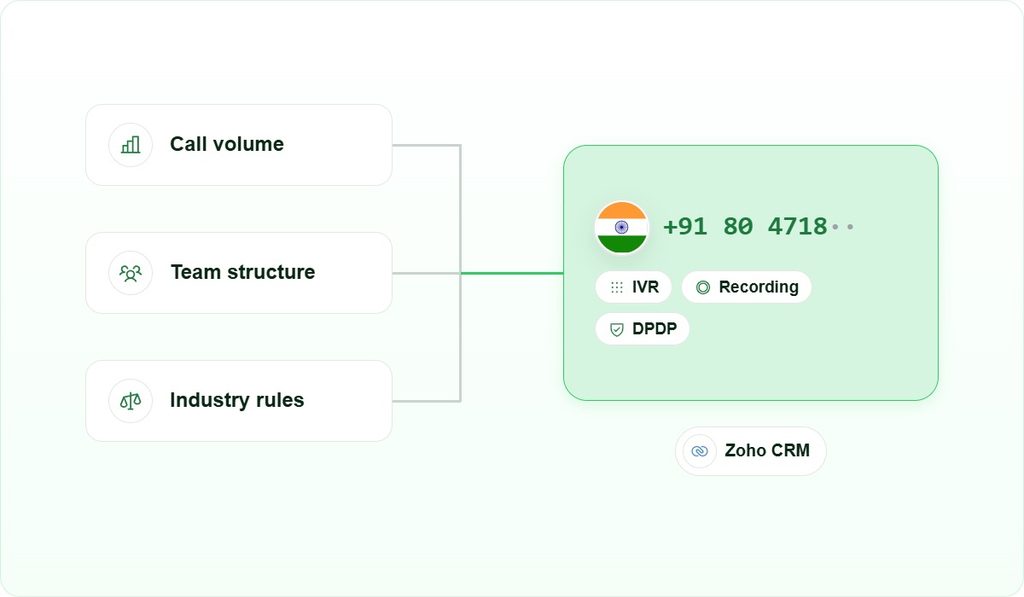
The mechanism is straightforward. A virtual number sits on a cloud telephony platform. When a call arrives, the platform checks your routing rules, which you configure through a web interface, and sends the call to the right agent, queue, or IVR (Interactive Voice Response) menu. Because the routing logic lives in software, you can change it in minutes. You can add a new city number, redirect calls during a public holiday, or split traffic between two teams without touching any hardware.
Key Benefits of Virtual Numbers for Enterprise Communication
The operational case for virtual numbers in India rests on six concrete advantages, each of which addresses a specific failure point in traditional telecom setups.
Location Flexibility Without Hardware
Remote, hybrid, and field teams can make and receive calls on any device. A sales rep working from Pune answers on the same number as a colleague in Delhi. Managers see both in the same dashboard.
Regional Presence Without Physical Offices
A virtual landline with a Mumbai or Hyderabad prefix signals local presence to customers in those cities. This matters because answer rates on local numbers are generally higher than on numbers customers do not recognise. You get the trust signal without leasing office space.
Instant Provisioning at Any Scale
You can provision 10 or 1,000 numbers through a web interface. There are no SIM cards to order, no cables to run, and no routers to configure. This is especially useful during campaign launches or rapid hiring cycles when call capacity needs to expand quickly.
CRM and Workflow Integration
When a virtual number platform connects to a CRM (Customer Relationship Management) system such as Zoho, Salesforce, or HubSpot, every call is logged automatically. The CRM record shows who called, how long the conversation lasted, what the outcome was, and where the recording is stored. Reps spend less time on manual data entry, and managers get accurate pipeline data without chasing updates.
Cross-Department Visibility
Sales, support, HR, and operations can each run on separate virtual lines while a single admin dashboard shows call volumes, missed calls, and agent availability across all teams. This matters when a VP of Sales needs to compare outbound performance across regions without requesting data exports from each team lead.
Centralised Reporting and Compliance
Every call is logged and, where configured, recorded. This creates an audit trail that supports quality assurance reviews, dispute resolution, and regulatory compliance under Indian law. Indian enterprises operating under the Department of Telecommunications (DoT) framework and the Digital Personal Data Protection (DPDP) Act 2023 need to manage call data carefully. A cloud virtual number platform that stores recordings and logs in India-based data centres simplifies that obligation considerably.
The FreJun Advantage
A virtual number on its own handles routing. The value multiplies when the number connects to a platform that also handles call recording, AI-generated call summaries, CRM auto-logging, and analytics. That combination turns each call from a one-time conversation into a structured data point your team can act on.
The AI-powered features, CRM integrations, and workflow automation tools that sit on top of a virtual number infrastructure are what separate a basic cloud number from a full enterprise calling stack. Without those layers, a manager still has to chase reps for call notes, and a RevOps team still has to reconcile CRM records manually at the end of each week.
We’d choose a platform with native CRM integration over one that requires a third-party connector, because every additional integration point is a failure mode. If the connector breaks, call logs stop flowing, and your CRM data goes stale within days.
What Features Should You Look for in a Virtual Number Provider?
Not every virtual number provider offers the same capabilities. Before committing to a platform, evaluate it against the features that actually affect daily operations for Indian enterprise teams.
Call Recording and Real-Time Dashboards
Call recording serves two purposes: quality assurance and compliance. For Indian enterprises, recordings also support dispute resolution and, in regulated sectors like BFSI, may be required under specific DoT or sector-specific guidelines. Real-time dashboards let managers see live call queues, agent availability, and missed call rates without waiting for end-of-day reports.
IVR and Automated Routing
An IVR (Interactive Voice Response) system greets callers, presents menu options, and routes each call based on the caller’s input, the time of day, or the agent’s availability. Without IVR, every inbound call lands in a general queue and depends on a human to redirect it. With IVR, a caller pressing “1 for sales” reaches the sales team directly, even if the main reception line is busy.
CRM Integration
Native integration with CRMs such as Zoho, Salesforce, HubSpot, and Pipedrive means call records, recordings, and outcomes sync automatically. This is the feature that most directly affects CRM data quality. Without it, reps log calls manually, and manual logging is inconsistent. By Friday afternoon, your pipeline data reflects what reps remembered to type, not what actually happened on calls.
WhatsApp and SMS Compatibility
Some virtual number platforms allow the same number to send and receive WhatsApp messages and SMS alongside voice calls. This matters for Indian enterprises because WhatsApp is a primary communication channel for many customer segments. Running voice and messaging on the same number reduces the number of contact points a customer needs to manage.
User-Level Access Control and Multi-Department Support
Enterprise teams need role-based permissions. A support agent should not have access to the sales team’s call recordings. A regional manager should see only their team’s data. Platforms that offer granular access control reduce both security risk and the noise of irrelevant data in each user’s view.
Indian Regulatory Compliance
Indian enterprises making commercial calls must comply with the Telecom Regulatory Authority of India’s (TRAI) Telecom Commercial Communications Customer Preference Regulations (TCCCPR) and the Department of Telecommunications (DoT) licensing framework. Commercial outbound calls require DLT (Distributed Ledger Technology) registration. The DPDP Act 2023, administered by the Ministry of Electronics and Information Technology (MeitY), governs how call recordings and customer data are stored and processed. A provider that operates within India’s regulatory framework and stores data in India-based infrastructure simplifies your compliance posture significantly. Note that GDPR is a European Union regulation and does not apply to India-based enterprise communication. The applicable Indian frameworks are DoT, TRAI, and the DPDP Act 2023.
For a detailed look at how TRAI’s rules affect outbound calling operations, see our guide on TRAI compliance for call centers in India.
How Virtual Numbers Support Indian Enterprise Calling Workflows
Virtual numbers India enterprises deploy most effectively are those connected end-to-end to the rest of the calling stack. The number itself is the entry point. What happens after the call connects determines whether the interaction becomes a structured business asset or a conversation that disappears into a rep’s memory.
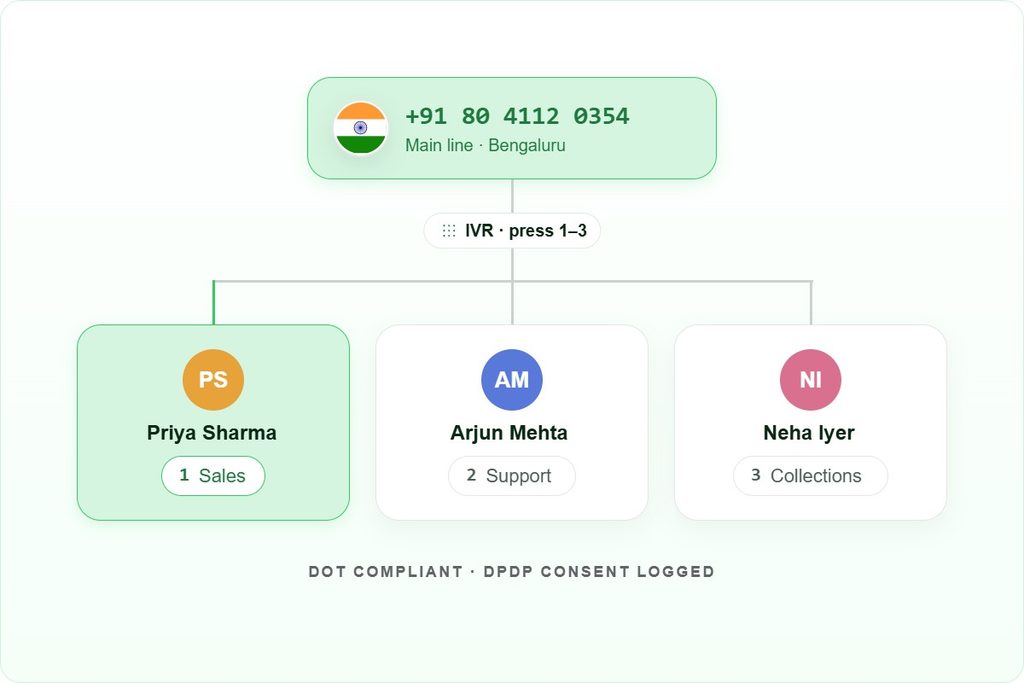
Instant Activation of Local, National, and Toll-Free Numbers
Cloud virtual number platforms provision numbers across any Indian region, including mobile, landline, and toll-free formats, within minutes. There is no physical setup, no SIM card order, and no waiting for a telecom operator to activate a line. This is particularly useful for teams launching regional campaigns or opening new city operations on short notice.
Intelligent Call Routing with Dynamic IVR
Route incoming calls based on language preferences, business hours, call history, agent availability, or department. A caller pressing “2 for Hindi support” reaches a Hindi-speaking agent directly. A call arriving outside business hours plays a custom message and offers a callback option. The routing logic is configured through a web interface, so operations teams can update it without raising a support ticket.
For a deeper look at how routing rules interact with CRM data, see our guide on smart call routing for sales teams.
Native CRM Integration with Auto-Syncing
Call details, outcomes, dispositions, and recordings log automatically into CRMs like HubSpot, Zoho, Salesforce, and Pipedrive. No manual entry is needed. This matters because manual logging is the single biggest source of CRM data decay. When reps log calls themselves, they log the ones they remember, at the end of the day, with the detail level they choose. Automatic sync removes all three of those variables.
See How FreJun Integrates with Leading CRMs
Real-Time Call Analytics and Performance Dashboards
Track agent productivity, missed calls, pickup rates, average talk time, and resolution trends, filtered by user, team, region, or campaign. Real-time visibility means a manager can intervene during a busy period rather than reviewing what went wrong the following morning.
Discover How FreJun’s Call Recording Works
Multi-Channel Support: Voice, SMS, WhatsApp
Some platforms allow the same virtual number to handle voice calls, SMS, and WhatsApp messages. For Indian enterprise teams, this is operationally useful because customers often switch between channels mid-conversation. A support agent who can see the WhatsApp thread alongside the call history has the full context before picking up.
Smart Workflow Triggers
Call events can trigger downstream actions automatically. A completed call can create a follow-up task in the CRM, send a summary to the manager’s Slack channel, or escalate an unresolved issue to a senior agent. These triggers reduce the manual coordination that typically happens between a call ending and the next action being taken.
When Virtual Numbers Are Not the Right Fit
Virtual numbers suit most Indian enterprise use cases, but there are scenarios where they are not the best choice. Solo operators or very low-volume users may find that a standard mobile SIM is simpler and cheaper. Teams in industries with strict on-premise data requirements may need a solution that keeps call data within their own infrastructure rather than a cloud provider’s servers. Businesses that need to make calls using the 140 or 160 number series for commercial or BFSI outreach have specific DoT and TRAI registration requirements that go beyond a standard virtual number setup. In those cases, the compliance architecture matters as much as the number itself.
For context on how virtual numbers compare to traditional setups, and for guidance on call routing and CRM integration options, the linked guides cover each topic in detail.
Key Takeaways
For Indian enterprises, voice remains one of the highest-trust communication channels, but the infrastructure underneath it has changed fundamentally. Traditional telecom contracts are inflexible, slow to provision, and produce no structured data. Virtual numbers address all three problems.
What Matters Most When Choosing a Provider
The number format matters less than the platform it sits on. A local landline number that routes calls intelligently, logs every interaction to your CRM, and stores recordings in a compliant Indian data centre is worth considerably more than the same number on a platform that does none of those things. Evaluate providers on their CRM integration depth, their IVR flexibility, their data residency posture under the DPDP Act 2023, and their support for the specific number series your industry requires under DoT and TRAI rules.
For a broader view of how AI-powered calling tools fit into an enterprise communication stack, the linked guide covers the operational case in detail.
Final Thoughts & Recommendations
Virtual numbers India enterprises adopt most successfully are those treated as infrastructure rather than a feature. The number is the entry point. The routing logic, the CRM sync, the call recording, and the analytics are what determine whether that entry point produces business value or just a ringing phone.
Before selecting a provider, confirm three things. First, does the platform integrate natively with your CRM, or does it require a third-party connector that adds a failure point? Second, does it support the specific number series your industry requires under DoT and TRAI regulations? Third, does it store call recordings and customer data in a way that is consistent with your obligations under the DPDP Act 2023?
Teams that get these three decisions right find that virtual numbers stop being a communication tool and start being a source of operational intelligence. Teams that skip the compliance and integration questions often find themselves rebuilding their setup six months later when a regulatory audit or a CRM migration forces the issue.
For further reading on related topics, see our guide on Zoho Call: Full Tutorial for Beginners and our overview of why virtual numbers benefit your business.
Frequently Asked Questions
Setup and Coverage
Yes. Cloud virtual number platforms let you provision separate numbers for each team, city, or campaign. Each number can have its own routing rules, IVR menu, and call recording settings. A sales team in Mumbai and a support team in Bengaluru can each operate on a dedicated number while a single admin dashboard shows performance across both.
Yes. Most enterprise virtual number platforms include IVR (Interactive Voice Response) and auto-attendant functionality. You configure the menu options, routing logic, and business-hours rules through a web interface. Callers hear a greeting, select an option, and reach the right team or agent without manual intervention. No coding is required for standard IVR setups.
Yes. Enterprise virtual number platforms typically offer native integrations with Salesforce, Zoho, HubSpot, and Pipedrive. Native integration means call records, recordings, and outcomes sync automatically to the CRM contact record without manual entry. Third-party connectors also exist but add a dependency that can break during CRM updates.
Compliance and Regulations
Indian enterprises using virtual numbers for commercial communication must comply with TRAI’s TCCCPR framework, which requires DLT (Distributed Ledger Technology) registration for outbound commercial calls. The DoT licensing framework governs number allocation and use. The DPDP Act 2023 governs how call recordings and customer data are stored and processed. GDPR is a European Union regulation and does not apply to India-based enterprise communication.
A local virtual number carries a city STD code such as 040 for Hyderabad or 022 for Mumbai, signalling regional presence to callers. The caller pays standard call charges. A toll-free number in the 1800 series shifts the call cost to the business, which typically increases inbound call volume from customers who would otherwise avoid dialling a paid number. The right choice depends on whether your priority is local trust or inbound volume.