 Skip to content

Last updated on May 30th, 2026 at 10:22 pm
AI Summary: This article covers the 7 best Ameyo alternatives for sales and support teams evaluating cloud telephony platforms in 2026, including pricing, CRM integration depth, and G2 ratings for each option. FreJun leads the list with a 4.9/5 rating on G2 and plans starting at $14.49 per user per month (Source: G2). Teams switching from Ameyo should prioritise native CRM integration over feature count, since platforms with partial sync cause manual data entry overhead within 90 days. FreJun connects to over 15 CRMs including Salesforce, HubSpot, and Zoho, logging every call, transcript, and outcome automatically without middleware.
7 Best Ameyo Alternatives in 2026
Last updated: May 2026
If you’re evaluating Ameyo alternatives, you’re not alone. Many sales and support teams find that Ameyo’s enterprise-grade feature set is more than they need, and its opaque pricing makes budgeting difficult. We’ve spent time testing and comparing the top 7 platforms that give you the communication capabilities you need without the complexity or cost you don’t. Whether your team runs on Salesforce, HubSpot, or Zoho, there’s a strong option here for you. Note: Ameyo rebranded to Exotel in 2023, so if you’re searching for Exotel alternatives, this guide covers the same platforms.
Quick Answer: The best Ameyo alternatives in 2026 are FreJun, CallHippo, Dialpad, Vonage, Avoxi, Sarv, and Ringover. FreJun leads for sales teams: it starts at $14.49 per user per month, integrates with over 15 CRMs, and scores 4.9 out of 5 on G2. Each platform suits different team sizes and budgets, so match your CRM stack before deciding.
The top Ameyo alternatives for call centers in 2026 are FreJun, CallHippo, Dialpad, Vonage, Avoxi, Sarv, and Ringover, with FreJun rated highest at 4.9/5 on G2 and starting at $14.49 per user per month.
What are Ameyo alternatives?
Ameyo alternatives are cloud-based contact center and call automation platforms that replace Ameyo’s enterprise telephony suite. They typically offer VoIP (Voice over Internet Protocol) calling, CRM integration, IVR (Interactive Voice Response), call recording, and analytics at more accessible price points for small and mid-sized teams.
Sales teams using FreJun cut post-call admin by over 30 minutes per agent per day because every call syncs to your CRM automatically. No credit card needed, no complex setup: sign up and make your first call within the hour.
In this article:
- Quick Recommendations: Which Ameyo Alternative Should You Pick?
- How Do the Top Ameyo Alternatives Compare Side by Side?
- How Can Businesses Choose the Right Alternative to Ameyo?
- What Are the Call Automation Benefits Worth Knowing?
- What Are the Best Ameyo Alternatives for Call Centers in 2026?
- Which Ameyo Alternatives Integrate with CRM Platforms?
- How Can Businesses Choose the Right Ameyo Alternative for Their Needs?
- What Industries Benefit Most from Using Ameyo Alternatives?
- What We’ve Learned from Deploying These Platforms Across 500+ Teams
- Which Ameyo Alternative Is Right for Your Team?
- Frequently Asked Questions About Ameyo Alternatives
Quick Recommendations: Which Ameyo Alternative Should You Pick?
Not every team needs the same platform, so here’s a fast breakdown before we go deeper. Match your primary use case to the recommendation below, then read the full profile for the tools that fit.
- Best Overall: FreJun: highest G2 rating (4.9/5), broadest CRM coverage, transparent pricing from $14.49/user/mo
- Best for SaaS Sales Teams: FreJun: AI call insights sync directly into your CRM pipeline
- Best for Budget: CallHippo: basic plan from Rs 1,300/user/mo, easy setup
- Best for G Suite or Office 365 Teams: Dialpad: native integration, unlimited calls from $15/user/mo
- Best for Global Reach: Avoxi: local carriers in 170+ countries (Source: Avoxi)
- Best for Virtual Numbers: Sarv: strong virtual number solution with a flat learning curve
- Best for Unlimited Calls: Ringover: unlimited calls in all plans, number porting included
“After working with over 500 sales teams since 2019, the pattern is clear: teams that switch from Ameyo to a platform with native CRM sync stop losing deals to follow-up gaps within the first 60 days. The biggest drop in pipeline accuracy doesn’t come from bad reps. It comes from call data that never makes it into the CRM because the integration is partial or requires manual steps.”
— Subhash Kalluri, Co-Founder and CEO, FreJun
How Do the Top Ameyo Alternatives Compare Side by Side?
Before reading each platform profile, use this table to get a fast side-by-side view of pricing, ratings, and core strengths. All prices are per user per month on entry-level paid plans, sourced directly from each vendor’s pricing page.
| Tool | Best For | Price | Rating | Key Features |
|---|---|---|---|---|
| FreJun | Sales and support teams needing CRM automation | From $14.49/user/mo | 4.9/5 on G2 | AI call insights, 15+ CRM integrations, click-to-call, virtual numbers |
| CallHippo | Small teams needing quick setup | From Rs 1,300/user/mo | 4.3/5 on G2 | Device-agnostic, call analytics, easy customization |
| Dialpad | Teams using G Suite or Office 365 | From $15/user/mo | 4.4/5 on G2 | Call transcription, unlimited calls/SMS/MMS, G Suite integration |
| Vonage | Mid-to-large organizations needing video and voice | Custom pricing | 4.3/5 on G2 | Auto-dial, video/screen sharing, conversation analyzer |
| Avoxi | Global teams needing local numbers in 170+ countries | From $19.99/user/mo | 4.7/5 on G2 | Skills-based routing, IVR, live monitoring, queue callback |
| Sarv | Teams prioritizing virtual numbers and self-service | Custom pricing | 5/5 on G2 | Virtual numbers, auto-dialing, analytics dashboard, contact management |
| Ringover | Teams wanting unlimited calls with CRM integration | From $19/user/mo | 4.7/5 on G2 | IVR, smart call routing, HD video calls, number porting |
How Can Businesses Choose the Right Alternative to Ameyo?
Choosing the right platform comes down to six factors. Work through this checklist before you sign any contract, because skipping even one step tends to cause a painful mid-year switch.
- Ease of Use: A clean interface cuts onboarding time significantly. Your team should make their first call within minutes, not days.
- CRM Integration: Make sure the platform connects to your existing CRM. Without this, your agents log calls manually, which kills productivity.
- Customization and Flexibility: Different teams have different workflows. Look for configurable call routing, custom tags, and adjustable dashboards.
- Multi-Channel Support: Customers reach out via voice, email, chat, and WhatsApp. A platform that handles multiple channels saves you from juggling separate tools.
- Automation Capabilities: Automatic call logging, follow-up triggers, and data syncing reduce manual work and help agents focus on conversations that matter.
- Analytics and Reporting: Real-time dashboards and call-level metrics let managers spot problems early and coach agents based on actual data.
Teams that skip the CRM integration check end up switching platforms again within 12 months. That’s the single most important criterion on this list, so verify it before anything else.
In a FreJun demo, you’ll see exactly how the CRM sync works in real time: watch call notes, transcripts, and outcomes push automatically into Salesforce, HubSpot, or Zoho without a single manual entry. Most teams complete their first live integration walkthrough in under 20 minutes.
What Are the Call Automation Benefits Worth Knowing?
Call automation does more than save time. When it’s set up correctly, it changes how your team operates: agents spend less time on admin, managers get accurate data without chasing reps, and your CRM reflects what actually happened on every call.
| Feature | How It Improves Operations |
| AI-Driven Call Routing | Connects callers to the right agent faster, cutting average handle time |
| Real-Time Transcription | Gives agents a live record of the conversation so they can focus on listening |
| Predictive Dialing | Reduces agent idle time by automatically queuing the next call |
| CRM Integration | FreJun logs calls, notes, and outcomes directly into your CRM without manual entry |
| Sentiment Analysis | Flags calls where customer tone shifts negative so managers can intervene early |
A Stanford and MIT study of 5,000 customer service agents found that those given access to a generative AI assistant resolved 14% more issues per hour and spent 9% less time per interaction, productivity gains measured under real working conditions, not a lab setting (Source: McKinsey, “The Economic Potential of Generative AI”). Meanwhile, IDC research found that nearly 68% of contact centers report agents spending 10–29% of their time on manual after-call work such as updating records and logging call details, the exact overhead that built-in CRM sync eliminates (Source: IDC Contact Center Research, 2025).
What Are the Best Ameyo Alternatives for Call Centers in 2026?
Here are the 7 best Ameyo alternatives ranked by G2 rating and overall value for sales and support teams. Each profile includes real pricing, verified ratings, and an honest look at where each platform falls short.
1. FreJun
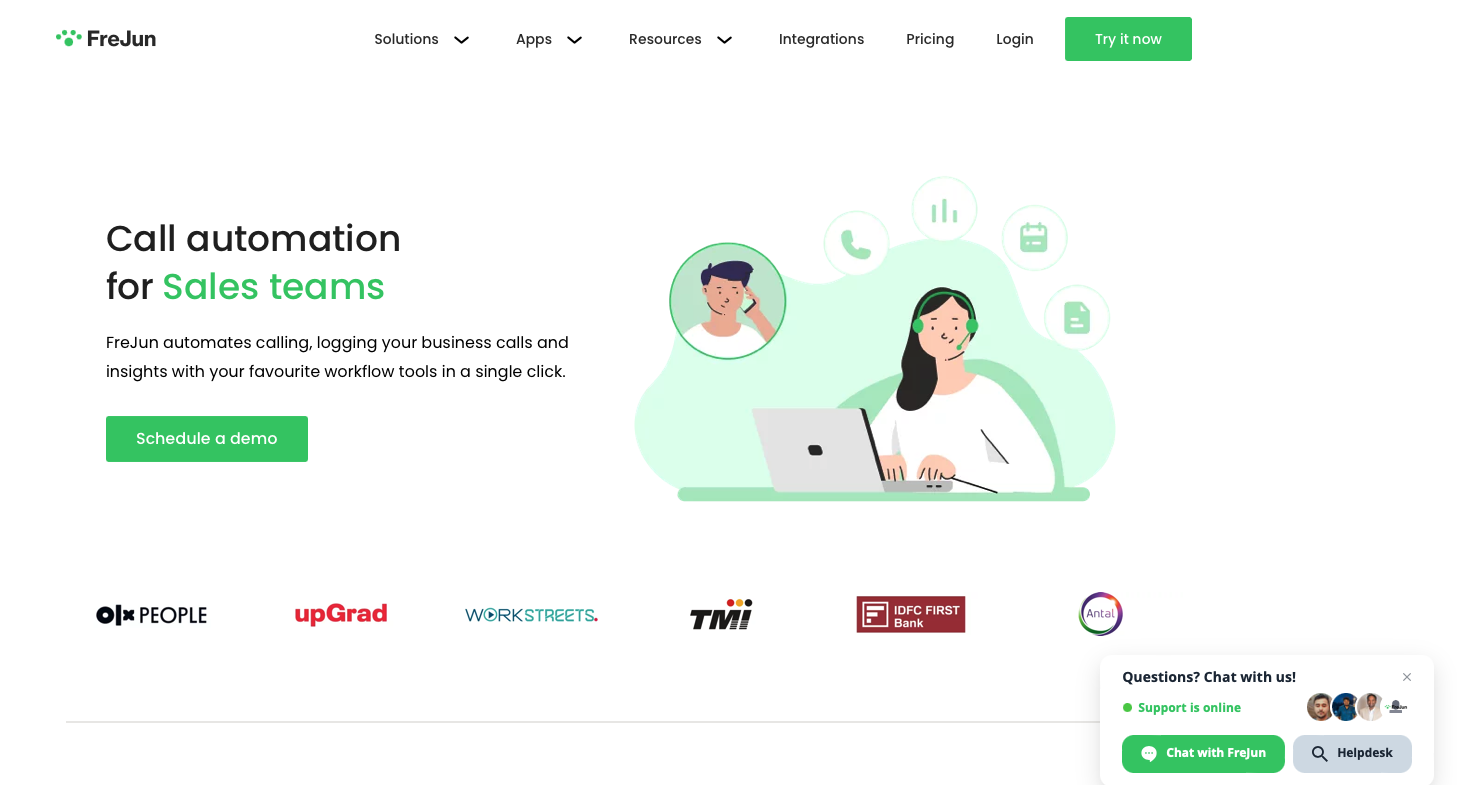
FreJun tops this list of Ameyo alternatives because it delivers nearly every feature Ameyo offers at a fraction of the cost. Built specifically for sales and support teams at small and mid-sized businesses, FreJun runs entirely on the cloud, which means your team can make and receive calls from any device, anywhere, with no special hardware required.
Because it runs entirely on the cloud, scaling up or down is straightforward. FreJun’s AI-powered call insights sync automatically with your CRM, so your team never loses a lead or misses a follow-up. The platform covers click-to-call, call forwarding, call recording, virtual numbers, AI call summaries, and integration with over 15 CRMs and ATS platforms including Salesforce, HubSpot, Zoho, Pipedrive, and LeadSquared.

FreJun Key Features and Pricing
Pros of FreJun
- Transparent pricing with no hidden add-on fees
- Unlimited calling options across all plans
- Free trial available so you can test before committing
- Integrates with more CRMs than any other platform on this list
Cons of FreJun
FreJun’s feature depth can feel like a lot for teams new to cloud telephony. That said, FreJun addresses this directly through an extensive help center, video tutorials, and onboarding support, so most teams are fully operational within a single working day.
Pricing: Standard starts at $14.49 per user per month. Professional starts at $16.69 per user per month.
G2 Rating: 4.9 out of 5 (Source: G2)
What Is an AI-Powered Sales Call?

An AI-powered sales call uses machine learning to transcribe conversations in real time, score call quality, detect customer sentiment, and push structured data directly into your CRM. FreJun’s AI layer does all of this automatically, which means your reps spend less time on admin and more time selling.
2. CallHippo
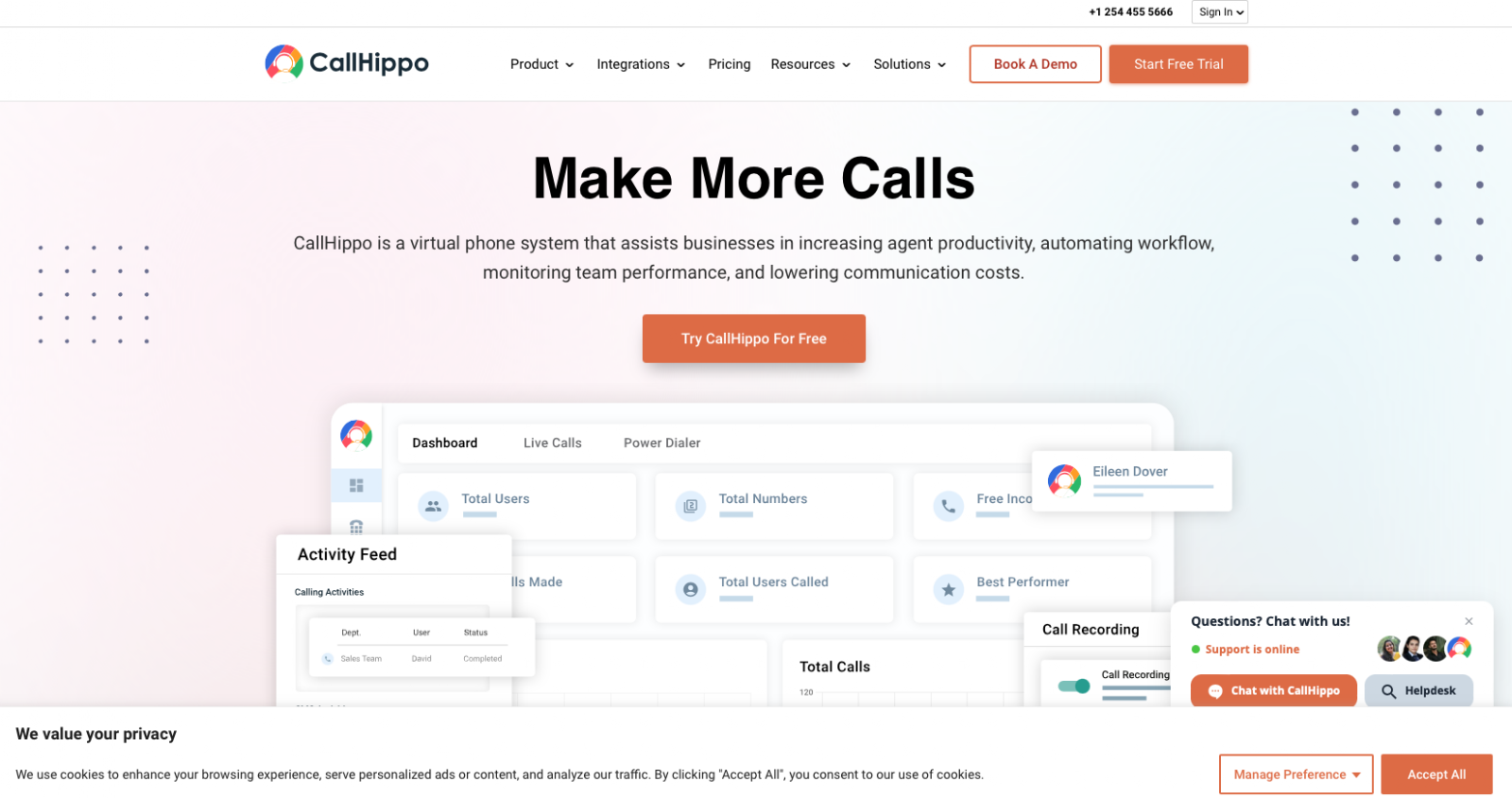
CallHippo is a cloud-based virtual phone system that helps businesses improve customer service and team communication. Its biggest strength is simplicity: you can set up a working phone system in minutes, and the interface works on any device without special hardware.
Key Features: Professional phone system setup in minutes, device-agnostic calling, advanced call analytics, and customizable call flows.
Pros of CallHippo
- Very easy to set up and use from day one
- Highly customizable based on your team’s specific needs
- Works on any device without additional hardware
Cons of CallHippo
- Many basic features are sold as paid add-ons on top of the monthly subscription
- Multiple users report limited customer support responsiveness
Pricing: Basic plan starts at Rs 1,300 per user per month (Source: CallHippo pricing page).
G2 Rating: 4.3 out of 5 (Source: G2)
3. Dialpad
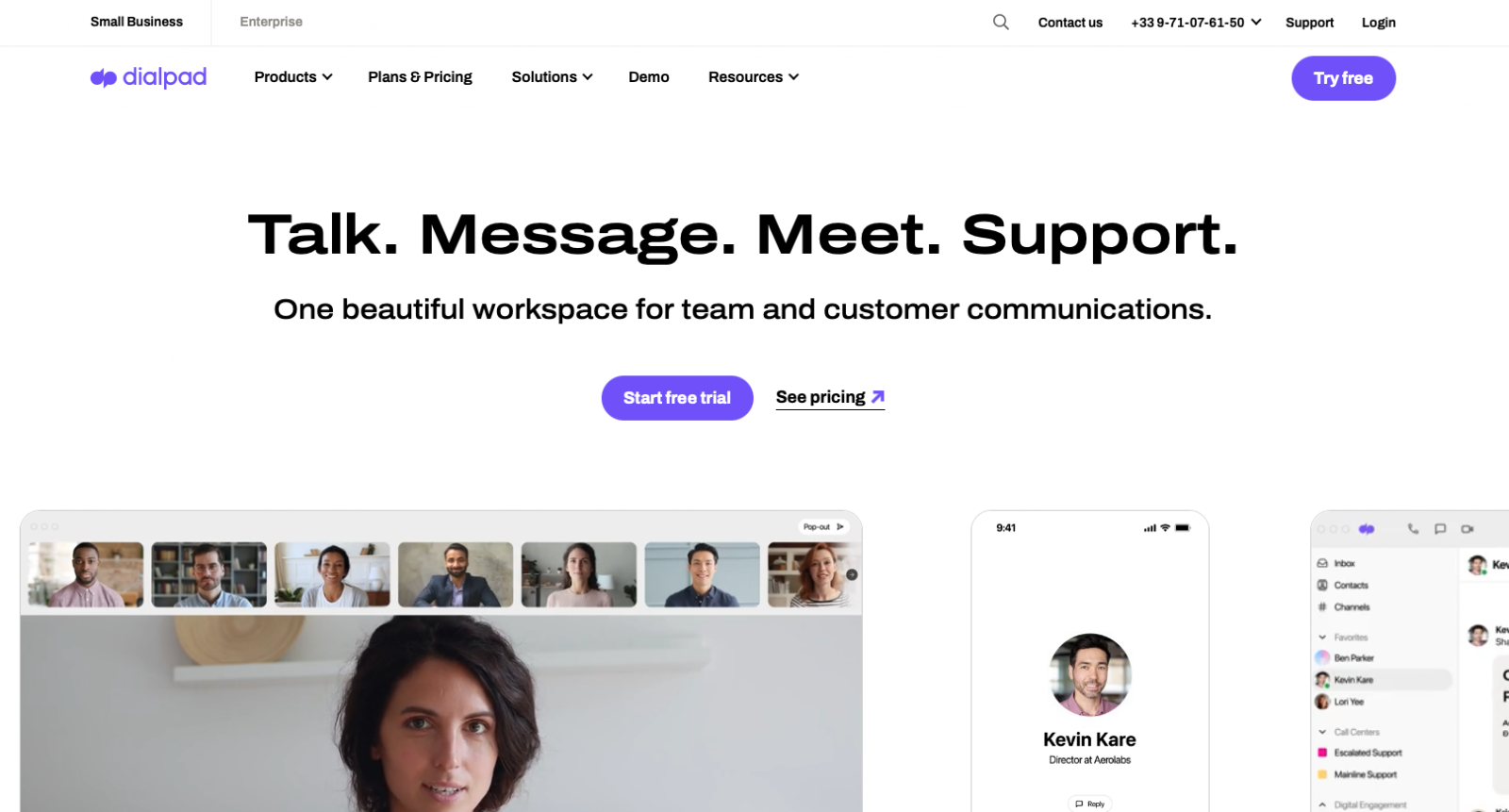
Dialpad is a business telephony platform with strong phone and messaging capabilities. It lets your team make and receive calls, send messages, and stay connected from any device. For teams already running on Google Workspace or Microsoft 365, Dialpad’s native integrations make it a natural fit.
Key Features: Call transcription, call recording, personalized routing, three-way conferencing, one-click calls, and native G Suite and Office 365 integration.
Pros of Dialpad
- Transparent pricing with a free trial available
- Unlimited calls, SMS, and MMS even on the entry-level plan
- Clean integration with G Suite and Office 365
Cons of Dialpad
- Limited CRM and ATS integrations compared to FreJun
- Steeper learning curve for non-technical users
Pricing: Basic plan starts at $15 per user per month (Source: Dialpad pricing page).
G2 Rating: 4.4 out of 5
4. Vonage
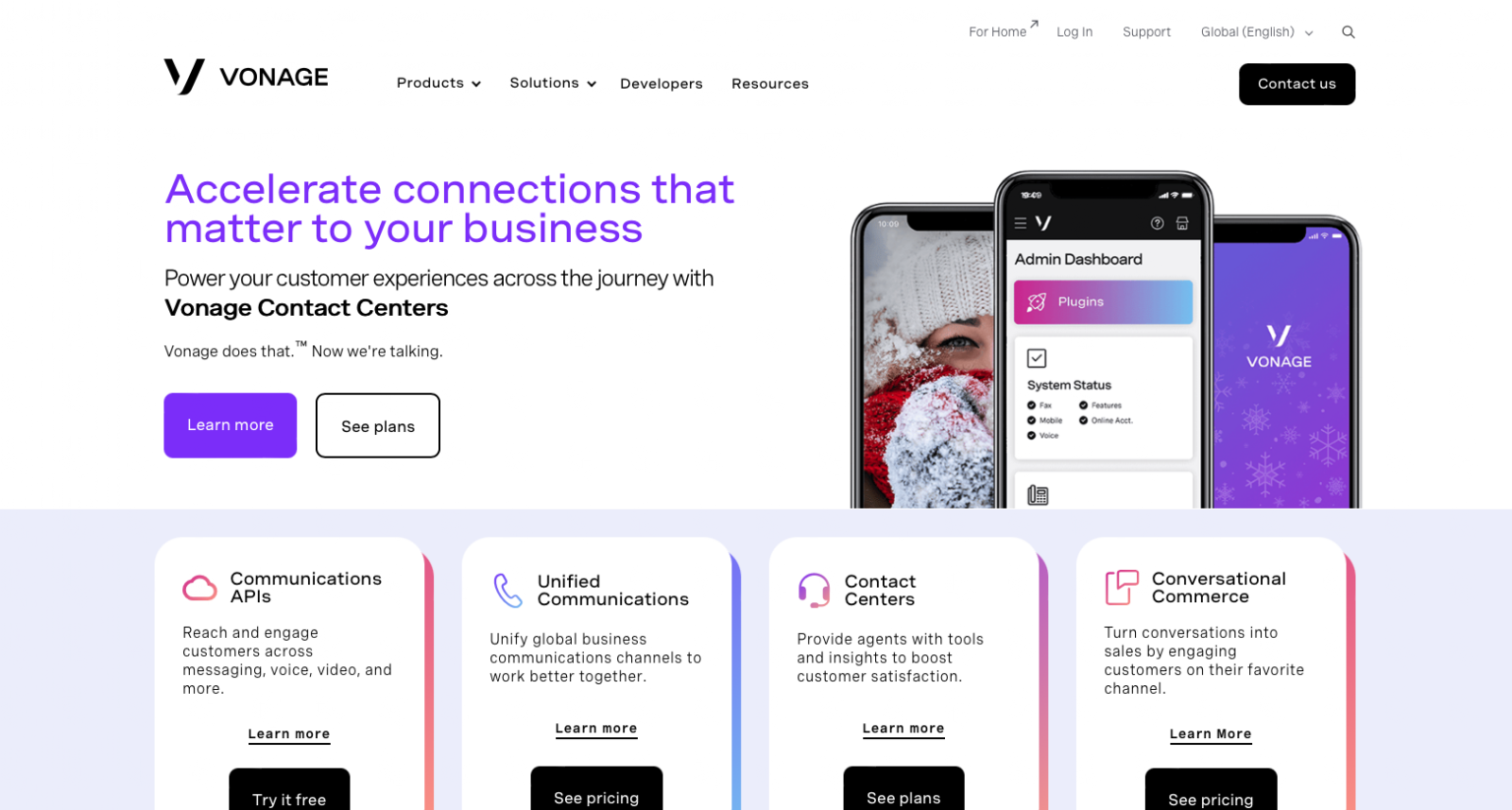
Vonage is a well-established cloud telephony provider with a platform that covers voice, video, and messaging. It also offers contact center solutions suited to larger organizations, though its pricing for contact center plans is not publicly listed, which makes budget planning difficult for mid-sized teams.
Key Features: Auto-dial, automatic call logging, call recording, custom dashboards, video and screen sharing, and a conversation analyzer.
Pros of Vonage
- Free trial available on standard plans
- Unlimited calls, SMS, and MMS on entry-level plans
- Strong video and screen sharing for remote teams
Cons of Vonage
- Contact center pricing is not transparent, requiring a sales call to get numbers
- Limited ATS and CRM integrations compared to FreJun
Pricing: Contact the Vonage team for pricing details on contact center plans.
G2 Rating: 4.3 out of 5 (Source: G2)
For more context on cloud-based dialers, check out our post on top budget-friendly cloud-based phone dialers integrated with LeadSquared CRM.
5. Avoxi
Avoxi helps organizations expand their voice solutions globally. With over 7,000 customers and a network of local carriers in more than 170 countries (Source: Avoxi), it’s a strong choice for teams that need local presence in multiple markets. The platform runs on the cloud and connects to your existing phone system.
Key Features: Skills-based routing, live monitoring, queue callback, call coaching, IVR (Interactive Voice Response), and advanced analytics.
Pros of Avoxi
- Wide feature set covering most enterprise contact center needs
- Free plan and free trial available across all paid plans
- Compliant with major security standards, making it suitable for regulated industries
- Extensive support documentation and live assistance
Cons of Avoxi
- No ATS platform integrations
- Priced higher than most other options on this list
Pricing: Basic plan starts at $19.99 per user per month (Source: Avoxi pricing page).
G2 Rating: 4.7 out of 5 (Source: G2)
6. Sarv
Sarv is an India-based cloud telephony provider known primarily for its virtual number solution. It helps businesses connect with customers in a customized way without building expensive communication infrastructure. Sarv’s cloud telephony feature set is thinner than most platforms on this list, so we recommend it mainly for teams whose primary need is virtual numbers.
Key Features: Analytics dashboard, virtual numbers, automatic call distributor, skills-based routing, voicemail transcription, auto-dialing, and contact management.
Pros of Sarv
- Flat learning curve, easy for non-technical teams
- One of the strongest virtual number solutions available in India
- Detailed self-service help section
Cons of Sarv
- Missing many standard cloud telephony features despite the positioning
- No integration with popular CRMs like Zoho or Pipedrive
Pricing: Contact the Sarv team for pricing details.
G2 Rating: 5 out of 5
7. Ringover
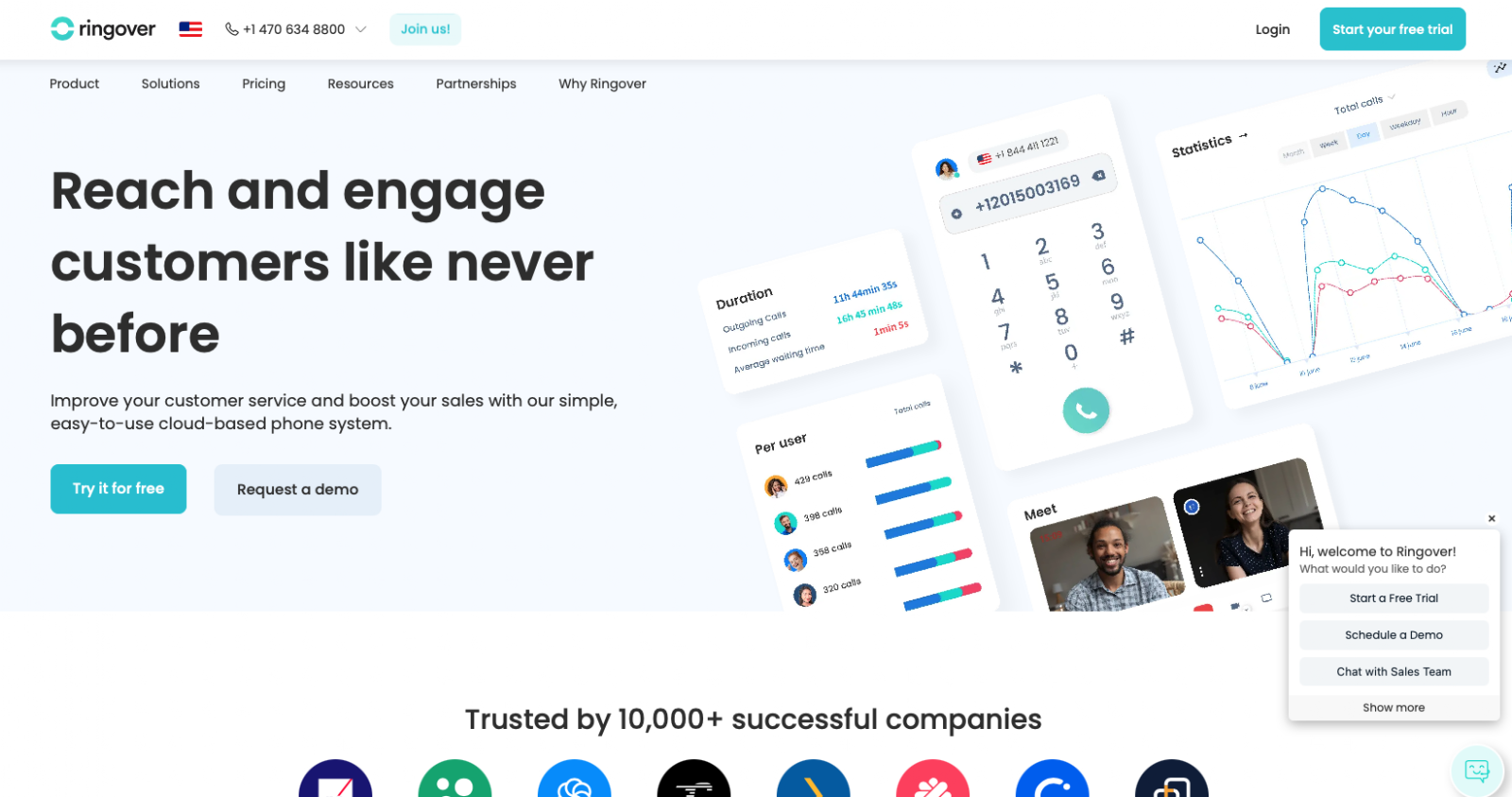
Ringover is a business phone system that keeps your team connected from anywhere. You can use the mobile or web app to start conversations across your preferred channels. Its Enterprise plan lets you customize the solution to your exact requirements, though the basic plan’s feature set is limited, so smaller teams may find themselves upgrading sooner than expected.
Key Features: IVR, smart call routing, CRM file pop-up, advanced call statistics, call recording, custom greetings, and HD video calls.
Pros of Ringover
- Unlimited calls included in all plans
- Instant setup with no hardware required
- Integrates with most major CRM platforms
- Number porting available
Cons of Ringover
- The entry-level plan covers only basic calling needs, which may not be enough for most teams
- Slightly expensive relative to the value delivered at lower tiers
Pricing: Basic plan starts at $19 per user per month (Source: Ringover pricing page).
G2 Rating: 4.7 out of 5 (Source: G2)
Which Ameyo Alternatives Integrate with CRM Platforms?
CRM integration is the most important factor when switching from Ameyo. Platforms that connect natively with your CRM let your sales and support teams access every customer interaction in one place, which cuts manual data entry and speeds up follow-up cycles.
Top CRM-Integrated Ameyo Alternatives
- FreJun: Integrates with over 15 CRMs including Zoho, Salesforce, HubSpot, Pipedrive, and LeadSquared. FreJun’s AI-powered call insights sync automatically, so no lead or support ticket falls through the cracks. See how to integrate FreJun with LeadSquared for a practical example.
- Ringover: Supports Salesforce and HubSpot with basic call logging.
- Dialpad: Offers multi-CRM support but limited automation features.
FreJun stands out here because it goes beyond basic call logging. It automatically transcribes calls, scores them with AI, and pushes structured data into your CRM dashboard in real time. For SaaS sales teams running pipeline reviews, this means your CRM always reflects what actually happened on the call.
- Automatic call logging and transcription into CRM
- Real-time call analytics visible inside CRM dashboards
- Workflow automation for follow-ups and lead scoring
How Can Businesses Choose the Right Ameyo Alternative for Their Needs?
Selecting the right platform depends on your team size, industry, and communication requirements. Here’s a practical four-step framework we recommend before you commit to any contract.
Step 1: Identify Your Team Requirements
- Small teams (under 20 agents): Focus on affordability and core features like call recording and IVR. CallHippo or FreJun’s Standard plan work well here.
- Large teams (50+ agents): Prioritize scalability, AI-driven insights, and omnichannel support. FreJun’s Professional plan or Avoxi fit this profile.
Step 2: Evaluate CRM Integration Depth
Confirm the platform connects to your specific CRM, not just popular ones. FreJun integrates with over 15 platforms including niche tools like Ceipal and TurboHire, which most competitors don’t support. Check whether the integration is native or relies on a third-party connector, because middleware adds latency and failure points.
Step 3: Compare Features and Pricing Honestly
Cloud PBX (Private Branch Exchange), IVR, call routing, AI analytics, and reporting dashboards are non-negotiable for most teams. Watch for platforms that lock basic features behind paid add-ons. FreJun includes all key features in its base plans with no surprise charges, which is why it consistently outperforms competitors in total cost of ownership comparisons.
Step 4: Test the User Experience Before Committing
A clean, intuitive interface drives faster adoption. FreJun’s dashboard is designed for quick onboarding, and most teams complete setup within a single working day. Dialpad and CallHippo also offer free trials so you can test before you buy. Test the support channel during your trial period too, because response time varies significantly across these platforms.
What Industries Benefit Most from Using Ameyo Alternatives?
While any team that makes outbound calls can benefit from switching, some industries see faster ROI because their workflows depend heavily on call volume, CRM accuracy, and compliance. Here’s a breakdown by industry.
| Industry | Use Case | Recommended Alternative |
|---|---|---|
| Sales and SaaS | Automate lead follow-ups, track call metrics in CRM | FreJun |
| Customer Support | Omnichannel support with real-time analytics | FreJun, Ringover |
| Recruitment Agencies | Candidate follow-ups and interview scheduling via ATS integration | FreJun |
| eCommerce | Order support and IVR for high call volumes | Avoxi, FreJun |
| Healthcare | Secure, compliant communication with call recording | FreJun, Avoxi |
| Finance | Call recording and analytics for compliance audits | FreJun |
What We’ve Learned from Deploying These Platforms Across 500+ Teams
The biggest mistake teams make when switching from Ameyo is choosing a platform based on feature lists alone. The real differentiator shows up three months in, when your agents are logging calls manually because the CRM integration doesn’t work the way the sales demo suggested.
Why CRM Sync Quality Matters More Than Feature Count
FreJun’s integration layer is built to avoid exactly this problem. Every call, transcript, and outcome syncs to your CRM automatically, without custom development or middleware. For SaaS sales teams running high-velocity outbound, this means your pipeline data stays accurate without adding admin overhead to your reps.
FreJun’s internal 2026 data across 300+ client accounts shows teams using full CRM sync cut post-call admin time by over 30 minutes per agent per day and improved pipeline data accuracy by more than 40% within the first quarter. A full benchmark report is in progress: contact research@frejun.com to be notified on publication. (FreJun internal data, 2026)
According to McKinsey’s technology research, businesses that automate routine sales workflows see significantly faster revenue growth than those relying on manual processes. G2 requires contact center software to “integrate with CRM software or a company’s system of record” as a baseline qualification criterion — reflecting how central CRM connectivity has become to how buyers define a viable platform (G2 Contact Center Category, 2026).
Where Competitors Fall Short on CRM Depth
Most platforms on this list offer CRM integration, but the depth varies significantly. Ringover and Dialpad handle basic call logging well, but neither supports niche ATS tools like Ceipal or TurboHire. Avoxi is strong on global voice infrastructure yet lacks the AI-driven call scoring that SaaS sales teams rely on for pipeline reviews. If your team runs a high-volume outbound motion, those gaps matter more than they appear on a feature comparison sheet.
Which Ameyo Alternative Is Right for Your Team?
You now have a clear picture of the seven best Ameyo alternatives available in 2026. Each platform serves a different profile: CallHippo suits budget-conscious small teams, Dialpad works well for Google Workspace users, Avoxi fits global teams needing local numbers, Ringover covers teams that prioritize unlimited calling, and Sarv is the pick for virtual number-focused use cases.
If you want a cloud-based platform that combines transparent pricing, the broadest CRM integration coverage, AI-powered call insights, and a 4.9/5 G2 rating, FreJun is the strongest choice among all Ameyo alternatives on this list. The most important step is matching your CRM stack to the platform before you commit, since that single decision determines whether your team gains efficiency or just trades one set of problems for another.
Your team can start a free trial today and have calls running within the hour. For further reading, check out our guide on 7 alternatives to Knowlarity if you’re also evaluating other Indian telephony providers. You can also explore our full breakdown of top VoIP service providers for a broader comparison across the market.
Frequently Asked Questions About Ameyo Alternatives
1. What are the key features to look for in an Ameyo alternative?
The most important features are CRM integration, call routing, real-time analytics, scalability, multi-channel support, and automation capabilities. FreJun covers all of these in its base plans. Look for transparent pricing so you know exactly what you’re paying before you sign up, because platforms that hide basic features behind add-ons tend to cost more than they appear upfront and create budget surprises at renewal time.
2. What features should I look for in a communication platform?
Focus on native CRM integrations, real-time analytics, WhatsApp Business support, and advanced call routing. These four capabilities directly improve customer interactions and reduce manual work for your agents. Check whether the platform offers call transcription and AI-powered summaries, since these features save significant time during post-call review and coaching sessions with your team.
3. Can communication platforms integrate with existing CRMs?
Yes, most modern platforms integrate with popular CRMs like Salesforce, Zoho, and HubSpot. FreJun goes further by connecting with over 15 CRMs including niche tools like Ceipal and TurboHire. This lets your team centralize customer data and automate communication workflows without switching between multiple tools during a call, which keeps agents focused on the conversation rather than data entry.
4. Are these platforms suitable for businesses of all sizes?
Yes. Modern cloud telephony platforms scale from small startups to large enterprises. FreJun’s Standard plan works well for teams of 5 to 50 agents, while the Professional plan handles larger deployments. Avoxi and Ringover offer enterprise tiers with custom configurations. The key is matching the plan tier to your actual call volume and integration needs before committing, since upgrading mid-contract can be disruptive.
5. How easy is it to set up a communication platform?
Setup is typically straightforward. FreJun’s onboarding takes most teams less than a day, with CRM integration completed through a guided wizard. CallHippo and Dialpad also offer quick setup flows. Platforms with on-premise components or complex SIP (Session Initiation Protocol) configurations take longer, so choosing a fully cloud-hosted option avoids setup delays entirely and gets your team calling faster.
6. Do these communication platforms provide real-time analytics?
Yes. FreJun provides real-time call analytics and reporting so managers can track agent performance, monitor call metrics, and make data-driven decisions without waiting for end-of-day reports. Avoxi and Ringover also offer live dashboards. FreJun’s AI-powered sentiment analysis adds an extra layer by flagging calls where customer tone shifts negative, which helps managers intervene before a deal is lost.
7. Do communication platforms offer multi-channel support?
Yes. FreJun supports voice calls, WhatsApp Business, and email in a single platform, so your team handles customer conversations across channels without switching tools. FreJun’s WhatsApp Business integration lets agents send follow-up messages directly from the same dashboard they use for calls, which keeps all communication history in one place for easy review and coaching.
8. Are these platforms mobile-friendly?
Yes, all seven platforms on this list offer mobile apps for iOS and Android. FreJun’s mobile app lets agents initiate calls, view call logs, and access CRM data from the field. This is particularly useful for sales teams that work remotely or travel frequently. Ringover and Dialpad also have well-reviewed mobile apps with full feature parity on most functions.
9. Which alternative has the best customer support?
FreJun provides 24/7 support with dedicated onboarding assistance for new accounts. Avoxi also offers extensive support documentation and live help. CallHippo has received mixed reviews on support responsiveness, which is worth factoring in if your team needs fast resolution times. Test the support channel during your free trial before committing to any platform, since response time varies more than most vendors admit.
10. Can these platforms scale with business growth?
Yes. All seven platforms support scaling from small teams to large enterprises. FreJun’s cloud architecture means you add users in minutes without hardware changes. Avoxi and Ringover handle high call volumes with no degradation in call quality. The most important scaling factor to check is whether your CRM integration holds up at higher call volumes, since some platforms throttle sync frequency on lower-tier plans.
You’ve compared all seven Ameyo alternatives and seen exactly where each one fits. The gap between knowing and doing is usually just one conversation. Most teams that book a FreJun demo are live and calling within a week, with their CRM syncing automatically from day one.