

AI Summary: This article compares the top 11 voice API provider India platforms for 2026, evaluating each on real-time latency, model-agnostic architecture, INR pricing, and TRAI compliance requirements. As of 2026, the global conversational AI market is projected to exceed $29 billion by 2028, according to MarketsandMarkets, making voice API selection a foundational infrastructure decision for any AI product team in India. Developers need a voice API that delivers sub-100ms latency, integrates with any STT, LLM, or TTS provider without lock-in, and handles carrier-level TRAI compliance automatically. FreJun Teler meets all three requirements, with outbound calling from Rs.0.15 per minute and raw WebSocket streaming that works with any AI stack the team already uses.
Key criteria in this comparison: We ranked these platforms on pricing transparency in INR, real-time WebSocket latency for AI voice loops, TRAI compliance support, model-agnostic architecture, and documentation quality, since these are the factors that most affect a developer team’s build speed and total cost in India.
Quick Answer: The best voice API provider India in 2026 is FreJun Teler, which delivers sub-100ms WebSocket streaming latency, a fully model-agnostic architecture compatible with any STT, LLM, or TTS provider, and outbound calling from Rs.0.15 per minute with TRAI-compliant virtual numbers. Teler is purpose-built for AI voice agents, unlike general CPaaS platforms that abstract the audio layer and add latency.
The best voice API provider India option for teams building AI voice agents in 2026 is Teler, which combines raw WebSocket audio streaming, INR-denominated pricing, and zero AI provider lock-in in a single platform designed specifically for real-time voice AI workloads.
What is a voice API provider India?
A voice API provider India is a cloud-based telephony infrastructure service that gives developers programmatic access to real phone networks so they can build, control, and automate voice calls through code rather than physical hardware. The best providers offer WebSocket-based media streaming, SIP trunking, virtual Indian phone numbers, and per-minute billing in INR. They handle carrier interconnects, number provisioning, and audio transport so engineering teams can focus entirely on the AI logic sitting above the telephony layer. Businesses operating in India specifically need providers that comply with TRAI regulations, support 140-series numbers for promotional calls and 1600-series for transactional calls, and respect the NCPR (National Customer Preference Register) to avoid regulatory penalties on outbound AI calling campaigns.
India’s AI voice agent market is growing rapidly as enterprises across BFSI, e-commerce, and healthcare deploy automated calling at scale. As of 2026, the Indian cloud communications market is expanding at a double-digit CAGR, according to IMARC Group, driven by demand for intelligent IVR, outbound automation, and real-time voice bots. What separates the best voice API provider India platforms from basic telephony resellers is the ability to stream raw audio over WebSocket with sub-100ms latency, support any STT or LLM stack without proprietary lock-in, and publish transparent INR pricing that scales predictably with call volume. Teams evaluating providers outside India, such as those comparing a voice API provider in the USA, will find similar tradeoffs between latency, pricing transparency, and model-agnostic architecture.
.fj-solid{display:inline-block;background-color:#31C170;color:#ffffff;font-weight:700;font-family:’DM Sans’,sans-serif;font-size:15px;padding:14px 28px;border-radius:12px;text-decoration:none;transition:background-color 0.18s ease;} .fj-solid:hover{background-color:#009349;color:#ffffff;text-decoration:none;} .fj-outline{display:inline-block;background-color:#ffffff;color:#31C170;font-weight:700;font-family:’DM Sans’,sans-serif;font-size:15px;padding:12px 28px;border-radius:12px;border:2px solid #31C170;text-decoration:none;transition:all 0.18s ease;} .fj-outline:hover{background-color:#F4FBF6;color:#009349;border-color:#009349;text-decoration:none;}Which voice API provider India platforms rank highest in 2026?
The table below compares all 11 voice API provider India platforms covered in this guide on best-fit use case, starting price, and free trial availability so you can shortlist quickly before reading the full profiles.
| # | Provider | Best for | Starting price (India) | Free trial |
|---|---|---|---|---|
| 1 | FreJun Teler | AI voice agent infrastructure | Rs.600/channel/month + Rs.0.15/min outbound | Yes — 3,000 free minutes on first upgrade |
| 2 | Twilio Voice | General CPaaS developers | $0.0040/min (browser/app); local calls $0.0699/min | No |
| 3 | Plivo | Cost-conscious CPaaS | Rs.0.34/min (Browser/SIP); Rs.0.60/min local | Yes — 90 days free |
| 4 | Exotel | India enterprise telephony | Contact sales | No |
| 5 | Knowlarity | India telephony teams | Contact sales (INR volume tiers available) | No |
| 6 | Kaleyra | Enterprise communications | Contact sales | No |
| 7 | Sinch | Enterprise CPaaS | Contact sales | No |
| 8 | Ozonetel | Enterprise contact centers | Contact sales | No |
| 9 | Telnyx | Low-latency voice stacks | Contact sales | No |
| 10 | Vonage API | General CPaaS developers | Contact sales | No |
| 11 | Bird (MessageBird) | Omnichannel comms teams | Contact sales | No |
Teler is the only voice API provider India platform on this list that combines transparent INR pricing, raw WebSocket streaming at sub-100ms latency, and a fully model-agnostic architecture out of the box.
↓ Scroll for the full breakdown of each tool, including features, pros, cons, pricing, and ideal use case.
How do you choose the best voice API provider India in 2026?
Step 1: Define your AI voice architecture
Before evaluating any voice API provider India platform, map out the AI stack you are already using or plan to use. Identify your STT (Speech-to-Text) engine, which converts the caller’s voice into text the LLM can process, your LLM (Large Language Model), the AI brain that reads the text and decides what to respond, and your TTS (Text-to-Speech) engine, which converts the AI’s text response back into natural-sounding audio. Conversational agents that must feel natural need sub-100ms end-to-end latency. Form-filling bots or appointment schedulers can tolerate up to 500ms. Knowing your latency requirement narrows the field immediately, since general CPaaS platforms often add 400 to 800ms by abstracting the audio path.
Step 2: Choose your integration path
Two integration paths exist for connecting a voice API to your AI stack. WebSocket streaming keeps a persistent, full-duplex connection continuously open between the caller and your server, so raw audio frames arrive in real time with no polling delay. This is the right path for AI voice agents that need sub-100ms response loops. SIP (Session Initiation Protocol) trunking, the standard protocol for establishing voice calls over the internet, is better for connecting existing SIP-enabled platforms or enterprise PBX infrastructure to a carrier network. If you are building a new AI voice agent from scratch, start with WebSocket. If you are integrating with an existing telephony stack, SIP trunking is the faster path. Teams specifically building browser-based calling experiences should also compare WebRTC voice API providers in India before finalizing their architecture.
Step 3: Check India-specific carrier and TRAI compliance requirements
TRAI (Telecom Regulatory Authority of India) governs all outbound calling in India, and AI-powered outbound campaigns carry additional compliance obligations beyond standard voice. Promotional calls must originate from 140-series numbers, while transactional calls use the 1600-series. No outbound calls are permitted after 9 PM IST. Your voice API provider India must support NCPR (National Customer Preference Register) scrubbing to avoid calling registered DNC numbers. Providers that handle these requirements at the carrier layer save your engineering team from building compliance logic from scratch. Confirm that the provider you choose has DoT-registered infrastructure and can provision compliant virtual numbers for India before signing any contract. Teams with operations beyond India, including those researching a voice API provider in Singapore, should apply the same latency and compliance criteria used in this comparison.
Step 4: Evaluate pricing in INR
Voice API costs in India have four components: channel fees (a fixed monthly cost per concurrent call slot), per-minute outbound rates, per-minute inbound rates, and media streaming fees if you use WebSocket audio. Recording and storage add a fifth line item if you need call logs. Calculate a realistic monthly cost based on your expected call volume before committing. A provider charging Rs.0.15 per outbound minute costs Rs.9,000 for 60,000 minutes. One charging Rs.0.60 per minute costs Rs.36,000 for the same volume. That difference compounds fast at scale, so always model the full monthly bill, not just the headline per-minute rate.
Step 5: Test latency and audio quality on a real call
Latency, the delay between when a person speaks and when they hear a response, is the single most important quality metric for conversational AI. The lower the latency, the more natural the conversation feels. Do not rely on published latency claims alone. Run a real test call through the full Media Streaming Loop, which is the complete real-time cycle of Voice to STT to LLM to TTS to Voice playback, before committing to a provider. Teler offers 3,000 free minutes on the first plan upgrade in India, which is enough to run a full integration test and benchmark the end-to-end latency of your specific STT and LLM combination before paying anything beyond the channel fee.
Top 11 voice API provider India platforms for 2026
1. FreJun Teler – Purpose-built voice API for AI agents in India
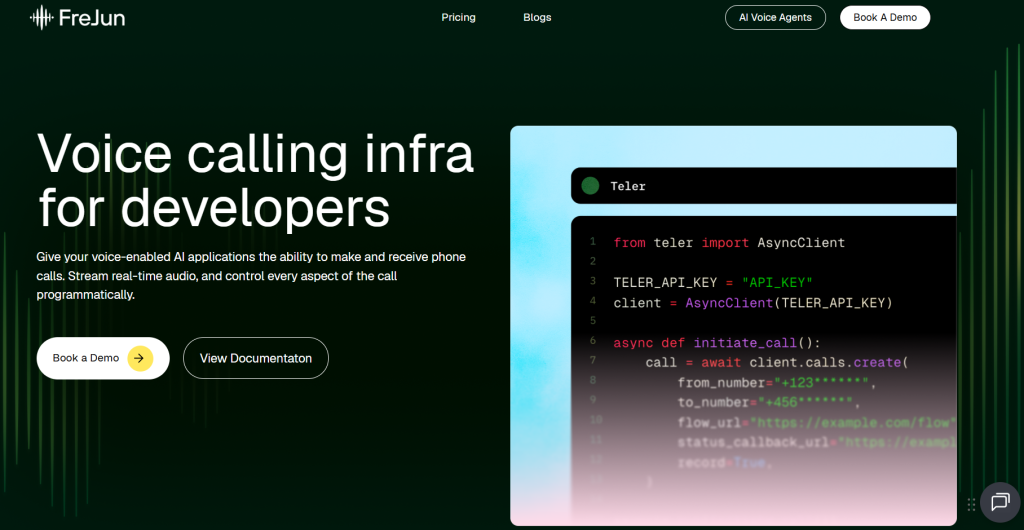
FreJun Teler is a voice API provider India platform built specifically for developers who need to connect AI chatbots and LLMs to real phone calls in real time, handling the entire voice transport layer so engineering teams can focus on their AI product logic.
Best for: AI voice agent infrastructure
Key features
- Raw WebSocket audio streaming in L16/8000Hz format delivers sub-100ms end-to-end latency, so your AI voice agent responds fast enough to feel like a natural conversation rather than a delayed bot.
- Fully model-agnostic architecture means you bring your own STT engine (Google STT, Deepgram, Whisper, AssemblyAI), your own LLM (OpenAI GPT, Anthropic Claude, Google Gemini), and your own TTS (ElevenLabs, Google TTS, Azure TTS, Play.ht) with zero lock-in to any Teler-mandated provider.
- SIP trunking with TCP/TLS transport and both credential-based and IP-based authentication connects existing SIP-enabled platforms or enterprise PBX systems directly to Teler’s carrier network without rebuilding your telephony stack.
- TRAI-compliant virtual numbers for India, including support for 140-series promotional and 1600-series transactional number ranges, so your outbound AI campaigns meet regulatory requirements at the carrier layer.
- Webhook callbacks fire on every call state change, so your application receives real-time event data when calls start, connect, or end without polling the API.
- REST API endpoints and multi-language SDKs let your team get a working first call running the same day using the getting-started guide at frejun.com.
- Prepaid billing in INR with monthly, quarterly, half-yearly, or annual cycles gives finance teams predictable cost control without surprise invoices.
Pros and cons
| Pros | Cons |
|---|---|
| Sub-100ms WebSocket latency purpose-built for real-time AI voice loops | Minimum 10 channels required to start, so very low-volume pilots carry a fixed monthly floor cost |
| Fully model-agnostic: works with any STT, LLM, or TTS provider the team already uses | Elastic SIP trunking (auto-scaling without channel limits) is on the roadmap but not yet available |
| Transparent INR pricing with 3,000 free minutes on first upgrade for real-world testing | Platform is focused on AI voice infrastructure, so teams needing a full business dialer with CRM sync need the separate FreJun product |
Pricing
(India): Rs.600 per channel per month (minimum 10 channels), Rs.0.15 per minute outbound, Rs.0.10 per minute inbound, Rs.0.15 per minute media streaming, Rs.0.04 per minute recording and storage. First upgrade includes 3,000 free minutes. Prepaid billing in INR. “Teler’s virtual numbers currently cover both India and UAE, making it a viable option for teams also evaluating a voice API provider in the UAE for regional expansion. See full pricing
Why Teler is the top recommendation
Why Teler ranks #1 for India: Teler is the only voice API provider India platform that combines transparent INR pricing from Rs.0.15 per minute, TRAI-compliant virtual numbers with 140-series and 1600-series support, and sub-100ms WebSocket latency in a model-agnostic architecture that general CPaaS platforms cannot match for real-time AI voice workloads. While Twilio and Plivo abstract the audio layer for human-to-human calls, Teler gives developers the raw audio stream directly, so the AI stack processes it in under 100ms with no proprietary conversion layer in the way. Start building →
Teler by the numbers: Sub-100ms latency | Model-agnostic: 10+ AI providers | Virtual numbers: India and UAE | Same-day integration via WebSocket or SIP | 3,000 free minutes on first upgrade (India)
2. Twilio Voice – Broad CPaaS for general developer use cases
Twilio Voice is a programmable CPaaS (Communications Platform as a Service), a cloud-based platform that adds voice, SMS, and video capabilities to applications via APIs, designed for general developers building inbound and outbound calling, browser calling, IVRs, and voice workflows at scale.
Best for: General CPaaS developers
Key features
- Pay-as-you-go call control via REST API lets developers trigger, modify, and end calls programmatically without managing physical infrastructure.
- India route-level pricing is published in USD, giving developers a transparent cost baseline for local and mobile call routes before building.
- SIP interface and BYOC (Bring Your Own Carrier) trunking connect existing telephony infrastructure to Twilio’s network without full migration.
- ConversationRelay and Media Streams enable AI voice agent workflows by streaming audio to a developer’s server, though the abstraction layer adds latency compared to raw WebSocket providers.
- Selectable speech-recognition providers including Deepgram Nova, Google v2, and legacy Google v1 give developers some flexibility in the STT layer without fully leaving the Twilio ecosystem.
Pros and cons
| Pros | Cons |
|---|---|
| Large developer ecosystem with extensive documentation and official SDKs for major languages | India voice pricing is published in USD rather than INR, which complicates budgeting for India-based teams |
| Flexible route-level pricing and BYOC trunking suit teams with existing carrier relationships | Audio abstraction layer adds 400 to 800ms latency, making real-time AI voice loops harder to achieve than with raw WebSocket providers |
| ConversationRelay supports AI voice agent workflows without fully custom engineering | Designed as a broad CPaaS rather than an AI-first voice infrastructure, so AI voice use cases require heavier custom engineering overhead |
Pricing
(India): $0.0040 per minute for browser and app voice; local calls at $0.0699 per minute; mobile calls at $0.0496 per minute. Pay-as-you-go, no monthly minimum. Pricing published in USD. See full pricing
3. Plivo – Cost-conscious CPaaS with INR pricing
Plivo is a programmable voice CPaaS for developers building telephony applications, browser and SIP calling, and audio-streaming voice workflows, with India pricing published in INR and a 90-day free trial period.
Best for: Cost-conscious CPaaS
Key features
- INR pricing for India routes, including Browser SDK calls at Rs.0.34 per minute and local calls at Rs.0.60 per minute, removes the currency conversion guesswork that USD-only providers create for India-based finance teams.
- 90-day free trial period gives developers enough runway to build and test a working integration before committing to paid usage.
- Browser SDK and SIP routes let teams choose between web-based calling and traditional telephony infrastructure depending on their existing stack.
- Audio streaming support enables bring-your-own-stack AI voice workflows, though the audio format is not publicly documented in detail.
- Public GitHub repository with a voice audio stream setup example gives developers a working starting point rather than building from a blank API reference.
Pros and cons
| Pros | Cons |
|---|---|
| INR pricing and 90-day free trial lower the barrier to entry for India-based teams | Audio format for streaming is not publicly documented, which slows AI voice agent integration |
| Public GitHub repo with streaming setup example reduces initial build time | No native STT, LLM, or TTS provider integrations documented, so the full AI stack requires custom engineering |
Pricing
(India): Rs.0.34 per minute for Browser SDK and SIP calls; Rs.0.60 per minute for local calls. 90-day free trial available. See full pricing
4. Exotel – India enterprise telephony with AI streaming

Exotel is a cloud telephony and voice API platform built for enterprise call flows and AI voice agent streaming in India, offering a dedicated AgentStream path for real-time audio forwarding to developer-owned AI stacks.
Best for: India enterprise telephony
Key features
- AgentStream and Passthru applets forward base64-encoded audio frames of approximately 100ms each to your server, so your STT engine receives a continuous audio feed without polling.
- Bring-your-own STT, LLM, and TTS stack is supported through the streaming path, with TTS audio returned to Exotel for playback to the caller.
- Exophone caller ID management lets enterprises present consistent, branded numbers to callers across inbound and outbound campaigns.
- Migration path from TwiML to Exotel’s Connect API is documented, which reduces switching costs for teams moving away from Twilio’s India pricing.
- Call-flow applets give non-developer teams a way to configure routing logic without writing code, while the API layer handles custom AI integrations.
Pros and cons
| Pros | Cons |
|---|---|
| India-focused platform with documented migration path from Twilio and typically lower India call pricing | AgentStream access must be enabled by support, adding friction before developers can test the AI voice path |
| Passthru applet supports bring-your-own AI stack without proprietary provider lock-in | No public SDK found, and pricing requires a sales conversation rather than self-serve signup |
5. Knowlarity – India telephony with WSS streaming and INR volume tiers

Knowlarity is a cloud telephony and voice API provider with developer-facing voice documentation and India-enterprise INR pricing tiers, offering WSS-based streaming for AI voice agent integration.
Best for: India telephony teams
Key features
- WSS (WebSocket Secure) endpoint construction lets developers connect their AI stack to live call audio over an encrypted streaming channel.
- Ngrok-based local development workflow means developers can test webhook and streaming integrations from a local machine without deploying to a public server first.
- Real-time log output on test calls gives developers immediate visibility into what the platform is receiving and sending during integration testing.
- INR volume-tier pricing billed per 15-second blocks scales down in cost as monthly minute volumes increase, rewarding high-volume deployments.
- Logging-enabled and premium voice API tiers let teams choose between cost-optimised and feature-rich configurations depending on their use case.
Pros and cons
| Pros | Cons |
|---|---|
| INR volume-tier pricing and India-based offices make it a natural fit for India enterprise procurement | Audio format for WSS streaming is not publicly documented, which slows AI voice agent integration planning |
| Ngrok-based local dev workflow and real-time logs reduce the time to a first working test call | No public SDK found and no explicit auth or security guide in available documentation |
6. Kaleyra Voice – Enterprise communications platform
Kaleyra Voice is a programmable voice API for enterprise CPaaS and business calling teams, positioned as a voice-plus-messaging platform with public API documentation and volume-discount pricing for large deployments.
Best for: Enterprise communications
Key features
- REST API call control is documented publicly, giving developers a standard HTTP interface for triggering and managing voice calls without proprietary SDKs.
- Volume-discount pricing and custom enterprise bundles let large teams negotiate rates that reflect their actual call volume rather than paying list price at scale.
- Voice-plus-messaging platform positioning means teams that need both outbound calling and SMS campaigns can consolidate under one vendor contract.
- Enterprise support contact is available for teams that need dedicated account management rather than self-serve documentation.
Pros and cons
| Pros | Cons |
|---|---|
| Volume-discount pricing and custom bundles suit large enterprise deployments with predictable call volumes | No public quickstart guide or WebSocket code example found, which slows developer onboarding significantly |
| Voice-plus-messaging platform reduces vendor count for teams needing both channels | INR pricing, India virtual number availability, and TRAI compliance details are not confirmed in public documentation |
7. Sinch – Enterprise CPaaS for large-scale communications

Sinch is a programmable voice and CPaaS platform for enterprise communications teams, offering voice, messaging, and video capabilities through a unified API platform for large-scale deployments.
Best for: Enterprise CPaaS
Key features
- Unified voice and messaging API platform lets enterprise teams manage multiple communication channels through a single vendor relationship and billing account.
- Global carrier network supports international voice routing, which suits enterprises with operations across multiple geographies beyond India.
- Enterprise-grade SLAs and dedicated support are available for teams that require contractual uptime guarantees rather than best-effort service.
- Programmable voice capabilities cover inbound routing, outbound dialing, and IVR configuration through API-driven call control.
Pros and cons
| Pros | Cons |
|---|---|
| Unified multi-channel platform suits enterprises managing voice and messaging under one contract | India-specific pricing, INR billing, and TRAI compliance details are not publicly documented |
| Global carrier network supports multi-geography deployments beyond India | No public WebSocket streaming documentation found, making AI voice agent integration path unclear |
8. Ozonetel – Cloud contact center platform for enterprise teams
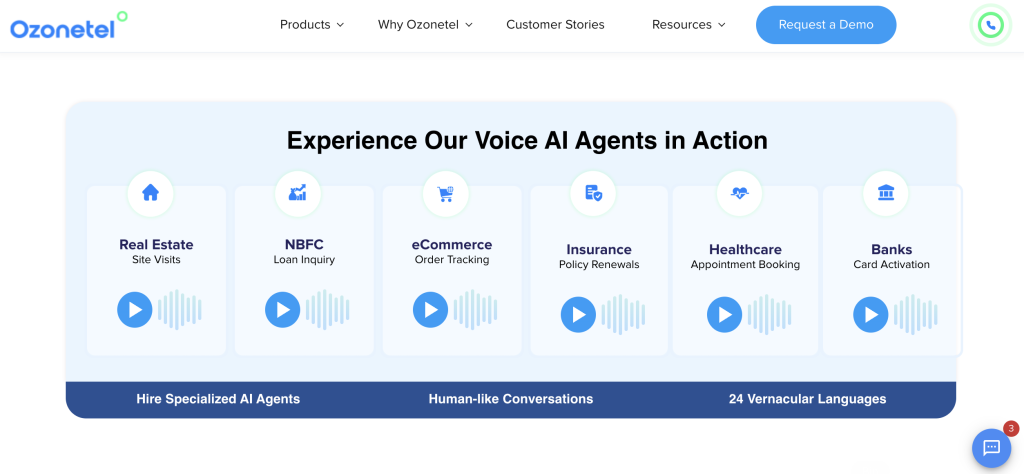
Ozonetel is a cloud contact center and telephony platform for enterprise calling teams in India, combining inbound routing, outbound dialing, and agent management tools in a single platform.
Best for: Enterprise contact centers
Key features
- Cloud contact center platform combines inbound ACD (Automatic Call Distribution) routing with outbound dialing in a single managed environment, reducing the number of vendors a contact center team needs to manage.
- India-focused deployment with local carrier relationships supports TRAI compliance requirements for enterprise outbound calling campaigns.
- Agent management and supervisor monitoring tools give operations teams real-time visibility into call queues and agent performance without separate analytics software.
- API access for call control lets development teams build custom integrations with CRM platforms like Salesforce, Zoho, or Freshsales alongside the contact center layer.
Pros and cons
| Pros | Cons |
|---|---|
| India-focused contact center platform with local carrier relationships and TRAI awareness | Platform is designed for human agent contact centers rather than AI voice agent infrastructure |
| Combined inbound and outbound capabilities reduce vendor count for enterprise contact center teams | No public WebSocket streaming or raw audio API documentation found for AI voice agent use cases |
9. Telnyx – Developer-first voice platform for low-latency stacks

Telnyx is a developer-first voice and telephony platform built for teams that need low-latency voice infrastructure, offering programmable voice, SIP trunking, and real-time communication APIs through a self-serve developer portal.
Best for: Low-latency voice stacks
Key features
- Developer-first platform with self-serve signup and a programmable voice API lets teams get started without a sales conversation, which reduces time to first call.
- SIP trunking infrastructure supports enterprise telephony integrations for teams connecting existing PBX or UCaaS platforms to a carrier network.
- Programmable voice API covers inbound and outbound call control, IVR configuration, and call recording through standard REST endpoints.
- Global network with private backbone routing is designed to reduce public internet hops, which can lower latency for international voice routes.
Pros and cons
| Pros | Cons |
|---|---|
| Developer-first self-serve platform reduces onboarding friction for technical teams | India-specific pricing, INR billing, and TRAI compliance details are not publicly documented |
| Private backbone network designed to reduce latency on international voice routes | No public WebSocket raw audio streaming documentation found for AI voice agent integration in India |
10. Vonage API – Programmable communications for voice developers

Vonage API is a programmable communications platform for voice and messaging developers, offering call control, WebSocket audio streaming, and SIP connectivity through a developer-facing API suite.
Best for: General CPaaS developers
Key features
- Programmable voice API covers inbound and outbound call control, conference calling, and call recording through REST endpoints that follow standard HTTP conventions.
- WebSocket audio streaming support enables AI voice agent workflows by connecting live call audio to a developer’s server for STT processing.
- SIP connectivity options let teams integrate existing telephony infrastructure without full platform migration.
- Voice and messaging under one API platform reduces integration complexity for teams that need both channels in a single product.
Pros and cons
| Pros | Cons |
|---|---|
| Combined voice and messaging API reduces vendor count for teams needing both channels | India-specific pricing, INR billing, and TRAI compliance details are not publicly confirmed |
| WebSocket audio streaming support enables AI voice agent integration paths | Pricing requires a sales contact rather than self-serve transparency, which slows budget planning |
11. Bird (MessageBird) – Omnichannel CPaaS for customer communications

Bird, formerly MessageBird, is a customer communications and omnichannel CPaaS platform with voice and messaging capabilities, designed for teams that need to manage customer interactions across multiple channels from a single platform.
Best for: Omnichannel comms teams
Key features
- Omnichannel platform combines voice, SMS, WhatsApp, email, and push notifications under one API, so teams managing customer journeys across multiple touchpoints can consolidate tooling.
- Programmable voice capabilities cover inbound routing and outbound calling through a REST API that integrates with the broader Bird messaging platform.
- Customer data platform layer connects communication events to customer profiles, giving marketing and support teams context on who they are calling before the call connects.
- Global reach across multiple countries supports enterprises with international customer bases beyond India.
Pros and cons
| Pros | Cons |
|---|---|
| Omnichannel platform consolidates voice, SMS, and messaging under one vendor for customer communications teams | India-specific pricing, INR billing, and TRAI compliance details are not publicly documented |
| Customer data platform layer adds context to voice interactions beyond raw call control | No public raw audio streaming or WebSocket documentation found for AI voice agent use cases in India |
Voice API provider India feature comparison: 2026
| Feature | Teler | Twilio | Plivo | Exotel | Knowlarity | Kaleyra | Sinch | Ozonetel | Telnyx | Vonage API | Bird |
|---|---|---|---|---|---|---|---|---|---|---|---|
| Raw WebSocket audio streaming (sub-100ms) | Yes | Partial – via Media Streams, adds latency | Partial – audio streaming available, format undocumented | Partial – base64 frames via AgentStream | Partial – WSS endpoint, format undocumented | No | No | No | Partial – WebSocket available, latency undocumented | No | No |
| Model-agnostic (bring any STT/LLM/TTS) | Yes | Partial – selectable STT providers only | Yes — bring-your-own stack via streaming | Yes – bring-your-own stack via AgentStream | Partial – no native provider list documented | No | No | No | No | No | No |
| INR pricing published publicly | Yes | No – USD only | Yes | No – contact sales | Yes – volume tiers in INR | No | No | No | No | No | No |
| TRAI-compliant virtual numbers for India | Yes | Partial – not confirmed in public docs | Partial – not confirmed in public docs | Yes – Exophone caller ID with India compliance | Partial – India presence confirmed, compliance details limited | Partial – India presence confirmed, compliance details limited | No | Partial – India-focused but details limited | No | No | No |
| SIP trunking | Yes | Yes – BYOC trunking | Yes | No | No | No | No | No | Yes | Yes | No |
| Free trial or free credits available | Yes – 3,000 free minutes on first upgrade | No | Yes – 90 days free | No | No | No | No | No | No | No | No |
Teler is the only voice API provider India platform in this comparison that scores positively on all six differentiating features, while most competitors score on two or three at most.
Which voice API provider India is right for your team in 2026?
Different teams have different priorities when choosing a voice API provider India platform. The right choice depends on your technical architecture, call volume, budget, and whether you are building AI-first or extending an existing telephony stack.
If you are building a real-time AI voice agent from scratch: Choose Teler. It is the only voice API provider India platform with sub-100ms raw WebSocket streaming, model-agnostic architecture, and transparent INR pricing designed specifically for AI voice workloads.
If you are a developer who needs a broad CPaaS with a large ecosystem and extensive documentation: Choose Twilio Voice. Its developer community, SDK coverage, and ConversationRelay feature make it a reasonable starting point, though you will need to engineer around the audio abstraction layer for low-latency AI use cases. For teams that want to skip that extra engineering work, see our Twilio alternative in India comparison of lower-latency options.
If you are cost-sensitive and want INR pricing with a free trial period: Choose Plivo. Its 90-day free trial and INR-denominated pricing make it the most accessible entry point for India-based teams testing voice API integration on a limited budget.
If you are an India enterprise team migrating from Twilio and need a local telephony provider with call-flow tooling: Choose Exotel. Its documented migration path from TwiML and AgentStream support for AI voice make it a practical choice for enterprise teams with existing Twilio infrastructure.
If you are running a high-volume contact center in India and need combined inbound and outbound management: Choose Ozonetel. Its contact center platform is built for India enterprise call operations rather than developer-first API use cases.
Which tool wins overall in India?
If you want the best overall voice API provider India for 2026 with AI features, INR billing, and TRAI compliance: Choose Teler. It is the only platform that delivers sub-100ms WebSocket latency, zero AI provider lock-in, and transparent INR pricing in a single product built specifically for the AI voice agent use case rather than adapted from a general CPaaS.
Frequently asked questions about voice API provider India in 2026
What is the best voice API provider India in 2026?
The best voice API provider India in 2026 is FreJun Teler, which is purpose-built for AI voice agent infrastructure rather than adapted from a general CPaaS. Teler delivers sub-100ms latency through raw WebSocket streaming, so the full Media Streaming Loop, which is the complete cycle of Voice to STT to LLM to TTS to Voice playback, completes fast enough for natural conversation. It is fully model-agnostic, meaning developers bring their own STT, LLM, and TTS providers with zero lock-in. Outbound calling starts at Rs.0.15 per minute with TRAI-compliant virtual numbers available for India.
How much does a voice API provider India cost in 2026?
Voice API costs in India vary widely depending on the provider and pricing model. Teler charges Rs.600 per channel per month with a minimum of 10 channels, plus Rs.0.15 per minute for outbound calls, Rs.0.10 per minute for inbound calls, Rs.0.15 per minute for media streaming, and Rs.0.04 per minute for recording and storage. Plivo publishes INR pricing at Rs.0.34 per minute for Browser SDK calls and Rs.0.60 per minute for local calls. Most other providers on this list require a sales conversation before sharing India-specific pricing. Teler’s first upgrade includes 3,000 free minutes, which lets teams test the full stack before paying for production usage.
What latency can developers expect from a voice API provider India?
Latency depends heavily on the integration path the voice API provider India uses. Teler’s WebSocket streaming delivers sub-100ms end-to-end latency for the full AI voice loop, which is fast enough for natural, uninterrupted conversation. General CPaaS platforms like Twilio and Plivo abstract the audio layer for human-to-human call quality, but that abstraction adds 400 to 800ms of delay because the audio is processed through a proprietary conversion layer before reaching the developer’s server. For AI voice agents, that extra delay makes conversations feel robotic and unnatural. Raw WebSocket streaming, where the audio arrives at your server as L16/8000Hz frames with no intermediate conversion, is the only path that reliably achieves sub-100ms latency in production.
Which voice API provider India works with any STT, LLM, or TTS provider?
Teler is the voice API provider India platform with the most complete model-agnostic architecture. It works with Google STT, Deepgram, Whisper, and AssemblyAI for speech recognition, with OpenAI GPT, Anthropic Claude, Google Gemini, and any custom model for the LLM layer, and with ElevenLabs, Google TTS, Azure TTS, and Play.ht for text-to-speech. Developers pay their AI providers directly. Teler handles only the voice transport layer, so there is no Teler-mandated AI provider and no proprietary audio format that locks the stack in. This matters in production because AI provider capabilities evolve fast, and teams that are locked into one provider cannot switch without rebuilding their telephony integration from scratch.
What does TRAI compliance mean for AI outbound calling in India?
TRAI (Telecom Regulatory Authority of India) sets the rules for all outbound calling in India, and AI-powered campaigns carry specific obligations beyond standard voice. Promotional calls must originate from 140-series numbers, while transactional calls use the 1600-series. No outbound calls are permitted after 9 PM IST. Your voice API provider India must support NCPR (National Customer Preference Register) scrubbing so your system does not call numbers registered on the Do Not Call list. Violations carry financial penalties and can result in number suspension. Providers that handle these requirements at the carrier layer, rather than leaving compliance logic to the developer, significantly reduce regulatory risk for teams running automated outbound AI calling at scale.
What is the difference between SIP trunking and WebSocket streaming for AI voice?
SIP (Session Initiation Protocol) trunking is the standard protocol for establishing voice calls over the internet, and it is the right integration path for connecting existing SIP-enabled platforms, enterprise PBX systems, or AI voice frameworks like Vapi or Retell to a carrier network. WebSocket streaming keeps a persistent, full-duplex connection continuously open between the caller and your server, so raw audio frames arrive in real time with no polling delay. For new AI voice agents built from scratch, WebSocket is the better choice because it delivers sub-100ms latency and gives your STT engine direct access to the raw audio stream. SIP trunking is better when you are integrating with an existing telephony stack that already speaks SIP rather than building a new WebSocket-based AI voice pipeline.
How do I get started building an AI voice agent with a voice API provider India?
Start by choosing your AI stack: pick an STT engine to transcribe caller audio, an LLM to generate responses, and a TTS engine to convert those responses back to audio. Then connect them to a voice API provider India platform that streams raw audio over WebSocket. The full Media Streaming Loop works like this: the caller speaks, Teler captures the audio and streams it to your server over WebSocket in L16/8000Hz format, your STT engine transcribes it, your LLM generates a response, your TTS engine converts that response to audio, and Teler plays it back to the caller. The full loop completes in under 100ms on Teler. Since Teler includes 3,000 free minutes on the first plan upgrade in India, you can run a complete integration test before paying for production usage. The getting-started guide is available at knowledge.frejun.com.
Can I use Teler with orchestration platforms like Vapi or Retell AI?
Yes. Vapi, Retell AI, and similar platforms are orchestration layers that sit above the telephony layer. Teler is the infrastructure level below them, providing the actual carrier connectivity, real-time audio streaming, and SIP trunking that these platforms need to make and receive real phone calls. Developers building on Vapi or Retell can connect Teler as their telephony provider, so the orchestration platform handles the AI conversation logic while Teler handles the voice transport. This separation of concerns means you can switch your orchestration layer without rebuilding your telephony integration, and you can switch your telephony provider without rebuilding your AI logic.
Conclusion: Best voice API provider India in 2026 for AI voice agents
The top three voice API provider India platforms in 2026 are Teler for AI-first infrastructure, Plivo for cost-conscious developers who need INR pricing and a free trial, and Exotel for India enterprise teams migrating from Twilio. Teler is the top recommendation for any team building real-time AI voice agents in India because it is the only platform that combines sub-100ms raw WebSocket latency, a fully model-agnostic architecture compatible with any STT, LLM, or TTS provider, transparent INR pricing from Rs.0.15 per minute, and TRAI-compliant virtual numbers in a single product built specifically for AI voice workloads. If your team is ready to build, start with Teler’s 3,000 free minutes and have a working AI voice agent running the same day.


