AI Summary: This article compares the top 7 WebRTC voice API providers in India for 2026, evaluating each platform on real-time latency, model-agnostic architecture, INR pricing, and TRAI compliance requirements. As of 2026, the global conversational AI market is projected to exceed $29 billion by 2028, according to MarketsandMarkets, making WebRTC voice API selection a foundational infrastructure decision for any AI product team building in India. Developers need a provider that delivers sub-100ms latency for natural conversation, integrates with any STT, LLM, or TTS provider without lock-in, and handles carrier-level TRAI compliance automatically. FreJun Teler meets all three requirements, with outbound calling from ₹0.15 per minute and raw WebSocket streaming that works with any AI stack the team already uses.
Key criteria in this comparison: We ranked these platforms on real-time WebSocket latency, model-agnostic architecture, pricing transparency in INR, TRAI compliance support, and documentation quality, since these are the factors that most affect a developer team’s build speed and total cost when building AI voice agents in India.
Quick Answer: The best WebRTC voice API providers in India for 2026 is FreJun Teler, which delivers sub-100ms raw WebSocket streaming, a fully model-agnostic architecture compatible with any STT, LLM, or TTS provider, and outbound calling from ₹0.15 per minute with TRAI-compliant carrier infrastructure. Developers can complete a working first call the same day using WebSocket or SIP integration.
The best WebRTC voice API providers India teams can use in 2026 is Teler, which offers purpose-built programmable voice infrastructure for AI agents with sub-100ms latency, model-agnostic design, and INR-denominated pricing that scales from the first channel.
What are WebRTC voice API providers in India?
WebRTC voice API providers in India are cloud-based platforms that give developers programmatic access to real-time voice infrastructure, so they can build AI voice agents, intelligent IVR systems, and automated calling workflows without constructing any telecom stack from scratch. The best providers expose raw audio streams over WebSocket, a persistent full-duplex connection that keeps the audio channel continuously open between the caller and the developer’s server, enabling sub-100ms response loops that feel natural to the caller. They also offer SIP trunking, the standard protocol for establishing voice calls over the internet, for teams connecting existing enterprise telephony platforms. Indian businesses specifically need providers that comply with TRAI, the Telecom Regulatory Authority of India, support 140-series numbers for promotional calls and 1600-series for transactional calls, and offer INR billing with virtual numbers available for Indian carrier networks. Before evaluating WebRTC-specific platforms, it helps to understand what a voice API provider in India actually needs to support at the carrier level, including TRAI rules and INR billing.
As of 2026, the AI voice agent market in India is growing rapidly, driven by demand from BFSI, e-commerce, and healthcare sectors automating customer outreach at scale. According to MarketsandMarkets, the global conversational AI market is projected to exceed $29 billion by 2028, and India represents one of the fastest-growing deployment regions. What separates basic CPaaS, or Communications Platform as a Service, platforms from the best WebRTC voice API providers India developers rely on is the ability to stream raw audio directly to a developer’s server without a proprietary conversion layer adding latency. Teams evaluating providers beyond India should note that requirements differ significantly for those comparing WebRTC voice API providers in the USA, since latency benchmarks, carrier compliance, and pricing currencies vary by region.
Which WebRTC voice API providers India teams use rank highest in 2026?
The table below compares all seven WebRTC voice API providers India developers are evaluating in 2026, ranked by AI voice readiness, latency, and pricing transparency.
| # | Provider | Best for | Starting price (India) | Free trial |
|---|---|---|---|---|
| 1 | FreJun Teler | AI voice agent infrastructure | ₹600/channel/month + ₹0.15/min outbound | Yes, 3,000 free minutes on first upgrade |
| 2 | Twilio | General CPaaS voice | From $0.0040/min (India) | Yes, trial account available |
| 3 | Vonage | WebRTC plus PSTN calling | Contact sales | Check website |
| 4 | Agora | RTC voice apps | Contact sales | Yes, 167 hours free per month |
| 5 | Daily | WebRTC voice infrastructure | Free tier, then $9/month | Yes, 10K participant-minutes/month free |
| 6 | LiveKit | Open-source voice agents | Free tier, then $50/month | Yes, 1,000 agent session minutes/month free |
| 7 | Plivo | Telephony voice APIs | Contact sales | Check website |
Teler leads on AI voice readiness and INR pricing transparency. Scroll for the full breakdown of each tool, including features, pros, cons, pricing, and ideal use case.
“WebSockets are for server-to-server communication, while WebRTC is for client-server. Twilio uses WebSockets because in their case it is server to server.”
– Tom Shapland, LiveKit via LinkedIn
How do you choose the best WebRTC voice API providers India in 2026?
Choosing among WebRTC voice API providers India developers trust requires matching the platform’s technical architecture to your specific AI voice use case. The five steps below cover the decisions that matter most before you commit to a provider.
Step 1: Define your AI voice architecture
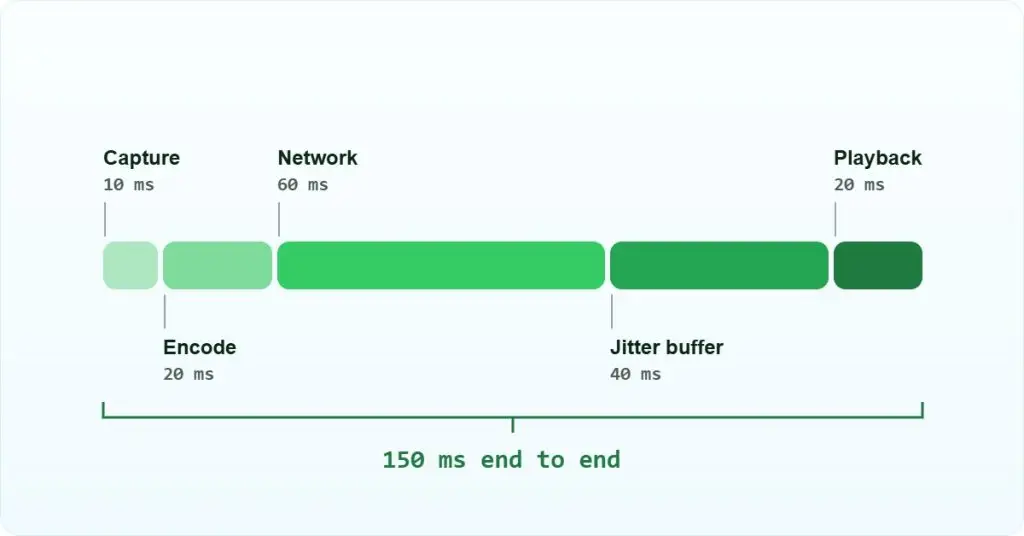
Start by mapping the STT, or Speech-to-Text, engine, the LLM, or Large Language Model, and the TTS, or Text-to-Speech, engine you plan to use. Different providers have different levels of compatibility with popular stacks like Deepgram plus OpenAI GPT plus ElevenLabs. If you already have a preferred AI stack, confirm the voice API can stream raw audio to your server without forcing a proprietary format. Latency requirements also vary by use case. Conversational AI agents need sub-100ms end-to-end loops, while form-filling bots can tolerate up to 500ms without the caller noticing a delay.
Step 2: Choose your integration path
Two integration paths exist for WebRTC voice API providers India teams evaluate. WebSocket streaming keeps a persistent, full-duplex connection open between the caller and your server, so raw audio arrives continuously with no polling overhead. This is the lowest-latency path and the right choice for real-time AI voice agents. SIP trunking, using the Session Initiation Protocol, is better for connecting existing enterprise telephony platforms or SIP-enabled PBX systems to a carrier network. If you are building a new AI voice product from scratch, start with WebSocket. If you are extending an existing telephony infrastructure, SIP is the faster path to production.
Step 3: Check TRAI compliance requirements
TRAI, the Telecom Regulatory Authority of India, sets strict rules for outbound calling that go beyond standard voice. AI outbound calling must use 140-series numbers for promotional campaigns and 1600-series numbers for transactional calls. No outbound calls are permitted after 9 PM IST. Providers must also support NCPR, the National Customer Preference Register, to avoid calling numbers that have opted out. Confirm that any WebRTC voice API provider India teams select handles these carrier-level rules automatically, rather than leaving compliance logic entirely to the developer. Developers based outside India who need similar sub-100ms performance should instead review options built around a voice API for the US market, since TRAI rules and INR pricing do not apply there.
Step 4: Evaluate pricing in INR
Per-minute rates, channel costs, media streaming fees, and recording storage costs all add up quickly at scale. For WebRTC voice API providers India developers use, calculate a realistic monthly cost based on expected call volume before signing up. A provider charging ₹0.15 per outbound minute with a ₹600 per channel monthly fee is straightforward to model. Providers that require a sales call just to get a price make cost forecasting difficult, which is a real operational risk for teams running tight engineering budgets.
Step 5: Test latency and audio quality on a real call
No benchmark replaces a live call test on your actual infrastructure. Teler offers 3,000 free minutes on the first plan upgrade in India, which is enough to run a complete Media Streaming Loop, the full real-time cycle of Voice to STT to LLM to TTS to Voice playback, and measure the actual end-to-end latency your stack produces. Test with your real STT engine and your real LLM, not a synthetic benchmark, since each component in the chain adds its own latency contribution.
Top 7 WebRTC voice API providers India developers use in 2026
1. FreJun Teler – Purpose-built AI voice infrastructure for India
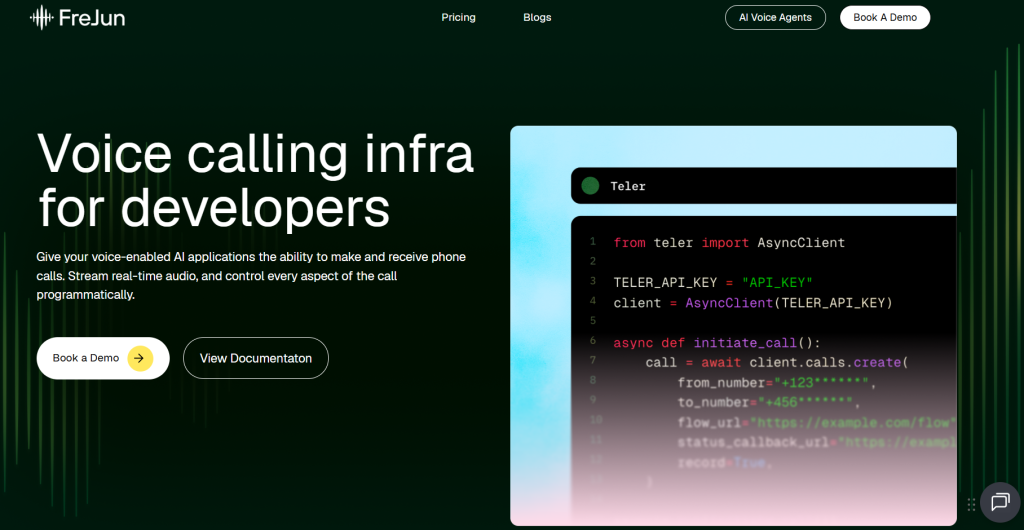
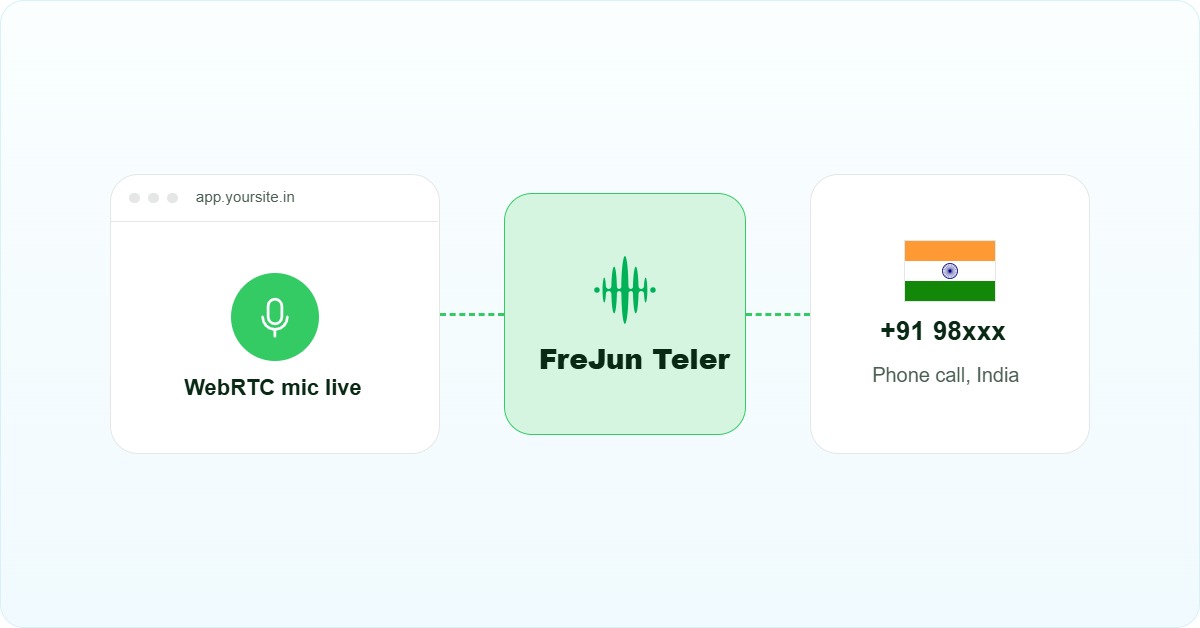
FreJun Teler is a Voice API platform built for developers constructing AI voice agents on Indian carrier networks, offering raw WebSocket audio streaming and SIP trunking with TRAI-compliant infrastructure and INR pricing.
Best for: AI voice agents and real-time bots
Key features
- Raw WebSocket audio streaming in L16/8000Hz format delivers audio directly to your server, so your STT engine receives it with no proprietary conversion layer adding latency to the loop.
- Sub-100ms Media Streaming Loop completes the full Voice to STT to LLM to TTS to Voice cycle fast enough for natural, uninterrupted conversation with a real caller.
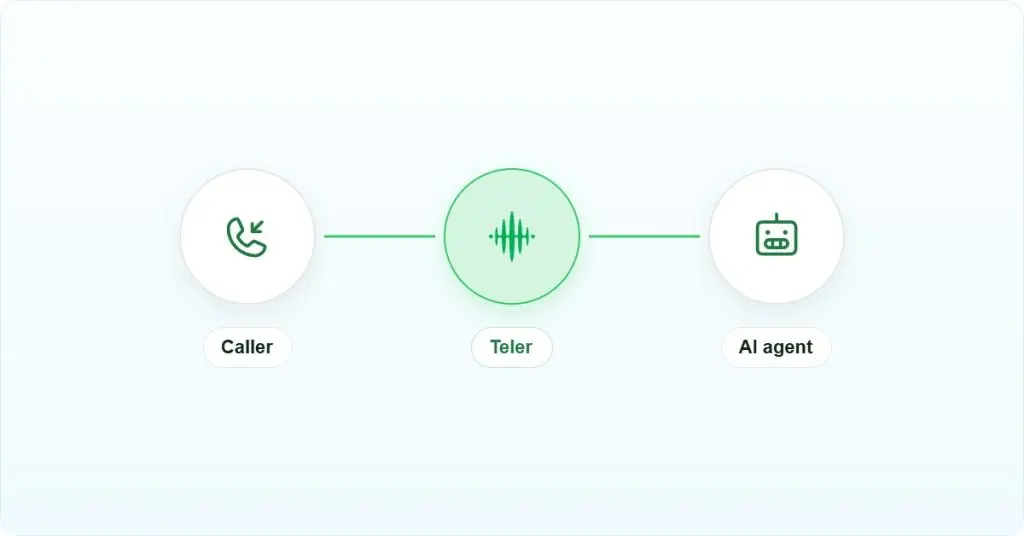
- Model-agnostic architecture means developers bring their own STT engine, LLM, and TTS engine and pay those providers directly. Teler handles only the voice transport layer, with zero lock-in to any AI provider.
- SIP trunking with TCP and TLS transport supports credential-based or IP-based authentication, connecting existing SIP-enabled platforms directly to Teler’s carrier network.
- Virtual numbers available for India with TRAI-compliant carrier routing, including support for 140-series promotional and 1600-series transactional number types.
- Webhook callbacks fire on call start, end, and state changes, so your application reacts to call events without polling the API.
- REST API endpoints and SDKs in multiple languages let teams integrate using standard HTTP calls, with same-day integration achievable via the getting-started guide at frejun.ai/docs.
Pros and cons
| Pros | Cons |
|---|---|
| Sub-100ms WebSocket latency purpose-built for AI voice agent loops | Minimum 10 channels required to start, so very low-volume pilots carry a fixed monthly floor cost |
| Fully model-agnostic: works with any STT, LLM, or TTS provider the team already uses | Elastic SIP trunking is on the roadmap but not yet available; capacity is managed through channels |
| INR pricing with transparent per-minute rates and 3,000 free minutes on first upgrade | India virtual numbers require purchasing 10 channels first before additional numbers can be added |
Pricing
Pricing (India): ₹600 per channel per month, minimum 10 channels. Outbound calling at ₹0.15 per minute, inbound at ₹0.10 per minute, media streaming at ₹0.15 per minute, and recording plus storage at ₹0.04 per minute. Billing is prepaid on monthly, quarterly, half-yearly, or annual cycles. First upgrade includes 3,000 free minutes. See full pricing
Why Teler is the top recommendation
Why Teler ranks #1 for India: Teler is the only WebRTC voice API provider India developers can use that combines sub-100ms raw WebSocket streaming, full TRAI compliance at the carrier level, and a model-agnostic architecture that works with any STT, LLM, or TTS stack, all priced transparently in INR from ₹0.15 per outbound minute. General CPaaS platforms abstract the audio layer for human-to-human calls, which adds 400 to 800ms of latency that makes real-time AI inference impractical. Teler removes that abstraction entirely. Start building →
Teler by the numbers: Sub-100ms latency | Model-agnostic: 10+ AI providers | Virtual numbers: India and UAE | Same-day integration via WebSocket or SIP | 3,000 free minutes on first upgrade (India)
2. Twilio – Programmable CPaaS for general voice workflows
Twilio is a programmable CPaaS, or Communications Platform as a Service, for voice calling, WebRTC, SIP, and media-streaming workflows, built for general developers and contact-center teams who need a broad channel set across voice, SMS, and messaging.
Best for: General CPaaS voice and messaging
Key features
- Media Streams sends live call audio to your server over WebSocket as base64-encoded 8 kHz mu-law audio chunks, so your backend can process the audio in near real time.
- SIP interface and BYOC, or Bring Your Own Carrier, trunking lets teams route PSTN calls through their own carrier agreements while keeping Twilio’s call control layer.
- ConversationRelay provides a structured path for building conversational voice flows without writing the full WebSocket loop from scratch.
- Browser and app voice calls are supported via the Twilio Client SDK, so web and mobile applications can place and receive calls without a separate telephony stack.
- Recording and transcription are built in, with support for Deepgram Nova and Google v2 as transcription providers alongside Twilio’s own speech features.
Pros and cons
| Pros | Cons |
|---|---|
| Mature, well-documented platform with SDKs in Node.js, Python, Java, C#, PHP, Ruby, and Go | Audio arrives as base64-encoded 8 kHz mu-law chunks, not raw PCM, which adds a conversion step before most STT engines can process it |
| India voice pricing is publicly listed, starting from $0.0040 per minute for browser or app calls | Broad CPaaS design means significant Twilio-specific engineering overhead before a working AI voice loop is running |
Pricing
Pricing (India): From $0.0040 per minute for browser or app calls and Media Streams in India. Other India voice rates are listed on the public pricing page. Trial accounts are available. See full pricing
3. Vonage – WebRTC and PSTN calling for enterprise teams
Vonage is a CPaaS voice platform that supports WebRTC and PSTN calling for web and mobile applications, built for enterprise telephony teams that need both in-app voice and traditional phone network connectivity.
Best for: WebRTC plus PSTN enterprise calling
Key features
- WebRTC client SDKs for web and mobile let developers embed in-app voice calls without requiring users to have a phone number or a SIP device.
- PSTN connectivity bridges in-app WebRTC calls to traditional phone networks, so callers on mobile apps can reach landlines and mobile numbers directly.
- Phone number purchase and association through the API lets teams provision numbers programmatically and link them to call-handling webhooks.
- Webhook-based call orchestration fires on call events, so your server can route, record, or transfer calls based on real-time logic without polling the API.
- Official SDKs for Node.js, Python, PHP, Java, Ruby, and .NET cover the most common backend stacks for enterprise development teams.
Pros and cons
| Pros | Cons |
|---|---|
| Call-control-focused design means developers can bring their own STT, LLM, and TTS stack without any native AI bundle forcing lock-in | No dedicated WebSocket voice stream is documented, which limits real-time AI voice loop options compared to providers with raw audio streaming |
| Broad SDK coverage across six languages reduces integration time for enterprise backend teams | India pricing, virtual numbers, and TRAI compliance details are not publicly listed, requiring a sales conversation before cost modeling is possible |
4. Agora – Real-time audio and video RTC for app developers
Agora is a real-time audio and video RTC platform for developers building WebRTC applications and voice-calling experiences, with a publish-subscribe model and token-based room management suited to consumer and enterprise app teams.
Best for: RTC voice apps and live audio experiences
Key features
- Real-time publish-subscribe audio lets multiple participants join a channel and subscribe to each other’s audio tracks with low-latency delivery across regions.
- Token-based room join provides secure, session-specific access control so only authenticated users can enter a channel without exposing API credentials client-side.
- Client-side track subscription gives developers fine-grained control over which audio tracks each participant receives, useful for selective listening in multi-party voice apps.
- Cross-platform SDKs for JavaScript, iOS, Android, React Native, and Flutter mean a single Agora integration can serve web, iOS, and Android users from one codebase.
- A free tier of 167 hours per month lets small teams prototype and test voice features before committing to a paid plan.
Pros and cons
| Pros | Cons |
|---|---|
| 167 free hours per month makes it accessible for prototyping without upfront cost | Raw server-side WebSocket audio streaming is not documented, which limits its fit for AI voice agent architectures that need direct audio access |
| Cross-platform SDK coverage across five platforms reduces development time for multi-device consumer apps | India virtual numbers and TRAI compliance guidance are not available, so teams building outbound AI calling in India need a separate telephony layer |
5. Daily – WebRTC video and audio infrastructure with agent support
Daily is a WebRTC video and audio infrastructure platform with REST APIs for rooms, recordings, transcripts, and dial-out, plus Daily Bots and Pipecat Cloud for teams building AI voice agent workflows on top of a managed WebRTC transport layer.
Best for: WebRTC voice infrastructure with Pipecat integration
Key features
- REST APIs for rooms, recordings, and transcripts let developers manage the full call lifecycle programmatically without building custom session management infrastructure.
- Daily Bots and Pipecat Cloud provide a managed path for deploying AI voice agents on top of Daily’s WebRTC transport, so teams can focus on agent logic rather than infrastructure scaling.
- Dial-out support bridges WebRTC sessions to PSTN phone numbers, so AI agents built on Daily can call real phone numbers rather than only reaching users inside the app.
- Cross-platform client SDKs for Web, iOS, Android, React Native, and Flutter cover the most common deployment targets for consumer and enterprise voice applications.
- Documented integration with Gemini and Pipecat confirms that third-party AI stacks are supported, so developers are not locked into a Daily-specific AI provider.
Pros and cons
| Pros | Cons |
|---|---|
| Native Pipecat Cloud integration gives teams a fast path to deploying AI voice agents without managing their own agent infrastructure | India pricing, virtual numbers, and TRAI compliance guidance are not publicly documented, which creates uncertainty for teams building India-specific outbound calling |
| Free tier of 10,000 participant-minutes per month and a $9 per month Starter plan make cost entry low for early-stage teams | Audio format contract for raw streaming is not clearly documented, which can slow down integration with custom STT engines that expect a specific format |
Pricing
Pricing: Free tier includes 10,000 participant-minutes per month. Starter plan at $9 per month flat. Production tier at $0.004 per participant-minute. See full pricing
6. LiveKit – Open-source real-time media stack for voice agents

LiveKit is an open-source real-time media stack for WebRTC applications and AI voice agents, with a hosted cloud option, a self-hosting path under MIT license, and a LiveKit Agents Playground for fast prototyping of voice agent workflows.
Best for: Open-source AI voice agent development
Key features
- Open-source self-hosting under MIT license means teams with strict data residency requirements can run the entire media stack on their own infrastructure without vendor dependency.
- LiveKit Agents Playground provides a fast testing environment for voice agent workflows, so developers can validate agent behavior before connecting to a production carrier.
- Token-based room joins give each session a secure, short-lived credential so client-side code never exposes a long-lived API key.
- Documented integration with AssemblyAI confirms the stack is transport-first and model-agnostic, so developers can pair it with any STT, LLM, or TTS provider they choose.
- SDKs in JavaScript, Python, Go, Swift, and Kotlin cover both backend agent logic and native mobile client development in one ecosystem.
Pros and cons
| Pros | Cons |
|---|---|
| MIT-licensed open-source core gives teams full control over the media stack and eliminates vendor lock-in at the infrastructure level | India virtual numbers, TRAI compliance, and outbound PSTN calling are not part of the LiveKit stack, so teams need a separate telephony provider for India carrier connectivity |
| Free Build tier with 1,000 agent session minutes per month and paid plans from $50 per month make the cost curve predictable for growing teams | Raw audio loop reference implementation is not clearly documented, which can slow down teams building custom STT pipelines that need a specific audio format contract |
Pricing
Pricing: Free Build tier includes 1,000 agent session minutes per month. Paid plans start at $50 per month. Self-hosting remains open source at no platform cost. See full pricing
7. Plivo – Programmable CPaaS for telephony and SIP workflows

Plivo is a programmable CPaaS voice platform for developers building telephony, SIP trunking, and PSTN calling workflows, with REST call control and a broad SDK set covering the most common backend languages.
Best for: Telephony voice APIs and SIP trunking
Key features
- REST call control lets developers initiate, route, transfer, and terminate calls using standard HTTP requests, so call logic lives in your application code rather than a proprietary scripting language.
- SIP trunking connects existing PBX systems and SIP-enabled platforms to Plivo’s carrier network, so enterprise teams can extend their current telephony infrastructure without replacing it.
- Number management APIs let teams provision, release, and configure phone numbers programmatically across multiple countries from a single dashboard.
- Call recording is built in and stored automatically, so compliance teams have a retrievable record of every call without custom storage integration.
- SDKs in Node.js, Python, PHP, Ruby, Java, Go, and .NET cover the broadest range of backend stacks among the providers in this list.
Pros and cons
| Pros | Cons |
|---|---|
| Broad SDK coverage across seven languages reduces integration time for teams with diverse backend stacks | WebSocket audio streaming is not documented, which makes real-time AI voice agent architectures difficult to implement without a separate audio transport layer |
| Call-control-focused design means developers can bring any STT, LLM, or TTS stack without a native AI bundle forcing provider lock-in | India pricing, virtual numbers, and TRAI compliance details are not publicly listed, so cost modeling requires a sales conversation before development begins |
WebRTC voice API providers India feature comparison: 2026
The table below compares all seven WebRTC voice API providers India developers evaluate on the six features that most directly affect AI voice agent build speed and production performance.
| Feature | Teler | Twilio | Vonage | Agora | Daily | LiveKit | Plivo |
|---|---|---|---|---|---|---|---|
| Raw WebSocket audio streaming | Yes, L16/8000Hz | Partial, base64 mu-law 8 kHz | No | No | Partial, format not documented | Partial, format not documented | No |
| Sub-100ms AI voice latency | Yes | No, abstraction adds latency | No | No | No | No | No |
| Model-agnostic STT/LLM/TTS | Yes, 10+ providers | Partial, some native providers | Yes | Yes | Yes | Yes | Yes |
| India virtual numbers and TRAI compliance | Yes | Partial, pricing listed, compliance not confirmed | No | No | No | No | No |
| INR pricing transparency | Yes | Partial, USD only | No | No | No | No | No |
| SIP trunking | Yes | Yes | Yes | No | Partial, via dial-out | No | Yes |
Teler is the only provider in this comparison that combines raw WebSocket streaming, sub-100ms latency, India virtual numbers, TRAI compliance, and INR pricing in a single platform.
Which WebRTC voice API providers India is right for your team in 2026?
Different teams have different priorities when evaluating WebRTC voice API providers India developers use. The right choice depends on your AI stack, your integration path, and your compliance requirements.
If you are building a real-time AI voice agent in India: Choose Teler. It is the only provider with sub-100ms raw WebSocket streaming, TRAI-compliant carrier infrastructure, and INR pricing all in one platform.
If you are building on an existing Twilio integration and need to add AI voice: Choose Twilio. Its Media Streams and ConversationRelay features give you a path to AI voice without migrating your existing telephony setup, though the base64 audio format adds a conversion step before most STT engines.
If you need open-source self-hosting for data residency reasons: Choose LiveKit. Its MIT-licensed core lets you run the full media stack on your own infrastructure, though you will need a separate telephony provider for India PSTN connectivity and TRAI compliance.
If you are building a Pipecat-based voice agent and want managed infrastructure: Choose Daily. Its native Pipecat Cloud integration removes the need to manage your own agent infrastructure, and the free tier covers early prototyping.
If you are extending an existing enterprise SIP telephony system: Choose Plivo. Its SIP trunking and REST call control cover the most common enterprise telephony extension use cases, with SDK support across seven languages.
Which tool wins overall in India?
If you want the best overall WebRTC voice API providers India platform with AI features, INR billing, and TRAI compliance: Choose Teler. No other provider in this list combines sub-100ms raw WebSocket streaming, model-agnostic architecture across 10+ AI providers, India virtual numbers, and transparent INR pricing in a single platform that developers can integrate the same day.
Frequently asked questions about WebRTC voice API providers India in 2026
What is the best WebRTC voice API provider in India in 2026?
The best WebRTC voice API providers India developers use in 2026 is FreJun Teler. It delivers sub-100ms raw WebSocket streaming in L16/8000Hz format, so your STT engine receives audio with no proprietary conversion layer adding latency. Teler is fully model-agnostic, meaning developers bring their own STT, LLM, and TTS providers and pay those providers directly. It also provides TRAI-compliant carrier infrastructure with India virtual numbers and transparent INR pricing from ₹0.15 per outbound minute, which no other provider in this list matches end to end.
How much do WebRTC voice API providers India cost in 2026?
Costs vary significantly across WebRTC voice API providers India teams evaluate. Teler charges ₹600 per channel per month with a minimum of 10 channels, plus ₹0.15 per outbound minute, ₹0.10 per inbound minute, ₹0.15 per minute for media streaming, and ₹0.04 per minute for recording and storage. The first plan upgrade includes 3,000 free minutes. Twilio lists India voice rates publicly from $0.0040 per minute. Daily starts at a free tier and $9 per month. LiveKit offers a free Build tier and paid plans from $50 per month. Vonage and Plivo require a sales conversation for India pricing.
What latency can developers expect from WebRTC voice API providers India?
Latency, the delay between when a person speaks and when they hear a response, varies by architecture. Teler’s WebSocket streaming completes the full Media Streaming Loop in under 100ms, fast enough for natural, uninterrupted conversation. General CPaaS platforms like Twilio abstract the audio layer for human-to-human calls, which adds 400 to 800ms by encoding audio into a proprietary format before delivering it to your server. That abstraction makes real-time AI inference impractical for conversational agents. Raw WebSocket streaming, where audio arrives at your server as L16/8000Hz PCM without any intermediate encoding, is the only architecture that reliably achieves sub-100ms end-to-end loops.
Which WebRTC voice API works with any STT, LLM, or TTS provider?
Teler is fully model-agnostic across the entire AI stack. Developers bring their own STT engine, such as Deepgram, Whisper, Google STT, or AssemblyAI, their own LLM, such as OpenAI GPT, Anthropic Claude, or Google Gemini, and their own TTS engine, such as ElevenLabs, Azure TTS, or Play.ht. Teler handles only the voice transport layer and does not mandate any AI provider. This matters in production because AI provider pricing and quality change rapidly. Zero lock-in means teams can swap any component in the stack without migrating their telephony infrastructure.
What does TRAI compliance mean for AI outbound calling in India?
TRAI, the Telecom Regulatory Authority of India, sets rules that go beyond standard voice calling for AI-powered outbound campaigns. Promotional AI calls must use 140-series numbers, while transactional calls use 1600-series numbers. No outbound calls are permitted after 9 PM IST. Teams must also check numbers against the NCPR, the National Customer Preference Register, before dialing to avoid calling opted-out contacts. Carriers that are not DoT-registered cannot legally originate these call types in India. Teler handles carrier-level TRAI compliance automatically, so developers do not need to build NCPR lookup logic or number-series routing into their application code.
What is the difference between SIP trunking and WebSocket streaming for AI voice?
SIP trunking uses the Session Initiation Protocol to establish voice calls over the internet, connecting existing PBX systems or SIP-enabled platforms to a carrier network. It is the right choice when extending enterprise telephony infrastructure that already speaks SIP. WebSocket streaming keeps a persistent, full-duplex connection open between the caller and your server, delivering raw audio continuously without polling. For AI voice agents, WebSocket is the preferred path because it gives your STT engine a continuous audio feed with no session setup overhead on each audio chunk. Teler supports both paths, so teams can choose based on their existing infrastructure rather than being forced into one architecture.
How do I get started building an AI voice agent with WebRTC voice API providers India?
Start by selecting your AI stack: an STT engine to transcribe the caller’s speech, an LLM to decide what to respond, and a TTS engine to convert the response back to audio. Then connect Teler as the voice transport layer using WebSocket. When a caller speaks, Teler captures the audio and streams it to your server in L16/8000Hz format. Your STT engine transcribes it, your LLM generates a response, and your TTS engine converts that response to audio, which Teler plays back to the caller. This full Media Streaming Loop completes in under 100ms on Teler. Sign up at platform.frejun.ai and use the 3,000 free minutes included on your first upgrade to test the full stack before paying. The Teler knowledge base includes a getting-started guide for same-day WebSocket integration.
Conclusion: Best WebRTC voice API providers India in 2026
The top three WebRTC voice API providers India developers should evaluate in 2026 are Teler for AI-first infrastructure, Twilio for general CPaaS breadth, and LiveKit for open-source self-hosting. Among all WebRTC voice API providers India teams can use today, Teler is the clear top recommendation for building real-time AI voice agents because it is the only platform that combines sub-100ms raw WebSocket streaming, TRAI-compliant carrier infrastructure, model-agnostic architecture across 10+ AI providers, and transparent INR pricing in a single platform. Start building your AI voice agent today and use the 3,000 free minutes on your first upgrade to validate the full stack before committing to a plan.