

AI Summary: This article compares the top TeleCMI alternatives for developers in India in 2026, evaluating each platform on real-time WebSocket latency, model-agnostic architecture, INR pricing transparency, and TRAI compliance. As of 2026, the Indian conversational AI market is growing at a compound annual rate exceeding 25%, according to NASSCOM, making voice API selection a foundational infrastructure decision for any AI product team building in India. Developers need a platform that targets sub-100ms latency for natural conversation, integrates with any STT, LLM, and TTS provider without lock-in, and handles carrier-level compliance automatically. FreJun Teler meets all three requirements, with outbound calling from ₹0.15 per minute and raw WebSocket streaming that works with any AI stack the team already uses.
Key criteria in this comparison: We ranked these platforms on real-time WebSocket latency, model-agnostic architecture, INR pricing transparency, TRAI compliance support, and documentation quality, since these are the factors that most directly affect a developer team’s build speed and total cost when shipping AI voice agents in India.
Quick Answer: The best TeleCMI alternative for developers in India in 2026 is FreJun Teler, a purpose-built voice API that streams raw audio over WebSocket at a sub-100ms latency target, starts at ₹0.15 per minute for outbound calls, and works with any STT, LLM, or TTS provider the team already uses, with no proprietary lock-in and 3,000 free minutes on first upgrade.
The best TeleCMI alternative for developers in India in 2026 is FreJun Teler, which targets sub-100ms latency via raw WebSocket streaming and charges outbound calls from ₹0.15 per minute, making it the most developer-ready and cost-transparent option for AI voice agent infrastructure in the Indian market.
What is a TeleCMI alternative for developers in India?
A TeleCMI alternative for developers in India is a programmable voice API or CPaaS (Communications Platform as a Service, a cloud platform that adds voice, SMS, and video to applications via APIs) platform that lets engineering teams build AI-powered phone call experiences without relying on TeleCMI’s specific infrastructure or pricing model.
The best alternatives give developers direct access to real-time audio streams, SIP (Session Initiation Protocol, the standard protocol for establishing voice calls over the internet) trunking, and webhook-driven call control so they can wire in their own STT (Speech-to-Text, the component that converts the caller’s voice into text the LLM can process), LLM (Large Language Model, the model that reads the text and decides what to respond), and TTS (Text-to-Speech, the component that converts the response back into natural-sounding audio) engines. For developers in India specifically, the right platform also publishes INR pricing, supports TRAI (Telecom Regulatory Authority of India) compliance rules, and provides virtual numbers that work with Indian carriers without requiring a separate carrier agreement.
As of 2026, the Indian AI voice market is growing at over 25% CAGR, according to NASSCOM, driven by demand for vernacular voice bots, automated outbound campaigns, and AI-first IVR systems. What separates a basic cloud telephony provider from a genuinely developer-ready platform in 2026 is whether it exposes raw audio over WebSocket for sub-100ms AI inference loops, or abstracts the audio layer in a way that adds latency and makes real-time AI conversation difficult to build.
Which TeleCMI alternatives rank highest in India in 2026?
The table below ranks every platform covered in this guide by starting price, best-fit use case, and whether free credits are available for Indian developers to test before committing.
| # | Provider | Best for | Starting price (India) | Free credits |
|---|---|---|---|---|
| 1 | FreJun Teler | AI voice agents, real-time bots | ₹0.15/min outbound | Yes, 3,000 min on first upgrade |
| 2 | Exotel | Indian cloud telephony and IVR | Contact sales | ~₹7,000 credits for DPIIT startups |
| 3 | Ozonetel | Contact center voice AI | Contact sales | Check website |
| 4 | Knowlarity | Enterprise IVR and call routing | Contact sales | Check website |
| 5 | Airtel IQ | Carrier-backed voice APIs | Contact sales | Check website |
| 6 | Plivo | Voice AI agents with SIP trunking | ₹0.25/min (browser/WebRTC) | Yes, $10 free credits |
| 7 | Twilio | Programmable voice at scale | $0.0040/min (browser/app) | Check website |
Teler leads on INR pricing transparency and AI-first WebSocket architecture, while Plivo and Twilio offer broader global coverage but require more custom engineering to achieve the same real-time AI voice loop. See the full breakdown in the tool profiles below.
“Have you looked into Twilio? My brother, who is in the tech industry, mentioned that they’re quite reliable for voice services in India. It offers live streaming capabilities, but it doesn’t support Indian phone numbers, which is crucial for establishing trust with our users.”
– Developer, via Reddit r/AskReddit
How to choose the best TeleCMI alternative for developers in India in 2026?
Step 1: Define your AI voice architecture
Before comparing platforms, map the AI stack you already use or plan to use. Identify your STT engine, your LLM, and your TTS provider. Then decide what latency your use case requires. Conversational AI voice agents need sub-100ms end-to-end response time so the conversation feels natural and uninterrupted. Form-filling bots or appointment confirmation flows can tolerate up to 500ms. If you are building a real-time conversational agent, you need a platform that exposes raw audio over WebSocket rather than abstracting it behind a proprietary layer. That abstraction is the single biggest source of added latency in general CPaaS platforms.
Step 2: Choose your integration path
Two integration paths exist for AI voice infrastructure. WebSocket (a persistent, full-duplex connection that keeps the audio channel continuously open between the caller and the developer’s server) streaming gives you the lowest latency because raw audio arrives at your server in real time with no conversion layer in between. SIP trunking connects existing SIP-enabled platforms or AI providers directly to a carrier network using credential-based or IP-based authentication. If you are building a net-new AI voice agent from scratch, WebSocket is the right path. If you are connecting an existing SIP-enabled contact center or AI orchestration platform, SIP trunking is the faster route to production.
Step 3: Check Indian carrier and compliance requirements
India telephony deployments must comply with TRAI (Telecom Regulatory Authority of India) and DoT (Department of Telecommunications) registration requirements. Outbound calls after 9 PM IST are prohibited. Promotional calls must use 140-series numbers, while transactional calls use 1600-series numbers. The NCPR (National Customer Preference Register) must be checked before any outbound campaign. A voice API platform that does not surface these requirements in its documentation forces your team to handle compliance manually, which adds engineering overhead and legal risk. Confirm that your chosen platform either enforces these rules at the infrastructure level or provides clear guidance on how to implement them.
Step 4: Evaluate pricing in INR
Compare per-minute outbound rates, per-minute inbound rates, channel costs, media streaming fees, and recording storage costs. Calculate a realistic monthly cost based on your expected call volume. For example, at 10,000 outbound minutes per month, a ₹0.15/min rate costs ₹1,500, while a ₹0.38/min rate costs ₹3,800. That difference compounds quickly at scale. Also check whether the platform charges separately for media streaming, since some platforms bundle it and others bill it as an add-on. See current Teler pricing for a transparent INR breakdown.
Step 5: Test latency and audio quality before committing
No benchmark replaces a real call on your actual infrastructure. Before signing a contract, run a live test using the platform’s free credits. Measure the round-trip time from when the caller finishes speaking to when they hear the AI’s response. If the platform offers 3,000 free minutes on first upgrade, as Teler does for Indian developers, you can run a full integration test including STT, LLM inference, and TTS playback before spending a rupee on production traffic. Audio quality on Indian mobile networks varies significantly, so test on both 4G and Wi-Fi connections.
Top TeleCMI alternatives for developers in India for 2026
1. FreJun Teler – Purpose-built voice API for AI voice agents

FreJun Teler is a developer-first voice API platform built specifically for teams shipping AI voice agents in India, connecting LLMs and chatbots to real phone calls via raw WebSocket audio streaming with no proprietary lock-in.
Best for: AI voice agents and real-time bots
Key features
- Raw WebSocket audio streaming in L16/8000Hz format lets your STT engine receive the caller’s voice in real time, so the full Media Streaming Loop (the complete real-time cycle: voice capture, STT, LLM inference, TTS, and voice playback) targets sub-100ms end-to-end latency.
- Model-agnostic architecture means you bring your own STT (Google STT, Deepgram, Whisper, AssemblyAI), LLM (OpenAI GPT, Anthropic Claude, Google Gemini, or any custom model), and TTS (ElevenLabs, Google TTS, Azure TTS, Play.ht), paying those providers directly with no Teler lock-in.
- SIP trunking with TCP/TLS transport and credential-based or IP-based authentication connects existing SIP-enabled platforms or AI orchestration layers directly to Teler’s carrier network, so teams migrating from legacy IVR do not need to rebuild their entire stack.
- Virtual numbers available for India let you assign a local Indian number to your AI agent, which increases answer rates on outbound campaigns because callers see a familiar area code rather than an international number.
- Webhook callbacks for call lifecycle events (call started, call answered, call ended, recording ready) give your backend real-time visibility into every call without polling, so you can trigger downstream CRM updates or analytics pipelines automatically.
- REST API endpoints for call control let you programmatically initiate outbound calls, transfer calls, play audio, and hang up, all from the same server-side code that handles your AI logic.
- SDKs in multiple languages reduce the boilerplate required to authenticate, open a WebSocket connection, and handle audio frames, so a working first call is achievable the same day using the Teler documentation.
Pros and cons
| Pros | Cons |
|---|---|
| Sub-100ms latency target via raw WebSocket, the lowest available for AI voice in India | Minimum 10 channels required, so very low-volume prototypes carry a fixed monthly floor cost |
| Fully model-agnostic: swap STT, LLM, or TTS without changing the telephony layer | Elastic SIP trunking (auto-scaling without channel limits) is on the roadmap but not yet available |
| Transparent INR pricing published publicly, no sales call required to get a number | Newer platform, so community forum volume is smaller than Twilio’s ecosystem |
Pricing
Pricing (India): ₹600 per channel per month (minimum 10 channels), outbound calling at ₹0.15 per minute, inbound at ₹0.10 per minute, media streaming at ₹0.15 per minute, and recording at ₹0.04 per minute. First upgrade includes 3,000 free minutes. Billing is prepaid and available monthly, quarterly, half-yearly, or annually. See full pricing
Why FreJun Teler is the top recommendation
Why Teler ranks #1 for India: Teler is the only platform in this list purpose-built for AI voice agent infrastructure in India, with outbound calling from ₹0.15 per minute, TRAI-aware compliance guidance, and a raw WebSocket audio path that targets sub-100ms latency, which general CPaaS platforms cannot match because they abstract the audio layer for human-to-human calls rather than AI inference loops. Its model-agnostic architecture means your team is never locked into a single AI provider, a critical advantage as STT and LLM models improve rapidly in 2026.
Teler by the numbers: Sub-100ms latency target | Model-agnostic across 10+ AI providers | Virtual numbers in India and UAE | Same-day integration via WebSocket or SIP | 3,000 free minutes on first upgrade (India)
2. Exotel – Indian cloud telephony with voicebot support
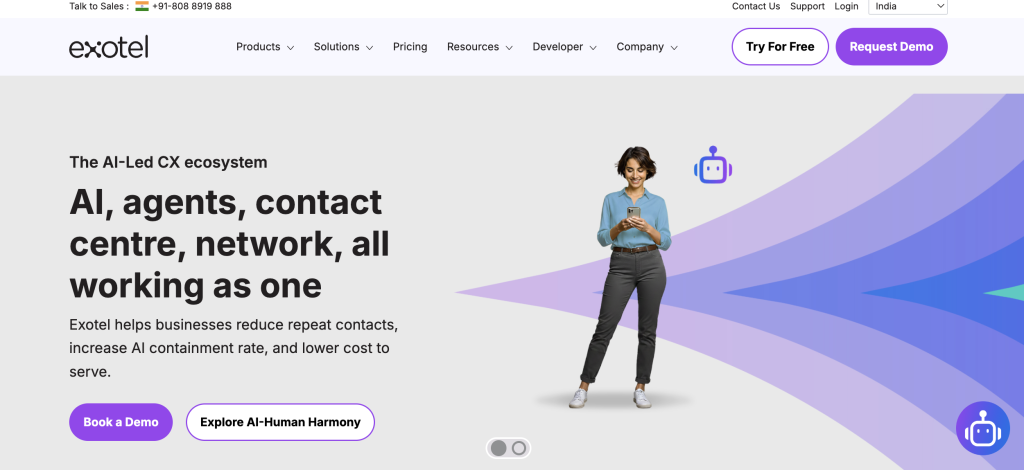
Exotel is an Indian CPaaS platform offering programmable voice APIs, IVR flows, and a dedicated Voicebot API with bidirectional WebSocket audio streaming for teams building AI phone bots on Indian carrier infrastructure.
Best for: Indian cloud telephony and IVR automation
Key features
- Voicebot API with bidirectional WebSocket streaming lets your bot server send and receive voice data in real time, so you can wire in an LLM without building a separate media gateway.
- AgentStream provides three WebSocket connection methods with a full protocol reference, giving developers flexibility in how they architect the audio relay between Exotel and their AI backend.
- Voice v3 API (currently in beta) adds enhanced call detail reporting, active stream monitoring, and voice log downloads, which help teams debug production issues faster.
- ExoML, Exotel’s XML-based call flow language, lets teams define IVR logic declaratively without writing server-side code for every call event.
- DPIIT-recognized startups in India can access approximately ₹7,000 in free credits, which is enough to run a meaningful integration test before committing to a paid plan.
Pros and cons
| Pros | Cons |
|---|---|
| Deep Indian carrier coverage with local compliance built into the platform | Pricing is not publicly listed, requiring a sales conversation before you can model costs |
| Voicebot API with bidirectional WebSocket is purpose-built for AI voice agent use cases | Voice v3 API is still in beta, so some features may change before general availability |
Pricing
Pricing (India): Not publicly listed. Contact Exotel sales for a quote. DPIIT-recognized startups may access approximately ₹7,000 in free credits.
3. Ozonetel – Contact center voice AI platform
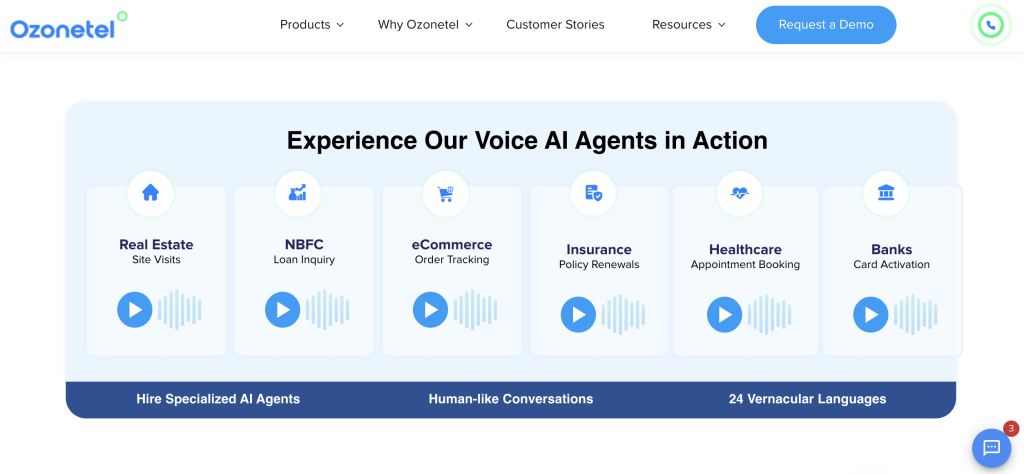
Ozonetel is an Indian CPaaS and contact center platform that offers a kookoo-voicebot SDK with OpenAI Realtime and ElevenLabs integration, targeting teams that want to scaffold an AI phone bot quickly on Indian infrastructure.
Best for: Contact center voice AI with quick scaffolding
Key features
- kookoo-voicebot SDK supports OpenAI Realtime, ElevenLabs, and live-translate out of the box, so teams can scaffold a deployable phone bot without writing the STT-to-LLM-to-TTS glue code from scratch.
- Multilingual support is built in, which matters for Indian deployments where callers may speak Hindi, Tamil, Telugu, or other regional languages rather than English.
- Claude skill integration lets developers describe their agent in one sentence and generate a deployable phone bot, reducing the time from idea to first call.
- Contact center features including call routing, queue management, and agent handoff are available alongside the voicebot layer, so teams can build hybrid human-plus-AI workflows.
- Indian carrier connectivity is native, so you do not need a separate SIP trunk agreement to get an Indian virtual number.
Pros and cons
| Pros | Cons |
|---|---|
| Fast scaffolding via kookoo-voicebot SDK reduces time to first working call | Pricing is not publicly listed, making cost modeling difficult before a sales call |
| Native multilingual support suits India’s diverse language landscape | Less developer community documentation compared to global platforms like Twilio |
4. Knowlarity – Enterprise IVR and call routing
Knowlarity is an Indian cloud telephony provider focused on enterprise IVR, call routing, and virtual number management for businesses that need a managed voice infrastructure without deep API customization.
Best for: Enterprise IVR and managed call routing
Key features
- Virtual number management across Indian carrier networks lets enterprises assign dedicated numbers to departments or campaigns without managing physical SIM infrastructure.
- IVR builder with multi-level menu support handles inbound call routing without requiring server-side code for every call path, which suits teams with limited backend engineering resources.
- Call recording and analytics give compliance and QA teams access to call logs and transcripts for audit purposes.
- CRM integration options connect call data to popular enterprise CRM platforms, so sales and support teams see call history alongside customer records.
- Toll-free number support is available for Indian deployments, which is useful for customer support lines where callers should not bear the cost of the call.
Pros and cons
| Pros | Cons |
|---|---|
| Strong Indian carrier coverage with toll-free and virtual number options | Not designed for raw audio streaming to AI backends, limiting real-time AI voice agent use cases |
| Managed IVR builder suits teams without deep telephony engineering expertise | Pricing requires a sales conversation, with no public per-minute rates available |
5. Airtel IQ – Carrier-backed voice APIs

Airtel IQ is a CPaaS platform backed by Airtel’s Indian carrier network, offering voice APIs, SMS, and number management for enterprises that want carrier-grade reliability without managing a separate telecom relationship.
Best for: Carrier-backed voice APIs with Airtel network reliability
Key features
- Direct Airtel carrier integration means calls route over Airtel’s own network, which can improve call completion rates on Airtel subscriber numbers compared to third-party SIP routes.
- Virtual number provisioning for Indian deployments is available through the Airtel network, so teams get a local number without a separate carrier agreement.
- Voice API endpoints let developers trigger outbound calls, manage IVR flows, and receive call status webhooks from their application backend.
- SMS and voice bundled in one platform reduces the number of vendor relationships a team needs to manage for a multi-channel communication stack.
- Enterprise SLA support is available for teams that need guaranteed uptime commitments backed by Airtel’s network operations center.
Pros and cons
| Pros | Cons |
|---|---|
| Carrier-native reliability on Airtel’s Indian network for high call completion rates | No publicly documented raw WebSocket audio streaming for AI voice agent use cases |
| Bundled voice and SMS reduces vendor complexity for multi-channel teams | Pricing is not publicly listed, requiring a sales engagement before cost modeling |
6. Plivo – Voice AI agents with SIP trunking
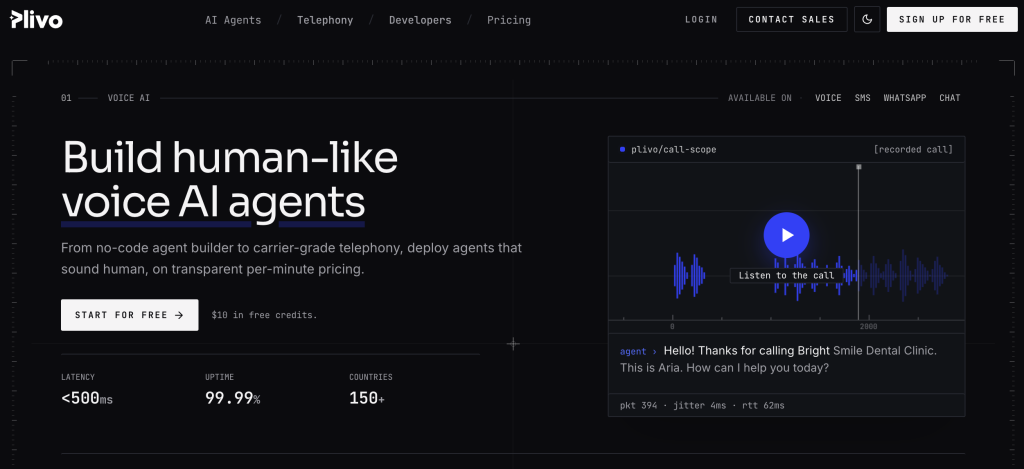
Plivo is a global CPaaS platform offering SIP trunking, audio streaming, AI agent infrastructure, and Indian phone numbers, with publicly listed INR pricing that makes it one of the more transparent options for Indian developers evaluating a TeleCMI alternative.
Best for: Voice AI agents with transparent INR pricing
Key features
- Audio streaming is included in Plivo’s voice offering, so call audio can be fed into a server-side AI inference loop without a separate media gateway, which reduces the number of moving parts in your architecture.
- India voice pricing is published in INR on Plivo’s pricing page, with domestic outbound starting at ₹0.38 per minute and browser/WebRTC calls at ₹0.25 per minute, making budget modeling straightforward before you sign up.
- Domestic Indian numbers are listed at ₹200 per month, so PSTN testing has a published number-rental cost that you can include in your cost model from day one.
- LiveKit and Pipecat compatibility is documented, which reduces the custom glue code required if your AI orchestration stack already uses either of those frameworks.
- Enterprise pricing covers 50 concurrent calls and 3 calls per second throughput, giving teams a concrete scale ceiling to plan against before needing a custom contract.
Pros and cons
| Pros | Cons |
|---|---|
| Publicly listed INR pricing with per-minute rates and number rental costs | Audio streaming documentation does not show a complete end-to-end AI voice quickstart |
| LiveKit and Pipecat compatibility reduces integration effort for common AI stacks | Pay-as-you-go plan caps at $2,500 monthly usage, so high-volume teams need a custom contract |
Pricing
Pricing (India): Browser/WebRTC at ₹0.25 per minute, domestic outbound at ₹0.38 per minute, Indian number rental at ₹200 per month. $10 in free credits on sign-up, no credit card required. See full pricing
7. Twilio – Programmable voice at global scale
Twilio is a global CPaaS platform with programmable voice, Media Streams, Conversation Relay, and SIP trunking, offering India voice pricing in USD and a broad ecosystem of integrations for teams that need global reach alongside Indian deployments.
Best for: Programmable voice at global scale
Key features
- Media Streams and Conversation Relay are Twilio’s primary entry points for AI voice agent builds, letting developers stream call audio to a WebSocket endpoint and wire in their own AI logic.
- India voice pricing is publicly listed in USD, with local calls at $0.0699 per minute, mobile calls at $0.0496 per minute, and browser/app calls at $0.0040 per minute, so cost modeling is possible without a sales call.
- SIP interface and BYOC (Bring Your Own Carrier) trunking give teams a path to carrier interconnects instead of relying solely on Twilio-hosted numbers, which matters for teams with existing carrier relationships.
- Gather Speech Recognition is available as an add-on, so basic speech features can be layered onto calls without a separate STT provider if your use case does not require a custom model.
- Pricing API lets developers query real-time, account-specific pricing for phone numbers and voice routes programmatically, which is useful for building cost-attribution dashboards into your platform.
Pros and cons
| Pros | Cons |
|---|---|
| Reliable voice infrastructure with live streaming capabilities, confirmed by Indian developers | Indian phone numbers were not supported in at least one documented developer use case, limiting local caller trust |
| Broad global coverage and a large developer ecosystem with extensive community resources | Pricing is in USD rather than INR, adding currency conversion complexity for Indian teams |
Pricing
Pricing (India): Browser/app at $0.0040 per minute, mobile calls at $0.0496 per minute, local calls at $0.0699 per minute. BYOC trunking at $0.0040 per minute. Pricing is in USD. See full pricing
TeleCMI alternative feature comparison: India 2026
| Feature | Teler | Exotel | Ozonetel | Knowlarity | Airtel IQ | Plivo | Twilio |
|---|---|---|---|---|---|---|---|
| Raw WebSocket audio streaming | Yes | Yes, via AgentStream | Yes, via kookoo SDK | No | No | Yes, via audio streaming | Yes, via Media Streams |
| Model-agnostic (bring your own STT/LLM/TTS) | Yes | Partial, some built-in options | Partial, OpenAI and ElevenLabs built in | No | No | Partial | Partial |
| Public INR pricing | Yes | No | No | No | No | Yes | No, USD only |
| Indian virtual numbers | Yes | Yes | Yes | Yes | Yes | Yes | Partial, availability not confirmed |
| SIP trunking | Yes | Partial | No | No | No | Yes | Yes |
| Free credits for testing | Yes, 3,000 min on first upgrade | Yes, for DPIIT startups | Check website | Check website | Yes, $10 free credits | Yes, $10 free credits | Check website |
Teler and Exotel are the only platforms in this list that combine raw WebSocket audio streaming with Indian virtual numbers and a documented AI voice agent path, but Teler is the only one with publicly listed INR pricing and a model-agnostic architecture that imposes zero lock-in on your AI stack.
Which TeleCMI alternative is right for your team in India?
The right platform depends on your AI architecture, your call volume, and how much engineering time you want to spend on telephony versus AI logic. Here is a quick decision guide based on the most common developer profiles in India.
If you are building a real-time AI voice agent with your own STT, LLM, and TTS stack: Choose Teler. Its raw WebSocket path and model-agnostic architecture are built for exactly this use case, and the INR pricing is transparent from day one.
If you are an Indian startup recognized by DPIIT and want to test cheaply: Choose Exotel. The approximately ₹7,000 in free credits give you enough runway to validate your voicebot before committing to a paid plan.
If you need a contact center platform with AI voicebot scaffolding and multilingual support: Choose Ozonetel. The kookoo-voicebot SDK reduces time to first call, and native multilingual support suits India’s language diversity.
If you need global voice coverage alongside India and your stack already uses LiveKit or Pipecat: Choose Plivo. Its audio streaming layer is compatible with both frameworks, and the INR pricing page makes cost modeling straightforward.
If you need global scale and a large developer ecosystem with extensive community resources: Choose Twilio. Its Media Streams and Conversation Relay surfaces are well-documented, though Indian phone number availability should be confirmed before building a local-number-dependent flow.
Which tool wins overall in India?
If you want the best overall TeleCMI alternative for developers in India for 2026: Choose Teler. It is the only platform in this list purpose-built for AI voice agent infrastructure with transparent INR pricing, a sub-100ms WebSocket latency target, and zero lock-in on your AI stack, which means your team spends engineering time on the AI product rather than on telephony plumbing.
Frequently asked questions
What is the best TeleCMI alternative for developers in India in 2026?
The best TeleCMI alternative for developers in India in 2026 is FreJun Teler. It targets sub-100ms latency via raw WebSocket audio streaming, which is the lowest available for AI voice agent infrastructure in India. It is fully model-agnostic, so your team brings its own STT, LLM, and TTS without any lock-in. Outbound calling starts at ₹0.15 per minute with transparent INR pricing, and Indian virtual numbers are available without a separate carrier agreement. The 3,000 free minutes on first upgrade let you test the full AI voice loop before spending on production traffic.
How much does a voice API cost for Indian developers in 2026?
Costs vary significantly by platform. Teler charges ₹600 per channel per month (minimum 10 channels), ₹0.15 per minute for outbound calls, ₹0.10 per minute for inbound calls, ₹0.15 per minute for media streaming, and ₹0.04 per minute for recording. At 10,000 outbound minutes per month, that is ₹1,500 in calling costs plus ₹6,000 in channel fees. Plivo lists domestic outbound at ₹0.38 per minute, which is ₹3,800 for the same volume. Exotel, Ozonetel, Knowlarity, and Airtel IQ do not publish INR pricing publicly, so you need a sales call to model costs for those platforms. See current Teler pricing for a full breakdown.
Why does latency matter so much for AI voice agents, and what is sub-100ms?
Latency is the delay between when a person finishes speaking and when they hear the AI’s response. Human conversation tolerates roughly 200-300ms of silence before it feels unnatural. If your AI voice agent takes 600ms or more to respond, callers perceive it as broken or slow and disengage. General CPaaS platforms abstract the audio layer for human-to-human calls, which adds processing overhead and makes sub-300ms AI inference loops difficult to achieve. Teler streams raw L16/8000Hz audio directly to your server over a persistent WebSocket connection, so your STT engine receives the audio with no proprietary conversion layer in the way. The full Media Streaming Loop targets under 100ms end to end, which is fast enough for natural, uninterrupted conversation.
What does model-agnostic mean, and why does it matter for production AI voice agents?
Model-agnostic means the voice API platform does not require you to use a specific STT, LLM, or TTS provider. You bring your own AI stack and pay those providers directly. This matters in production because AI models improve rapidly. If your telephony provider locks you into a specific STT engine, you cannot switch to a better or cheaper model without rebuilding your entire voice infrastructure. Teler is compatible with Google STT, Deepgram, Whisper, and AssemblyAI for transcription; OpenAI GPT, Anthropic Claude, and Google Gemini for language modeling; and ElevenLabs, Google TTS, Azure TTS, and Play.ht for synthesis. As of 2026, Teler is compatible with 10+ STT, LLM, and TTS providers, giving developers complete freedom to choose their AI stack.
What TRAI compliance rules apply to AI outbound calling in India?
TRAI (Telecom Regulatory Authority of India) sets the rules for outbound voice calls in India, and they apply to AI-generated calls just as they do to human agents. Outbound calls after 9 PM IST are prohibited. Promotional calls must originate from 140-series numbers, while transactional calls use 1600-series numbers. Before any outbound campaign, your system must check the NCPR (National Customer Preference Register) and skip numbers that have opted out. DoT (Department of Telecommunications) registration is required for commercial voice services. Failing to comply can result in your numbers being blocked by carriers. When evaluating a TeleCMI alternative for developers in India, confirm whether the platform surfaces these requirements in its documentation or enforces them at the infrastructure level. See the TRAI website and DoT website for current regulations.
What is the difference between SIP trunking and WebSocket streaming for AI voice agents?
SIP trunking uses SIP (Session Initiation Protocol) to establish and control voice calls over the internet, connecting your platform to a carrier network via credential-based or IP-based authentication. It is the right path if you are connecting an existing SIP-enabled contact center, an AI orchestration platform like Vapi or Retell, or a legacy IVR system to a new carrier. WebSocket streaming keeps a persistent, full-duplex connection open between the call and your server, delivering raw audio frames in real time so your STT engine can process them with minimal delay. WebSocket is the right path if you are building a net-new AI voice agent where latency is the primary constraint. Teler supports both paths, so teams can start with WebSocket for a new AI agent and add SIP trunking later when connecting to an existing enterprise telephony stack. Read more in the Teler documentation.
How do I get started with a TeleCMI alternative for AI voice agents in India?
Start by signing up for Teler and upgrading to your first plan, which includes 3,000 free minutes for Indian developers. Open a WebSocket connection from your server to Teler’s audio endpoint using the same WebSocket protocol you already use for real-time applications. Teler streams raw L16/8000Hz audio to your server as the caller speaks. Your STT engine transcribes the audio to text, your LLM generates a response, and your TTS engine converts that response back to audio. Stream the audio back through Teler and the caller hears the response. The full Media Streaming Loop targets under 100ms. A working first call is achievable the same day using the getting-started guide. Because Teler is model-agnostic, you can swap any component of the AI stack without changing the telephony layer, which keeps your architecture flexible as models improve.
Conclusion: Best TeleCMI alternative in India for 2026
For developers in India evaluating a TeleCMI alternative in 2026, three platforms stand out for different reasons. Teler leads on AI-first architecture, with a sub-100ms WebSocket latency target, transparent INR pricing from ₹0.15 per minute, and zero lock-in on your STT, LLM, or TTS stack. Exotel is the strongest local alternative for teams that need deep Indian carrier coverage and a voicebot API with bidirectional WebSocket, especially for DPIIT-recognized startups with access to free credits.
Plivo is the best choice for teams that need global coverage alongside India and want publicly listed pricing without a sales call. If you are building a real-time AI voice agent and need the lowest latency, the most transparent pricing in INR, and the freedom to use any AI provider, the right TeleCMI alternative for developers in India in 2026 is Teler. The decision now is whether to start with the free minutes and test your full AI voice loop today, or spend another sprint evaluating platforms that require a sales call just to get a price.


