AI Summary: This article compares the top 9 Plivo alternative USA platforms for developers building AI voice agents and programmable telephony applications in 2026, evaluating each on real-time latency, model compatibility, US pricing, and TCPA compliance. As of 2026, the global CPaaS market is projected to reach $45.3 billion by 2030, according to Grand View Research, making Voice API selection a foundational infrastructure decision for any AI product team. Developers need a platform that delivers sub-100ms latency, integrates with any STT, LLM, and TTS provider without lock-in, and handles US carrier compliance automatically. FreJun Teler meets all three requirements, with outbound calling from $0.20 per minute and raw WebSocket streaming that works with any AI stack the team already uses.
Key criteria in this comparison: We ranked these platforms on pricing transparency, real-time WebSocket latency, TCPA compliance support, model-agnosticism, and documentation quality, since these are the factors that most affect a developer team’s build speed and total cost when choosing a Plivo alternative USA.
Quick Answer: The best Plivo alternative USA in 2026 is FreJun Teler, a purpose-built Voice API platform that streams raw audio over WebSocket at sub-100ms latency so AI agents can respond in real time. Teler is model-agnostic, works with any STT, LLM, or TTS provider, and starts at $0.20 per minute for outbound calling with $5 in free credits on first upgrade.
The best Plivo alternative USA for AI voice development is Teler, which delivers sub-100ms WebSocket latency and a model-agnostic architecture that general CPaaS platforms cannot match for real-time AI voice workloads.
What is Plivo?
Plivo is a cloud communications platform that provides voice and SMS APIs for developers building telephony applications. It is widely used for basic programmable voice, two-factor authentication, and outbound SMS campaigns, with a strong presence in the US and India markets. Businesses look for a Plivo alternative USA when they need lower latency for AI voice workloads, more flexible model integration, or pricing structures that scale more predictably at high call volumes. Common reasons to switch include limited real-time audio streaming support, restricted WebSocket documentation, and the absence of a purpose-built path for connecting LLMs directly to live phone calls. Teams evaluating options outside the US should note that the criteria differ by region; for example, a Plivo alternative India deployment must account for TRAI regulations and INR-based pricing rather than TCPA and USD billing.
As of 2026, the US CPaaS market is growing at a compound annual growth rate of 18.2%, according to Grand View Research, driven largely by demand for AI-powered voice agents in sales, support, and healthcare. Businesses operating in the Gulf region face a different regulatory and numbering landscape, which is why a dedicated Plivo alternative UAE comparison is worth reviewing separately from this US-focused guide. Basic voice API providers handle human-to-human calls well, but the best platforms for AI voice go further: they expose raw audio streams over WebSocket, support sub-100ms media loops, and impose zero lock-in on the AI stack underneath. Similarly, teams building for Southeast Asia should consult a Plivo alternative Singapore breakdown, since local carrier rules and pricing benchmarks differ significantly from the US market covered here.
Which Plivo alternative USA platforms rank highest in 2026?
The table below compares all nine platforms on best use case, starting price, and free trial availability so you can shortlist quickly before reading the full profiles.
| # | Provider | Best for | Starting price (USD) | Free trial |
|---|---|---|---|---|
| 1 | Teler | AI voice agent infrastructure | $0.20/min outbound | Yes, $5 free credits on first upgrade |
| 2 | Twilio | General CPaaS developers | ~$0.0085/min voice | Yes, free trial available |
| 3 | Telnyx | Carrier-grade voice apps | $0.002/min voice | Yes, free account available |
| 4 | Vonage API | Voice workflow builders | Contact sales | Check website |
| 5 | Bandwidth | Enterprise telephony teams | $0.010/min outbound | Check website |
| 6 | Sinch | Enterprise messaging and voice | Contact sales | Check website |
| 7 | Bird | Omnichannel messaging teams | Contact sales | Check website |
| 8 | Infobip | Global enterprise comms | Contact sales | Check website |
| 9 | Kaleyra | Telecom-heavy enterprise teams | Contact sales | Check website |
Scroll down for the full breakdown of each Plivo alternative USA option, covering features, pros, cons, pricing, and ideal use case.
How do you choose the best Plivo alternative USA in 2026?
Choosing the right Plivo alternative USA depends on your AI architecture, integration path, compliance requirements, and expected call volume. Work through these five steps before committing to any platform.
Step 1: Define your AI voice architecture
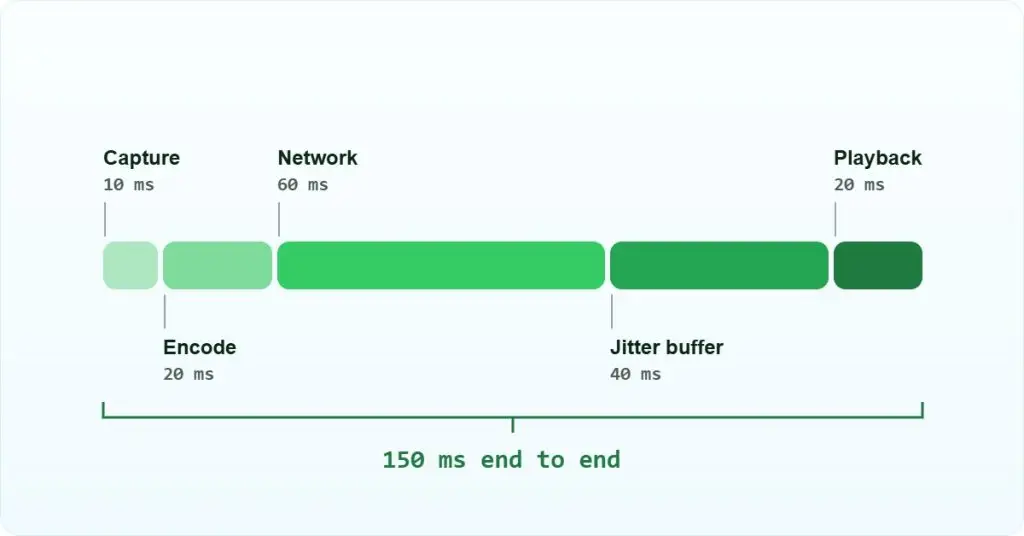
Start by mapping the AI components you already use or plan to use: your STT (Speech-to-Text) engine, which converts caller audio into text; your LLM (Large Language Model), which reads that text and decides what to respond; and your TTS (Text-to-Speech) engine, which converts the response back into audio. Each component adds latency to the loop. If you are building a conversational agent, you need the full cycle to complete in under 100ms so the conversation feels natural. Form-filling bots or async notification systems can tolerate up to 500ms. Know your latency budget before evaluating any platform.
Step 2: Choose your integration path
Two paths exist for connecting a voice API to your AI stack. WebSocket streaming keeps a persistent, full-duplex connection open between the caller and your server, so raw audio flows continuously in both directions with no HTTP round-trip overhead. This is the lowest-latency path and the right choice for real-time AI voice agents. SIP (Session Initiation Protocol) trunking, the standard protocol for establishing voice calls over the internet, is better for connecting existing SIP-enabled platforms or enterprise PBX infrastructure to your carrier network. If you are building from scratch for AI, choose WebSocket. If you are integrating with an existing telephony stack, SIP trunking is the faster path.
Step 3: Check US carrier and compliance requirements
In the US, outbound calling is governed by the FCC and the TCPA (Telephone Consumer Protection Act), which requires prior express written consent before placing automated calls to mobile numbers. AI voice agents that dial without consent face significant legal exposure. Check whether your chosen platform supports TCPA-compliant consent workflows, DNC (Do Not Call) registry scrubbing, and call recording disclosures. These are not optional features for US deployments. Any Plivo alternative USA you evaluate should document its TCPA compliance posture clearly.
Step 4: Evaluate pricing in USD
Compare per-minute rates for both inbound and outbound calls, channel costs, media streaming fees, and recording storage charges. A platform with a low per-minute rate but high channel minimums can cost more at moderate volumes than a platform with slightly higher per-minute rates and no channel floor. Build a realistic monthly cost model based on your expected call volume before signing up. Platforms that require a sales call just to get pricing are harder to evaluate quickly, so factor that friction into your timeline.
Step 5: Test latency and audio quality on a real call
No benchmark replaces a real call test on your actual infrastructure. Most platforms offer free credits or a trial period. Teler provides $5 in free calling credits on first upgrade, which is enough to run a full end-to-end test of the WebSocket media loop with your STT and TTS engines connected. Test at the time of day your production traffic peaks, since carrier routing can affect latency. A platform that performs well in a sandbox but adds 400ms in production is not a viable choice for conversational AI.
Top 9 Plivo alternative USA platforms for AI voice in 2026
1. Teler – Purpose-built Voice API for AI voice agents
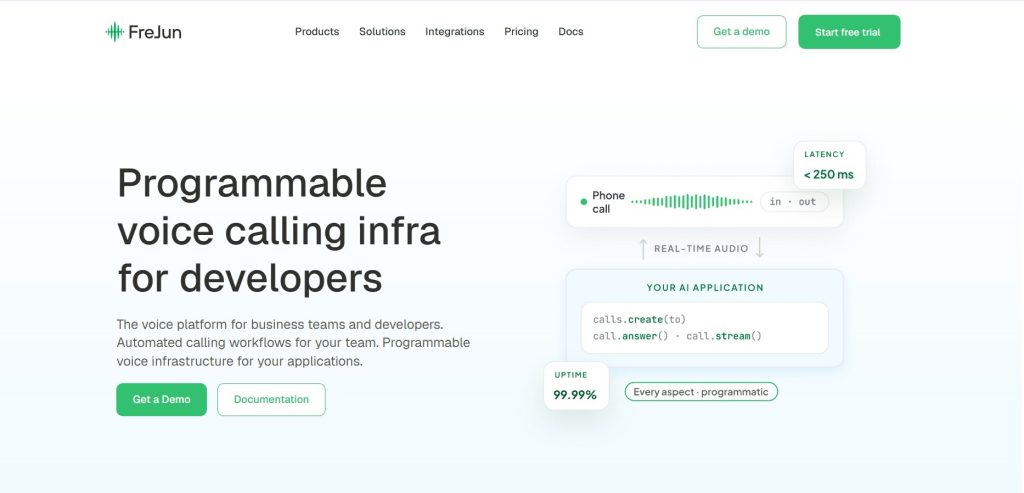
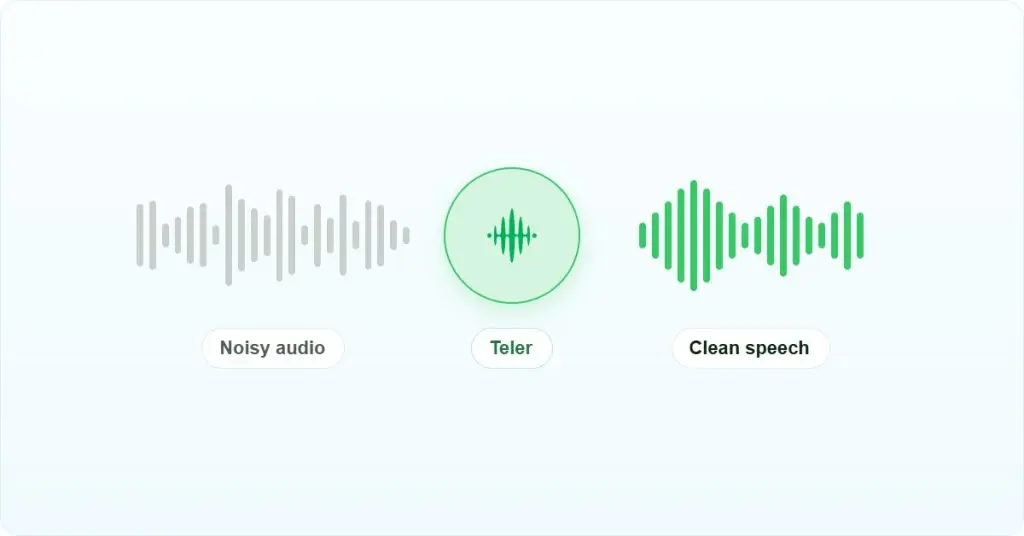
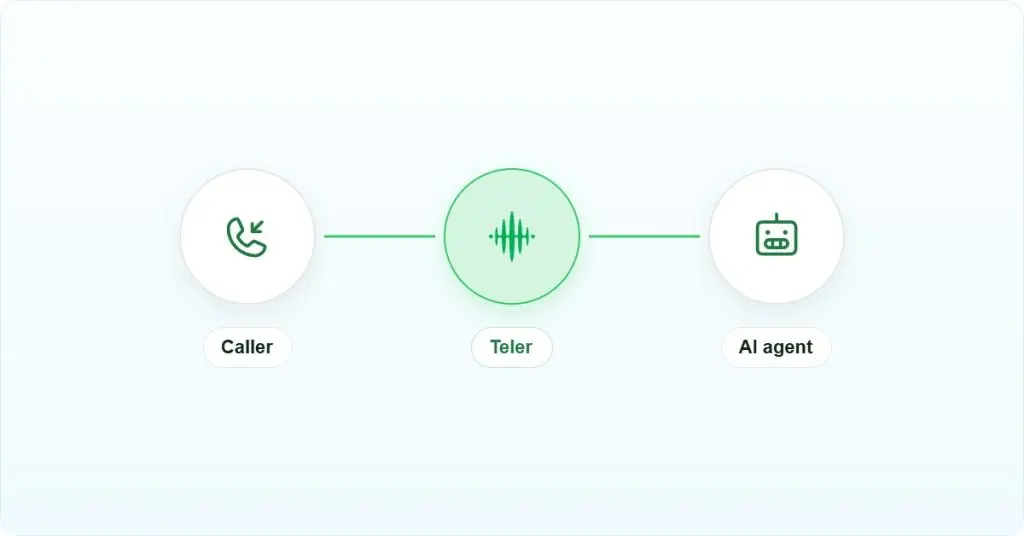
FreJun Teler is a Voice API platform built specifically for developers connecting AI agents to real phone calls, making it the strongest Plivo alternative USA for real-time AI voice workloads.
Best for: AI voice agent infrastructure
Key features
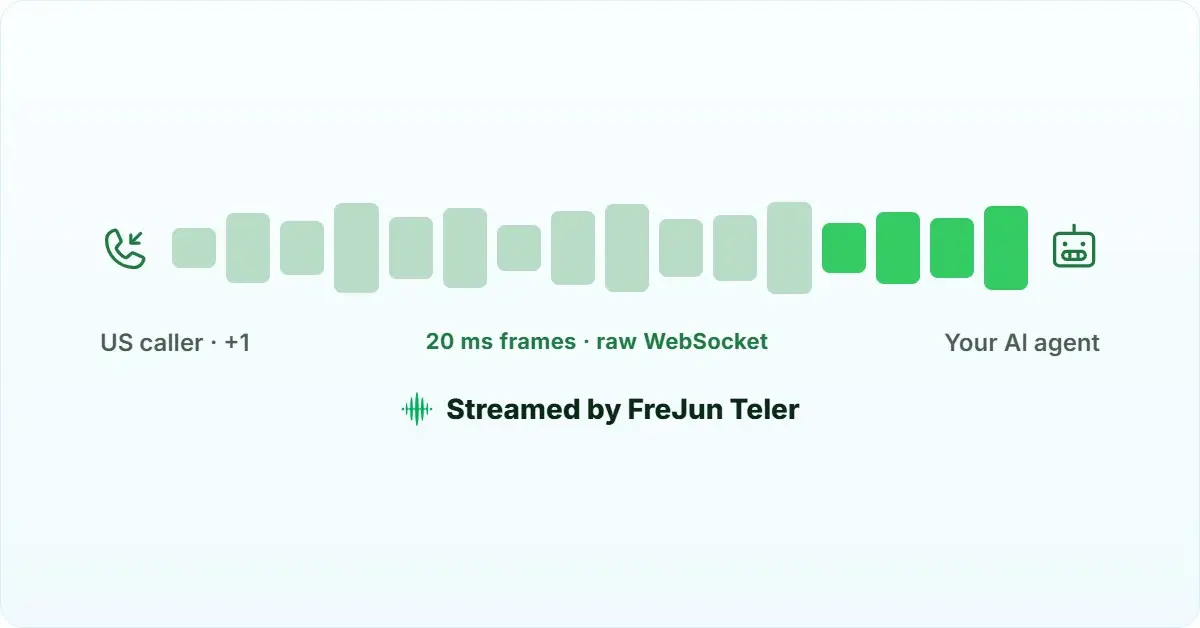
- Raw WebSocket audio streaming at L16/8000Hz delivers the caller’s voice directly to your server so your STT engine receives it with no proprietary conversion layer adding delay.
- Sub-100ms Media Streaming Loop completes the full Voice to STT to LLM to TTS to Voice cycle fast enough for natural, uninterrupted conversation.
- Model-agnostic architecture means you bring your own STT (Google, Deepgram, Whisper, AssemblyAI), LLM (OpenAI GPT, Claude, Gemini), and TTS (ElevenLabs, Azure TTS, Play.ht) and pay those providers directly, with zero lock-in to any Teler-mandated AI vendor.
- SIP trunking with TCP/TLS transport and credential-based or IP-based authentication connects existing SIP-enabled platforms directly to Teler’s carrier network.
- REST API endpoints and webhook callbacks give developers standard HTTP call control for dial, transfer, hangup, and event-based notifications when calls start or change state.
- Same-day integration via WebSocket or SIP means a working first call is achievable the same day using the getting-started guide at frejun.ai/docs, with no physical telecom infrastructure required.
Pros and cons
| Pros | Cons |
|---|---|
| Sub-100ms WebSocket latency purpose-built for AI voice loops | Virtual numbers currently available for India and UAE, not US local numbers |
| Zero model lock-in: works with any STT, LLM, or TTS provider | Elastic SIP trunking is on the roadmap but not yet available |
| Transparent per-minute pricing with free credits on first upgrade | Smaller developer community than Twilio at this stage |
Pricing
Pricing (USD): Channel cost starts at $15 per channel per month with a minimum of 10 channels. Outbound calling is $0.20 per minute, inbound is $0.10 per minute, media streaming is $0.0017 per minute, and recording plus storage is $0.00046 per minute. UAE number rental is $100 per month per number. First upgrade includes $5 in free calling credits. Billing is prepaid on monthly, quarterly, half-yearly, or annual cycles. Teams that are specifically weighing Twilio against other options may also want to read a dedicated Twilio alternative USA comparison for a deeper look at how it stacks up beyond this roundup. See full pricing
Why Teler is the top recommendation
Why Teler ranks #1 for Plivo alternative USA: Teler is the only platform in this list designed from the ground up for AI voice agents rather than adapted from a general CPaaS. Its raw WebSocket streaming delivers sub-100ms latency so AI agents respond at conversation speed, its model-agnostic architecture means no vendor lock-in on your STT, LLM, or TTS stack, and its transparent per-minute pricing in USD makes cost modeling straightforward without a sales call. For US teams building TCPA-compliant AI voice products, Teler provides the infrastructure layer that general CPaaS platforms were not designed to deliver. Start building →
Teler by the numbers: Sub-100ms latency | Model-agnostic: 10+ AI providers | Virtual numbers: India and UAE | Same-day integration via WebSocket or SIP | $5 free credits on first upgrade (UAE/USD)
2. Twilio – Broad CPaaS for general voice and messaging
Twilio is a cloud communications platform (CPaaS, meaning Communications Platform as a Service) for SMS, email, and voice, widely used by developers who need a broad channel set rather than a purpose-built AI voice path, making it a common starting point when searching for a Plivo alternative USA.
Best for: General CPaaS developers
Key features
- Live call audio streaming to your server via WebSocket lets developers access raw audio, though the format is base64-encoded mu-law at 8 kHz, which requires manual conversion before most STT engines can process it.
- REST call control API handles dial, transfer, and hangup logic so developers can orchestrate call flows programmatically without managing carrier infrastructure directly.
- SIP trunking provides PSTN handoff for connecting existing telephony systems to Twilio’s network.
- Phone number provisioning covers US virtual numbers with A2P 10DLC and toll-free verification for compliant messaging campaigns.
- SDKs in Node.js, Python, Ruby, PHP, Java, C#, Go, and .NET reduce the time to a first working call for teams already using those languages.
Pros and cons
| Pros | Cons |
|---|---|
| Large developer ecosystem with extensive documentation and community support | Media Streams require manual mu-law/8 kHz audio handling and custom buffering logic |
| Broad channel coverage: voice, SMS, email, and video in one platform | Pricing complexity increases significantly at scale, with multiple add-on fees |
| Free trial available with no credit card required | Designed for general CPaaS, not purpose-built for sub-100ms AI voice loops |
Pricing
Pricing (USD): Programmable Voice starts at approximately $0.0085 per minute. US local numbers cost approximately $1.15 per month. Pricing is not publicly listed in full on the main pricing page; exact rates depend on volume and product combination. For a closer look at how Telnyx compares against other carrier-network platforms specifically, see this Telnyx alternative USA breakdown. See full pricing
3. Telnyx – Carrier-network voice at low per-minute rates

Telnyx is a carrier-network CPaaS centered on voice and messaging APIs, with Call Control as its primary voice workflow, making it a cost-competitive Plivo alternative USA for teams that prioritize low per-minute rates.
Best for: Carrier-grade voice apps
Key features
- Carrier-network voice pricing at $0.002 per minute makes Telnyx one of the lowest-cost options for high-volume outbound calling in the US.
- Call Control API gives developers programmatic control over call state, so dial, transfer, and hangup logic runs through standard REST calls rather than proprietary SDKs.
- Number search and buy workflow lets teams provision US virtual numbers directly through the API without a manual provisioning request.
- API-key authentication with E.164 number format enforcement keeps call routing consistent and reduces formatting errors in production.
- Free account sign-up with two Telnyx numbers for testing lets developers validate the integration before committing to paid usage.
Pros and cons
| Pros | Cons |
|---|---|
| Very low per-minute voice pricing at $0.002/min on the carrier network | Full real-time WebSocket audio loop documentation was not surfaced in research |
| Free account with test numbers available for immediate integration testing | Steeper learning curve for developers new to carrier-grade telephony concepts |
| Solid onboarding documentation for Call Control API and number provisioning | Not purpose-built for AI voice agent architectures requiring sub-100ms loops |
Pricing
Pricing (USD): Voice starts at $0.002 per minute. US numbers are available. Full pricing breakdown is on the Telnyx pricing page. See full pricing
4. Vonage API – Voice workflow builder with WebSocket support

Vonage API is a communications API suite for voice, SMS, and video developers, offering WebSocket media streams and SIP integration as part of its voice workflow toolkit, making it a flexible Plivo alternative USA for teams already in the Ericsson ecosystem.
Best for: Voice workflow builders
Key features
- Voice API with WebSocket media stream support lets developers pipe call audio to their own server for processing, though the full real-time audio loop requires additional custom engineering.
- SMS and video APIs in the same platform reduce the number of vendors a team needs to manage for multi-channel communication products.
- SIP integration connects existing SIP-enabled infrastructure to Vonage’s carrier network without replacing the entire telephony stack.
- Webhook-driven call control fires events when calls start, end, or change state, so developers can trigger downstream logic without polling.
- SDKs in Node.js, Python, PHP, Ruby, Java, and .NET cover the most common backend languages used by API-first development teams.
Pros and cons
| Pros | Cons |
|---|---|
| Multi-channel coverage: voice, SMS, and video in one API suite | Pricing requires a sales contact, which slows down evaluation for smaller teams |
| WebSocket and SIP both supported for flexible integration paths | Real-time AI voice builders still need to stitch together the audio loop from separate documentation pages |
Pricing
Pricing (USD): Contact sales. No public per-minute rate is listed. See full pricing
5. Bandwidth – Enterprise telephony with US carrier ownership
Bandwidth is a cloud communications platform built on its own US carrier network, covering voice, messaging, emergency calling, and phone number management APIs, making it a strong Plivo alternative USA for enterprise teams that need direct carrier relationships.
Best for: Enterprise telephony teams
Key features
- Own-network carrier infrastructure means Bandwidth controls the full call path from origination to termination, which reduces the number of third-party hops that can add latency or cause quality issues.
- Emergency calling (E911) API is a differentiator for enterprise deployments where regulatory compliance around emergency services is a hard requirement.
- Phone number management API lets teams provision, port, and manage large inventories of US numbers programmatically without manual carrier requests.
- MFA and toll-free verification APIs add identity and compliance layers that enterprise security teams typically require before approving a new telephony vendor.
- REST API call control handles voice call orchestration through standard HTTP, so existing backend teams can integrate without learning a proprietary protocol.
Pros and cons
| Pros | Cons |
|---|---|
| Own US carrier network gives direct control over call quality and routing | No public WebSocket audio streaming guide surfaced, limiting AI voice agent use cases |
| E911 and toll-free verification built in for enterprise compliance requirements | Documentation appears enterprise-led rather than AI-voice-builder-led |
Pricing
Pricing (USD): Outbound voice is approximately $0.010 per minute and inbound is approximately $0.0055 per minute for US calls. Full pricing requires contacting sales. See full pricing
6. Sinch – Enterprise messaging and calling API platform

Sinch is a communications API platform with a Calling API for developers building voice workflows, positioned primarily at enterprise messaging and voice teams rather than AI-first developers, and is a recognized Plivo alternative USA for large-scale outbound campaigns.
Best for: Enterprise messaging and voice
Key features
- Calling API provides programmatic voice call control so developers can build outbound dialing, IVR, and call routing workflows without managing carrier infrastructure directly.
- Messaging APIs cover SMS, MMS, and RCS channels in the same platform, which reduces vendor count for teams running multi-channel outreach campaigns.
- Number management workflows let teams provision and manage virtual numbers through the API rather than through a manual provisioning process.
- Webhook-based call control fires events at key call lifecycle moments, so downstream logic can trigger without polling the API continuously.
- Enterprise support model provides dedicated account management and SLA-backed uptime commitments that smaller CPaaS providers typically do not offer.
Pros and cons
| Pros | Cons |
|---|---|
| Strong enterprise support model with dedicated account management | No public WebSocket audio streaming guide found, limiting real-time AI voice use cases |
| Multi-channel messaging and voice in one platform reduces vendor complexity | Pricing requires a sales contact, slowing evaluation for developer teams |
7. Bird – Omnichannel messaging and customer engagement platform

Bird (formerly MessageBird) is an omnichannel communications platform aimed at messaging and customer-engagement teams, covering WhatsApp, SMS, email, and voice channels, and is considered a Plivo alternative USA primarily by teams running multi-channel customer engagement rather than AI voice infrastructure.
Best for: Omnichannel messaging teams
Key features
- WhatsApp, SMS, and email channels in one platform let customer engagement teams manage outbound and inbound messaging from a single API surface without stitching together multiple vendors.
- REST API and webhook architecture gives developers standard HTTP-based control over messaging flows and call events without requiring a proprietary SDK.
- Voice and contact flow tools allow basic IVR and call routing to be configured alongside messaging campaigns in the same workspace.
- Developer webhooks fire on message delivery, read receipts, and call state changes, so downstream CRM or analytics systems can update in real time.
- Omnichannel workflow builder lets non-developer team members configure customer journeys across channels without writing code for every step.
Pros and cons
| Pros | Cons |
|---|---|
| Broad omnichannel coverage: WhatsApp, SMS, email, and voice in one platform | No raw WebSocket voice streaming guide found, making it unsuitable for sub-100ms AI voice loops |
| No-code workflow builder reduces engineering overhead for simple campaign flows | US pricing and compliance details are not clearly documented in public resources |
8. Infobip – Global CPaaS for enterprise messaging and voice
Infobip is a global CPaaS platform covering messaging, voice, verification, and customer-engagement workflows at enterprise scale, and is evaluated as a Plivo alternative USA by large organizations that need a single vendor for global multi-channel communications.
Best for: Global enterprise comms
Key features
- Omnichannel messaging covers SMS, WhatsApp, email, and voice in one API surface, so enterprise teams can consolidate vendor relationships and billing under a single contract.
- Voice API with REST call control and webhooks handles outbound dialing, IVR, and call routing without requiring developers to manage carrier infrastructure directly.
- Verification and OTP APIs add identity confirmation workflows that financial services and e-commerce teams typically need alongside their voice and messaging stack.
- Delivery receipts and analytics give operations teams visibility into message and call success rates across channels and geographies.
- Enterprise workflow APIs support complex routing logic, escalation paths, and SLA-backed uptime commitments that large organizations require before approving a new communications vendor.
Pros and cons
| Pros | Cons |
|---|---|
| Global reach with enterprise-grade SLA commitments across channels | No public WebSocket audio streaming guide found for real-time AI voice use cases |
| Broad API surface covers messaging, voice, and verification in one platform | Pricing requires a sales contact, which adds friction for developer-led evaluations |
9. Kaleyra – Enterprise voice and messaging for telecom-heavy teams

Kaleyra is an enterprise communications platform for voice and messaging workflows, positioned at telecom-heavy enterprise teams that need carrier-grade reliability and a managed service model, and is a niche Plivo alternative USA for organizations with existing telecom procurement relationships.
Best for: Telecom-heavy enterprise teams
Key features
- Voice APIs provide programmatic outbound and inbound call control so enterprise teams can build automated calling workflows without managing physical carrier infrastructure.
- Messaging APIs cover SMS and other channels, letting teams run verification, notification, and campaign workflows from the same platform as their voice stack.
- Verification and delivery tracking give compliance and operations teams auditable records of message and call delivery across campaigns.
- Enterprise communications workflows support complex routing, escalation, and reporting requirements that large organizations typically need before approving a new vendor.
- Managed service model provides dedicated support and onboarding for enterprise accounts, which reduces the internal engineering overhead of standing up a new telephony integration.
Pros and cons
| Pros | Cons |
|---|---|
| Managed service model reduces internal engineering overhead for enterprise teams | No public WebSocket audio streaming documentation found for AI voice use cases |
| Voice and messaging in one platform simplifies vendor management for large organizations | US pricing and compliance details are not publicly documented |
Plivo alternative USA feature comparison: 2026
The table below compares all nine Plivo alternative USA platforms on the six features that most directly affect AI voice agent development, so you can see at a glance where each platform stands before reading the full profiles.
| Feature | Teler | Twilio | Telnyx | Vonage API | Bandwidth | Sinch | Bird | Infobip | Kaleyra |
|---|---|---|---|---|---|---|---|---|---|
| Raw WebSocket audio streaming | Yes | Partial, base64 mu-law 8 kHz requires conversion | Partial, not fully documented | Partial, requires custom engineering | No | No | No | No | No |
| Sub-100ms AI voice latency | Yes | No, abstracted audio adds 400-800ms | No | No | No | No | No | No | No |
| Model-agnostic STT/LLM/TTS | Yes | Yes | Yes | Yes | Yes | Yes | Yes | Yes | Yes |
| SIP trunking | Yes | Yes | Yes | Yes | Yes | Partial, not fully documented | No | Partial | Partial |
| Transparent public per-minute pricing | Yes | Partial, base rates listed but add-ons opaque | Yes | No | Partial, some rates listed | No | No | No | No |
| Free trial or free credits | Yes, $5 on first upgrade | Yes, free trial no card required | Yes, free account with test numbers | No | No | No | No | No | No |
Teler is the only platform in this comparison that combines raw WebSocket streaming, sub-100ms latency, and transparent per-minute pricing, which is why it leads this Plivo alternative USA list for AI voice development teams. For a deeper side-by-side specifically on the four platforms developers compare most for AI voice — Teler, Twilio, Plivo, and Telnyx — see our dedicated Teler vs Twilio vs Plivo vs Telnyx for AI Voice breakdown.
Which Plivo alternative USA is right for your team in 2026?
Different teams have different priorities. The right Plivo alternative USA depends on whether you are building real-time AI voice agents, running high-volume enterprise messaging, or connecting an existing telephony stack to a new AI layer.
If you are building AI voice agents or voice bots: Choose Teler. Its raw WebSocket streaming and sub-100ms latency are purpose-built for this use case, and its model-agnostic architecture means you are not locked into any AI provider.
If you are a general CPaaS developer who needs SMS, voice, and email in one platform: Choose Twilio. Its broad channel set, large developer community, and extensive SDK coverage make it the most versatile starting point for teams that are not yet committed to an AI-first architecture.
If you need the lowest per-minute voice rate for high-volume outbound calling: Choose Telnyx. At $0.002 per minute on its carrier network, it undercuts most competitors significantly, and its free account lets you test before committing.
If you are an enterprise team that needs direct US carrier ownership and E911 compliance: Choose Bandwidth. Its own-network infrastructure and built-in emergency calling API are differentiators that no other platform in this list matches for regulated enterprise deployments.
If you are running omnichannel customer engagement across WhatsApp, SMS, and email: Choose Bird or Infobip. Both cover multi-channel messaging at scale, though neither is suited for real-time AI voice agent workloads.
Which tool wins overall in 2026?
If you want the best overall Plivo alternative USA with AI voice features, USD billing, and TCPA compliance support: Choose Teler. Its sub-100ms WebSocket latency, zero model lock-in, and transparent per-minute pricing give AI development teams the infrastructure layer that general CPaaS platforms were never designed to provide.
Frequently asked questions about Plivo alternative USA in 2026
What is the best Plivo alternative USA in 2026?
The best Plivo alternative USA in 2026 is FreJun Teler, a Voice API platform purpose-built for developers connecting AI agents to real phone calls. Teler delivers sub-100ms latency through raw WebSocket audio streaming, so the full Voice to STT to LLM to TTS to Voice cycle completes fast enough for natural conversation. It is model-agnostic, meaning developers bring their own STT, LLM, and TTS providers with zero lock-in. For teams that need a Plivo alternative USA specifically for AI voice workloads, no other platform in this list matches that combination of latency, flexibility, and transparent pricing.
How much does a Plivo alternative USA cost in 2026?
Pricing varies widely across Plivo alternative USA platforms. Teler charges $15 per channel per month with a minimum of 10 channels, $0.20 per minute for outbound calls, $0.10 per minute for inbound, and $0.0017 per minute for media streaming. Telnyx starts at $0.002 per minute for voice, making it the lowest per-minute option. Twilio charges approximately $0.0085 per minute for Programmable Voice. Bandwidth charges approximately $0.010 per minute outbound. Vonage API, Sinch, Bird, Infobip, and Kaleyra all require a sales contact for pricing. For AI voice workloads, total cost should include media streaming fees and channel minimums, not just per-minute rates.
What latency can developers expect from a Plivo alternative USA?
Latency, the delay between when a person speaks and when they hear a response, varies significantly across platforms. Teler’s WebSocket streaming delivers sub-100ms end-to-end latency for the full AI voice loop, which is fast enough for natural, uninterrupted conversation. General CPaaS platforms like Twilio abstract the audio layer, which adds 400 to 800ms of processing overhead before the audio even reaches the developer’s server. Since that abstraction happens before the STT engine receives the audio, the AI stack cannot compensate for it. For conversational AI agents, sub-100ms is the practical threshold. Anything above 400ms starts to feel like a noticeable pause to the caller.
Which Plivo alternative USA works with any STT, LLM, or TTS provider?
Teler is fully model-agnostic. Developers bring their own STT engine (Google STT, Deepgram, Whisper, or AssemblyAI), their own LLM (OpenAI GPT, Anthropic Claude, Google Gemini, or any custom model), and their own TTS engine (ElevenLabs, Azure TTS, Google TTS, or Play.ht). Teler handles only the voice transport layer and pays nothing to any AI provider on the developer’s behalf. This matters in production because AI model preferences change as better options emerge. A platform that locks you into its own STT or TTS forces a migration when you want to switch. Zero lock-in means you can swap any component of the stack without changing your telephony infrastructure.
What does TCPA compliance mean for AI outbound calling in the US?
The TCPA (Telephone Consumer Protection Act) is the primary US federal law governing automated outbound calls. It requires prior express written consent before placing automated or prerecorded calls to mobile numbers. AI voice agents that dial without documented consent face statutory damages of $500 to $1,500 per call under the TCPA, which makes compliance a hard requirement rather than a best practice. Any Plivo alternative USA used for AI outbound calling should support consent management workflows, DNC registry scrubbing, and call recording disclosures. The FCC enforces TCPA and has increased scrutiny of AI-generated calls since 2024, so teams should verify their platform’s compliance posture before launching outbound campaigns.
What does Teler offer that Plivo does not for AI voice agents?
Plivo is a general CPaaS designed for human-to-human voice calls and SMS. It abstracts the audio layer in ways that work well for standard telephony but add latency that makes real-time AI inference difficult. Teler exposes raw audio over WebSocket at L16/8000Hz, so the developer’s STT engine receives it directly with no conversion layer in the way. Teler also provides a documented Media Streaming Loop architecture, model-agnostic design with compatibility across 10+ STT, LLM, and TTS providers, and transparent per-minute pricing in USD. For teams building AI voice agents rather than standard telephony applications, Teler is purpose-built for the use case where Plivo is adapted from a different one.
What is the difference between SIP trunking and WebSocket streaming for AI voice?
SIP trunking uses the Session Initiation Protocol to establish voice calls over the internet, connecting existing telephony infrastructure like PBX systems or SIP-enabled platforms to a carrier network. It is the right choice when integrating with legacy enterprise telephony or connecting an existing SIP stack to a new AI layer. WebSocket streaming keeps a persistent, full-duplex connection open between the caller and the developer’s server, so raw audio flows continuously in both directions without the overhead of a new HTTP request for each audio chunk. Since WebSocket never closes between turns, the AI stack can process audio in real time and respond in under 100ms. For new AI voice agent builds, WebSocket is the lower-latency path. For enterprise integrations with existing telephony infrastructure, SIP trunking is the faster integration route.
How do I get started building an AI voice agent with a Plivo alternative USA?
Start by choosing your AI stack: pick an STT engine to transcribe caller audio, an LLM to generate responses, and a TTS engine to convert those responses back to audio. Then connect them to a voice API using the Media Streaming Loop: the caller speaks, the platform captures the audio and streams it to your server over WebSocket, your STT engine transcribes it, your LLM generates a response, your TTS engine converts that response to audio, and the platform plays it back to the caller. Teler supports this loop with sub-100ms latency and provides $5 in free calling credits on first upgrade so you can test the full stack before paying. WebSocket integration can be completed the same day using the getting-started guide at the Teler knowledge base. Sign up at platform.frejun.ai/signup to start building.
Conclusion: Best Plivo alternative USA in 2026
The top three Plivo alternative USA platforms in 2026 are Teler for AI voice infrastructure, Twilio for general CPaaS breadth, and Telnyx for lowest per-minute cost. Teler is the top recommendation for teams building real-time AI voice agents in the US because its raw WebSocket streaming delivers sub-100ms latency that general CPaaS platforms cannot match, and its model-agnostic architecture means no lock-in on any component of the AI stack. If your team is ready to move beyond Plivo and build voice agents that respond at conversation speed, Teler is the infrastructure layer to start with.