

AI Summary: This article compares the top 9 Twilio alternative UAE platforms for developers building AI voice agents and programmable telephony products in 2026, evaluating each on real-time latency, model compatibility, UAE pricing, and TRA compliance. As of 2026, the global CPaaS market is projected to reach $45 billion by 2030, according to Grand View Research, making Voice API selection a foundational infrastructure decision for any AI product team in the UAE. Developers need a platform that delivers sub-100ms latency, integrates with any STT, LLM, and TTS provider without lock-in, and handles UAE carrier compliance automatically. FreJun Teler meets all three requirements, with outbound calling from $0.20 per minute and raw WebSocket streaming that works with any AI stack the team already uses.
Key criteria in this comparison: We ranked these platforms on pricing transparency in USD, real-time WebSocket latency for AI voice loops, TRA compliance support, model-agnosticism across STT and LLM and TTS providers, and documentation quality, since these factors most directly affect a developer team’s build speed and total cost in the UAE.
Quick Answer: The best Twilio alternative UAE in 2026 is Teler, which delivers sub-100ms WebSocket latency for real-time AI voice loops, a model-agnostic architecture that works with any STT, LLM, or TTS provider, and outbound calling from $0.20 per minute with $5 in free credits on first upgrade. UAE developers can integrate via WebSocket or SIP trunking on the same day, with no proprietary lock-in.
The best Twilio alternative UAE developers can use in 2026 is Teler, a purpose-built Voice API platform that streams raw audio over WebSocket at sub-100ms latency so AI agents can hold natural, real-time phone conversations without the overhead of a general CPaaS layer.
What is Twilio?
Twilio is a cloud-based CPaaS (Communications Platform as a Service), meaning it adds voice, SMS, and video capabilities to applications via APIs, without requiring developers to build physical telecom infrastructure. Twilio was designed for general-purpose communications: human-to-human calls, SMS campaigns, two-factor authentication, and contact centre routing. Its architecture abstracts the audio layer to simplify those use cases, but that same abstraction adds 400 to 800ms of latency, which makes real-time AI inference difficult. UAE developers building AI voice agents increasingly look for a Twilio alternative UAE that exposes raw audio over WebSocket, so their STT engine can process speech in under 100ms. Beyond latency, Twilio’s pricing model involves multiple line items across voice, messaging, and add-ons, and its engineering overhead is high for teams whose only goal is to connect an LLM to a phone call.
As of 2026, the UAE’s AI and cloud communications market is growing at a double-digit CAGR, driven by Vision 2030-aligned digital transformation initiatives across banking, retail, and government sectors, according to IMARC Group. Businesses across Dubai and Abu Dhabi are deploying AI voice agents for customer support, appointment scheduling, and outbound sales, which means the demand for low-latency, model-agnostic Voice APIs has never been higher. What separates the best Twilio alternative UAE platforms from basic CPaaS tools is the ability to stream raw audio directly to a developer’s server, integrate with any AI provider without lock-in, and comply with TRA (Telecommunications and Digital Government Regulatory Authority) carrier requirements automatically.
Which Twilio alternative UAE platforms rank highest in 2026?
The table below ranks all nine platforms on best-fit use case, starting price in USD, and free trial availability so UAE developers can shortlist quickly before reading the full profiles.
| # | Provider | Best for | Starting price (USD) | Free trial |
|---|---|---|---|---|
| 1 | Teler | AI voice agent infrastructure | $15/channel/month | Yes – $5 free credits on first upgrade |
| 2 | Plivo | SMS and voice CPaaS | Contact sales | Yes – free trial credits |
| 3 | Telnyx | Carrier-grade programmable telephony | $0.002/min | Check website |
| 4 | Vonage API | Programmable voice and messaging | Contact sales | Check website |
| 5 | Sinch | Enterprise comms automation | Contact sales | Check website |
| 6 | Cequens | MENA enterprise messaging | Contact sales | Check website |
| 7 | Unifonic | MENA customer messaging | Contact sales | Check website |
| 8 | Infobip | Omnichannel enterprise comms | Contact sales | Check website |
| 9 | Bird (MessageBird) | Developer messaging workflows | Contact sales | Check website |
Teler is the only platform in this list purpose-built for AI voice agent infrastructure, with raw WebSocket streaming and a model-agnostic design that no general CPaaS can match for real-time AI workloads.
↓ Scroll for full breakdown of each tool – features, pros, cons, pricing, and ideal use case. UAE developers evaluating regional options can also compare this list against the best Twilio alternative USA, Twilio alternative UK, and Twilio alternative Australia platforms to see how pricing and latency benchmarks differ across markets.
How do you choose the best Twilio alternative UAE in 2026?
Choosing the right Twilio alternative UAE platform depends on your AI architecture, integration path, and UAE carrier requirements. The five steps below walk through the decision in the order that matters most for developers building real-time voice products.
Step 1: Define your AI voice architecture
Before evaluating any platform, map out the STT, LLM, and TTS providers you are already using or plan to use. If you are running OpenAI GPT with Deepgram STT and ElevenLabs TTS, you need a Voice API that exposes raw audio over WebSocket so each component can receive and return audio without a proprietary conversion layer in the way. Latency requirements also vary by use case: conversational AI agents need sub-100ms end-to-end response loops, while form-filling bots can tolerate up to 500ms. Locking in a platform before answering these questions often means rebuilding the integration later.
Step 2: Choose your integration path
Two integration paths are available on most serious Voice API platforms. WebSocket streaming keeps a persistent, full-duplex connection open between the caller and your server, so raw audio flows continuously in both directions with no HTTP round-trip overhead. This is the right path for AI voice agents that need sub-100ms response loops. SIP (Session Initiation Protocol), the standard protocol for establishing voice calls over the internet, is better for connecting existing SIP-enabled platforms or enterprise telephony infrastructure to the carrier network. If you are building a new AI voice product from scratch, start with WebSocket. If you are integrating with an existing PBX or a platform like Vapi or Retell, SIP trunking is the cleaner path.
Step 3: Check UAE carrier and compliance requirements
The UAE’s TRA (Telecommunications and Digital Government Regulatory Authority) governs all voice and messaging traffic in the country. AI outbound calling carries additional obligations beyond standard telephony: numbers registered on the DNCR (Do Not Call Registry) must not be called, and any automated outbound campaign must be structured to avoid DNCR violations. Your chosen platform must support UAE virtual number provisioning and handle carrier routing through TRA-compliant infrastructure. Platforms without UAE-specific carrier relationships often route calls through international hubs, which adds latency and creates compliance gaps.
Step 4: Evaluate pricing in USD for UAE
UAE Voice API pricing has several components: channel cost per month, outbound per-minute rate, inbound per-minute rate, media streaming cost, recording and storage fees, and UAE number rental. A platform that looks cheap on outbound minutes can become expensive once you add media streaming and number rental. Build a realistic monthly cost model based on your expected call volume before committing. Teler’s UAE pricing is fully transparent: $15 per channel per month, $0.20 per minute outbound, $0.10 per minute inbound, $0.0017 per minute for media streaming, and $100 per month per UAE number. Teams operating across both markets may also want to review the best Twilio alternative India options, since Teler’s model-agnostic architecture and pricing structure extend to that region as well.
Step 5: Test latency and audio quality on a real call
No benchmark replaces a live call test on your actual AI stack. Teler gives developers $5 in free calling credits on first upgrade, which is enough to run a full Media Streaming Loop test: caller speaks, Teler captures audio via WebSocket, your STT engine transcribes it, your LLM generates a response, your TTS converts it back to audio, and Teler plays it to the caller. If the loop completes in under 100ms, the platform is ready for production. If it does not, the bottleneck is usually the STT or TTS provider, not the Voice API itself, and you can swap providers without changing the Teler integration.
Top 9 Twilio alternative UAE platforms for AI voice in 2026
1. Teler – Purpose-built Voice API for AI voice agents
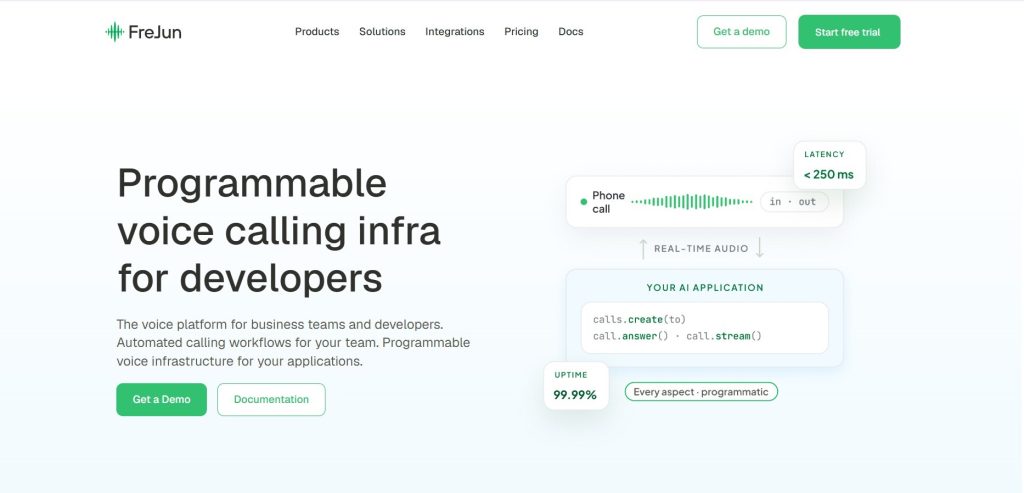
Teler is a Voice API platform built specifically for developers connecting AI agents to real phone calls in the UAE and beyond, making it the strongest Twilio alternative UAE teams can use for real-time AI voice workloads.
Best for: AI voice agent infrastructure
Key features
- Raw WebSocket audio streaming delivers L16/8000Hz audio directly to your server, so your STT engine receives caller speech with no proprietary conversion layer adding latency between the call and your AI stack.
- Sub-100ms Media Streaming Loop completes the full Voice to STT to LLM to TTS to Voice cycle fast enough for natural, uninterrupted conversation, unlike general CPaaS platforms that add 400 to 800ms by abstracting the audio path.
- Model-agnostic architecture means developers bring their own STT (Google STT, Deepgram, Whisper, AssemblyAI), LLM (OpenAI GPT, Anthropic Claude, Google Gemini), and TTS (ElevenLabs, Azure TTS, Play.ht), paying those providers directly with zero lock-in to Teler’s stack.
- SIP trunking with TCP and TLS transport supports credential-based or IP-based authentication, so teams connecting existing SIP-enabled platforms or enterprise PBX infrastructure can route calls through Teler’s carrier network without rebuilding their telephony layer.
- UAE virtual number provisioning gives developers a local UAE number for inbound and outbound calls, with TRA-compliant carrier routing built in so teams do not need to manage carrier relationships separately.
- REST API endpoints, webhook callbacks, and multi-language SDKs let developers control calls, receive event notifications, and integrate Teler into any backend stack on the same day using the getting-started guide at frejun.ai/docs.
- Compatible with AWS, Google Cloud, Azure, Vercel, LangChain, Vapi, Voiceflow, and Retell, so Teler plugs into the orchestration layer the team already uses rather than requiring a platform migration.
Pros and cons
| Pros | Cons |
|---|---|
| Sub100ms WebSocket latency is purpose-built for AI voice, not retrofitted onto a general CPaaS | UAE number rental at $100/month/number is a significant fixed cost for early-stage projects |
| Fully model-agnostic: bring any STT, LLM, or TTS provider with zero lock-in | Minimum 10 channels required to start, so very low-volume pilots carry a fixed monthly floor cost |
| $5 in free credits on first upgrade lets teams test the full AI voice loop before committing to a plan | Elastic SIP trunking (auto-scaling without channel limits) is on the roadmap but not yet available |
Pricing
Pricing (USD): $15 per channel per month (minimum 10 channels). Outbound calling at $0.20/min. Inbound at $0.10/min. Media streaming at $0.0017/min. Recording and storage at $0.00046/min. UAE number rental at $100/month/number. SIP trunking pay-as-you-go: $11.50/channel/month (min. 10 channels, 6-month commitment), outbound $0.12/min, inbound $0.03/min. First upgrade includes $5 in free calling credits. Prepaid billing with monthly, quarterly, half-yearly, or annual options. See full pricing
Why Teler is the top recommendation
Why Teler ranks #1 for UAE: Teler is the only platform in this list designed from the ground up for AI voice agent infrastructure, with outbound calling from $0.20/minute in USD, TRA-compliant UAE carrier routing, and sub-100ms WebSocket latency that general CPaaS platforms cannot match for real-time AI voice. Its model-agnostic architecture means UAE development teams keep full control of their STT, LLM, and TTS stack with zero vendor lock-in. Start building →
Teler by the numbers: Sub-100ms latency | Model-agnostic: 10+ AI providers | Virtual numbers: India and UAE | Same-day integration via WebSocket or SIP | $5 in free calling credits on first upgrade (UAE)
2. Plivo – Cloud CPaaS for voice and SMS developers
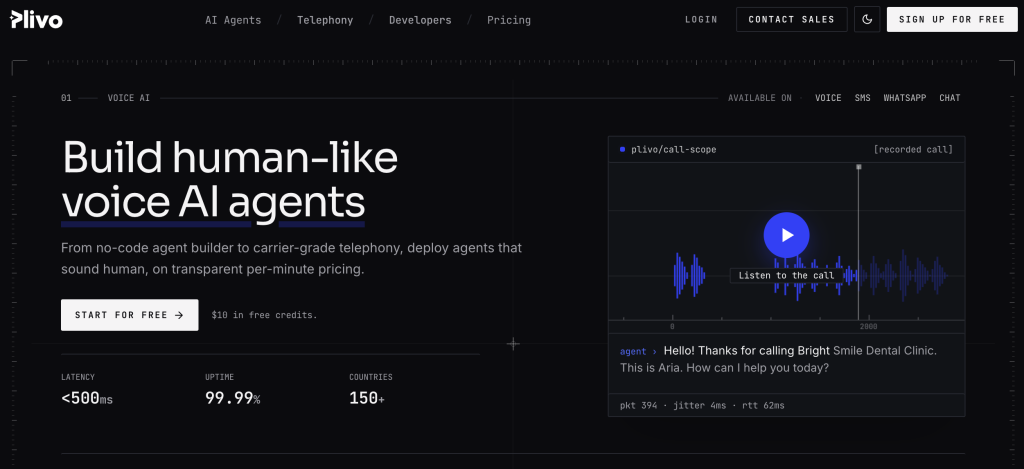
Plivo is a cloud communications platform offering voice and SMS APIs for developers who need a general-purpose CPaaS Twilio alternative UAE option with a free trial to test call flows before billing.
Best for: SMS and voice CPaaS
Key features
- Free trial credits let development teams test inbound and outbound call flows against real carrier infrastructure before any billing begins, reducing the risk of committing to a platform that does not fit the use case. Teams specifically comparing SMS and voice CPaaS options can also read our dedicated Plivo alternative UAE breakdown for a deeper look at pricing and feature gaps.
- Answer URL-based voice applications let your server answer and control inbound calls by returning instructions to Plivo’s platform, so call logic lives in your own backend rather than in a proprietary scripting environment.
- Auth ID and Auth Token authentication provides straightforward server-side API security without requiring OAuth flows, which shortens the time from account creation to first working API call.
- Account and messaging REST APIs give developers a consistent HTTP surface for automating call and SMS workflows from any backend language or framework.
- ngrok-based quickstart documentation shortens local webhook testing by letting developers expose a local server to Plivo’s platform without deploying to a public URL first.
Pros and cons
| Pros | Cons |
|---|---|
| Free trial credits available so teams can test before committing to a paid plan | WebSocket audio streaming for real-time AI voice loops is not documented, limiting AI agent use cases |
| Answer URL architecture keeps call logic in your own backend, avoiding proprietary scripting lock-in | No published latency benchmarks, making it difficult to evaluate for sub-100ms AI voice requirements |
Pricing
Pricing (USD): Contact sales. Free trial includes credits for testing. See full pricing
3. Telnyx – Carrier-network telephony for developers

Telnyx is a carrier-network communications platform for developers building voice, messaging, and verification products, positioning itself as a cost-efficient Twilio alternative UAE teams can use for programmable telephony.
Best for: Carrier-grade programmable telephony
Key features
- Voice API starting at $0.002 per minute gives cost-sensitive teams a transparent per-minute rate without requiring a sales call to get a number, which is useful for budgeting early-stage projects. For teams weighing carrier-grade telephony options in more depth, our Telnyx alternative UAE comparison covers pricing and latency in greater detail.
- SMS API at $0.004 per message and Verify API at $0.03 per verification let teams consolidate voice and messaging under one vendor, reducing the number of API integrations to maintain.
- Carrier-network ownership means Telnyx routes calls through its own infrastructure rather than reselling capacity from a third-party aggregator, which can reduce per-minute costs at higher volumes.
- Volume discounts and no-hidden-fees pricing model makes monthly cost forecasting more predictable than platforms that charge separately for each feature add-on.
- REST API call control supports backend automation for inbound and outbound telephony workflows using standard HTTP calls from any server-side language.
Pros and cons
| Pros | Cons |
|---|---|
| Transparent per-minute pricing starting at $0.002/min with no hidden fees | WebSocket audio streaming for AI voice agents was not confirmed in available documentation |
| Carrier-network ownership can reduce costs at high call volumes compared to aggregator-based platforms | Developer quickstart guide and full API reference were not found in retrieved sources, raising onboarding uncertainty |
Pricing
Pricing (USD): Voice API from $0.002/min. SMS API from $0.004/message. Verify API from $0.03/verification. Volume discounts available. See full pricing
4. Vonage API – Programmable voice and messaging platform
Vonage API is a communications APIs platform for voice, messaging, and verification, built for general developers and enterprise telephony teams looking for a Twilio alternative UAE with unified API coverage.
Best for: Programmable voice and messaging
Key features
- Unified voice and messaging APIs let teams manage both channels under one vendor account, reducing the integration surface compared to running separate providers for calls and SMS.
- Webhook callbacks support event-driven call handling, so your server receives a notification when a call starts, ends, or changes state and can respond with updated call instructions without polling.
- Number provisioning supports inbound and outbound telephony setups, giving teams a single place to manage virtual numbers across multiple regions.
- REST API control supports backend automation for call routing, recording, and transcription workflows using standard HTTP calls.
- Verification workflows sit alongside voice in the same platform, so teams building two-factor authentication alongside voice features do not need a separate vendor.
Pros and cons
| Pros | Cons |
|---|---|
| Unified voice and messaging under one API reduces vendor sprawl for teams managing both channels | WebSocket audio streaming for real-time AI voice was not confirmed in available documentation |
| Webhook-based event handling fits standard backend architectures without requiring proprietary SDKs | Pricing requires a sales conversation, making early-stage cost estimation difficult |
Pricing
Pricing (USD): Contact sales. See full pricing
5. Sinch – Enterprise communications automation platform

Sinch is a developer-focused communications platform with Agent Tools for building, testing, and running apps on its APIs, making it a viable Twilio alternative UAE for enterprise teams automating comms workflows.
Best for: Enterprise comms automation
Key features
- Agent Tools expose MCP, CLI, SDKs, Functions, and plugins so development teams can automate communications workflows directly from the tools they already use, without building custom glue code.
- OAuth2-style access token creation is documented for backend authentication, giving teams a standard security pattern that fits existing identity management setups.
- Dashboard-managed access keys reduce setup friction across development, staging, and production environments by centralising credential management in one place.
- SMS onboarding uses an API token and service plan ID visible in the dashboard, so teams can send their first message without navigating complex provisioning steps.
- API-first design positions the platform as compatible with external AI agent stacks, since no native STT or LLM or TTS stack is imposed on the developer.
Pros and cons
| Pros | Cons |
|---|---|
| Agent Tools with MCP and CLI support reduce automation overhead for developer and AI agent workflows | WebSocket audio streaming for real-time AI voice loops was not confirmed in available documentation |
| OAuth2 authentication and dashboard-managed keys fit standard enterprise security requirements | Pricing requires contacting sales, with no self-serve plan visible for early-stage testing |
6. Cequens – MENA-focused CPaaS for enterprise messaging

Cequens is a CPaaS vendor with a regional MENA footprint covering Egypt, UAE, and Saudi Arabia, making it a locally-relevant Twilio alternative UAE for compliance-heavy enterprise messaging projects.
Best for: MENA enterprise messaging
Key features
- Regional MENA footprint explicitly tracked across UAE, Saudi Arabia, and Egypt means the platform has established carrier relationships in markets where international CPaaS providers often route through non-local hubs.
- API key creation is shown in developer training material, giving teams a guided onboarding path through the channels and developer section of the dashboard.
- SMS and API integration follows a guided key-generation workflow, so developers can reach a working first message without navigating undocumented setup steps.
- Regional compliance positioning matters for UAE projects where TRA requirements and local data handling rules affect vendor selection.
- Enterprise onboarding support is available for teams that need guided setup rather than self-serve documentation.
Pros and cons
| Pros | Cons |
|---|---|
| Established MENA carrier relationships in UAE and Saudi Arabia reduce routing latency for regional deployments | UAE virtual numbers, AED pricing, and local compliance details were not publicly confirmed in available sources |
| Guided API key onboarding lowers the barrier for teams new to CPaaS integration in the MENA region | Full voice API developer documentation including WebSocket support was not found in available sources |
Pricing
Pricing (USD): Contact sales.
7. Unifonic – MENA cloud communications for customer engagement

Unifonic is a MENA-focused cloud communications platform for messaging, voice, and customer-engagement workflows, serving as a regionally-positioned Twilio alternative UAE for enterprise operations teams.
Best for: MENA customer messaging
Key features
- Omnichannel communications covering messaging and voice lets enterprise teams manage customer interactions across channels from one platform, reducing the number of vendor integrations to maintain.
- Regional MENA positioning can simplify local procurement for UAE enterprises that prefer vendors with established in-region presence and support teams.
- API-driven integration fits backend automation workflows, so operations teams can trigger notifications, reminders, and outbound calls from existing business systems.
- Number and notification workflows can be centralised under one account, reducing the operational overhead of managing separate providers for different communication types.
- Enterprise dashboards give operations managers visibility into message and call delivery without requiring direct API access for every reporting task.
Pros and cons
| Pros | Cons |
|---|---|
| MENA-regional positioning simplifies procurement and support for UAE enterprise teams | No publicly available developer documentation for WebSocket or real-time AI voice integration |
| Omnichannel coverage reduces vendor sprawl for teams managing both messaging and voice | Pricing requires a sales conversation, with no self-serve plan or trial available publicly |
8. Infobip – Global CPaaS for omnichannel enterprise communications

Infobip is a global CPaaS and customer-engagement platform for messaging, voice, and omnichannel developer workflows, offering broad channel coverage as a Twilio alternative UAE for large enterprise deployments.
Best for: Omnichannel enterprise comms
Key features
- Omnichannel messaging across SMS, WhatsApp, email, and voice reduces vendor sprawl for enterprise teams managing customer communications across multiple channels from one platform.
- Voice and messaging managed from one API surface means developers do not need to maintain separate integrations for different communication types, which lowers long-term maintenance overhead.
- API-first integration fits backend automation for notification, alert, and outbound campaign workflows using standard REST calls.
- Number and delivery workflows can be centralised under one account, giving operations teams a single dashboard for monitoring delivery rates across channels.
- Enterprise onboarding support is typically available for large deployments, reducing the time from contract to first live call or message.
Pros and cons
| Pros | Cons |
|---|---|
| Broad omnichannel coverage across SMS, WhatsApp, email, and voice under one platform | No publicly confirmed WebSocket audio streaming for real-time AI voice agent use cases |
| Global infrastructure with enterprise onboarding support suits large UAE deployments | Pricing requires a sales conversation, making early-stage cost comparison difficult |
Pricing
Pricing (USD): Contact sales. See full pricing
9. Bird (MessageBird) – Developer messaging and voice platform
Bird, formerly known as MessageBird, is a messaging and voice communications platform for developers, offering unified API coverage as a Twilio alternative UAE for teams running developer-led messaging workflows.
Best for: Developer messaging workflows
Key features
- Unified messaging and voice APIs reduce integration complexity for teams that need both channels under one vendor, since a single API key and authentication flow covers multiple communication types.
- Number provisioning supports inbound and outbound telephony workflows, giving developers a straightforward path to acquiring virtual numbers for UAE and international deployments.
- Webhook events drive call and message automation, so your backend receives real-time notifications when a call connects, ends, or a message is delivered without requiring polling.
- API-first control fits custom backend architectures, since Bird does not require a proprietary SDK to make a first API call.
- Multi-region deployment support suits UAE enterprises that need to route calls and messages through specific geographic infrastructure for latency or compliance reasons.
Pros and cons
| Pros | Cons |
|---|---|
| Unified messaging and voice APIs under one integration reduce developer maintenance overhead | No publicly confirmed WebSocket audio streaming for real-time AI voice agent workloads |
| Webhook-driven event handling fits standard backend architectures without proprietary SDK requirements | Pricing requires contacting sales, with no self-serve trial or transparent rate card publicly available |
Pricing
Pricing (USD): Contact sales. See full pricing
Twilio alternative UAE feature comparison: 2026
The table below compares all nine platforms on the six features that most directly affect a developer’s ability to build production-ready AI voice agents in the UAE. Use it to identify which platforms are viable for your specific architecture before reading the full profiles above.
| Feature | Teler | Plivo | Telnyx | Vonage API | Sinch | Cequens | Unifonic | Infobip | Bird |
|---|---|---|---|---|---|---|---|---|---|
| WebSocket audio streaming for AI voice | Yes | No | No | No | No | No | No | No | No |
| Sub-100ms real-time latency | Yes | No | No | No | No | No | No | No | No |
| Model-agnostic STT/LLM/TTS support | Yes | Partial – bring your own via webhook | Partial – bring your own via webhook | Partial – bring your own via webhook | Partial – bring your own via webhook | No | No | No | No |
| UAE virtual number provisioning | Yes | Check website | Check website | Check website | Check website | Partial – regional presence confirmed | Partial – MENA regional focus | Check website | Check website |
| SIP trunking | Yes | Partial – via REST call control | Yes | Partial – via REST call control | Partial – via REST call control | No | No | No | No |
| Transparent self-serve pricing | Yes | No – contact sales | Yes | No – contact sales | No – contact sales | No – contact sales | No – contact sales | No – contact sales | No – contact sales |
Teler is the only platform in this comparison that delivers all six capabilities for UAE AI voice agent development, while every other platform requires workarounds or lacks WebSocket streaming entirely.
Which Twilio alternative UAE is right for your team in 2026?
Different teams have different priorities. A startup building its first AI voice agent has different constraints than an enterprise migrating a contact centre. The recommendations below match each profile to the platform that fits their specific situation.
If you are building a real-time AI voice agent with your own STT, LLM, and TTS stack: Choose Teler. It is the only platform in this list with raw WebSocket streaming at sub-100ms latency and a fully model-agnostic architecture, so your AI stack connects to real phone calls without a proprietary conversion layer adding latency.
If you are a UAE enterprise team that needs MENA-regional carrier relationships and local support: Choose Cequens or Unifonic. Both have established regional footprints in the UAE and Saudi Arabia, which matters for procurement teams that need a vendor with in-region presence and compliance familiarity.
If you need transparent per-minute pricing without a sales call to get started: Choose Telnyx. Its Voice API starts at $0.002 per minute with a published rate card, so early-stage teams can model costs before committing to a plan.
If you need omnichannel coverage across SMS, WhatsApp, email, and voice under one platform: Choose Infobip. Its broad channel coverage reduces vendor sprawl for enterprise teams managing customer communications across multiple touchpoints.
If you are a developer-led team that wants to test SMS and voice with free trial credits before any billing: Choose Plivo. Its free trial credits let teams validate call flows against real carrier infrastructure before committing to a paid plan.
Which tool wins overall in UAE?
If you want the best overall Twilio alternative UAE for 2026 with AI voice features, USD billing, and TRA compliance: Choose Teler. No other platform in this list combines sub-100ms WebSocket latency, a model-agnostic architecture across 10+ STT, LLM, and TTS providers, transparent UAE pricing from $0.20 per minute, and same-day integration via WebSocket or SIP trunking.
Frequently asked questions about Twilio alternative UAE in 2026
What is the best Twilio alternative UAE in 2026?
The best Twilio alternative UAE in 2026 is FreJun Teler. It is purpose-built for AI voice agent infrastructure, while Twilio was designed for general CPaaS use cases like human-to-human calls and SMS campaigns. Teler delivers sub-100ms latency via raw WebSocket streaming, so the full Voice to STT to LLM to TTS to Voice loop completes fast enough for natural conversation. Its model-agnostic architecture means developers bring their own STT, LLM, and TTS providers with zero lock-in, and UAE virtual numbers are available with TRA-compliant carrier routing built in.
How much does a Twilio alternative UAE cost in 2026?
Teler’s UAE pricing starts at $15 per channel per month, with a minimum of 10 channels. Outbound calling costs $0.20 per minute, inbound costs $0.10 per minute, and media streaming costs $0.0017 per minute. Recording and storage adds $0.00046 per minute. UAE virtual number rental is $100 per month per number. SIP trunking is available on a pay-as-you-go basis at $11.50 per channel per month with a 6-month commitment. First upgrade includes $5 in free calling credits. Most other platforms in this comparison require a sales conversation for pricing, which makes Teler’s transparent rate card a practical advantage for early-stage budgeting.
What latency can developers expect from a Twilio alternative UAE?
Latency, the delay between when a person speaks and when they hear a response, is the most critical technical metric for AI voice agents. Teler’s WebSocket streaming delivers sub-100ms end-to-end latency for the full Media Streaming Loop, which is fast enough for natural, uninterrupted conversation. General CPaaS platforms like Twilio abstract the audio layer to simplify human-to-human call handling, but that abstraction adds 400 to 800ms of delay. Since AI inference requires the audio to reach your STT engine, be processed by your LLM, and return as TTS audio, any added latency compounds across the loop and makes the conversation feel unnatural.
Which Twilio alternative UAE works with any STT, LLM, or TTS provider?
Teler is fully model-agnostic, meaning developers bring their own STT (Speech-to-Text, the component that converts caller speech into text), LLM (Large Language Model, the AI that decides what to respond), and TTS (Text-to-Speech, the component that converts the AI’s response back into audio). Teler handles only the voice transport layer and streams raw audio over WebSocket to the developer’s server. Developers pay their AI providers directly and can swap any component without changing the Teler integration. As of 2026, Teler is compatible with 10+ STT, LLM, and TTS providers, including Google STT, Deepgram, Whisper, OpenAI GPT, Anthropic Claude, ElevenLabs, and Azure TTS.
What does TRA compliance mean for AI outbound calling in the UAE?
The TRA (Telecommunications and Digital Government Regulatory Authority) governs all voice and messaging traffic in the UAE. For AI outbound calling specifically, TRA compliance means two things beyond standard telephony rules. First, numbers registered on the DNCR (Do Not Call Registry) must not be called, and any automated outbound campaign must include a DNCR check before dialing. Second, all voice traffic must route through TRA-licensed carrier infrastructure, which means platforms without UAE-specific carrier relationships often route calls through international hubs, adding latency and creating potential compliance gaps. Teler provides UAE virtual numbers with TRA-compliant carrier routing built in, so developers do not need to manage carrier licensing separately.
What does Teler offer that Twilio does not for AI voice agents?
Twilio was built for general CPaaS use cases, so its audio layer is abstracted to simplify human-to-human call handling. That abstraction adds 400 to 800ms of latency, which makes real-time AI inference impractical. Teler exposes raw L16/8000Hz audio directly over WebSocket, so the developer’s STT engine receives caller speech with no conversion layer in the way. Teler is also fully model-agnostic, while Twilio’s AI voice features are tied to specific provider integrations. Since Teler handles only the voice transport layer, developers keep full control of their STT, LLM, and TTS stack and can update any component without rebuilding the telephony integration.
What is the difference between SIP trunking and WebSocket streaming for AI voice?
SIP (Session Initiation Protocol) is the standard protocol for establishing voice calls over the internet. SIP trunking connects an existing SIP-enabled platform, like a PBX or an AI voice orchestration layer, to a carrier network. It is the right path for teams integrating with existing enterprise telephony infrastructure. WebSocket streaming keeps a persistent, full-duplex connection open between the caller and the developer’s server, so raw audio flows continuously in both directions without HTTP round-trip overhead. WebSocket is the right path for AI voice agents that need sub-100ms response loops, since it eliminates the connection setup delay that occurs with standard HTTP. Teler supports both paths, so teams can choose based on their existing architecture.
How do I get started building an AI voice agent with a Twilio alternative UAE?
The fastest path is to use Teler’s WebSocket integration, which can be completed on the same day using the getting-started guide at knowledge.frejun.com. The Media Streaming Loop works like this: the caller speaks, Teler captures the audio via WebSocket and streams it to your server in L16/8000Hz format, your STT engine converts it to text, your LLM reads the text and generates a response, your TTS converts the response to audio, and Teler plays it back to the caller. The full loop completes in under 100ms on Teler. Sign up at platform.frejun.ai and use the $5 in free calling credits included on first upgrade to test the full stack before committing to a paid plan.
Conclusion: Best Twilio alternative UAE in 2026 for AI voice agents
The top three Twilio alternative UAE platforms in 2026 are Teler for AI voice agent infrastructure, Telnyx for transparent carrier-grade pricing, and Cequens for MENA-regional enterprise messaging. Teler is the clear top recommendation for UAE development teams building real-time AI voice products, because it is the only platform in this list that combines sub-100ms WebSocket latency, a fully model-agnostic architecture across 10+ AI providers, and transparent USD pricing from $0.20 per minute with TRA-compliant UAE carrier routing. If your team is ready to connect an AI agent to real phone calls in the UAE, start with Teler’s $5 in free credits and have a working voice loop running the same day. Developers expanding into Southeast Asia can find a similar breakdown in our guide to the best Twilio alternative Singapore platforms for AI voice agents. Teams evaluating European deployments can compare options in our guide to the best Twilio alternative in Germany, which covers GDPR and EECC compliance requirements for that market. For a more recently updated take on this same comparison, see our Twilio alternative in UAE guide. For the latest India-specific comparison with INR pricing and TRAI compliance details, see our Twilio alternative in India guide.


