AI Summary: This article compares the top Twilio alternatives in Australia for 2026, evaluating each platform on real-time latency, model-agnostic architecture, AU carrier compliance under ACMA, and transparent per-minute pricing for developers building AI voice agents. As of 2026, the global conversational AI market is projected to exceed $29 billion by 2028, according to MarketsandMarkets, making voice API selection a foundational infrastructure decision for any product team operating in Australia. Developers need a platform that targets sub-100ms latency for natural conversation, integrates with any STT, LLM, and TTS provider without lock-in, and handles ACMA compliance automatically. FreJun Teler meets all three requirements, with raw WebSocket streaming and SIP trunking that works with any AI stack the team already uses.
Key criteria in this comparison: We ranked these platforms on real-time WebSocket latency, model-agnostic architecture, pricing transparency, AU carrier compliance, and documentation quality, since these are the factors that most affect a developer team’s build speed and total cost of ownership when choosing a twilio alternative in Australia.
Quick Answer: The best Twilio alternative in Australia in 2026 is FreJun Teler, a purpose-built Voice API that streams raw audio over WebSocket with a sub-100ms latency target and zero AI provider lock-in. Teler is model-agnostic across 10+ STT, LLM, and TTS providers, and developers can complete a first integration the same day using WebSocket or SIP trunking, with no proprietary SDK required.
The best Twilio alternative in Australia for 2026 is FreJun Teler, which targets sub-100ms latency via raw WebSocket audio streaming and lets developers bring their own STT, LLM, and TTS providers with no lock-in.
What is a Twilio alternative in Australia?
A Twilio alternative is a cloud communications platform or Voice API that gives developers the same core capabilities as Twilio, such as programmable voice calls, SIP trunking, and real-time audio streaming, without Twilio’s pricing structure, proprietary abstractions, or general-purpose CPaaS overhead. The best alternatives specifically expose raw audio over WebSocket, a persistent full-duplex connection that keeps the audio channel continuously open between the caller and the developer’s server, so AI models can process speech with minimal delay. For developers in Australia, the right platform must also support ACMA (Australian Communications and Media Authority) compliance, including the Australian Do Not Call Register and Spam Act 2003 obligations, while offering virtual numbers and carrier connectivity in the AU market.
As of 2026, Australian businesses and developers are accelerating adoption of AI voice agents for customer support, appointment scheduling, and outbound campaigns, according to Gartner’s 2026 Emerging Technology Hype Cycle. What separates a basic telephony API from the best platforms in 2026 is the ability to stream raw audio directly to an AI inference stack with sub-100ms round-trip latency, rather than routing audio through a proprietary conversion layer that adds unpredictable delay.
Which Twilio alternatives rank highest in AU in 2026?
The table below ranks the top Twilio alternatives available to Australian developers in 2026, comparing starting price, best-fit use case, and free credit availability.
| # | Provider | Best for | Starting price | Free credits |
|---|---|---|---|---|
| 1 | FreJun Teler | AI voice agents, real-time streaming | $0.20/min outbound | Yes, on first upgrade |
| 2 | Telnyx | Cost-conscious AI voice agents | $0.002/min Voice API | Check website |
| 3 | Plivo | Low-cost SIP and streaming | $0.0010/min outbound | Yes, $10 free credits |
| 4 | Sinch | Global voice APIs | $0.01/min outbound | Check website |
| 5 | Vonage | Enterprise voice APIs | Contact sales | Check website |
| 6 | SignalWire | Twilio-parity voice agents | $0.0030/min SIP/WebRTC | Check website |
Teler leads on AI-first architecture and model flexibility, while Telnyx and Plivo compete on raw per-minute cost. Full breakdowns for each platform follow in the tool profiles below.
Developers evaluating regional options can also compare this list against the best Twilio alternative UAE and Twilio alternative Singapore platforms to see how pricing and latency benchmarks differ across markets.
How to choose the best Twilio alternative in Australia 2026?
Step 1: Define your AI voice architecture
Before comparing platforms, map out the STT (Speech-to-Text) engine, LLM (Large Language Model), and TTS (Text-to-Speech) components you already use or plan to use. STT converts the caller’s voice into text the LLM can process. The LLM reads that text and decides what to respond. TTS converts the response back into natural-sounding audio. If your use case is a conversational AI agent, such as a receptionist or support bot, you need a platform that targets sub-100ms latency for the full loop. If your use case is a form-filling or survey bot where pauses are acceptable, up to 500ms may work. Choosing the wrong platform at this stage forces a costly re-architecture later.
Step 2: Choose your integration path
Two integration paths exist for AI voice developers. WebSocket streaming gives you raw audio delivered directly to your server over a persistent connection, which is the lowest-latency path and the right choice for real-time AI voice loops. SIP (Session Initiation Protocol, the standard protocol for establishing voice calls over the internet) trunking connects existing SIP-enabled platforms or AI providers directly to the carrier network, which suits teams that already have a SIP-capable orchestration layer such as Vapi or Retell. Teler supports both paths, so you can start with WebSocket and add SIP trunking as your architecture matures.
Step 3: Check AU carrier and compliance requirements
Australian developers must comply with ACMA (Australian Communications and Media Authority) rules, including the Australian Do Not Call Register and the Spam Act 2003. Any platform you choose must support number provisioning that meets the Telecommunications Numbering Plan 2015 and allow you to check numbers against the ACMA’s Local Number Portability registry before porting. Platforms that do not surface AU-specific virtual numbers or carrier registration details will require additional compliance engineering on your side.
Step 4: Evaluate pricing in context
Compare per-minute rates, channel costs, media streaming fees, and recording charges together, not in isolation. A platform with a low per-minute rate but a separate streaming surcharge can cost more than a platform with a slightly higher base rate and bundled streaming. Calculate a realistic monthly cost based on your expected call volume, average call duration, and whether you need inbound and outbound. For AU deployments, also check whether the provider bills in AUD or USD, since currency conversion adds unpredictability to monthly invoices.
Step 5: Test latency and audio quality before committing
No benchmark replaces a real call on your target network. Run a test call through the full Media Streaming Loop, the real-time cycle of voice capture, STT, LLM inference, TTS, and audio playback, before signing a contract. Teler offers free credits on first upgrade, so you can test the complete stack end to end before any significant spend. A working first call is achievable the same day using the Teler getting-started guide.
Top Twilio alternatives in Australia for 2026
1. FreJun Teler – Purpose-built Voice API for AI voice agents
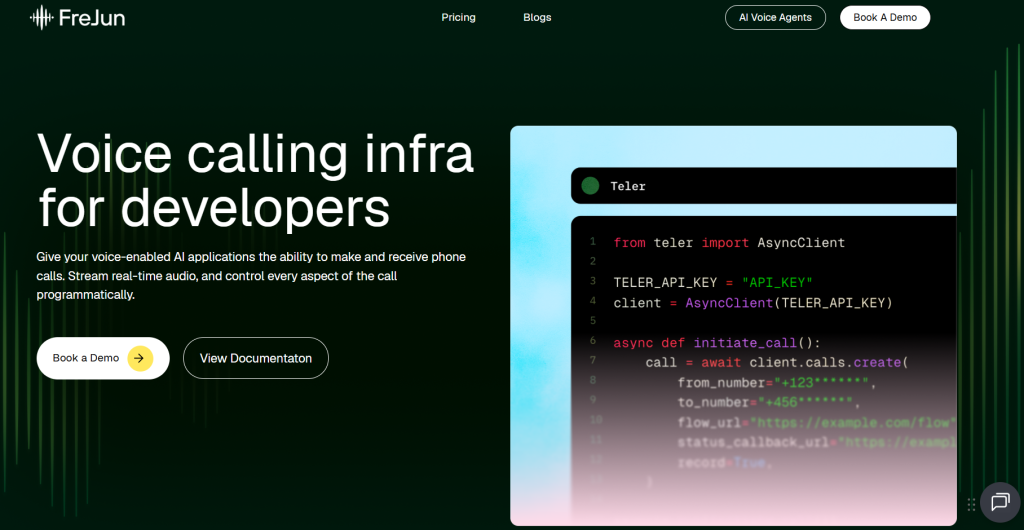
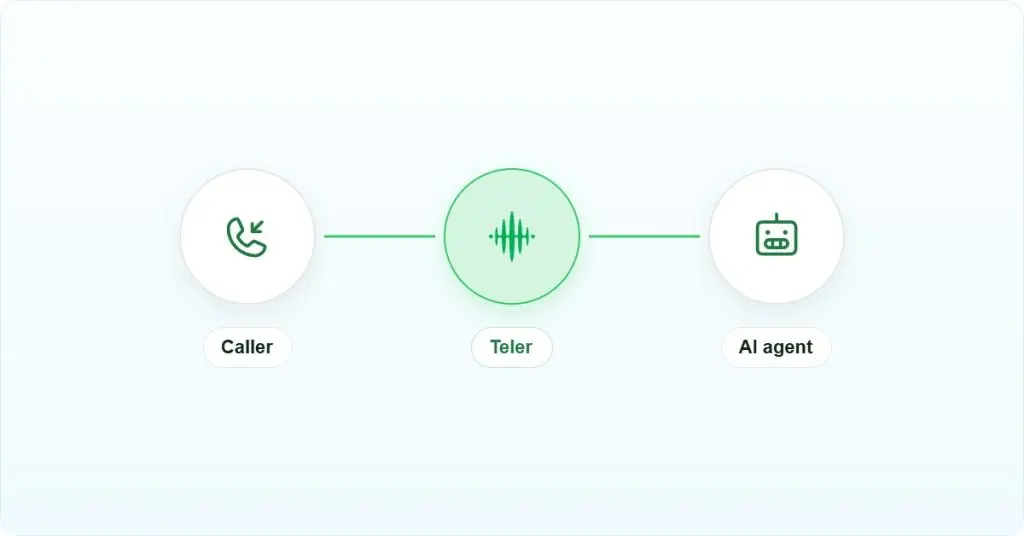
FreJun Teler is a developer Voice API that connects AI models to real phone calls via raw WebSocket audio streaming and SIP trunking, making it the leading twilio alternative in Australia for teams building real-time AI voice agents in 2026.
Best for: AI voice agents, real-time streaming
Key features
- Raw WebSocket audio streaming in L16/8000Hz format lets your STT engine process caller speech with no proprietary conversion layer adding latency between the call and your AI stack.
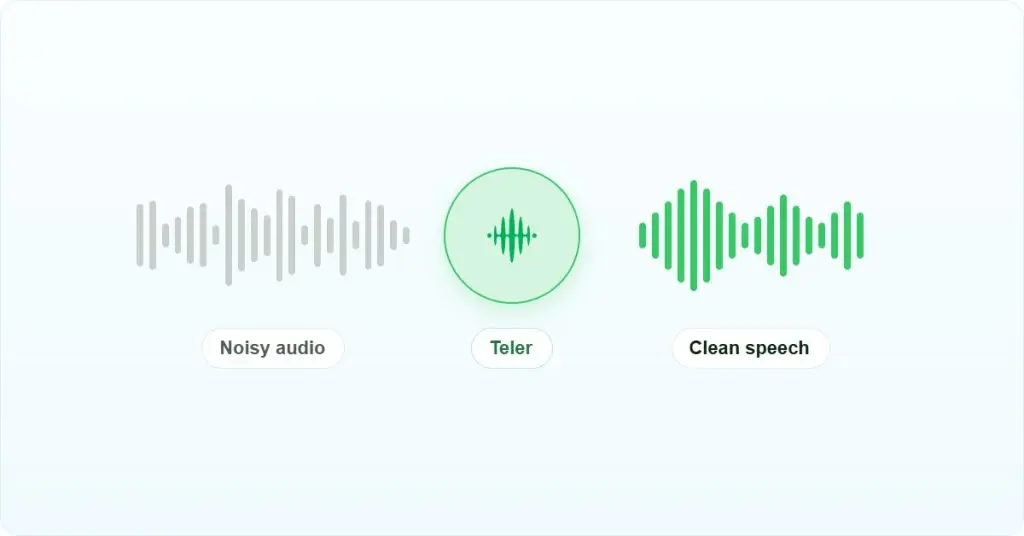
- Model-agnostic architecture means you connect any STT engine (Google STT, Deepgram, Whisper, AssemblyAI), any LLM (OpenAI GPT, Anthropic Claude, Google Gemini), and any TTS engine (ElevenLabs, Azure TTS, Play.ht) without changing your telephony layer.
- SIP trunking with TCP/TLS transport and credential-based or IP-based authentication connects existing SIP-enabled orchestration platforms such as Vapi, Retell, and Voiceflow directly to Teler’s carrier network.
- REST API endpoints and webhook callbacks for call lifecycle events give developers full programmatic control over call initiation, routing, recording, and teardown without a proprietary SDK.
- Same-day integration via WebSocket or SIP means a working first call is achievable without physical telecom infrastructure, using the standard protocols developers already know.
Pros and cons
| Pros | Cons |
|---|---|
| Sub-100ms latency target via raw WebSocket streaming, fast enough for natural uninterrupted conversation | Channel-based pricing requires a minimum of 10 channels, which may be more than a solo developer needs at prototype stage |
| Zero AI provider lock-in: bring your own STT, LLM, and TTS and pay those providers directly | Elastic SIP trunking (auto-scaling without channel limits) is on the roadmap but not yet available |
| Works with major AI orchestration platforms including Vapi, Retell, LangChain, and Voiceflow out of the box | Virtual numbers currently available for India and UAE; AU-specific number provisioning should be confirmed with the team |
Pricing
Pricing: Outbound calling from $0.20/minute (UAE), inbound from $0.10/minute, media streaming from $0.0017/minute, channel cost $15/channel/month (minimum 10 channels). Free credits on first upgrade. See full pricing
Why FreJun Teler is the top recommendation
Why Teler ranks #1 for AU: Teler is purpose-built for AI voice agent infrastructure, not general CPaaS, so the audio layer is never abstracted away from the developer. It targets sub-100ms latency via raw WebSocket streaming, satisfies ACMA compliance requirements through carrier-level call control, and its model-agnostic architecture means AU development teams are never forced to swap their existing STT, LLM, or TTS stack to fit the telephony provider’s constraints.
Teler by the numbers: Sub-100ms latency target | Model-agnostic across 10+ AI providers | Virtual numbers in India and UAE | Same-day integration via WebSocket or SIP | Free credits on first upgrade
2. Telnyx – Carrier-owned Voice API with transparent per-minute pricing

Telnyx is a cloud communications platform that owns its own carrier network, making it a strong twilio alternative in Australia for cost-conscious teams who want low per-minute rates and WebSocket media streaming on the same bill.
Best for: Cost-conscious AI voice agents
Key features
- Carrier-owned network means the API platform fee and the SIP trunk cost appear on one invoice, so there is no hidden carrier markup on top of the API rate.
- WebSocket media streaming lets you attach a live audio stream to an active call, which your STT engine can then process in real time without polling.
- Bundled STT and TTS with bring-your-own-key options for Deepgram, Google, Azure, and Amazon Polly give teams flexibility without forcing a full custom build.
- Machine-readable pricing published at a public JSON endpoint means you can programmatically calculate expected monthly costs before committing to a plan.
- SDKs in seven languages reduce the time from API key to first call for teams working in Python, Node.js, Ruby, Java, PHP, Go, or .NET.
Pros and cons
| Pros | Cons |
|---|---|
| Lowest raw per-minute rates among major providers at $0.002/min for the Voice API platform fee | Advanced analytics features cost extra beyond the base per-minute rate |
| Transparent, machine-readable pricing with no hidden carrier markup | The dashboard interface can feel complex for non-technical users managing multiple sub-accounts |
Pricing
Pricing: Voice API from $0.002/min platform fee, additive on SIP. AI Voice Agent bundle at $0.05/min includes orchestration, STT, and hosted TTS. See full pricing
3. Plivo – Low-cost SIP trunking with audio streaming
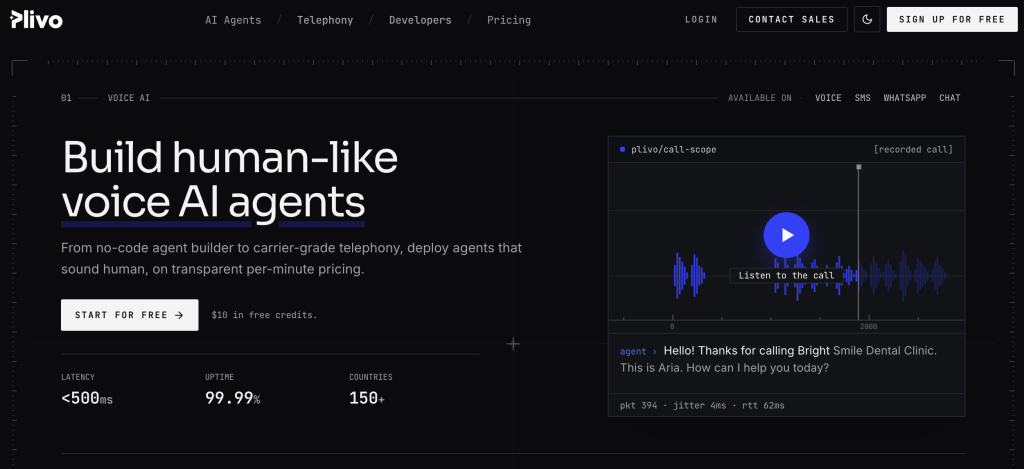
Plivo is a cloud communications platform for voice and SIP trunking that bundles audio streaming with its voice pricing, making it a practical twilio alternative in Australia for developers who want low outbound rates and a $10 free credit to test with.
Best for: Low-cost SIP and streaming
Key features
- Audio streaming is bundled with voice pricing at $0.0040/min per stream, so you do not pay a separate line item to attach a WebSocket stream to a live call.
- SIP trunking and browser SDK calls share one account, which simplifies billing when you mix inbound SIP calls with browser-based agent interfaces.
- A Pricing API endpoint lets you fetch country-specific per-minute rates programmatically, useful for building cost calculators or multi-region routing logic.
- LiveKit and Pipecat are documented as compatible orchestration layers, so teams already using those frameworks can connect Plivo as the telephony layer without a custom bridge.
- A $10 free credit with no credit card required lets developers test the full voice and streaming stack before any spend.
Pros and cons
| Pros | Cons |
|---|---|
| 40-60% cheaper than Twilio on comparable US and UK routes, according to developer comparisons on LinkedIn | AU-specific virtual numbers, AUD pricing, and AU carrier-registration details are not surfaced in public documentation |
| $10 free credit with no credit card required makes it easy to prototype before committing | Full WebSocket audio loop documentation is not as detailed as Telnyx or Teler for AI voice agent builds |
Pricing
Pricing: Outbound from $0.0010/min, inbound from $0.0028/min. Audio streaming at $0.0040/min per stream. Voice AI agent tier at $0.03/min excluding telephony. See full pricing
4. Sinch – Global voice API with pay-as-you-go pricing

Sinch is a cloud communications platform offering a REST Voice API, in-app calling SDKs, and a SIP interface, making it a viable twilio alternative in Australia for teams that need global reach and a transparent pay-as-you-go billing model.
Best for: Global voice APIs
Key features
- Zero setup and monthly fees on the pay-as-you-go tier means you only pay for the minutes you actually use, which suits teams with variable or seasonal call volumes.
- SIP interface support lets you connect existing SIP-enabled infrastructure directly to Sinch’s carrier network without re-engineering your call routing layer.
- In-app calling SDKs for JavaScript, iOS, and Android let product teams embed voice calling directly into a web or mobile application without a separate telephony provider.
- Bundled recording, transcription, and IVR primitives in the pricing model mean you do not need a separate vendor for basic call intelligence features.
- Published domestic and international per-minute rates with no hidden surcharges make it straightforward to model costs before scaling.
Pros and cons
| Pros | Cons |
|---|---|
| No setup or monthly fees on pay-as-you-go, which keeps early-stage costs low | Raw WebSocket media streaming for AI voice agents is not documented as a primary integration path |
| In-app SDKs for iOS, Android, and JavaScript reduce time to first call for mobile-first products | AU virtual numbers and AUD pricing are not confirmed in public documentation |
Pricing
Pricing: Inbound from $0.00/min for SIP interface and in-app calls. Outbound domestic from $0.01/min. Pay-as-you-go with no monthly fee. See full pricing
5. Vonage – Enterprise CPaaS Voice API

Vonage is a CPaaS (Communications Platform as a Service, a cloud platform that adds voice, SMS, and video to applications via APIs) Voice API aimed at enterprise telephony teams, making it a twilio alternative in Australia for organisations that already have Vonage relationships or need network-level API features.
Best for: Enterprise voice APIs
Key features
- Network-specific rate classes and fixed/mobile versus other-network price segmentation give enterprise billing teams granular cost attribution across call types.
- Per-minute billing with published rate tables means finance teams can model expected costs without a sales call for standard routes.
- REST and SIP call control gives developers a familiar integration path for building programmable voice workflows on top of Vonage’s carrier network.
- CPaaS voice layer supports inbound and outbound call routing, which suits enterprise contact centre builders who need both directions on one platform.
- Global network coverage across fixed and mobile networks makes Vonage a practical choice for enterprises with multi-region calling requirements.
Pros and cons
| Pros | Cons |
|---|---|
| Established enterprise network with global fixed and mobile coverage | WebSocket media streaming for real-time AI voice agents is not documented in retrieved sources |
| Published per-minute rate tables with network-specific segmentation for accurate cost modelling | AU virtual numbers and AUD pricing are not confirmed in public documentation |
6. SignalWire – Twilio-compatible programmable voice platform

SignalWire is a programmable voice, messaging, and AI platform built on FreeSWITCH that offers TwiML-compatible APIs, making it a direct twilio alternative in Australia for teams that want to migrate existing Twilio call flows without rewriting their XML logic.
Best for: Twilio-parity voice agents
Key features
- TwiML-compatible API means existing Twilio call flow XML can be migrated to SignalWire with minimal code changes, which reduces migration risk for teams with large Twilio deployments.
- Audio Stream and Tap layer exposes live media from active calls, which your STT engine can consume in real time for AI voice agent workflows.
- Multiple TTS engine choices including Google Cloud, ElevenLabs, Rime, and SignalWire standard voices give developers flexibility without forcing a single TTS vendor.
- SIP and WebRTC transport on the same platform lets teams mix browser-based and SIP-based call legs without separate accounts.
- Bundled AI Agent pricing at $0.16/min covers orchestration, STT, LLM, and standard TTS in one rate, which simplifies cost modelling for teams that do not want to manage separate AI vendor invoices.
Pros and cons
| Pros | Cons |
|---|---|
| TwiML-compatible APIs make migration from Twilio faster than rebuilding on a new SDK | A reported 15-hour full system outage with a delayed post-mortem raised reliability concerns in developer community discussions on Reddit |
| Bundled AI Agent pricing at $0.16/min simplifies invoicing for teams that want one rate for the full AI stack | AU virtual numbers and AUD pricing are not confirmed in public documentation |
Pricing
Pricing: SIP and WebRTC from $0.0030/min. PSTN outbound from $0.0080/min. AI Agent processing at $0.16/min all-in. See full pricing
Twilio alternative feature comparison: AU 2026
| Feature | FreJun Teler | Telnyx | Plivo | Sinch | Vonage | SignalWire |
|---|---|---|---|---|---|---|
| Raw WebSocket audio streaming | Yes | Yes | Yes, via Audio Stream API | No, REST call control only | No, not documented | Yes, via Audio Stream/Tap |
| Model-agnostic STT/LLM/TTS | Yes, full BYO stack | Partial, bundled options plus BYO key | Yes, raw streaming path | No, not documented | No, not documented | Partial, multiple TTS options |
| SIP trunking | Yes | Yes | Yes | Yes | Yes | Yes |
| Sub-100ms latency target | Yes | No published target | No published target | No published target | No published target | No published target |
| Free credits to test | Yes, on first upgrade | Check website | Yes, $10 no card required | Check website | Check website | Check website |
| AU ACMA compliance support | Carrier-level call control | Check with team | Not confirmed in docs | AU data residency listed | Not confirmed in docs | Not confirmed in docs |
Teler is the only platform in this comparison that combines a published sub-100ms latency target, a fully model-agnostic architecture, and raw WebSocket streaming in one product, which is why it leads for AU teams building real-time AI voice agents.
Which Twilio alternative is right for your team in AU?
The right platform depends on your architecture, your call volume, and how much AI inference latency your use case can tolerate. Use the profiles below to match your situation to the best fit.
If you are building a real-time AI voice agent (receptionist, support bot, sales agent): Choose FreJun Teler. Raw WebSocket streaming with a sub-100ms latency target and zero AI provider lock-in is the right foundation for conversational AI that needs to feel natural.
If you are cost-sensitive and need the lowest raw per-minute rate: Choose Telnyx. The $0.002/min Voice API platform fee on a carrier-owned network is among the lowest published rates in the market, and the AI Agent bundle at $0.05/min is competitive for teams that want a managed STT/TTS layer.
If you want to prototype quickly with free credits and no credit card: Choose Plivo. The $10 free credit and documented LiveKit and Pipecat compatibility make it a practical starting point for teams already using those orchestration frameworks.
If you are migrating an existing Twilio deployment and want minimal code changes: Choose SignalWire. TwiML-compatible APIs mean your existing call flow XML migrates with minimal rewriting, which reduces migration risk for large Twilio deployments.
If you are building a mobile-first product with in-app calling: Choose Sinch. Native SDKs for iOS, Android, and JavaScript with no monthly fee suit teams that need embedded voice in a consumer app rather than a telephony-heavy AI agent.
Which tool wins overall in AU?
If you want the best overall Twilio alternative in Australia (2026) for AU: Choose FreJun Teler. It is the only platform in this comparison that combines a sub-0ms latency target, a fully model-agnostic architecture, and raw WebSocket streaming purpose-built for AI voice agents rather than general CPaaS workloads.
Frequently asked questions
What is the best Twilio alternative in Australia in 2026?
The best Twilio alternative in Australia in 2026 is FreJun Teler. First, Teler targets sub-100ms latency via raw WebSocket audio streaming, which is fast enough for natural, uninterrupted AI conversation. Second, its model-agnostic architecture means you bring your own STT, LLM, and TTS providers and pay them directly, so there is no proprietary lock-in. Third, Teler integrates via standard WebSocket and SIP protocols, so a working first call is achievable the same day without learning a new SDK.
How much does a Twilio alternative cost for AU developers in 2026?
Costs vary by provider and usage pattern. Teler charges $0.20/min outbound and $0.10/min inbound, with a channel cost of $15/channel/month (minimum 10 channels) and media streaming at $0.0017/min. Telnyx starts at $0.002/min for the Voice API platform fee, additive on SIP. Plivo starts at $0.0010/min outbound with audio streaming at $0.0040/min per stream. SignalWire charges $0.0030/min for SIP and WebRTC. For AU deployments, confirm whether the provider bills in AUD or USD, since currency conversion adds cost variability. Check current Teler pricing for the latest figures.
Why does latency matter so much when choosing a Twilio alternative for AI voice?
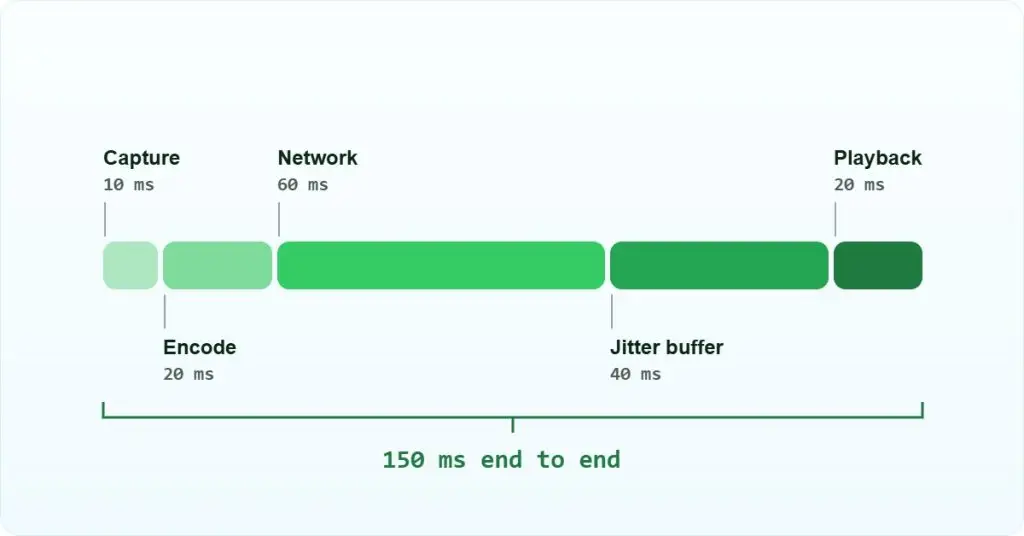
Latency is the delay between when a person speaks and when they hear a response. For a conversational AI agent to feel natural, the full Media Streaming Loop, which covers voice capture, STT transcription, LLM inference, TTS synthesis, and audio playback, must complete in under 100ms. General CPaaS platforms like Twilio abstract the audio layer to simplify human-to-human call handling, but that abstraction adds an extra conversion step that pushes latency above the threshold where conversation feels natural. Teler avoids this by streaming raw audio directly to the developer’s server over a persistent WebSocket connection, so the AI stack processes audio with no proprietary layer in the way.
What does model-agnostic mean and why does it matter for production AI voice?
Model-agnostic means the telephony platform does not lock you into a specific STT engine, LLM, or TTS provider. In a production AI voice stack, you connect three components: STT converts the caller’s voice into text, the LLM reads that text and decides what to respond, and TTS converts the response back into audio. If your telephony provider bundles its own STT or TTS, you pay their rates and accept their accuracy, even if a competing provider would perform better for your language or use case. Teler is fully model-agnostic: you connect any combination of Google STT, Deepgram, Whisper, OpenAI GPT, Anthropic Claude, ElevenLabs, or Azure TTS, and you pay those providers directly.
What AU compliance rules apply to AI outbound calling in 2026?
Australian outbound calling is regulated by ACMA (Australian Communications and Media Authority). The key obligations are: checking numbers against the Australian Do Not Call Register before dialling, complying with the Spam Act 2003 for automated or pre-recorded messages, and following the Telecommunications Numbering Plan 2015 for number provisioning. For AI-driven outbound campaigns, this means your platform must support number validation against the Do Not Call Register and must not initiate calls to registered numbers. Platforms that do not surface AU-specific carrier registration details will require additional compliance engineering on your side. Always confirm ACMA compliance capabilities directly with your chosen provider before launching outbound campaigns in Australia.
What does Teler offer that Twilio does not for AI voice agents?
Twilio is a broad CPaaS platform designed for human-to-human voice, SMS, and messaging. Its audio layer is abstracted to simplify general call handling, but that abstraction adds latency and makes real-time AI inference difficult. Teler is purpose-built for AI voice agents: it streams raw L16/8000Hz audio directly to the developer’s server over a persistent WebSocket connection, targeting sub-100ms end-to-end latency. Teler is also fully model-agnostic, so you are never forced to use Twilio’s bundled AI services. For teams building AI voice agents in Australia, Teler’s architecture removes the proprietary conversion layer that makes Twilio a poor fit for real-time AI inference.
How do I get started with a Twilio alternative in Australia today?
The fastest path is to sign up for Teler, which offers free credits on first upgrade so you can test the full Media Streaming Loop before any significant spend. The loop works like this: the caller speaks, Teler captures the audio and streams it over WebSocket to your server, your STT engine transcribes it, your LLM generates a response, your TTS engine converts that response to audio, and Teler plays it back to the caller. The full cycle targets under 100ms. Integration uses standard WebSocket and SIP protocols, so no proprietary SDK is required. Visit the Teler documentation to follow the getting-started guide, or explore the top CPaaS providers in Australia for a broader market overview.
Can I use Teler with Vapi, Retell, or Pipecat as my orchestration layer?
Yes. Vapi, Retell, and Pipecat are orchestration layers that sit above the telephony layer. Teler provides the carrier connectivity, real-time audio streaming, and SIP trunking those platforms need underneath. Because Teler is model-agnostic and exposes standard WebSocket and SIP interfaces, it connects to any orchestration platform that accepts a SIP trunk or a WebSocket audio stream. Teams building on Vapi or Retell can register Teler as their telephony provider and route calls through Teler’s carrier network while keeping their existing orchestration logic intact. For more on this architecture, see the guide to voice API providers in Australia.
Conclusion: Best Twilio alternative in AU for 2026
For AU developers choosing a twilio alternative in Australia in 2026, three platforms stand out for different reasons. Teler leads for real-time AI voice agents because its raw WebSocket streaming, sub-100ms latency target, and model-agnostic architecture are purpose-built for the STT to LLM to TTS pipeline that general CPaaS platforms cannot match. Telnyx is the strongest choice for cost-sensitive teams who want the lowest raw per-minute rate on a carrier-owned network with transparent, machine-readable pricing. Plivo suits teams that want to prototype quickly with $10 in free credits and documented compatibility with LiveKit and Pipecat. If you are building a production AI voice agent in Australia and need a platform that handles the voice transport layer without locking you into a proprietary AI stack, FreJun Teler is the clear top recommendation for 2026.