
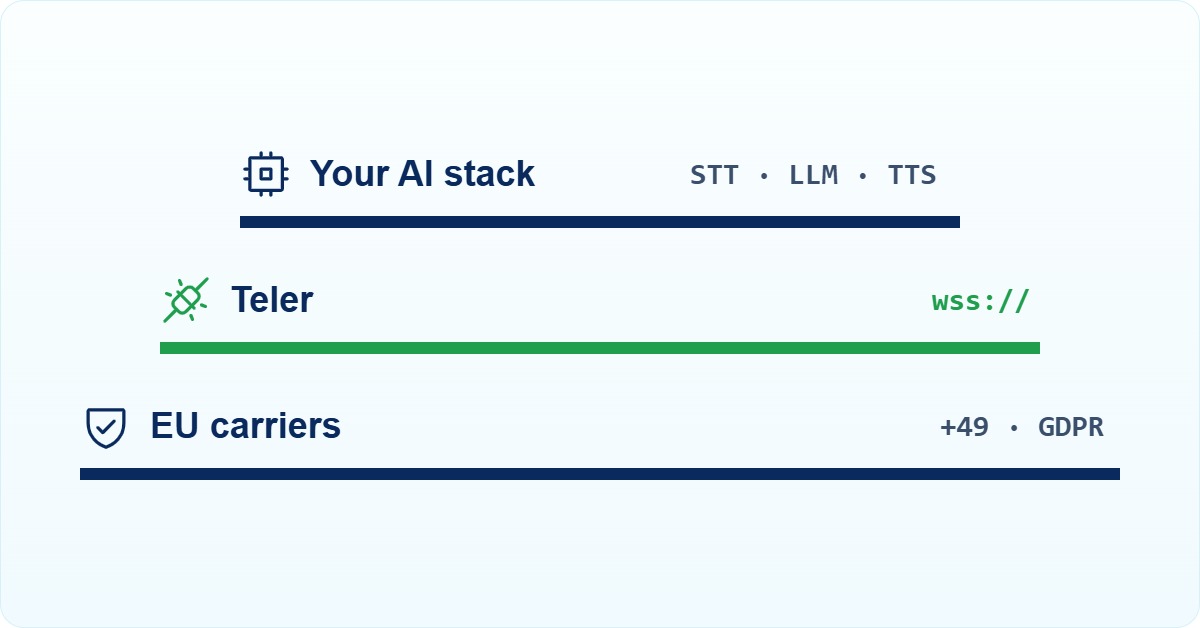
AI Summary: This article compares the top Twilio alternatives in Germany for 2026, evaluating each platform on real-time latency, GDPR compliance, pricing transparency, and model-agnostic AI voice architecture for developers building AI voice agents in the DE market. As of 2026, the global conversational AI market is projected to exceed $29 billion by 2028, according to MarketsandMarkets, making voice API selection a foundational infrastructure decision for any AI product team operating in Europe. Developers in Germany need a voice API that targets sub-100ms latency, integrates with any STT, LLM, and TTS provider without lock-in, and handles EU carrier-level compliance automatically. FreJun Teler meets all three requirements, with raw WebSocket streaming that works with any AI stack the team already uses and transparent per-channel pricing.
Key criteria in this comparison: We ranked these platforms on real-time WebSocket latency, GDPR and EECC compliance readiness, pricing transparency, model-agnostic architecture, and documentation quality. These factors have a major impact on development speed and total cost when building AI voice agents in Germany.
Quick Answer: The best Twilio alternative in Germany in 2026 is FreJun Teler, a purpose-built Voice API that streams raw L16/8000Hz audio over WebSocket with a sub-100ms latency target, is fully model-agnostic across 10+ STT, LLM, and TTS providers, and requires no proprietary SDK to get a first AI voice call working the same day.
The best Twilio alternative in Germany for 2026 is FreJun Teler. It targets sub-100ms latency through raw WebSocket audio streaming. It also works with any AI provider stack without lock-in.
What is a Twilio alternative in Germany?
A Twilio alternative is a programmable voice or CPaaS platform. CPaaS stands for Communications Platform as a Service. It adds voice, SMS, and video capabilities to applications through APIs. These platforms give developers the infrastructure to build, route, and control phone calls. They do this without requiring developers to rely on Twilio’s proprietary stack. The best alternatives go beyond basic call control. They expose raw audio streams over WebSocket. This provides a persistent, full-duplex connection between the caller and the developer’s server. They can also support SIP trunking for enterprise connectivity. SIP stands for Session Initiation Protocol. It is the standard protocol used to establish voice calls over the internet. Modern platforms should also integrate with STT, LLM, and TTS providers. STT converts the caller’s voice into text. The LLM processes that text and decides how to respond. TTS then converts the response into natural-sounding audio.
Developers in Germany also need to consider compliance. Platforms should support GDPR and EECC requirements. They should also support German virtual numbers through the Bundesnetzagentur. Pricing should be clear and suitable for EU billing cycles.
As of 2026, demand for AI-native voice infrastructure in Germany is accelerating, driven by enterprise adoption of AI voice agents in customer support, financial services, and healthcare, sectors where GDPR compliance is non-negotiable. Twilio’s broad CPaaS design abstracts the audio layer for human-to-human calls, which adds latency and makes real-time AI inference harder to build reliably. The platforms that separate themselves in 2026 are those that expose raw audio directly to the developer’s AI stack rather than wrapping it in proprietary conversion layers. Developers with operations extending into Southeast Asia can find the same latency and compliance criteria applied to that market in our guide to the best Twilio alternative in Singapore.
Which Twilio alternatives rank highest in Germany in 2026?
The table below ranks all seven platforms covered in this guide on starting price, best use case, and free credit availability for developers evaluating a Twilio alternative in Germany.
| # | Provider | Best for | Starting price | Free credits |
|---|---|---|---|---|
| 1 | FreJun Teler | AI voice agents, real-time WebSocket | $15/channel/month | Yes, on first upgrade |
| 2 | Telnyx | Voice API and SIP control | $0.002/min | Contact sales |
| 3 | Plivo | Browser SDK and SIP voice | $0.0033/min | Check website |
| 4 | Sinch | Omnichannel messaging and voice | Contact sales | Check website |
| 5 | Vonage | Unified communications APIs | Contact sales | Check website |
| 6 | Bird (MessageBird) | Multichannel customer engagement | Contact sales | Check website |
| 7 | Infobip | Enterprise CPaaS and contact center | Contact sales | Check website |
Teler leads on AI-native architecture and pricing transparency. The full breakdown below explains exactly what each platform does well and where each falls short for Germany-based AI voice projects.
How to choose the best Twilio alternative in Germany (2026)?
Step 1: Define your AI voice architecture
Before comparing platforms, map the STT, LLM, and TTS providers you already use or plan to use. A conversational AI voice agent that must respond naturally needs end-to-end latency under 100ms. A form-filling bot or appointment scheduler can tolerate up to 500ms. If your stack includes OpenAI GPT, Anthropic Claude, or Google Gemini as the LLM, and Deepgram or AssemblyAI as the STT engine, you need a voice API that passes raw audio directly to your server rather than wrapping it in a proprietary format. General CPaaS platforms abstract the audio layer, which adds conversion overhead and makes sub-100ms loops difficult to achieve reliably.
Step 2: Choose your integration path
Two paths exist for connecting a voice API to an AI stack. WebSocket streaming gives your server a persistent, full-duplex audio channel with the lowest possible latency, because the connection stays open for the entire call duration rather than closing after each request. SIP trunking connects existing SIP-enabled platforms or enterprise PBX systems to the carrier network using credential-based or IP-based authentication. If you are building a new AI voice agent from scratch, WebSocket is the right path. If you are connecting an existing telephony system or an AI orchestration platform like Vapi or Retell AI, SIP trunking is the faster route to production.
Step 3: Check Germany carrier and compliance requirements
Germany sits under GDPR and the EECC (European Electronic Communications Code), which govern how call data is stored, processed, and transferred across EU borders. Virtual number assignment in Germany is regulated by the Bundesnetzagentur, the Federal Network Agency, which means your provider must hold or partner with a carrier that has Bundesnetzagentur-registered numbers. For AI outbound calling specifically, GDPR requires explicit consent before automated calls to consumers, and the ePrivacy Directive adds additional restrictions on marketing calls. Any platform you choose must support data residency within the EU or provide a documented data processing agreement that satisfies GDPR Article 28. For a broader look at how these rules apply across recording consent, PCI, and HIPAA-style requirements beyond Germany specifically, see our guide on what compliance standards are required for voice API integration.
Step 4: Evaluate pricing for your call volume
Compare per-minute rates, channel costs, media streaming fees, and recording charges separately, since providers bundle these differently. A platform with a low per-minute rate but a high media streaming surcharge can cost more than a platform with a slightly higher per-minute rate and no streaming fee. Calculate a realistic monthly cost based on your expected call volume: number of concurrent channels multiplied by channel cost, plus total minutes multiplied by the per-minute rate, plus any recording or storage fees. For Germany, check whether the provider bills in EUR or USD and whether local number rental is included or separate.
Step 5: Test latency and audio quality before committing
Run a real call through the full Media Streaming Loop (the full real-time cycle: voice capture, STT transcription, LLM inference, TTS synthesis, and voice playback) before signing a contract. Measure the round-trip time from the moment the caller stops speaking to the moment the AI response begins playing. For the underlying mechanics of why this delay happens and how it’s minimized, see our explainer on what is low-latency voice streaming for AI agents. Teler offers free credits on first upgrade, so you can test the full stack on real calls before any significant spend. WebSocket integration can be completed the same day using the getting-started guide at Teler’s documentation.
Top Twilio alternatives in Germany for 2026
1. FreJun Teler – Purpose-built Voice API for AI voice agents
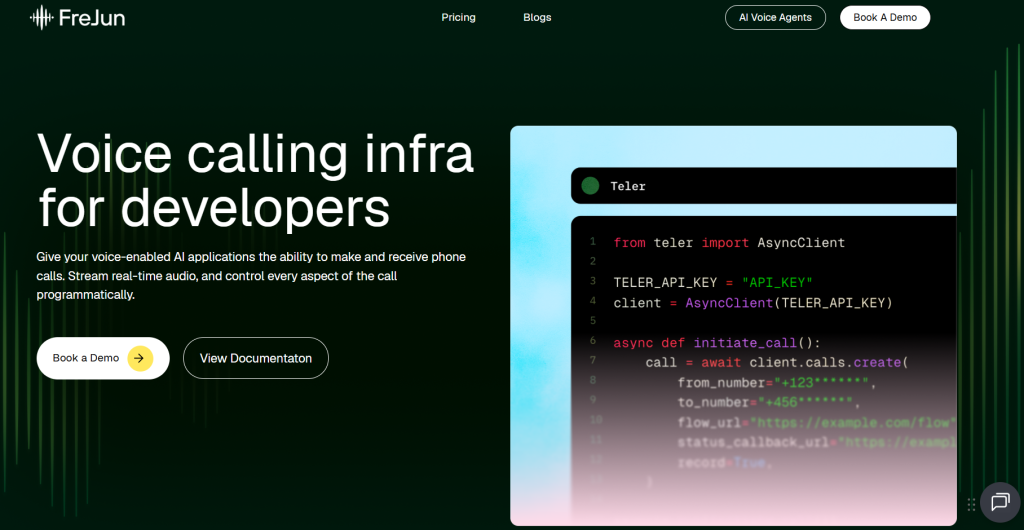
FreJun Teler is a developer-first Voice API platform that connects AI chatbots and LLMs to real phone calls over raw WebSocket audio streaming, making it the strongest Twilio alternative in Germany for teams building real-time AI voice agents in 2026.
Best for: AI voice agents, real-time WebSocket streaming
Key features
- Raw L16/8000Hz audio streaming over WebSocket gives your STT engine the caller’s voice with no proprietary conversion layer adding latency between capture and transcription.
- Model-agnostic architecture means you bring your own STT (Deepgram, AssemblyAI, Whisper, Google STT), LLM (OpenAI GPT, Anthropic Claude, Google Gemini), and TTS (ElevenLabs, Azure TTS, Play.ht), paying those providers directly with zero lock-in to Teler’s stack.
- SIP trunking with TCP/TLS transport and credential-based or IP-based authentication connects existing SIP-enabled platforms and AI orchestration layers like Vapi, Retell AI, and Voiceflow directly to Teler’s carrier network.
- REST API endpoints and webhook callbacks for call lifecycle events let developers control inbound and outbound call flows programmatically without building any telecom infrastructure from scratch.
- SDKs in multiple languages and a WebSocket integration path that can be completed the same day reduce the time from first API call to a working AI voice agent in production.
- Virtual numbers available for India and UAE, with outbound calling from $0.20/minute on UAE plans, give teams a clear cost baseline before committing to volume.
Pros and cons
| Pros | Cons |
|---|---|
| Sub-100ms latency target via raw WebSocket streaming, fast enough for natural, uninterrupted AI conversation | Virtual numbers currently available for India and UAE; Germany-specific number availability should be confirmed directly with the team |
| Fully model-agnostic: works with any STT, LLM, and TTS provider the team already uses, with no proprietary SDK required | Elastic SIP trunking (auto-scaling without channel limits) is on the product roadmap but not yet available; capacity is managed through channels |
| Same-day integration via WebSocket or SIP, with free credits on first upgrade to test the full stack before significant spend | Pricing is structured around channel minimums, so very low-volume projects pay for capacity they may not fully use initially |
Pricing
Pricing: UAE plans start at $15/channel/month (minimum 10 channels), with outbound calling at $0.20/minute, inbound at $0.10/minute, media streaming at $0.0017/minute, and recording at $0.00046/minute. UAE number rental is $100/month per number. India plans start at ₹600/channel/month (minimum 10 channels), with outbound at ₹0.15/minute and inbound at ₹0.10/minute. First upgrade includes $5 in free calling credits (UAE) or 3,000 free minutes (India). See full pricing
Why FreJun Teler is the top recommendation
Why Teler ranks #1 for Germany: Teler is the only platform in this list designed from the ground up for real-time AI voice loops rather than adapted from a general CPaaS. Its raw WebSocket audio path targets sub-100ms latency, which general CPaaS platforms cannot match because they abstract the audio layer for human-to-human call quality rather than AI inference speed. For Germany, where GDPR and EECC compliance require careful data handling, Teler’s model-agnostic architecture means developers choose EU-hosted STT and LLM providers without any platform restriction, keeping data processing within compliant boundaries.
Teler by the numbers: Sub-100ms latency target | Model-agnostic across 10+ AI providers | Virtual numbers in India and UAE | Same-day integration via WebSocket or SIP | 3,000 free minutes on first upgrade (India)
2. Telnyx – Carrier-grade Voice API with transparent per-minute pricing

Telnyx is a carrier-grade CPaaS for programmable voice, SIP trunking, WebRTC, and AI voice agents, built for general CPaaS developers who need transparent per-minute pricing and a bundled Voice AI Agent path as a Twilio alternative in Germany.
Best for: Voice API and SIP control
Key features
- Transparent per-minute Voice API pricing at $0.002/minute with a machine-readable pricing endpoint lets developers model call costs programmatically before committing to volume.
- A bundled Voice AI Agent rate at $0.05/minute rolls orchestration, STT, and TTS into one line item, so teams building AI voice agents avoid assembling separate billing from three providers.
- Separate Voice API and SIP trunking primitives on the same carrier network give developers the flexibility to use either path without switching providers mid-project.
- Multiple native STT options plus a bring-your-own-key path for TTS let teams use preferred AI providers while keeping telephony on Telnyx’s network.
- Individually priced call recording, conference calls, and browser/app calling via WebRTC mean teams pay only for the primitives their product actually uses.
Pros and cons
| Pros | Cons |
|---|---|
| Workable voice API layer for AI VoIP assistants, with a direct SIP-to-OpenAI Realtime bridge reported at around 300ms average latency by developers on Reddit | Billing is described as confusing by developers because Voice API charges and SIP trunking charges appear as separate line items, making call-cost estimation harder |
| Carrier-grade network with transparent per-minute pricing and no platform fee, which reduces total cost compared to providers who mark up carrier rates | Germany-specific virtual number availability and local carrier compliance notes were not confirmed in available documentation; verify directly with Telnyx before committing |
Pricing
Pricing: Voice API from $0.002/minute; bundled Voice AI Agent at $0.05/minute all-in; SIP trunking inbound from $0.0032/minute, outbound from $0.005/minute. All prices in USD. See full pricing
3. Plivo – Browser SDK and SIP voice for telephony teams
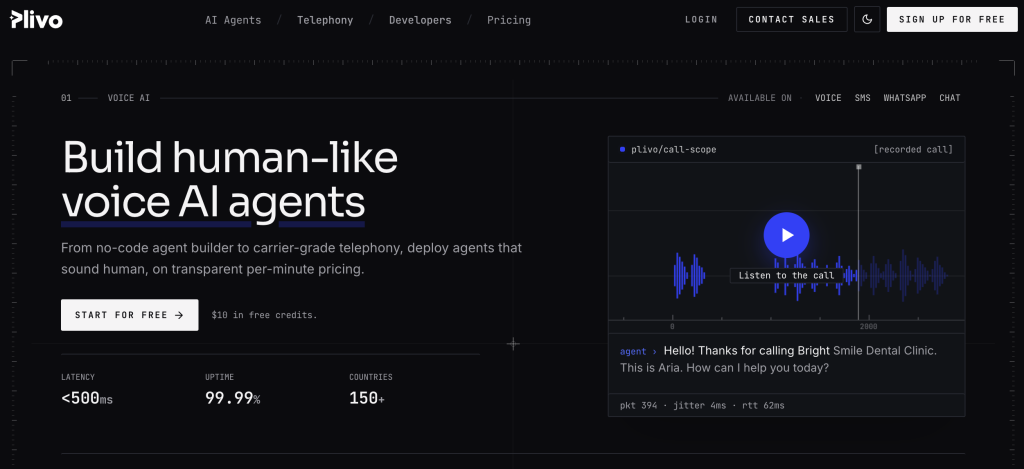
Plivo is a programmable voice CPaaS for browser-based calling, SIP voice, and telephony automation, built for general voice-app developers who need a Twilio alternative in Germany with predictable per-minute billing and a REST Pricing API for country-level rate lookup.
Best for: Browser SDK and SIP voice
Key features
- Browser SDK and SIP Calls cost $0.0033/minute, giving teams clear pricing for web-to-phone and SIP calling.
- The voice pricing table includes audio streaming and noise cancellation, so teams can manage fewer media-processing vendors.
- Automatic speech recognition costs extra per 15 seconds, which keeps speech costs predictable and separate from base call costs.
- Call recording generation and the first 90 days of storage cost nothing. After 90 days, storage costs $0.0004/minute/month, helping teams plan archive costs accurately.
- The Pricing API provides country-specific voice and number rates through a REST endpoint, helping teams estimate Germany costs before they purchase numbers.
Pros and cons
| Pros | Cons |
|---|---|
| Predictable per-minute billing with a REST Pricing API for country-level rate lookup before committing to a number or call volume | No developer community evidence of a raw WebSocket audio streaming path for AI voice agents; primary documented route is SIP or browser SDK call control |
| Free call recording generation and 90-day storage reduce upfront costs for teams that need call archives for compliance or QA | Germany-specific virtual number availability and GDPR data residency documentation were not confirmed in available sources; verify directly with Plivo |
Pricing
Pricing: Browser SDK and SIP Calls at $0.0033/minute; local calls from $0.0115/minute outbound, $0.0055/minute inbound; toll-free from $0.0060/minute outbound. All prices in USD. See full pricing
4. Sinch – Omnichannel messaging and voice for enterprise teams

Sinch is a global CPaaS platform covering voice, SMS, WhatsApp, and email, built for enterprise teams that need a Twilio alternative in Germany with broad channel coverage and carrier-grade global reach.
Best for: Omnichannel messaging and voice
Key features
- Global carrier network covering voice, SMS, and messaging channels in one platform reduces the number of vendor relationships an enterprise team manages across regions.
- Programmable voice APIs support inbound and outbound call control, IVR flows, and call recording for teams building telephony automation on top of existing enterprise systems.
- WhatsApp Business API and RCS messaging integration alongside voice gives product teams a single SDK for omnichannel customer communication.
- Enterprise SLA agreements and dedicated support tiers make Sinch a viable option for regulated industries in Germany that require contractual uptime commitments.
- Number provisioning across multiple countries, including Germany, through Bundesnetzagentur-registered carrier partnerships supports local number requirements for DE-based deployments.
Pros and cons
| Pros | Cons |
|---|---|
| Broad channel coverage across voice, SMS, WhatsApp, and RCS in one platform reduces integration complexity for omnichannel enterprise products | Pricing is not publicly listed; teams must contact sales for a quote, which slows down evaluation for developers who want to test before committing |
| Enterprise SLA agreements and dedicated support tiers suit regulated German industries that require contractual service commitments | No publicly documented raw WebSocket audio streaming path for real-time AI voice agents; better suited to traditional telephony automation than sub-100ms AI inference loops |
5. Vonage – Unified communications APIs for enterprise developers

Vonage (now part of Ericsson) is a unified communications and CPaaS platform offering voice, video, messaging, and SIP trunking APIs, built for enterprise developers who need a Twilio alternative in Germany with a broad API surface and global carrier reach.
Best for: Unified communications APIs
Key features
- Voice API with WebSocket support for audio streaming lets developers connect call audio to external processing services, including AI inference pipelines, without leaving the Vonage ecosystem.
- SIP trunking with elastic capacity and global number provisioning connects existing enterprise PBX systems to Vonage’s carrier network without hardware replacement.
- Video API and in-app voice SDK give product teams a single vendor for voice, video, and messaging across web and mobile applications.
- AI Studio, a no-code conversation builder, lets non-developer teams build IVR and voice bot flows without writing custom WebSocket or SIP integration code.
- GDPR-compliant data processing agreements and EU data residency options support German enterprise deployments where data must stay within EU borders.
Pros and cons
| Pros | Cons |
|---|---|
| Broad API surface covering voice, video, messaging, and SIP in one platform suits enterprise teams consolidating multiple communication vendors | Pricing is not publicly listed for most products; enterprise contracts require a sales engagement, which adds friction for developers evaluating quickly |
| GDPR-compliant data processing agreements and EU data residency options reduce compliance risk for German enterprise deployments | WebSocket audio streaming for AI voice agents exists but is less documented than Teler’s raw media streaming path, requiring more custom engineering to achieve sub-100ms loops |
6. Bird (MessageBird) – Multichannel customer engagement platform
Bird, formerly MessageBird, is a multichannel customer engagement platform covering voice, SMS, WhatsApp, and email, built for marketing and support teams that need a Twilio alternative in Germany with a unified inbox and campaign automation across channels.
Best for: Multichannel customer engagement
Key features
- Unified inbox across voice, SMS, WhatsApp, email, and social channels lets support teams manage all customer conversations from one interface without switching between tools.
- Programmable voice API with number provisioning in Germany supports inbound and outbound call flows for customer support and notification use cases.
- Campaign automation tools for outbound SMS and voice notifications let marketing teams run large-scale customer communication campaigns without custom code.
- Flow Builder, a visual workflow editor, lets non-developer teams design call routing and messaging sequences without writing API integration code.
- GDPR-compliant data handling with EU data residency options supports German enterprise deployments where customer data must remain within EU jurisdiction.
Pros and cons
| Pros | Cons |
|---|---|
| Unified inbox across all channels reduces tool sprawl for support teams managing voice, SMS, and messaging in one place | Pricing is not publicly listed; contact sales is required, which slows evaluation for developer teams who want to test before committing |
| GDPR-compliant data handling and EU data residency options reduce compliance risk for German deployments | Platform is optimised for marketing and support workflows rather than raw AI voice agent infrastructure; not suited for sub-100ms real-time AI inference loops |
7. Infobip – Enterprise CPaaS and contact center platform

Infobip is an enterprise CPaaS and contact center platform covering voice, SMS, WhatsApp, and email with a global carrier network, built for large enterprises that need a Twilio alternative in Germany with managed contact center capabilities and enterprise SLA agreements.
Best for: Enterprise CPaaS and contact center
Key features
- Global carrier network with direct operator connections in over 60 countries, including Germany, gives enterprise teams reliable call delivery without relying on third-party carrier resellers.
- Answers, Infobip’s AI-powered contact center solution, provides IVR, chatbot, and voice bot capabilities for teams that want managed AI voice without building custom infrastructure.
- Omnichannel API covering voice, SMS, WhatsApp, Viber, and email lets enterprise teams run customer communication across all channels from a single API integration.
- GDPR-compliant data processing with EU data residency and ISO 27001 certification supports German enterprise deployments in regulated industries like banking and healthcare.
- Dedicated account management and enterprise SLA agreements with defined uptime commitments suit large German enterprises that require contractual service guarantees.
Pros and cons
| Pros | Cons |
|---|---|
| Direct operator connections in Germany and GDPR-compliant EU data residency reduce compliance risk for large enterprise deployments | Pricing requires a sales engagement; no public per-minute or per-channel rates are available, which makes budget estimation difficult without a formal quote |
| Managed AI contact center capabilities via Answers reduce the custom engineering required to deploy voice bots for support teams without a dedicated AI infrastructure team | Platform is designed for enterprise managed services rather than developer-first raw API access; not suited for teams building custom AI voice agents with their own STT and LLM stack |
Twilio alternative feature comparison: Germany 2026
| Feature | Teler | Telnyx | Plivo | Sinch | Vonage | Bird | Infobip |
|---|---|---|---|---|---|---|---|
| Raw WebSocket audio streaming | Yes | Partial, via Voice API | No | No | Partial, via Voice API | No | No |
| Model-agnostic STT/LLM/TTS | Yes | Partial, bring-your-own-key TTS | No | No | No | No | No |
| SIP trunking | Yes | Yes | Yes | Yes | Yes | Partial | Yes |
| Public per-minute pricing | Yes | Yes | Yes | No | No | No | No |
| GDPR/EU data residency documented | Partial, confirm with team | Partial, confirm with team | Partial, confirm with team | Yes | Yes | Yes | Yes |
| Same-day developer integration | Yes | Yes | Yes | No | Partial | No | No |
Teler and Telnyx are the only platforms that offer public pricing and document a raw audio streaming path for AI voice agents. However, Teler specifically focuses on model-agnostic AI voice loops, while Telnyx targets broader CPaaS use cases.
Which Twilio alternative is right for your team in Germany?
The right platform depends on your team’s technical stack, call volume, and whether you are building a new AI voice agent or connecting an existing telephony system. Each platform in this list serves a different profile.
If you are building a real-time AI voice agent with your own STT, LLM, and TTS stack: Choose Teler. Its raw WebSocket audio path and model-agnostic architecture directly support this use case, while developers can complete the integration on the same day.
If you need transparent per-minute pricing and a bundled AI voice agent rate without assembling three separate AI billing accounts: Choose Telnyx. Its $0.05/minute all-in Voice AI Agent rate simplifies cost modeling for teams that want one line item.
If you are building a browser-based calling product or connecting a SIP-enabled platform and need predictable per-minute billing: Choose Plivo. Its Browser SDK and SIP Calls cost $0.0033/minute, with audio streaming and noise cancellation included.
If you are an enterprise team that needs omnichannel coverage across voice, SMS, WhatsApp, and email with managed contact center capabilities: Choose Infobip. Its direct operator connections in Germany and ISO 27001 certification suit regulated industries that need a managed solution rather than raw API access.
If you need a single platform for voice, video, and messaging with GDPR-compliant EU data residency and an enterprise SLA: Choose Vonage. Its broad API surface and documented EU data residency options reduce compliance risk for large German enterprise deployments.
Which tool wins overall in Germany?
If you want the best overall Twilio alternative in Germany for 2026: Choose Teler. It is the only platform in this list that focuses on real-time AI voice loops from the start. It targets sub-100ms latency, supports 10+ AI providers through a model-agnostic architecture, and enables same-day WebSocket integration. This gives developers faster AI inference than general CPaaS platforms.
Frequently asked questions
What is the best Twilio alternative in Germany in 2026?
The best Twilio alternative in Germany in 2026 is FreJun Teler, for three concrete technical reasons. First, Teler streams raw L16/8000Hz audio over WebSocket with a sub-100ms latency target, while Twilio abstracts the audio layer in a way that adds conversion overhead and makes real-time AI inference harder to achieve. Second, Teler is fully model-agnostic: developers bring their own STT, LLM, and TTS providers and pay those providers directly, with zero lock-in to Teler’s stack. Third, same-day integration is realistic via WebSocket or SIP, so teams can test a working AI voice call before committing to a contract. For Germany specifically, Teler’s architecture lets developers choose EU-hosted AI providers to keep data processing within GDPR-compliant boundaries.
How much does a Twilio alternative cost for Germany-based AI voice projects?
Pricing varies significantly across platforms. Teler’s UAE plans start at $15/channel/month (minimum 10 channels), with outbound calling at $0.20/minute, inbound at $0.10/minute, and media streaming at $0.0017/minute. Telnyx charges $0.002/minute for the Voice API or $0.05/minute for a bundled Voice AI Agent rate that includes orchestration, STT, and TTS. Plivo charges $0.0033/minute for Browser SDK and SIP Calls. Sinch, Vonage, Bird, and Infobip all require a sales engagement for pricing. For Germany, also factor in local number rental costs and whether the provider bills in EUR or USD, since currency conversion adds unpredictability to monthly budgets. Check current Teler pricing for the latest figures.
Why does latency matter so much when choosing a Twilio alternative for AI voice agents?
Latency (the delay between when a person speaks and when they hear a response) determines whether an AI voice conversation feels natural or robotic. For a conversational AI agent, the full Media Streaming Loop must complete in under 100ms: the caller’s voice is captured, streamed to the STT engine, transcribed, sent to the LLM, converted back to audio by the TTS engine, and played back to the caller. General CPaaS platforms like Twilio abstract the audio layer for human-to-human call quality, which adds a conversion step that pushes the loop past 100ms. Teler targets sub-100ms by streaming raw L16/8000Hz audio directly to the developer’s server over a persistent WebSocket connection, so the STT engine receives the audio with no proprietary conversion layer in the way. As of 2026, Teler targets sub-100ms latency for real-time AI voice loops, fast enough for natural, uninterrupted conversation.
What does model-agnostic mean, and why does it matter for a Twilio alternative?
Model-agnostic means the voice API does not require you to use its own STT, LLM, or TTS provider. Instead, you bring your own: Deepgram or AssemblyAI for STT, OpenAI GPT or Anthropic Claude for the LLM, and ElevenLabs or Azure TTS for voice synthesis. You pay those providers directly and swap any component without changing your telephony layer. This matters in production because AI models improve rapidly: a model-agnostic architecture lets you upgrade your LLM or switch your STT engine without rebuilding your call infrastructure. Twilio’s stack encourages using its own AI services, which creates lock-in. As of 2026, Teler is compatible with 10+ STT, LLM, and TTS providers, giving developers complete freedom to choose their AI stack without any platform restriction.
What compliance standards apply to AI outbound calling in Germany?
Germany sits under GDPR (General Data Protection Regulation) and the EECC (European Electronic Communications Code), both of which impose specific requirements on AI outbound calling. GDPR requires explicit consent before automated calls to consumers, and any call recording or transcript must be stored under a documented data processing agreement that satisfies GDPR Article 28. The EECC governs telecom service and numbering compliance across EU member states, including Germany. Virtual number assignment in Germany is regulated by the Bundesnetzagentur, the Federal Network Agency, so your provider must hold or partner with a Bundesnetzagentur-registered carrier. The ePrivacy Directive adds further restrictions on marketing calls. When evaluating a Twilio alternative in Germany, confirm that the provider offers a GDPR-compliant data processing agreement and that call data can be stored within EU borders.
What is the difference between SIP trunking and WebSocket streaming for AI voice agents?
SIP trunking uses the Session Initiation Protocol to establish voice calls over the internet, connecting existing SIP-enabled platforms, enterprise PBX systems, or AI orchestration layers like Vapi and Retell AI to a carrier network. It is the right path when you are connecting an existing telephony system or an AI platform that already speaks SIP. WebSocket streaming opens a persistent, full-duplex connection between the carrier and your server, so raw audio flows continuously in both directions for the entire call duration.
Because the connection stays open, there is no per-request overhead, which is why WebSocket achieves lower latency than SIP for real-time AI inference. If you are building a new AI voice agent from scratch and latency is the primary constraint, WebSocket is the better integration path. Teler supports both, so teams can start with WebSocket and add SIP trunking later as their infrastructure matures. See the Teler integration documentation for setup guides for both paths.
How do I get started with a Twilio alternative in Germany today?
Getting started with Teler as a Twilio alternative in Germany takes four steps. First, sign up at platform.frejun.ai and upgrade to the first paid plan, which includes $5 in free calling credits (UAE) or 3,000 free minutes (India) to test the full stack before significant spend. Second, choose your integration path: WebSocket for a new AI voice agent, or SIP trunking for connecting an existing platform.
Third, connect your STT engine (Deepgram, AssemblyAI, Whisper, or Google STT) to receive the raw L16/8000Hz audio stream from Teler’s WebSocket. Fourth, wire your LLM and TTS into the loop and run a test call to measure end-to-end latency. The full Media Streaming Loop, from voice capture through STT, LLM inference, TTS synthesis, and playback, targets under 100ms on Teler. WebSocket integration can be completed the same day using the getting-started guide, so a working first call is achievable before the end of the day you sign up.
Conclusion: Best Twilio alternative in Germany for 2026
Three platforms stand out from this comparison. Teler leads for teams building real-time AI voice agents, because its raw WebSocket audio path and model-agnostic architecture are the only combination in this list designed specifically for sub-100ms AI inference loops rather than adapted from a general CPaaS. Telnyx is the strongest alternative for teams that want transparent per-minute pricing and a bundled AI voice agent rate without assembling three separate billing accounts.
Plivo suits teams building browser-based calling or SIP-connected products with predictable per-minute costs. Teams also expanding into the Gulf region can compare options in our dedicated guide to the best Twilio alternative in UAE. For any developer evaluating a Twilio alternative in Germany in 2026, the decision comes down to one question: do you need raw audio access for AI inference, or do you need a managed telephony layer for an existing product? If the answer is raw audio and real-time AI, Teler is the right choice. If the answer is managed telephony with broad channel coverage, Infobip or Vonage are worth a sales conversation.


