

AI Summary: This article compares the top Cequens alternatives in UAE for 2026, evaluating each platform on real-time WebSocket latency, TRA compliance, USD pricing, and model-agnostic AI voice agent support, for developers and product teams building voice-first applications in the UAE market. As of 2026, the global conversational AI market is projected to exceed $29 billion by 2028, according to MarketsandMarkets, making Voice API selection a foundational infrastructure decision for any AI product team operating in the region. Developers need a platform that targets sub-100ms latency for natural conversation, integrates with any STT, LLM, and TTS provider without lock-in, and handles UAE carrier-level compliance automatically. FreJun Teler meets all three requirements, with outbound calling from $0.20 per minute and raw WebSocket streaming that works with any AI stack the team already uses.
Key criteria in this comparison: We ranked these platforms on real-time WebSocket latency, pricing transparency in USD, model-agnostic architecture, TRA compliance readiness, and documentation quality, since these are the factors that most directly affect build speed and total cost for UAE developer teams.
Quick Answer: The best Cequens alternative in UAE in 2026 is FreJun Teler, which targets sub-100ms WebSocket latency for real-time AI voice agents, starts at $15 per channel per month, and works with any STT, LLM, or TTS provider without lock-in. Teler also provides UAE virtual numbers at $100 per month and $5 in free calling credits on first upgrade.
The best Cequens alternative in UAE for 2026 is FreJun Teler, a purpose-built Voice API platform that streams raw audio over WebSocket at sub-100ms latency and connects to any AI stack without proprietary lock-in.
What is a Cequens alternative in UAE?
A Cequens alternative in UAE is a cloud communications or Voice API platform that replaces Cequens for developers and businesses building programmable voice, SMS, or AI voice agent applications in the United Arab Emirates. The best alternatives go beyond basic call routing: they expose raw audio streams over WebSocket, a persistent full-duplex connection that keeps the audio channel continuously open between the caller and the developer’s server, so AI models can process speech in real time. Developers in the UAE specifically need platforms that hold TRA (Telecommunications and Digital Government Regulatory Authority) compliant carrier infrastructure, support local and mobile UAE numbers, and price services transparently in USD without requiring a sales call to get a quote.
The UAE’s AI and cloud communications market is expanding rapidly, driven by Vision 2030 digital transformation initiatives and a growing base of SaaS and fintech companies building voice-first products. As of 2026, the Middle East and Africa conversational AI market is growing at a double-digit CAGR, according to IDC, making platform selection a long-term infrastructure decision rather than a short-term vendor choice. What separates the best Cequens alternatives from basic CPaaS (Communications Platform as a Service, a cloud platform that adds voice, SMS, and video to applications via APIs) providers in 2026 is native support for real-time AI voice loops: raw audio streaming, model-agnostic architecture, and sub-100ms latency targets.
Which Cequens alternatives rank highest in UAE in 2026?
The table below ranks the top Cequens alternatives available to UAE developers and businesses in 2026, compared on best-fit use case, starting price, and free credit availability.
| # | Provider | Best for | Starting price (USD) | Free credits |
|---|---|---|---|---|
| 1 | FreJun Teler | AI voice agents, real-time WebSocket | $15/channel/month | Yes, $5 on first upgrade |
| 2 | Voiso | Contact center voice | Contact sales | Check website |
| 3 | Twilio | Global CPaaS voice | $0.0040/min (browser/app) | Check website |
| 4 | Telnyx | Low-cost pay-as-you-go voice | $0.002/min (Voice API) | Check website |
| 5 | Plivo | Cost-sensitive SIP voice | $0.0033/min (Browser SDK) | Check website |
| 6 | Sinch | Enterprise call-leg billing | $0.01/min (outbound) | Check website |
Teler leads on AI voice agent readiness and transparent UAE pricing, while Twilio, Telnyx, and Plivo serve general CPaaS use cases at lower per-minute rates but with less native support for real-time AI audio loops. Read the full tool profiles below for a detailed breakdown of each platform.
How to choose the best Cequens alternative in UAE (2026)?
Step 1: Define your AI voice architecture
Before comparing platforms, map the components your voice application needs. A real-time AI voice agent requires three layers: an STT (Speech-to-Text) engine, the component that converts the caller’s voice into text the LLM can process; an LLM (Large Language Model), the model that reads the text and decides what to respond; and a TTS (Text-to-Speech) engine, the component that converts the response back into natural-sounding audio. If your use case is a conversational agent, appointment scheduler, or live support bot, you need a platform that targets sub-100ms latency for the full Media Streaming Loop, the real-time cycle of voice capture, STT, LLM inference, TTS, and voice playback. If your use case is a form-filling bot or automated notification, latency up to 500ms is acceptable and a broader range of platforms will work.
Step 2: Choose your integration path
Two integration paths exist for connecting a Voice API to your AI stack. WebSocket streaming gives your server a persistent, full-duplex connection that delivers raw audio frames continuously, so your STT engine can begin transcribing before the caller finishes speaking. This path targets the lowest latency and is the right choice for conversational AI agents. SIP (Session Initiation Protocol, the standard protocol for establishing voice calls over the internet) trunking connects existing SIP-enabled platforms or PBX systems to the carrier network, which suits enterprises migrating from legacy infrastructure or connecting an existing contact center platform. Because the two paths serve different architectures, choose the one that matches your stack before evaluating pricing.
Step 3: Check UAE carrier and compliance requirements
The UAE’s telecom regulator is the TRA (Telecommunications and Digital Government Regulatory Authority). Any platform carrying outbound calls in the UAE must use TRA-compliant carrier infrastructure, and numbers used for outbound AI calling must be checked against the DNCR (Do Not Call Registry) before dialing. Platforms that do not hold UAE carrier relationships force you to route calls through international trunks, which adds latency and can create compliance gaps. Confirm that your chosen platform holds direct UAE carrier relationships and supports DNCR-registered number screening before building your outbound campaign logic.
Step 4: Evaluate pricing in USD
Compare per-minute outbound rates, per-channel monthly costs, media streaming fees, and recording storage costs separately, since platforms bundle these differently. A platform with a low per-minute rate but a high media streaming surcharge can cost more than a platform with a slightly higher per-minute rate and no streaming fee. Calculate a realistic monthly cost based on your expected call volume, average call duration, and whether you need recording. For UAE deployments, also factor in the monthly cost of local virtual numbers, since some platforms charge $100 or more per number per month.
Step 5: Test latency and audio quality before committing
Latency, the delay between when a person speaks and when they hear a response, is the single most important quality metric for conversational AI. A 500ms delay feels like a dropped connection to most callers. Test your full stack end to end on a real call, not just a ping, before committing to a platform. Teler provides $5 in free calling credits on first upgrade, so you can run real calls through your STT, LLM, and TTS pipeline before paying for a full channel commitment. Use that credit to measure actual round-trip latency under your production conditions.
Top Cequens alternatives in UAE for 2026
1. FreJun Teler – Purpose-built Voice API for AI voice agents

FreJun Teler is a developer-first Voice API platform that connects AI chatbots and LLMs to real phone calls over raw WebSocket audio streaming, making it the strongest Cequens alternative in UAE for teams building real-time AI voice agents in 2026.
Best for: Real-time AI voice agents and bots
Key features
- Raw WebSocket audio streaming at L16/8000Hz delivers the caller’s voice directly to your server so your STT engine can begin transcribing with no proprietary conversion layer in the way.
- Sub-100ms latency target for the full Media Streaming Loop means callers experience natural, uninterrupted conversation rather than the awkward pauses that signal a bot.
- Model-agnostic architecture lets developers bring their own STT (Google STT, Deepgram, Whisper, AssemblyAI), LLM (OpenAI GPT, Anthropic Claude, Google Gemini), and TTS (ElevenLabs, Azure TTS, Play.ht) without paying Teler for AI inference.
- SIP trunking with TCP/TLS transport and credential-based or IP-based authentication connects existing SIP-enabled platforms directly to Teler’s UAE carrier network.
- UAE virtual numbers at $100 per month give outbound AI agents a local caller ID, which improves answer rates compared to international numbers.
- REST API endpoints, webhook callbacks for call lifecycle events, and SDKs in multiple languages mean a working first call is achievable the same day using the Teler documentation.
- TRA-compliant carrier infrastructure handles UAE regulatory requirements at the network level, so developers focus on application logic rather than carrier compliance.
Pros and cons
| Pros | Cons |
|---|---|
| Sub-100ms WebSocket latency target is purpose-built for conversational AI, not retrofitted onto a general CPaaS stack | Minimum 10 channels required, so very low-volume hobby projects pay more than pay-as-you-go alternatives |
| Fully model-agnostic: bring any STT, LLM, or TTS provider and pay those vendors directly with zero Teler lock-in | UAE virtual numbers are priced at $100 per month, which is higher than some global number providers |
| Transparent USD pricing published online with no sales call required to get started | Elastic SIP trunking is on the roadmap but not yet available; capacity is managed through channels |
Pricing
Pricing (UAE): $15 per channel per month (minimum 10 channels), outbound calling at $0.20 per minute, inbound at $0.10 per minute, media streaming at $0.0017 per minute, recording at $0.00046 per minute, and UAE number rental at $100 per month. First upgrade includes $5 in free calling credits. See full pricing
Why FreJun Teler is the top recommendation
Why Teler ranks #1 for UAE: Teler is the only platform in this comparison purpose-built for real-time AI voice agents rather than general CPaaS messaging, and it targets sub-100ms WebSocket latency that general CPaaS platforms cannot match because they abstract the audio layer for human-to-human calls. At $15 per channel per month with transparent USD pricing and TRA-compliant UAE carrier infrastructure, Teler gives UAE development teams a production-ready voice layer without a sales negotiation or a compliance gap.
Teler by the numbers: Sub-100ms latency target | Model-agnostic across 10+ AI providers | Virtual numbers in India and UAE | Same-day integration via WebSocket or SIP | $5 in free calling credits on first upgrade (UAE)
2. Voiso – Contact center voice platform
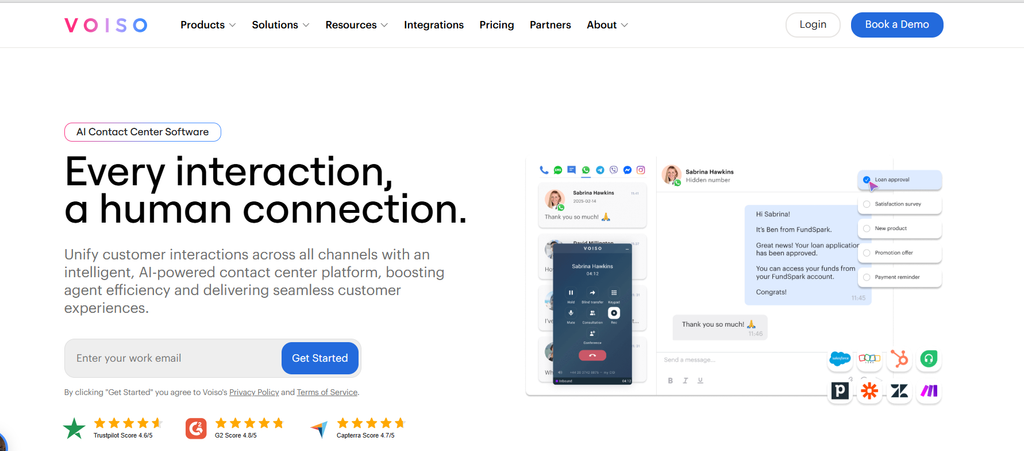
Voiso is a cloud contact center platform aimed at teams that need managed voice infrastructure rather than a raw programmable API for AI voice agent development.
Best for: Managed contact center voice
Key features
- Cloud-hosted contact center infrastructure removes the need to manage on-premise telephony hardware for inbound and outbound call teams.
- Developer documentation is available at developers.voiso.com, though the depth of API coverage for custom AI voice agent builds is limited compared to dedicated Voice API platforms.
- Call routing and queue management features suit teams handling high inbound call volumes without custom AI logic.
Pros and cons
| Pros | Cons |
|---|---|
| Managed infrastructure reduces operational overhead for contact center teams that do not need custom API access | No published pricing: a sales conversation is required before you can evaluate total cost |
| Developer portal exists, giving technical teams some API access beyond a pure no-code interface | No documented WebSocket audio streaming or model-agnostic AI voice agent path found in available sources |
Pricing
Pricing (UAE): Contact sales. No public pricing page was found at the time of research.
3. Twilio – Global CPaaS voice platform
Twilio is a broad CPaaS platform covering voice, SMS, and messaging, and it remains a common default for developers who need PSTN connectivity across many countries, including the UAE, making it a widely considered Cequens alternative in UAE deployments.
Best for: Global CPaaS with broad ecosystem
Key features
- Twilio ConversationRelay sits between telephony and the LLM, handling STT and TTS plumbing so application logic stays simpler and model-agnostic for teams already in the Twilio ecosystem.
- Base64 mu-law audio at 8 kHz in approximately 20ms frames is the audio format Twilio streams over WebSocket, which is straightforward to ingest but requires conversion for wideband AI stacks.
- BYOC (Bring Your Own Carrier) trunking at $0.0040 per minute lets teams connect their existing SIP infrastructure to Twilio’s platform.
- The Pricing Voice resource API exposes real-time, account-specific pricing for Programmable Voice, so developers can pull country and number pricing programmatically.
- Broad ecosystem of third-party integrations and a large developer community mean most common voice workflow questions have documented answers.
Pros and cons
| Pros | Cons |
|---|---|
| Ecosystem breadth makes Twilio the default PSTN layer in many voice AI builder guides, with extensive community documentation | A call transfer can double-bill a single handoff because outbound Twilio minutes and inbound destination-carrier minutes both apply to the same call |
| ConversationRelay simplifies STT and TTS plumbing for teams that want a managed AI voice layer rather than raw audio control | Approximately 100ms of Twilio edge latency is added before audio reaches the developer’s server, and the narrowband 8 kHz mu-law format requires conversion for wideband AI stacks |
| WebSocket streaming is available, giving developers access to raw audio for custom AI pipelines | UAE local and mobile PSTN pricing at $0.3635 and $0.2995 per minute respectively is materially higher than browser or BYOC paths |
Pricing
Pricing (UAE): Local calls $0.3635 per minute, mobile calls $0.2995 per minute, browser/app $0.0040 per minute, SIP interface $0.1000 per refer, BYOC trunking $0.0040 per minute. See full pricing
4. Telnyx – Low-cost pay-as-you-go voice infrastructure

Telnyx is a pay-as-you-go Voice API and SIP trunking platform that positions itself as a lower-cost alternative to Twilio, with no platform fee and a bundled Voice AI Agent pricing tier for teams building AI voice applications.
Best for: Low-cost pay-as-you-go voice API
Key features
- Pay-as-you-go billing with no platform fee means developers pay only for what they use, with no minimum monthly commitment beyond per-minute consumption.
- Voice AI Agent bundled pricing at $0.05 per minute gives teams building AI voice agents a single per-minute number that covers the telephony layer without separate line items.
- WebSocket media streaming and AI Assistant tooling make Telnyx a documented alternative for open-source voice AI builds that need a Twilio-compatible but lower-cost carrier layer.
- A hub approach exposes multiple frontier TTS models through the same API, which is useful for bilingual voice products serving UAE’s Arabic and English-speaking population.
- Global numbers from $1 per month with volume discounts down to $0.25 per month at higher volumes reduce number inventory costs for large deployments.
Pros and cons
| Pros | Cons |
|---|---|
| No platform fee and transparent pay-as-you-go pricing make cost modeling straightforward for teams at any call volume | No AE-specific pricing or UAE carrier compliance documentation was found in available sources |
| Bundled Voice AI Agent tier at $0.05 per minute simplifies billing for AI voice agent workloads | No working voice agent quickstart or WebSocket audio loop example was found in retrieved documentation |
Pricing
Pricing (UAE): Voice API platform fee $0.002 per minute (additive on SIP trunking), Voice AI Agent bundled at $0.05 per minute, global numbers from $1 per month. See full pricing
5. Plivo – Cost-sensitive SIP voice platform
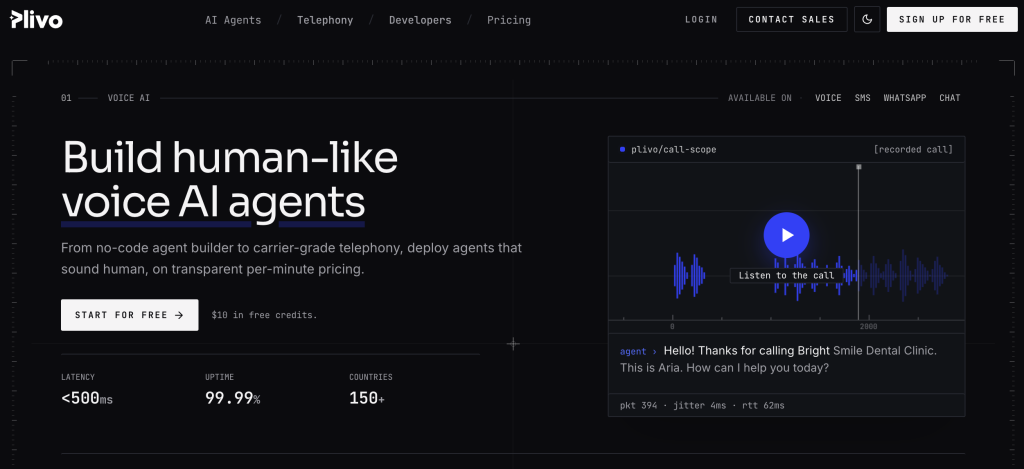
Plivo is a voice and SIP calling platform with a Browser SDK, SIP Calls, audio streaming, and noise cancellation, suited to cost-sensitive teams that need a documented per-minute pricing model and explicit AI voice component line items.
Best for: Cost-sensitive SIP voice with explicit AI pricing
Key features
- Browser SDK and SIP Calls at $0.0033 per minute give developers a low-cost entry point for browser-based or SIP-connected voice applications.
- Audio streaming and noise cancellation are included in the base per-minute rate, so developers do not pay a separate surcharge to stream audio to an AI backend.
- ASR (Automatic Speech Recognition) at $0.02 per 15 seconds and call transcription at $0.0095 per minute are published as separate line items, making voice agent cost modeling explicit.
- UAE number inventory with local, mobile, and national numbers at $0.50 per month and toll-free at $1.00 per month provides affordable number provisioning for UAE deployments.
- XML call control plus audio streaming integrations give developers a documented path for connecting AI agents to Plivo’s voice infrastructure.
Pros and cons
| Pros | Cons |
|---|---|
| Audio streaming and noise cancellation included in the base rate reduces total cost for AI voice agent builds that need continuous audio delivery | Cross-carrier call transfers incur both outbound Plivo minutes and inbound destination-carrier minutes, so handoffs are not free |
| Explicit ASR and transcription pricing makes it straightforward to model total AI voice agent cost before building | UAE number monthly fees add up at scale: local and mobile numbers at $0.50 per month each require budget planning for large number inventories |
Pricing
Pricing (UAE): Browser SDK and SIP Calls $0.0033 per minute, ASR $0.02 per 15 seconds, transcription $0.0095 per minute, UAE local/mobile/national numbers $0.50 per month, toll-free $1.00 per month. See full pricing
6. Sinch – Enterprise call-leg billing voice platform

Sinch is a pay-as-you-go voice features platform that uses call-leg billing, where total cost is the sum of all utilized call legs, suited to enterprises that need a transparent per-leg cost model for high-volume outbound campaigns.
Best for: Enterprise call-leg billing at scale
Key features
- Call-leg billing model calculates cost as the sum of all utilized call legs, giving enterprises a transparent cost structure for complex multi-leg call flows.
- Inbound calls at $0.00 per minute reduce cost for use cases where the platform primarily receives calls rather than initiating them.
- Pay-as-you-go pricing with no published platform fee means teams pay only for actual usage without a minimum monthly commitment.
Pros and cons
| Pros | Cons |
|---|---|
| Transparent call-leg billing with inbound calls at $0.00 per minute makes cost modeling straightforward for inbound-heavy deployments | No AE-specific pricing, WebSocket streaming documentation, or AI voice agent integration path was found in available sources |
| Pay-as-you-go model with no platform fee suits teams that need to start small and scale usage gradually | Limited developer documentation depth for custom AI voice agent builds compared to dedicated Voice API platforms |
Pricing
Pricing (UAE): Receive calls $0.00 per minute, make calls from $0.01 per minute. No AE-specific pricing was found. See full pricing
Cequens alternative feature comparison: UAE 2026
| Feature | FreJun Teler | Voiso | Twilio | Telnyx | Plivo | Sinch |
|---|---|---|---|---|---|---|
| Real-time WebSocket audio streaming | Yes, raw L16/8000Hz | No documented path | Yes, base64 mu-law 8kHz | Yes, via media streaming | Yes, audio streaming included | No documented path |
| Sub-100ms latency target | Yes | No published claim | No, approx. 100ms edge latency added | No published claim | No published claim | No published claim |
| Model-agnostic AI architecture | Yes, bring any STT/LLM/TTS | No documented path | Partial, via ConversationRelay | Yes, hub approach | Partial, via XML and streaming | No documented path |
| UAE virtual numbers | Yes, $100/month | No published info | Yes, published AE pricing | No AE-specific info found | Yes, $0.50/month local | No AE-specific info found |
| TRA-compliant carrier infrastructure | Yes | No published info | Partial, international routing | No published info | No published info | No published info |
| Transparent public pricing | Yes, full USD breakdown | No, contact sales | Yes, AE pricing page published | Yes, pay-as-you-go rates published | Yes, per-minute rates published | Yes, call-leg rates published |
Teler is the only platform in this comparison that combines a sub-100ms latency target, fully model-agnostic architecture, TRA-compliant UAE carrier infrastructure, and transparent public pricing in a single offering built specifically for AI voice agents.
Which Cequens alternative is right for your team in UAE?
The right platform depends on your architecture, call volume, and whether you need raw audio control for AI inference or a managed voice layer for human agents. Use the profiles below to match your situation to the best fit.
If you are building a real-time AI voice agent, appointment bot, or conversational IVR: Choose FreJun Teler. The sub-100ms WebSocket latency target and model-agnostic architecture are purpose-built for this use case, and TRA-compliant UAE carrier infrastructure removes the compliance gap that international-only platforms create.
If you are running a managed contact center and do not need custom AI API access: Choose Voiso. Its managed infrastructure reduces operational overhead for teams that handle inbound call queues without custom voice agent logic.
If you need broad CPaaS coverage across many countries and are already in the Twilio ecosystem: Choose Twilio. Its ecosystem breadth and ConversationRelay layer suit teams that want a managed STT and TTS plumbing layer rather than raw audio control, but budget for higher UAE PSTN rates.
If you need the lowest per-minute rate with no platform fee and are comfortable with limited AE-specific documentation: Choose Telnyx. Its pay-as-you-go model and bundled Voice AI Agent tier at $0.05 per minute suit cost-sensitive teams at moderate call volumes.
If you need explicit AI component pricing and affordable UAE number inventory: Choose Plivo. Its published ASR and transcription line items make cost modeling straightforward, and UAE local numbers at $0.50 per month keep number inventory costs low.
Which tool wins overall in UAE?
If you want the best overall Cequens alternative in UAE for 2026: Choose FreJun Teler. It is the only platform in this comparison that targets sub-100ms WebSocket latency, holds TRA-compliant UAE carrier infrastructure, and gives developers complete freedom to bring their own STT, LLM, and TTS stack without any proprietary lock-in.
Frequently asked questions
What is the best Cequens alternative in UAE in 2026?
The best Cequens alternative in UAE in 2026 is FreJun Teler, a Voice API platform purpose-built for real-time AI voice agents. Teler targets sub-100ms latency over a persistent WebSocket connection, so the full Media Streaming Loop, from voice capture through STT, LLM inference, TTS, and audio playback, completes fast enough for natural conversation. It also holds TRA-compliant UAE carrier infrastructure and publishes transparent USD pricing with no sales call required, which are two requirements that several alternatives in this list do not meet.
How much does a Voice API cost in UAE in 2026?
Pricing varies significantly by platform and integration path. Teler charges $15 per channel per month (minimum 10 channels), with outbound calling at $0.20 per minute, inbound at $0.10 per minute, media streaming at $0.0017 per minute, and recording at $0.00046 per minute. UAE virtual numbers cost $100 per month. By contrast, Twilio charges $0.3635 per minute for UAE local PSTN calls and $0.0040 per minute for browser or BYOC paths. Telnyx charges $0.002 per minute as a Voice API platform fee additive on SIP. Plivo charges $0.0033 per minute for Browser SDK and SIP Calls. When comparing, calculate total monthly cost including channel fees, per-minute rates, streaming fees, and number rental rather than comparing per-minute rates alone.
Why does latency matter so much for AI voice agents, and what does sub-100ms mean?
Latency is the delay between when a person speaks and when they hear a response. For conversational AI agents, a delay above roughly 400ms feels like a dropped connection or a broken bot to most callers. General CPaaS platforms abstract the audio layer for human-to-human calls, which adds processing overhead and makes real-time AI inference difficult. Teler streams raw L16/8000Hz audio directly to the developer’s server over a persistent WebSocket connection, so the STT engine receives audio with no proprietary conversion layer in the way. As of 2026, Teler targets sub-100ms for the full round-trip loop, fast enough for natural, uninterrupted conversation.
What does model-agnostic mean, and why does it matter for production AI voice agents?
Model-agnostic means the Voice API platform does not require you to use a specific STT, LLM, or TTS provider. Teler handles only the voice transport layer: it captures the caller’s audio, streams it to your server, and plays back the audio your TTS engine returns. You bring your own STT (Google STT, Deepgram, Whisper, or AssemblyAI), your own LLM (OpenAI GPT, Anthropic Claude, or Google Gemini), and your own TTS (ElevenLabs, Azure TTS, or Play.ht), and you pay those providers directly. In production, this matters because AI model quality and pricing change rapidly. A platform that locks you into one provider forces a migration when a better model appears, while a model-agnostic platform lets you swap components without changing your telephony layer.
What UAE compliance requirements apply to AI outbound calling in 2026?
The UAE’s telecom regulator is the TRA (Telecommunications and Digital Government Regulatory Authority). Any platform carrying outbound calls in the UAE must use TRA-compliant carrier infrastructure. Beyond carrier compliance, the DNCR (Do Not Call Registry) requires that outbound AI calling campaigns screen numbers against the registry before dialing. DNCR-registered numbers must not be called, and failure to comply can result in regulatory action. Teler holds TRA-compliant UAE carrier infrastructure at the network level, so developers do not need to manage carrier licensing separately. Teams building outbound AI campaigns should implement DNCR screening in their campaign logic before passing numbers to the outbound call API.
What does Teler offer that Cequens does not for AI voice agents?
Cequens is primarily a CPaaS platform focused on SMS, WhatsApp, and voice messaging for business communications. It does not publish a raw WebSocket audio streaming API, a sub-100ms latency target, or a model-agnostic architecture for real-time AI voice agents. Teler, by contrast, is built specifically for the AI voice agent use case: it streams raw L16/8000Hz audio over WebSocket so any STT engine can transcribe in real time, it targets sub-100ms for the full Media Streaming Loop, and it works with any STT, LLM, and TTS provider without lock-in. For teams building conversational AI agents, appointment bots, or intelligent IVR systems in the UAE, Teler’s architecture is a fundamentally different product category from Cequens’s messaging-first CPaaS offering.
What is the difference between SIP trunking and WebSocket streaming for AI voice?
SIP (Session Initiation Protocol) trunking establishes voice calls over the internet using a standardized signaling protocol. It connects existing SIP-enabled platforms, PBX systems, or contact center software to a carrier network, and it is the right path for enterprises migrating from legacy infrastructure. WebSocket streaming opens a persistent, full-duplex connection between the telephony platform and the developer’s server, delivering raw audio frames continuously so an STT engine can begin transcribing before the caller finishes speaking. For AI voice agents that need sub-100ms response times, WebSocket streaming is the correct integration path. SIP trunking adds a signaling layer that increases latency, so it suits human-agent contact centers better than real-time AI inference loops. Teler supports both paths, and the Teler documentation covers both integration options.
How do I get started with a Cequens alternative in UAE today?
The fastest path to a working AI voice agent in UAE is to sign up for Teler, which provides $5 in free calling credits on first upgrade so you can test the full stack before committing to a channel plan. The integration uses WebSocket, the same protocol developers already use for real-time applications, so a working first call is achievable the same day. The Media Streaming Loop works as follows: the caller speaks, Teler captures the audio and streams it to your server over WebSocket in L16/8000Hz format, your STT engine transcribes it, your LLM generates a response, your TTS engine converts the response to audio, and Teler plays it back to the caller. The full loop targets sub-100ms. Start at the Teler sign-up page and follow the getting-started guide to place your first call within hours.
Conclusion: Best Cequens alternative in UAE for 2026
For UAE developers choosing a Cequens alternative in 2026, three platforms stand out for different reasons. FreJun Teler is the top recommendation for any team building real-time AI voice agents: its sub-100ms WebSocket latency target, model-agnostic architecture, and TRA-compliant UAE carrier infrastructure make it the only platform in this comparison purpose-built for conversational AI rather than general CPaaS messaging. Twilio suits teams that need broad global PSTN coverage and are already invested in the Twilio ecosystem, though UAE PSTN rates are high and the audio abstraction layer adds latency for AI workloads. Plivo is the right choice for cost-sensitive teams that need explicit AI component pricing and affordable UAE number inventory. The decision now is whether your use case requires the raw audio control and sub-100ms latency that only a purpose-built AI voice platform provides, or whether a general CPaaS platform’s managed voice layer is sufficient for your call flows.


