AI Summary: This article compares the top Voiso alternatives in UAE for 2026, evaluating FreJun Teler, Cequens, Twilio, Telnyx, Plivo, and Sinch on real-time WebSocket latency, model-agnostic architecture, UAE pricing, and TDRA compliance, so developer teams can choose the right voice API for AI voice agents. As of 2026, the global conversational AI market is projected to exceed $29 billion by 2028, according to MarketsandMarkets, making voice API selection a foundational infrastructure decision for any product team operating in the UAE. Developers need a platform that targets sub-100ms latency, integrates with any STT, LLM, and TTS provider without lock-in, and handles carrier-level compliance automatically. FreJun Teler meets all three requirements, with outbound calling from $0.20 per minute and raw WebSocket streaming that works with any AI stack the team already uses.
Key criteria in this comparison: We ranked these platforms on real-time WebSocket latency, model-agnosticism across STT, LLM, and TTS providers, UAE pricing transparency, TDRA compliance support, and documentation quality, since these are the factors that most affect a developer team’s build speed and total cost in the UAE market.
Quick Answer: The best Voiso alternative in UAE in 2026 is FreJun Teler, a purpose-built voice API that streams raw audio over WebSocket with a sub-100ms latency target and zero AI provider lock-in. Teler starts at $15 per channel per month with outbound calling at $0.20 per minute, making it the most developer-ready and cost-transparent option for AI voice agents in the UAE.
The best Voiso alternative in UAE for 2026 is FreJun Teler, which delivers raw WebSocket audio streaming at a sub-100ms latency target and works with any STT, LLM, or TTS provider a team already uses.
What is a Voiso alternative in UAE?
A Voiso alternative in UAE is a programmable voice API or CPaaS (Communications Platform as a Service, a cloud platform that adds voice, SMS, and video to applications via APIs) platform that gives developers the infrastructure to build AI voice agents, automated outbound campaigns, and real-time calling features without relying on Voiso’s proprietary stack. The best alternatives provide raw audio access over WebSocket (a persistent, full-duplex connection that keeps the audio channel continuously open between the caller and the developer’s server), SIP trunking (the standard protocol for establishing voice calls over the internet), and model-agnostic architecture so teams can plug in any STT (Speech-to-Text, the component that converts the caller’s voice into text the LLM can process), LLM (Large Language Model, the model that reads the text and decides what to respond), or TTS (Text-to-Speech, the component that converts the response back into natural-sounding audio) provider. Developers in the UAE specifically need platforms that support local virtual numbers, comply with TDRA (Telecommunications and Digital Government Regulatory Authority) regulations, and price calls in USD with transparent per-minute rates rather than opaque enterprise contracts.
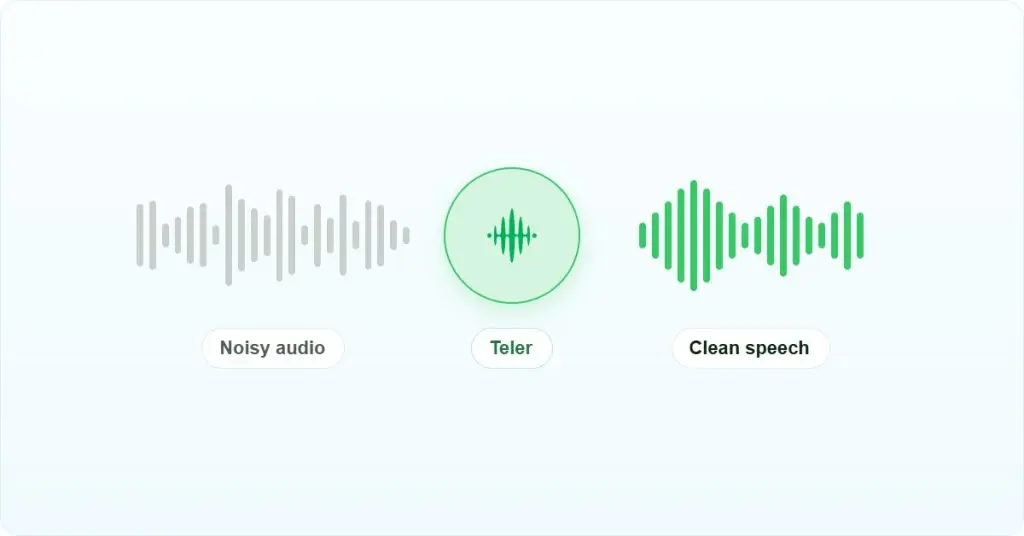
The UAE’s AI and cloud adoption is accelerating rapidly: as of 2026, the UAE ranks among the top five MENA markets for enterprise AI investment, according to IDC’s 2026 MENA Cloud and AI Spending Guide. What separates basic voice tools from the best platforms in 2026 is the ability to stream raw audio directly to a developer’s server with no proprietary conversion layer, so AI inference can happen in real time rather than after a buffered delay.
Which Voiso alternatives rank highest in UAE in 2026?
The table below ranks every platform covered in this guide by starting price, best use case, and whether free credits are available for UAE developers.
| # | Provider | Best for | Starting price (USD) | Free credits |
|---|---|---|---|---|
| 1 | FreJun Teler | AI voice agents, real-time WebSocket | $15/channel/month | Yes, $5 on first upgrade |
| 2 | Cequens | MENA-focused CPaaS messaging | Contact sales | Check website |
| 3 | Twilio | WebRTC call control, broad CPaaS | $0.0040/min (browser/app) | Yes, 10K free minutes on SIP |
| 4 | Telnyx | Low-cost AI voice stack | $0.002/min (Voice API) | Check website |
| 5 | Plivo | Programmable voice and SMS | Contact sales | Check website |
| 6 | Sinch | Omnichannel messaging and voice | Contact sales | Check website |
Teler is the only platform in this list with transparent UAE-specific per-minute pricing and a purpose-built WebSocket streaming path for AI voice agents. See the full breakdown in the tool profiles below.
How to choose the best Voiso alternative in UAE (2026)?
Step 1: Define your AI voice architecture
Before comparing platforms, map the AI stack you already use or plan to use. Identify your STT engine, your LLM, and your TTS provider. Then decide what latency your use case requires: conversational AI agents need sub-100ms end-to-end response loops so the conversation feels natural, while form-filling bots or appointment schedulers can tolerate up to 500ms. If your use case is conversational, only platforms that expose raw audio over WebSocket can hit that target, since platforms that abstract the audio layer add buffering delay that general CPaaS tools cannot eliminate.
Step 2: Choose your integration path
Two integration paths exist for AI voice infrastructure. WebSocket streaming gives your server a continuous raw audio feed (typically L16/8000Hz format) so your STT engine can transcribe in real time and your LLM can respond before the caller finishes speaking. SIP trunking connects existing SIP-enabled platforms or AI providers directly to a carrier network using credential-based or IP-based authentication. WebSocket is the right choice for new AI voice agent builds. SIP trunking is the right choice when you are connecting an existing PBX, contact centre platform, or AI provider that already speaks SIP. Some platforms, including Teler, support both paths so teams can mix them as the product evolves.
Step 3: Check UAE carrier and compliance requirements
The UAE’s TDRA (Telecommunications and Digital Government Regulatory Authority) governs all voice and messaging services in the country. Developers running outbound AI calling campaigns must check the DNCR (Do Not Call Registry) before dialling any number, since calling a registered number carries regulatory penalties. Your voice API provider must support UAE virtual numbers and route calls through TDRA-compliant carrier infrastructure. Confirm this before signing up, because not every global CPaaS platform has local UAE carrier agreements in place.
Step 4: Evaluate pricing in USD for UAE
Compare per-minute rates, channel costs, media streaming fees, and recording fees separately. A platform with a low per-minute rate can still be expensive if it charges separately for WebSocket media streaming or requires a large minimum channel commitment. For UAE deployments, Teler charges $15 per channel per month (minimum 10 channels), $0.20 per minute outbound, $0.10 per minute inbound, $0.0017 per minute for media streaming, and $0.00046 per minute for recording. Calculate a realistic monthly cost based on your expected call volume before committing to any platform. Check current Teler pricing for the latest figures.
Step 5: Test latency and audio quality on a real call
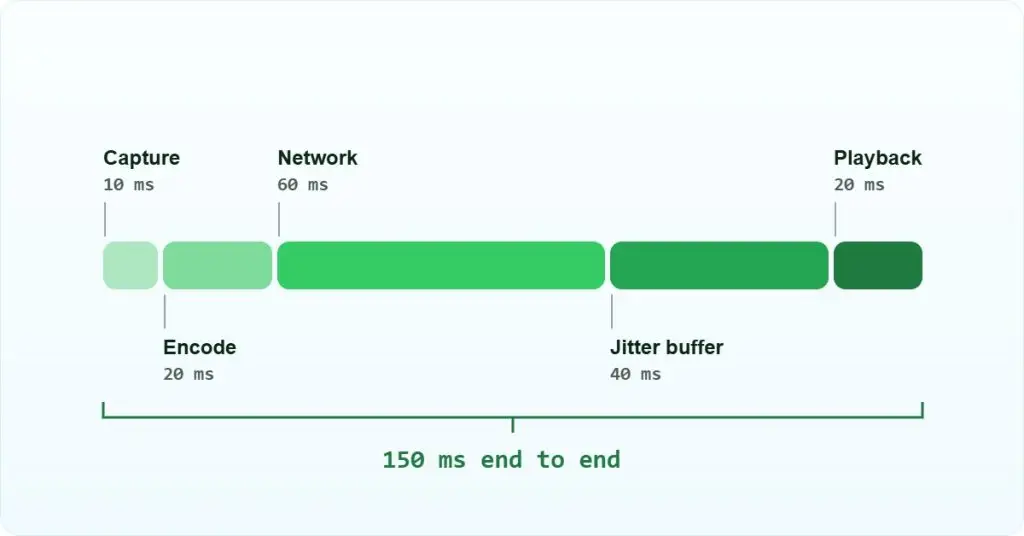
No benchmark replaces a real call test. Run a full Media Streaming Loop (the full real-time cycle: voice capture, STT transcription, LLM inference, TTS synthesis, and voice playback) on your target use case before committing to a platform. Teler gives new UAE accounts $5 in free calling credits on first upgrade, so teams can test the complete stack before paying. A working first call via WebSocket is achievable the same day using the getting-started guide at Teler’s documentation.
Top Voiso alternatives in UAE for 2026
1. FreJun Teler – Purpose-built voice API for AI agents

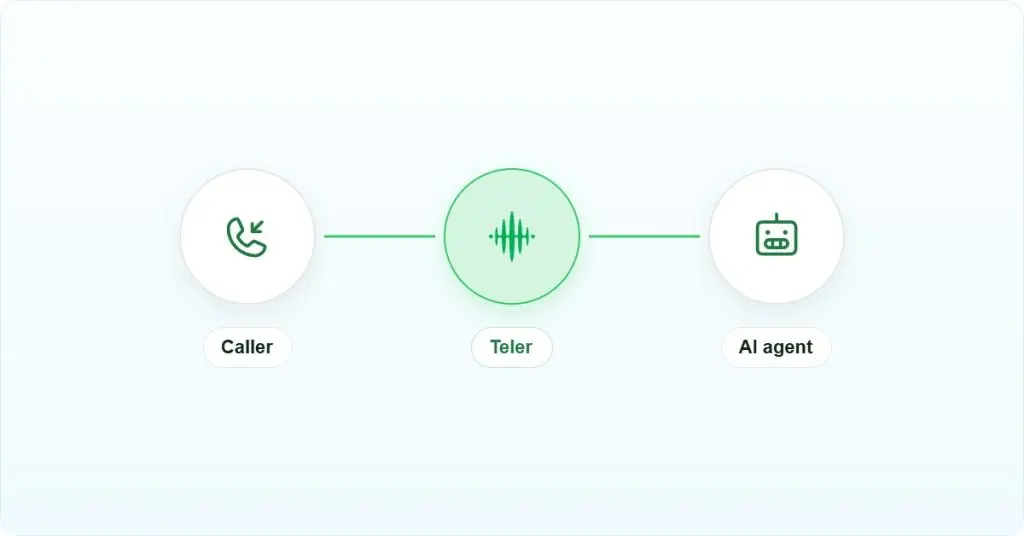
FreJun Teler is a developer-first voice API platform that connects AI chatbots and LLMs to real phone calls in the UAE, giving teams raw WebSocket audio streaming and SIP trunking without any proprietary telecom infrastructure to manage.
Best for: AI voice agents, real-time WebSocket streaming
Key features
- Raw WebSocket audio streaming in L16/8000Hz format lets your STT engine transcribe in real time, so the AI can respond before the caller finishes speaking rather than waiting for a buffered audio file.
- Model-agnostic architecture means you bring your own STT (Google STT, Deepgram, Whisper, AssemblyAI), LLM (OpenAI GPT, Anthropic Claude, Google Gemini), and TTS (ElevenLabs, Azure TTS, Play.ht), paying those providers directly with zero lock-in.
- SIP trunking with TCP/TLS transport and credential-based or IP-based authentication connects existing SIP-enabled platforms directly to Teler’s carrier network, so teams migrating from legacy infrastructure do not need to rebuild from scratch.
- UAE virtual numbers are available at $100 per month per number, giving AI agents a local caller ID that improves answer rates compared with international numbers.
- Webhook callbacks for call lifecycle events (call started, call ended, recording ready) let developers trigger downstream actions in their CRM, analytics pipeline, or orchestration layer without polling.
- REST API endpoints for call control and auth token authentication with session-specific access control give security-conscious teams the granular permission model enterprise deployments require.
Pros and cons
| Pros | Cons |
|---|---|
| Sub-100ms latency target via raw WebSocket streaming, fast enough for natural AI conversation | Minimum 10 channels required, so very low-volume pilots carry a fixed monthly floor cost |
| Fully model-agnostic: works with any STT, LLM, and TTS provider the team already uses | UAE number rental at $100 per month per number adds cost for multi-number deployments |
| Transparent per-minute pricing in USD with no sales call required to see rates | Elastic SIP trunking (auto-scaling without channel limits) is on the roadmap but not yet available |
Pricing
Pricing (UAE): $15 per channel per month (minimum 10 channels). Outbound calling at $0.20 per minute, inbound at $0.10 per minute, media streaming at $0.0017 per minute, recording at $0.00046 per minute. UAE number rental at $100 per month per number. New accounts receive $5 in free calling credits on first upgrade. SIP trunking pay-as-you-go: $11.50 per channel per month (minimum 10 channels, 6-month commitment), outbound at $0.12 per minute, inbound at $0.03 per minute. See full pricing
Why FreJun Teler is the top recommendation
Why Teler ranks #1 for UAE: Teler is the only platform in this comparison that combines transparent UAE pricing (outbound from $0.20 per minute), TDRA-compliant carrier infrastructure with local virtual numbers, and a raw WebSocket streaming path that targets sub-100ms latency for real-time AI voice loops. General CPaaS platforms abstract the audio layer for human-to-human calls, which adds buffering delay that makes sub-100ms AI inference impossible. Teler’s model-agnostic architecture means teams keep full control of their STT, LLM, and TTS stack with zero proprietary lock-in.
Teler by the numbers: Sub-100ms latency target | Model-agnostic across 10+ AI providers | Virtual numbers in India and UAE | Same-day integration via WebSocket or SIP | $5 in free calling credits on first upgrade (UAE)
2. Cequens – MENA-focused CPaaS platform

Cequens is a MENA-region CPaaS provider offering voice and messaging APIs, positioned as a Voiso alternative in UAE for teams that want a regionally headquartered communications vendor.
Best for: MENA-focused CPaaS messaging and voice
Key features
- Regional MENA presence means carrier agreements and support teams are closer to UAE operations than US-headquartered providers.
- Voice and messaging APIs cover both outbound calling and SMS in a single platform, reducing the number of vendor relationships a team needs to manage.
- Enterprise-oriented onboarding process allows for custom SLA negotiation, which suits large UAE organisations with specific compliance requirements.
- Arabic language support in customer-facing interfaces and documentation reduces friction for UAE-based non-English-speaking teams.
- Dedicated account management is available for enterprise contracts, providing a named contact for escalations and technical issues.
Pros and cons
| Pros | Cons |
|---|---|
| MENA-regional carrier relationships and local support reduce compliance friction for UAE teams | Pricing is not publicly listed, requiring a sales conversation before any cost comparison is possible |
| Combined voice and messaging in one platform simplifies vendor management for omnichannel teams | No publicly documented WebSocket streaming path for real-time AI voice agent integration |
Pricing
Pricing (UAE): Contact sales. No public per-minute rates are listed. See full pricing
3. Twilio – Broad CPaaS with WebRTC call control
Twilio is a widely used CPaaS platform that gives developers programmable voice, SMS, and media streaming APIs, making it a common Voiso alternative in UAE for teams already invested in the Twilio ecosystem.
Best for: WebRTC call control, broad CPaaS integrations
Key features
- Media Streams send live call audio to a secure WebSocket, so a bot can process speech in real time without building a separate telephony proxy layer from scratch.
- SIP Interface and BYOC (Bring Your Own Carrier) trunking let teams reuse existing carrier numbers and IP infrastructure instead of rebuilding carrier connectivity.
- Regional edge routing lets developers select the nearest Twilio region, which reduces round-trip time for UAE-based deployments compared with a single US-only endpoint.
- Gather Speech Recognition with Deepgram Nova or Google v2 is available out of the box, so teams can avoid building the STT hookup from scratch for simpler IVR use cases.
- Browser and app calling at $0.0040 per minute lets voice be embedded in web and mobile clients rather than only phone networks.
Pros and cons
| Pros | Cons |
|---|---|
| Media Streams expose live call audio over WebSocket, enabling real-time AI processing without a telephony proxy layer | Forwarded calls are billed on both legs, so transfer-heavy AI flows cost significantly more than the headline per-minute rate suggests |
| SIP Interface and BYOC trunking let teams reuse existing carrier numbers and IP infrastructure | Feature enablement involves many configuration steps, and Reddit developers describe the setup process as painful for basic voice builds |
| Strong telephony primitives for dialling and call routing with broad global coverage | Some real-time voice developers report Twilio feels costly and inflexible compared with more specialised AI voice stacks |
Pricing
Pricing (UAE): Browser/app calling from $0.0040 per minute. Voice API local calls from $0.0140 per minute to make and $0.0085 per minute to receive. First 10,000 minutes free on TwiML-enabled SIP connections. UAE-specific destination rates require the Pricing Voice API or the account pricing page. See full pricing
4. Telnyx – Low-cost AI voice stack with WebSocket STT

Telnyx is a CPaaS and voice platform that separates Voice API from SIP trunking and bundles orchestration, STT, and TTS into a single AI Voice Agents rate, making it a Voiso alternative in UAE for cost-sensitive developer teams.
Best for: Low-cost AI voice stack with transparent rate cards
Key features
- Machine-readable pricing and destination-aware rate cards let teams model international call costs before committing to a deployment, reducing billing surprises at scale.
- Separate Voice API and SIP trunking pricing gives teams the choice of API control, carrier interconnect, or both, rather than forcing a single billing model.
- Voice AI Agents bundle at $0.05 per minute combines orchestration, STT, and TTS in one rate, simplifying unit economics for teams that want a managed AI voice stack.
- WebSocket STT endpoint at wss://api.telnyx.com/v2/speech-to-text/transcription provides a direct path into a custom audio-processing pipeline without a proprietary SDK.
- Multiple TTS engines including Telnyx TTS, Amazon Polly, and MiniMax let teams swap voice quality without changing the telephony layer underneath.
Pros and cons
| Pros | Cons |
|---|---|
| Machine-readable pricing and destination rate cards make international cost routing easier to model than most CPaaS competitors | Billing is hard to interpret because a single call can generate separate Voice API and SIP trunk line items, requiring rate-deck lookups for exact destination cost |
| WebSocket STT endpoint provides a clean path into a custom audio-processing pipeline | Documentation does not include a full end-to-end quickstart, code sample, or auth guide, so teams must stitch the stack together manually |
| Voice AI Agents bundle simplifies unit economics with a single all-in per-minute rate | TTS pricing is split across engines and models, adding comparison overhead when teams want to switch voice providers |
Pricing
Pricing (UAE): Voice API from $0.002 per minute. SIP trunking carrier cost from $0.0032 per minute inbound and $0.005 per minute outbound. Voice AI Agents bundle at $0.05 per minute all-in. UAE-specific destination rates require the My Pricing page or a downloadable rate deck. See full pricing
5. Plivo – Programmable voice and SMS API
Plivo is a programmable voice and SMS CPaaS platform used by developer teams as a Voiso alternative in UAE when they need a straightforward REST API for outbound calling and basic IVR without a complex setup process.
Best for: Programmable voice and SMS with REST API simplicity
Key features
- REST API for outbound and inbound call control lets developers trigger calls, play audio, and collect DTMF input without managing SIP infrastructure directly.
- Global carrier coverage includes UAE routing, so teams can make and receive calls in the region without building local carrier relationships.
- XML-based call flow scripting (similar to TwiML) gives developers a familiar pattern for building IVR menus and call routing logic.
- SMS and voice in a single API reduces the number of vendor integrations needed for omnichannel notification workflows.
- Pay-as-you-go pricing with no minimum commitment suits early-stage teams testing call volume before scaling.
Pros and cons
| Pros | Cons |
|---|---|
| Simple REST API with familiar XML scripting reduces the learning curve for teams coming from Twilio | No publicly documented real-time WebSocket audio streaming path for AI voice agent integration |
| Pay-as-you-go pricing with no minimum commitment suits early-stage UAE deployments | Pricing for UAE-specific destinations is not publicly listed and requires a sales conversation |
6. Sinch – Omnichannel messaging and voice platform

Sinch is a global omnichannel communications platform covering voice, SMS, WhatsApp, and email APIs, used as a Voiso alternative in UAE by enterprise teams that need a single vendor for multiple communication channels.
Best for: Omnichannel messaging and voice at enterprise scale
Key features
- Unified API for voice, SMS, WhatsApp, and email lets enterprise teams consolidate channel management under a single vendor contract and billing relationship.
- Global carrier network with regional points of presence reduces latency for UAE-based outbound calling compared with providers routing all traffic through US or EU data centres.
- Verification and OTP APIs support phone number validation flows, which are common requirements for UAE fintech and e-commerce platforms.
- Enterprise SLA options with dedicated support are available for large-scale deployments that require contractual uptime commitments.
- Conversation API abstracts channel differences so the same business logic handles voice, SMS, and messaging without separate integrations per channel.
Pros and cons
| Pros | Cons |
|---|---|
| Single vendor for voice, SMS, WhatsApp, and email simplifies procurement and billing for enterprise UAE teams | Pricing is not publicly listed, requiring a sales engagement before any cost comparison is possible |
| Global carrier network with regional presence reduces latency for UAE outbound calling | No publicly documented real-time WebSocket audio streaming path for AI voice agent use cases |
Voiso alternative feature comparison: UAE 2026
| Feature | FreJun Teler | Cequens | Twilio | Telnyx | Plivo | Sinch |
|---|---|---|---|---|---|---|
| Real-time WebSocket audio streaming | Yes | No | Yes, via Media Streams | Partial, WebSocket STT only | No | No |
| Model-agnostic STT/LLM/TTS | Yes | No | Partial, Deepgram or Google only | Partial, select engines | No | No |
| UAE virtual numbers | Yes, $100/month | Yes | Yes | Yes | Yes | Yes |
| Transparent public pricing | Yes | No | Yes | Yes | No | No |
| SIP trunking | Yes | Yes | Yes | Yes | Yes | Yes |
| Free credits on signup | Yes, $5 on first upgrade | No | Yes, 10K SIP minutes | No | No | No |
Teler is the only platform in this comparison that combines real-time WebSocket audio streaming, fully model-agnostic architecture, transparent UAE pricing, and free credits for testing, making it the strongest technical fit for AI voice agent development in the UAE.
Which Voiso alternative is right for your team in UAE?
The right platform depends on your AI stack, your call volume, and whether you need a real-time WebSocket path or a managed omnichannel solution. Use the decision guide below to match your situation to the right tool.
If you are building a real-time AI voice agent with sub-100ms response loops: Choose FreJun Teler. It is the only platform here with a purpose-built WebSocket streaming path, model-agnostic architecture, and transparent UAE pricing that lets you calculate costs before you build.
If you are a MENA-based enterprise that needs a regionally headquartered vendor with Arabic support: Choose Cequens. Its regional carrier relationships and dedicated account management suit large UAE organisations with local compliance requirements.
If you are already deep in the Twilio ecosystem and need Media Streams for a voice bot: Choose Twilio. Its WebSocket Media Streams and BYOC trunking work well for teams that have already built on Twilio’s primitives, but budget for both call legs on transfers.
If you need the lowest per-minute rate for a high-volume AI voice stack and can tolerate billing complexity: Choose Telnyx. Its $0.05 per minute all-in Voice AI Agents bundle is competitive, but expect to spend time interpreting the two-line billing model.
If you need omnichannel voice, SMS, and WhatsApp under one enterprise contract: Choose Sinch. Its Conversation API consolidates channel management, though real-time AI voice agent use cases are not well documented.
Which tool wins overall in UAE?
If you want the best overall Voiso alternative in UAE for 2026: Choose FreJun Teler. It is the only platform that combines a sub-100ms WebSocket latency target, fully model-agnostic architecture across 10+ AI providers, transparent UAE pricing from $0.20 per minute outbound, and TDRA-compliant carrier infrastructure with local virtual numbers.
Frequently asked questions
What is the best Voiso alternative in UAE in 2026?
The best Voiso alternative in UAE in 2026 is FreJun Teler. It targets sub-100ms latency via raw WebSocket audio streaming, so AI voice agents can respond within a natural conversational window rather than after a buffered delay. Teler is fully model-agnostic, meaning teams bring their own STT, LLM, and TTS providers and pay those services directly with no lock-in. UAE pricing is transparent at $0.20 per minute outbound and $15 per channel per month, with local virtual numbers available at $100 per month. No other platform in this comparison combines all three of those properties.
How much does a voice API cost in the UAE in 2026?
Teler’s UAE pricing starts at $15 per channel per month with a minimum of 10 channels, outbound calling at $0.20 per minute, inbound at $0.10 per minute, media streaming at $0.0017 per minute, and recording at $0.00046 per minute. UAE virtual number rental is $100 per month per number. SIP trunking is available at $11.50 per channel per month on a 6-month commitment, with outbound at $0.12 per minute. New UAE accounts receive $5 in free calling credits on first upgrade. Twilio and Telnyx publish per-minute rates publicly, while Cequens, Plivo, and Sinch require a sales conversation for UAE-specific pricing. Check current Teler pricing for the latest figures.
Why does latency matter so much for AI voice agents, and what is sub-100ms?
Latency is the delay between when a person speaks and when they hear a response. For a conversation to feel natural, that delay must stay below roughly 100 milliseconds. General CPaaS platforms abstract the audio layer for human-to-human calls, which adds buffering that pushes latency above 500ms and makes real-time AI inference impossible. Teler targets sub-100ms by streaming raw L16/8000Hz audio directly to the developer’s server over a persistent WebSocket connection, so the STT engine can begin transcribing before the caller finishes speaking. That design is what makes natural, uninterrupted AI conversation achievable rather than theoretical.
What does model-agnostic mean, and why does it matter in production?
Model-agnostic means the voice API handles only the transport layer and does not dictate which STT, LLM, or TTS provider you use. In production, this matters because AI models improve rapidly: a team locked into a single provider cannot switch to a better STT engine or a cheaper LLM without rebuilding their telephony integration. Teler is compatible with Google STT, Deepgram, Whisper, and AssemblyAI for transcription, OpenAI GPT, Anthropic Claude, and Google Gemini for reasoning, and ElevenLabs, Azure TTS, and Play.ht for synthesis. Teams pay those providers directly and swap them independently of the voice infrastructure layer.
What UAE compliance rules apply to AI outbound calling in 2026?
The TDRA (Telecommunications and Digital Government Regulatory Authority) governs all voice services in the UAE. Before running any outbound AI calling campaign, developers must check the DNCR (Do Not Call Registry) and exclude registered numbers from their dial lists, since calling a DNCR-registered number carries regulatory penalties. Your voice API provider must route calls through TDRA-compliant carrier infrastructure and support UAE virtual numbers with a local caller ID. Teler’s UAE carrier infrastructure is built to meet these requirements. For the authoritative regulatory reference, see the TDRA official site.
What is the difference between SIP trunking and WebSocket streaming for AI voice agents?
SIP trunking connects your platform to the public telephone network using SIP (Session Initiation Protocol), the standard protocol for establishing voice calls over the internet. It is the right path when you are connecting an existing PBX, contact centre platform, or AI provider that already speaks SIP. WebSocket streaming opens a persistent, full-duplex connection between the caller and your server, delivering raw audio frames in real time so your STT engine can transcribe as the caller speaks. WebSocket is the right path for new AI voice agent builds where sub-100ms latency is a requirement. Teler supports both paths, so teams can use WebSocket for new AI agents and SIP trunking for legacy system integration without switching providers.
How do I get started with a Voiso alternative in UAE today?
The fastest path is to sign up for Teler, upgrade to the first paid plan to unlock $5 in free UAE calling credits, and follow the WebSocket quickstart in Teler’s documentation. The Media Streaming Loop works as follows: a caller dials in, Teler captures the audio and streams it to your server over WebSocket in L16/8000Hz format, your STT engine transcribes it, your LLM generates a response, your TTS engine converts that response to audio, and Teler plays it back to the caller. The full loop targets under 100ms. A working first call is achievable the same day using the getting-started guide, with no physical telecom infrastructure required. For teams that prefer to explore the platform before upgrading, the free credits cover enough call minutes to validate the full stack end to end. You can also read about top voice API providers in UAE for a broader market view.
Conclusion: Best Voiso alternative in UAE for 2026
For UAE developers choosing a Voiso alternative in UAE in 2026, three platforms stand out for different reasons. FreJun Teler is the top recommendation for AI voice agent development: it combines a sub-100ms WebSocket latency target, fully model-agnostic architecture across 10+ AI providers, and transparent UAE pricing from $0.20 per minute outbound, with no sales call required to see rates. Twilio suits teams already invested in its ecosystem who need Media Streams and BYOC trunking, but the two-leg billing on transfers adds cost for AI flows with frequent handoffs. Telnyx is the strongest option for cost-sensitive teams who want a managed AI voice bundle at $0.05 per minute all-in and can tolerate the billing complexity of separate Voice API and SIP trunk line items. The decision comes down to one question: does your use case require real-time AI inference on live audio, or do you need a general-purpose CPaaS with broad channel coverage? If the answer is real-time AI, Teler is the only platform in this list built specifically for that problem.