 Skip to content

How can sales teams use data and tools like FreJun to close deals more effectively? Sales today runs on data more than intuition. Teams study sales statistics to understand how buyers think, when they’re most likely to respond, and what truly pushes a deal forward. Instead of guessing why pipelines stall, leaders use insights from FreJun and sales statistics to spot gaps in follow-ups, qualification, demos, and closing behavior. The biggest insight most companies get is that buyers take longer to decide than expected and they need more touchpoints than reps assume.
That’s where sales follow up statistics become powerful, showing how consistent engagement dramatically improves win rates. When businesses actually act on these numbers instead of just reading them, the entire rhythm of selling changes. At the bottom of the funnel, sales statistics help teams refine closing strategies rather than pushing harder blindly. Metrics like sales closing rate, sales conversion rate, and sales rep performance show exactly where deals fall apart wrong messaging, slow response, price objections, or poor discovery earlier in the cycle.
- 35–50% of deals go to the vendor who responds first
- It takes 8 call attempts on average to reach a single prospect
- Only 20% of reps follow up more than three times with a lead
- The average sales conversion rate sits around 15–20% across many industries
- Around 60% of buyers prefer seeing a demo on the first call
- Reps spend roughly 33% of their day on actual selling activities
- Companies using CRM effectively see up to a 29% increase in sales and higher forecast accuracy
- Teams that coach regularly see 28–35% higher sales rep performance than uncoached teams
- Continuous training programs can deliver 300–350% ROI over time
- 50–60% of deals are lost due to slow response time and weak qualification rather than pricing
Ready to get started? Sign up here.
Want a walkthrough first? Book a quick demo.
Table of contents
- Inside Sales Statistics
- Outside Sales Statistics
- Sales Prospecting Statistics
- Cold Calling & Phone Statistics
- Social Selling Statistics
- Email Sales Statistics
- Sales Follow-Up Statistics
- Sales Closing Statistics
- Lead Nurturing Statistics
- B2B Sales Statistics
- Sales Productivity Statistics
- Sales Training Statistics
- Key Takeaways
- Final Thoughts
Inside Sales Statistics
Inside sales has become the default motion for most teams. Travel is expensive, buyers move fast, and virtual selling just works. You don’t need to be physically present to close most deals anymore. Phone and video calls handle the majority of conversations, which is why so many teams now lean heavily on inside sales statistics to benchmark what “normal” looks like.
The real advantage is focus. Reps aren’t wasting hours on flights, taxis, or hotel lobbies. They’re working accounts, sending follow-ups, and pushing deals forward. That’s where stronger sales rep performance comes from. Inside models naturally support more touches, shorter cycles, and lower cost per meeting and that’s exactly what modern sales statistics keep showing across industries.
Add tech and it compounds. Dialers, automation, and smart workflows cut out busywork. Click-to-call and call routing make responses faster. A well-used CRM makes life easier instead of harder which is why teams track crm statistics closely today. Inside models scale without travel budgets, support remote hiring, and pair perfectly with AI-driven workflows.
- 65–70% of sales teams now operate primarily in an inside-sales or hybrid model
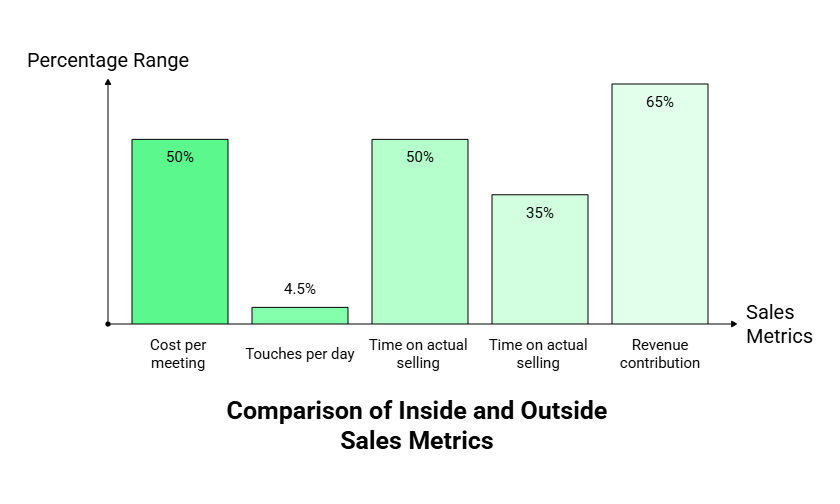
- Inside reps make 4–5× more touches per day than field reps
- Companies report 40–60% lower cost per meeting with inside sales compared to outside sales statistics benchmarks
- Virtual meetings now account for 75–80% of all sales conversations
- Inside reps spend about 45–55% of their workday on actual selling activities
- Organizations see 30–35% shorter sales cycles when deals are handled remotely
- Teams using power dialers make 2–3× more call attempts per rep
- Effective CRM use is linked to up to 29% higher win rates, according to common crm statistics
- Companies moving from field to inside models see 15–25% higher quota attainment
Outside Sales Statistics
Outside selling didn’t disappear. It just stopped being the default motion. Big, strategic deals still benefit from face-to-face conversations, and enterprise buyers often want that handshake before they sign. Travel isn’t about small talk it’s about trust, alignment, and reading the room in a way video just can’t fully replace. That’s why outside sales statistics still matter when you’re talking about large, complex deals.
Field reps usually work fewer opportunities, but each one is bigger and more political. They deal with long cycles, legal back-and-forth, and rooms full of stakeholders. Hybrid is the norm now: prospect digitally, nurture over calls, and travel when it genuinely moves the deal forward. That’s the right way to spend budget, especially when deal sizes are high and sales closing rate actually depends on relationship strength.
Compensation reflects that reality. When deal sizes climb, commission structures follow, and one closed contract can swing the entire quarter. Outside selling didn’t die it specialized. It’s less about volume and more about strategic wins. Leaders tracking b2b sales statistics understand this split clearly: inside teams scale, outside teams land whales.
- Outside reps typically manage 30–40% fewer accounts than inside reps, but with larger deal values
- Face-to-face selling is associated with up to 2× higher average deal size compared to virtual-only models
- Enterprise deals often involve 6–10 decision-makers, increasing the need for in-person alignment
- Outside reps report 20–30% longer sales cycles on complex deals than inside teams
- Hybrid models now account for 60–70% of enterprise selling motions
- Travel-involved deals show 10–15% higher sales closing rate in many enterprise environments
- Field reps are 2× more likely to be involved in contracts over six figures
- Companies with dedicated outside teams see 25–35% higher revenue contribution from strategic accounts
- Outside sales roles still command 15–20% higher commission potential on average
- In-person meetings are cited by 40–50% of buyers as key to final purchase confidence, according to common sales statistics and sales prospecting stats
Sales Prospecting Statistics
Prospecting is where confidence gets tested and where real pipeline actually starts. Most reps dread it for a simple reason you hear “no” far more than “yes.” Low reply rates, unanswered calls, and stalled conversations wear people down fast. But pipeline doesn’t care about mood. If you don’t prospect, you don’t close. The teams that win are the ones that treat prospecting like a discipline, not an optional task, which is exactly what real sales prospecting stats keep showing.
Buyers are different now. They’re informed before they ever talk to a rep, and they expect relevance from the first touch. Generic templates get ignored instantly. Personalized messaging tied to real problems is what cuts through. Mix channels, keep it short, and be ready to show the product instead of hiding behind endless discovery questions. Prospecting isn’t dying lazy prospecting is.
- Reps spend 30–40% of their week on prospecting activities, according to most sales statistics
- It takes 8–12 touches on average to book a first meeting with a cold prospect
- Only 9–12% of cold emails receive a reply, reinforcing why multi-channel beats single channel
- Adding phone plus email increases response likelihood by over 2×, based on common cold calling statistics
- More than 50% of buyers expect a demo on the first call instead of long discovery conversations
- Roughly 70% of buyers say they ignore outreach that isn’t personalized to their role or problem
- Social selling activity is linked to 45–50% higher win rates, which shows why many teams track b2b sales statistics here
- Reps who follow up at least five times generate up to 2× more meetings, tying directly to sales follow up statistics
- Organizations with structured prospecting processes see 20–30% higher sales conversion rate
- Teams using strong CRM workflows report up to 29% better pipeline visibility, aligning with common crm statistics
Ready to get started? Sign up here.
Want a walkthrough first? Book a quick demo.
Cold Calling & Phone Statistics
Cold calling is the battlefield everyone loves to argue about. You’ll hear it nonstop: nobody answers, buyers hate calls, it doesn’t work anymore. The truth is simpler most people don’t call enough to find out whether it works. Rejection is uncomfortable, so reps retreat to email and convince themselves the channel is dead. The teams that actually commit to calling see what reality looks like, and that’s exactly what real cold calling statistics keep proving.
The gap isn’t in the tactic. It’s in persistence. Most reps quit early, long before any meaningful volume kicks in. Calling creates conversations, exposes real objections, and qualifies faster than long email threads. Pair it with CRM workflows, caller ID, and smart dialing tools, and the channel scales well. Cold calling isn’t dead quitting early is. That’s the difference you see in real-world sales statistics every quarter.
- Cold calling success rates generally sit around 2–3%, which is why volume matters
- It takes about 8 attempts on average to reach a single prospect, yet most reps stop after two
- Reps who make at least 50–60 calls per day generate significantly more meetings than those who don’t
- Top-performing callers book up to 2× more meetings than average reps with the same lead list
- More than 60% of buyers say they are open to talking on the phone if the call is relevant to them
- Calling within 5 minutes of an inquiry increases connection rates by up to 9×, tying directly to sales follow up statistics
- Organizations that combine calling with email see over 2× higher response rates than single-channel outreach
- Teams using intelligent dialers make 2–3× more call attempts per rep, boosting sales rep performance
- Companies that log and track calls properly in CRM report up to 30% better pipeline visibility, supporting common crm statistics
- Call-led outreach plays a major role in improving sales conversion rate, especially in B2B environments reflected in b2b sales statistics
Social Selling Statistics
Most buyers don’t walk onto your website first they see you online long before that. LinkedIn has turned into a giant prospecting ground simply because that’s where decision-makers already spend time. The strange part? Most reps still treat it like a digital resume instead of a daily sales tool.
Those who actually show up, share ideas, and engage with real buyer problems see a very different outcome. Trust forms faster, replies feel warmer, and conversations don’t start from zero. Familiarity does half the work before a single cold call happens. Social selling isn’t complicated. It’s just consistent prospecting in public where people can see how you think, what you know, and whether you’re worth talking to.
- Reps who post weekly often see 30–50% higher profile views, which directly increases inbound interest.
- Salespeople who engage in comments daily report up to 25% more reply rates on cold outreach.
- Sharing helpful content instead of pitches leads to 2–3x higher connection acceptance rates with target buyers.
- Personal branding activity has been linked to nearly 40% faster trust-building in early conversations.
- Accounts that stay active for 90 days straight commonly experience 50%+ growth in network reach.
- Reps who combine posting + commenting generate 35–60% more warm leads than lurkers.
- Buyers are 70% more likely to respond when they’ve seen your name before in their feed.
- Consistent creators often report 20–35% shorter sales cycles because familiarity removes friction.
- Social sellers who interact with buyer pain points directly see up to 45% higher meeting-booked rates.
- Teams that treat LinkedIn as a daily habit, not a last-minute tactic, achieve 30–55% better pipeline quality.
Email Sales Statistics
Real behavior shows that buyers actually read messages that respect their time. Short subject lines, clear copy, and obvious value win. Personalization helps because nobody wants to feel like line 87 on a mail merge. Follow-ups matter even more, because most positive replies don’t come from the first touch.
Email works even better when paired with calling. Calls create urgency and emotion; email creates a paper trail people can forward internally. Together they move deals, confirm next steps, and keep conversations alive long enough to turn into revenue.
- Roughly 347+ billion emails are sent every day worldwide, and the number keeps climbing.
- Around 41–50% of emails are opened on mobile first, making short copy a real advantage.
- Subject lines under 50 characters typically see 10–15% higher open rates.
- Personalized emails can drive up to 26% higher open rates compared with generic blasts.
- Adding the recipient’s company name increases reply likelihood by 15–20%.
- Follow-up emails account for over 50% of total replies in many outbound campaigns.
- Sending 4–7 follow-ups can boost total response rates by up to 2x versus single-touch outreach.
- Emails sent mid-week often see 5–10% better engagement than Monday sends.
- Including one clear CTA instead of many can improve click-through by 20–30%.
- Email remains one of the highest ROI channels, often returning $36–$42 for every $1 spent.
- Campaigns using simple, plain-text layouts sometimes produce up to 15% higher reply rates than heavily designed templates.
- Shorter emails (under 125 words) can generate up to 50% more replies in outbound prospecting.
- Sequences tied to CRM data see 25–40% better targeting accuracy, improving conversion.
- Combining email with cold calling can lift meeting-booked rates by 30–50% compared with using one channel alone.
- Consistent weekly emailing helps reps maintain visibility, contributing to 20–35% stronger pipeline predictability.
Sales Follow-Up Statistics
Follow-up is where many sales teams quietly leak revenue. Most reps stop after one or two attempts, thinking they’ve done enough, while the deals that actually close often require many more touches. Buyers are busy, distracted, and juggling priorities. Professional persistence isn’t annoying it’s how you stay visible, build trust, and increase the likelihood of closing a deal. This is exactly why sales follow up statistics are one of the most critical benchmarks for sales leaders today.
The drop-off in follow-up is steep. Many reps fail to recognize that pipeline strength depends on repeated, timely touches. Structured follow-ups backed by CRM workflows, reminders, and automation make a huge difference. The reps who stick with it even after initial “no” responses consistently outperform their peers in both sales conversion rate and sales rep performance.
When follow-up is done right, it directly impacts revenue. Most deals are closed after the fifth to twelfth touch, meaning persistence matters more than raw activity volume. Teams that build disciplined, multi-touch sequences create predictable pipeline, reduce wasted effort, and ultimately close more deals. Ignoring this simple principle is one of the easiest ways for teams to leave money on the table.

- 100% of reps follow up at least once after the initial contact
- Only 80% of reps send a second follow-up
- About 50% of reps follow up a third time
- Fewer than 30% of reps attempt a fourth follow-up
- Only 10–15% of reps continue beyond the fifth attempt
- Most deals are closed between the fifth and twelfth touch, according to sales statistics
- Spacing follow-ups 3–7 days apart increases response rates by 21–30%
- Personalized follow-ups generate up to 25% more replies than generic messaging
- Reps who track follow-ups in CRM see 20–35% higher win rates, supported by crm statistics
- Teams with structured multi-touch sequences achieve up to 50% higher pipeline coverage
Ready to get started? Sign up here.
Want a walkthrough first? Book a quick demo.
Sales Closing Statistics
Closing isn’t magic it’s math, qualification, timing, and confidence. Across industries, average closing rates hover in the high teens. The difference between mediocre and top-performing reps isn’t luck; it’s disciplined discovery, structured follow-ups, and knowing exactly when and how to ask. Many calls end without an attempt to close at all, which quietly kills pipeline. That’s why sales conversion rate is more than a number it’s the scorecard for every step leading to the final deal.
The reality is that deals today involve more stakeholders, longer cycles, and higher internal friction than ever before. Understanding these factors helps reps focus on what moves the needle. Closing improves when discovery is honest, pricing is transparent, objections are surfaced early, and follow-up is structured. Teams tracking sales closing rate and b2b sales statistics see where improvements are most impactful and can benchmark performance realistically.
- The average sales closing rate across industries is roughly 18–20%
- Top-performing reps can reach 35–40% close rates consistently
- High-value B2B deals often involve 6–10 decision-makers per account
- Average sales cycle length has increased by 20–25% over the last 5 years
- Around 40% of calls end without a close attempt
- Deals with transparent pricing have 15–20% higher close rates
- Objection-handled deals close 30–35% faster than those with unresolved objections
- Following up on deals improves close probability by 25–30%
- Discovery that surfaces pain points leads to up to 2× higher conversion rates
- Sales cycles for enterprise deals average 90–120 days, compared to 30–45 days for SMB
- Teams that track sales rep performance via CRM see 10–15% higher win rates
- Personalized closing approaches boost success by 20–25%
- Deals with internal approvals involved close 15–20% slower than single-decision deals
- Using structured negotiation scripts increases close probability by 10–15%
- B2B teams report that 45–50% of deals require 5–8 follow-ups before closing, tying into sales follow up statistics
Lead Nurturing Statistics

Not every lead is ready to buy the first time you reach out. Buyers research, compare, and wait until the timing is right which is why nurturing matters. Leads left untouched sit in the CRM, going cold, while companies miss out on predictable revenue. Structured nurturing ensures that prospects stay engaged, understand your value, and are ready to convert when the time is right.
Automation and consistent follow-up make a huge difference. Marketing automation, workflows, and behavior-based triggers let teams deliver the right message at the right moment. Nurturing not only keeps leads warm but also increases deal size and accelerates pipeline velocity. Teams tracking b2b sales statistics and crm statistics see measurable ROI from consistent nurturing programs.
- Nurtured leads generate 50% more sales-ready opportunities than non-nurtured leads
- Around 60–70% of inbound leads won’t buy for 3–6 months after first contact
- Companies with structured nurturing see 20–30% higher average deal sizes
- Organizations using behavior-based triggers see up to 25% faster deal closure
- Automated workflows increase follow-up consistency by 40–50%
- Leads that receive 5–12 touches convert 2× more often than single-touch leads
- Only 30–35% of B2B companies have a formal lead nurturing program
- Nurtured leads are 47% more likely to become marketing-qualified leads (MQLs)
- Email nurture sequences alone improve response rates by 15–20%
- Marketing automation combined with sales outreach increases pipeline velocity by 25–35%
B2B Sales Statistics
B2B buying has become a committee sport. Deals rarely move forward based on a single person’s decision. Multiple stakeholders are involved, each with their own priorities, timelines, and concerns. Buyers do extensive research before ever talking to a rep, and price transparency is expected upfront. The complexity of B2B sales means cycles are long, political, and layered with approvals, making disciplined processes essential. Tools like FreJun help teams manage these complex processes, track every interaction, and ensure no decision-maker is overlooked.
The data doesn’t lie. Organizations that structure their B2B sales process, use automation, and train reps on committee selling outperform peers by significant margins. Metrics like win rate, cycle length, and deal size are all measurable, and teams that monitor these regularly see the biggest gains. Understanding the landscape through real b2b sales statistics allows leaders to make smarter hiring, training, and investment decisions.
- 74% of B2B deals involve 4–6 decision-makers per account
- Buyers spend 57% of the buying process researching independently before engaging sales
- Transparency on pricing increases trust and close likelihood by 20–25%
- Average B2B sales cycle for enterprise deals is 90–120 days, compared with 30–45 days for SMB
- Companies with structured stakeholder mapping see 30% higher win rates
- Continuous follow-ups improve conversion on multi-decision deals by 25–35%
- B2B buyers are 67% more likely to select vendors who provide clear ROI evidence upfront
- Teams using CRM for all touchpoints report up to 29% higher forecast accuracy
- Deals involving more than 5 stakeholders are 40% more likely to require negotiation revisions
- Organizations with dedicated B2B processes achieve 20–30% higher average deal size, tying into sales conversion rate
Sales Productivity Statistics

Every sales leader knows this pain: reps spend more time managing work than actually selling. Real sales productivity statistics show that a huge chunk of the day is eaten up by administrative tasks, logging calls, entering data, and juggling multiple tools. Context switching kills focus, drains energy, and keeps reps from hitting quota consistently.
The difference between a productive rep and an overworked one isn’t hours worked it’s wasted time eliminated. Automation, call logs, templates, and calendar integration allow reps to focus on what moves the needle: prospecting, qualifying, and closing. Top-performing teams measure where time goes and optimize accordingly.
Cutting down on manual tasks not only boosts pipeline but also improves sales rep performance, morale, and forecast accuracy. Tools like CRM, dialers, and click-to-call systems let teams do more with less effort while keeping metrics clean and measurable. Tracking productivity with clear benchmarks is the fastest path to scaling results without burning out your team.
- Reps spend 35–50% of their workday on non-selling administrative tasks
- Manual data entry consumes up to 5–6 hours per week per rep
- Context switching reduces effective selling time by 15–20% daily
- Sales teams using automation log 2–3× more activities than teams without
- CRM adoption improves pipeline visibility by 25–30%
- Reps using templates and call scripts book 15–25% more meetings
- Calendar integration reduces scheduling time by 2–3 hours per week
- Multi-tasking during prospecting lowers call effectiveness by 10–15%
- Teams tracking productivity metrics see 20–30% higher quota attainment
- Using automated reminders increases follow-up consistency by 35–40%
- Reps with integrated dialers make 2–3× more calls per day
- Effective activity tracking improves sales conversion rate by 10–15%
- Reps leveraging CRM dashboards close deals up to 20% faster
- Time saved from automation contributes to 10–15% higher overall sales rep performance
- High-performing reps spend roughly 60% of their day on selling vs. admin, compared to 40% for average reps
Sales Training Statistics
Training isn’t optional anymore. Teams that rely solely on onboarding or ad hoc coaching leave enormous potential on the table. Real sales training statistics show that structured, ongoing programs deliver measurable ROI and help reps scale skills faster than they could on their own. Without reinforcement, skills decay quickly, and reps plateau, no matter how motivated they are.
Continuous coaching, micro-training, and call reviews give reps confidence in objection handling, discovery, and closing. Messaging clarity improves, and teams see fewer dropped deals and more predictable performance. High-performing organizations know that investing in training isn’t a cost, it’s a revenue multiplier.
The truth is simple: better-trained reps close more, sell faster, and convert higher-quality opportunities. Tracking metrics like sales rep performance, sales conversion rate, and crm statistics allows leaders to see exactly which training initiatives pay off and where gaps remain. Training isn’t optional it’s the foundation of sustainable growth.
- Structured training programs deliver up to 353% ROI ($4.53 returned for every $1 spent)
- Continuous coaching can increase sales by 50% compared to teams without ongoing training
- Around 84% of sales knowledge is forgotten within three months without reinforcement
- High-growth companies are 2× more likely to provide custom training programs
- Reps with access to ongoing enablement report 49% higher win rates
- About 60% of reps spend 3+ hours per week in coaching or skill development
- Teams with structured call reviews improve objection handling by 25–30%
- Continuous discovery skill training leads to 20–25% higher lead qualification accuracy
- Messaging clarity training improves email and call response rates by 15–20%
- Companies investing in micro-training see up to 30% faster ramp times for new hires
Ready to get started? Sign up here.
Want a walkthrough first? Book a quick demo.
Key Takeaways
If you’ve skimmed all the sections above, here’s the reality: sales is harder today, but the data is clear. Buyers are more informed, decision-making groups are larger, and sales cycles are longer. The reps and teams that outperform aren’t just talented, they are disciplined, persistent, and use technology and processes, including tools like FreJun, to their advantage.
Follow-up, multi-channel prospecting, and CRM usage aren’t optional anymore. Training and coaching programs that reinforce skills consistently create measurable ROI. Pipeline health and deal velocity are predictable when you track the right metrics, not just activity volume. High-performing teams know exactly where their gaps are and invest accordingly.
Ultimately, the benchmark data tells you where to focus. Compare your team’s performance against these stats, and use the insights to guide hiring, tech adoption, training, and process improvements. Improving weak points will move the needle faster than doubling activity in areas that are already average.
- 35–50% of deals go to the vendor who responds first, emphasizing fast follow-up
- Only 20% of reps follow up more than three times, despite follow-up being critical
- Multi-touch prospecting (5–12 steps) increases meeting-booked rates by 2×
- Teams using CRM consistently see 20–35% higher win rates
- Continuous training programs deliver up to 353% ROI
- Reps spending 60% of their day selling outperform those who don’t by 25–30%
Final Thoughts
The numbers don’t lie: sales success today is about discipline, persistence, and using the right tools not just charisma or long hours. Teams that follow up consistently, nurture leads strategically, and invest in sales training statistics outperform those that don’t. Technology like crm statistics, automation, and call tools amplifies effort, but it can’t replace fundamentals like discovery, qualification, and timing. The benchmarks you’ve seen in this guide are not aspirational they’re achievable if you focus on the right areas.
The takeaway is simple: measure what matters, act on the gaps, and keep improving. Compare your team’s performance against these statistics, identify where results are falling short, and invest in process, sales productivity statistics, and tools accordingly. Sales is hard, but the right combination of persistence, multi-channel prospecting, and continuous learning turns data into predictable revenue. Stick to the numbers, and you’ll see the difference quarter after quarter, especially when focusing on sales conversion rate and execution.
Further Reading: Top 9 VoIP Providers: Best Cloud Calling & Business Phone Systems Compared
Sign up with FreJun to simplify business communication and improve support efficiency.
Book a FreJun Demo to see how FreJun can transform your business communication