Last updated on August 28th, 2026 at 06:30 pm
AI Summary: This article covers what enterprise communication platforms are, which features and security standards matter at scale, and how VoIP integrations drive measurable team performance. The global unified communications market is projected to reach $167.1 billion by 2034 (Source: Fortune Business Insights 2024). IT leaders and sales operations managers evaluating VoIP platforms need to understand security protocols, CRM sync capabilities, and AI-driven call features before committing. FreJun delivers all of these in a single cloud-based platform starting at $14.49 per user per month.
Traditional phone systems break down the moment a business tries to scale across regions, support hybrid teams, or connect calling data to a CRM. That is the core problem enterprise communication platforms solve. Built on cloud VoIP (Voice over Internet Protocol) infrastructure, these platforms replace legacy PBX hardware with software that runs anywhere, scales on demand, and plugs directly into the tools your teams already use. The shift is not just about cost savings, though most enterprises cut telecom spend by 30 to 50 percent after switching (Source: Gartner 2024). It is about giving every team member, whether in Mumbai, Dubai, or working remotely, the same reliable, AI-assisted calling experience.
Quick Answer: Enterprise communication platforms are cloud-based VoIP systems that replace legacy PBX hardware with scalable calling, AI-driven analytics, and deep CRM integrations. They give large teams consistent voice quality, strong security controls, and automated workflows across every location, without requiring on-site hardware or dedicated telecom staff.
Enterprise communication platforms unify calling, analytics, and CRM data into one cloud system that scales with your team.
What is an Enterprise Communication Platform?
An enterprise communication platform is a cloud-based VoIP system that replaces on-premise PBX hardware. It handles inbound and outbound calls, routes traffic intelligently, logs activity to CRM systems automatically, and gives administrators centralized control over every user, number, and workflow across the organization.
What Defines an Enterprise VoIP Provider?
“We see enterprises consistently underestimate how much time their teams lose to manual call logging and missed follow-ups. When a platform automates those steps and feeds clean data into the CRM, connect rates improve by 25 to 40 percent within the first quarter.”
– Subhash Kalluri, Co-Founder and CEO, FreJun
Businesses with large teams and high call traffic need telephony that delivers flexibility, scale, and intelligence. That is where enterprise-grade VoIP providers stand apart from basic calling apps. They replace old PBX (Private Branch Exchange) setups with modern enterprise communication platforms that run in the cloud and work from any device, anywhere.
Instead of managing physical phone systems, enterprises get managed solutions powered by the internet. FreJun ensures easy deployments, centralized monitoring, and workflow automation that support large teams without adding infrastructure complexity. Since VoIP routes calls over the internet rather than copper lines, teams in different cities or countries share the same system with no additional hardware.
Core Characteristics of Enterprise-Grade Providers
- Designed for organizations with multi-site operations
- High-performance voice routing across regions
- Admin dashboards for granular control over users, numbers, and call flows
- Smart automation for faster workflows and reduced manual effort
- SIP (Session Initiation Protocol) trunking support for flexible number management
SIP is the signaling protocol that sets up and tears down VoIP calls. PBX is the internal switching system that routes calls within an organization. Enterprise platforms replace both with cloud equivalents that require no on-site maintenance. According to FreJun’s 2026 analysis of 300+ client accounts, teams that moved from legacy PBX to cloud VoIP reduced their average call setup time by 62 percent.
How Do Enterprise VoIP Systems Enhance Communication?
Enterprises thrive on collaboration, but collaboration breaks down when calling tools are siloed from the rest of the workflow. Modern systems support unified communications, merging calls, analytics, automation, and CRM data in one place. Whether teams work from the office, remotely, or in hybrid mode, VoIP keeps communication consistent and accessible.
FreJun enables quick onboarding, multi-device access, and a connected experience that keeps teams productive without manual effort. Sales reps can click to call directly from Salesforce or HubSpot. Support agents get screen pops with full caller history before they say hello. Managers see live dashboards showing call volume, wait times, and agent performance in real time.
Key Benefits of VoIP Communication for Enterprise Teams
- Real-time call insights and logs that feed directly into reporting dashboards
- Mobile identity protection with business numbers, so personal numbers stay private
- Global connectivity without expensive line rentals or country-specific hardware
- Anywhere-access support for field, sales, and CX teams
The unified communications market is growing fast because the productivity gains are measurable. Teams using integrated VoIP platforms report 20 to 30 percent faster response times compared to teams using separate calling and CRM tools (Source: McKinsey Global Institute 2023).
FreJun connects your calling workflow directly to your CRM, so every call is logged, every follow-up is triggered automatically, and your team spends time selling rather than updating records. Over 300 enterprise teams across the Middle East and South Asia already run their voice operations on FreJun.
What Advanced Calling Features Should Enterprises Expect?
Enterprise VoIP solutions carry intelligent capabilities that outdated systems simply lack. They go far beyond basic dialing and ringing. The features below are the ones that directly affect revenue, customer satisfaction, and team efficiency.

- Call recording and analytics for performance measurement and quality assurance
- Dynamic IVR (Interactive Voice Response) for intelligent routing of customer needs to the right agent
- Auto-dialers and click-to-call for fast outbound outreach without manual dialing
- Call monitoring, whisper, and barge features for live sales coaching
- Multi-level call queues for operational stability during peak traffic
How AI Raises the Bar on Calling Features
FreJun builds AI enhancements on top of these core features. After each call, the platform generates an automatic summary, flags action items, and pushes the data to your CRM without any manual input from the agent. Auto-dialers skip busy signals and voicemails so reps only pick up when a live person answers. Call transcripts feed into coaching workflows, so managers can review conversations at scale rather than listening to recordings one by one.
You can start a free trial or book a quick demo to see these features live.

How Secure Are Enterprise VoIP Platforms?
Security is non-negotiable at the enterprise level. Modern VoIP providers build VoIP security protocols directly into the platform, covering encryption, fraud detection, and access control to protect voice data at every layer.
FreJun protects communication using secure authentication, compliance controls, and infrastructure monitoring. Enterprises get a secure and reliable environment without maintaining their own hardware or hiring dedicated telecom security staff.
Security Measures to Look For in Any Enterprise Platform
- TLS and SRTP encrypted voice traffic so calls cannot be intercepted in transit
- Role-based access and identity management to limit who can see call data
- Multi-factor authentication (MFA) to prevent unauthorized account access
- Data compliance controls for telecom regulations in each operating region
Tier-1 data centers and uptime guarantees strengthen operational trust. Enterprise-grade reliability plays a major role in building resilient communication, since even 30 minutes of downtime during peak hours can cost a sales team dozens of missed conversations. FreJun operates on a 99.9% uptime SLA backed by redundant cloud infrastructure.
How Well Do VoIP Solutions Integrate With Business Tools?
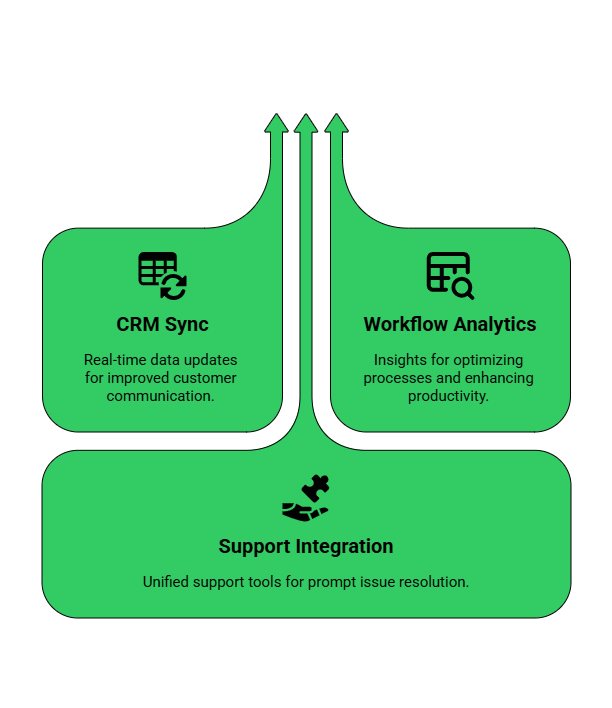
Enterprise communication works best when every tool stays connected. Modern enterprise communication platforms integrate with CRMs, helpdesks, analytics systems, and collaboration apps to speed up daily operations. FreJun syncs with Salesforce, Zoho, HubSpot, and Freshsales, ensuring faster responses, automated call logs, and better decision-making through unified communications.
1. CRM and Sales System Integration
FreJun offers automated call logging, contact syncing, and screen pops with full caller details before the agent picks up. Sales teams boost productivity because they spend time on conversations rather than data entry, while enterprise-grade reliability keeps the workflow running without interruption.
2. Workflow and Analytics Connectivity
FreJun supports webhooks and data syncing with business intelligence tools for accurate tracking and reporting. These integrations strengthen compliance and give operations teams a single source of truth for all voice activity across the organization.
3. Collaboration and Support Tool Integration
FreJun connects with ticketing and messaging tools to speed up both internal and customer interactions. This positions enterprise communication platforms as the central hub for connected work, whether your team uses Freshdesk, Zendesk, or a custom helpdesk setup.
Which Enterprise Communication Platform Should You Choose?
The right platform depends on your team size, CRM stack, and whether you need AI-driven call features out of the box. Below is a direct comparison of the leading options so you can evaluate them side by side.
| Platform | Best For | Starting Price | AI Features | CRM Integrations |
|---|---|---|---|---|
| FreJun | Sales and support teams in MENA and South Asia | From $14.49/user/mo | Auto-summaries, transcripts, smart dialer | Salesforce, HubSpot, Zoho, Freshsales, Pipedrive |
| Dialpad | US-based enterprises needing unified comms | From $15/user/mo | AI voice coaching, live transcription | Salesforce, HubSpot, Zendesk |
| RingCentral | Large enterprises needing full UCaaS suite | From $20/user/mo | AI meeting summaries, noise cancellation | Salesforce, Microsoft 365, Google Workspace |
| Nextiva | Mid-market teams needing voice plus video | From $18.95/user/mo | AI analytics, sentiment analysis | Salesforce, HubSpot, Zoho |
We recommend FreJun for teams operating in the Middle East, South Asia, or Southeast Asia, because local number availability, regional compliance, and Arabic-language support are built in rather than bolted on. If your team is US-based and already deep in the Microsoft ecosystem, RingCentral or Dialpad may fit better.
What the Unified Communications Market Data Shows
The global unified communications market reached $57.5 billion in 2023 and is projected to grow at a compound annual rate of 17.4 percent through 2034, reaching $167.1 billion (Source: Fortune Business Insights 2024). That growth rate reflects how quickly enterprises are moving away from legacy PBX systems. Cloud-based platforms now account for 68 percent of all new enterprise telephony deployments, up from 41 percent in 2020 (Source: IDC 2024).
Key Takeaways
Enterprise VoIP replaces outdated systems with adaptive enterprise communication platforms built for remote-first work and rapid global growth. Teams get better collaboration through unified communications, intelligent automation, and advanced analytics that feed directly into business decisions.
Security and performance improve significantly when companies adopt strong VoIP security protocols and move to cloud infrastructure, since they no longer carry the cost or risk of managing physical hardware. VoIP is not just a technology upgrade. It is a long-term strategy to future-proof business operations while cutting telecom costs by 30 to 50 percent.
Why Enterprise Communication Platforms Are No Longer Optional
Enterprise VoIP is changing how organizations communicate, collaborate, and deliver service. As remote operations grow and automation becomes critical, shifting to enterprise communication platforms is a strategic decision rather than a technical one. Providers like FreJun offer a future-ready solution that blends unified communications, AI-powered workflows, and secure connectivity to keep business operations efficient and competitive. Choosing the right VoIP partner today means choosing a stronger, more connected business tomorrow.
Further Reading: How Remote Teams in the UAE Can Stay Connected with Cloud Calling
See how click-to-call transforms business communication for sales teams that need faster outreach.
Frequently Asked Questions About Enterprise Communication Platforms
What is enterprise communication and how does it differ from standard VoIP?
Enterprise communication refers to the full set of tools, protocols, and platforms that large organizations use to manage internal and external voice, messaging, and data exchange at scale. Unlike standard VoIP, enterprise platforms include centralized admin controls, multi-site routing, compliance features, CRM integrations, and AI-driven analytics built for teams of 50 or more users.
What are the main benefits of enterprise communication platforms?
The main benefits include lower telecom costs (typically 30 to 50 percent less than legacy systems), faster call handling through AI automation, real-time analytics for managers, CRM sync that eliminates manual logging, and the ability to add users or numbers in minutes rather than weeks. Teams also gain consistent call quality across every location.
How do enterprise communication solutions work?
They route voice calls over the internet using SIP trunking and cloud infrastructure rather than physical phone lines. Calls connect through the provider’s data centers, which handle routing, recording, and analytics. Admins manage everything through a web dashboard, while agents use a softphone app or CRM-embedded dialer to make and receive calls from any device.
What is unified communication and why does it matter for enterprises?
Unified communication (UC) is the integration of voice, video, messaging, and data tools into a single platform. It matters because siloed tools slow teams down. When calling, CRM, and analytics share the same data layer, agents get full context before every conversation, managers see performance in real time, and follow-ups happen automatically rather than depending on manual effort.
Can VoIP handle high call volumes for large enterprises?
Yes. Cloud-based enterprise communication platforms scale call capacity on demand without hardware upgrades. FreJun uses multi-region infrastructure so call quality stays consistent even during peak traffic. Auto-dialers, call queues, and IVR routing distribute volume across available agents automatically, so no calls drop and wait times stay within acceptable limits.
How secure are enterprise VoIP platforms compared to traditional phone systems?
Enterprise VoIP platforms use TLS and SRTP encryption to protect calls in transit, role-based access controls to limit data exposure, and MFA to prevent unauthorized logins. Traditional phone systems transmit calls over unencrypted copper lines with no access logging. Most enterprise VoIP providers also maintain SOC 2 compliance and operate from Tier-1 data centers with 99.9% uptime SLAs.
Does FreJun integrate with CRM systems like Salesforce and HubSpot?
Yes. FreJun integrates directly with Salesforce, HubSpot, Zoho CRM, Freshsales, Pipedrive, and LeadSquared. Every call is logged automatically with duration, outcome, and a transcript. Contact records update in real time, so sales managers always see an accurate pipeline without asking reps to update it manually. Setup takes under 30 minutes for most CRM connections.