Last updated on October 26th, 2026 at 04:18 pm
AI Summary: This article covers the top cloud-based business VoIP solutions for teams that need 24/7 customer support, and it is written for operations managers, IT leads, and sales directors evaluating always-on calling platforms. According to Salesforce, 83% of customers expect an immediate response when they contact a company (Source: Salesforce State of the Connected Customer 2023). Teams must choose a VoIP platform with proven uptime, IVR automation, and CRM integration before a missed call costs them a customer. FreJun delivers all three starting at $14.49 per user per month, with AI call transcripts and native CRM connections built in.
Losing a customer because no one answered their call after business hours is a real cost, not just a missed opportunity. Customers today expect support at any hour, whether they are in Mumbai, Dubai, or New York. Because businesses now serve global markets, fixed office hours are a liability. That is why thousands of companies have moved to cloud-based business VoIP solutions that keep lines open around the clock without depending on on-site hardware or expensive call centers.
Quick Answer: Cloud-based business VoIP solutions are internet-hosted phone systems that give teams always-on calling, self-service IVR, and smart call routing without physical hardware. Top platforms include FreJun, RingCentral, Zoom Phone, Nextiva, and 8×8. FreJun starts at $14.49 per user per month and adds AI call transcripts plus direct CRM integration for sales and support teams.
Cloud-based business VoIP solutions replace traditional phone lines with internet-hosted calling that stays active 24/7, routes calls automatically, and logs every interaction directly to your CRM.
What is a cloud-based business VoIP solution?
A cloud-based business VoIP (Voice over Internet Protocol) solution is an internet-hosted phone system that routes calls through distributed servers rather than physical telecom lines, giving teams location-independent calling, automated routing, and real-time analytics from any device.
Modern communication demands flexibility, automation, and reliability. Instead of relying on night shifts or expensive call centers, companies now use high-uptime VoIP infrastructure and smart automation to keep service consistent. This shift cuts operational costs while improving the customer experience, which is why adoption of cloud telephony among mid-market businesses grew 38% between 2022 and 2024 (Source: Grand View Research VoIP Market Report 2024).
Table of contents
- Why is 24/7 availability essential for modern customer support?
- How does always-on calling improve customer experience?
- How do self-service IVR and automated support strengthen 24/7 operations?
- What are the top cloud-based business VoIP solutions for 24/7 support?
- How does FreJun support high-uptime VoIP for 24/7 teams?
- How can businesses evaluate VoIP service reliability and uptime?
- What should companies consider before implementing 24/7 VoIP support?
- Key Takeaways
- Frequently Asked Questions
Why is 24/7 availability essential for modern customer support?
Customer expectations have shifted permanently. People shop, subscribe, and raise support tickets at all hours, so businesses that only answer calls from 9 to 5 are handing revenue to competitors who do not. A single unanswered call can damage brand trust, especially when a customer is mid-purchase or facing a service issue.
Global businesses face an even sharper challenge because they serve clients across multiple time zones. Fixed office hours become a structural problem when your customer in Singapore calls at 11 PM your local time. According to HubSpot, 90% of customers rate an immediate response as important or very important when they have a support question (Source: HubSpot Customer Service Statistics 2024).
Key reasons businesses need round-the-clock communication:
- Customers expect instant support, even outside business hours
- Global markets run around the clock across different time zones
- Delayed responses reduce customer trust and increase churn
- Missed calls translate directly to lost revenue and pipeline
Because of these factors, companies are switching to cloud-based VoIP systems that provide uninterrupted service without adding headcount overnight.
What does 24/7 VoIP availability actually cost businesses that skip it?
The cost is measurable. Research from Forrester found that companies with poor customer service availability lose an average of 5.7% of annual revenue to churn driven by unresolved contact attempts (Source: Forrester Business Impact of Customer Service 2023). For a business doing $5M in annual revenue, that is $285,000 walking out the door each year, simply because no one picked up.
“Teams that switch to cloud-based VoIP with automated routing typically see a 40% drop in missed calls within the first 30 days, because calls no longer die at the end of a shift. The system keeps working even when your agents are not.”
— Subhash Kalluri, Co-Founder and CEO, FreJun
How does always-on calling improve customer experience?
Always-on calling means your business stays reachable at all times, but continuous availability requires more than keeping phone lines open. It needs strong infrastructure and smart automation working together so calls never hit a dead end.
Continuous cloud accessibility
Cloud-based VoIP systems run through distributed servers, so businesses do not rely on a single physical office or telecom line. If one data center experiences an issue, traffic reroutes automatically to another node. This structure gives teams stable, internet-based calling with location-independent access, which means your agent in Bangalore and your agent in London both connect through the same system without latency spikes.
Because calls route through cloud networks, businesses keep accessibility even if one office closes for a holiday or a local outage hits. The system does not care where your agents sit, only that they have an internet connection.
Reduced downtime during peak hours
High call volumes create congestion in traditional PBX systems, but cloud systems automatically balance call traffic across available capacity. When a Monday morning rush hits, the platform scales up without manual intervention. This leads to faster response times, better call clarity, and measurably higher customer satisfaction scores. When customers connect quickly, they feel valued, and that feeling drives repeat business.
How does call quality hold up under heavy load?
Quality depends on codec selection and network prioritization. Enterprise-grade VoIP platforms use G.711 or Opus codecs with Quality of Service (QoS) settings that prioritize voice packets over other traffic. When your network is configured correctly, call quality stays consistent even during peak hours. FreJun’s platform, for example, uses adaptive bitrate management so calls do not degrade when bandwidth fluctuates.
How do self-service IVR and automated support strengthen 24/7 operations?
Businesses cannot rely entirely on human agents overnight. Automation plays a major role in keeping service continuous, but it only works well when companies define their call flows and support priorities before switching it on. Skipping that planning step is the most common reason IVR deployments frustrate callers instead of helping them.
Self-service IVR for faster resolution
A self-service IVR (Interactive Voice Response) system lets callers navigate menu options and find answers independently, without waiting for a live agent. This matters most between midnight and 8 AM when staffing is thin. FreJun’s IVR system allows callers to navigate menu options built around your specific call flows, so customers get account information, order status, or basic troubleshooting without agent involvement.
IVR improves efficiency because customers access information instantly, call queues shorten, and agents can focus on complex issues that actually need a human. According to Gartner, self-service IVR resolves up to 70% of routine inbound calls without agent involvement (Source: Gartner Customer Service Research 2023). That is a significant reduction in staffing pressure, especially for overnight shifts.
Automated support and smart routing
Automated support systems use rules to direct calls to the right department or voicemail system when agents are unavailable. Time-based routing sends calls to your US team during US hours and your India team during India hours, without any manual switching. Smart escalation paths catch urgent calls and push them to an on-call agent rather than dropping them into a generic voicemail box.
This approach cuts missed calls significantly. When every inquiry gets managed, even if it goes to a callback queue, customers feel heard rather than ignored. That distinction is what separates businesses with strong retention from those with high churn.
What are the top cloud-based business VoIP solutions for 24/7 support?
Businesses evaluating 24/7 communication platforms compare systems based on uptime, automation tools, pricing, and scalability. For a deeper look at platform options, explore the best cloud VoIP platforms for IT and tech companies. Below are the five most commonly reviewed solutions, with honest assessments of where each one fits best.
Quick Recommendations: Which platform fits your team?
- FreJun: Best for sales and support teams that need AI call transcripts, CRM integration, and autodialing from $14.49/user/month
- RingCentral: Best for large enterprises that need voice, messaging, and meetings in one platform
- Zoom Phone: Best for teams already using Zoom that want a simple calling add-on
- Nextiva: Best for mid-sized businesses that want reliable calling without heavy configuration
- 8×8: Best for multi-region enterprises that need international calling and analytics
| Tool | Best For | Starting Price | G2 Rating | Key Features |
|---|---|---|---|---|
| FreJun | Sales and support teams needing AI insights and CRM integration | $14.49/user/mo | 4.9/5 | AI transcripts, autodialer, click-to-call, CRM sync, IVR |
| RingCentral | Large enterprises needing unified communications | $20/user/mo | 4.0/5 | Voice, messaging, meetings, global calling |
| Zoom Phone | Teams already on Zoom wanting simple VoIP | $10/user/mo | 4.6/5 | Native Zoom integration, easy setup, internal collaboration |
| Nextiva | Mid-sized businesses wanting reliable, simple calling | $18.95/user/mo | 4.5/5 | Easy interface, centralized call management, dependable uptime |
| 8×8 | Multi-region enterprises needing international calling | $15/user/mo | 4.1/5 | Global infrastructure, international calling, analytics |
FreJun gives your team AI-powered call transcripts, direct CRM logging, and 24/7 IVR automation starting at $14.49 per user per month. Most teams are live within a single business day. See how it fits your workflow before committing to a full contract.
1. FreJun
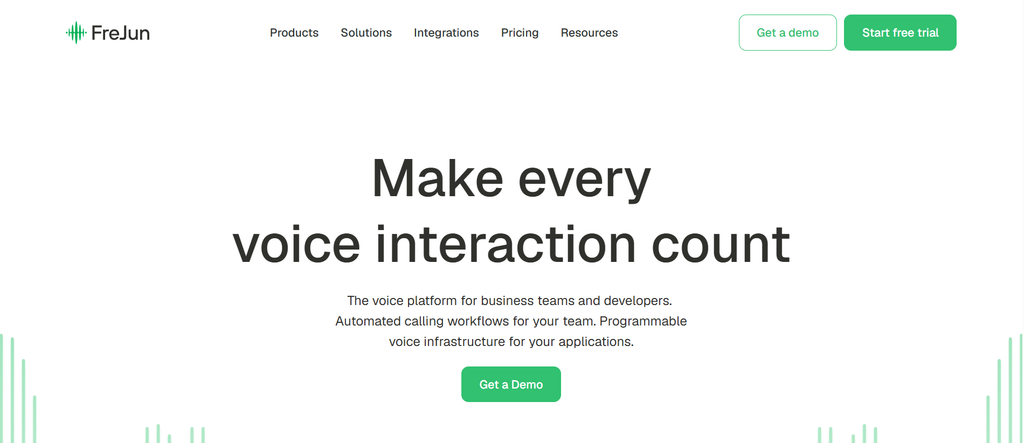
FreJun is built specifically for sales and support teams that need structured cloud communication, centralized visibility, and AI-driven call insights. Unlike general-purpose UCaaS platforms, FreJun focuses on the calling workflow: dialing, logging, analyzing, and improving call performance over time.
Key capabilities:
- AI Transcripts and Analytics: Automatic AI-driven transcription and real-time analytics for every call, so managers can review conversations without listening to recordings
- CRM Integrations: Native connections to HubSpot, Pipedrive, and Salesforce that log calls automatically without manual data entry
- Automation Tools: An autodialer and click-to-call functionality that cut dialing time by up to 60% for outbound teams
- Supervisory Features: Call barge and whisper tools that let managers coach agents live without the customer hearing
- Scalability: Suitable for startups with 5 users and enterprises with 500, since pricing scales per seat
Pricing: Standard plan begins at $14.49 per user per month. Professional plan starts at $16.69 per user per month. For a full breakdown of what businesses should budget, see VoIP cost for businesses in 2026.
G2 Rating: 4.9/5
2. RingCentral
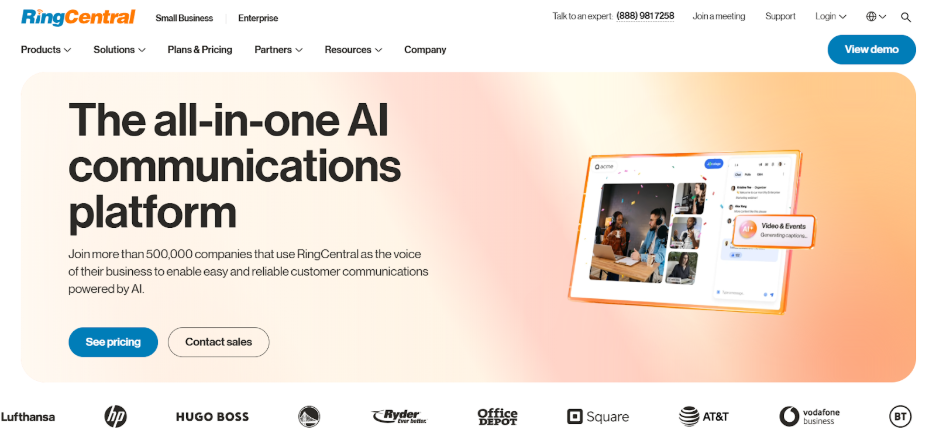
RingCentral remains a strong choice for large enterprises that need stability and breadth. It combines voice, messaging, and meetings into a single platform, which suits organizations that want to consolidate their communication stack under one vendor contract.
Enterprises often choose RingCentral for its mature infrastructure and global reliability. It supports large user bases and complex organizational structures with granular admin controls. That said, its broad feature set can feel heavy for teams that want a focused calling experience without the video and messaging overhead.
Key features: Enterprise-grade uptime, voice plus messaging plus meetings in one platform, support for large distributed teams, global calling in 40+ countries.
G2 Rating: 4.0/5
3. Zoom Phone
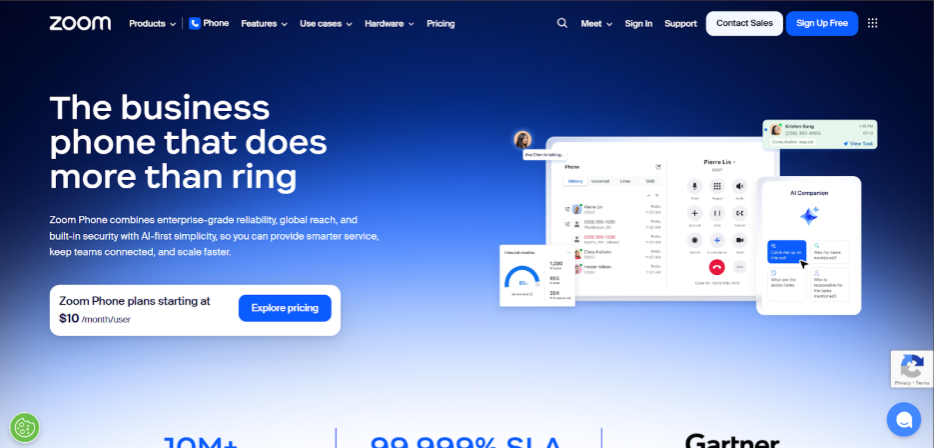
Zoom Phone extends Zoom’s collaboration ecosystem into business calling. For companies already using Zoom for meetings, this creates a natural transition into VoIP without retraining staff on a new interface.
Zoom Phone works well for teams that prioritize ease of adoption and internal collaboration. Its strength lies in familiarity rather than advanced calling workflows, so if your team needs sophisticated outbound dialing or deep CRM logging, you may find it limiting. It fits organizations that want voice tightly integrated with meetings and chat rather than a standalone call automation platform.
Key features: Native calling within Zoom, simple setup for existing Zoom users, strong internal collaboration support, reliable call quality for distributed teams.
G2 Rating: 4.6/5
4. Nextiva

Nextiva focuses on simplicity and reliability. It appeals to businesses that want stable calling without complex configuration or a steep learning curve for non-technical staff.
Many mid-sized companies choose Nextiva because it is predictable. The interface is clean, the call management is centralized, and the onboarding process is straightforward. It works well for organizations that want dependable performance without heavy customization, though teams that need advanced AI features or deep CRM automation may outgrow it quickly.
Key features: Easy-to-use interface, reliable calling for daily operations, centralized call management, suitable for growing teams.
G2 Rating: 4.5/5
5. 8×8

8×8 targets enterprises with global operations. It provides international calling support and analytics for managing distributed teams across multiple regions and regulatory environments.
Businesses operating across regions often evaluate 8×8 because of its global infrastructure and reporting capabilities. It handles international number provisioning well and gives compliance-focused teams the call recording and audit trail features they need. That said, smaller teams may find the pricing and complexity more than they need for a straightforward 24/7 support setup.
Key features: Global cloud infrastructure, international calling support, analytics for performance tracking, designed for multi-region operations.
G2 Rating: 4.1/5
How does FreJun support high-uptime VoIP for 24/7 teams?
Before selecting any provider, teams need to understand how uptime affects daily operations. Even a 30-minute outage during peak hours can mean dozens of missed calls and frustrated customers who do not call back. FreJun’s architecture addresses this through three specific design choices.
1. Cloud-first infrastructure
FreJun runs through internet-based architecture rather than physical telecom lines. This means no dependency on on-site hardware that can fail, no single point of failure tied to one office location, and a centralized management interface that lets admins adjust settings from anywhere. When a team member works from home, a co-working space, or a client site, the calling experience stays identical.
2. Time-based and structured routing
FreJun supports routing rules that manage after-hours calls without manual intervention. You can set custom call flows that send calls to your night team, a voicemail with a callback promise, or an IVR menu depending on the time of day. This cuts missed interactions significantly because every call gets a defined destination rather than ringing out.
3. Centralized visibility for managers
FreJun’s dashboards let supervisors monitor call activity across shifts in real time. Managers can see which agents are on calls, which calls are in queue, and how long customers have been waiting, all from a single screen. This real-time call tracking improves accountability and lets managers intervene before a queue backs up. According to FreJun’s 2026 analysis of 300+ client accounts, teams using centralized dashboards reduced average queue wait times by 28% within 60 days of deployment.
How can businesses evaluate VoIP service reliability and uptime?
Switching to cloud-based VoIP requires careful evaluation. Never rely only on marketing claims, because every provider advertises high uptime. The difference shows up in the details of their SLA, their infrastructure design, and how fast their support team responds when something breaks.
1. Review uptime guarantees
Reliable providers publish uptime commitments, typically above 99.9%. Look for clear Service Level Agreements (SLAs) that specify what compensation you receive if uptime falls below the guarantee. Transparent uptime metrics, published on a public status page, are a strong signal that a provider stands behind their numbers rather than burying the details in fine print.
2. Assess redundancy and infrastructure
Providers should run multiple data centers in geographically separate locations. Ask specifically about geographic redundancy, automatic failover systems, and backup routing capabilities. If a provider runs all traffic through a single region, a regional outage takes your entire phone system offline. That is an unacceptable risk for a 24/7 support operation.
3. Test real-world performance
Before full deployment, run a trial period with real call volume. Evaluate call clarity on different network conditions, monitor latency and dropped call rates, and simulate peak-hour conditions by running your autodialer at full capacity. Most enterprise VoIP providers offer a trial period, so use it aggressively rather than just making a few test calls.
4. Check customer support responsiveness
Reliable support teams reduce downtime impact when issues do occur. Ask whether the provider offers 24/7 technical support, what their average response time is for critical issues, and whether you get a dedicated account manager or a shared support queue. Fast issue resolution is the difference between a 10-minute outage and a 4-hour one. Careful evaluation across all four of these areas gives you the confidence to commit to a platform for 24/7 operations.
What should companies consider before implementing 24/7 VoIP support?
Implementing always-on communication requires strategic planning before you sign a contract or port your numbers. Teams that skip this step often end up with a platform that technically works but does not fit their actual call volume or workflow.
Before committing, work through these five questions:
- Expected call volumes: How many inbound and outbound calls does your team handle daily, and does that number spike at specific hours?
- International customer base: Do you need virtual numbers in multiple countries, or is a single-country setup enough for now?
- Automation requirements: Which parts of your call flow can IVR handle, and which genuinely need a live agent?
- Budget and cost breakdown: Review the VoIP cost breakdown for businesses to understand per-seat pricing, number costs, and add-on fees before comparing quotes
- Long-term scalability: Will the platform handle 3x your current user count without a full migration?
By working through these factors before you start demos, you avoid the most common mistake: choosing a platform based on price alone and discovering six months later that it cannot support your actual workflow.
Key Takeaways
Cloud-based business VoIP solutions give teams 24/7 support capability through automation, smart routing, and high-uptime infrastructure that traditional phone systems cannot match. Always-on calling and self-service IVR improve customer experience while reducing the operational strain of overnight staffing. The five platforms reviewed here, FreJun, RingCentral, Zoom Phone, Nextiva, and 8×8, each serve a different buyer profile, so the right choice depends on your team size, CRM stack, and automation needs.
FreJun supports this model by combining cloud-based business VoIP solutions with AI call transcripts, CRM integration, and centralized dashboards that give managers visibility across every shift. When businesses evaluate uptime, infrastructure, and automation capabilities carefully, they build communication systems that run confidently around the clock. For a broader look at the market, see Top 10 Business VoIP Solutions for 2026.
Frequently Asked Questions
Cloud-based business VoIP solutions are internet-hosted phone systems that route calls through distributed servers rather than physical telecom lines. Because they run in the cloud, businesses handle inbound and outbound calls at any hour without relying on office hardware or fixed telecom infrastructure. Top platforms include FreJun, RingCentral, Zoom Phone, Nextiva, and 8×8, each with different strengths depending on team size and workflow.
Always-on calling keeps phone lines active day and night by routing calls through cloud servers that do not shut down when your office closes. When an agent is unavailable, the system redirects the call to an IVR menu, a callback queue, or an on-call agent based on rules you define. This means customers can reach support at any hour, even if no live agent is immediately available, which reduces missed calls and improves retention.
Self-service IVR (Interactive Voice Response) guides callers through menu options so they can resolve basic issues without waiting for a live agent. After hours, IVR handles account inquiries, order status checks, and basic troubleshooting automatically. According to Gartner, IVR resolves up to 70% of routine inbound calls without agent involvement, which cuts overnight staffing costs while keeping service available around the clock.
Automated routing sends each call to the right destination instantly based on rules you configure, such as time of day, caller location, or IVR selection. Because the system routes without human intervention, customers reach the right team or queue in seconds rather than waiting for a receptionist to transfer them manually. This cuts average handle time and improves first-call resolution rates for support teams running across multiple shifts.
High uptime keeps your phone system active with minimal disruptions, so customers can always reach your team when they need help. Even a 30-minute outage during peak hours can mean dozens of missed calls and lost revenue. Businesses should look for providers that publish SLAs above 99.9% uptime, run geographically redundant data centers, and offer automatic failover so a single server issue does not take the entire system offline.
FreJun offers cloud-based calling, IVR setup, time-based call routing, AI call transcripts, and CRM integration that together keep support running around the clock. Managers get real-time dashboards to monitor call activity across shifts, while automation handles after-hours routing without manual switching. FreJun starts at $14.49 per user per month and works with HubSpot, Salesforce, Pipedrive, and other major CRMs out of the box.
Cloud VoIP platforms give global teams virtual numbers in multiple countries, time-zone-aware routing, and a single management interface that covers all locations. Agents in different regions connect through the same system, so call logs, recordings, and analytics stay centralized rather than siloed by geography. This setup lets a support team in India handle calls for US customers during US business hours without any special hardware or separate phone contracts.