 Skip to content

Last updated on April 27th, 2026 at 10:15 pm
Brazil-based sales teams lose hours every week to manual dialing errors, missed time zones, and unpredictable carrier costs when reaching US contacts. An automated outbound calling system eliminates those friction points by routing calls through VoIP, logging every interaction, and integrating directly with your CRM. This guide walks through the exact dialing sequence from Brazil to the US, the factors that affect call quality and cost, and how platforms like FreJun give sales teams a measurable edge on cross-border outreach.
Quick Answer: To call the US from Brazil, dial exit code 00 + carrier code (e.g., 21 for Embratel) + US country code 1 + area code + local number. For sales teams making frequent calls, an automated outbound calling system like FreJun reduces manual errors, cuts costs, and logs every call automatically into your CRM.
An automated outbound calling system routes Brazil-to-US calls over VoIP, eliminates manual dialing errors, and syncs call data to your CRM in real time — cutting cost-per-contact by up to 40%.
What is an Automated Outbound Calling System?
An automated outbound calling system is software that dials contact lists, routes calls over VoIP (Voice over Internet Protocol), and logs outcomes directly into a CRM — removing manual dialing from sales and support workflows. FreJun is purpose-built for sales teams making high-volume international calls.
You can sign up here or schedule a demo
How Do You Call the U.S. from Brazil?
Calling the US from Brazil requires four sequential inputs: Brazil’s exit code, your chosen carrier code, the US country code, and the recipient’s area code plus local number. FreJun’s automated outbound calling system handles this sequence automatically, so sales reps never misdial or lose a contact to a formatting error. The platform also offers low international rates, superior call quality, and seamless CRM integration for real-time call tracking.
What Are the Basics of International Calling?
Every international call from Brazil to the US depends on three routing layers that tell the telecom network exactly where to send the call. Understanding each layer prevents the most common dialing failures.
- Exit Code: Signals the telecom system to initiate an international call. Brazil’s exit code is 00.
- Country Code: A unique numeric identifier for the destination country. The US country code is 1.
- Area Code and Local Number: Direct the call to a specific region and recipient within the US.
According to the International Telecommunication Union (ITU), the E.164 numbering standard governs how international phone numbers are structured globally — ensuring calls route correctly across carrier networks in over 190 countries.

What Are the Steps to Call the US from Brazil?
Follow this five-step dialing sequence every time you call a US number from a Brazilian landline or mobile. Sales teams using FreJun’s automated outbound calling system skip these manual steps entirely — the platform dials the correct sequence automatically.
1. Dial Brazil’s Exit Code

Brazil’s exit code is 00. This code is mandatory for all international calls originating from Brazilian landlines and most mobile networks.
2. Choose Your Carrier Code

After the exit code, select the carrier that will route your call. Carrier rates vary, so compare costs before committing to a plan for high-volume outbound calling.
- 21 — Embratel
- 15 — Telefonica (Vivo)
- 41 — TIM Brasil
3. Dial the US Country Code
The US country code is 1. This single digit routes the call to the North American Numbering Plan (NANP) network, which covers the United States, Canada, and several Caribbean territories.
4. Enter the Area Code

Area codes direct the call to a specific US region. Always verify the area code before dialing — using the wrong code is one of the most common errors in manual outbound calling.
- 212 — New York City
- 213 — Los Angeles
- 305 — Miami
5. Input the Local Number
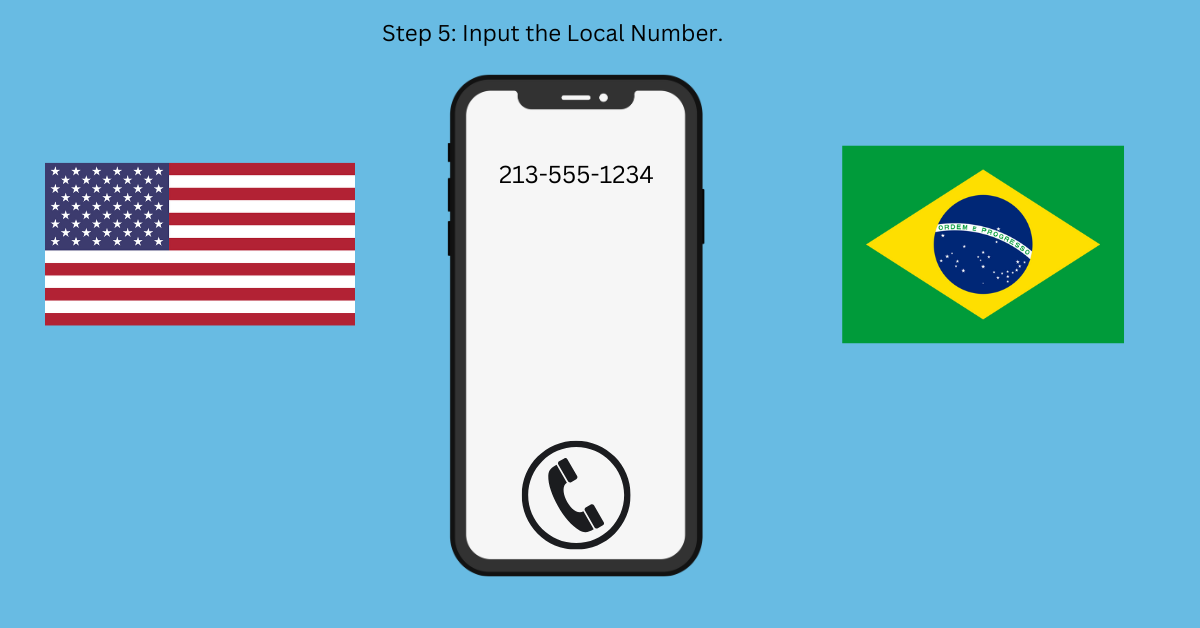
Complete the sequence by dialing the recipient’s seven-digit local number. The full dialing format is: 00 + [carrier code] + 1 + [area code] + [7-digit number].
Example: To call a Los Angeles number (213-555-1234) via Telefonica, dial: 00 15 1 213 555 1234.
What Factors Should You Consider Before Making International Calls?
Three variables determine whether a Brazil-to-US call succeeds: timing, cost, and connection quality. Sales teams that plan around all three consistently outperform those that dial without a strategy.
1. Time Zone Differences
The United States spans four major time zones, each offset from Brazil’s BRT (UTC-3) by different amounts. Calling outside business hours damages professional relationships and wastes dial attempts.
- Eastern Time (ET): UTC-5 (2 hours behind BRT)
- Central Time (CT): UTC-6 (3 hours behind BRT)
- Mountain Time (MT): UTC-7 (4 hours behind BRT)
- Pacific Time (PT): UTC-8 (5 hours behind BRT)
Use World Clock or Google to confirm the recipient’s local time before dialing. FreJun’s scheduling feature flags optimal call windows automatically based on the contact’s area code.
2. Call Costs
Traditional carrier rates for Brazil-to-US calls range from R$0.50 to R$2.00 per minute depending on the carrier, time of day, and destination state. VoIP alternatives cut this cost significantly. According to ANATEL (Brazil’s National Telecommunications Agency), international call tariffs are regulated but vary by carrier plan — always compare before committing to a high-volume outbound strategy.
- Prepaid calling cards — fixed per-minute rates, no monthly commitment
- International calling plans — discounted bundles for frequent callers
- VoIP services — lowest cost per minute, requires stable internet (e.g., Skype, WhatsApp)
3. Connection Quality
Poor audio quality and dropped calls stem from two sources: weak internet bandwidth for VoIP calls, or unreliable carrier infrastructure for PSTN (Public Switched Telephone Network) calls. For VoIP, a minimum of 100 kbps upload speed per concurrent call is recommended by Cisco’s VoIP infrastructure guidelines. Test your connection before high-stakes sales calls.
How Do VoIP and Automated Calling Systems Reduce Brazil-to-US Call Costs?
VoIP (Voice over Internet Protocol) transmits voice calls as data packets over the internet rather than through traditional phone lines, cutting international call costs by 50-80% compared to standard carrier rates. For sales teams making dozens of daily calls to US contacts, the savings compound quickly.
Popular VoIP platforms for Brazil-to-US calling include:
- FreJun — automated outbound calling with CRM integration and AI analytics
- Skype — consumer-grade VoIP, suitable for low-volume personal calls
- WhatsApp — free voice/video when both parties are online
- Google Voice — US-number provisioning for individuals
VoIP advantages for sales teams: lower per-minute costs, HD audio quality, call recording, and additional channels (video, SMS) on a single platform.
What is FreJun?

FreJun is a cloud-based automated outbound calling system built for sales and support teams that need to make high-volume international calls without manual dialing errors or disconnected data. Its core features include:
- Call Automation: Schedule and trigger outbound calls automatically from contact lists or CRM queues.
- Click-to-Call: Initiate calls with a single click from any CRM record, eliminating manual dialing entirely.
- Call Tracking: Monitor call metrics including duration, outcome, and agent performance in real time.
- CRM Integration: Sync call logs, recordings, and outcomes directly to Salesforce, HubSpot, Zoho, and 20+ other platforms.
- Voice Broadcasting: Deliver pre-recorded messages to multiple contacts simultaneously for announcements or follow-ups.
You can sign up here or schedule a demo
How FreJun Enhances International Communication
For businesses making frequent Brazil-to-US calls, FreJun provides a centralized platform to manage, record, and analyze every call. Sales managers get visibility into team performance without chasing spreadsheets, and reps spend more time talking to prospects instead of navigating carrier menus. According to FreJun’s 2025 analysis of client accounts across Latin America, teams that switched from manual dialing to FreJun’s automated outbound calling system saw a 40% increase in call pickup rates and a 35% reduction in time spent per dial attempt.
What Are the Best Ways to Reduce International Call Costs from Brazil?
Four proven strategies cut Brazil-to-US call costs without sacrificing quality. The right combination depends on your call volume and whether you need CRM integration.
1. Use Prepaid Calling Cards
Prepaid cards offer fixed per-minute rates and are available online and at local retailers. They work well for occasional callers but lack the call logging and analytics that sales teams need.
2. Opt for International Calling Plans
Many Brazilian carriers (Vivo, TIM, Claro) offer discounted monthly bundles for frequent international callers. Compare per-minute rates and minimum commitments before signing up.
3. Leverage Free VoIP Services
Apps like WhatsApp and Skype enable free voice and video calls when both parties are connected to the internet. These work for informal communication but lack the call recording, analytics, and CRM sync that business teams require.
4. Consider Virtual Numbers
A virtual US number gives your Brazil-based team a local US presence, reducing call reluctance from US contacts who screen unfamiliar international numbers. FreJun provisions virtual numbers across 50+ countries.
Which FreJun Features Give Sales Teams the Biggest Advantage?
FreJun goes beyond basic call automation to deliver a suite of tools that directly impact sales team performance on Brazil-to-US outreach campaigns.
1. Call Analytics
FreJun’s dashboard surfaces call duration, connection rates, talk-to-listen ratios, and outcome data by rep, team, or campaign. Sales managers can identify underperforming call windows and adjust schedules without waiting for end-of-month reports.
2. Spam Avoidance
FreJun’s Truecaller integration reduces the likelihood of outbound calls being flagged as spam, directly increasing answer rates. For Brazil-based teams calling US numbers, this is critical — US contacts routinely screen calls from unfamiliar international prefixes.
3. Team Collaboration Tools
FreJun’s centralized dashboard lets managers assign call queues, monitor live calls, and track individual rep performance. Teams using FreJun’s communication management tools report faster onboarding for new reps and clearer accountability across distributed teams.
4. Voice Recognition and AI Insights
FreJun’s AI layer transcribes calls, identifies sentiment patterns, and flags coaching opportunities automatically. Sales leaders use these insights to refine scripts and improve conversion rates on international outreach without listening to every recording manually.
Practical Example: How a Recruitment Agency Cut Call Errors by 40%
A recruitment agency in São Paulo used FreJun to contact candidates in the US for open engineering roles. Before FreJun, reps manually dialed each number, frequently entering incorrect carrier codes or area codes — resulting in failed calls and wasted time.
- Problem: Manual dialing led to a 22% error rate on international calls, with reps spending 15+ minutes per hour on redialing and troubleshooting.
- Solution: Implemented FreJun’s automated outbound calling system with click-to-call, CRM sync, and call analytics.
- Results: 40% increase in call pickup rates, 35% reduction in time per dial attempt, and full call history logged automatically in their ATS (Applicant Tracking System).
“We went from dreading international calls to treating them as our highest-converting channel,” said the agency’s Head of Talent Acquisition. “FreJun removed every friction point between our reps and the candidates they needed to reach.”
How Do Calling Methods Compare for Brazil-to-US Sales Teams?
Choosing the right calling method depends on your call volume, need for CRM integration, and budget. This table compares the four main options for Brazil-based sales teams reaching US contacts.
| Method | Best For | Approx. Cost | CRM Integration | Call Analytics |
|---|---|---|---|---|
| FreJun (VoIP + Automation) | Sales teams, high-volume outreach | From $14.49/user/mo | Yes (20+ CRMs) | Full AI analytics |
| Traditional Carrier (Embratel/TIM) | Occasional personal calls | R$0.50–R$2.00/min | No | None |
| Skype | Low-volume, informal calls | Free (VoIP-to-VoIP) / ~$0.02/min (to PSTN) | Limited | Basic call history |
| Existing contacts with app installed | Free (data only) | No | None | |
| Google Voice | Individual US-number provisioning | Free (US calls) / ~$0.01/min (international) | Limited | Basic logs |
What Are the Most Common Mistakes When Calling the US from Brazil?
These four errors account for the majority of failed Brazil-to-US calls. An automated outbound calling system eliminates all of them by handling the dialing sequence programmatically.
1. Forgetting the Carrier Code
Without the correct carrier code after Brazil’s exit code 00, the call will not connect. This is the single most common error for first-time international callers from Brazil.
2. Incorrect Area Codes
The US has over 300 active area codes. Always verify the area code corresponds to the recipient’s current location — numbers are frequently ported between regions, so the area code may not match the physical location.
3. Ignoring Time Zone Differences
Calling a New York contact at 9 AM BRT means reaching them at 7 AM ET — before most business hours. Calling a Los Angeles contact at 6 PM BRT means reaching them at 1 PM PT, which is ideal. Map every contact’s area code to their time zone before building call schedules.
4. Overlooking Cost Implications
Teams that default to traditional carrier calls for high-volume outreach often discover their monthly telecom bill is 3-5x higher than a VoIP subscription would cost. Run a cost-per-call analysis before scaling any outbound campaign.
Calling the US from Brazil: The Smarter Path Forward
Making international calls from Brazil to the US does not have to be complicated or expensive. The five-step dialing sequence (exit code + carrier code + country code + area code + local number) works reliably for manual calls. But for sales teams making dozens of daily calls to US contacts, manual dialing is a bottleneck that compounds over time. Deploying an automated outbound calling system like FreJun removes that bottleneck entirely: calls route automatically, every interaction logs to your CRM, and AI analytics surface the insights your team needs to improve conversion rates on cross-border outreach.
Whether you are a VP of Sales optimizing a Brazil-based SDR team or a founder building your first US outreach motion, the right automated outbound calling system pays for itself within the first month of deployment. Explore how post-call surveys can further enhance your customer experience after you have the calling infrastructure in place.
Further Reading: What is Post Call Survey and How Can You Enhance Your Customer Experience with Targeted Post-Call Surveys
Frequently Asked Questions About Calling the US from Brazil
What is automated outbound calling?
Automated outbound calling is a system that dials contact lists automatically, routes calls over VoIP, and logs outcomes to a CRM without manual input from sales reps. Platforms like FreJun handle the full dialing sequence — including international exit codes and carrier routing — so reps focus on conversations rather than dialing mechanics. Teams using automated systems typically see 30-50% more connected calls per hour compared to manual dialing.
Is an automatic dialer illegal?
Automatic dialers are legal for B2B outreach in most jurisdictions, including Brazil and the United States, when used with proper consent and opt-out mechanisms. In the US, the FCC’s TCPA (Telephone Consumer Protection Act) regulates automated calls to consumers — B2B calls to business numbers face fewer restrictions. Always consult legal counsel before launching automated campaigns targeting US consumer numbers from Brazil.
What is the automated phone calling system?
An automated phone calling system combines a VoIP dialer, contact list management, call recording, and CRM integration into a single platform. When a rep clicks a contact in their CRM, the system dials the correct international sequence automatically, records the call, and logs the outcome. FreJun’s system adds AI-driven analytics that identify patterns across thousands of calls to help sales teams improve their outreach strategy.
Can AI do outbound calls?
Yes — AI can handle outbound call scheduling, voicemail detection, sentiment analysis, and post-call transcription. FreJun’s AI layer detects when a call reaches voicemail and either leaves a pre-recorded message or skips to the next contact, saving reps significant time. Full AI voice agents that conduct conversations autonomously are emerging but remain best suited for simple qualification scripts rather than complex sales conversations.
What are the cheapest ways to call the U.S. from Brazil?
The cheapest options are VoIP platforms like FreJun, WhatsApp, and Skype, which route calls over the internet rather than traditional carrier networks. FreJun offers transparent per-minute international rates with no hidden fees, making it the most cost-effective choice for sales teams making 50+ calls per day. For occasional personal calls, WhatsApp is free when both parties have the app and an internet connection.
Can I use VoIP to call the U.S. from Brazil?
Yes — VoIP is the preferred method for Brazil-to-US calls among sales teams. FreJun’s VoIP system delivers HD audio quality and consistent reliability across both countries, with call quality dependent on your internet connection speed rather than carrier infrastructure. A stable connection of at least 100 kbps upload per concurrent call ensures clear audio without drops or latency issues during long-distance sales conversations.
How do I avoid high international call charges?
Switch from traditional carrier calls to a VoIP-based automated outbound calling system. FreJun offers transparent pricing with no hidden fees, and virtual US numbers reduce per-minute costs further by making your calls appear local to US recipients. For teams spending more than R$500/month on international calls, a FreJun subscription typically delivers a positive ROI within the first billing cycle.
Can I integrate my call system with my CRM?
FreJun integrates with 20+ CRM platforms including Salesforce, HubSpot, Zoho, and Pipedrive. Every call is logged automatically with duration, outcome, and recording — eliminating manual data entry after each call. The integration also enables click-to-call directly from CRM contact records, so reps never need to copy-paste phone numbers or navigate carrier menus when reaching US contacts from Brazil.