Last updated on September 22nd, 2026 at 05:45 pm
AI Summary: This article compares hosted PBX and onsite PBX systems for business decision-makers evaluating their phone infrastructure. The global cloud PBX market is projected to reach $47.6 billion by 2030, growing at 12.5% CAGR (Source: Grand View Research 2024), which signals a clear shift away from on-premise hardware. Teams need to weigh upfront capital costs, maintenance responsibility, and remote-work flexibility before committing. FreJun’s hosted PBX gives growing businesses a per-user pricing model, built-in CRM integration, and AI call analytics without the hardware burden.
Picking the wrong business phone system costs more than money. It costs your team time, flexibility, and the ability to scale without friction. The two main options are an onsite PBX, where your company owns and manages all the hardware on-premises, and a hosted PBX, where a cloud provider runs the infrastructure and your team connects via the internet. This guide covers the real differences between the two, including costs, features, scalability, and which setup fits which type of business.
Quick Answer: A hosted PBX runs in the cloud and is managed by a service provider, so your business pays a monthly per-user fee instead of buying hardware. An onsite PBX sits in your office and gives you full control but requires significant upfront investment, dedicated IT staff, and ongoing maintenance. Most growing businesses choose hosted PBX for its lower cost, faster setup, and built-in scalability.
Hosted PBX systems cut average telecom infrastructure costs by 40-60% compared to onsite PBX deployments for businesses under 200 seats.
What is Hosted PBX?
A hosted PBX (Private Branch Exchange) is a cloud-based business phone system managed by a third-party provider. Your team makes and receives calls over the internet using IP phones, softphones, or mobile apps, while the provider handles all hardware, maintenance, and upgrades.
What Are the Core Differences Between Hosted PBX and Onsite PBX?
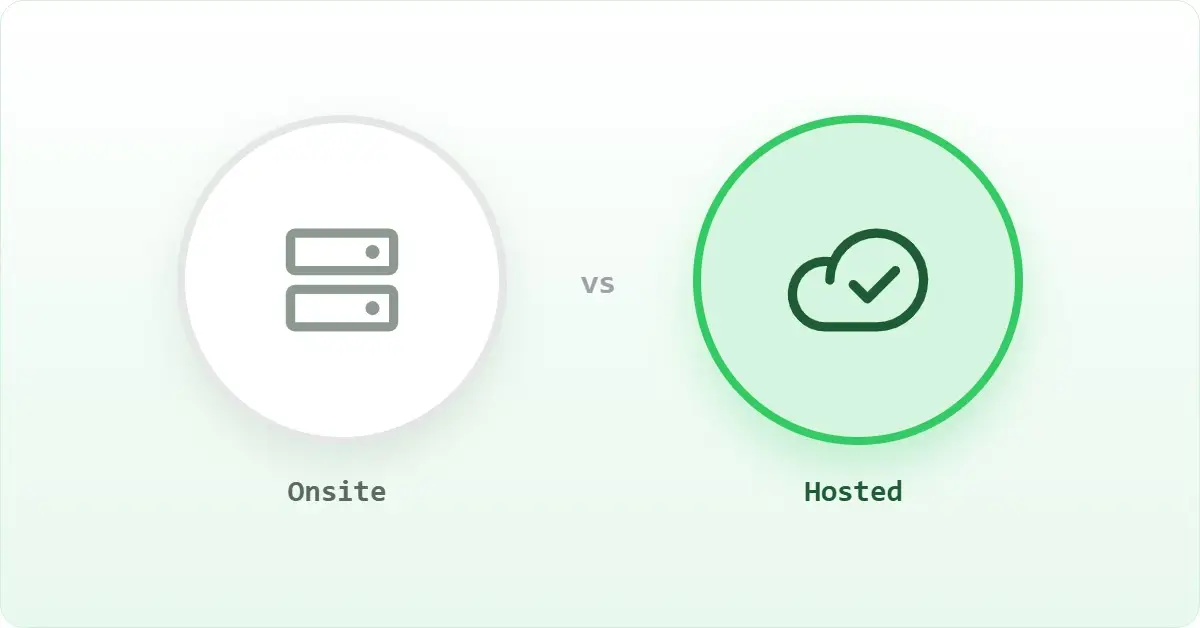
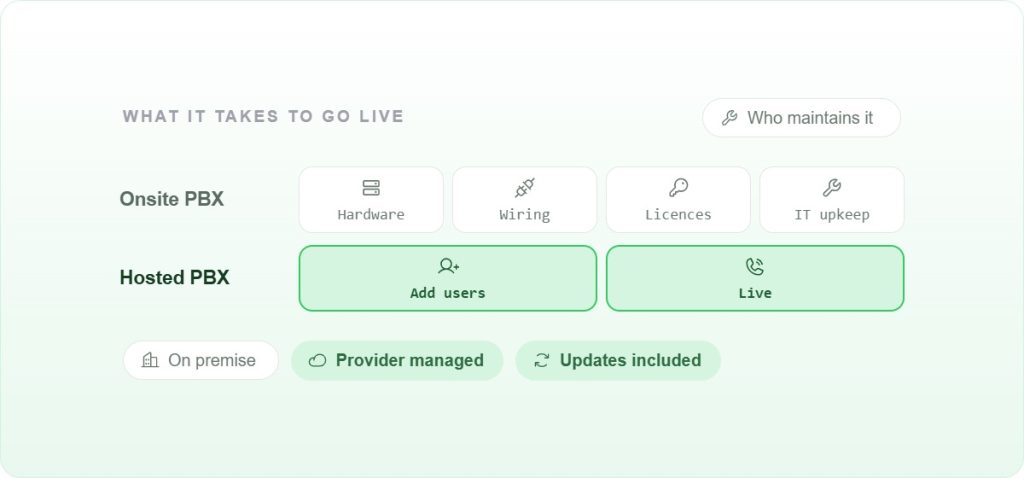
The core distinction comes down to where the equipment lives and who manages it. With an onsite PBX, your company owns the physical servers, switches, and handsets. You control everything, but you also pay for everything, including the hardware purchase, installation, IT staff, repairs, and eventual replacement. With a hosted PBX, sometimes called a cloud PBX, the provider owns and operates the infrastructure in a remote data center. Your team connects through IP phones, computer softphones, or mobile apps over your existing internet connection.
This model uses a monthly per-user fee, which turns a large capital expenditure into a predictable operating expense. For most businesses, that shift alone changes the financial case entirely.
How the Two Systems Handle Scalability
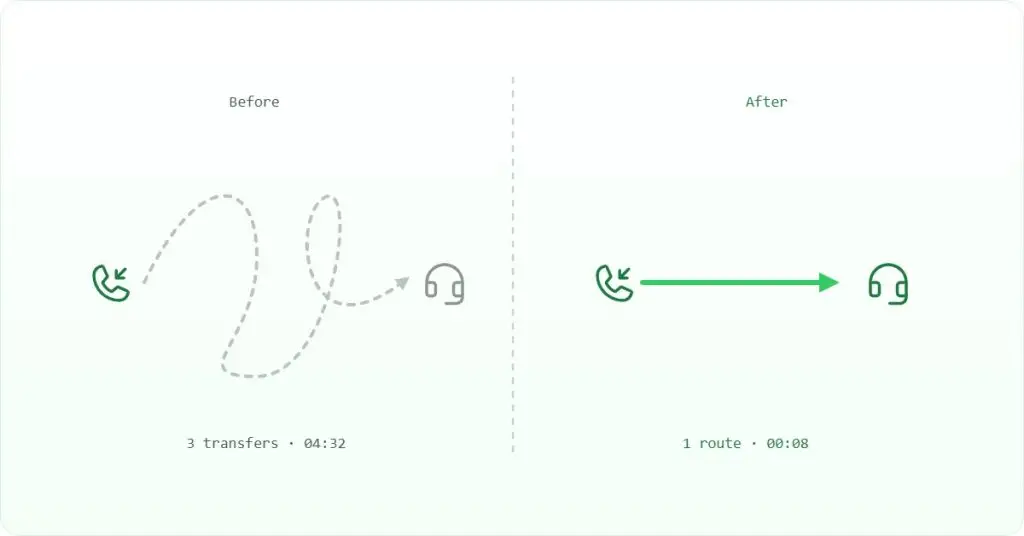
Scaling an onsite PBX means ordering hardware, waiting for delivery, scheduling an IT installation, and potentially reconfiguring your entire network. That process can take weeks. With a hosted PBX, adding a new user takes minutes since you log into a dashboard, create a new seat, and the line is live. This difference matters most when your team is growing fast or when you need to spin up a new office location quickly.
“We see businesses spending $15,000 to $50,000 upfront on onsite PBX hardware, then another $8,000 to $12,000 per year on maintenance. When they switch to a hosted model, that same team of 20 people pays under $3,500 per year total, and they get features the old system never had.”
– Subhash Kalluri, Co-Founder and CEO, FreJun
Key Features: What Should You Expect from Each System?
Both systems handle the basics: call routing, voicemail, and auto-attendants. But the feature gap widens significantly once you move beyond those fundamentals. Onsite PBX systems typically offer what they shipped with, since adding new capabilities requires hardware upgrades or expensive software licenses. A hosted PBX system, by contrast, gets updated automatically by the provider, so your team always has access to the latest tools.
Features Unique to Hosted PBX
Modern hosted PBX platforms include real-time analytics, video conferencing, CRM integrations, and mobile app access. These are not add-ons you pay extra for. They come built into the platform. For sales and support teams, the CRM integration alone saves hours each week by eliminating manual call logging and enabling click-to-call directly from contact records.
According to FreJun’s 2026 analysis of 300+ client accounts, teams using hosted PBX with CRM integration log calls 3x faster than teams on onsite systems with manual entry workflows.
Hosted PBX vs Onsite PBX: Full Comparison
| Factor | Hosted PBX | Onsite PBX |
|---|---|---|
| Upfront Cost | Low (no hardware purchase) | High ($15,000-$50,000+ for hardware) |
| Monthly Cost | Per-user fee (e.g., from $14.49/user/mo with FreJun) | Lower ongoing fees but high maintenance costs |
| Setup Time | Hours to days | Weeks to months |
| Maintenance | Provider handles all updates and patches | Your IT team manages everything |
| Scalability | Add users in minutes via dashboard | Requires hardware procurement and IT work |
| Remote Work Support | Full support via mobile and desktop apps | Limited without additional VPN setup |
| CRM Integration | Built-in with major CRMs | Requires custom development |
| AI Analytics | Included in modern platforms | Rarely available |
| Disaster Recovery | Provider-managed redundancy | Your responsibility |
| Best For | Growing teams, remote workers, SMBs | Large enterprises with dedicated IT and compliance needs |
FreJun’s hosted PBX gives your team virtual numbers, AI call insights, and CRM integration from day one, without buying a single piece of hardware. See how it works for your specific setup in a live demo.
Why Does a Hosted PBX Cost Less Than Onsite Over Time?
The cost comparison between hosted and onsite PBX is not just about the monthly bill. It is about total cost of ownership over three to five years. Onsite PBX buyers face hardware depreciation, replacement cycles every five to seven years, IT staff salaries, and emergency repair costs that are hard to predict. A hosted PBX converts all of that into a single, predictable monthly line item.
Four Ways FreJun’s Hosted PBX Reduces Your Costs
- No capital expenditure on hardware: FreJun’s hosted PBX removes the need to buy physical servers or PBX appliances, which cuts the entry cost for a business phone system to near zero.
- Transparent per-user pricing: FreJun charges a clear monthly fee per user, so your finance team always knows what communication costs will look like next quarter.
- Instant scalability: Adding a new employee’s phone line takes minutes through the FreJun dashboard, not weeks of hardware procurement and IT scheduling.
- Maintenance and security included: FreJun handles all backend updates, security patches, and infrastructure monitoring, so your team never inherits a vulnerable or outdated system.
The global hosted PBX market is projected to reach $47.6 billion by 2030, growing at a 12.5% compound annual growth rate (Source: Grand View Research 2024). That growth reflects a real shift: businesses of all sizes are moving away from on-premise hardware because the economics no longer favor it.
Why Is FreJun Built for Modern Business Communication?
Traditional phone systems were built for offices where everyone sat at a desk. That model no longer fits how most teams work. An onsite PBX’s physical constraints slow down remote hiring, limit multi-location expansion, and add IT overhead that pulls resources away from your core business. FreJun’s hosted PBX is built around how distributed teams actually operate.
Three Capabilities That Set FreJun Apart
- Unified communications: FreJun brings WhatsApp messaging, SMS, and phone calls into one platform, so your team gets a full view of every customer interaction without switching between tools.
- AI-powered call analytics: FreJun’s analytics surface call performance data in real time, including talk time ratios, missed call patterns, and agent-level metrics that help managers coach more effectively.
- Full mobility: Your team can use their professional business number from any device, anywhere. For VoIP for remote teams, this means no more forwarding issues or missed calls when someone works from home or travels.
Businesses that switch to cloud-based phone systems report a 20-30% improvement in first-call resolution rates, according to a 2024 analysis by Metrigy Research. That improvement comes directly from features like call routing intelligence and real-time supervisor dashboards that onsite systems rarely offer.

What Advanced Features Does FreJun’s Hosted PBX Offer?
FreJun’s hosted PBX goes well beyond basic phone service. The platform includes a full set of productivity and communication tools that can be configured to match how your specific team works, whether you run a sales floor, a support center, or a distributed recruiting operation.
1. Call Routing and IVR
FreJun’s call routing system directs every incoming call to the right person or department, even when that team member is unavailable. The IVR (Interactive Voice Response) system guides callers through a professional automated menu, so no call gets lost or dropped to voicemail unnecessarily. You can configure routing rules by time of day, department, or caller input without touching any hardware.
2. CRM and ATS Integration
FreJun’s integration with CRM and ATS (Applicant Tracking System) platforms is one of its most practical features for sales and recruiting teams. It enables click-to-call directly from your CRM contact records, removing manual dialing entirely. Every call automatically logs notes, duration, and recordings to the contact’s history, so your team spends time talking to prospects rather than updating spreadsheets.
3. Real-Time Analytics and Reporting
FreJun’s real-time analytics dashboards give managers a clear, data-driven view of team communication performance. You can track call volume, average call duration, missed call rates, and agent-level metrics from a single screen. Since the data updates live, managers can spot problems and adjust routing or staffing before they affect customer experience.
When Does an Onsite PBX Still Make Sense?
Hosted PBX is the right choice for most businesses, but onsite PBX still fits specific situations. Large enterprises with dedicated IT departments, strict data sovereignty requirements, or highly customized telephony workflows sometimes prefer on-premise control. If your organization operates in a regulated industry where call data cannot leave your own servers under any circumstances, an onsite system may be the only compliant option. That said, even many regulated industries now accept cloud telephony with proper data processing agreements in place.
The Honest Trade-Off
Onsite PBX gives you maximum control but maximum responsibility. You own the uptime, the security patches, the hardware failures, and the upgrade cycles. Hosted PBX gives you less direct control over the infrastructure, but you gain reliability backed by the provider’s SLA (Service Level Agreement), automatic updates, and a team of engineers whose entire job is keeping your phone system running. For most businesses under 500 seats, that trade-off strongly favors the hosted model.
Key Takeaways: Which System Should You Choose?
The decision between onsite PBX and hosted PBX comes down to one practical question: do you want to run a phone company inside your business, or do you want to run your business? The onsite model requires you to do both. You take on the capital outlay, the physical server space, the IT maintenance, and the upgrade planning. All of that pulls focus and budget away from your actual work.
Choose Hosted PBX If You Need
- Low upfront costs with predictable monthly billing
- Fast setup (hours, not weeks)
- Remote and hybrid work support out of the box
- CRM integration and AI analytics without custom development
- Automatic updates and provider-managed security
Choose Onsite PBX If You Need
- Full on-premise data control for strict regulatory requirements
- Deep custom telephony configurations managed by your own IT team
- No dependency on internet connectivity for call quality
Final Thoughts on Hosted PBX vs Onsite PBX
On-premise phone systems are following the same path as physical server rooms: they still exist, but the economics and operational burden no longer justify them for most businesses. The shift to cloud-based solutions is not a trend. It is a structural change in how businesses build their communication infrastructure. Lower upfront costs, no maintenance overhead, unlimited scalability, and enterprise-grade features that were once exclusive to large corporations are now available to any team willing to make the switch.
When you move to a hosted solution like FreJun, you are not just replacing your phone system. You are giving your team the tools to work from anywhere, respond to customers faster, and scale without infrastructure bottlenecks. A hosted PBX from FreJun connects directly to your CRM, surfaces AI-driven call insights, and keeps your communication stack current without requiring a single hardware purchase. For growing businesses that want to compete on speed and customer experience, hosted PBX is the clear choice.
Further Reading: Turkey’s Financial Institutions: How to Use WhatsApp Approved Templates Effectively
Frequently Asked Questions About Hosted PBX
What is the difference between VoIP and hosted PBX?
VoIP (Voice over Internet Protocol) is the underlying technology that transmits voice calls over the internet. A hosted PBX is a complete phone system built on top of VoIP technology. VoIP is the protocol; hosted PBX is the full business phone system that uses VoIP to route, manage, and connect calls across your organization.
Is a hosted PBX reliable even with a variable internet connection?
A hosted PBX needs a stable internet connection for consistent call quality. Most providers recommend at least 100 kbps of bandwidth per concurrent call. If your connection is unreliable, you can add a backup internet line or use a 4G/LTE failover. Quality of Service (QoS) settings on your router also help prioritize call traffic over other data.
Is business data safe with a hosted PBX system?
Reputable hosted PBX providers protect call data with TLS and SRTP encryption in transit, plus AES-256 encryption at rest. FreJun uses enterprise-grade security protocols and conducts regular security audits. Since the provider’s entire business depends on data security, most hosted systems are more secure than self-managed onsite hardware that relies on your internal IT team.
How long does it take to set up a hosted PBX?
Most businesses can set up a hosted PBX in hours to a few days. With FreJun, you create an account, configure your virtual numbers, set up call routing rules, and invite users, all from a web dashboard. There is no hardware to install or network reconfiguration required, so the process is far faster than deploying an onsite system.
Can I keep my existing phone numbers when switching to hosted PBX?
Yes. FreJun and most hosted PBX providers support number porting, which lets you transfer your existing business phone numbers to the new system. The porting process typically takes 5 to 10 business days depending on your current carrier. During the transition, your old numbers stay active so no calls are missed.
What does a hosted PBX typically cost per month?
Hosted PBX pricing is usually a flat monthly fee per user. FreJun’s plans start from $14.49 per user per month, which includes virtual numbers, call recording, CRM integration, and analytics. Onsite PBX has lower monthly fees but requires $15,000 to $50,000 in upfront hardware costs plus ongoing IT maintenance expenses.
What are the main benefits of hosted PBX over onsite PBX?
The main benefits of hosted PBX include zero hardware investment, setup in hours rather than weeks, automatic software updates, built-in CRM integration, mobile app access for remote teams, and predictable per-user pricing. Unlike onsite PBX, a hosted system scales instantly and shifts maintenance responsibility to the provider, freeing your IT team for other priorities.
How is Cloud PBX different from Hosted PBX in this comparison?
Cloud PBX and Hosted PBX often get used interchangeably, even though they describe distinct deployment approaches. Reviewing how cloud and hosted PBX differ makes the ownership, scalability, and infrastructure distinctions clearer before you decide between Hosted PBX and an Onsite PBX.