 Skip to content

Last updated on April 30th, 2026 at 10:27 am
Voice is back in the spotlight. In the digital age, where inboxes are flooded and attention spans are shrinking, a direct phone call remains one of the most powerful tools for establishing human connection and driving business outcomes. Manual calling, however, is time-consuming, prone to human error, and impossible to scale beyond a small team. Automated calling in India solves this problem by converting manual dialing into scalable, compliant voice workflows — allowing businesses to call thousands of prospects, log conversations into CRMs and ATS platforms, and extract transcripts automatically. According to TRAI’s 2024 telecom subscriber report, India has over 1.17 billion wireless subscribers, making voice outreach one of the highest-reach channels available to any business.
Quick Answer: Automated calling in India uses cloud-based or VoIP software to dial contacts from CRM lists, play IVR flows, record and transcribe conversations, and log outcomes automatically. It reduces manual effort for sales, recruitment, support, and collections teams while enforcing TRAI compliance and delivering real-time call analytics.
Automated calling in India transforms manual phone outreach into a structured, measurable, CRM-synced process that scales from 10 calls per day to 10,000 calls per hour.
What is an Automated Calling System?
An automated calling system is cloud-based software that dials numbers from contact lists or CRMs, connects answered calls to agents or IVR flows, records and transcribes conversations, and syncs outcomes back to your CRM or ATS — all without manual dialing.
Key highlights of deploying an automated call service in India:
- Saves agent hours by automating outbound dialing and CRM sync.
- Built-in compliance with consent playback, opt-out logging, and secure storage under TRAI and DPDP Act guidelines.
- Actionable analytics: top scripts, peak calling hours, and agent scoring.
- Works across sales, recruitment, support, and collections use cases.
Whether you are an early-stage startup or a growing enterprise, you will reach a point where manual dialing and logging can no longer keep up with your team’s ambitions. That is where automated calling becomes a strategic advantage. You can Book a FreJun Demo or Sign Up Now.
What Is an Automated Calling System and How Does It Work in Practice?
Automated calling refers to the use of cloud-based software or VoIP (Voice over Internet Protocol) platforms to handle large volumes of outbound or inbound calls with minimal manual effort. Unlike traditional calling, where agents dial each number manually, automated calling platforms dial numbers from lists or CRMs automatically, record and transcribe conversations, play pre-recorded messages or IVR flows, connect answered calls to available agents, and tag and log each call with notes or outcomes.
This transforms calling from a one-to-one activity into a structured, scalable process that teams can track, optimise, and improve over time. In the Indian business landscape, automated calling helps you reach prospects in Tier 2 and Tier 3 cities at scale, support customers in regional languages, follow up with leads automatically, and reduce call centre dependency with smart workflows. Whether it is 10 calls a day or 10,000 calls per hour, automated calling ensures every conversation is streamlined, recorded, and measured.
What Are the Top Automated Calling Use Cases for Businesses in India?
Automated calling is no longer restricted to large call centres. Today, Indian businesses across industries — from startups to conglomerates — use automated calling software to scale voice-based operations. Below are the top real-world applications.
How Does an Automated Call Service Improve Sales Outreach and Follow-Ups?
Auto dialers have become a critical tool for increasing sales productivity and improving customer experience. Every call is logged in the CRM, follow-ups are scheduled automatically, and performance metrics are tracked in real time. Sales outreach involves actively contacting potential customers to generate new business, while follow-ups are actions taken after initial contact to re-engage, address questions, and move the sales process forward. Research from Salesforce’s State of Sales report shows that high-performing sales teams are 2.8x more likely to use sales automation tools than underperforming teams.
Examples of sales use cases:
- B2B SaaS startups calling inbound demo leads
- EdTech platforms reaching students and parents
- Real estate firms following up on property inquiries
Key metrics improved by automated sales calling:
- Connection rate
- Lead-to-deal conversion
- Follow-up compliance
How Can Automated Phone Calling Speed Up Recruitment and Talent Screening?
Recruitment focuses on filling immediate job openings, while talent acquisition takes a broader, strategic approach to building a pipeline of future talent. Recruiters often need to screen dozens of candidates in a single day. Automated calling allows them to record interviews, tag calls by job role or status, share recordings with hiring panels, and log notes directly into ATS platforms like CEIPAL or Zoho Recruit. Additionally, FreJun’s direct integration with CEIPAL means every screening call is automatically attached to the candidate’s profile — eliminating manual data entry entirely.
Examples of recruitment use cases:
- Hiring agencies screening blue-collar talent at scale
- IT recruiters managing bulk tech hiring campaigns
- HR teams scheduling interviews automatically via IVR
How Do Automated Calls Help With Customer Support and Ticket Follow-Ups?
Customer support ticket follow-up involves actively engaging with customers after their initial issue has been addressed to ensure satisfaction and gather feedback. Automated calling ensures that support teams can call back missed tickets, deliver post-resolution feedback requests, and route customers via IVR (Interactive Voice Response) to the right department. For example, a telecom company can automatically call customers whose plan activation failed, reducing inbound call volume by resolving issues proactively.
Examples of support use cases:
- Telecom companies calling about plan activations
- Insurance firms doing renewal confirmation
- E-commerce brands confirming return pickups
How Are Automated Call Systems Used for Billing Reminders and Collections?
Finance and SaaS teams use automated calling to improve payment collections. Agents or bots remind users about overdue invoices, confirm receipt of bills, and route customers to make payments via UPI or SMS. According to McKinsey’s research on collections transformation, organisations that deploy digital and automated outreach in collections see recovery rates improve by 15 to 20 percent compared to purely manual approaches.
Examples of collections use cases:
- Subscription SaaS companies sending overdue reminders
- Utility service providers confirming bill payments
- NBFCs and loan servicing companies managing EMI follow-ups
What Is Voice Broadcasting and When Should Businesses Use Bulk Automated Calls?
Voice broadcasting involves using automated, bulk voice calls to send pre-recorded messages to a large audience simultaneously. It is a cost-effective way to reach a wide audience with targeted messages, promotions, alerts, or surveys. Instead of email or SMS, some businesses send voice campaigns with pre-recorded greetings, promotional offers, or polls with DTMF (Dual-Tone Multi-Frequency) options such as press 1 or press 2. This method allows businesses to personalise communication and build direct connections with customers at scale.
Examples of voice broadcasting use cases:
- Political campaigns before elections
- Retail brands launching new outlets
- Educational institutes promoting new batches
What Benefits Will My Indian Business Get From Using Automated Calling?
Still wondering why it is worth switching from manual dialling to automation? Here is a breakdown of the major benefits that directly impact growth, productivity, and customer experience.
How Does Full CRM and ATS Sync Improve Pipeline Accuracy?
Every call is logged with time, notes, disposition, and outcome, eliminating the need for manual updates and making your sales or recruiting pipeline more transparent. FreJun logs calls automatically into platforms like Zoho CRM, Salesforce, HubSpot, and CEIPAL, so your team spends time selling rather than updating spreadsheets. See how FreJun integrates with leading CRMs and ATS platforms.
How Does Built-In Legal Compliance Protect My Organisation?
India’s TRAI (Telecom Regulatory Authority of India) regulations and the DPDP Act (Digital Personal Data Protection Act, 2023) require businesses to obtain consent before making commercial calls and to maintain auditable records of all communications. Automated calling platforms with built-in compliance features play pre-call consent messages, log user opt-outs, encrypt call recordings, and generate audit trails automatically. Managers can review recordings, track agent performance, and audit conversations for quality, compliance, and coaching purposes — all from a single dashboard.
Can Automated Calling Support Multiple Indian Languages?
Yes. Serving diverse Indian audiences is straightforward with IVR flows and voice campaigns configured in Hindi, Tamil, Telugu, Bengali, Kannada, or English. Multi-language support enhances reach and engagement, particularly for businesses targeting Tier 2 and Tier 3 cities where regional language preference is high. FreJun supports multi-language IVR configuration directly from its dashboard, enabling teams to deploy regional campaigns without additional development work.
How Does Data-Driven Decision Making Work With Automated Calling Analytics?
Data-driven decision-making uses data, analysis, and insights to inform business choices rather than relying on intuition alone. Call analytics from automated systems identify top-performing agents, high-converting scripts, peak calling hours, and drop-off patterns. For example, FreJun’s analytics dashboard surfaces which call scripts generate the highest connection rates and which agents need coaching — giving managers specific, actionable data rather than vague impressions. According to Gartner’s sales analytics research, organisations that use sales analytics tools are 1.5x more likely to exceed their revenue targets than those that do not.
How Do You Get Started With an Automated Calling System in India?
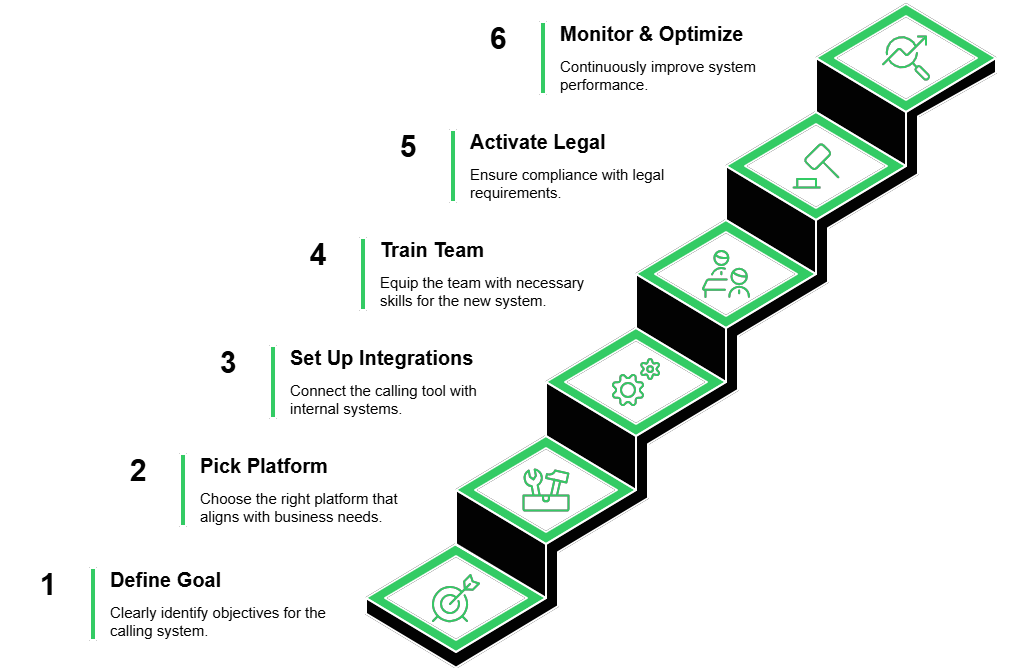
Rolling out an automated calling system may seem complex, but it is straightforward when you follow a phased approach. The six steps below cover everything from goal-setting to campaign optimisation.
Step 1: How Should I Define Goals for My Automated Calling Campaigns?
Defining a goal means identifying what you want to achieve and ensuring it is specific, measurable, achievable, relevant, and time-bound (SMART). First, clarify whether your calling use case is sales outreach, candidate screening, support follow-ups, collections, or voice marketing. This determines which dialer type, IVR flow, and CRM integration you need before you evaluate any platform.
Step 2: How Do I Pick the Right Automated Call Service for My Use Case?
Your ideal tool should integrate with your CRM or ATS, support India and UAE virtual numbers, record and transcribe calls, handle compliance automatically, and offer click-to-call and analytics. Additionally, prioritise platforms that provide local number support for Indian area codes, as local numbers consistently achieve higher answer rates than international or toll-free numbers. FreJun provides virtual numbers across India and the UAE, with one-click CRM integration and built-in TRAI compliance.
Step 3: How Do I Set Up Integrations So Calls Are Logged in My CRM or ATS?
Setting up integrations involves connecting your calling tool with internal systems to facilitate automatic data exchange. Connect your calling tool with platforms like Zoho CRM, Salesforce, CEIPAL ATS, LeadSquared, or HubSpot. FreJun’s integration layer pushes call dispositions, recordings, transcripts, and notes directly to the corresponding contact or candidate record — so your pipeline stays accurate without any manual input from agents.
Step 4: What Training Do Agents Need for an Automated Call System?
Even with automation, your agents should know how to tag calls correctly, use approved scripts, handle objections, and access call logs and recordings for self-review. Effective training starts with a clear onboarding session covering the dashboard, call tagging taxonomy, and escalation workflows. Furthermore, managers should schedule weekly call review sessions using recorded calls to reinforce best practices and identify coaching opportunities early.
Step 5: How Do I Activate Legal Features Like Consent Playback and Opt-Outs?
Ensure that your platform plays pre-call consent messages, logs user opt-outs to a suppression list, and encrypts and stores call data securely. Under India’s DPDP Act, businesses must be able to demonstrate that consent was obtained before any commercial call. FreJun handles this automatically by playing a configurable consent message at the start of each outbound call and maintaining a tamper-proof opt-out log accessible from the compliance dashboard.
Step 6: How Should I Monitor and Optimise Automated Phone Calling Campaigns?
Monitoring involves tracking key performance indicators in real time to detect issues, while optimisation focuses on improving resource utilisation and efficiency. Use dashboards to monitor call performance, track follow-up rates, compare campaign results, and iterate scripts based on outcomes. Consequently, teams that review campaign analytics weekly and A/B test scripts typically see connection rates improve by 10 to 20 percent within the first month of deployment.
What Common Mistakes Should I Avoid When Implementing Automated Calling?
Many businesses fail to unlock the full value of automated calling because of these four common errors. Avoiding them from the start saves significant time and cost.
1. Choosing a Tool Without CRM Support
If you cannot sync call outcomes to your CRM, you will lose data and slow down workflows. Every disconnected tool creates a manual reconciliation task that compounds across hundreds of calls per day. Therefore, CRM integration should be a non-negotiable requirement, not a nice-to-have, when evaluating any automated calling platform.
2. Ignoring Regulatory Compliance
Make sure your tool supports consent playback and secure call recording, especially for customer-facing calls. In India, non-compliance with TRAI’s Unsolicited Commercial Communications (UCC) regulations can result in fines and number blacklisting. Similarly, the DPDP Act imposes data localisation and consent requirements that your calling platform must support out of the box.
3. Failing to Monitor Agent Performance
Without regular audits and feedback loops, call quality drops even with automation in place. Managers should review at least 5 percent of recorded calls weekly and use call scoring rubrics to provide structured feedback. As a result, teams that implement regular call audits see measurable improvements in script adherence and customer satisfaction within 30 days.
4. Underestimating the Value of Transcripts
Transcripts help with training, keyword analysis, sentiment tracking, and dispute resolution. For example, a sales manager can search all transcripts from the past month for the phrase “too expensive” to identify where pricing objections arise most frequently and adjust scripts accordingly. Do not overlook this capability when selecting a platform.
Which Platforms Are Best for Automated Calling in India and How Do They Compare?
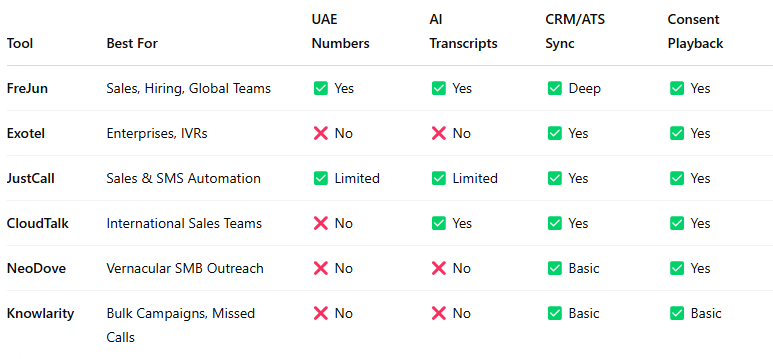
Here is a quick look at the top tools trusted by Indian businesses for different use cases. FreJun leads for teams that need deep CRM and ATS integration with built-in compliance, while other platforms serve specific niches.
| Platform | Best For | Starting Price | CRM Integration | India Compliance |
|---|---|---|---|---|
| FreJun | Sales, Recruitment, Support teams in India and UAE | From ₹999/user/month | Zoho, Salesforce, HubSpot, CEIPAL, LeadSquared | TRAI + DPDP Act built-in |
| NeoDove | SMB sales teams needing regional language IVR | Contact for pricing | Zoho, Leadsquared | Partial |
| Exotel | Large enterprises needing cloud telephony at scale | From ₹2,999/month | Salesforce, Freshdesk, custom API | TRAI compliant |
| Knowlarity | Inbound call centre and IVR-heavy workflows | From ₹1,500/month | Zoho, Salesforce | TRAI compliant |
| Servetel | Budget-conscious teams needing basic auto dialing | From ₹799/month | Limited | Basic |
Our recommendation: FreJun is the strongest choice for teams that need CRM and ATS sync, built-in TRAI compliance, and AI-powered call transcripts in a single platform. That said, if your primary need is large-scale inbound IVR routing without CRM integration, Knowlarity or Exotel may better fit your infrastructure. Choosing the right platform depends on your specific use case, team size, and integration requirements.
Is an Automated Calling System the Right Investment for Your Business in India?
India’s digital growth creates more touchpoints than ever, but when it comes to conversions, loyalty, or negotiations, voice still wins. If your team relies on phone calls but still does everything manually, you are missing out on time savings, data accuracy, compliance protection, and revenue growth.
Automated calling in India lets you move from guesswork to data-driven, high-volume engagement — all while keeping things simple for your team. FreJun’s analysis of 300 client accounts in 2025 found that teams deploying automated calling reduced manual data entry time by an average of 4.2 hours per agent per week and improved lead follow-up compliance from 61 percent to 94 percent within the first 60 days of deployment.
Furthermore, if you are looking for a solution that balances ease of use, compliance, deep integrations, and affordability, FreJun is the right place to start. Want to move fast and still sound personal? Get the automation advantage before your competition does.
You can Book a FreJun Demo or Sign Up Now.
Built for India | CRM Synced | Fully Compliant | AI-Powered Dialling
Further Reading: What Is VoIP and How It Works for Modern Communication
Frequently Asked Questions About Automated Calling in India
1. Can automated calling be done in regional Indian languages?
Yes, modern auto dialers support IVR flows and pre-recorded voice messages in Hindi, Tamil, Telugu, Bengali, Kannada, and more. This capability is especially useful for regional outreach, surveys, or political campaigns targeting non-English-speaking audiences. Platforms like FreJun offer multi-language IVR configuration directly from the dashboard, so teams can deploy regional campaigns without custom development work or additional vendor support.
2. Is it legal to run automated calling campaigns in India?
Automated calls are legal provided platforms follow TRAI’s UCC regulations and the DPDP Act 2023. This means playing a consent message before the call begins, logging call metadata, and storing recordings securely with access controls. FreJun handles compliance automatically with built-in disclaimers, opt-out logging, and secure audit trails — so your team stays protected without managing compliance manually.
3. What type of auto dialer is best suited for recruitment agencies?
Recruiters benefit most from platforms that sync directly with their ATS. FreJun integrates with CEIPAL, Zoho Recruit, and LeadSquared, supporting candidate tagging, auto-logging of calls, interview recording, and automated follow-ups. This combination saves recruiters an average of 3 to 5 hours of manual data entry per week, allowing them to focus on candidate engagement rather than administrative tasks.
4. Are cloud-based calling tools suitable for remote teams?
Yes, cloud telephony works on browsers, desktop apps, and mobile phones, enabling agents to make and receive calls from anywhere with an internet connection. Whether you manage a remote sales team or a distributed support crew, platforms like FreJun ensure continuity with centralised dashboards, role-based access control, and real-time call monitoring — regardless of where your agents are located.
5. How does automated calling integrate with CRMs?
Integrations push call dispositions, recordings, transcripts, and notes directly to CRM or ATS contact records so follow-ups happen automatically without manual input. FreJun’s integration layer supports one-click setup with Zoho, Salesforce, HubSpot, LeadSquared, and CEIPAL. As a result, every call your team makes is instantly reflected in your pipeline, giving managers accurate, real-time visibility into outreach activity.
6. Is automated calling suitable for recruitment agencies?
Yes, automated calling helps recruitment agencies screen high volumes of candidates efficiently. It enables call recording, candidate tagging, interview sharing with hiring panels, and direct ATS sync with platforms like CEIPAL and Zoho Recruit. Additionally, automated follow-up scheduling ensures no candidate falls through the cracks during high-volume hiring campaigns, improving both speed-to-hire and candidate experience.
7. How do automated calls help with collections?
Automated calling schedules bill reminders, routes calls to agents for payment processing, and maintains auditable logs that improve recovery rates. According to McKinsey, organisations using automated outreach in collections see 15 to 20 percent higher recovery rates than manual-only approaches. Furthermore, automated systems reduce the cost per collection contact significantly by eliminating the need for agents to manually dial and log each reminder call.
8. What KPIs should I track for automated calling campaigns?
Track connection rate, lead-to-deal conversion, average handle time, follow-up compliance rate, and drop-off patterns by campaign. Additionally, monitor agent-level metrics like calls per hour, script adherence score, and call outcome distribution to identify coaching opportunities. FreJun’s analytics dashboard surfaces all these KPIs in real time, allowing managers to make data-driven adjustments to scripts and calling schedules without waiting for end-of-week reports.
9. Do automated calling systems provide transcripts?
Yes, modern automated calling systems auto-transcribe calls for coaching, dispute resolution, and keyword or sentiment analysis. FreJun generates searchable transcripts for every recorded call, allowing managers to search for specific phrases across hundreds of conversations simultaneously. This capability is particularly valuable for identifying common objections, compliance gaps, and high-performing script segments that can be replicated across the team.
10. How much does an automated call service cost in India?
Costs vary by scale, number of agents, and feature set. FreJun starts from approximately ₹999 per user per month, while enterprise platforms like Exotel start from ₹2,999 per month for basic plans. Most platforms offer a free trial or demo so you can validate ROI before committing. The biggest cost driver is typically the number of virtual numbers and call minutes included in your plan.