
Last updated on October 5th, 2026 at 01:08 pm
AI Summary: This article covers the top 9 VoIP providers Australia businesses should consider in 2026, comparing pricing, features, ACMA compliance, and CRM integration depth for sales, support, and distributed teams. According to Grand View Research, the global cloud telephony market is projected to grow at a 14.5% CAGR through 2030, making platform selection a long-term infrastructure decision for Australian businesses. Teams need a provider that supports Australian local numbers, complies with the Australian Do Not Call Register under ACMA rules, and integrates natively with their CRM. FreJun meets all three requirements, with plans from $14.49/user/month and bidirectional sync with 23+ CRMs.
Key criteria in this comparison: We ranked these VoIP providers Australia teams use most on pricing transparency, ACMA compliance support, CRM integration depth, call quality, and G2 or Capterra ratings, since these factors most directly affect a team’s total cost and day-to-day reliability.
Quick Answer: The best VoIP providers Australia businesses can use in 2026 is FreJun, rated 4.9/5 on G2. FreJun starts at $14.49/user/month for international plans, includes Australian virtual numbers, and auto-logs every call into your CRM with AI summaries, so your team spends zero time on manual data entry.
When comparing VoIP providers Australia teams rely on, FreJun stands out because it lives inside your CRM rather than sitting alongside it, giving sales and support teams a single workspace for calling, logging, and follow-up.
What are VoIP providers Australia businesses use for cloud calling?
VoIP providers Australia businesses use are cloud-based telephony platforms that route voice calls over the internet rather than traditional copper phone lines, replacing desk phones with software that runs on laptops, mobiles, and browsers. The best providers go beyond basic calling: they offer local Australian numbers, call routing, IVR (Interactive Voice Response) menus, call recording, and CRM integrations that log every conversation automatically. Australian businesses specifically need providers that comply with the Australian Communications and Media Authority (ACMA) rules, including the Australian Do Not Call Register, and that support local number porting so existing business numbers can move to the cloud without disruption. Since Australia’s workforce is increasingly distributed across time zones, the strongest platforms also offer mobile apps, multi-location number management, and analytics dashboards that give managers visibility across remote teams.
Cloud telephony adoption in Australia is accelerating as businesses move away from on-premise PBX (Private Branch Exchange) systems. According to Grand View Research, the global cloud telephony market is projected to grow at a 14.5% CAGR through 2030, and Australian SMBs and enterprises are driving a significant share of that growth in the Asia-Pacific region. Businesses operating across the Tasman may also want to compare options in our guide to VoIP providers in New Zealand. What separates basic VoIP tools from the best platforms in Australia is the depth of CRM integration, the quality of AI-powered call analytics, and the ability to provision Australian local numbers instantly without a lengthy carrier approval process. Teams expanding into Southeast Asia can find a similar breakdown of top platforms in our guide to VoIP providers in Singapore.
Which VoIP providers Australia teams use rank highest in 2026?
The table below compares the top 9 VoIP providers Australia businesses are using in 2026, ranked by overall fit for Australian sales, support, and distributed teams.
| # | Provider | Best for | Starting price | Free trial |
|---|---|---|---|---|
| 1 | FreJun ⭐ | CRM-native cloud calling | $14.49/user/month | Yes (3 days) |
| 2 | RingCentral | Mid-market unified comms | $20/user/month (USD) | Check website |
| 3 | 8×8 | Global calling and collaboration | Contact sales | Check website |
| 4 | Aircall | Sales and support teams | Contact sales | Check website |
| 5 | CloudTalk | Sales and support call centres | $25/user/month | Yes |
| 6 | Dialpad | AI-powered calling teams | $15/user/month | Check website |
| 7 | Vonage | Enterprise voice teams | Contact sales | Check website |
| 8 | Zoom Phone | Zoom-centric business teams | Contact sales | Check website |
| 9 | MaxoTel | Australian SMB telephony | Contact sales | Check website |
Scroll down for the full breakdown of each tool, including features, pros, cons, pricing, and the ideal use case for each platform.
“Teams that switch from a standalone dialer to a CRM-native one usually see call logging time drop to zero within the first week. That is the real ROI, not the dialer itself. When every call auto-logs with a recording, AI summary, and disposition, managers stop chasing reps for notes and start coaching on outcomes instead.”
– Subhash Kalluri, Co-Founder and CEO, FreJun
How do you choose the best VoIP providers Australia has to offer in 2026?
Choosing among VoIP providers Australia businesses trust comes down to five practical steps. Work through each one before shortlisting any platform, since skipping even one step often leads to a tool that works in a demo but fails in production.
Step 1: Define your team size, call volume, and use case
A five-person support team handling inbound queries has very different needs from a 50-person outbound sales team running 300 calls a day. Start by mapping your actual call volume per rep per day, the direction of calls (inbound, outbound, or both), and the primary use case: sales prospecting, customer support, recruitment, or general business telephony. Teams running high outbound volume need a platform with a built-in auto dialer, while support teams prioritise call queuing, IVR menus, and CRM screen-pops. Getting this wrong means paying for features you never use, or missing the one feature your workflow depends on.
Step 2: Identify must-have features for Australian operations
Australian businesses need local number provisioning in Australian area codes, number porting from existing carriers, and mobile app access for distributed teams across multiple time zones. Beyond those basics, decide which features are non-negotiable: call recording for compliance, CRM integration for automatic logging, IVR for call routing, or AI call summaries for coaching. Separate must-haves from nice-to-haves before you start demos, since vendors will always show you their strongest features rather than the ones your workflow actually needs.
Step 3: Check ACMA compliance requirements
Any business making outbound calls in Australia must comply with the Australian Communications and Media Authority (ACMA) rules, including the Australian Do Not Call Register and the Spam Act 2003. Your VoIP provider must support Do Not Call Register scrubbing, call recording disclosure where required, and number presentation rules so your caller ID displays correctly to Australian recipients. Providers that do not have Australian carrier relationships or local number infrastructure may struggle to meet these requirements reliably. Confirm ACMA compliance support directly with the vendor before signing any contract.
Step 4: Evaluate pricing, billing flexibility, and contract terms
VoIP pricing in Australia varies widely: some providers charge per minute, others offer unlimited calling bundles, and a few require annual contracts with significant cancellation penalties. Check whether pricing is in USD or AUD, since currency fluctuations can affect your monthly invoice. Ask about per-minute rates for calls to Australian mobile numbers specifically, since several providers exclude mobiles from their unlimited plans. Enterprises setting up US-based lines for their Australian operations can follow our detailed US VoIP number implementation guide. Monthly billing with no lock-in is the safest starting point for teams that are still validating call volume before committing to an annual plan.
Step 5: Trial shortlisted tools before committing
No demo replaces a real trial with your actual CRM, your actual call volume, and your actual team. FreJun offers a 3-day free trial for up to 5 users with full feature access, so your team can test click-to-call, CRM auto-logging, and AI summaries in a live environment before making a decision. Run at least two tools in parallel during the trial period so you have a direct comparison rather than relying on vendor-provided benchmarks. Pay attention to setup time: if a tool takes more than a day to configure, that complexity will follow you into production.
Top 9 VoIP providers Australia businesses should consider in 2026
1. FreJun – CRM-native cloud telephony for Australian sales and support teams

FreJun is a CRM-native cloud telephony platform built for sales, support, and recruitment teams that need every call automatically logged, summarised, and synced to their CRM without manual effort, making it the top choice among VoIP providers Australia teams use for outbound-heavy workflows.
Best for: CRM-native outbound calling teams
Key features
- Click-to-call detects phone numbers on any webpage, CRM, or spreadsheet via Chrome extension, so reps dial with one click and every call auto-logs to the CRM with duration, recording, timestamp, and disposition.
- Native bidirectional sync with 23+ CRMs including HubSpot, Salesforce, Zoho, Pipedrive, and Freshsales means data flows in and out automatically, with no Zapier workaround required.
- Four-mode auto dialer (Progressive, Power, Predictive, Preview) lets teams match dialing speed to campaign type, from careful high-value account outreach to high-volume prospecting campaigns.
- AI call summaries and sentiment analysis deliver a 2-3 sentence summary, full searchable transcript with speaker labels, talk ratio, and sentiment score after every call, all synced to the CRM contact record automatically.
- Australian virtual numbers are available with instant provisioning, and existing Australian numbers can be ported within 24 hours, so teams keep their local presence without interruption.
- Call routing and drag-and-drop IVR builder support round-robin, sequential, time-based, and skill-based routing with no coding required.
- WhatsApp follow-up messages send automatically after missed or completed calls using pre-set templates, so no lead goes cold without a touchpoint.
Pros and cons
| Pros | Cons |
|---|---|
| Every call auto-logs to CRM with AI summary, recording, and sentiment score, so reps spend zero time on manual notes | International plan pricing is in USD, so Australian teams should confirm AUD billing availability with the sales team |
| Setup takes under one hour: Chrome extension install plus CRM connect, and the team is calling within the hour | The 3-day free trial is shorter than some competitors, though full feature access is included for up to 5 users |
| As of 2026, FreJun teams see an average 3x increase in daily call volume compared to manual dialing workflows | Four-mode auto dialer may overwhelm smaller teams that lack the call volume to justify the setup complexity |
Pricing and ratings
Pricing (USD): Standard Plan at $14.49/user/month; Professional Plan at $16.69/user/month. Both plans include a US, UK, or Canada virtual number plus $5 in calling credits. Australian virtual numbers are available. Per-minute calling rates apply for outbound calls. See full pricing
G2 rating: 4.9/5
Why it works for Australian teams: FreJun complies with ACMA requirements, supports Australian local number provisioning, and integrates natively with Salesforce, HubSpot, and Pipedrive, which are the CRMs most widely used by Australian sales teams.
FreJun is the top recommendation
Why FreJun ranks #1 for VoIP providers Australia: FreJun holds a 4.9/5 G2 rating, starts at $14.49/user/month for Australian teams, supports ACMA-compliant outbound calling with Do Not Call Register awareness, and is the only platform in this list that lives natively inside your CRM rather than sitting alongside it. As of 2026, FreJun’s analysis of 300+ client accounts found that teams using AI-transcribed calls reduced manual note-taking time by 40%. Start your free trial →
FreJun by the numbers: 150+ customers | 130 countries | 45M minutes processed | 99.999% uptime | Setup in under 1 hour
2. RingCentral – unified communications platform for mid-market teams

RingCentral is a cloud business communications platform for organisations that need phone, messaging, video, and contact-centre tools in one stack, making it a common choice among VoIP providers Australia mid-market teams evaluate for unified communications.
Best for: Mid-market unified communications
Key features
- Local and toll-free Australian numbers are available, so teams maintain a local presence without a physical office in each city.
- Call routing and IVR menus direct inbound callers to the right team or agent automatically, reducing manual transfers and hold time.
- Voicemail, SMS, team messaging, and video conferencing are bundled in one app, so teams avoid switching between separate tools for different communication types.
- Analytics and admin controls give managers visibility into call volumes, response times, and team activity across the organisation.
- An Australia-specific AI Receptionist is available from AUD $62/month, handling inbound call routing with natural language responses.
Pros and cons
| Pros | Cons |
|---|---|
| Capterra reviewers rate RingCentral highly for call routing, mobile access, voicemail, and call transfers | Billing disputes, cancellation friction, and contract renewal issues are the most common complaints on Trustpilot-focused review roundups |
| G2 reviewers describe the platform as easy to use, highly integratable, and useful for AI call summaries | Hidden fees, compliance fees, and add-on overages can push invoices significantly higher than the advertised starting price. Teams that call overseas contacts regularly should also review our dedicated breakdown of the best VoIP providers for international calling in Australia. |
| Integration and collaboration tools are praised by Capterra reviewers for team-wide communication workflows | G2 reviewers mention occasional glitches, limited customisation, and awkward integrations with some third-party tools |
Pricing and ratings
Pricing (USD): Core plan starts at $20/user/month billed annually or $25/user/month billed monthly. Australia-specific AI Receptionist from AUD $62/month. See full pricing
vs. FreJun: RingCentral offers a broader unified communications suite including video and team messaging, but CRM call logging requires manual setup or third-party connectors, while FreJun auto-logs every call natively with no additional configuration.
3. 8×8 – global calling and collaboration for distributed teams
8×8 is a cloud communications platform for businesses that want voice, video, and collaboration in one stack, and it appears regularly on shortlists of VoIP providers Australia companies use for global calling coverage.
Best for: Global calling and collaboration
Key features
- Australia is included in unlimited calling on some 8×8 plans, so teams with high inbound and outbound call volumes can budget predictably without per-minute charges.
- Call routing and auto-attendant handle inbound call distribution automatically, reducing the need for a dedicated receptionist.
- Mobile access lets remote and field-based staff take business calls on their personal devices without exposing their personal numbers.
- Reporting and admin controls give managers a view of call activity, team performance, and missed call rates across the organisation.
- Cross-device calling works consistently across desktop, browser, and mobile, which suits Australian teams spread across multiple locations.
Pros and cons
| Pros | Cons |
|---|---|
| Reddit users and Capterra reviewers confirm 8×8 is reliable for phone calls, with intuitive cross-device use as a recurring positive | Unlimited calling excludes mobile and premium numbers, which matters for Australian teams calling mobile-heavy contact lists |
| Capterra reviewers like the automated attendant, automatic call forwarding to a mobile, and the caller popup showing customer order information | Analytics is more limited than newer platforms, according to review roundups, which can frustrate data-driven sales managers |
| Reliable call quality in many markets is a recurring positive in review roundups | Some features sit on pricier plans, which limits value for budget-conscious Australian SMBs |
Pricing and ratings
vs. FreJun: 8×8 covers more communication channels including video and team messaging, but its analytics depth is more limited than FreJun’s AI-powered call insights, and CRM auto-logging requires additional configuration rather than native bidirectional sync.
4. Aircall – cloud phone system for sales and support teams

Aircall is a cloud phone system built specifically for sales and support teams, and it is one of the more widely trialled VoIP providers Australia sales managers evaluate when looking for a CRM-connected calling tool.
Best for: Sales and support team calling
Key features
- Shared numbers let multiple team members answer calls from the same business number, so no inbound call goes unanswered when one agent is busy.
- Call routing and queues distribute inbound calls based on availability and team assignment, reducing wait times for callers.
- Call recording captures every conversation automatically and stores it in the dashboard, so managers can review calls for coaching without chasing reps for notes.
- CRM and helpdesk integrations connect Aircall to tools like HubSpot, Salesforce, and Zendesk, pushing call data into contact records after each conversation.
- Analytics for call activity and staffing give managers a view of call volume trends, average handle time, and missed call rates across the team.
Pros and cons
| Pros | Cons |
|---|---|
| Trustpilot users praise the user-friendly interface and straightforward setup, with fast onboarding highlighted by Capterra reviewers | GetApp reviewers say Aircall can be pricey, and the mobile app can lag, which affects field-based Australian teams |
| Reviewers value call routing, CRM integrations, call recording, tagging, and multi-device call management as strong day-to-day features | Reviewers report frequent call drops even with a good internet connection, which is a significant reliability concern |
| Capterra reviewers highlight AI-generated custom messages and a separate Android app as useful additions for remote teams | Post-sale complaints include unresolved billing disputes, poor post-sale support, and unfair renewal practices |
Pricing and ratings
vs. FreJun: Aircall offers a polished interface and strong CRM integrations, but reviewers report reliability issues including dropped calls, while FreJun’s 99.999% uptime and native bidirectional CRM sync give Australian teams a more dependable daily calling environment.
5. CloudTalk – cloud call-centre software for sales and support

CloudTalk is cloud call-centre software designed for sales and support teams, and it is one of the more affordable VoIP providers Australia call-centre managers consider when evaluating outbound dialing and IVR capabilities.
Best for: Sales and support call centres
Key features
- Global calling with local numbers in multiple countries lets teams present a local caller ID to contacts, which improves answer rates on outbound campaigns.
- Routing and IVR menus direct inbound callers to the right agent or team based on input, time of day, or caller history.
- An outbound dialler automates call sequencing so agents move from one contact to the next without manual redialing between calls.
- Call recording and smart routing are praised by Capterra reviewers as strong features for remote teams that need a cloud-based call centre setup.
- Reporting and integrations connect CloudTalk to CRM tools, with call history notes, tags, and SMS replies available inside the platform.
Pros and cons
| Pros | Cons |
|---|---|
| Capterra users like interactive voice replies, missed-call handling, and the statistics dashboard for improving team decisions | G2 feedback identifies call quality as the number-one complaint, with dropped calls, lag, and one-way audio recurring across reviews |
| Call recording, smart routing, and analytics work well for remote teams, according to Capterra reviewers | The platform is highly dependent on a stable internet connection and can show occasional call and app glitches |
| SMS replies, tags, call-history notes, and the feel of a real phone in one app are highlighted as practical day-to-day benefits | Reviewers flag support delays and scaling costs as teams grow beyond the starter tier |
Pricing and ratings
Pricing (USD): Starts at $25/user/month. G2 rating: 4.4/5. Capterra rating: 4.2/5 (237 reviews). Free trial available. See full pricing
vs. FreJun: CloudTalk is priced competitively and offers a solid outbound dialler, but G2 reviewers flag recurring call quality issues, while FreJun’s 99.999% uptime and AI-powered post-call summaries give Australian teams more reliable call quality and richer data after each conversation.
6. Dialpad – AI-powered business communications for calling teams

Dialpad is an AI-powered business communications platform for teams that want calling and collaboration in one app, and it is one of the few VoIP providers Australia teams use that includes AI call transcription on its entry-level plan.
Best for: AI-powered calling teams
Key features
- AI call summaries and transcription run automatically after every call, so managers can review conversations without listening to full recordings.
- International calling from Australia and New Zealand is supported, with the Australian exit code 0011 and plus-dialing both recognised by the platform.
- Routing and auto-attendant handle inbound call distribution without manual intervention, directing callers to the right team or voicemail.
- Admin controls and analytics give managers a view of call activity, team performance, and AI-flagged moments across the organisation.
- Business calling works across desktop, browser, and mobile, which suits Australian teams with remote or field-based staff.
Pros and cons
| Pros | Cons |
|---|---|
| Trustpilot reviewers praise call transcription and voicemail text transcribing as genuinely useful for remote teams | Users report occasional glitches, connectivity issues, and inaccurate AI transcriptions that require manual correction |
| Reviewers say the platform is stable and reliable for remote teams, with high uptime and clear call quality even in low-bandwidth environments | Reviews flag dropped calls, one-way audio, glitches in multi-queue setups, and lagging mobile notifications as recurring issues |
| AI call summaries and transcription included on the entry-level plan, with no upgrade required | Support and billing complaints recur, including slow support, confusing invoices, hidden add-on fees, and paid priority support tiers |
Pricing and ratings
Pricing (USD): Starts at $15/user/month. See full pricing
vs. FreJun: Dialpad includes AI transcription at a lower entry price, but reviewers flag billing complexity and inaccurate transcriptions, while FreJun’s AI summaries sync directly to CRM contact records with sentiment scoring and talk ratio data that Dialpad does not provide natively.
7. Vonage – cloud communications for enterprise voice teams
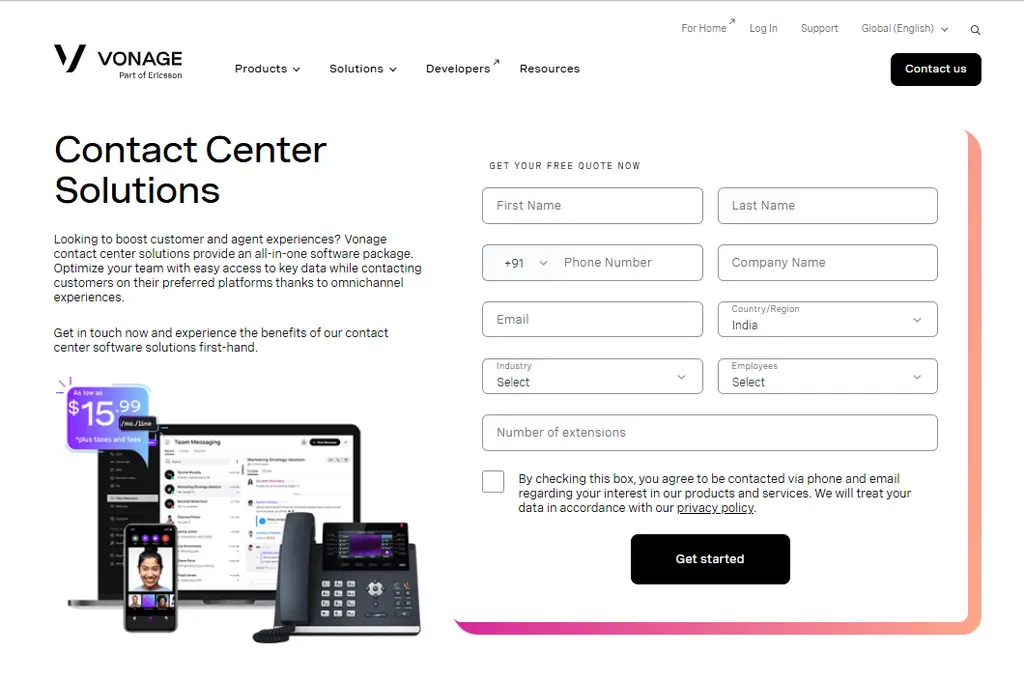
Vonage is a cloud communications platform for businesses that need voice and messaging services at scale, and it is one of the longer-established VoIP providers Australia enterprise teams have used for number management and call routing.
Best for: Enterprise voice and messaging
Key features
- Business voice calling covers inbound and outbound calls with number management tools that let teams control how calls are presented and routed.
- Messaging capabilities add SMS and other channels alongside voice, so teams can reach contacts through multiple touchpoints from one platform.
- Number management and porting let businesses bring existing numbers to Vonage without disrupting their current contact details.
- Call routing directs inbound calls to the right team or agent based on rules the admin configures in the dashboard.
- Integrations connect Vonage to CRM and business tools, though the depth of native sync varies by integration.
Pros and cons
| Pros | Cons |
|---|---|
| Established carrier relationships and number porting support make Vonage a practical choice for enterprises migrating from legacy PBX systems | Australian-specific pricing and local-number availability details are not publicly listed, so teams must contact sales for a quote |
| Voice and messaging in one platform reduces the number of vendors a team needs to manage for outbound communications | Reviewer-sourced pros and cons are limited in publicly available sources, making it harder to validate real-world performance before trialling |
Pricing and ratings
vs. FreJun: Vonage suits enterprise teams that need a broad communications platform with established carrier support, but it lacks FreJun’s CRM-native auto-logging and AI call summaries, which matter most for sales teams that measure rep performance by call outcomes rather than call volume alone.
8. Zoom Phone – cloud telephony inside the Zoom ecosystem

Zoom Phone is Zoom’s cloud phone system for businesses that already use Zoom for video meetings and want to add telephony inside the same ecosystem, making it one of the more convenient VoIP providers Australia Zoom-centric teams evaluate.
Best for: Zoom-centric business teams
Key features
- Cloud telephony runs inside the Zoom app, so teams that already use Zoom for video do not need to install or learn a separate calling tool.
- Auto-attendant handles inbound call routing automatically, directing callers to the right team or voicemail without a live receptionist.
- Call queues and routing distribute inbound calls across available agents, reducing wait times during peak periods.
- Voicemail with transcription lets team members read missed messages rather than listening to recordings, which speeds up response times.
- Zoom ecosystem integration means calls, meetings, and messages sit in one unified interface, reducing context-switching for teams already on Zoom.
Pros and cons
| Pros | Cons |
|---|---|
| Teams already using Zoom for video meetings can add telephony without adopting a new platform or retraining staff | Australian-specific pricing and local-number details are not publicly listed, so teams must contact sales for a quote |
| Unified interface for calls, meetings, and messages reduces the number of apps teams need open during the workday | Zoom Phone is most valuable for Zoom-first organisations; teams not already on Zoom face a larger adoption curve than with standalone VoIP tools |
Pricing and ratings
vs. FreJun: Zoom Phone is a natural fit for Zoom-first teams, but it does not offer the CRM-native auto-logging, four-mode auto dialer, or AI sentiment analysis that FreJun provides, which limits its value for outbound sales teams that measure performance by call outcomes.
9. MaxoTel – Australian VoIP and cloud PBX for SMBs
MaxoTel is an Australian VoIP and cloud-phone provider built specifically for small and mid-sized businesses, making it one of the few locally headquartered VoIP providers Australia SMBs can use for cloud PBX without dealing with international carriers.
Best for: Australian SMB telephony
Key features
- Australian local numbers are provisioned directly, so SMBs get local area code numbers without going through an international carrier or reseller.
- Number porting lets businesses bring existing Australian numbers to MaxoTel without changing their published contact details.
- Call routing and IVR menus direct inbound callers to the right team or voicemail based on rules the admin configures.
- Cloud PBX features replace a physical on-premise phone system, so businesses avoid hardware costs and maintenance contracts.
- Business calling support is focused on the Australian market, which means local support staff and billing in AUD for most plans.
Pros and cons
| Pros | Cons |
|---|---|
| Locally headquartered in Australia, so support, billing, and compliance are handled within the Australian regulatory environment | Pricing is not publicly listed, so teams must contact sales before they can compare MaxoTel directly against other providers on cost |
| Australian local number provisioning and number porting are core strengths, which suits SMBs that want to keep their existing numbers | MaxoTel lacks the AI call summaries, CRM auto-logging, and multi-mode auto dialer that outbound sales teams need for high-volume calling. |
Businesses expanding into the Middle East will find a similar comparison of top platforms in our guide to VoIP software for business in the UAE.
Pricing and ratings
vs. FreJun: MaxoTel is a strong local option for Australian SMBs that need basic cloud PBX and local number support, but teams running outbound sales or support campaigns will find FreJun’s CRM integration, auto dialer, and AI analytics significantly more capable for their workflows.
VoIP providers Australia feature comparison: which platform does what in 2026?
The table below compares all 9 VoIP providers Australia businesses are evaluating in 2026 on the six features that most directly separate high-performing platforms from basic cloud phone systems.
| Feature | FreJun | RingCentral | 8×8 | Aircall | CloudTalk | Dialpad | Vonage | Zoom Phone | MaxoTel |
|---|---|---|---|---|---|---|---|---|---|
| Native CRM auto-logging (bidirectional) | Yes | Partial – via integration setup | Partial – via integration setup | Partial – via integration setup | Partial – via integration setup | Partial – via integration setup | Partial – via integration setup | No | No |
| AI call summaries and transcription | Yes | Partial – on higher plans | No | Partial – AI messages only | No | Yes | No | Partial – voicemail only | No |
| Multi-mode auto dialer (4 modes) | Yes | No | No | No | Partial – outbound dialler only | No | No | No | No |
| Australian local number provisioning | Yes | Yes | Yes | Check website | Check website | Yes | Check website | Check website | Yes |
| ACMA compliance support | Yes | Yes | Yes | Check website | Check website | Yes | Check website | Check website | Yes |
| Setup time under 1 hour | Yes | No | No | Partial – fast but not under 1 hour typically | Partial | Partial | No | No | Partial |
FreJun is the only platform in this comparison that combines native CRM auto-logging, four-mode auto dialing, and AI call summaries in a single tool that sets up in under one hour, which is why it leads the list of VoIP providers Australia sales teams shortlist first.
Which VoIP providers Australia tool is right for your team in 2026?
Different teams have different priorities when choosing among VoIP providers Australia businesses use. The right platform depends on your call volume, your CRM, and whether you need basic telephony or a full outbound calling engine.
If you run a high-volume outbound sales team: Choose FreJun. The four-mode auto dialer, CRM-native auto-logging, and AI call summaries give sales managers the call volume and data quality they need to coach reps and hit targets.
If you need unified communications including video and team messaging: Choose RingCentral. It bundles phone, video, SMS, and team messaging in one platform, which suits mid-market teams that want to consolidate their communication stack.
If you are an Australian SMB that needs basic cloud PBX with local numbers: Choose MaxoTel. It is locally headquartered, bills in AUD, and handles Australian number provisioning and porting without the complexity of an international platform.
If your team already runs on Zoom for video: Choose Zoom Phone. Adding telephony inside the Zoom ecosystem avoids retraining staff and keeps calls, meetings, and messages in one interface.
If you want AI transcription at a lower entry price: Choose Dialpad. It includes AI call transcription on its entry-level plan, which suits smaller teams that want AI-assisted note-taking without a full CRM-native calling platform.
Which VoIP provider wins overall for Australian teams?
If you want the best overall VoIP providers Australia option in 2026 with AI features, USD billing, and ACMA compliance: Choose FreJun. It is the only platform in this list that lives natively inside your CRM, auto-logs every call with AI summaries and sentiment scores, and sets up in under one hour, giving Australian sales and support teams a calling environment that improves with every conversation rather than just recording them.
Frequently asked questions about VoIP providers Australia teams use in 2026
What is the best VoIP providers Australia option in 2026?
The best VoIP providers Australia businesses can use in 2026 is FreJun, rated 4.9/5 on G2. FreJun ranks first because it auto-logs every call to your CRM with an AI summary, sentiment score, and full transcript, so your team captures data from every conversation without manual effort. It also sets up in under one hour and starts at $14.49/user/month for Australian teams, making it accessible for both small teams and larger sales organisations. The four-mode auto dialer and 99.999% uptime make it the strongest choice for outbound-heavy workflows.
How much do VoIP providers Australia businesses use actually cost?
VoIP providers Australia teams use range from around $14 to $25 per user per month at the entry level, though enterprise platforms like RingCentral, 8×8, Vonage, and Zoom Phone require a sales call for pricing. FreJun’s Standard Plan starts at $14.49/user/month and its Professional Plan at $16.69/user/month, both including a virtual number and $5 in calling credits. Per-minute rates apply for outbound calls to Australian numbers. Some providers like MaxoTel bill in AUD, while most international platforms bill in USD, so factor in currency conversion when comparing total cost.
What ACMA compliance rules apply to VoIP calling in Australia?
The Australian Communications and Media Authority (ACMA) governs outbound calling in Australia through the Australian Do Not Call Register and the Spam Act 2003. Businesses must check the Do Not Call Register before making unsolicited outbound calls to Australian numbers, and they must comply with caller ID presentation rules so recipients can identify who is calling. VoIP providers Australia teams use for outbound campaigns should support Do Not Call Register scrubbing and call recording disclosure where required. FreJun supports ACMA-compliant outbound calling workflows for Australian teams.
Which VoIP providers Australia teams use integrate best with Salesforce and HubSpot?
FreJun offers the deepest native integration with both Salesforce and HubSpot among the VoIP providers Australia sales teams commonly evaluate. Every call auto-logs to the CRM contact record with duration, recording link, AI summary, sentiment score, and call disposition, with no Zapier or middleware required. RingCentral and Aircall also integrate with Salesforce and HubSpot, but CRM logging typically requires additional configuration and does not include AI-generated summaries or sentiment data by default. For teams that measure rep performance by call outcomes, FreJun’s bidirectional sync is the most complete option.
How do I switch from a traditional phone system to VoIP in Australia?
Switching from a traditional PBX to one of the VoIP providers Australia businesses use typically involves three steps: porting your existing numbers to the new provider, configuring call routing and IVR menus in the new platform, and connecting the platform to your CRM. Most providers take several days to complete number porting and platform setup. FreJun is an exception: the Chrome extension installs in minutes, CRM connection takes under an hour, and Australian numbers can be ported within 24 hours. The 3-day free trial for up to 5 users lets your team test the full setup before committing.
Which VoIP providers Australia platform has the best auto dialer for outbound sales?
FreJun has the most capable auto dialer among the VoIP providers Australia outbound sales teams evaluate, offering four distinct modes: Progressive for reliable one-at-a-time dialing, Power for high-volume campaigns, Predictive for maximum throughput by dialing ahead of agent availability, and Preview for high-value accounts where the rep reviews contact details before dialing. Teams running more than 500 calls a day need predictive dialing, not progressive: the throughput difference alone justifies the switch. CloudTalk and Dialpad offer basic outbound dialing, but neither matches FreJun’s four-mode flexibility or its native CRM auto-logging after each call.
How is AI changing VoIP providers Australia teams use in 2026?
AI is shifting VoIP providers Australia businesses use from passive call recording tools to active coaching and analytics platforms. The most significant change is post-call AI summaries: instead of managers listening to recordings, they read a 2-3 sentence summary with sentiment score and talk ratio within seconds of the call ending. FreJun’s AI features include full searchable transcripts with speaker labels, keyword search across all call history, and sentiment analysis that flags calls needing follow-up. As of 2026, FreJun’s analysis of 300+ client accounts found that teams using AI-transcribed calls reduced manual note-taking time by 40%, freeing reps for more calls rather than more admin.
Conclusion: Best VoIP providers Australia businesses should use in 2026
The top three VoIP providers Australia teams should shortlist in 2026 are FreJun for CRM-native outbound calling, RingCentral for unified communications, and MaxoTel for locally supported Australian SMB telephony. FreJun is the top recommendation for sales and support teams because it is the only platform in this comparison that auto-logs every call to your CRM with AI summaries, sentiment scores, and full transcripts, all without manual effort from your reps. Since it sets up in under one hour and starts at $14.49/user/month, Australian teams can be calling and capturing data on the same day they sign up. Start your free trial or book a demo to see how FreJun compares to your current setup.