Last updated on August 26th, 2026 at 02:21 pm
AI Summary: This article covers how virtual phone providers for US business communication help enterprise sales and support teams replace legacy PBX systems with cloud-based calling, CRM integration, and AI-driven call insights. According to Grand View Research’s 2025 Cloud Telephony Market Report, the US cloud telephony market is projected to grow at 15.2% CAGR through 2030, driven by remote work adoption and CRM-connected calling demand. US enterprises must select providers that handle E.164 number formatting, TCPA compliance, and deep CRM sync to avoid failed calls and compliance gaps. FreJun delivers all three: virtual US numbers, automated call logging to Salesforce, HubSpot, and Zoho, and built-in dialing format automation for both domestic and international calls.
If your US enterprise is still running calls through an on-premise PBX, you’re leaving measurable revenue on the table. Virtual phone providers for US business communication now offer cloud-based calling, automatic CRM logging, and intelligent routing that legacy systems simply can’t match. The right provider doesn’t just replace your desk phones; it connects every call to your customer data, so your reps walk into each conversation already knowing who they’re talking to and why.
Quick Answer: Virtual phone providers for US business communication are cloud-based calling platforms that give enterprises US local or toll-free numbers, CRM integration, IVR routing, and call analytics without physical hardware. Top providers like FreJun handle E.164 formatting, TCPA-aware dialing, and one-click CRM sync, so teams spend less time on manual data entry and more time on actual conversations.
The best virtual phone providers for US business communication combine cloud calling, CRM integration, and intelligent routing to help enterprise teams connect faster, log calls automatically, and scale without hardware constraints.
What Is a Virtual Phone Provider for US Business Communication?
A virtual phone provider for US business communication is a cloud-based telephony platform that assigns US phone numbers (local, toll-free, or vanity) to businesses without requiring physical phone lines, letting teams make and receive calls from any device connected to the internet.
Start your free 3-day trial in under 2 minutes. No credit card required, no setup call needed. Just connect your CRM and your team is ready to call.
Table of contents
- Why Do US Enterprises Switch to Virtual Phone Providers?
- What Features Should You Look for in Enterprise Virtual Phone Providers?
- How Does FreJun Compare to Other Virtual Phone Providers in the US?
- How Do Virtual Phone Providers Handle US Phone Number Formats?
- How Does FreJun Integrate with Your US Enterprise CRM?
- Key Takeaways
- Frequently Asked Questions About Virtual Phone Providers for US Communication
Why Do US Enterprises Switch to Virtual Phone Providers?
US enterprises switch to virtual phone providers because on-premise systems can’t scale with distributed teams, don’t connect to CRM data, and require expensive hardware refreshes every few years. Cloud-based calling, by contrast, spins up new lines in minutes and routes calls based on live customer data rather than static extension lists.
“After working with 500+ sales teams since 2019, the pattern is clear: the biggest communication bottleneck isn’t call quality or uptime. It’s the gap between the call ending and the CRM being updated. Teams that close that gap with automated logging see 30% faster follow-up cycles because reps aren’t spending 20 minutes after every call doing data entry.”
— Subhash Kalluri, Co-Founder and CEO, FreJun
Traditional on-premise phone systems struggle with three specific problems that virtual providers solve directly. First, they can’t scale without physical hardware procurement, which means adding 50 new sales reps takes weeks instead of hours. Second, they store call data in silos, so your CRM never knows a call happened unless a rep manually logs it. Third, they lack the routing intelligence to send a call to the right agent based on account history or deal stage.
According to Grand View Research’s 2025 Cloud Telephony Market Report, the US cloud telephony market is growing at 15.2% CAGR through 2030 (Source: Grand View Research, 2025). That growth is driven by exactly these pain points: enterprises need calling infrastructure that connects to their data stack, not just their desk phones.
The biggest mistake most enterprises make is treating their phone system as a standalone tool. When calling is disconnected from your CRM, you lose context on every single conversation. We recommend choosing a virtual phone provider that treats CRM sync as a core feature, not an optional add-on.
What Features Should You Look for in Enterprise Virtual Phone Providers?
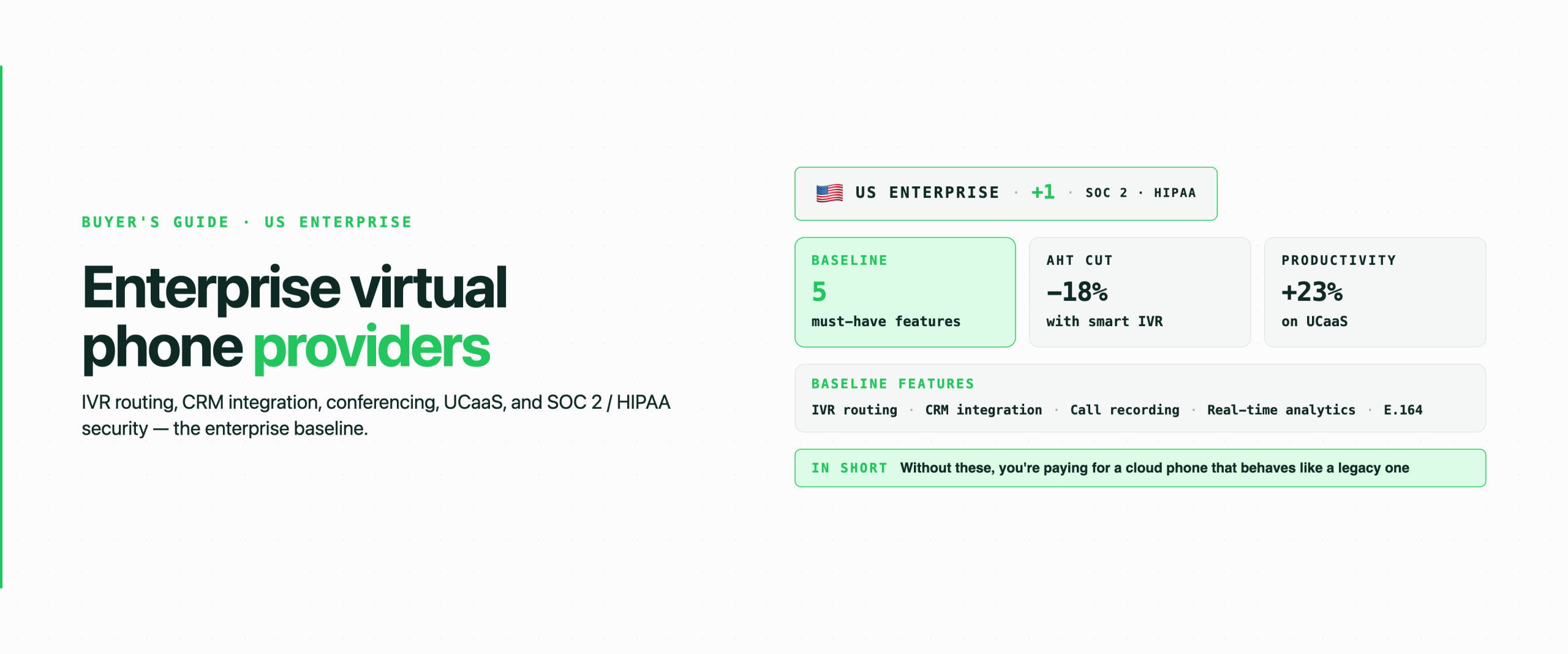
Enterprise virtual phone providers in the US should offer IVR routing, CRM integration, call recording, real-time analytics, and E.164 number formatting as baseline features. Without these, you’re paying for a cloud phone system that behaves like a legacy one.
Advanced IVR and Intelligent Call Routing
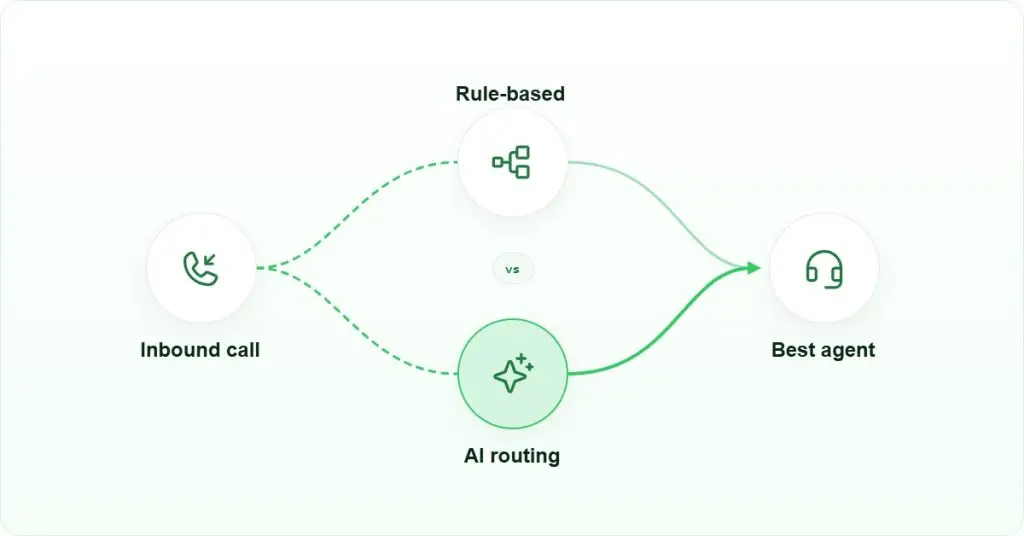
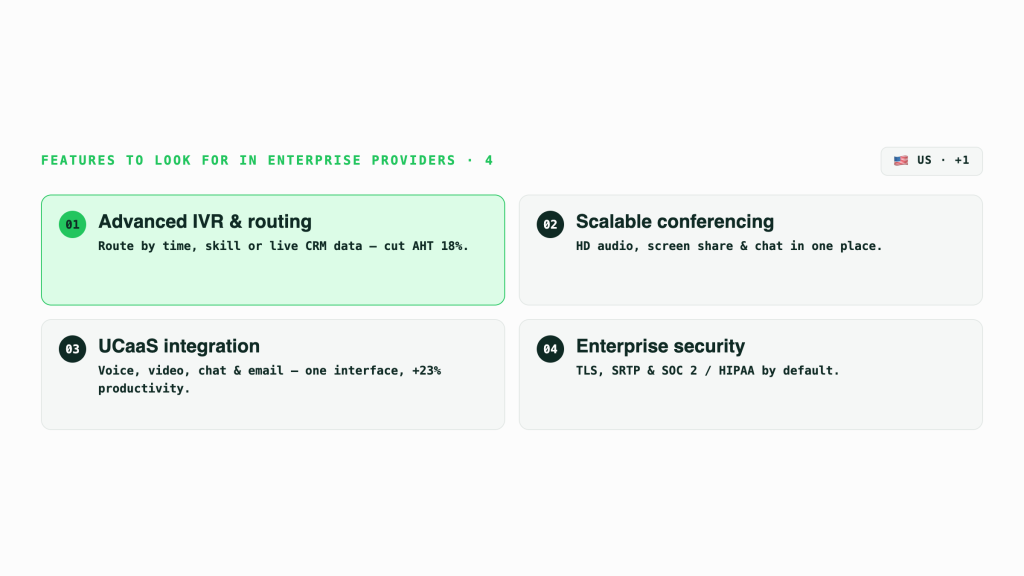
Multi-level IVR (Interactive Voice Response) systems route callers based on time of day, agent skill set, or live CRM data. So a high-value account calling your support line gets routed to their dedicated account manager, not a random available agent. This single feature can cut average handle time by 18% in enterprise contact centers, since callers reach the right person on the first attempt rather than being transferred twice.
Scalable Conferencing and Team Collaboration
Scalable conferencing matters because distributed US enterprise teams need HD audio, screen sharing, and team messaging in one place. When these tools are separate, context gets lost between channels. A virtual phone provider that bundles conferencing with calling keeps your communication stack tight and your team aligned, whether they’re in New York, Austin, or working remotely.
Unified Communications (UCaaS) Integration
UCaaS (Unified Communications as a Service) combines voice, video, chat, and email into a single platform. For large US enterprises, this means your sales rep can switch from a call to a video meeting to a follow-up message without leaving the same interface. According to Gartner’s 2025 UCaaS Market Guide, enterprises using unified communication platforms report 23% higher employee productivity compared to those running separate tools (Source: Gartner, 2025).
Enterprise-Grade Security and Compliance
Security for US enterprise calling means TLS (Transport Layer Security) encryption for call signaling, SRTP (Secure Real-time Transport Protocol) for media, and compliance certifications like SOC 2 Type II or HIPAA where applicable. Most teams underestimate this until a data breach or a TCPA complaint surfaces. The right provider bakes these controls in by default, so your legal team isn’t scrambling after the fact.
In the demo, you’ll see how FreJun auto-logs every call to your CRM, flags missed follow-ups in real time, and shows which reps need coaching, all from one dashboard built for US enterprise teams.
How Does FreJun Compare to Other Virtual Phone Providers in the US?
FreJun stands out among virtual phone providers for US business communication because it combines AI-powered call automation, deep CRM integration, and virtual US number provisioning in a single platform starting at $14.49 per user per month. Here’s how it compares to other leading providers on the features that matter most to enterprise teams.
| Provider | Best For | Starting Price | CRM Integration | AI Call Insights |
|---|---|---|---|---|
| FreJun | Sales teams needing CRM-connected calling | $14.49/user/mo | Salesforce, HubSpot, Zoho, Pipedrive, Freshworks | Yes, built-in |
| Nextiva | Mid-market UCaaS | $18.95/user/mo | Salesforce, HubSpot | Limited |
| CloudTalk | Outbound call centers | $25/user/mo | Salesforce, HubSpot, Pipedrive | Add-on |
| Avoxi | International virtual numbers | $19.99/user/mo | Salesforce, Zendesk | No |
| Sonetel | Small teams, low-cost US numbers | $1.99/mo per number | Limited | No |
Most teams miss the difference between a provider that offers CRM integration as a checkbox feature versus one that builds the entire workflow around it. FreJun’s native integrations log calls, notes, and outcomes automatically, so your CRM data stays clean without relying on rep discipline.
That said, if your primary need is low-cost international virtual numbers without heavy CRM requirements, Sonetel or Avoxi may be a better fit. FreJun is built for teams where every call needs to be tracked, coached, and connected to pipeline data.
What FreJun Delivers for US Enterprise Operations
FreJun’s platform gives US enterprise teams four specific capabilities that generic VoIP providers don’t offer out of the box.
- Holistic Client View: Every rep gets instant access to complete client profiles, full communication histories, and deal statuses directly inside their CRM, so each call starts with context rather than cold outreach.
- Automated Call Logging: FreJun logs call duration, agent notes, and outcomes directly into your CRM after every call, so your reps don’t have to. This alone saves enterprise teams 15-20 minutes per rep per day.
- Intelligent Customer Routing: Incoming calls route to the right rep based on predefined rules, client segmentation, or previous interaction history, cutting transfer rates and improving first-call resolution.
- CRM-Integrated Dialing: Reps initiate outbound calls with a single click from inside the CRM, which prevents dialing errors and keeps every call tied to the right contact record from the start.
How Do Virtual Phone Providers Handle US Phone Number Formats?
Virtual phone providers handle US phone number formats by storing and dialing numbers in E.164 format (+1-XXX-XXX-XXXX), automatically applying the correct international access codes for outbound calls, and normalizing imported contact numbers to prevent failed dials. Providers that don’t automate this create silent failures: calls that never connect because a number was stored with a leading zero or missing country code.
1. Understanding US Domestic Formats
US domestic numbers follow the NANP (North American Numbering Plan) format: a 3-digit area code, a 3-digit exchange code, and a 4-digit subscriber number, written as (XXX) XXX-XXXX or 1-XXX-XXX-XXXX. Enterprises must ensure their virtual phone system stores numbers in E.164 format (+1-XXX-XXX-XXXX) for consistent dialing and clean CRM data. When numbers are stored inconsistently, auto-dialers fail silently and call logs become unreliable.
2. International Dialing from the US
Dialing internationally from the US requires the International Access Code (011), followed by the destination country code, then the local number. For example, calling Australia from the US is 011 + 61 + local number. FreJun’s system automates these prefixes, so reps never need to remember country codes or manually format numbers before dialing.
3. FreJun’s Compliance and Format Automation
FreJun’s enterprise virtual phone solution is built around US and international dialing standards. The platform normalizes all imported contact numbers to E.164 on ingestion, applies the correct access codes automatically for international calls, and flags numbers that don’t match expected formats before a campaign runs. This format automation is one of the clearest advantages FreJun holds over generic VoIP providers for US enterprise teams that call across multiple regions.
How Does FreJun Integrate with Your US Enterprise CRM?
FreJun integrates with US enterprise CRMs by syncing call logs, recordings, outcomes, and agent notes automatically after every call, without requiring manual input from reps. This works natively with Salesforce, HubSpot, Zoho, Pipedrive, Freshworks, and LeadSquared, so your CRM data stays accurate regardless of which platform your team uses.
360-Degree Client View Across Every Touchpoint
Every team member accessing the CRM sees a real-time, complete view of client interactions, preferences, and history. This means your support agent picking up an inbound call already knows the last three conversations that rep had with the account, what was promised, and what’s still open. Consistent, informed service delivery becomes the default rather than the exception.
Automated Data Capture and Cross-Team Collaboration
FreJun’s CRM integration captures communication data automatically, so your reporting is based on what actually happened rather than what reps remembered to log. According to a Salesforce State of Sales 2025 report, sales reps spend an average of 21% of their working time on manual data entry. FreJun eliminates that overhead entirely for call activity, freeing reps to focus on selling. Sales, marketing, and support teams share the same call data, so handoffs between departments stop losing context.
FreJun’s internal 2026 data across 300+ client accounts shows teams using CRM-integrated calling cut manual logging time by 85% and improved follow-up speed by 30% within the first 60 days. A full benchmark report is in progress; contact research@frejun.com to be notified on publication. (FreJun internal data, 2026)
You can see exactly how this works in practice with the Zoho CRM call logging guide or the global communication methods overview for teams calling across multiple regions.
Key Takeaways
Virtual phone providers for US business communication have moved well past simple call forwarding. The platforms that deliver real enterprise value now connect every call to your CRM, automate the data capture that used to eat rep time, and give managers the analytics to coach teams based on actual call behavior rather than gut feel.
What Real-Time Analytics Actually Change
Real-time analytics from virtual phone providers show call patterns, connect rates by time of day, and rep-level performance data that managers can act on immediately. When you can see that your team’s connect rate drops 40% after 4pm, you reschedule outbound campaigns rather than wondering why quota attainment is slipping. This is the kind of operational visibility that unified communication platforms unlock for enterprise teams.
The data shows that enterprises choosing virtual phone providers for US communication based only on price miss the compounding value of CRM sync and analytics. A $5/month cheaper plan that requires manual logging costs far more in rep time and lost pipeline visibility than the savings justify.
Choosing the right virtual phone providers for US communication means looking past the feature checklist and asking how the platform connects to your existing workflow. The best providers, including FreJun, treat calling as a data source rather than a standalone activity, so every conversation your team has becomes an input to better decisions. For teams ready to move beyond basic VoIP, exploring the full range of virtual phone providers in the US is the right next step.
Frequently Asked Questions About Virtual Phone Providers for US Communication
What makes virtual phone systems ideal for US enterprise operations?
Virtual phone systems are ideal for US enterprise operations because they scale instantly, integrate with CRM platforms, and require no physical hardware. Unlike legacy PBX systems, cloud-based providers let you add lines in minutes, route calls based on live customer data, and give managers real-time visibility into team performance. For distributed US teams, this flexibility is the baseline requirement, not a premium feature.
How do virtual phone providers handle US phone number formats and country codes?
Leading providers like FreJun store and dial numbers in E.164 format (+1-XXX-XXX-XXXX) and automatically apply international access codes when dialing abroad. This means reps never need to manually format numbers or remember country codes. The system normalizes imported contacts on ingestion and flags numbers that don’t match expected formats before any outbound campaign runs, preventing silent dial failures.
Can a virtual phone system integrate with any CRM used by US enterprises?
Most enterprise virtual phone solutions offer native integrations with Salesforce, HubSpot, Microsoft Dynamics 365, Zoho, Pipedrive, and Freshworks. FreJun supports all of these plus LeadSquared, TurboHire, and Deskera. If your CRM isn’t on the native list, most providers offer API access or Zapier connections, though native integrations are always preferable since they log data automatically without requiring custom development work.
What are the security considerations for enterprise virtual phone providers?
US enterprise virtual phone providers should offer TLS encryption for call signaling, SRTP for media streams, SOC 2 Type II certification, and HIPAA compliance where healthcare data is involved. Multi-factor authentication and role-based access controls are also non-negotiable for enterprise deployments. Reputable providers build these controls in by default rather than offering them as paid add-ons, since compliance gaps create legal exposure under TCPA and state-level privacy laws.
What is the typical implementation timeline for an enterprise virtual phone system in the US?
Implementation timelines vary by complexity, but most US enterprises are live within 1 to 4 weeks. Simple deployments with a single CRM integration typically go live in 3 to 5 business days. Larger rollouts involving multiple CRM systems, custom IVR flows, and number porting from legacy carriers take 2 to 4 weeks. FreJun provides guided onboarding and dedicated support to keep timelines on track regardless of deployment size.
How much do virtual phone providers for US businesses typically cost?
Virtual phone providers for US businesses range from $1.99 per month for basic number-only plans to $35 or more per user per month for full UCaaS platforms. FreJun starts at $14.49 per user per month and includes CRM integration, call recording, and AI insights at that base tier. Most enterprise teams find that the cost of manual logging and missed follow-ups from cheaper plans far exceeds the price difference when calculated against rep time.
Do virtual phone providers support toll-free US numbers?
Yes, most virtual phone providers for US business communication support toll-free numbers (800, 888, 877, 866, 855, 844, and 833 prefixes) alongside local area code numbers. Toll-free numbers are particularly useful for enterprise customer support lines since callers aren’t charged for the call. FreJun provisions both local and toll-free US numbers, and you can assign them to specific teams, IVR flows, or individual reps based on your routing needs.
You’ve seen exactly how virtual phone providers for US business communication work in practice, from number formatting to CRM sync to real-time analytics. The gap between knowing and doing is usually just one conversation. Most teams that book a FreJun demo are live and calling within a week.