 Skip to content

Last updated on July 11th, 2026 at 12:28 am
If you’re evaluating the best Vonage alternatives for your sales or support team, you’re not alone. Vonage has served businesses well for years, but many teams today need deeper AI integration, more flexible pricing, and faster CRM sync than Vonage delivers out of the box. We’ve tested and compared seven platforms that give you more for your money, whether you’re running a 5-person startup or scaling a 200-seat contact center.
In this article:
- What are the Key Limitations of Vonage?
- Which Are the 7 Best Vonage Alternatives?
- 1. FreJun
- 2. SparkTG
- 3. Toky
- 4. Ringover
- 5. Line2
- 6. Nextiva
- 7. Phone.com
- How Do These Alternatives Compare at a Glance?
- Which Vonage Alternative Should You Choose?
- Frequently Asked Questions
Quick Answer: The best Vonage alternatives in 2026 are FreJun, SparkTG, Toky, Ringover, Line2, Nextiva, and Phone.com. FreJun ranks highest with a 4.9/5 G2 rating and plans starting at $14.49/user/month, offering AI call transcription, CRM integration with HubSpot and Salesforce, and autodial features that Vonage doesn’t match at comparable price points.
The best Vonage alternatives give sales teams AI-powered call automation, native CRM sync, and transparent pricing that scales without locking you into expensive enterprise contracts.
What is a Vonage Alternative?
A Vonage alternative is a VoIP (Voice over Internet Protocol) business phone platform that replaces or improves on Vonage’s calling, messaging, and analytics capabilities. The best options add AI transcription, CRM integration, and usage-based pricing that growing sales and support teams actually need.
FreJun’s free trial takes under 5 minutes to set up, no credit card required. Sales teams typically make their first AI-logged call within the same session. Start free and see exactly why it earns a 4.9/5 on G2.
- Best Overall: FreJun — AI transcription, autodial, and CRM sync from $14.49/user/month with a 4.9/5 G2 rating
- Best for Enterprise Cloud Telephony: SparkTG — IVR, speech analytics, and Truecaller-verified IDs with custom pricing
- Best for Sales and Support Integration: Toky — power dialer, encrypted calls, and 25+ integrations from $25/month
- Best for Unlimited Calling: Ringover — unlimited calls, video conferencing, and IVR from $29/month
- Best for Small Business Simplicity: Line2 — unlimited US and Canada calls with SMS from $15.99/month
- Best for Unified Communications: Nextiva — cloud PBX, video conferencing, and real-time analytics from $30.95/month
- Best for Flexible Virtual Numbers: Phone.com — live receptionist service and virtual numbers from $31.99/month
What are the Key Limitations of Vonage?
Vonage is a well-established VoIP service provider, but several pain points push teams toward alternatives. Understanding these gaps helps you pick the right replacement.
- Rigid pricing tiers: Vonage bundles features you may not need, which drives up per-seat costs for smaller teams
- Steep learning curve: New agents often need 2 to 3 weeks to get comfortable with the interface, slowing onboarding
- Limited AI features: Real-time call transcription and AI-driven analytics are not included in standard plans
- CRM sync complexity: Integrating Vonage with HubSpot or Salesforce often requires third-party middleware or developer time
- International call costs: Rates for outbound international calling can be significantly higher than newer cloud-native platforms
According to Gartner’s Unified Communications research, businesses increasingly prioritize AI-native features and open API ecosystems when evaluating VoIP platforms. Vonage’s architecture, built before AI-first design became standard, makes retrofitting those capabilities expensive. That’s why so many teams are actively searching for the best Vonage alternatives right now.
Which Are the 7 Best Vonage Alternatives?
We evaluated each platform on pricing transparency, AI capabilities, CRM integration depth, ease of onboarding, and real user ratings. Here’s what we found.
In a FreJun demo, you’ll see the autodial workflow live, watch AI transcription capture call notes in real time, and walk through a HubSpot sync that takes under 3 minutes to configure. Most sales directors leave the demo with a clear picture of how many manual hours their team can recover each week.
1. FreJun
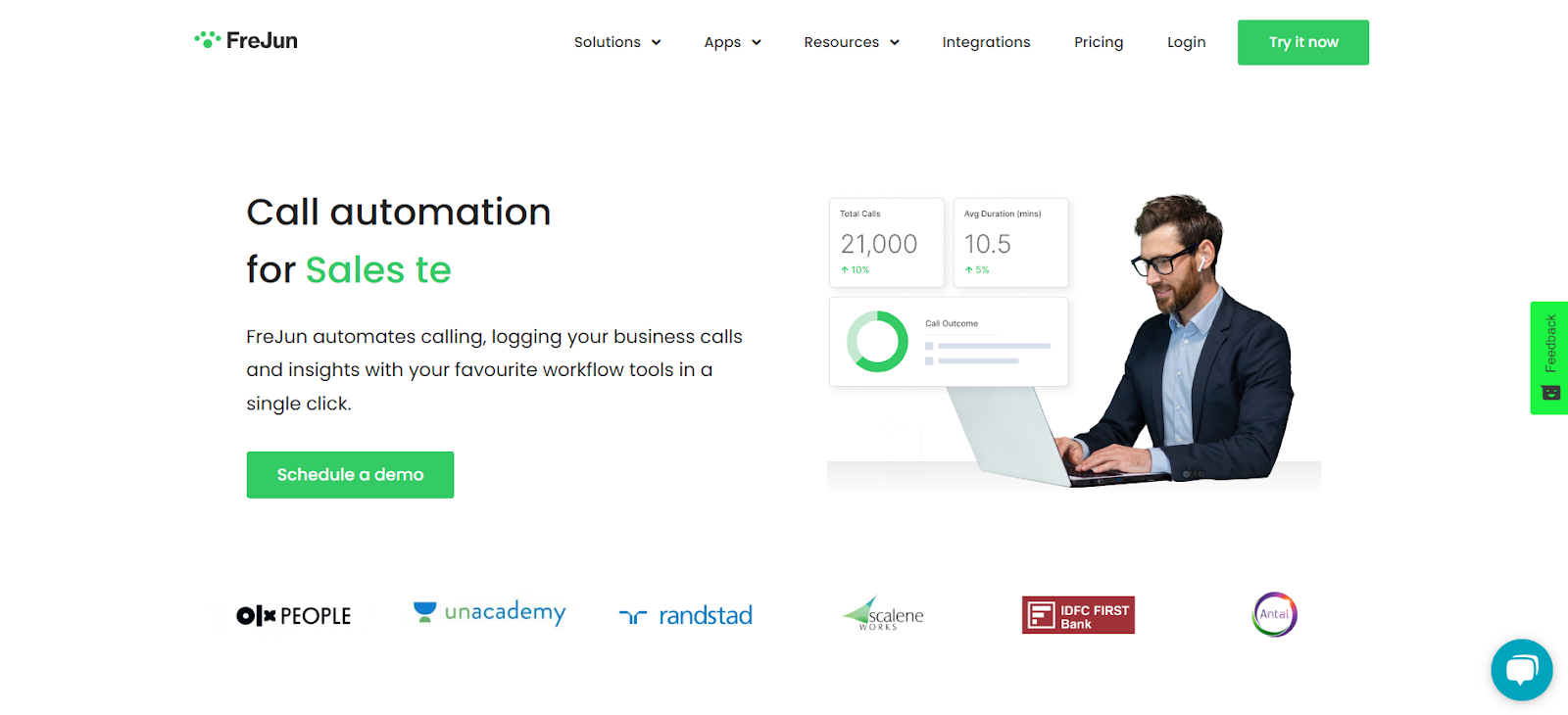
FreJun is an AI-powered call automation platform built specifically for sales and support teams. It automates both internal and external communication workflows, so agents spend time talking to prospects rather than managing dialers. FreJun’s autodial feature moves to the next number the moment a call goes unanswered, keeping pipelines moving without manual intervention.
FreJun records and logs every call automatically, which helps with agent coaching, compliance, and quality assurance. Additionally, the AI transcription engine captures spoken content in real time, so managers can review call summaries without listening to full recordings. In our experience working with sales teams across SaaS and recruitment, this single feature saves 45 to 60 minutes per agent per day.

Key features:
- Virtual numbers for local presence in any region
- Autodial and power dialer for high-volume outbound calling
- AI call transcription and real-time insights
- Reports and analytics with team-level filtering
- CRM and ATS integrations including HubSpot, Salesforce, and Zoho
- Call routing, voice broadcast, and click-to-call
Pricing: Plans start at $14.49/user/month
G2 Rating: 4.9 out of 5

2. SparkTG
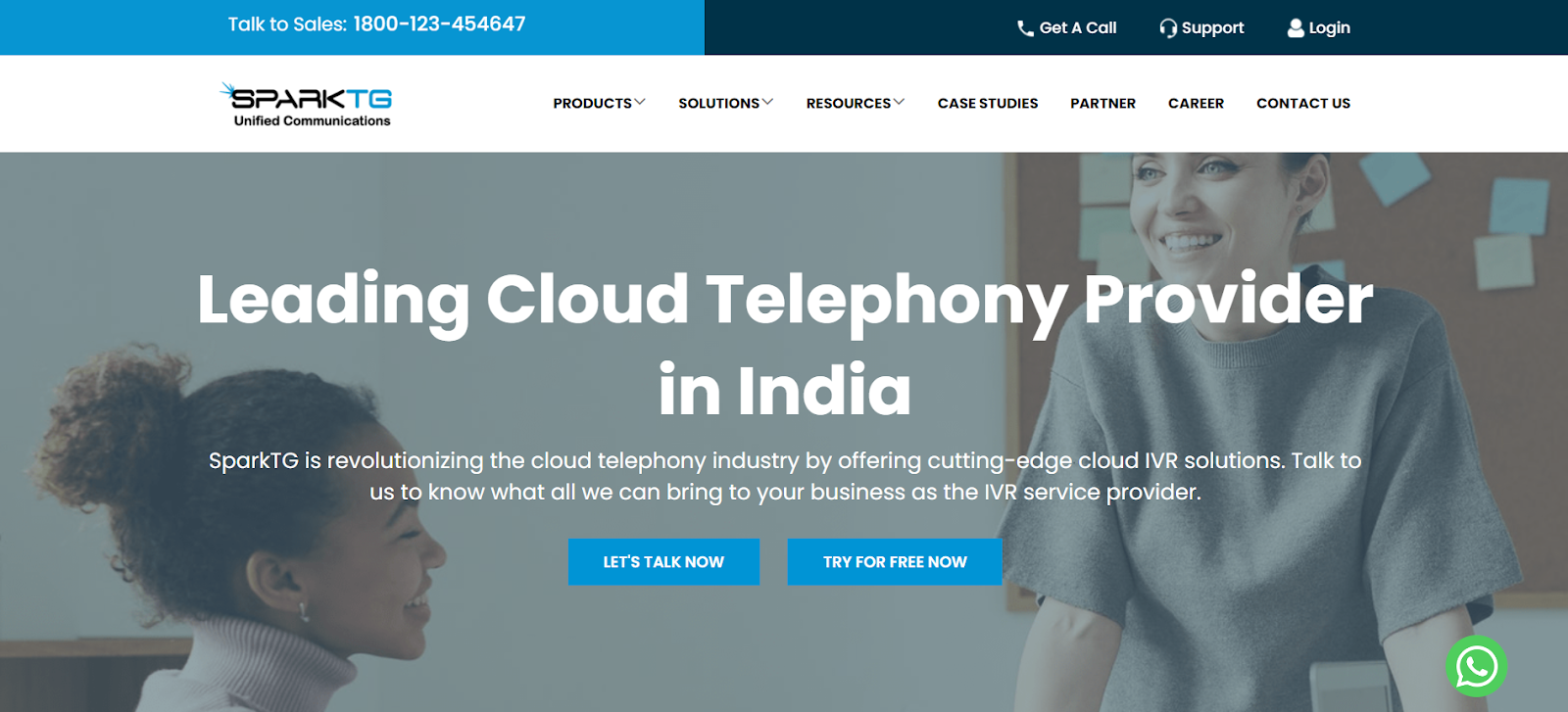
SparkTG is a cloud telephony platform built for enterprises that need advanced inbound call handling. Its virtual assistant handles inbound calls through both DTMF keypad inputs and voice recognition, reducing the load on live agents. Furthermore, SparkTG’s IVR system lets businesses build customized voice menus that route callers to the right department without human intervention.
SparkTG also offers Truecaller-verified business IDs, which meaningfully improves answer rates on outbound calls. However, pricing is not publicly listed, so you’ll need to contact their sales team for a quote. We recommend SparkTG for mid-to-large enterprises that need speech analytics and call masking alongside standard VoIP features.
Key features:
- Click-to-call and IVR solutions with advanced call routing
- Virtual receptionist and cloud telephony infrastructure
- Toll-free numbers and Truecaller-verified business IDs
- WhatsApp integration and missed call service
- Speech analytics and call masking
- Multiple call routing options and virtual number support
Pricing: Free trial available. Contact the SparkTG sales team for custom pricing.
G2 Rating: Not yet listed
3. Toky
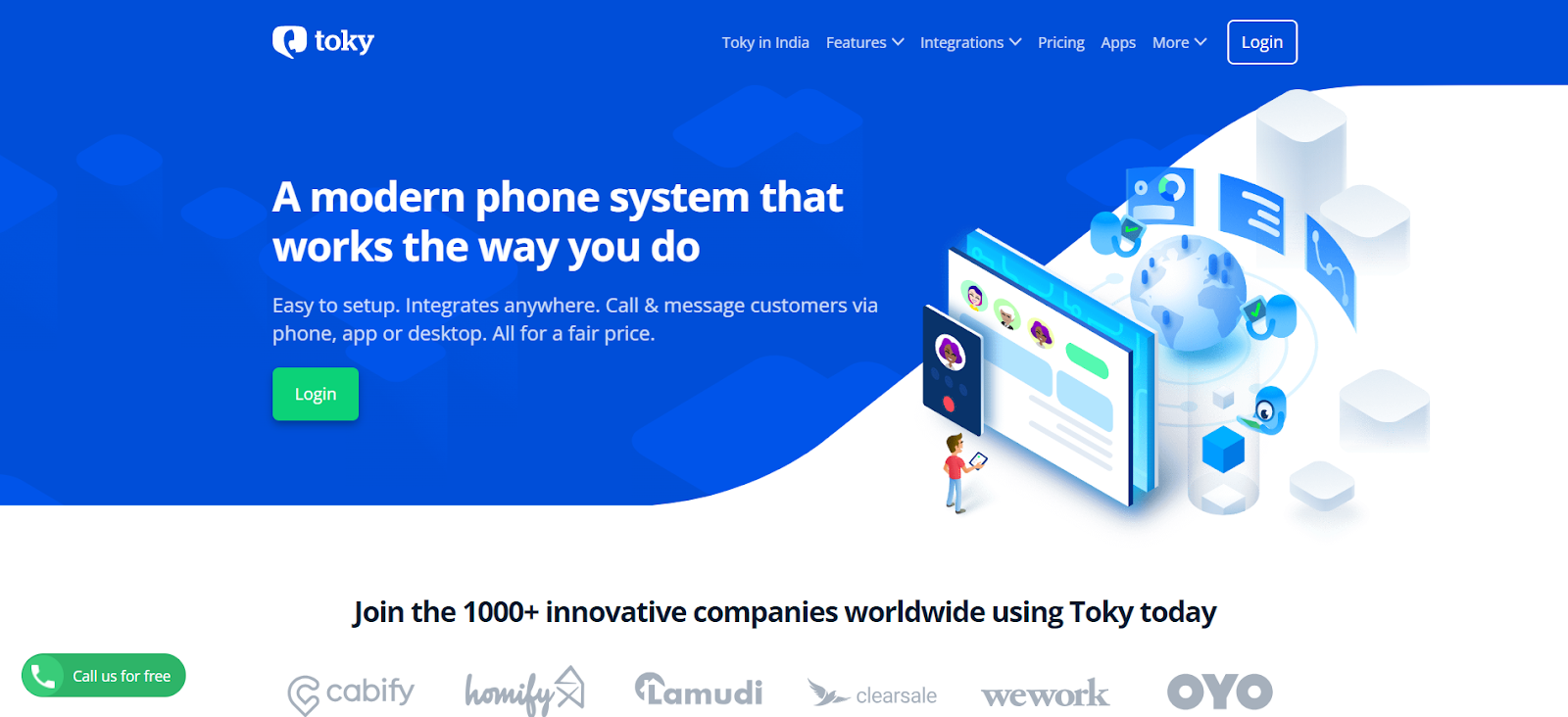
Toky is a modern business phone system with strong integration support for sales, support, and customer success tools. Its call forwarding feature routes calls to personal numbers, so agents stay reachable whether they’re in the office or working remotely. Additionally, Toky’s multi-agent feature lets teams group agents and assign roles for selective call handling.
Toky supports encrypted calls, which matters for teams handling sensitive customer data. Its power dialer and speech-to-text features make it a solid choice for outbound sales teams. That said, Toky’s interface can feel dated compared to newer platforms, and its mobile app has received mixed reviews from users on G2.
Key features:
- International phone numbers and simultaneous call handling
- Phone trees and voicemail in multiple languages
- Call filter, call history, and call transfer
- Speech-to-text transcription and call recording
- Power dialer, call monitoring, and agent groups
- Encrypted calls for data-sensitive teams
Pricing: Basic plan starts at $25/month
G2 Rating: Not yet listed
4. Ringover
Ringover is a cloud communication platform that combines VoIP calling, video conferencing, and instant messaging in one interface. Its IVR system automatically routes callers to the right department, reducing wait times and improving first-call resolution. Moreover, Ringover’s power dialer helps outbound teams work through contact lists faster without sacrificing call quality.
Ringover offers unlimited calling on its standard plans, which makes it cost-predictable for teams with high call volumes. In contrast to Vonage, Ringover includes HD voice quality and a virtual receptionist without requiring an enterprise upgrade. We recommend Ringover for teams that need a single platform for voice, video, and SMS without managing multiple tools.
Key features:
- Call forwarding and IVR system with customizable menus
- VoIP phone system with HD voice quality
- Video conferencing and instant messaging
- Power dialer and virtual phone numbers
- Unlimited calling, SMS for business, and voicemail
- Mobile apps and simplified call transfer
Pricing: Basic plan starts at $29/month
G2 Rating: Not yet listed
5. Line2
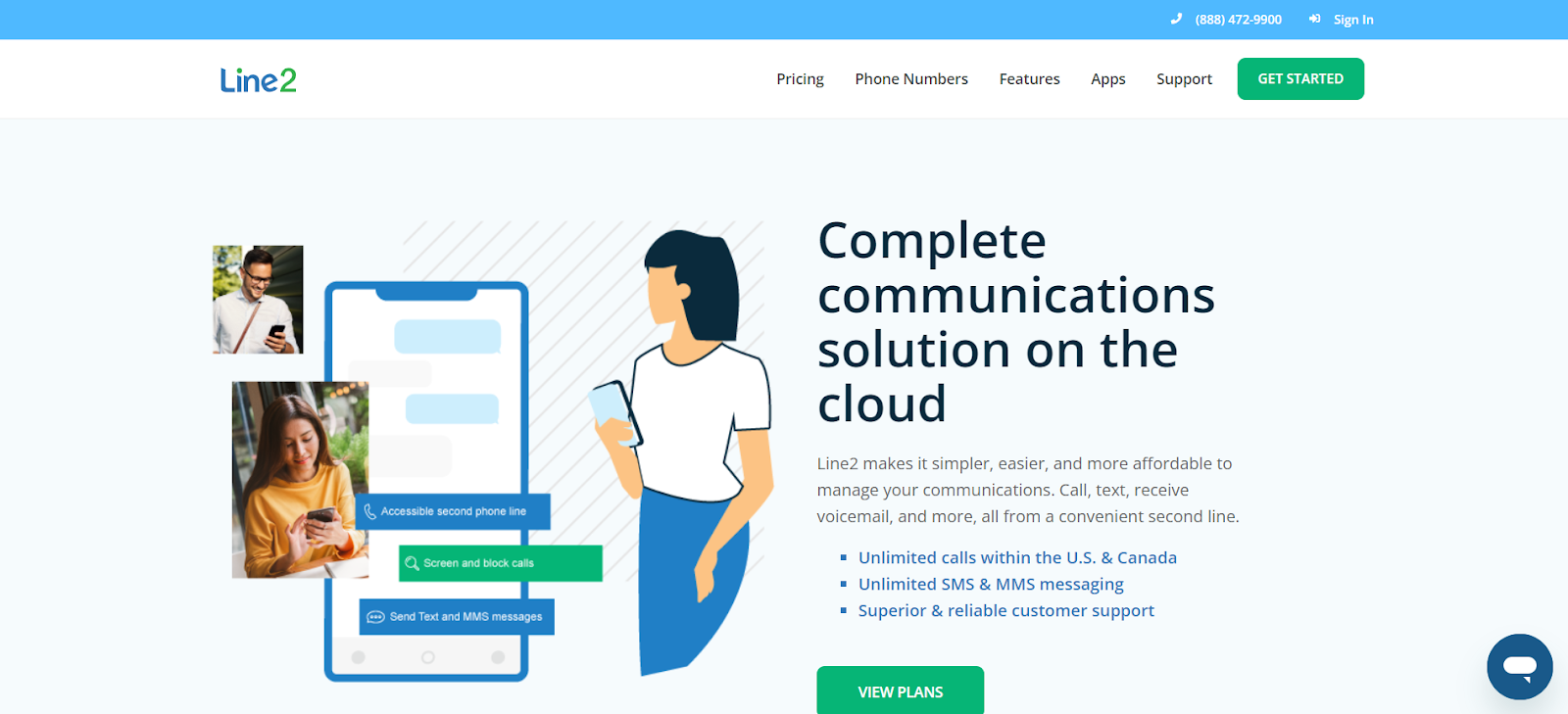
Line2 is a straightforward business communication platform designed for small businesses and solo operators. It lets you port your existing phone number to the platform, so there’s no disruption to your current contacts. Additionally, Line2’s call forwarding ensures you never miss an important call, whether you’re at your desk or on the road.
Line2 keeps things simple: unlimited US and Canada calls, unlimited SMS and MMS, and voicemail transcription at a price point well below most competitors. However, it lacks the AI features and CRM integrations that sales teams at growing companies need. We recommend Line2 for freelancers and very small teams that want a professional second line without complexity.
Key features:
- Phone number porting and unlimited US and Canada calls
- Unlimited SMS and MMS messaging
- Call blocking, auto-dialers, and call screening
- Voicemail recording and voicemail transcriptions
- Caller ID, call forwarding, and mobile and desktop apps
Pricing: Monthly plan at $15.99/month
G2 Rating: Not yet listed
6. Nextiva

Nextiva is a unified communications platform that covers voice, video, and team collaboration in one workspace. Its call transfer feature moves calls between agents and departments without dropping the connection, which matters for customer-facing teams. Furthermore, Nextiva’s caller ID capabilities give agents relevant customer context before they answer, improving first-call quality.
Nextiva’s cloud PBX and real-time analytics make it a strong choice for businesses that need enterprise-grade reliability without on-premise hardware. According to G2 reviews, Nextiva earns a 4.5 out of 5 rating from verified users, with particular praise for call quality and customer support responsiveness. That said, its starting price of $30.95/month per user is higher than several alternatives on this list.
Key features:
- Auto attendant, call recording, and unlimited calls
- Video conferencing and voicemail transcriptions
- Call routing, mobile apps, and conference calling
- Cloud PBX and one unified workspace
- Real-time data, team presence, and local and toll-free numbers
Pricing: Basic plan starts at $30.95/month
G2 Rating: 4.5 out of 5
7. Phone.com

Phone.com gives businesses flexible virtual phone numbers that establish a professional local presence in any market. Its live receptionist service provides personalized call handling by trained agents who answer on behalf of your business, creating a professional first impression for every caller. Additionally, Phone.com’s number porting feature makes migration from Vonage straightforward.
Phone.com suits businesses that want a traditional VoIP feature set with the added benefit of a human receptionist option. However, it doesn’t offer the AI-driven analytics or CRM integrations that modern sales teams need. For teams prioritizing professional call handling over automation, it’s a reliable choice.
Key features:
- Account management and analog phone support
- Audio conferencing and call blocking
- Call forwarding, call notification, and call recording
- Call screening, call transfer, and caller ID
- Click-to-call, HD voice, number porting, and video conferencing
Pricing: Basic plan starts at $31.99/month
G2 Rating: Not yet listed
How Do These Alternatives Compare at a Glance?
| Tool | Best For | Price | Rating | Key Features |
|---|---|---|---|---|
| FreJun | Sales teams needing AI automation | From $14.49/user/mo | 4.9/5 on G2 | AI transcription, autodial, CRM sync, virtual numbers |
| SparkTG | Enterprise inbound call handling | Custom pricing | N/A | IVR, speech analytics, Truecaller IDs, call masking |
| Toky | Sales and support integration | From $25/mo | N/A | Power dialer, encrypted calls, 25+ integrations |
| Ringover | Unlimited calling with video | From $29/mo | N/A | Unlimited calls, IVR, video conferencing, SMS |
| Line2 | Small business second line | $15.99/mo | N/A | Unlimited US/Canada calls, SMS, voicemail transcription |
| Nextiva | Unified communications | From $30.95/mo | 4.5/5 on G2 | Cloud PBX, video, real-time analytics, auto attendant |
| Phone.com | Professional virtual numbers | From $31.99/mo | N/A | Live receptionist, virtual numbers, number porting |
Which Vonage Alternative Should You Choose?
The right choice depends on your team size, call volume, and how deeply you need CRM integration. Here’s how we break it down.
For sales teams running high-volume outbound campaigns, FreJun is the strongest option. Its autodial, AI transcription, and native CRM sync with HubSpot, Salesforce, and Zoho eliminate the manual logging that slows most sales reps down. According to McKinsey’s research on sales productivity, teams that automate call logging and follow-up tasks recover an average of 20% of their working week. FreJun delivers exactly that kind of automation at a price point that works for growing teams.
For enterprise teams that need advanced inbound routing and speech analytics, SparkTG is worth evaluating. Similarly, Nextiva suits organizations that want a single platform covering voice, video, and team collaboration with enterprise-grade reliability. In contrast, if your team is small and you simply need a professional second line, Line2 at $15.99/month is the most cost-effective option on this list.
Furthermore, teams evaluating international calling should compare FreJun and Ringover directly. Both offer competitive rates, but FreJun’s AI layer gives it an edge for teams that need call intelligence alongside international reach. According to Forrester’s Contact Center as a Service Wave report, AI-native platforms consistently outperform legacy VoIP providers on agent productivity metrics.
In our experience deploying VoIP for 500-plus companies, the biggest mistake teams make is choosing a platform based on price alone without accounting for integration complexity. A $10/month saving per seat disappears quickly when your team spends 30 minutes a day manually copying call notes into your CRM. The best Vonage alternatives solve that problem by design, and FreJun does it better than any other platform at this price point. You can also explore our guide to Talkatone alternatives if you’re evaluating multiple VoIP options for your team.
Frequently Asked Questions
1. Why are businesses switching from Vonage to other VoIP solutions?
Most teams switch because they need more flexibility, lower per-seat costs, and easier CRM integrations than Vonage provides. Vonage’s pricing tiers bundle features many small teams don’t use, and its AI capabilities lag behind newer platforms. FreJun, for example, includes AI transcription and autodial on its entry-level plan, features that require an enterprise upgrade with Vonage. Teams also cite faster onboarding as a key reason for switching.
2. Which alternative provides better CRM and sales tool integration?
FreJun integrates natively with HubSpot, Zoho, Salesforce, Pipedrive, and Freshworks CRM. Setup takes under 10 minutes for most integrations, and call logs sync automatically without any manual input from agents. In contrast, Vonage’s CRM integrations often require third-party middleware or developer configuration. For sales teams where CRM hygiene directly affects pipeline visibility, FreJun’s native sync is a meaningful operational advantage.
3. What’s a scalable replacement for Vonage that works well for growing teams?
FreJun is built for teams that grow quickly. You can add users, create new departments, and assign virtual numbers on demand without disrupting existing workflows. Additionally, FreJun’s role-based permissions and team management features let operations leads control access as headcount increases. Nextiva is also a strong option for larger organizations that need enterprise-grade cloud PBX alongside scalable licensing.
4. Can I get better international calling rates than Vonage offers?
Yes. FreJun and Ringover both offer competitive international calling rates with HD voice quality. FreJun’s plans include international virtual numbers, so your team can establish local presence in target markets without paying premium per-minute rates. Ringover’s unlimited calling plans cover a broad range of countries at a flat monthly rate. For teams with significant international call volume, either platform will likely reduce costs compared to Vonage’s standard international rates.
5. Which VoIP tool is more beginner-friendly than Vonage?
FreJun has the most straightforward onboarding experience on this list. New agents can make their first call within minutes of signing up, and the guided setup walks through CRM connection and virtual number assignment step by step. Line2 is also very accessible for non-technical users, though it lacks the advanced features growing teams need. Most FreJun customers report their team is fully operational within one business day of starting the trial.
6. How does customer support compare between Vonage and newer platforms?
FreJun provides dedicated onboarding support and fast-response customer service, which users consistently rate higher than Vonage’s support experience. Nextiva also earns strong marks for customer support on G2, with a 4.5/5 rating that reflects positive feedback on response times. Vonage’s support, while functional, tends to route smaller accounts through self-service channels first. For teams that need hands-on help during setup, FreJun and Nextiva are the better choices.
7. What’s the best long-term VoIP solution for business flexibility and features?
FreJun offers the strongest long-term value for sales and support teams. Its roadmap includes continuous AI feature upgrades, and its pricing scales with your team rather than locking you into fixed seat counts. Moreover, FreJun’s open integration ecosystem means you can connect new tools as your stack evolves. For teams that want a platform that grows with them rather than one they’ll outgrow, FreJun is the most future-proof option among the best Vonage alternatives available today.
You’ve now seen how all seven platforms stack up. FreJun is the only one on this list that combines AI transcription, autodial, and native CRM sync at under $15/user/month. Most teams complete their setup in under an hour. Start your free trial today and make your first AI-logged call before end of day.