 Skip to content

Last updated on June 19th, 2026 at 12:27 am
AI Summary: This article covers 11 affordable cloud phone systems with CRM integration, written for VP of Sales and Revenue Ops leaders at SaaS companies evaluating telephony tools in 2026. According to Salesforce’s 2025 State of Sales report, sales reps spend an average of 21% of their time on manual data entry, a cost that native CRM-calling integration directly removes. Teams need a platform that logs calls automatically, routes intelligently, and surfaces coaching data without adding admin overhead. FreJun connects directly to HubSpot, Zoho, Salesforce, and Pipedrive, auto-logging every call and providing AI transcripts so reps focus on selling, not note-taking.
Sales teams waste hours every week switching between their phone and CRM, manually logging calls, and chasing down recordings. The right affordable cloud phone system with CRM integration fixes all of that in one move. These platforms handle call routing, auto-logging, transcription, and analytics from a single dashboard, so your reps spend time selling instead of doing admin. Below, we cover 11 options across different price points and use cases, with FreJun standing out as the strongest choice for AI-driven automation and deep CRM connectivity.
Quick Answer: The best affordable cloud phone systems with CRM integration in 2026 are FreJun, Ringover, CallHippo, Dialpad, and Zadarma. FreJun leads for AI automation and native CRM sync starting at $16.99/user/month. Each platform on this list supports call logging, recording, and CRM connectivity, but they differ significantly in pricing, AI features, and the depth of their integrations.
Affordable cloud phone systems with CRM integration give sales and support teams one platform for calling, logging, and analytics, replacing manual workflows that cost reps up to 21% of their working day (Source: Salesforce State of Sales 2025).
What is a Cloud-Based Telephony System with CRM Integration?
A cloud-based telephony system with CRM integration is a VoIP (Voice over Internet Protocol) phone platform that connects directly to your CRM, automatically logging calls, syncing contact data, and triggering follow-up workflows without manual input from your reps.
FreJun connects to your CRM in minutes, no IT ticket required. Start your free trial, link your HubSpot or Zoho account, and your team is making logged, recorded calls the same day.
Table of contents
What is the Best Affordable Cloud Phone System with CRM?
The best system combines reliable calling, native CRM sync, call automation, and real-time analytics at a price that doesn’t require a CFO sign-off. For most sales and support teams, that means a platform under $30/user/month that still delivers AI-powered features.
FreJun is our top pick. It offers cloud-based calling with native integrations for HubSpot, Zoho, Salesforce, and Pipedrive, plus AI-powered transcription and auto-dial, starting at $16.99/user/month. It’s built for startups, remote teams, and growing sales orgs that need enterprise-grade features without enterprise pricing.
“After working with 500+ sales teams since 2019, the pattern is clear: teams that integrate their phone system directly with their CRM see call logging compliance jump from around 40% to over 90% within the first month. The data quality improvement alone changes how managers coach and forecast. The biggest mistake teams make is buying a phone system and a CRM separately and assuming they’ll connect cleanly, because they rarely do without native integration.”
Subhash Kalluri, Co-Founder and CEO, FreJun
Quick Recommendations by Use Case
Before diving into each platform, here’s where each tool fits best so you can skip straight to the options relevant to your team size and workflow.
| Tool | Best For | Starting Price | G2 Rating | Key CRM Integrations |
|---|---|---|---|---|
| FreJun | Sales teams, startups, remote teams | $16.99/user/mo | 4.9/5 | HubSpot, Zoho, Salesforce, Pipedrive |
| Zadarma | Multi-country presence, SMBs | $44/mo (10 users) | N/A | Zoho, HubSpot, Salesforce |
| Ringover | Distributed teams, easy onboarding | $19/user/mo | 4.7/5 | Salesforce, Zoho, HubSpot, ActiveCampaign |
| Toky | Small teams needing call forwarding | $25/mo | 3.7/5 | HubSpot, Salesforce, Zendesk |
| CallHippo | Teams with niche or custom CRMs | $18/user/mo | N/A | 100+ CRM platforms |
| RingCentral | Enterprise, multi-site orgs | $30/user/mo | 3.9/5 | Salesforce, Zoho, HubSpot |
| Vonage | Teams needing device flexibility | $13.99/user/mo | 4.3/5 | Limited CRM options |
| Aircall | Large enterprise support teams | $40/license/mo | 4.3/5 | Salesforce, HubSpot, ActiveCampaign |
| CallRail | Marketing attribution, lead tracking | $40/mo | N/A | HubSpot, Salesforce, Google Analytics |
| Dialpad | AI-first teams, real-time coaching | $23/user/mo | N/A | Zoho, Salesforce, HubSpot, Zendesk |
| Ring.io | Salesforce-native sales teams | $69/user/mo | N/A | Salesforce, HubSpot |
In the demo, you’ll see how FreJun auto-logs every call to your CRM, flags missed follow-ups, and shows which reps need coaching, all from one dashboard. Most teams go live within a week of signing up.
11 Affordable Cloud Phone Systems with CRM Integration
Each platform below is evaluated on CRM depth, call features, pricing transparency, and fit for sales or support teams. We’ve included real pricing where published and flagged where CRM integration is limited.
1) FreJun
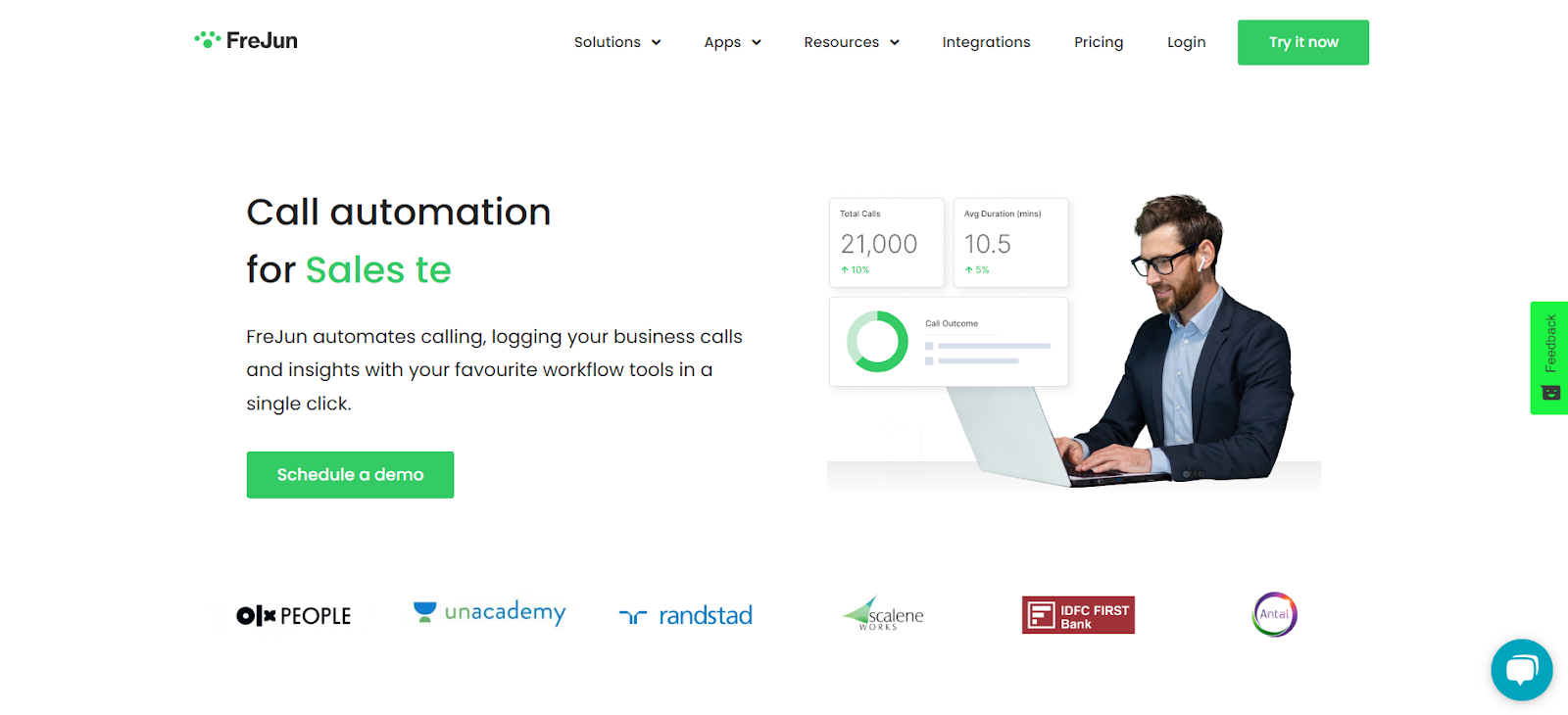
FreJun is a cloud calling platform built specifically for sales teams that need deep CRM connectivity without complex setup. It integrates natively with HubSpot, Pipedrive, Zoho, Salesforce, and Freshworks, automating call logging, contact sync, and follow-up triggers so reps never have to manually update their CRM after a call.
The auto-dial feature is where FreJun separates itself from basic VoIP tools. Agents dial multiple numbers straight from the CRM, and if a call goes unanswered, FreJun moves to the next number automatically, keeping call flow continuous. Combined with AI-generated call transcripts and summaries, managers get coaching data without listening to every recording.
Key features: Call routing, virtual numbers, auto-dial, reports and analytics, AI call transcripts, voice broadcast, and CRM integration.
Pricing: Basic plan starts at $16.99/user/month. See full FreJun pricing.
G2 Rating: 4.9 out of 5
Best for: Sales teams, startups, and remote teams that need AI automation with native CRM sync at an accessible price point.
2) Zadarma
Zadarma is a cost-effective communication platform that covers virtual numbers across 100+ countries, making it a strong pick for businesses that need local presence in multiple markets without paying for separate SIM cards or local carriers.
The platform integrates with Zoho, HubSpot, and Salesforce, though the integration depth is lighter than FreJun or Ringover. That said, Zadarma’s speech analytics and call tracking features give marketing and sales teams enough data to measure campaign performance. The $44/month plan covers 10 users, so the per-seat cost is competitive for small teams.
Key features: Speech analytics, call forwarding, callback button, call tracking, CRM integration, and video conferencing.
Pricing: Paid plans start at $44/month for 10 users. See Zadarma pricing.
G2 Rating: Not listed.
Best for: SMBs that need multi-country virtual numbers at a flat team rate.
3) Ringover
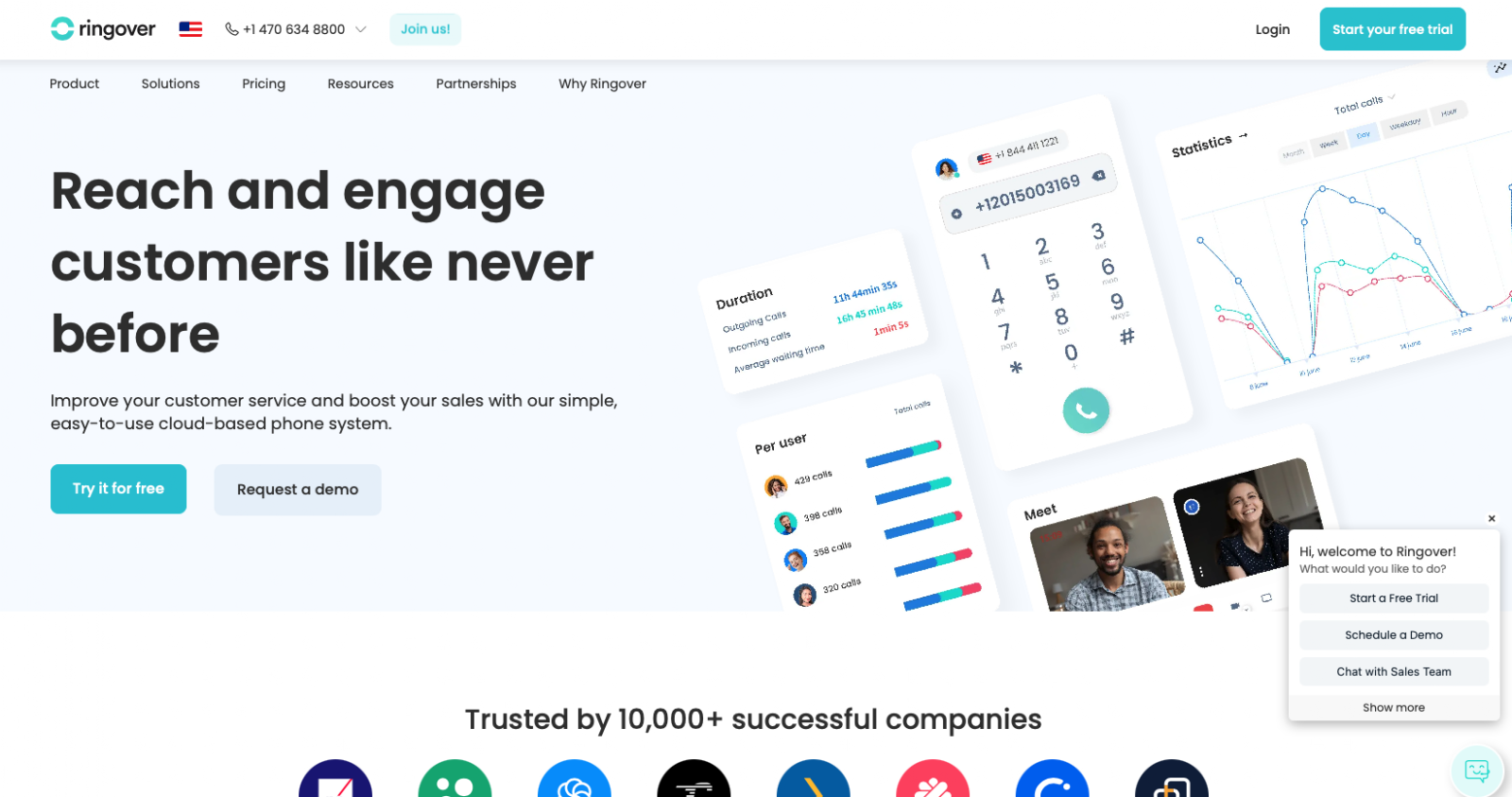
Ringover is a business phone system accessible via mobile app or web browser, so distributed teams can use it without installing hardware or configuring desk phones. The learning curve is low, which matters when you’re onboarding a new sales cohort quickly.
Ringover integrates with Salesforce, Zoho, HubSpot, ActiveCampaign, and Clientify, keeping call data inside your existing CRM rather than in a separate silo. Smart call routing and IVR (Interactive Voice Response) handle inbound traffic, while HD video calls cover internal team meetings. At $19/user/month, it’s one of the more affordable options with solid CRM breadth.
Key features: Smart call routing, IVR, advanced call statistics, call recording, and HD video calls.
Pricing: Basic plan starts at $19/user/month. See Ringover pricing.
G2 Rating: 4.7 out of 5
Best for: Distributed teams that want fast onboarding and broad CRM compatibility.
4) Toky
Toky is a cloud phone system known for clean CRM integration and a call-forwarding feature that redirects calls to agents’ personal phones when they’re away from their desk. This means reps never miss a prospect call, even when they’re between meetings or traveling.
Toky’s phone tree and call filter features give small teams control over inbound routing without needing an IT team to configure it. Speech-to-text transcription and call monitoring round out the feature set. The G2 rating of 3.7/5 is lower than others on this list, so it’s worth trialing before committing, especially if your team relies heavily on call quality.
Key features: Phone trees, call filter, call history, call transfer, speech-to-text, call recording, and call monitoring.
Pricing: Basic plan starts at $25/month. See Toky pricing.
G2 Rating: 3.7 out of 5
Best for: Small teams that need call forwarding to mobile and basic CRM sync.
5) CallHippo

CallHippo is a virtual phone system that claims integration with 100+ CRM platforms, including less common ones that most competitors don’t support. If your team runs a niche or industry-specific CRM, CallHippo is worth evaluating since you won’t need to build a custom connector.
The customisable IVR system lets teams build call-routing experiences without developer help. Power dialer and call queuing features make it suitable for outbound sales teams running high-volume campaigns. At $18/user/month, it’s priced competitively, though the absence of a published G2 rating means you’ll want to check recent user reviews before signing a contract.
Key features: Power dialer, call forwarding, call transfer, call queuing, call barging, call recording, and call analytics.
Pricing: Basic paid plan starts at $18/user/month. See CallHippo pricing.
G2 Rating: Not listed.
Best for: Teams using niche CRMs that need broad integration coverage without custom development.
6) RingCentral

RingCentral uses VoIP technology to deliver voice communication over the internet, removing the need for traditional phone infrastructure. This cuts installation and hardware costs significantly, which is why enterprise IT teams often prefer it for multi-site rollouts.
CRM integration covers Salesforce, Zoho, and HubSpot. Customisable call routing directs inbound calls to the right department or individual, which improves first-call resolution rates. That said, at $30/user/month, RingCentral sits at the higher end of this list. It’s a better fit for established businesses than early-stage startups watching burn rate.
Key features: Call recording, visual voicemail, vanity numbers, answering rules, shared lines, and call park.
Pricing: Basic plan starts at $30/user/month. See RingCentral pricing.
G2 Rating: 3.9 out of 5
Best for: Enterprise businesses and multi-site organisations that need scalable VoIP without hardware dependency.
7) Vonage

Vonage is a business phone system with a strong feature set for device flexibility, though its CRM integration options are more limited than most others on this list. If deep CRM sync is your primary requirement, Vonage may not be the right fit.
Where Vonage stands out is its Call Flip feature, which lets you transfer an active call between devices with a single tap. For reps who move between desk and mobile throughout the day, this removes the friction of dropped handoffs. Call Park lets you place a call on hold and pick it up from any phone in the organisation, which is useful for support teams handling escalations.
Key features: Call recording, mobile app, call park, call flip, call forwarding, call rerouting, and call tagging.
Pricing: Basic plan starts at $13.99/user/month. See Vonage pricing.
G2 Rating: 4.3 out of 5
Best for: Teams that need device flexibility and basic calling features at the lowest price point on this list.
Further reading: Top 7 Alternatives to Vonage
8) Aircall
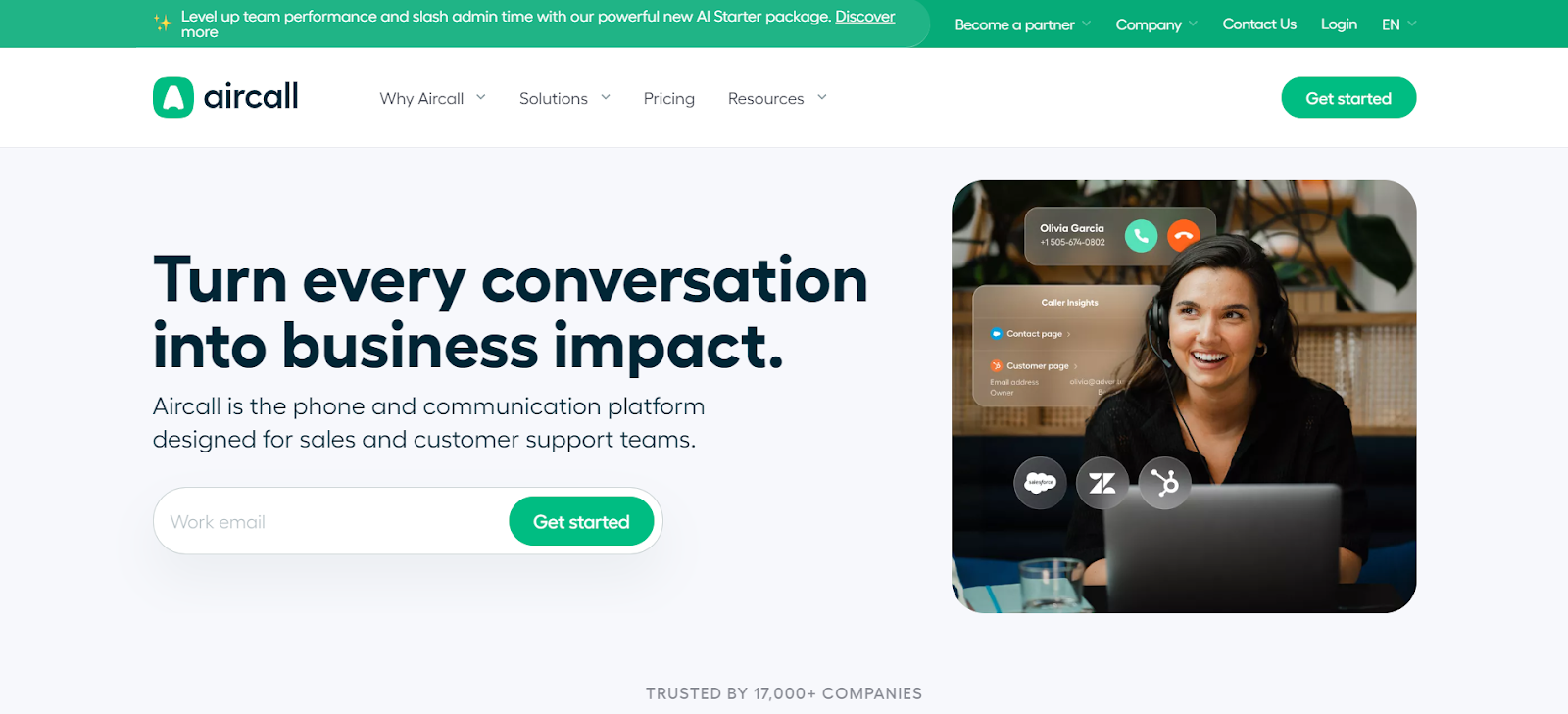
Aircall is a cloud communication platform that integrates with Salesforce, HubSpot, ActiveCampaign, Klaviyo, and Invelo, giving enterprise support teams a single window for call data and CRM records. Reps don’t need to switch tabs during calls since all contact information surfaces automatically.
The trade-off is price. At $40/license/month, Aircall is the most expensive option on this list alongside CallRail. It’s better suited to large enterprise teams where the per-seat cost is justified by volume and the need for advanced call routing and transcription. Smaller teams or startups will find better value elsewhere.
Key features: Call conference, call routing, virtual call centre, ring groups, call queuing, and call transcription.
Pricing: Basic plan starts at $40/license/month. See Aircall pricing.
G2 Rating: 4.3 out of 5
Best for: Large enterprise support teams that need deep CRM integration and can absorb higher per-seat costs.
9) CallRail
CallRail is a call tracking and analytics platform that connects phone data to marketing attribution, making it a strong choice for teams that need to know which campaigns are driving inbound calls. Once integrated with your CRM, reps get full prospect context before picking up the phone.
The built-in analytics engine covers keyword analysis, call transcripts, and form tracking, so marketing and sales teams share a single source of truth for lead quality. Automation capabilities keep campaigns running without manual intervention. At $40/month for the basic plan, CallRail is priced for teams where marketing attribution is a core workflow, not just a nice-to-have.
Key features: Call transcripts, keyword analysis, call tracking, form tracking, call recording, and custom form builder.
Pricing: Basic plan starts at $40/month. See CallRail pricing.
G2 Rating: Not listed.
Best for: Marketing-led teams that need call attribution data alongside CRM logging.
10) Dialpad
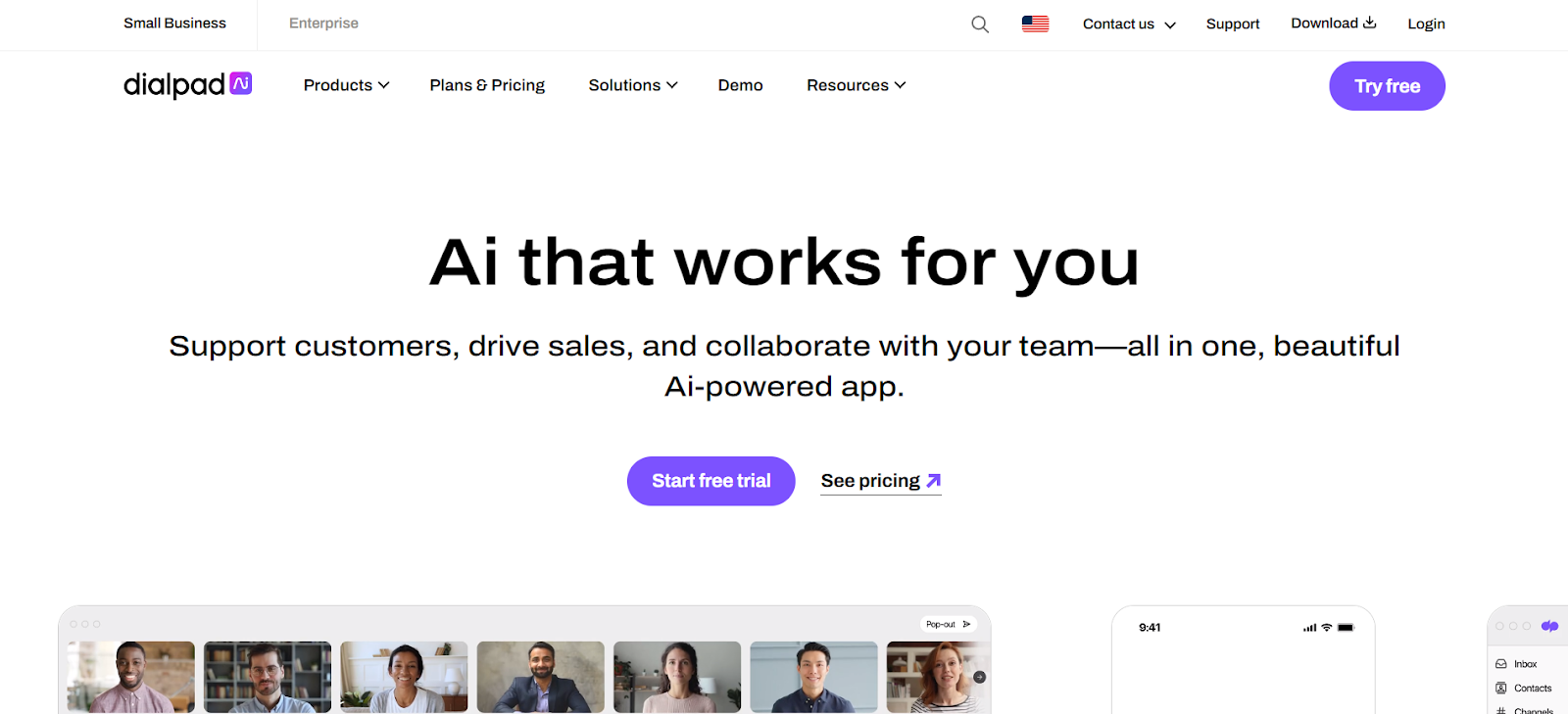
Dialpad is a fully AI-powered cloud phone system with voice intelligence technology that gives reps real-time guidance during calls. Rather than reviewing recordings after the fact, managers can see live call sentiment and suggested responses, which shortens the coaching cycle significantly.
Dialpad integrates with Zoho, Salesforce, HubSpot, and Zendesk. The power dialer and web conferencing features make it suitable for both outbound sales and internal team communication. At $23/user/month, it’s a reasonable price for the AI feature depth, though teams that don’t need real-time coaching may find FreJun or Ringover a better value.
Key features: Three-way calling, call routing, call transfer, power dialer, web conferencing, and dial-in number.
Pricing: Basic plan starts at $23/user/month. See Dialpad pricing.
G2 Rating: Not listed.
Best for: AI-first sales teams that want real-time call coaching and CRM sync in one platform.
11) Ring.io
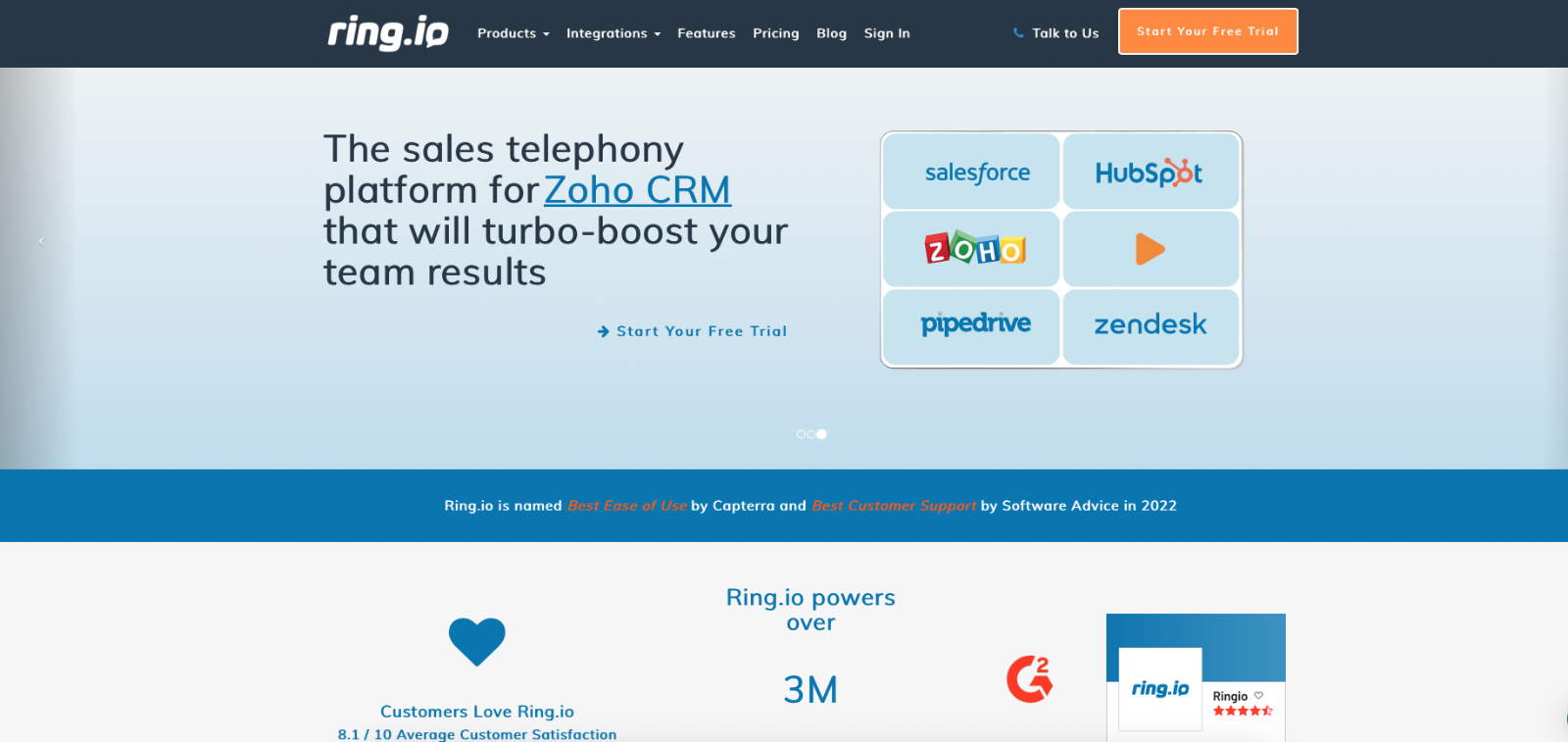
Ring.io is a Salesforce-native calling platform built around one goal: helping sales teams close more deals faster. The automation layer handles call logging, notes, and follow-up triggers automatically, so reps focus entirely on the conversation rather than post-call admin.
Ring.io integrates with most major CRMs and lets reps call directly from within the CRM interface. Click-to-call, call monitoring, and call queuing are all included. The catch is price: at $69/user/month, Ring.io is the most expensive option on this list. It’s a fit for Salesforce-heavy enterprise sales teams where the productivity gain justifies the cost, but it’s not the right choice if budget is a primary constraint.
Key features: Click-to-call, call notes, call logging, caller ID, voicemail, call recording, call monitoring, and call queuing.
Pricing: Basic plan starts at $69/user/month. See Ring.io pricing.
G2 Rating: Not listed.
Best for: Salesforce-native enterprise sales teams where automation ROI justifies the higher per-seat cost.
How to Choose the Right Cloud Phone System for Your CRM
Picking the wrong platform costs more than the subscription fee. You lose time on a migration, your reps lose call history, and your CRM data quality drops during the transition. Here’s a practical framework for making the right call the first time.
Step-by-Step: Evaluating an Affordable Cloud Phone System with CRM
- Map your CRM first. Identify which CRM your team uses and confirm the phone system has a native integration, not just a Zapier workaround. Native integrations sync bidirectionally and don’t break when either platform updates.
- Define your call volume. If your team makes fewer than 50 calls per day per rep, most platforms on this list will handle the load. If you’re running high-volume outbound campaigns, prioritise platforms with power dialer or auto-dial features like FreJun or CallHippo.
- Check AI feature depth. Basic call recording is table stakes in 2026. Look for AI transcription, call summaries, and sentiment analysis if you want coaching data without manual review. FreJun and Dialpad both deliver this at different price points.
- Trial the onboarding experience. A platform that takes two weeks to configure is a problem for a sales team that needs to be live next Monday. Ringover and FreJun both offer fast onboarding with minimal IT involvement.
- Verify pricing transparency. Some platforms list a low base price but charge separately for call recording, analytics, or additional numbers. Check what’s included in the base plan before comparing costs across vendors.
- Run a two-week pilot with real reps. Give two or three reps access to the trial, connect it to your CRM, and measure call logging compliance, call quality, and time saved on post-call admin. The numbers from a real pilot beat any vendor demo.
The biggest mistake teams make is choosing a phone system based on the feature list rather than the integration quality. A platform with 50 features and a shallow CRM sync will cost your team more time than a simpler tool that logs every call correctly.
What Does CRM Integration Depth Actually Mean?

CRM integration depth refers to how much data flows between your phone system and your CRM automatically, without rep intervention. Shallow integration logs the call date and duration. Deep integration logs the call, attaches the recording, generates an AI summary, updates the contact record, and triggers a follow-up task, all without the rep touching the CRM. FreJun’s integration with HubSpot and Zoho operates at this deeper level, which is why CRM automation built on top of it produces measurable pipeline improvements.
According to Salesforce’s 2026 State of Sales report, based on a survey of 4,050 sales professionals, reps now spend 60% of their time on non-selling tasks, including manual data entry, while CRM adoption improves sales forecast accuracy by an average of 42% because managers work from a complete, live pipeline rather than whatever reps remembered to log. (Source: Salesforce State of Sales 2026). That’s the real ROI of choosing an affordable cloud phone system with CRM over a standalone VoIP tool.
Which Cloud Phone System Fits Your Business Type?
Not every team has the same requirements. Here’s a quick reference so you can match your business type to the right platform without reading every section above.
| Business Type | Recommended Platform | Key Benefit |
| Startups | FreJun, Ringover, CallHippo | AI automation, low per-seat cost |
| Customer Support Teams | Aircall, Ringover, FreJun | Intelligent call routing, CRM context |
| Sales Teams | FreJun, Dialpad, Ring.io | Auto-dial, CRM sync, AI coaching |
| Enterprise Businesses | RingCentral, Aircall, FreJun | Global calling, scalability |
| Remote Teams | FreJun, Ringover, Zadarma | Browser-based, multi-country numbers |
| Marketing Teams | CallRail, FreJun | Call attribution, campaign tracking |
FreJun’s Internal Data: What Teams Actually See After Integration
FreJun’s internal 2026 data across 300+ client accounts shows teams using native CRM calling integration cut post-call admin time by an average of 35% and improved CRM data completeness from roughly 45% to over 90% within the first 60 days. A full benchmark report is in progress. Contact research@frejun.com to be notified on publication. The pattern holds across team sizes from 5-rep startups to 200-rep enterprise sales floors, which suggests the gain is structural rather than dependent on team discipline.
We recommend FreJun over Dialpad for teams under 50 reps because the per-seat cost difference ($16.99 vs $23) compounds quickly, and FreJun’s CRM integration depth matches Dialpad’s for the core use cases most sales teams actually need. Dialpad’s real-time coaching edge matters most for teams running structured sales methodologies at scale.
Why Affordable Cloud Phone Systems with CRM Are Worth the Switch
The 11 platforms on this list cover every major use case, from startup sales teams watching burn rate to enterprise support orgs handling thousands of calls per day. Each one connects to your CRM, logs calls automatically, and removes the manual overhead that slows reps down.
That said, not all integrations are equal. The difference between a shallow sync and a deep native integration shows up in your CRM data quality, your forecast accuracy, and how much time your reps spend on admin versus selling. Before committing to any platform, run a two-week pilot with real call volume and measure logging compliance directly.
For most sales and support teams evaluating affordable cloud phone systems with CRM in 2026, FreJun delivers the strongest combination of AI automation, native CRM depth, and accessible pricing. Whether you’re a startup connecting HubSpot for the first time or a scaling sales team replacing a legacy VoIP system, the right affordable cloud phone system with CRM integration pays for itself within the first quarter through time saved and pipeline data improved.
Further reading: Top 11 Predictive Outbound Dialer Software
Frequently Asked Questions About Affordable Cloud Phone Systems with CRM
Which cloud phone system integrates most easily with HubSpot and Zoho?
FreJun offers native plug-and-play integration with both HubSpot and Zoho, syncing calls, contacts, and activity logs without manual configuration. Setup takes under 30 minutes for most teams. Ringover also supports both CRMs with solid integration depth, making it a strong alternative if your team is already on the Ringover ecosystem. For HubSpot-heavy teams, FreJun’s auto-logging and AI transcript sync give it a clear edge.
Are there affordable VoIP tools that support full CRM sync?
Yes. FreJun starts at $16.99/user/month and supports full CRM sync including call logging, recording attachment, contact updates, and follow-up task creation. Ringover at $19/user/month and CallHippo at $18/user/month also offer CRM sync at accessible price points. The key distinction is integration depth: FreJun and Ringover sync bidirectionally, while some cheaper tools only push data one way.
Can I get call recording and CRM logging in one system?
Yes. FreJun provides built-in call recording with automatic attachment to the CRM contact record after every call. Aircall, Ringover, and Dialpad also combine recording with CRM logging. The difference is whether the recording is manually attached or auto-synced. FreJun auto-syncs recordings and AI-generated transcripts to HubSpot, Zoho, and Salesforce without rep action, which keeps your CRM data complete even on high-volume days.
What is the best cloud phone system for remote sales teams?
FreJun and Ringover are both strong choices for remote teams since they run entirely in the browser with no hardware required. FreJun’s mobile app and browser-based dialer let reps call from anywhere while keeping all activity logged in the CRM. Zadarma adds value for remote teams that need local virtual numbers across multiple countries. For fully distributed teams, the ability to call from any device without VPN or desk phone setup is the deciding factor.
Is there a CRM-integrated telephony platform that supports call automation?
FreJun includes automation for follow-up tasks, call notes, AI summaries, and voicemail drops, all linked directly to your CRM. Dialpad offers real-time AI assistance during calls. CallHippo supports automation triggers for outbound campaigns. If automation is your primary requirement, FreJun’s combination of auto-dial, AI transcription, and CRM-triggered workflows covers the most ground at the lowest price point on this list.
Which affordable telephony system is easiest to onboard and scale?
FreJun and Ringover both have flat onboarding curves with no hardware setup required. FreJun’s CRM connector activates in under 30 minutes, and adding new users takes seconds from the admin dashboard. Ringover’s web app is similarly fast to deploy. For scaling teams, FreJun’s per-seat pricing model means you add licenses as you hire without renegotiating contracts, which keeps procurement simple as headcount grows.
Can I track call analytics and performance data inside my CRM?
FreJun syncs call analytics directly to your CRM, so managers can view call volume, duration, outcomes, and AI-scored performance data without leaving HubSpot or Zoho. Dialpad and Aircall also offer analytics dashboards, though their data lives primarily in the phone platform rather than inside the CRM. For Revenue Ops teams that build pipeline reports in the CRM, FreJun’s approach keeps all data in one place.
How does a cloud phone system differ from a traditional PBX?
A PBX (Private Branch Exchange) is an on-premise hardware system that routes internal and external calls through physical equipment. A cloud phone system routes calls over the internet using VoIP (Voice over Internet Protocol), with no hardware required. Cloud systems are faster to deploy, cheaper to maintain, and scale instantly by adding user licenses. For teams using a CRM, cloud systems also enable direct API integration that hardware PBX systems cannot support natively.
You’ve now seen exactly how 11 affordable cloud phone systems with CRM stack up against each other. The gap between knowing which tool fits and actually having it live is usually just one conversation. Most teams that book a FreJun demo are connected to their CRM and making logged calls within a week.