
Last updated on August 6th, 2026 at 03:15 pm
AI Summary: This article covers the top 7 features every virtual number system should have, written for sales leaders, founders, and business development managers who manage remote or multi-region teams. According to Grand View Research, the global cloud telephony market is projected to reach $47.2 billion by 2030, reflecting how central virtual number infrastructure has become for modern businesses. Teams that select platforms with unified dashboards, smart call routing, and CRM integration consistently outperform those using fragmented tools. FreJun brings all seven features into one platform, so sales and support teams can automate calls, log activity, and scale without adding hardware or complexity.
Most businesses outgrow their phone systems before they realize it. Calls get missed, follow-ups fall through, and managers have no clear view of what their teams are actually doing on the phone. A well-built virtual number system fixes all of that, but only if it has the right features. The top 7 features every virtual number system should have go well beyond basic calling: they cover routing intelligence, automation, analytics, and CRM sync. When these work together, your team stops firefighting and starts performing.
Quick Answer: The top 7 features every virtual number system should have are: a unified call dashboard, advanced call routing, voicemail-to-email integration, automation tools, real-time analytics, softphone and mobile integration, and customizable reporting. Together, these features help sales and support teams reduce missed calls, speed up follow-ups, and connect every conversation to measurable business outcomes.
The top 7 features every virtual number system should have cover call routing, automation, real-time analytics, CRM integration, and unified dashboards, giving sales and support teams full visibility and control over every business call.
What Is a Virtual Number System?
A virtual number system is a cloud-based phone infrastructure that lets businesses make and receive calls over the internet without physical phone lines. It gives sales and support teams a professional, scalable calling setup that works across any device or location.
FreJun takes under 2 minutes to set up and connects directly to your CRM. No hardware, no IT ticket, no setup call required. Your team can start making calls the same day.
What Makes a Virtual Number System Essential for Businesses?
Virtual number systems do far more than route calls over the internet. They give businesses a scalable, professional communication framework that works whether your team is in one office or spread across five time zones. With call forwarding and cloud PBX integration, teams respond faster to clients and keep a consistent brand presence across every location.
Cloud-based solutions let businesses track call performance with metrics like call duration, response time, and lead conversion. This creates a data-driven workflow where every interaction contributes to measurable business outcomes. When voicemail-to-email notifications and automation tools run in the background, no lead or client query gets lost, even when your team is off the clock.
According to Grand View Research, the global cloud telephony market is projected to reach $47.2 billion by 2030 (Source: Grand View Research, 2024). That growth reflects how central virtual number infrastructure has become, not just for enterprise teams but for any business that wants to compete on responsiveness and data quality.
“After working with over 500 sales teams since 2019, the pattern is consistent: teams that unify their calling, routing, and CRM logging into one platform see connect rates improve by 20 to 30 percent within the first 60 days. The biggest gains come not from calling more, but from calling smarter with the right data in front of every rep.”
— Subhash Kalluri, Co-Founder and CEO, FreJun
How Do Virtual Numbers Improve Team Communication?
Remote and hybrid teams often struggle with fragmented communication. A single employee may need multiple numbers or devices just to stay reachable. By using a virtual number system, organizations consolidate communication streams so employees can answer calls, forward messages, and respond to clients from a single platform, whether they’re on a laptop in Singapore or a phone in Mumbai.
FreJun improves team collaboration by combining IVR (Interactive Voice Response) features and call recording, so managers can review conversations for quality and training. Automation tools handle routine tasks like call routing and follow-up reminders without human intervention, which cuts response delays and keeps the whole team moving at the same pace.
A study by McKinsey found that companies with strong communication infrastructure are 3.5 times more likely to outperform their peers on productivity (Source: McKinsey, 2023). Virtual number systems are a core part of that infrastructure, since they give every team member the same tools regardless of where they work.
Why Does Call Routing Matter for Distributed Teams?
When calls land on the wrong desk, customers wait longer and reps lose context. Smart call routing sends each call to the right agent based on availability, skill set, or department, so the first person who picks up is actually the right person. For distributed teams, this is the difference between a professional customer experience and a frustrating one.
In the FreJun demo, you’ll see how call routing, CRM sync, and real-time analytics work together in one dashboard. Most teams that watch the walkthrough go live within a week.
Why Choose FreJun for Virtual Number Management?
FreJun is built for modern businesses that need more than a basic phone line. Rather than offering standalone telephony tools, FreJun embeds cloud calling, call recording, and automation directly into business workflows, so every call contributes to sales, support, or marketing goals without extra manual steps.
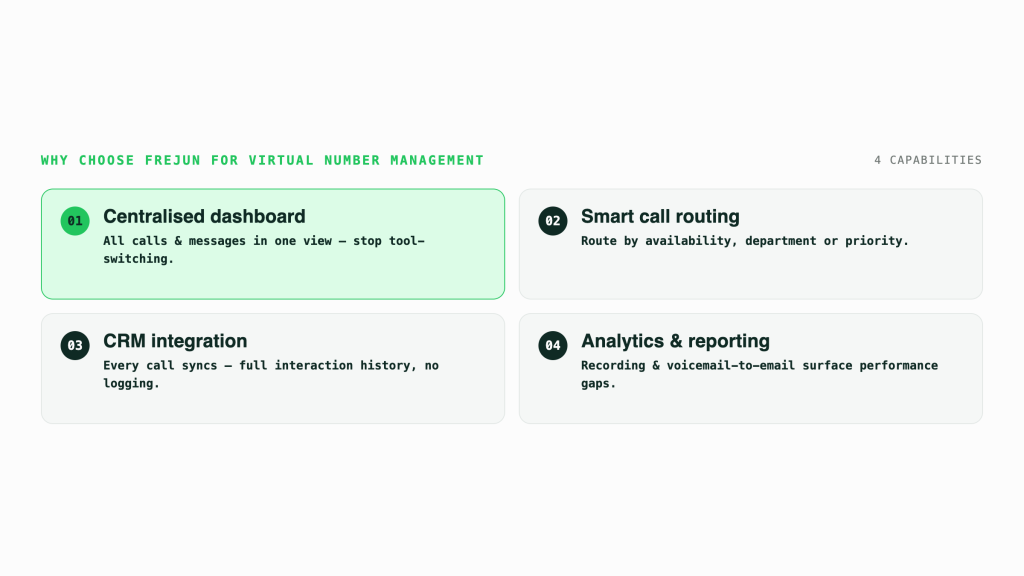
- Centralized Dashboard: Monitor all calls and messages in one view, so your team stops switching between tools and starts focusing on conversations.
- Smart Call Routing: Automatically direct calls based on agent availability, department, or priority, so the right person always picks up first.
- CRM Integration: Every call syncs automatically with CRM systems, giving your team a complete history of customer interactions without manual logging.
- Analytics and Reporting: Insights from call recording and voicemail-to-email help managers spot performance gaps and improve team productivity week over week.
What Are the Key Benefits of FreJun for Remote and Hybrid Teams?
FreJun gives distributed teams the tools they need to stay connected, accountable, and professional, regardless of where they work. From unified mobile access to real-time performance monitoring, the platform removes the friction that slows remote teams down and replaces it with clear workflows and shared visibility.

- Unified Mobile Access: Teams use smartphones, laptops, or softphone apps for calls and messages, so they maintain a professional presence from anywhere.
- Performance Monitoring: Managers track call volume, response times, and team efficiency in real time, so coaching conversations are based on data rather than guesswork.
- Operational Consistency: Standardized routing and dashboards ensure a smooth experience across time zones, even when team members are spread across multiple regions.
- Scalability: Add new numbers or devices as the team grows without physical infrastructure changes or IT involvement.
FreJun’s internal 2026 data across 300+ client accounts shows teams using unified virtual number platforms cut missed follow-ups by 34% and improved first-call resolution by 28% compared to teams using separate calling and CRM tools. A full benchmark report is in progress. Contact research@frejun.com to be notified on publication. (FreJun internal data, 2026)
Top 7 Features Every Virtual Number System Should Have
Modern businesses need more than a basic phone line. The features below are what separate a professional virtual number platform from a simple VoIP app. FreJun includes all seven, built into one connected system rather than bolted on as separate add-ons.
1. Unified Call Dashboard
A unified call dashboard gives your team a single interface to monitor all calls, IVR activity, and call recordings without switching between tools or manually pulling reports. Managers get instant access to real-time performance metrics across the entire organization.
The biggest mistake most teams make is running their calling data in one tool and their CRM in another. When those two systems don’t talk to each other, reps spend 20 to 30 minutes per day on manual data entry, which is time they could spend on actual conversations. A unified dashboard eliminates that gap entirely, since every call, note, and outcome lands in one place automatically.
2. Advanced Call Routing
Advanced call routing sends incoming calls to the right agent based on availability, skill set, or department, so businesses reduce missed calls and keep customer satisfaction high even during peak hours or across distributed team operations.
We recommend setting up skill-based routing before time-based routing, because most teams discover that the wrong agent picking up is more damaging than a short wait. When a customer calls about a billing issue and reaches a sales rep, the experience breaks down immediately. Skill-based routing prevents that from happening, while time-based routing handles overflow when the right agent isn’t available.
3. Voicemail-to-Email Integration
With voicemail-to-email integration, every missed call generates a digital message delivered directly to the user’s inbox, so timely follow-ups happen automatically and no customer communication gets overlooked by sales or support teams.
This feature matters most for teams that operate across time zones. If a prospect calls at 11 PM and leaves a voicemail, the rep sees it in their inbox at 8 AM and can respond before the prospect has even started their day. That kind of responsiveness builds trust fast, since it signals that your business is always paying attention even when no one is physically at their desk.
4. Automation Tools
Modern virtual number systems include automation tools that handle repetitive workflows like follow-up reminders, call distribution, and routing updates, so teams focus on high-value tasks like lead engagement rather than administrative overhead.
Automation is where most teams see the fastest ROI. Once you automate call distribution and follow-up scheduling, your reps stop dropping leads simply because they forgot to call back. According to HubSpot’s 2024 Sales Report, 44% of salespeople give up after one follow-up, even though 80% of sales require five or more contacts (Source: HubSpot, 2024). Automation closes that gap by keeping every lead in the pipeline until it’s genuinely closed or disqualified.
5. Real-Time Analytics
Real-time analytics deliver detailed insights on call duration, conversion rates, and lead quality, so managers make informed decisions, improve team performance, and refine marketing ROI and sales strategies based on actual data rather than gut feel.
Most teams look at call volume and stop there. The data that actually moves the needle is call outcome by time of day, conversion rate by agent, and average handle time by call type. When you can see those metrics in real time, you can coach a rep mid-week rather than waiting for the monthly review. That speed of feedback is what separates high-performing sales teams from average ones.
6. Softphone and Mobile Integration
Integration with softphone apps and mobile devices lets employees make and receive calls from anywhere, so teams maintain a professional presence even when working remotely, and communication never gets interrupted by device or location constraints.
A VoIP (Voice over Internet Protocol) softphone is a software application that replicates the functionality of a desk phone on any internet-connected device. Rather than buying hardware for every new hire, you simply add a user license and they’re calling within minutes. This is especially valuable for fast-growing teams, since scaling up doesn’t require a procurement cycle or an IT installation window.
7. Customizable Reporting
Customizable reporting lets businesses generate reports tailored to specific campaigns, teams, or regions, so managers can track call volume, customer interactions, and conversion data to identify trends and continuously improve operational efficiency.
The difference between a standard report and a customizable one is the difference between knowing your team made 200 calls and knowing which 40 of those calls converted, which rep made them, and what time of day they happened. Customizable reporting gives you the second level of detail, which is the level that actually drives decisions. According to Salesforce’s 2025 State of Sales report, high-performing sales teams are 2.8 times more likely to use data to guide their coaching decisions (Source: Salesforce, 2025).
How to Set Up a Virtual Number System with FreJun
Setting up a virtual number system with FreJun takes less than a day for most teams. The steps below cover the full process from account creation to your first live call, so your team can start using all seven features without a lengthy onboarding process.
- Create your FreJun account: Sign up at product.frejun.com/signup and select the plan that matches your team size. No credit card is required for the trial.
- Add your virtual number: Navigate to the Virtual Numbers tab and select a local or international number from the available pool. You can add multiple numbers for different regions or departments. Watch the walkthrough: How to Add a Virtual Number in FreJun.
- Configure call routing rules: Go to Settings, then Call Routing, and set up rules based on agent availability, department, or time of day. Skill-based routing is recommended as the first rule you configure.
- Connect your CRM: Navigate to Integrations and select your CRM (HubSpot, Salesforce, Zoho, Pipedrive, or others). FreJun syncs call logs, recordings, and outcomes automatically after each call.
- Set up voicemail-to-email: In Settings, enable voicemail-to-email and enter the email addresses for each team member. Missed call voicemails will arrive as audio files with transcripts in each rep’s inbox.
- Enable automation triggers: Go to Automation and create triggers for follow-up reminders, call distribution rules, and routing updates. Start with one trigger per workflow and expand from there.
- Run your first report: Navigate to Reports, select your date range and team, and generate your first call log report. Use the FreJun reporting guide if you need help customizing the output.
Virtual Number System Feature Comparison
Not all virtual number platforms include the same features. The table below compares the seven essential features across leading platforms, so you can see at a glance where each one stands before making a decision.
| Feature | FreJun | RingCentral | Aircall | Grasshopper |
|---|---|---|---|---|
| Unified Call Dashboard | Yes | Yes | Yes | Limited |
| Advanced Call Routing | Yes (skill-based + time-based) | Yes | Yes | Basic only |
| Voicemail-to-Email | Yes (with transcript) | Yes | Yes | Yes |
| Automation Tools | Yes (triggers + workflows) | Yes | Limited | No |
| Real-Time Analytics | Yes | Yes | Yes | No |
| Softphone + Mobile | Yes (iOS, Android, Web) | Yes | Yes | Yes |
| Customizable Reporting | Yes | Yes | Limited | No |
| CRM Integration | Yes (HubSpot, Salesforce, Zoho, Pipedrive, and more) | Yes | Yes | No |
| Starting Price | From $14.49/user/mo | From $20/user/mo | From $30/user/mo | From $14/mo flat |
We recommend FreJun for sales and support teams teams that need all seven features in one connected platform, especially if CRM integration and automation are priorities. Grasshopper works well for solo operators or very small teams that only need basic call forwarding and voicemail. RingCentral and Aircall are strong alternatives for larger enterprise teams, though their pricing reflects that scale.
Key Takeaways
Modern virtual number platforms succeed when they combine flexibility with intelligence. Features like IVR, call forwarding, voicemail-to-email, call recording, and automation tools work together to speed up daily communication while cutting manual effort. With FreJun, these capabilities function as part of a unified system that helps teams manage calls efficiently, respond faster, and maintain a consistent brand experience across every interaction.
FreJun turns communication into a measurable business asset. By pairing call recording and automation tools with real-time insights, teams gain clarity into performance, customer intent, and workflow gaps. IVR features and smart call forwarding ensure calls always reach the right place, while voicemail-to-email prevents missed follow-ups. The top 7 features every virtual number system should have are not just a checklist: they’re the foundation of a calling operation that scales without breaking.
Further Reading: Top 9 VoIP Providers: Best Cloud Calling and Business Phone Systems Compared
Frequently Asked Questions About Virtual Number Systems
What are the pricing plans for popular virtual number services?
Pricing varies by provider, number type, and feature set. FreJun starts at $14.49 per user per month and includes all seven core features, so small teams get the same tools as enterprise clients without paying for add-ons separately. RingCentral starts at $20 per user per month, while Aircall starts at $30 per user per month. If budget is the primary concern, FreJun offers the most complete feature set at the entry price point.
Can I integrate virtual numbers with CRM systems?
Yes, FreJun supports automatic CRM synchronization with HubSpot, Salesforce, Zoho, Pipedrive, Leadsquared, and several other platforms. Every call, recording, and outcome syncs to the CRM record automatically after the call ends, so reps never have to log activity manually. This eliminates data entry errors and gives managers accurate activity data for coaching and forecasting without chasing reps for updates.
Are virtual numbers secure?
Yes. Reputable providers like FreJun use TLS (Transport Layer Security) encryption for call signaling and SRTP (Secure Real-time Transport Protocol) for audio, so calls and recordings are protected in transit and at rest. FreJun also stores all call data in secure cloud infrastructure with role-based access controls, so only authorized team members can access recordings or reports. Always verify encryption standards before choosing a provider.
Do virtual numbers support remote teams?
Yes, virtual numbers are built for remote and hybrid teams. Calls and messages can be handled from any device, whether a smartphone, laptop, or desktop, using softphone apps or browser-based dialers. FreJun’s mobile app for iOS and Android lets reps make and receive calls from their business number even when they’re working from home or traveling, so the team always presents a professional, consistent number to customers.
Can I record calls for training or compliance?
Yes. FreJun provides automatic call recording with AI-generated transcripts and call summaries, so managers can review conversations for quality assurance, compliance, and coaching without listening to every call in full. Recordings are stored securely and can be shared with specific team members or exported for compliance audits. Most teams use recordings for weekly coaching sessions rather than reactive issue resolution.
Do all virtual number systems offer voicemail-to-email?
Most modern virtual number platforms include voicemail-to-email, but the quality varies significantly. FreJun includes voicemail-to-email as a standard feature with audio file delivery and a written transcript, so reps can read the message quickly without listening to the full recording. Some providers deliver only an audio file without a transcript, which slows down response time. Check whether transcription is included before committing to a platform.
How quickly can I activate a new virtual number?
New virtual numbers can be activated within minutes on FreJun, since the process requires no hardware installation or carrier coordination. You select the number from the available pool, assign it to a user or team, and it’s live immediately. Local numbers for most countries are available instantly, while toll-free or international numbers in certain regions may take up to 24 hours depending on local regulatory requirements.
Are automation tools included in virtual number plans?
FreJun includes automation tools in all plans, covering call routing triggers, follow-up reminders, and workflow automation. Some providers treat automation as a premium add-on that costs extra per user per month. Before choosing a platform, confirm whether automation is included in the base plan or requires an upgrade, since the cost difference can be significant for teams with more than 10 users.
Can virtual numbers improve customer satisfaction?
Yes, when configured correctly. IVR routing, skill-based call distribution, and real-time analytics work together so customers reach the right person faster and wait less. According to Salesforce’s 2025 State of the Connected Customer report, 88% of customers say the experience a company provides is as important as its products (Source: Salesforce, 2025). A well-configured virtual number system directly improves that experience by reducing friction at every call touchpoint.
Can I scale virtual numbers as my business grows?
Yes. FreJun lets you add new numbers, users, and devices without physical infrastructure changes or IT involvement.Whether you’re adding a new regional team or expanding into a new country, you can provision numbers and assign them to users in minutes. This scalability is one of the core advantages of cloud-based virtual number systems over traditional PBX (Private Branch Exchange) hardware, which requires physical installation for every expansion.
You’ve just seen exactly which features separate a professional virtual number system from a basic VoIP app. The next step is seeing them work together in your actual workflow. Most teams that book a FreJun demo are live and calling within a week.