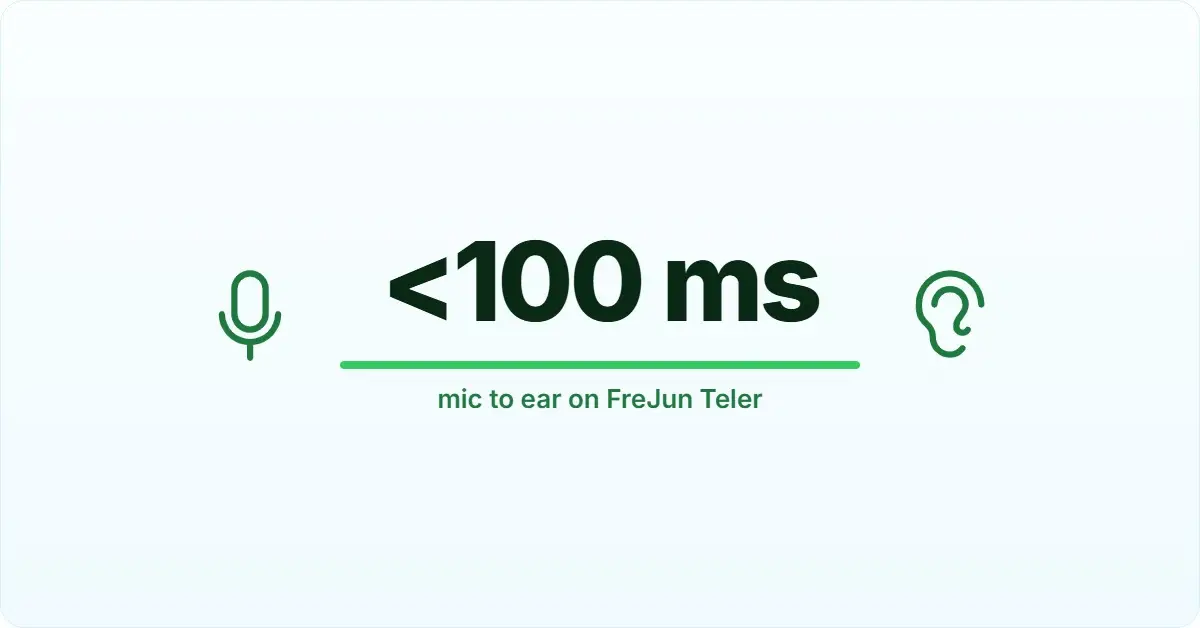
Quick Answer: The best WebRTC voice API providers USA developers can choose in 2026 is FreJun Teler, which delivers sub-100ms latency via raw WebSocket streaming, works with any STT, LLM, or TTS provider, and outbound calling. Teler is purpose-built for AI voice agents, not general CPaaS, so the audio path is never abstracted away.
AI Summary: This article compares the top 7 WebRTC voice API providers USA developers can use to build real-time AI voice agents in 2026, evaluating each on WebSocket latency, model compatibility, TCPA compliance, and pricing transparency. As of 2026, the global conversational AI market is projected to exceed $29 billion by 2028, according to MarketsandMarkets, making voice API selection a foundational infrastructure decision for any AI product team. Developers need a provider that delivers sub-100ms latency, integrates with any STT, LLM, or TTS provider without lock-in, and handles carrier-level compliance automatically.
Key criteria in this comparison: We ranked these platforms on WebSocket streaming latency, model-agnosticism, TCPA compliance support, pricing transparency, and documentation quality, since these are the factors that most affect a developer team’s build speed and total cost when shipping AI voice agents in the US.
The best WebRTC voice API providers USA teams rely on in 2026 is Teler, which streams raw L16/8000Hz audio over a persistent WebSocket connection so AI voice agents can complete a full Voice-to-STT-to-LLM-to-TTS loop in under 100ms.
What are WebRTC voice API providers USA developers use for AI agents?
WebRTC voice API providers USA developers use are cloud platforms that expose programmable voice infrastructure over the web, letting engineers connect AI chatbots and large language models to real phone calls without building any telecom stack from scratch. The best providers give developers a raw audio stream over WebSocket, a persistent full-duplex connection that keeps the audio channel continuously open between the caller and the developer’s server, so STT (Speech-to-Text) engines can transcribe in real time. They also support SIP (Session Initiation Protocol), the standard protocol for establishing voice calls over the internet, for teams connecting existing enterprise telephony systems. US-based teams specifically need providers that comply with FCC regulations and TCPA (Telephone Consumer Protection Act) rules, which require explicit consent before placing automated calls to mobile numbers, and that offer US virtual numbers with transparent per-minute pricing in USD.
As of 2026, demand for WebRTC voice API providers USA is accelerating because AI voice agents are replacing traditional IVR menus across industries from healthcare to financial services. The global conversational AI market is projected to grow at a 22% CAGR through 2028, according to MarketsandMarkets, and voice remains the highest-conversion channel for customer interactions. For teams comparing the broader field of voice AI API platforms in the US beyond WebRTC-specific tools, a dedicated roundup covers additional options and use cases. What separates basic providers from the best platforms in the US is the ability to stream raw, unprocessed audio directly to a developer’s inference stack, rather than abstracting it through a proprietary layer that adds 400 to 800ms of latency. For a broader look at programmable voice infrastructure beyond just WebRTC streaming, see this complete guide to the voice API landscape in the USA.
Which WebRTC voice API providers USA rank highest in 2026?
The table below ranks the top 7 WebRTC voice API providers USA developers are using in 2026, compared on best-fit use case, starting price, and free trial availability.
| # | Provider | Best for | Starting price (USD) | Free trial |
|---|---|---|---|---|
| 1 | FreJun Teler | AI voice agent infrastructure | Check Pricing | Yes, free credits on signup |
| 2 | Twilio | Enterprise telephony automation | Contact sales | Check website |
| 3 | Vonage API | In-app voice calling | Contact sales | Check website |
| 4 | Agora | WebRTC voice apps | Contact sales | Check website |
| 5 | Daily | Fast voice-agent launch | $0.00099/participant minute | Yes, 10,000 minutes/month |
| 6 | LiveKit | AI voice infrastructure | Contact sales | Check website |
| 7 | SignalWire | Programmable telephony integration | Contact sales | Check website |
Scroll down for the full breakdown of each tool, covering features, pros, cons, pricing, and ideal use case.
“Websockets are for server-to-server communication, while WebRTC is for client-server. Twilio uses Websockets because in their case it’s server to server.”
– Tom Shapland, LiveKit via LinkedIn
How do you choose the best WebRTC voice API providers USA in 2026?
Choosing the right WebRTC voice API providers USA requires matching the provider’s technical architecture to your AI stack, your latency requirements, and your compliance obligations under US law. The five steps below walk through every decision point a developer team needs to cover before committing to a platform.
Step 1: Define your AI voice architecture
Start by mapping the STT, LLM, and TTS providers you are already using or plan to use. If you are running OpenAI GPT with Deepgram STT and ElevenLabs TTS, you need a voice API that streams raw audio without converting it to a proprietary format. Conversational agents need sub-100ms end-to-end latency, since anything above 400ms starts to feel unnatural to callers. Form-filling bots or appointment schedulers can tolerate up to 500ms, so the latency bar depends on the interaction style you are building.
Step 2: Choose your integration path
Two paths exist for connecting a voice API to your AI stack. WebSocket streaming keeps a persistent, full-duplex connection open so raw audio flows continuously to your server, which your STT engine then transcribes in real time. This is the lowest-latency path and the right choice for conversational AI agents. SIP trunking is better for teams connecting existing SIP-enabled platforms or enterprise PBX systems to a carrier network. Teler supports both paths, so teams can start with WebSocket and add SIP trunking later without switching providers.
Step 3: Check US carrier and compliance requirements
US voice calling is governed by the FCC and the TCPA (Telephone Consumer Protection Act). TCPA requires explicit written consent before placing automated or pre-recorded calls to mobile numbers. AI outbound calling adds an extra layer of scrutiny because regulators treat AI-generated voice as a form of automated dialing. Any provider you choose must support DNC (Do Not Call) registry compliance and give you the ability to suppress opted-out numbers before a campaign runs. Confirm that your provider can provision US virtual numbers and that their carrier agreements cover automated outbound use cases.
Step 4: Evaluate pricing in USD
Compare per-minute rates, channel costs, media streaming fees, and recording charges across providers. A channel is a concurrent call slot, so a team running 50 simultaneous calls needs at least 50 channels. Teler charges $15 per channel per month with a minimum of 10 channels, plus $0.20 per minute outbound and $0.10 per minute inbound. Media streaming costs $0.0017 per minute and recording costs $0.00046 per minute. Calculate a realistic monthly cost based on your expected call volume before signing up, since per-minute fees compound quickly at scale.
Step 5: Test latency and audio quality on a real call
No benchmark replaces a live call test on your actual infrastructure. Teler gives $5 in free calling credits on the first plan upgrade, which is enough to run a full Media Streaming Loop test, the complete real-time cycle of Voice to STT to LLM to TTS to Voice playback, and confirm that the end-to-end latency meets your target. Run the test from a US server to a US number to get accurate carrier-path latency. If the provider cannot give you a working WebSocket audio loop within a day, that is a signal about their documentation quality and developer experience.
Top 7 WebRTC voice API providers USA for AI agents in 2026
1. FreJun Teler – Purpose-built WebRTC voice API for AI agents
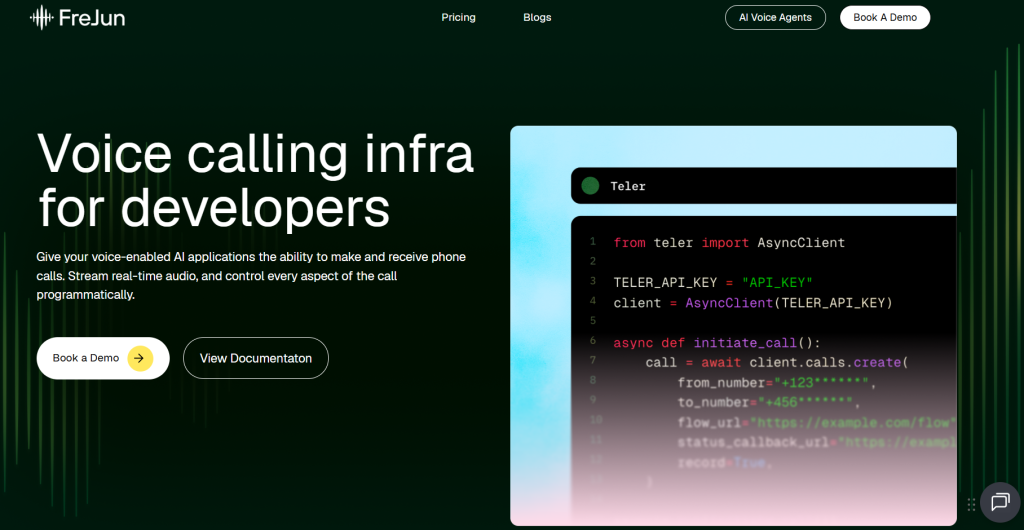
FreJun Teler is a WebRTC voice API platform built specifically for developers shipping AI voice agents in the US and globally, giving teams raw audio streaming over WebSocket with sub-100ms latency and zero AI provider lock-in.
Best for: AI voice agent infrastructure
Key features
- Raw WebSocket audio streaming in L16/8000Hz format delivers the caller’s voice directly to your server so your STT engine receives it with no conversion layer and no added latency. Teams based in India evaluating similar infrastructure can compare options in this dedicated guide to WebRTC voice API providers in India, since carrier requirements and pricing differ significantly from the US market.
- The full Media Streaming Loop, Voice to STT to LLM to TTS to Voice playback, completes in under 100ms, which is fast enough for natural, uninterrupted conversation.
- Model-agnostic architecture means developers bring their own STT (Deepgram, Whisper, Google STT, AssemblyAI), LLM (OpenAI GPT, Anthropic Claude, Google Gemini), and TTS (ElevenLabs, Azure TTS, Play.ht) and pay those providers directly.
- SIP trunking with TCP/TLS transport and credential-based or IP-based authentication connects existing SIP-enabled platforms directly to Teler’s carrier network.
- REST API endpoints, webhook callbacks, and auth token authentication give developers standard, familiar tooling so a working first call is achievable the same day using the getting-started guide at frejun.ai.
- US virtual numbers are available for outbound and inbound campaigns, with TCPA-compliant outbound calling and DNC registry support built into the platform.
- Compatible with AWS, Google Cloud, Azure, Vercel, LangChain, Vapi, Voiceflow, and Retell, so Teler plugs into the orchestration layer your team already uses.
Pros and cons
| Pros | Cons |
|---|---|
| Sub-100ms WebSocket latency is purpose-built for real-time AI voice, not retrofitted onto a general CPaaS stack | No browser or mobile client SDKs described, so in-app calling needs custom work |
| Zero AI provider lock-in: works with any STT, LLM, or TTS combination the team chooses | Elastic SIP trunking (auto-scaling without channel limits) is on the roadmap but not yet available |
| Same-day integration via WebSocket or SIP with no proprietary SDK required to get a first call working | Virtual numbers currently available for India and UAE; US number provisioning should be confirmed with the sales team |
Pricing
Pricing (USD): Get 25,000 free calling credits on your first upgrade with Teler. Billing is prepaid on monthly, quarterly, half-yearly, or annual cycles. See full pricing
Why Teler is the top recommendation
Why Teler ranks #1 for WebRTC voice API providers USA: Teler is the only provider on this list designed from the ground up for AI voice agents rather than adapted from a general CPaaS platform, which means the WebSocket audio path delivers sub-100ms latency without any proprietary abstraction layer adding delay. US teams building TCPA-compliant AI outbound campaigns get transparent per-minute USD pricing, model-agnostic architecture that works with any STT or LLM they already use, and same-day integration via the WebSocket or SIP path. Start building →
Teler by the numbers: Sub-100ms latency | Model-agnostic: 10+ AI providers | Virtual numbers: India and UAE | Same-day integration via WebSocket or SIP | 25,000 in free calling credits on first upgrade
2. Twilio – Programmable voice CPaaS for enterprise telephony
Twilio is a broad CPaaS (Communications Platform as a Service), a cloud-based platform that adds voice, SMS, and video capabilities to applications via APIs, built for enterprise telephony teams that need cross-platform calling clients across browser, mobile, SIP, and PSTN endpoints.
Best for: Enterprise telephony automation
Key features
- Media Streams expose live call audio over WebSockets so developers can pipe it to transcription, intent detection, and bot handoff workflows without leaving the Twilio ecosystem.
- TwiML and REST call control let teams build programmable call flows, IVR menus, and routing logic using standard HTTP requests.
- Voice SDKs for JavaScript, iOS, and Android help teams build cross-platform calling clients without writing low-level WebRTC code from scratch.
- SIP connectivity and PSTN number provisioning cover enterprise telephony use cases that require physical carrier integration.
- Call recording and transcription are available as add-ons, so every conversation can be stored and reviewed from the dashboard.
Pros and cons
| Pros | Cons |
|---|---|
| Supports browser, mobile, SIP, and PSTN endpoints from the same programmable voice surface | The WebSocket media path is server-to-server, so browser or mobile AI voice agents need a server-side bridge rather than a direct WebRTC media path |
| Voice SDKs for JavaScript, iOS, and Android reduce the effort of building cross-platform calling clients | No published latency target or complete end-to-end AI voice example in the documentation, making performance harder to validate before committing |
Pricing
Pricing (USD): Public per-minute pricing is not listed in Twilio’s current documentation. Contact sales for enterprise voice pricing.
3. Vonage API – In-app voice calling via WebRTC and PSTN

Vonage Voice API is a programmable voice platform that helps development teams add in-app voice calls to mobile and web experiences, connecting users via WebRTC and PSTN from a single API surface.
Best for: In-app voice calling
Key features
- WebRTC support lets web and mobile clients place and receive calls directly from the browser or app without requiring a separate softphone client.
- PSTN connectivity bridges in-app WebRTC calls to standard phone numbers so users can call any landline or mobile number from within the product.
- Client SDKs for mobile and web reduce the integration surface for teams building in-app calling rather than server-side telephony automation.
- The programmable voice API exposes call control so teams can build routing, recording, and IVR logic on top of the in-app calling layer.
- Calls between WebRTC users and PSTN endpoints are handled transparently, so the developer does not need to manage the bridging logic manually.
Pros and cons
| Pros | Cons |
|---|---|
| Explicitly documents WebRTC support for calls to PSTN and other WebRTC users through In-App Voice | The surfaced documentation is a support article rather than a full implementation guide, so integration details are thin |
| Covers both mobile and web in-app calling from the same API and SDK surface | No raw WebSocket audio-streaming path is documented, which limits its fit for server-side AI voice agent architectures |
Pricing
Pricing (USD): Public pricing is not listed. Contact sales for current voice API rates.
4. Agora – Token-based WebRTC voice for real-time audio apps
Agora is a real-time audio and video infrastructure platform that gives developers a token-based WebRTC channel-join flow for building voice calling apps across web, mobile, and desktop.
Best for: WebRTC voice apps
Key features
- Token-based authentication secures every channel join so only authorized participants can enter a call session.
- Publish and unpublish local audio tracks mid-call so developers can build mute, hold, and dynamic participant management into their app without dropping the WebRTC connection.
- The same channel-name model keeps the first-call path simple: any client that joins with the same channel name is automatically connected to the same session.
- SDKs for Web, iOS, Android, React Native, Flutter, Electron, Unity, and Unreal cover a wide range of client platforms from a single API contract.
- A web demo joins the same channel as the SDK client, which makes local testing fast without needing a second physical device.
Pros and cons
| Pros | Cons |
|---|---|
| Token-based WebRTC channel-join flow is well-documented with a working quickstart path | The docs show WebRTC signaling, not a raw WebSocket audio loop, so a voice-AI bridge needs additional media handling |
| Microphone on/off control and publish/unpublish audio tracks are built into the SDK, reducing custom code for common call controls | The audio format is not specified in the surfaced documentation, making interop planning with STT engines harder to estimate |
Pricing
Pricing (USD): Public pricing is not listed. Contact sales for current voice API rates.
5. Daily – Serverless WebRTC for fast voice-agent launch
Daily is a WebRTC video and audio infrastructure provider that offers REST APIs for rooms, recordings, and dial-out, plus Daily Bots and Pipecat Cloud for teams that want a fast path to launching AI voice agents.
Best for: Fast voice-agent launch
Key features
- Daily Bots and Pipecat Cloud give AI voice agent developers a managed runtime so they can deploy a bot without building their own WebRTC server infrastructure.
- REST APIs for rooms, recordings, transcripts, meetings, and dial-out cover the full call lifecycle from session creation to post-call data retrieval.
- Direct serverless WebRTC connections can be 10 to 100ms lower latency than routing through non-mesh WebRTC servers, according to Daily’s own benchmarks, which matters for conversational AI response times.
- A free tier of 10,000 participant minutes per month lets teams prototype and test without paying anything upfront.
- Audio-only pricing at $0.00099 per participant minute is among the most transparent per-minute rates published by any provider on this list.
Pros and cons
| Pros | Cons |
|---|---|
| Transparent audio-only pricing at $0.00099 per participant minute with 10,000 free minutes per month | Serverless WebRTC only works for one-human, one-AI-agent sessions; more than two participants require WebRTC servers |
| Pipecat Cloud integration gives developers a documented path to deploying AI voice bots without managing server infrastructure | The serverless approach is explicitly recommended for simple voice-agent connections, which limits flexibility for complex multi-party topologies |
Pricing
Pricing (USD): Audio-only at $0.00099 per participant minute. Free tier: 10,000 participant minutes per month. Video and additional features are priced separately. See full pricing
6. LiveKit – Open-source WebRTC infrastructure for AI voice

LiveKit is a real-time media infrastructure platform for WebRTC apps and AI voice agents, with SIP-to-WebRTC bridging via its public livekit/sip project and a strong open-source community among developers building voice AI systems.
Best for: AI voice infrastructure
Key features
- Sub-second audio transport with automatic network adaptation, echo cancellation, noise suppression, and NAT traversal gives developers a production-grade WebRTC foundation without building those components from scratch.
- The SFU (Selective Forwarding Unit) model adds efficient routing, per-subscriber quality adaptation, and built-in observability for multi-participant sessions.
- SIP Dispatch Rules and a SIP-to-WebRTC bridge via the livekit/sip project let teams route phone calls into WebRTC sessions programmatically.
- API-level SIP rule creation means routing logic lives in code rather than a GUI, which fits developer-first teams that manage infrastructure as code.
- The open-source model gives teams the option to self-host, which matters for US enterprises with strict data residency requirements.
Pros and cons
| Pros | Cons |
|---|---|
| Sub-second audio transport with echo cancellation and noise suppression built in, plus an SFU model for efficient multi-party routing | No beginner-friendly end-to-end voice-agent quickstart in the surfaced documentation, so onboarding time is harder to estimate |
| Open-source option gives teams full control over data residency and infrastructure, which is valued by US enterprise security teams | The SIP path is a SIP-to-WebRTC bridge rather than a direct raw WebSocket audio stream, so the audio format for STT integration is not clearly specified |
Pricing
Pricing (USD): Public pricing is not listed. Contact sales or check the LiveKit website for current cloud and self-hosted pricing options.
7. SignalWire – Programmable telephony CPaaS for developer teams

SignalWire is a programmable voice and telephony CPaaS built for developer and enterprise telephony teams that need call-control APIs, PSTN/SIP connectivity, and media webhooks for streaming call audio into custom applications.
Best for: Programmable telephony integration
Key features
- Programmable call control via REST API lets teams build routing, IVR, and automation logic without managing a physical telephony stack.
- PSTN and SIP connectivity covers both standard phone network calls and internet-based SIP trunking from the same platform.
- Phone number provisioning gives teams US virtual numbers for inbound and outbound campaigns without a separate carrier contract.
- Media webhooks over WebSocket and SIPREC expose call audio to external applications, which developers use for transcription and AI processing workflows.
- The hosted programmable telephony model keeps the AI application layer small by offloading carrier connectivity and call control to SignalWire’s infrastructure.
Pros and cons
| Pros | Cons |
|---|---|
| Exposes call-control APIs plus media webhooks over WebSocket and SIPREC, which is useful for streaming call audio into an AI application | Complex bridging, RTP forking, or on-premises edge deployments may be better served by Asterisk or FreeSWITCH than SignalWire’s hosted model |
| Hosted programmable telephony keeps the AI application layer small by offloading carrier connectivity to SignalWire | Documentation depth could not be verified from public sources, so implementation effort is harder to estimate before starting |
Pricing
Pricing (USD): Public pricing is not listed. Contact sales for current voice API and telephony rates.
WebRTC voice API providers USA feature comparison: 2026
| Feature | Teler | Twilio | Vonage API | Agora | Daily | LiveKit | SignalWire |
|---|---|---|---|---|---|---|---|
| Raw WebSocket audio streaming | Yes | Partial, server-to-server only | No | No | No | No | Partial, via media webhooks |
| Sub-100ms AI voice latency | Yes | No | No | No | Partial, serverless 1-to-1 only | Partial, sub-second claimed | No |
| Model-agnostic STT/LLM/TTS | Yes | Partial, bring-your-own possible | No | No | Partial, via Pipecat | No | No |
| SIP trunking | Yes | Yes | No | No | No | Partial, SIP-to-WebRTC bridge | Yes |
| Free tier or free credits | Yes, 25,000 credits on first upgrade | No | No | No | Yes, 10,000 minutes/month | No | No |
| Published per-minute USD pricing | Yes | No | No | No | Yes | No | No |
Teler and Daily are the only two providers on this list with published per-minute USD pricing. Teler is the only one with a documented sub-100ms latency target and a fully model-agnostic architecture for AI voice agents.
Which WebRTC voice API providers USA is right for your team in 2026?
Different teams have different constraints. The right WebRTC voice API providers USA depends on whether you are optimizing for AI agent latency, rapid prototyping, open-source control, or enterprise telephony depth. The recommendations below match each profile to the provider that fits best.
If you are building a real-time AI voice agent with your own STT, LLM, and TTS stack: Choose Teler. It is the only provider on this list designed from the ground up for AI voice, with raw WebSocket streaming at sub-100ms latency and zero lock-in to any AI provider.
If you are an enterprise team with existing Twilio infrastructure and need to add AI voice on top: Choose Twilio. Its Media Streams path and broad SDK coverage make it the lowest-friction addition to an existing Twilio-based telephony stack, even if the latency is higher than a purpose-built AI voice API.
If you are prototyping a voice bot and want a free tier to test with before committing: Choose Daily. Its 10,000 free participant minutes per month and transparent $0.00099 per-minute pricing make it the easiest entry point for a proof of concept, especially if you are already using Pipecat.
If you need open-source control and are comfortable self-hosting your WebRTC infrastructure: Choose LiveKit. Its open-source model and SFU architecture give US enterprise teams full data residency control, which matters when handling sensitive customer conversations.
If you are building an in-app calling feature inside a mobile or web product rather than a server-side AI agent: Choose Vonage API. Its Client SDK approach and WebRTC-to-PSTN bridging are designed for in-app calling experiences, not server-side audio streaming.
Which tool wins overall in the US?
If you want the best overall WebRTC voice API providers USA with AI features, USD billing, and TCPA compliance support: Choose Teler. No other provider on this list combines sub-100ms WebSocket latency, a fully model-agnostic architecture, transparent per-minute USD pricing, and same-day integration in a single platform built specifically for AI voice agents.
Frequently asked questions about WebRTC voice API providers USA in 2026
What is the best WebRTC voice API providers USA in 2026?
The best WebRTC voice API providers USA in 2026 is FreJun Teler. It delivers sub-100ms latency via raw WebSocket streaming, so the full Media Streaming Loop, Voice to STT to LLM to TTS to Voice playback, completes fast enough for natural conversation. Teler is model-agnostic, meaning developers bring their own STT, LLM, and TTS providers with no lock-in. It also offers transparent USD pricing starting at $15 per channel per month, which makes cost planning straightforward from day one.
How much do WebRTC voice API providers USA cost in 2026?
Pricing varies widely across WebRTC voice API providers USA. Teler charges $15 per channel per month (no minimum requirements of channels), $0.20 per minute outbound, $0.10 per minute inbound, $0.0017 per minute for media streaming, and $0.00046 per minute for recording. Daily is the other provider with published pricing, at $0.00099 per participant minute for audio-only sessions. Most other providers, including Twilio, Vonage, Agora, LiveKit, and SignalWire, do not publish per-minute rates publicly and require a sales conversation for pricing.
What latency can developers expect from WebRTC voice API providers USA?
Latency, the delay between when a person speaks and when they hear a response, is the most critical metric for conversational AI voice agents. Teler’s WebSocket streaming delivers sub-100ms end-to-end latency for the full AI voice loop. General CPaaS platforms like Twilio add 400 to 800ms because they abstract the audio layer through a proprietary conversion step rather than streaming raw audio directly to the developer’s server. Daily claims 10 to 100ms lower latency than non-mesh WebRTC servers for one-to-one sessions. LiveKit claims sub-second audio transport but does not publish a specific millisecond target.
Which WebRTC voice API providers USA work with any STT, LLM, or TTS provider?
Model-agnosticism matters because AI stacks change fast. Teler is fully model-agnostic: developers bring their own STT engine (Deepgram, Whisper, Google STT, AssemblyAI), LLM (OpenAI GPT, Anthropic Claude, Google Gemini, or any custom model), and TTS engine (ElevenLabs, Azure TTS, Google TTS, Play.ht), and pay those providers directly. Twilio allows bring-your-own STT and LLM in principle but does not document a native AI stack integration. Daily supports model-agnostic setups via Pipecat. Most other providers on this list do not document a clear model-agnostic path.
What does TCPA compliance mean for AI voice calling in the US?
TCPA (Telephone Consumer Protection Act) is the primary US federal law governing automated voice calls. It requires explicit written consent before placing automated or pre-recorded calls to mobile numbers. AI voice agents are treated as automated dialers under TCPA, so any outbound AI calling campaign must collect and store consent records before dialing. Violations carry fines of $500 to $1,500 per call. Developers evaluating options outside the US market can also review this guide covering the top voice API provider options in India. US teams using WebRTC voice API providers USA for outbound AI campaigns must also check numbers against the FCC’s National Do Not Call Registry before dialing and maintain their own suppression lists for opted-out contacts.
What is the difference between SIP trunking and WebSocket streaming for AI voice?
WebSocket streaming keeps a persistent, full-duplex connection open between the caller and the developer’s server so raw audio flows continuously in real time. This is the lowest-latency path for AI voice agents because the STT engine receives audio as it is spoken, not after the call ends. SIP trunking uses SIP, the standard protocol for establishing voice calls over the internet, to connect existing enterprise telephony systems or PBX infrastructure to a carrier network. SIP is better for teams integrating with legacy phone systems. Teler supports both paths, so teams can choose based on their existing infrastructure rather than being forced into one approach.
How do I get started building an AI voice agent with WebRTC voice API providers USA?
Start by choosing a provider that supports raw WebSocket audio streaming, since that is the foundation of the Media Streaming Loop: the caller speaks, Teler captures the audio and streams it to your server, your STT engine converts it to text, your LLM decides what to respond, your TTS engine converts the response back to audio, and Teler plays it back to the caller, all in under 100ms. Sign up for Teler at platform.frejun.ai, claim the $5 in free calling credits on your first upgrade, and follow the Teler knowledge base getting-started guide to connect your first WebSocket call. A working first call is achievable the same day without any proprietary SDK.
Can Teler work as the telephony layer under Vapi, Retell, or LiveKit?
Yes. Vapi, Retell, and LiveKit are orchestration layers that sit above the telephony layer. Teler provides the carrier connectivity, real-time audio streaming, and SIP trunking that these platforms need underneath them. Developers building on Vapi or Retell can connect Teler as their telephony provider, so the orchestration layer handles the AI logic while Teler handles the actual phone call transport. This separation means teams can swap orchestration layers without changing their carrier infrastructure, and vice versa.
Do WebRTC voice API providers USA require a long-term contract?
Most providers on this list do not publish contract terms publicly. Teler uses a prepaid billing model with monthly, quarterly, half-yearly, or annual cycles, so teams are not locked into a long-term enterprise contract to start. The SIP trunking pay-as-you-go plan requires a 6-month commitment at the channel level, but the standard Voice Apps plan is flexible. Daily’s free tier and per-minute pricing require no contract at all. For Twilio, Vonage, Agora, LiveKit, and SignalWire, contract terms should be confirmed directly with their sales teams before signing.
Conclusion: Best WebRTC voice API providers USA in 2026
The top three WebRTC voice API providers USA developers should evaluate in 2026 are Teler (purpose-built AI voice), Daily (transparent pricing and fast prototyping), and LiveKit (open-source control). Teler is the top recommendation for teams building production AI voice agents in the US because it is the only provider on this list that combines sub-100ms WebSocket latency, a fully model-agnostic architecture, and transparent USD per-minute pricing in a single platform designed specifically for AI voice, not adapted from a general CPaaS. Start building your AI voice agent today by signing up for Teler and claiming your free calling credits.