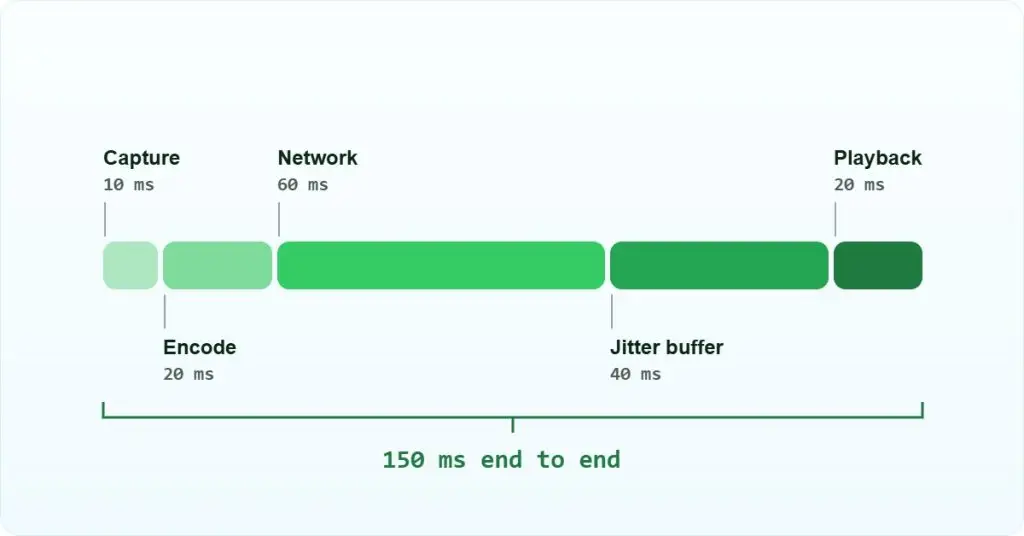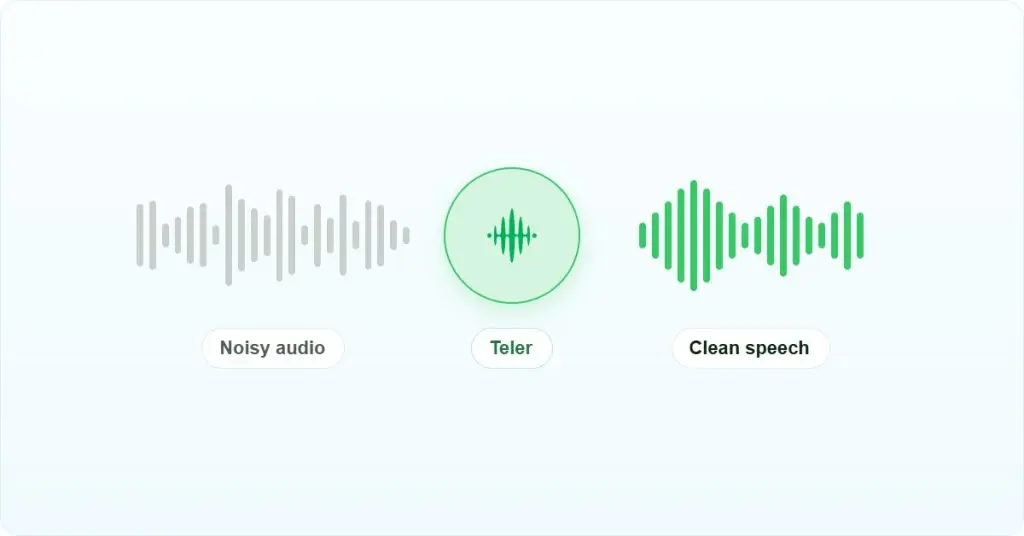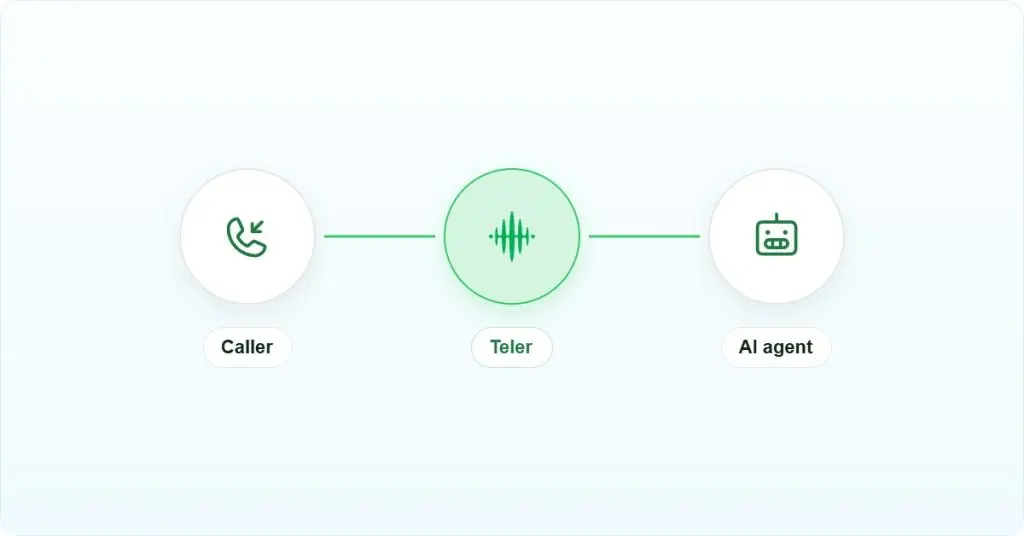

AI Summary: This article compares the top 7 vapi voice api usa options for developers building AI voice agents in the US in 2026, evaluating each on real-time latency, Vapi integration depth, model compatibility, and TCPA compliance. As of 2026, the global conversational AI market is projected to exceed $29 billion by 2028, according to MarketsandMarkets, making telephony infrastructure selection a foundational decision for any AI product team. Developers need a voice API that delivers sub-100ms latency, integrates cleanly with Vapi’s orchestration layer, and works with any STT, LLM, or TTS provider without lock-in. FreJun Teler meets all three requirements, with raw WebSocket streaming at L16/8000Hz and outbound calling from $0.20 per minute.
Key criteria in this comparison: We ranked these platforms on Vapi integration depth, real-time WebSocket latency, audio format compatibility, TCPA compliance support, and pricing transparency, since these are the factors that most affect a developer team’s build speed and total infrastructure cost when connecting a telephony layer to Vapi.
Quick Answer: The best vapi voice api usa in 2026 is FreJun Teler, which delivers raw WebSocket audio streaming at sub-100ms latency and plugs directly into Vapi’s STT-LLM-TTS pipeline with zero model lock-in. Teler starts at $15 per channel per month with outbound calling at $0.20 per minute, making it the most purpose-built telephony layer for US-based Vapi developers.
The best vapi voice api usa for developers building on Vapi in the US is Teler, which provides raw WebSocket audio streaming at sub-100ms latency and connects to any STT, LLM, or TTS provider without proprietary lock-in.
What is Vapi?
Vapi is an AI voice orchestration platform that lets developers build, test, and deploy conversational voice agents without managing the full telephony stack themselves. It sits above the carrier layer, handling the agent logic, turn-taking, and model routing while relying on an external voice API to provide the actual phone connectivity and real-time audio transport. Developers use Vapi to wire together their chosen STT (Speech-to-Text), LLM (Large Language Model), and TTS (Text-to-Speech) components into a working voice agent, but Vapi itself does not own the PSTN (Public Switched Telephone Network) infrastructure. That means every Vapi deployment needs a separate telephony provider underneath it, one that can deliver raw audio over WebSocket or route calls via SIP (Session Initiation Protocol) into Vapi’s assistant layer.
In the US, choosing the right vapi voice api usa provider directly determines the latency, call quality, and compliance posture of the entire agent. Developers building similar Vapi-based agents for the Indian market can review the vapi voice api india options to compare region-specific pricing, number provisioning, and compliance requirements.
As of 2026, AI voice agent adoption in the US is accelerating rapidly, with the conversational AI market projected to grow at a 22% CAGR through 2030, according to Grand View Research. US developers building on Vapi face a specific challenge: most general CPaaS (Communications Platform as a Service) platforms abstract the audio layer for human-to-human calls, which adds 400 to 800ms of latency that makes real-time AI inference feel unnatural. The best vapi voice api usa providers solve this by exposing raw audio streams directly over WebSocket, so the AI stack can process each utterance in under 100ms.
Which vapi voice api usa providers rank highest in the US in 2026?
The table below ranks the top seven vapi voice api usa options by Vapi integration depth, latency, and pricing transparency so you can compare them at a glance before reading the full profiles.
| # | Provider | Best for | Starting price (USD) | Free trial |
|---|---|---|---|---|
| 1 | FreJun Teler | AI voice agent infrastructure | $15/channel/month + $0.20/min outbound | Yes free credits on signup |
| 2 | Twilio | Programmable voice routing | ~$0.0085/min | No |
| 3 | Telnyx | Carrier-low-cost voice | $0.002/min | No |
| 4 | Plivo | Low-cost PSTN calling | $0.0033/min | Yes free trial credits |
| 5 | Vonage API | Webhook voice apps | Contact sales | No |
| 6 | Daily | WebRTC in-app voice | Contact sales | No |
| 7 | SignalWire | Programmable telephony stacks | Contact sales | No |
Scroll down for the full breakdown of each vapi voice api usa tool, including features, pros, cons, pricing, and ideal use case.
How do you choose the best vapi voice api usa in the US?
Step 1: Understand what Vapi needs from a telephony layer
Vapi is an orchestration layer, not a carrier. It needs a telephony provider underneath it that can either route inbound calls via SIP into a Vapi assistant or stream raw audio over WebSocket so Vapi’s pipeline can process it. Before evaluating any vapi voice api usa provider, confirm two things: what audio format the provider outputs (raw PCM or L16/8000Hz is ideal for AI pipelines), and whether it supports SIP trunking, WebSocket media streaming, or both. Providers that only offer abstracted call control without raw audio access will require a custom bridge, which adds latency and engineering overhead.
Step 2: Choose your integration path – WebSocket or SIP
WebSocket is a persistent, full-duplex connection that keeps the audio channel continuously open between the caller and your server. It is the lowest-latency path for AI voice agents because audio frames arrive in real time without the overhead of repeated HTTP handshakes. SIP (Session Initiation Protocol), the standard protocol for establishing voice calls over the internet, is better suited for connecting existing enterprise telephony infrastructure or SIP-enabled platforms directly to a carrier network. If you are building a conversational AI agent where response latency under 100ms matters, choose a provider with native WebSocket streaming. If you are connecting a legacy PBX or an existing SIP trunk, choose a provider with strong SIP trunking support. Teams evaluating alternative real-time media frameworks for US deployments may also want to compare LiveKit voice API options before finalizing their telephony layer.
Step 3: Check US carrier and TCPA compliance requirements
In the US, AI outbound calling is governed by the FCC and the TCPA (Telephone Consumer Protection Act), which requires prior express written consent before placing automated calls to mobile numbers. Any vapi voice api usa provider you choose must support TCPA-compliant workflows, including Do Not Call (DNC) Registry scrubbing and consent management. Some providers handle carrier registration automatically for US numbers; others leave compliance entirely to the developer. Confirm which approach each provider takes before committing, since TCPA violations carry fines of $500 to $1,500 per call.
Step 4: Evaluate pricing in USD for your expected call volume
Per-minute rates vary widely across vapi voice api usa providers, from $0.002/min on Telnyx to $0.0085/min on Twilio for basic voice. But per-minute rate is only one cost component. Also factor in channel costs (some providers charge per concurrent channel), media streaming fees, recording and storage fees, and the cost of US virtual number rental. Build a realistic monthly cost model based on your expected call volume before choosing a provider. A provider with a lower per-minute rate but high channel fees can end up more expensive at scale than one with a slightly higher per-minute rate and no channel minimums.
Step 5: Test latency and audio quality on a real call before committing
Latency, the delay between when a person speaks and when they hear a response, is the single most important quality metric for conversational AI agents. A delay over 400ms feels unnatural and breaks the conversation flow. Test the full Media Streaming Loop (Voice to STT to LLM to TTS to Voice playback) end-to-end on a real call before committing to any provider. Teler offers $5 in free calling credits on first upgrade for UAE and 3,000 free minutes for India, so developers can validate the full stack before paying. For US deployments, contact the Teler sales team to confirm current US trial options.
Top 7 vapi voice api usa providers for US developers in 2026
1. FreJun Teler – Purpose-built voice API for AI agents on Vapi

FreJun Teler is a Voice API platform built specifically for developers connecting AI voice agents to real phone networks, making it the most technically aligned vapi voice api usa option for teams building on Vapi in the US.
Best for: AI voice agent infrastructure
Key features
- Raw WebSocket streaming at L16/8000Hz delivers audio frames directly to your server, so your STT engine receives them with no proprietary conversion layer adding delay between the caller and your AI pipeline.
- Sub-100ms Media Streaming Loop completes the full Voice to STT to LLM to TTS to Voice cycle fast enough for natural, uninterrupted conversation, unlike general CPaaS platforms that add 400 to 800ms by abstracting the audio path.
- Model-agnostic architecture means developers bring their own STT (Google STT, Deepgram, Whisper, AssemblyAI), LLM (OpenAI GPT, Anthropic Claude, Google Gemini), and TTS (ElevenLabs, Azure TTS, Play.ht) and pay those providers directly, with zero lock-in to Teler’s stack.
- SIP trunking with TCP/TLS transport and credential-based or IP-based authentication connects existing SIP-enabled platforms or AI providers directly to Teler’s carrier network, so teams with legacy infrastructure are not forced to rebuild from scratch.
- REST API endpoints, webhook callbacks, and auth token authentication give developers standard, familiar tooling to control calls, receive event notifications, and secure sessions without learning a proprietary SDK.
- Compatible with Vapi, Voiceflow, Retell, LangChain, AWS, Google Cloud, and Azure, so Teler slots into the orchestration stack the team already uses rather than requiring a platform switch. Developers who are also evaluating other AI-first orchestration platforms alongside Vapi may find it useful to compare Retell AI voice API options built for similar US-based agent architectures.
Pros and cons
| Pros | Cons |
|---|---|
| Sub-100ms WebSocket latency is purpose-built for AI voice agent pipelines, not retrofitted from a general CPaaS | Virtual numbers are currently available for India and UAE; US number availability should be confirmed with the sales team |
| Zero model lock-in: works with any STT, LLM, or TTS provider the team already uses or plans to use | Elastic SIP trunking (auto-scaling without channel limits) is on the roadmap but not yet available; capacity is managed through channels |
| Same-day integration via WebSocket or SIP, using protocols developers already know, with no proprietary SDK required to get a first call working | Pricing is structured around channel minimums (10 channels), so very low-volume prototypes may find per-minute-only pricing from other providers more flexible at the earliest stage |
Pricing
Pricing (USD): Channel cost starts at $15/channel/month (minimum 10 channels). Outbound calling at $0.20/min, inbound at $0.10/min, media streaming at $0.0017/min, and recording at $0.00046/min. UAE number rental is $100/month per number. SIP trunking is available at $11.50/channel/month (minimum 10 channels, 6-month commitment) with outbound at $0.12/min and inbound at $0.03/min. First upgrade includes $5 in free calling credits (UAE) or 3,000 free minutes (India). See full pricing
Why Teler is the top recommendation
Why Teler ranks #1 for vapi voice api usa: Teler is the only provider in this list designed from the ground up for AI voice agent infrastructure rather than general CPaaS telephony. Its raw WebSocket streaming at L16/8000Hz plugs directly into Vapi’s STT-LLM-TTS pipeline at sub-100ms latency, while its model-agnostic architecture means US developers keep full control of their AI stack. For teams building TCPA-compliant AI outbound agents on Vapi, Teler removes the custom audio bridge that every other provider on this list requires. Start building →
Teler by the numbers: Sub-100ms latency | Model-agnostic: 10+ AI providers | Virtual numbers: India and UAE | Same-day integration via WebSocket or SIP | 3,000 free minutes on first upgrade (India)
Integration with Vapi: Teler provides raw WebSocket audio streaming at L16/8000Hz that plugs directly into Vapi’s STT-LLM-TTS pipeline, with SIP trunking as an alternative path for teams routing inbound calls to a Vapi assistant. No custom audio bridge is required.
2. Twilio – Programmable voice routing for Vapi SIP handoff
Twilio is a broad CPaaS (Communications Platform as a Service) platform that developers use as the PSTN edge layer before bridging audio into a Vapi assistant via SIP or a custom WebSocket server, making it a common but engineering-heavy vapi voice api usa option.
Best for: Programmable voice routing
Key features
- SIP trunking and TwiML/REST call control let you route inbound US calls to a webhook or SIP endpoint, so you can hand calls off to a Vapi assistant without rebuilding your carrier layer.
- Media Streams expose base64-encoded 8 kHz mu-law audio frames over WebSocket, giving developers access to raw audio, though a conversion step to L16/8000Hz is required before feeding frames into most AI STT engines.
- US virtual number provisioning and USD pricing are part of Twilio’s core offering, so TCPA-compliant number management is handled within the same platform as call routing.
- REST API and TwiML call control give developers fine-grained control over call flow, including barge-in behavior, silence thresholds, and webhook retry handling.
- Multi-language SDKs and a mature developer ecosystem mean most backend stacks already have a Twilio integration path available without writing low-level telephony code.
Pros and cons
| Pros | Cons |
|---|---|
| Standard webhook plumbing with Account SID and Auth Token fits existing backend infrastructure, so teams do not need to learn a new auth model | Twilio is not a turnkey AI voice stack; developers still need a custom WebSocket bridge or audio conversion layer to feed Media Streams into a Vapi or STT pipeline |
| Keeping Twilio on transport lets teams retain their carrier layer while swapping the AI stack behind it, which is useful for teams with existing Twilio numbers | Latency compounds across the Twilio to Vapi to STT/LLM/TTS hops, making the end-to-end voice loop more sensitive to network delay than a purpose-built AI voice API |
Pricing
Pricing (USD): Approximately $0.0085/min for US voice calls, billed per minute. No published free trial. See full pricing
Integration with Vapi: Compatible via SIP handoff, where Twilio routes inbound calls to a Vapi assistant. A custom WebSocket bridge or audio conversion step is required when using Twilio Media Streams, since the base64-encoded 8 kHz mu-law format does not match Vapi’s expected audio input natively.
3. Telnyx – Carrier-network pricing for Vapi number routing
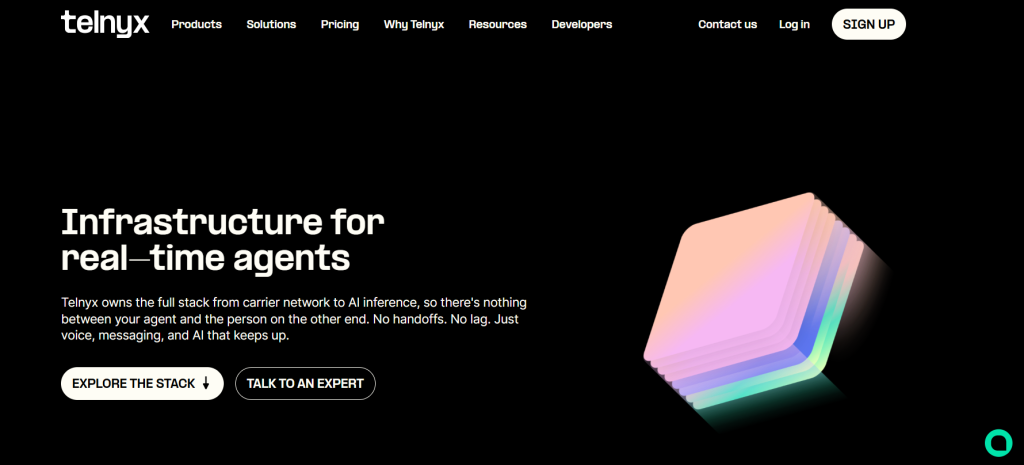
Telnyx is a carrier-network Voice API and CPaaS that offers low per-minute rates and documented Vapi number-import support, making it a cost-focused vapi voice api usa option for teams routing inbound calls to a Vapi assistant.
Best for: Carrier-low-cost voice
Key features
- Phone number import into Vapi is officially documented, so teams can assign Telnyx numbers to a Vapi assistant for inbound routing without building a custom bridge.
- Outbound voice profiles give developers control over destination routing, so outbound calls from a Vapi agent can be managed through Telnyx’s carrier network at $0.002/min.
- SIP trunk routing to Vapi connects Telnyx’s carrier network to a Vapi assistant via standard SIP, which is the primary integration path for inbound call handling.
- Call Control API provides REST-based call workflow management, so developers can control call state, transfer calls, and handle events programmatically alongside the Vapi agent layer.
- Lower carrier-network pricing compared to general CPaaS platforms makes Telnyx attractive for high-volume deployments where per-minute cost is the primary budget driver.
Pros and cons
| Pros | Cons |
|---|---|
| Officially documented Vapi number-import path reduces integration time for inbound routing compared to providers with no documented Vapi support | No end-to-end audio-loop streaming example is documented in available sources, so raw WebSocket AI voice integration requires additional custom engineering |
| $0.002/min carrier-network pricing is among the lowest published rates for US voice in this comparison | Telnyx’s native AI offering bundles its own STT and TTS, which can create partial lock-in if developers use the native stack rather than the Vapi integration path |
Pricing
Pricing (USD): Starts at $0.002/min for US voice, billed per minute. No published free trial. See full pricing
Integration with Vapi: Compatible and officially documented for number-routing via Telnyx number import into Vapi. A full raw audio-loop streaming example for AI voice agents is not documented in available sources, so teams building real-time conversational agents may need additional custom work beyond the number-import path.
4. Plivo – Low-cost PSTN calling with free trial credits
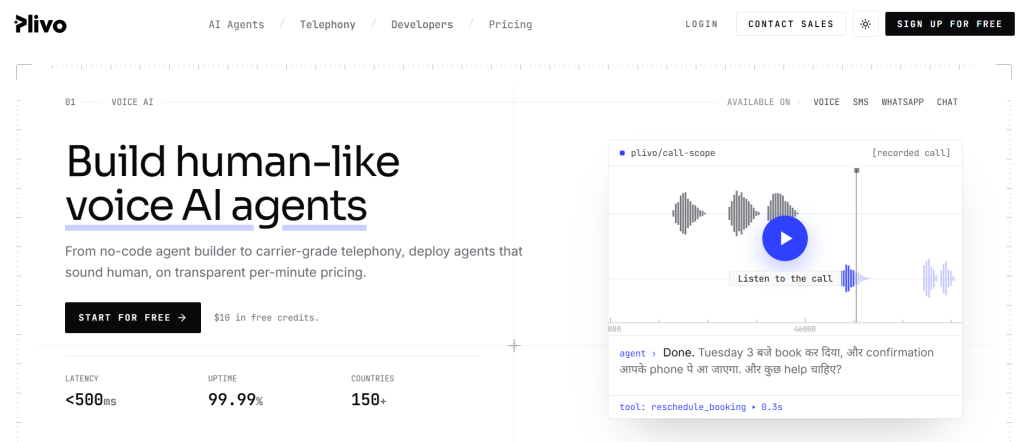
Plivo is a cloud voice API and CPaaS for developers building phone-call automation and SIP calling workflows, offering one of the few free trial options among vapi voice api usa providers but without a documented Vapi integration path.
Best for: Low-cost PSTN calling
Key features
- Browser SDK and SIP calling at $0.0033/min gives developers a low-cost entry point for voice automation without committing to per-channel minimums upfront.
- Free trial with included credits lets developers test the full call flow before paying, which is useful for validating audio quality on US routes before committing to a production integration.
- Audio streaming and noise cancellation are included in the platform, so developers building voice bots get basic audio processing without adding a separate service.
- REST API with Auth ID and Auth Token authentication follows a standard pattern that fits existing backend infrastructure without requiring a new auth model.
- US local and toll-free number pricing is published in USD, so cost modeling for US deployments is straightforward without a sales call.
Pros and cons
| Pros | Cons |
|---|---|
| Free trial with credits is the most accessible entry point in this comparison for developers prototyping on a tight budget | No documented Vapi integration path means developers building on Vapi must build a custom bridge, adding engineering time and potential latency |
| $0.0033/min browser SDK and SIP pricing is competitive for US PSTN calling without channel minimums | No full real-time agent audio loop is documented in available sources, so Plivo is better suited as a telephony transport than a purpose-built AI voice API |
Pricing
Pricing (USD): Starts at $0.0033/min for browser SDK and SIP calls. Free trial includes credits. See full pricing
Integration with Vapi: No documented integration path. Developers would need to build custom bridging between Plivo’s SIP or browser SDK transport and Vapi’s assistant layer, which adds engineering overhead and potential latency compared to providers with native Vapi support.
5. Vonage API – Webhook voice apps for existing telephony teams
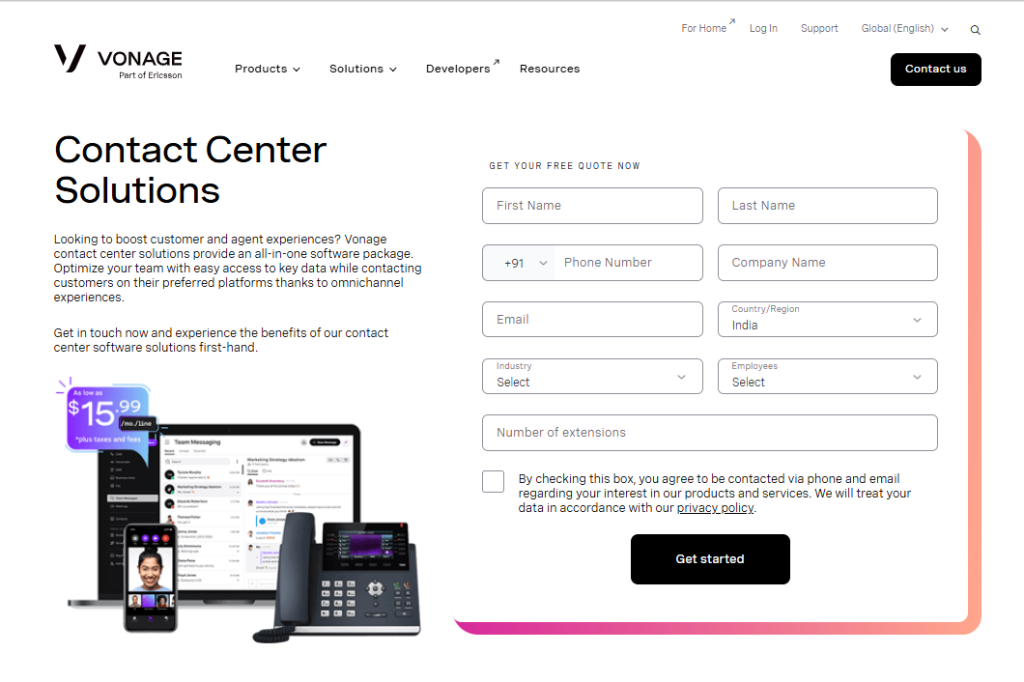
Vonage API Platform’s voice product lets developers build programmable voice applications with webhooks, virtual numbers, and Node.js SDKs, but it is aimed at telephony teams rather than AI voice orchestration, making it a limited vapi voice api usa option for Vapi-native builds.
Best for: Webhook voice apps
Key features
- Answer URL and event URL webhooks let developers control call flow programmatically, so inbound calls can be routed based on custom logic without a proprietary dashboard configuration.
- Virtual number provisioning through the dashboard gives teams a managed way to buy and configure US numbers alongside their voice application setup.
- Node.js voice SDK and JWT authentication provide a familiar development experience for teams already working in JavaScript-based backend stacks.
- Smart number configuration in the dashboard allows non-developer team members to manage number routing rules without touching code.
Pros and cons
| Pros | Cons |
|---|---|
| Answer and event webhook model is straightforward for teams already building webhook-driven call flows in Node.js | No documented Vapi integration path and no raw WebSocket AI audio loop in available sources, so Vapi developers must build a full custom bridge |
| Dashboard-based smart number configuration reduces the code required for basic routing changes | Pricing is not publicly listed, which makes cost modeling for US deployments impossible without a sales conversation |
Integration with Vapi: No documented integration path. The webhook-based call control model would require a custom bridge to route audio into Vapi’s assistant layer, and no raw WebSocket AI voice streaming example is available in current documentation.
6. Daily – WebRTC voice transport for in-app agent experiences
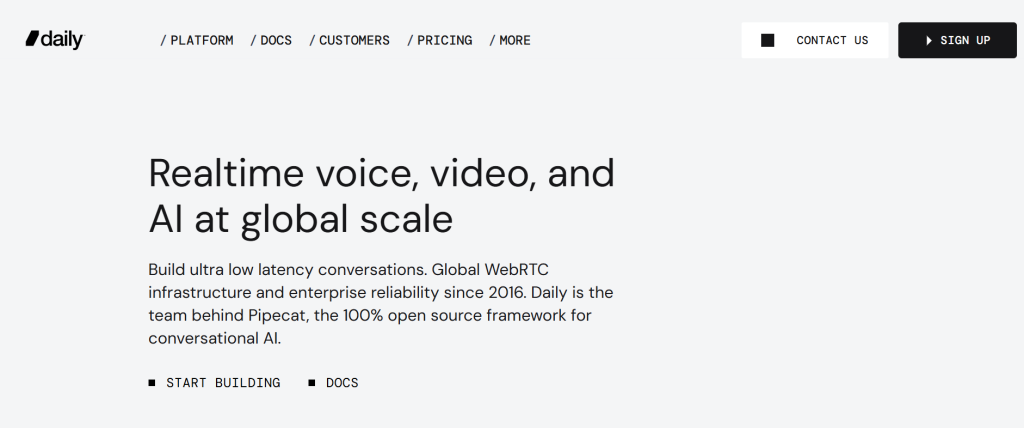
Daily is a real-time audio and video platform for WebRTC-based conversational apps, suited to developers building in-app voice agent experiences rather than PSTN telephony, which limits its fit as a vapi voice api usa provider for teams needing US phone number connectivity. Developers building for the Indian market with a WebRTC-first approach can similarly evaluate LiveKit voice API India providers before committing to a telephony stack.
Best for: WebRTC in-app voice
Key features
- Low-latency WebRTC media transport delivers real-time audio for browser and mobile applications, so developers building in-app voice agents get a reliable media layer without managing their own WebRTC infrastructure.
- REST room management API lets developers create and configure audio rooms programmatically, so agent sessions can be spun up and torn down via standard HTTP calls.
- Browser and mobile SDKs give front-end developers a ready-made integration path for embedding voice agent experiences directly into web or native apps.
- Webhook and event hooks notify the developer’s server when participants join, leave, or trigger call events, so the agent logic layer can respond to session state changes in real time.
- Model-agnostic transport means developers bring their own STT, LLM, and TTS stack, since Daily handles only the media layer and does not bundle AI components.
Pros and cons
| Pros | Cons |
|---|---|
| Low-latency WebRTC transport is well-suited for in-app voice agent experiences where the user is already inside a browser or mobile app | Daily does not provide US virtual numbers or PSTN connectivity, so it cannot replace a telephony provider for agents that need to call or receive calls on real phone numbers |
| Model-agnostic design lets developers bring any STT, LLM, or TTS stack without platform lock-in | No documented Vapi integration path and no PSTN support make Daily a poor fit for most vapi voice api usa use cases that require outbound or inbound phone calls |
Integration with Vapi: No documented integration path. Daily’s WebRTC transport is designed for in-app media, not PSTN call routing, so connecting it to Vapi’s telephony layer would require significant custom engineering and would not provide US phone number connectivity.
7. SignalWire – Programmable telephony for custom CPaaS stacks

SignalWire is a programmable communications platform for voice, messaging, and video that gives developers CPaaS capabilities plus real-time media control, but it lacks a documented Vapi integration path, making it a general-purpose vapi voice api usa option rather than an AI-first one.
Best for: Programmable telephony stacks
Key features
- Call control via REST and webhooks lets developers manage call state, transfer calls, and respond to events programmatically, so custom telephony workflows can be built without a proprietary dashboard dependency.
- SIP trunking support connects existing SIP-enabled infrastructure to SignalWire’s carrier network, so teams with legacy PBX systems can route calls without replacing their entire telephony stack.
- US virtual number provisioning is part of the telephony product line, so teams can acquire and manage US numbers within the same platform as their call control logic.
- Real-time media tooling gives developers access to live audio streams for processing, which is a prerequisite for any AI voice agent integration even if the Vapi path is not yet documented.
Pros and cons
| Pros | Cons |
|---|---|
| SIP trunking and real-time media tooling give developers a flexible foundation for building custom telephony stacks alongside AI agent logic | No documented Vapi integration path means teams must build a custom bridge, adding engineering time before the first AI voice call can be placed |
| US virtual number provisioning is included in the core product, so number management does not require a separate vendor | Pricing is not publicly listed, which makes it difficult to compare total cost against providers with transparent per-minute rates |
Integration with Vapi: No documented integration path. SignalWire’s SIP trunking could theoretically route calls into a Vapi assistant, but no official guide or community example was found in available sources, so developers would need to build and validate the integration themselves.
Vapi voice api usa feature comparison: 2026
| Feature | Teler | Twilio | Telnyx | Plivo | Vonage API | Daily | SignalWire |
|---|---|---|---|---|---|---|---|
| Raw WebSocket audio streaming (L16/8000Hz) | Yes | Partial base64 mu-law, requires conversion | No | No | No | Partial WebRTC only, no PSTN | Partial real-time media, format unconfirmed |
| Documented Vapi integration path | Yes | Partial via SIP handoff | Yes number import only | No | No | No | No |
| Model-agnostic (no STT/LLM/TTS lock-in) | Yes | Yes | Partial native AI stack available | Yes | No | Yes | Yes |
| US virtual number provisioning | Partial confirm with sales for US | Yes | Yes | Yes | Yes | No | Yes |
| Transparent per-minute USD pricing | Yes | Yes | Yes | Yes | No | No | No |
| Sub-100ms AI voice latency | Yes | No latency compounds across hops | No numeric guarantee not published | No | No | Partial WebRTC only | No |
Teler is the only provider in this comparison that combines a documented Vapi integration path, raw WebSocket audio streaming, sub-100ms latency, and transparent USD pricing in a single platform designed for AI voice agents rather than general telephony.
Which vapi voice api usa is right for your team in the US?
Different teams have different constraints. The right vapi voice api usa provider depends on your integration path, call volume, budget, and how much custom engineering your team can absorb before shipping.
If you are building a real-time conversational AI agent on Vapi and need the lowest possible latency: Choose Teler. Its raw WebSocket streaming at L16/8000Hz and sub-100ms Media Streaming Loop are purpose-built for this exact use case, with no custom audio bridge required.
If you are routing inbound US calls to a Vapi assistant and already have Twilio numbers: Choose Twilio. The SIP handoff path is well-documented, and keeping Twilio on transport lets you retain your existing carrier layer while Vapi handles the agent logic.
If you are running high call volumes and per-minute cost is your primary constraint: Choose Telnyx. At $0.002/min with a documented Vapi number-import path, it is the most cost-efficient option for teams where volume makes per-minute rate the dominant budget driver.
If you are prototyping on a tight budget and need free trial credits to validate audio quality before committing: Choose Plivo. Its free trial with included credits and $0.0033/min browser SDK pricing make it the most accessible entry point for early-stage testing, even though a custom Vapi bridge will be needed.
If you are building an in-app voice agent experience inside a browser or mobile app rather than over the phone network: Choose Daily. Its WebRTC transport is well-suited for in-app media, though it cannot replace a PSTN provider for agents that need to place or receive real phone calls.
Which tool wins overall in the US?
If you want the best overall vapi voice api usa for the US with AI-first architecture, transparent USD billing, and TCPA-aware outbound calling: Choose Teler. It is the only provider in this list built specifically for AI voice agent infrastructure rather than retrofitted from a general CPaaS, and its raw WebSocket streaming at sub-100ms latency removes the custom engineering overhead that every other option on this list requires before a Vapi agent can make a natural-sounding call.
Frequently asked questions about vapi voice api usa in the US
What is the best vapi voice api usa in the US in 2026?
The best vapi voice api usa in the US in 2026 is FreJun Teler. It delivers raw WebSocket audio streaming at L16/8000Hz with sub-100ms end-to-end latency, which is fast enough for natural, uninterrupted AI conversation. Teler is model-agnostic, so developers bring their own STT, LLM, and TTS providers without lock-in. It also integrates directly with Vapi’s orchestration layer via WebSocket or SIP, with no custom audio bridge required, which is the key technical differentiator that separates it from general CPaaS providers on this list.
How much does vapi voice api usa cost in the US?
Pricing for vapi voice api usa providers in the US varies widely. Teler starts at $15 per channel per month (minimum 10 channels) with outbound calling at $0.20/min and inbound at $0.10/min. Media streaming costs $0.0017/min and recording $0.00046/min. Telnyx is the lowest published per-minute rate at $0.002/min, while Twilio charges approximately $0.0085/min and Plivo $0.0033/min. Vonage, Daily, and SignalWire do not publish pricing publicly. For US deployments, contact the Teler sales team to confirm current US-specific plan availability and any applicable number rental fees.
What latency can developers expect from vapi voice api usa providers?
Latency, the delay between when a person speaks and when they hear a response, is the most critical quality metric for conversational AI agents. Teler’s WebSocket streaming delivers sub-100ms end-to-end latency for the full Media Streaming Loop: Voice to STT to LLM to TTS to Voice playback. General CPaaS platforms like Twilio add 400 to 800ms by abstracting the audio layer for human-to-human calls, since that abstraction was not designed for real-time AI inference. Providers without raw WebSocket streaming require a custom audio bridge, which adds at least one additional network hop and compounds latency further. For natural conversation, sub-300ms is the practical ceiling.
Which vapi voice api usa works with any STT, LLM, or TTS provider?
Teler is fully model-agnostic. Developers bring their own STT engine (Google STT, Deepgram, Whisper, or AssemblyAI), their own LLM (OpenAI GPT, Anthropic Claude, Google Gemini, or any custom model), and their own TTS engine (ElevenLabs, Azure TTS, Google TTS, or Play.ht), and pay those providers directly. Teler handles only the voice transport layer. Zero lock-in matters in production because AI model performance improves rapidly, and teams that are locked into a provider’s bundled STT or TTS cannot switch without rebuilding their telephony integration. Twilio, Daily, and SignalWire are also model-agnostic at the transport level, but none offer the same AI-first WebSocket streaming architecture as Teler.
What does TCPA compliance mean for AI outbound calling in the US?
The TCPA (Telephone Consumer Protection Act), enforced by the FCC, requires prior express written consent before placing automated calls or using artificial or prerecorded voice messages to mobile numbers in the US. For AI voice agents, this means every outbound call to a mobile number must be backed by documented consent from the recipient. Violations carry fines of $500 to $1,500 per call, and class-action exposure is significant. Developers building vapi voice api usa deployments for outbound AI calling must implement DNC (Do Not Call) Registry scrubbing, consent management, and call-time restrictions. Confirm with your telephony provider which compliance steps they handle at the carrier level and which remain the developer’s responsibility.
What is the difference between SIP trunking and WebSocket streaming for AI voice?
SIP (Session Initiation Protocol) is the standard protocol for establishing voice calls over the internet. SIP trunking connects your platform to a carrier network so calls can be placed and received on real phone numbers. WebSocket is a persistent, full-duplex connection that keeps the audio channel continuously open between the caller and your server. For AI voice agents, WebSocket streaming is the lower-latency path because audio frames arrive in real time without the overhead of repeated connection setup. SIP is better for routing calls into an existing telephony infrastructure or connecting a Vapi assistant to inbound call flows. Many production deployments use both: SIP for call setup and number routing, WebSocket for real-time audio processing once the call is connected.
Does Vapi require a specific SIP trunk provider or audio format?
Vapi does not mandate a single SIP trunk provider, but it does expect audio in a specific format when using WebSocket-based integrations. Raw PCM or L16/8000Hz is the format most compatible with the STT engines Vapi developers use. Providers that output base64-encoded 8 kHz mu-law audio (like Twilio Media Streams) require a conversion step before the audio can be fed into a Vapi-compatible STT engine, which adds latency and engineering overhead. Teams building custom conversational pipelines outside of Vapi may also want to review Pipecat voice API options as an alternative orchestration approach for US deployments. Teler outputs raw WebSocket audio at L16/8000Hz natively, so no conversion layer is needed. When evaluating any vapi voice api usa provider, confirm the exact audio format the provider outputs over WebSocket before building the integration.
How do I get started building an AI voice agent with vapi voice api usa in the US?
Start by choosing your AI stack: pick an STT engine to transcribe the caller’s speech, an LLM to generate responses, and a TTS engine to convert those responses back to audio. Then choose a vapi voice api usa provider that can deliver raw audio to your STT engine with sub-100ms latency. The full Media Streaming Loop works like this: the caller speaks, the voice API captures the audio and streams it to your server over WebSocket, your STT engine converts it to text, the LLM reads the text and generates a response, your TTS engine converts that response to audio, and the voice API plays it back to the caller. Teler’s WebSocket integration can be completed the same day using the getting-started guide at knowledge.frejun.com. Sign up at platform.frejun.ai to access free credits and test the full stack before committing to a paid plan.
Conclusion: Best vapi voice api usa in the US for 2026
The top three vapi voice api usa providers for US developers in 2026 are Teler (purpose-built AI voice infrastructure), Twilio (broad CPaaS with SIP handoff), and Telnyx (carrier-low-cost routing with documented Vapi number import). Teler is the top recommendation for teams building real-time conversational AI agents on Vapi in the US because it is the only provider in this comparison that delivers raw WebSocket audio at L16/8000Hz with sub-100ms latency, a documented Vapi integration path, and a fully model-agnostic architecture, without requiring a custom audio bridge before the first call can be placed. If your team is ready to build, start with Teler’s free credits and validate the full Media Streaming Loop on a real call before committing to a production plan.