
AI Summary: This article compares the top 7 vapi voice api india options for developers building AI voice agents in India in 2026, evaluating each on real-time latency, model compatibility, pricing in INR, and TRAI compliance. As of 2026, the global conversational AI market is projected to exceed $29 billion by 2028, according to MarketsandMarkets, making telephony layer selection a foundational infrastructure decision for any AI product team. Developers need a voice API that delivers sub-100ms latency, integrates with any STT, LLM, and TTS provider without lock-in, and handles carrier-level compliance automatically. FreJun Teler meets all three requirements, with outbound calling from ₹0.15/minute and raw WebSocket streaming that works with any AI stack the team already uses.
Key criteria in this comparison: We ranked these platforms on real-time WebSocket latency, model-agnosticism, pricing transparency in INR, TRAI compliance support, and documentation quality, since these are the factors that most affect a developer team’s build speed and total cost when choosing a vapi voice api india solution.
Quick Answer: The best vapi voice api india for building AI voice agents in 2026 is FreJun Teler, which delivers sub-100ms WebSocket streaming latency, a fully model-agnostic architecture compatible with 10+ STT, LLM, and TTS providers, and outbound calling from ₹0.15/minute with 3,000 free minutes on first upgrade. It is purpose-built for AI voice infrastructure, unlike general CPaaS platforms that abstract the audio layer and add latency.
The best vapi voice api india option for developers in 2026 is Teler, which provides purpose-built programmable voice infrastructure for AI agents with sub-100ms latency and a model-agnostic design that works with any STT, LLM, or TTS provider.
What is Vapi?
Vapi is an AI voice agent orchestration platform that lets developers build, deploy, and manage voice-based AI agents without handling the full telephony stack themselves. It sits above the telephony layer, coordinating the STT (Speech-to-Text) engine that converts caller audio to text, the LLM (Large Language Model) that decides what to respond, and the TTS (Text-to-Speech) engine that converts the response back to audio. But Vapi itself is not a carrier. It needs a separate voice API or telephony provider underneath it to handle the actual phone call transport, carrier connectivity, and real-time audio streaming. That is why choosing the right vapi voice api india provider matters so much: the telephony layer determines the latency, audio quality, compliance posture, and per-minute cost of every call the agent makes or receives.
As of 2026, the AI voice agent market in India is growing rapidly, driven by demand for automated customer support, outbound reminders, and intelligent IVR across BFSI, e-commerce, and healthcare sectors. According to Grand View Research, the global voice AI market is projected to grow at a CAGR of over 17% through 2030. Indian developers building on Vapi need a telephony provider that delivers raw audio in a format Vapi can process, supports TRAI-compliant outbound calling, and prices in INR without requiring a sales call just to get started. While this comparison focuses on India, developers building on Vapi in the United States should evaluate vapi voice api usa options against similar latency, pricing, and compliance criteria.
Which vapi voice api india providers rank highest in India in 2026?
The table below ranks the top 7 vapi voice api india options by best-fit use case, starting price, and free trial availability so developers can compare at a glance before reading the full profiles. Developers who are specifically evaluating LiveKit as an alternative orchestration layer can find a dedicated comparison of LiveKit voice API India providers as well.
| # | Provider | Best for | Starting price | Free trial |
|---|---|---|---|---|
| 1 | FreJun Teler | AI voice agent infrastructure | ₹600/channel/month + ₹0.15/min outbound | Yes 3,000 free minutes on first upgrade |
| 2 | Twilio | Global CPaaS voice | Contact sales | Yes trial credits available |
| 3 | Plivo | REST-first voice apps | Contact sales | Yes free trial credits |
| 4 | Telnyx | Low-cost carrier voice | $0.002/minute | Check website |
| 5 | Exotel | India voice automation | Contact sales | Check website |
| 6 | Vonage API | Global voice control | Contact sales | Check website |
| 7 | Daily | Browser voice agents | Contact sales | Check website |
Teler leads on pricing transparency and AI-first architecture. The other providers each serve a specific niche, which the full profiles below explain in detail.
↓ Scroll for full breakdown of each tool — features, pros, cons, pricing, and ideal use case.
“We are an API for developers to build voice agents.”
— Nikhil Gupta, Vapi.ai via YouTube
How do you choose the best vapi voice api india provider in 2026?
Step 1: Understand what Vapi needs from a telephony layer
Vapi is an orchestration layer. It coordinates your STT, LLM, and TTS pipeline, but it does not carry the phone call itself. The telephony provider underneath Vapi must deliver raw audio in a format Vapi can process, typically PCM or L16 at 8000Hz, over a persistent WebSocket connection. If the provider abstracts the audio into a proprietary format or adds a conversion layer, latency increases and the real-time conversation loop breaks down. Before evaluating any vapi voice api india provider, confirm the audio format it outputs and whether it supports raw WebSocket streaming or only SIP trunking.
Step 2: Choose your integration path – WebSocket or SIP
WebSocket streaming keeps a persistent, full-duplex connection open between the caller and your server, so audio flows continuously in both directions without the overhead of opening a new connection for each exchange. This is the lowest-latency path and the right choice for conversational AI agents where sub-100ms response time matters. SIP (Session Initiation Protocol), the standard protocol for establishing voice calls over the internet, is better suited for connecting existing enterprise telephony infrastructure or SIP-enabled platforms directly to a carrier network. If you are building a real-time AI voice agent on Vapi, WebSocket is almost always the right path. SIP trunking makes more sense when you are integrating Vapi into an existing PBX or contact centre stack. Teams evaluating US-based infrastructure instead of Vapi may also want to compare LiveKit voice API USA options before deciding on a telephony provider.
Step 3: Check TRAI compliance requirements for India
India’s Telecom Regulatory Authority of India (TRAI) sets strict rules for outbound calling. AI-powered outbound agents must use the 140-series number prefix for promotional calls and the 1600-series for transactional calls. Calls cannot be made after 9 PM IST. Numbers on the NCPR (National Customer Preference Register) must not be dialled. These rules apply to automated AI agents just as they do to human agents. Any vapi voice api india provider you choose must support TRAI-compliant number provisioning, or you take on the compliance risk yourself. Teler handles TRAI compliance at the carrier level, so developers do not need to build regulatory logic into the agent itself.
Step 4: Evaluate pricing in INR against your call volume
Per-minute rates look small in isolation, but they compound fast at scale. A team running 10,000 outbound minutes per month at ₹0.15/minute pays ₹1,500 in calling costs alone, before channel fees or media streaming charges. Build a realistic monthly cost model using your expected call volume, average call duration, inbound-to-outbound ratio, and whether you need call recording. Providers that only quote USD pricing add currency conversion uncertainty for Indian teams. Teler prices in INR, which makes budgeting straightforward. Some global providers like Twilio and Telnyx quote in USD, so factor in exchange rate risk when comparing.
Step 5: Test latency and audio quality before committing
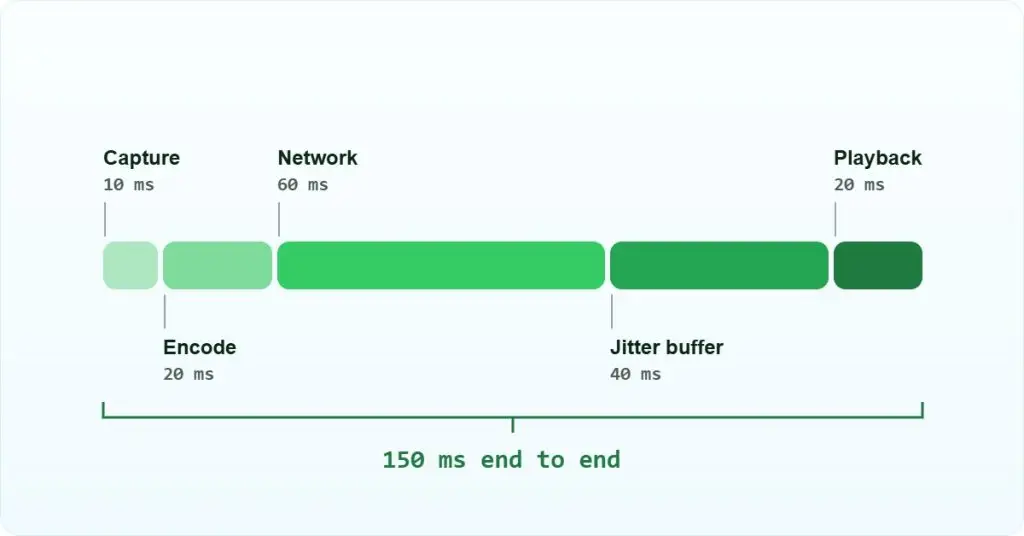
Latency, the delay between when a person speaks and when they hear a response, is the single most important quality metric for a conversational AI agent. Under 100ms feels natural. Over 500ms feels like a lag. Over 800ms breaks the conversation entirely. Do not rely on a provider’s published latency claims. Run a real call through your full STT, LLM, and TTS stack and measure the round-trip time yourself. Teler offers 3,000 free minutes on first upgrade in India, so you can test the complete media streaming loop before committing to a paid plan. This is the only reliable way to validate that the vapi voice api india provider you choose will perform at the quality your users expect.
Top 7 vapi voice api india providers for developers in 2026
1. FreJun Teler – Purpose-built AI voice infrastructure for India

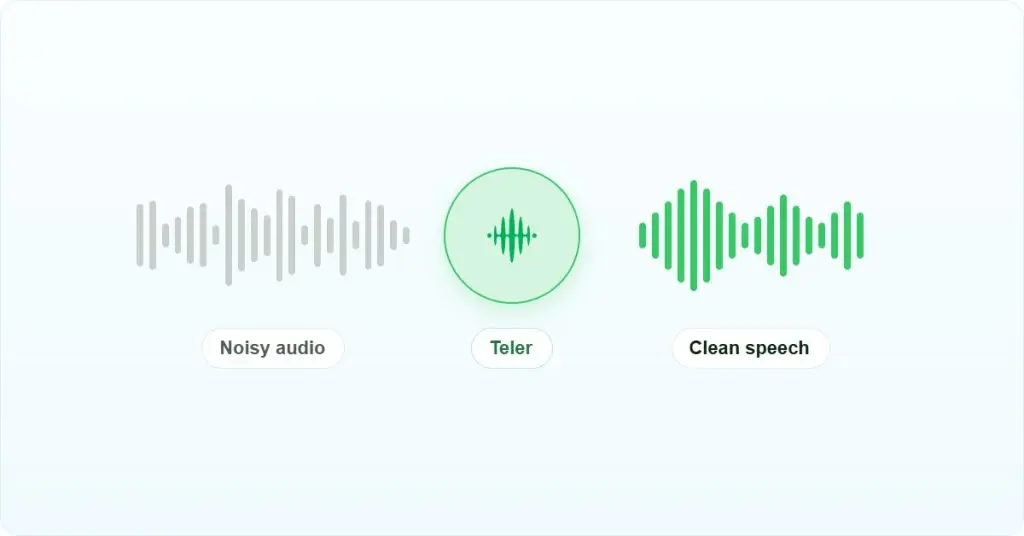
FreJun Teler is a Voice API platform built specifically for developers connecting AI voice agents to real phone calls in India, making it the strongest vapi voice api india choice for teams that need sub-100ms latency and zero AI provider lock-in.
Best for: AI voice agent infrastructure
Key features
- Raw WebSocket streaming delivers L16/8000Hz audio directly to your server, so your STT engine receives it with no conversion layer and no added latency — the full media streaming loop completes in under 100ms.
- Model-agnostic architecture means you bring your own STT (Google STT, Deepgram, Whisper, AssemblyAI), LLM (OpenAI GPT, Anthropic Claude, Google Gemini), and TTS (ElevenLabs, Google TTS, Azure TTS, Play.ht) – Teler handles only the voice transport layer.
- SIP trunking with TCP/TLS transport and credential-based or IP-based authentication connects existing SIP-enabled platforms or AI providers directly to Teler’s carrier network.
- Virtual numbers for India and UAE are available after purchasing 10 channels, so your AI agent can make and receive calls on a local number without a separate number provider.
- TRAI-compliant outbound calling with support for 140-series promotional and 1600-series transactional number prefixes, so regulatory logic is handled at the carrier level rather than in your agent code.
- REST API endpoints, webhook callbacks, and auth token authentication give developers standard, familiar tooling – no proprietary SDK is required to get a first call working.
- Compatible with Vapi, Retell, Voiceflow, LangChain, and fully custom setups, since Teler sits at the infrastructure layer below any orchestration platform. ince Teler is also compatible with Retell, developers weighing that orchestration layer may want to see a dedicated breakdown of Retell AI voice API India providers
Pros and cons
| Pros | Cons |
|---|---|
| Sub-100ms WebSocket latency purpose-built for real-time AI voice loops | Minimum 10 channels required to start, so very low-volume prototypes carry a fixed monthly cost |
| Fully model-agnostic works with any STT, LLM, or TTS provider the team already uses | Elastic SIP trunking (auto-scaling without channel limits) is on the roadmap but not yet available |
| INR pricing with 3,000 free minutes on first upgrade makes cost planning straightforward for Indian teams | UAE number rental adds $100/month/number, which increases cost for teams needing multi-market coverage |
Pricing
Pricing (India): ₹600/channel/month (minimum 10 channels). Outbound calling: ₹0.15/minute. Inbound calling: ₹0.10/minute. Media streaming: ₹0.15/minute. Recording and storage: ₹0.04/minute. Billing is prepaid on monthly, quarterly, half-yearly, or annual cycles. First upgrade includes 3,000 free minutes. See full pricing
Why Teler is the top recommendation
Why Teler ranks #1 for vapi voice api india: Teler is the only provider in this list that combines INR pricing from ₹0.15/minute, TRAI-compliant carrier infrastructure, and raw WebSocket audio streaming at sub-100ms latency — the exact combination Vapi developers in India need. General CPaaS platforms like Twilio and Plivo abstract the audio layer for human-to-human calls, which adds 400–800ms of latency that breaks real-time AI conversation. Teler’s model-agnostic architecture means your STT, LLM, and TTS choices stay entirely yours. Start building →
Teler by the numbers: Sub-100ms latency | Model-agnostic: 10+ AI providers | Virtual numbers: India and UAE | Same-day integration via WebSocket or SIP | 3,000 free minutes on first upgrade (India)
Integration with Vapi: Teler provides raw L16/8000Hz audio over WebSocket, which plugs directly into Vapi’s STT pipeline with no proprietary conversion layer, giving Vapi developers in India the lowest-latency telephony path available.
2. Twilio – Global CPaaS voice platform

Twilio is a broad CPaaS (Communications Platform as a Service) platform for programmable voice, messaging, and video, built for general enterprise telephony teams rather than AI-first voice agent developers looking for a vapi voice api india solution.
Best for: Global CPaaS voice
Key features
- Media Streams sends call audio over WebSocket as base64-encoded 8 kHz mu-law (G.711) frames, so developers can access raw audio — but the codec requires transcoding before most modern STT pipelines, which adds latency and extra processing code.
- TwiML call-flow primitives let developers control call behaviour declaratively, which speeds up standard telephony workflows even if it adds abstraction for AI voice use cases.
- Broad global telephony coverage means Twilio can reach phone numbers in most countries, making it a practical choice for teams that need multi-region calling beyond India.
- SDKs in Node.js, Python, Java, C#, PHP, Ruby, and Go reduce integration time for teams already working in those languages.
- SIP trunking bridges PSTN calls to existing enterprise telephony infrastructure, so teams migrating from legacy systems have a documented path.
Pros and cons
| Pros | Cons |
|---|---|
| Extensive global telephony coverage and a large developer ecosystem with strong documentation | 8 kHz mu-law audio stream requires transcoding before modern STT engines, adding latency to the AI voice loop |
| Trial credits available so developers can test before committing to a paid plan | Pricing complexity increases significantly at scale, and India-specific per-minute rates are not published upfront |
| SDKs in 7 languages reduce initial integration time for teams in common stacks | Designed for general CPaaS, not AI-first architectures, so building a real-time AI voice loop requires heavy custom engineering |
Pricing
Pricing: Trial credits available on signup. Production pricing is not published upfront and requires account setup to view India-specific rates. Billing is per-minute and per-message. See full pricing
Integration with Vapi: Twilio outputs base64-encoded 8 kHz mu-law audio frames. Vapi’s documented telephony path terminates RTP over SIP, so a transcoding or media bridge layer is required – there is no documented native integration path between Twilio Media Streams and Vapi as of 2026.
3. Plivo – REST-first programmable voice
Plivo is a RESTful Voice API and programmable voice platform for CPaaS developers and telephony teams, offering a clean REST onboarding experience but limited documentation for the raw media streaming path that vapi voice api india developers need.
Best for: REST-first voice apps
Key features
- REST API call control with Answer URL and webhook flows lets developers configure call behaviour without a proprietary SDK, which speeds up standard telephony integration.
- Auth ID and Auth Token authentication model is clearly documented, so developers can authenticate and make their first API call within minutes of signing up.
- Trial credits on signup let teams test basic call flows before committing to a paid plan.
- Phone number rental and Answer URL configuration are handled through the console, reducing the setup steps for simple inbound or outbound call routing.
- REST base path is well-documented, making Plivo a reasonable choice for teams that need a straightforward webhook-driven voice API without complex streaming requirements.
Pros and cons
| Pros | Cons |
|---|---|
| Clean REST onboarding with clear Auth ID/Token model and free trial credits | No first-party low-latency media streaming example for AI voice agents developers must build the streaming bridge themselves |
| Webhook and Answer URL flows are well-documented for standard telephony use cases | Audio format for streaming is not specified in documentation, creating uncertainty for Vapi integration |
Pricing
Pricing: Contact sales. Free trial credits available on signup. India-specific per-minute rates are not published publicly. See full pricing
Integration with Vapi: Plivo’s standard onboarding path is webhook and XML-driven rather than raw media streaming. Since Vapi’s telephony path is RTP over SIP, a custom bridge is required. No documented integration path between Plivo and Vapi exists as of 2026.
4. Telnyx – Carrier-network voice at low per-minute rates

Telnyx is a Voice API built on its own carrier network, offering low per-minute rates and WebSocket streaming for programmable voice applications, though it requires custom bridging to work as a vapi voice api india telephony provider.
Best for: Low-cost carrier voice
Key features
- Carrier-network pricing starts at $0.002/minute, which is among the lowest published per-minute rates for programmable voice, making Telnyx attractive for high-volume calling workloads where per-minute cost is the primary constraint.
- WebSocket streaming exposes base64-encoded audio frames so developers can access raw call audio, though the exact codec is not surfaced in public documentation.
- SIP trunking is available alongside the REST API, giving teams flexibility to connect existing telephony infrastructure or AI providers directly.
- SDKs in Node.js, Python, PHP, Ruby, Java, and Go reduce integration time for teams in common stacks.
- REST API call control with separate media sessions lets developers manage call state and audio independently, though this split architecture puts retry and state handling on the developer.
Pros and cons
| Pros | Cons |
|---|---|
| Among the lowest published per-minute rates at $0.002/minute for high-volume workloads | Voice orchestration is split across call-control events and separate media sessions, so state and retry handling are on the developer |
| WebSocket streaming available for raw audio access alongside SIP trunking | No documented native integration path with Vapi codec validation and custom bridging are required |
Pricing
Pricing: Starts at $0.002/minute. India-specific rates and INR billing are not published. See full pricing
Integration with Vapi: Telnyx outputs base64 audio frames over WebSocket. Since Vapi’s telephony path is RTP over SIP, codec validation and a custom bridge are required. Compatible in principle, but no documented native path exists as of 2026.
5. Exotel – India-focused voice automation
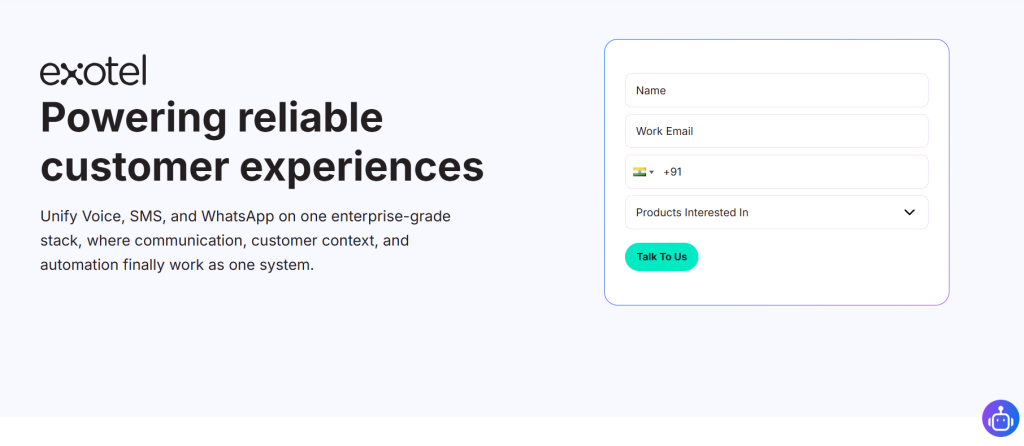
Exotel is a RESTful voice API platform with India-focused deployment and an AgentStream protocol for AI voice workflows, making it one of the few vapi voice api india options with a documented Mumbai endpoint and INR-native operations.
Best for: India voice automation
Key features
- AgentStream is Exotel’s streaming protocol for AI voice workflows, sending base64-encoded audio frames in roughly 100ms chunks so developers can feed audio to an STT engine in near real time.
- Mumbai and Singapore API endpoints are documented, which reduces network latency for Indian teams compared to providers that only offer US or European endpoints.
- Exophone caller ID is required in the migration flow, giving AI agents a local Indian number identity for outbound calls.
- REST API call control with account-level authentication handles outbound call bridging via the Calls/connect endpoint.
- The migration guide implies a bring-your-own-AI-agent model, so developers can plug in their own STT, LLM, and TTS stack rather than using a bundled provider.
Pros and cons
| Pros | Cons |
|---|---|
| Mumbai endpoint and Exophone caller ID make it genuinely India-native, reducing latency for local calls | AgentStream must be enabled by support, so it is not fully self-serve for rapid prototyping |
| AgentStream provides a documented AI streaming path with 100ms audio frames | No public GitHub repo and no working WebSocket code example in public documentation for the AI streaming path |
Integration with Vapi: Exotel AgentStream sends base64 audio frames in 100ms chunks. Vapi’s telephony path is RTP over SIP, so conversion and bridging are still needed. No documented native integration path between Exotel and Vapi exists as of 2026.
6. Vonage API – Programmable voice with NCCO orchestration
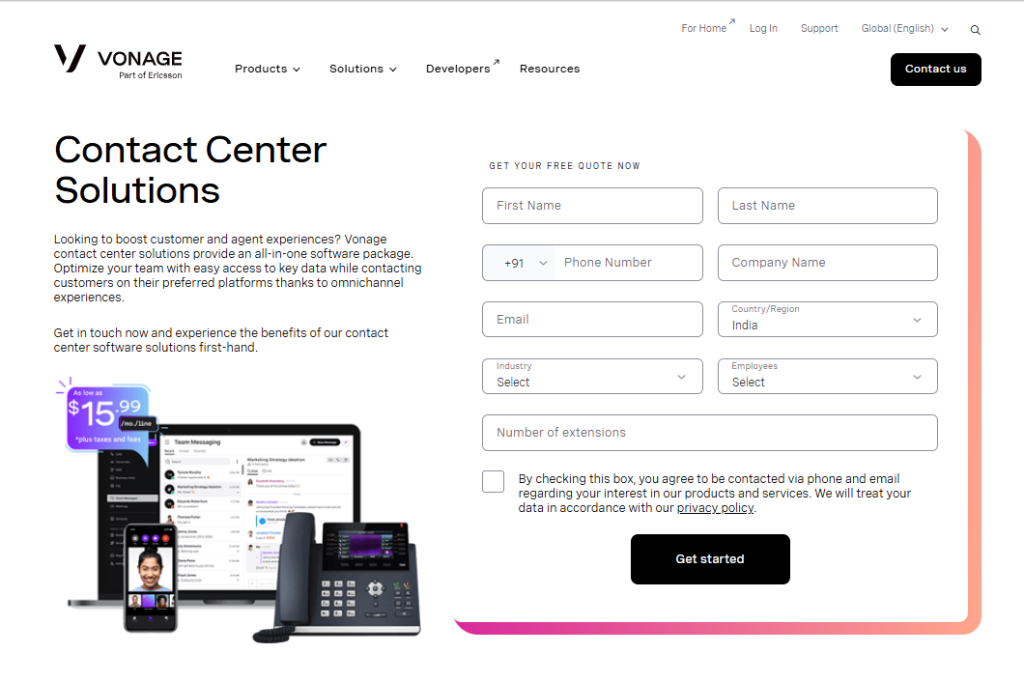
Vonage API is a cloud communications platform with programmable voice, WebSocket streaming, and SIP trunking for general CPaaS developers, though it requires manual coordination of call state and media for AI voice agent use cases as a vapi voice api india option.
Best for: Global voice control
Key features
- NCCO (Nexmo Call Control Object) call-flow orchestration lets developers define call behaviour declaratively, which speeds up standard telephony workflows even if it adds abstraction for real-time AI use cases.
- WebSocket audio streaming exposes call audio to a developer’s server, so the raw audio path is available for STT processing — though barge-in and reconnect logic must be built manually.
- SIP trunking and number management support give enterprise teams a path to connect existing telephony infrastructure.
- SDKs in Node.js, Python, PHP, Ruby, Java, C#, and Go reduce integration time for teams in common stacks.
- Model-agnostic design means developers can bring their own STT, LLM, and TTS stack without being locked into a Vonage-specific AI provider.
Pros and cons
| Pros | Cons |
|---|---|
| WebSocket streaming available with broad SDK support across 7 languages | NCCO and WebSocket flows require manual coordination of call state, media, barge-in, and reconnect logic |
| Model-agnostic no lock-in to a specific STT, LLM, or TTS provider | No documented native integration path with Vapi and no India-specific pricing published publicly |
Integration with Vapi: Vonage’s retrieved materials do not surface a codec contract for its WebSocket stream. Since Vapi’s telephony path is RTP over SIP, no native match is confirmed. A custom bridge is required, and no documented integration path exists as of 2026.
7. Daily – WebRTC media platform for browser voice agents
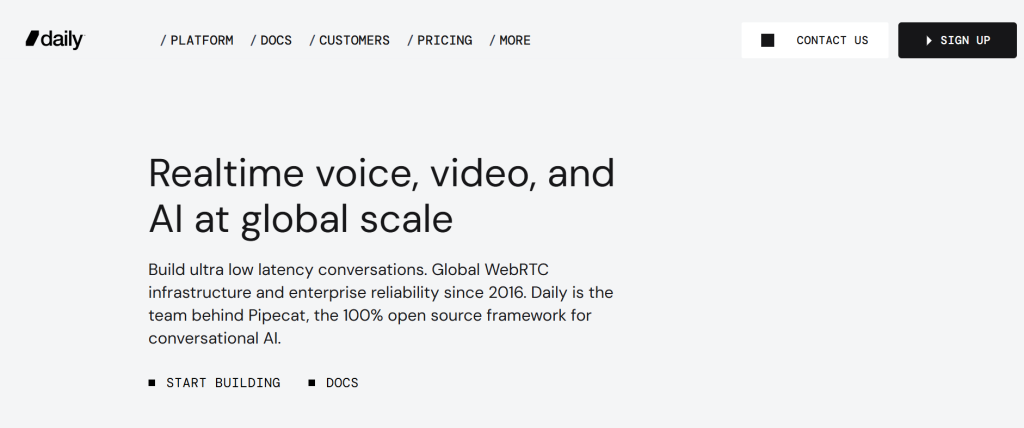
Daily is a real-time audio and video platform for WebRTC applications, built for browser and app developers rather than PSTN telephony teams, making it a niche vapi voice api india option for browser-native AI voice agents that do not need phone-number ingress.
Best for: Browser voice agents
Key features
- Browser-native real-time audio transport over WebRTC delivers Opus audio over RTP, which is compatible with Vapi’s web voice agent path for browser-based AI interactions.
- Room and session control via REST API lets developers manage voice sessions programmatically without building a custom signalling layer.
- SIP ingress and egress support provides a bridge between WebRTC sessions and traditional telephony, though phone-number provisioning still requires a separate carrier.
- Recording and bot-friendly media APIs make it practical for AI agent developers who need to capture session audio for quality review or fine-tuning.
- JavaScript/TypeScript and Python SDKs cover the two most common stacks for web and AI agent development.
Pros and cons
| Pros | Cons |
|---|---|
| Browser-native WebRTC transport is compatible with Vapi’s web voice agent path without a custom bridge | Not a PSTN carrier phone-number ingress and egress require a separate provider, adding cost and complexity |
| Bot-friendly media APIs and recording support are well-suited for AI agent session capture | No India virtual-number product and no INR pricing, so TRAI compliance and local number provisioning are not handled |
Integration with Vapi: Daily uses WebRTC media, typically Opus over RTP. Vapi supports voice agents over phone, web, and SIP, so browser media is compatible in principle for web-based agents. But Daily is not a PSTN carrier, so phone-call builders still need a separate carrier layer for any India telephony use case.
Vapi voice api india feature comparison: 2026
| Feature | Teler | Twilio | Plivo | Telnyx | Exotel | Vonage API | Daily |
|---|---|---|---|---|---|---|---|
| Raw WebSocket audio streaming | Yes L16/8000Hz, sub-100ms | Partial base64 mu-law, requires transcoding | No webhook/XML path only | Partial base64 frames, codec unspecified | Partial AgentStream, 100ms frames, requires support enablement | Partial WebSocket available, codec contract undocumented | No WebRTC only, not raw telephony WebSocket |
| Model-agnostic STT/LLM/TTS | Yes zero lock-in, 10+ providers | Yes third-party AI stacks allowed | Not documented | Yes no provider lock-in indicated | Partial implied by migration guide, not explicitly stated | Yes no STT/LLM/TTS lock-in documented | Yes Daily is media layer only |
| India virtual numbers and TRAI compliance | Yes INR pricing, TRAI-compliant carrier | Partial India coverage available, TRAI details not published | Partial India coverage, TRAI details not published | No India-specific compliance not documented | Yes Mumbai endpoint, Exophone caller ID | No India-specific compliance not documented | No no India virtual-number product |
| INR pricing published | Yes ₹0.15/min outbound, ₹600/channel/month | No USD pricing, India rates require account setup | No contact sales | No USD pricing only | No contact sales | No contact sales | No contact sales |
| Documented Vapi integration path | Yes WebSocket and SIP both documented | No custom bridge required | No custom bridge required | No custom bridge required | No custom bridge required | No custom bridge required | Partial browser path compatible, PSTN requires carrier |
| Free trial or free credits | Yes 3,000 free minutes on first upgrade | Yes trial credits on signup | Yes free trial credits | Not documented | Not documented | Not documented | Not documented |
Teler is the only provider in this comparison that combines INR pricing, TRAI compliance, raw WebSocket streaming at sub-100ms latency, and a documented Vapi integration path making it the strongest vapi voice api india choice for developers building AI voice agents in India.
Which vapi voice api india provider is right for your team in India?
Different teams have different constraints. The right vapi voice api india provider depends on your integration path, call volume, compliance requirements, and whether you need PSTN telephony or browser-only audio. Here is a direct recommendation for each common developer profile.
If you are building a real-time AI voice agent on Vapi in India: Choose Teler. It is the only provider with a documented Vapi integration path, raw L16/8000Hz WebSocket streaming, TRAI-compliant carrier infrastructure, and INR pricing — all four requirements in one platform.
If you are building a global multi-region voice application and India is one of many markets: Choose Twilio. Its global telephony coverage and large developer ecosystem make it practical for teams that need to reach phone numbers across many countries, even though the AI voice loop requires extra engineering work.
If you need the lowest possible per-minute rate for high-volume outbound calling: Choose Telnyx. Its $0.002/minute carrier-network pricing is among the lowest published rates, though you will need to build a custom bridge to connect it to Vapi.
If you are building a browser-native AI voice agent without PSTN requirements: Choose Daily. Its WebRTC media layer is compatible with Vapi’s web voice agent path and does not require a separate carrier for browser-to-browser calls.
If you are an India-based team that needs a local vendor with a Mumbai endpoint: Consider Exotel. Its AgentStream protocol and Mumbai endpoint make it a locally-grounded option, though AgentStream requires support enablement and lacks a self-serve streaming example.
Which tool wins overall in India?
If you want the best overall vapi voice api india provider for India with AI features, INR billing, and TRAI compliance: Choose Teler. It is the only platform in this list that was designed specifically for AI voice agent infrastructure, delivers sub-100ms WebSocket latency without a transcoding layer, and handles TRAI-compliant carrier connectivity so your team can focus on building the agent rather than managing telecom infrastructure.
Frequently asked questions about vapi voice api india in 2026
What is the best vapi voice api india provider in 2026?
The best vapi voice api india provider in 2026 is FreJun Teler. It delivers sub-100ms WebSocket streaming latency, which is fast enough for natural, uninterrupted AI conversation. Developers can bring their own STT, LLM, and TTS providers because the platform is fully model-agnostic, eliminating vendor lock-in. Pricing starts at ₹0.15/minute for outbound calls in India, while TRAI compliance is handled at the carrier level. Additionally, the platform provides a documented integration path with Vapi. No other provider in this list combines all four of those requirements.
How much does vapi voice api india cost in India?
Pricing varies by provider. Teler charges ₹600/channel/month with a minimum of 10 channels, plus ₹0.15/minute for outbound calls, ₹0.10/minute for inbound calls, ₹0.15/minute for media streaming, and ₹0.04/minute for recording and storage. The first upgrade includes 3,000 free minutes. Telnyx publishes $0.002/minute but does not publish India-specific INR rates. Twilio, Plivo, Exotel, Vonage, and Daily all require a sales conversation to get India pricing. Teler is the only vapi voice api india provider with fully transparent INR pricing published on its website.
What latency can developers expect from a vapi voice api india provider?
Latency depends on the integration path. Teler’s WebSocket streaming completes the full media streaming loop — Voice to STT to LLM to TTS to Voice playback — in under 100ms. That is fast enough for natural conversation. General CPaaS platforms like Twilio and Plivo abstract the audio layer for human-to-human calls. That abstraction adds 400–800ms of latency because the audio must be encoded, transmitted through the platform’s processing layer, and decoded before your STT engine receives it. For real-time AI voice agents, raw WebSocket streaming is the only path that reliably stays under 100ms.
Which vapi voice api india provider works with any STT, LLM, or TTS provider?
Teler is fully model-agnostic. Developers bring their own STT engine (Google STT, Deepgram, Whisper, or AssemblyAI), their own LLM (OpenAI GPT, Anthropic Claude, Google Gemini, or any custom model), and their own TTS engine (ElevenLabs, Google TTS, Azure TTS, or Play.ht). Teler handles only the voice transport layer and does not mandate any specific AI provider. This matters in production because AI provider pricing, quality, and availability change frequently. Zero lock-in means you can swap any component of the stack without changing your telephony provider. Twilio and Vonage also allow third-party AI stacks on their streaming paths, but neither has a documented native Vapi integration path.
What does TRAI compliance mean for AI outbound calling in India?
TRAI, the Telecom Regulatory Authority of India, sets the rules for all outbound calling in India. For AI voice agents specifically, this means using the 140-series number prefix for promotional calls and the 1600-series for transactional calls. Calls cannot be made after 9 PM IST. Numbers registered on the NCPR (National Customer Preference Register) must not be dialled. These rules apply to automated AI agents just as they do to human callers. Violating TRAI rules can result in number blocking or regulatory penalties. Teler handles TRAI compliance at the carrier level, so developers do not need to build regulatory logic into the agent itself. Teams building with Pipecat instead of Vapi should review a similar comparison of Pipecat voice API India providers to apply the same latency and compliance criteria.
Does Vapi require a specific SIP trunk provider or audio format?
Vapi’s documented telephony path terminates RTP over SIP, so any SIP trunk provider that delivers standard RTP audio can connect to it. For WebSocket-based integrations, Vapi expects raw audio in a format its STT pipeline can process directly — typically PCM or L16 at 8000Hz. Providers that output base64-encoded mu-law audio (like Twilio Media Streams) require a transcoding step before the audio reaches Vapi’s STT engine, which adds latency. Teler outputs L16/8000Hz audio over WebSocket, which plugs directly into Vapi’s pipeline without a conversion layer. This is why Teler is the recommended vapi voice api india telephony provider for teams that need the lowest possible end-to-end latency.
How do I get started building an AI voice agent with a vapi voice api india provider?
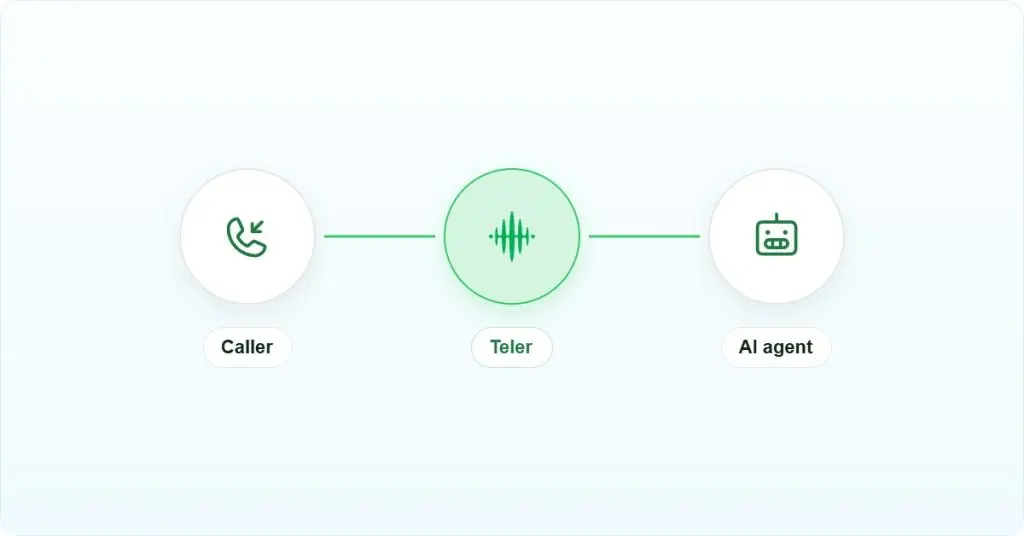
The core architecture is the Media Streaming Loop: a caller speaks, the telephony provider captures the audio and streams it to your server over WebSocket, your STT engine converts the audio to text, your LLM reads the text and decides what to respond, your TTS engine converts the response to audio, and the audio streams back through the telephony provider to the caller. The full loop should complete in under 100ms for natural conversation. With Teler, you can set up the WebSocket integration the same day using the getting-started guide at knowledge.frejun.com. The first upgrade includes 3,000 free minutes in India, so you can test the complete stack before paying. Since Teler is model-agnostic, you connect your existing STT, LLM, and TTS providers directly — no proprietary AI stack is required.
Conclusion: Best vapi voice api india provider in India for 2026
The top three vapi voice api india providers in this comparison are Teler (best for AI-first infrastructure), Twilio (best for global multi-region coverage), and Exotel (best for India-native local deployment). Teler is the top recommendation for developers building real-time AI voice agents on Vapi in India because it is the only provider that combines sub-100ms WebSocket latency, TRAI-compliant carrier infrastructure, transparent INR pricing, and a documented Vapi integration path in a single platform. If you are ready to build, start with Teler’s 3,000 free minutes and connect your first AI voice agent to a real Indian phone number the same day.