AI Summary: This article compares the top 7 pipecat voice api USA options for developers building real-time AI voice agents in 2026, evaluating each on WebSocket latency, model compatibility, TCPA compliance, and documentation quality. As of 2026, the global conversational AI market is projected to exceed $29 billion by 2028, according to MarketsandMarkets, making telephony layer selection a foundational infrastructure decision for any Pipecat-based voice product. Developers need a voice API that delivers raw audio over a persistent connection, integrates with any STT, LLM, or TTS provider without lock-in, and handles carrier compliance automatically. FreJun Teler meets all three requirements, with outbound calling from $0.20 per minute and raw WebSocket streaming that plugs directly into any Pipecat pipeline.
Key criteria in this comparison: We ranked these platforms on WebSocket streaming latency, model-agnostic architecture, TCPA compliance support, pricing transparency, and documentation quality, since these are the factors that most affect a developer team’s build speed and total cost when integrating a telephony layer with Pipecat.
Quick Answer: The best pipecat voice api USA is FreJun Teler, which delivers sub-100ms WebSocket streaming latency and a fully model-agnostic architecture so Pipecat developers can connect any STT, LLM, or TTS provider without lock-in. Teler starts at $15 per channel per month with outbound calling at $0.20 per minute, making it the most technically precise and cost-transparent option for AI voice agent infrastructure in the US.
The best pipecat voice api USA for developers building real-time AI voice agents is Teler, which provides raw WebSocket audio streaming at sub-100ms latency and works with any AI stack a Pipecat team already uses.
What is Pipecat?
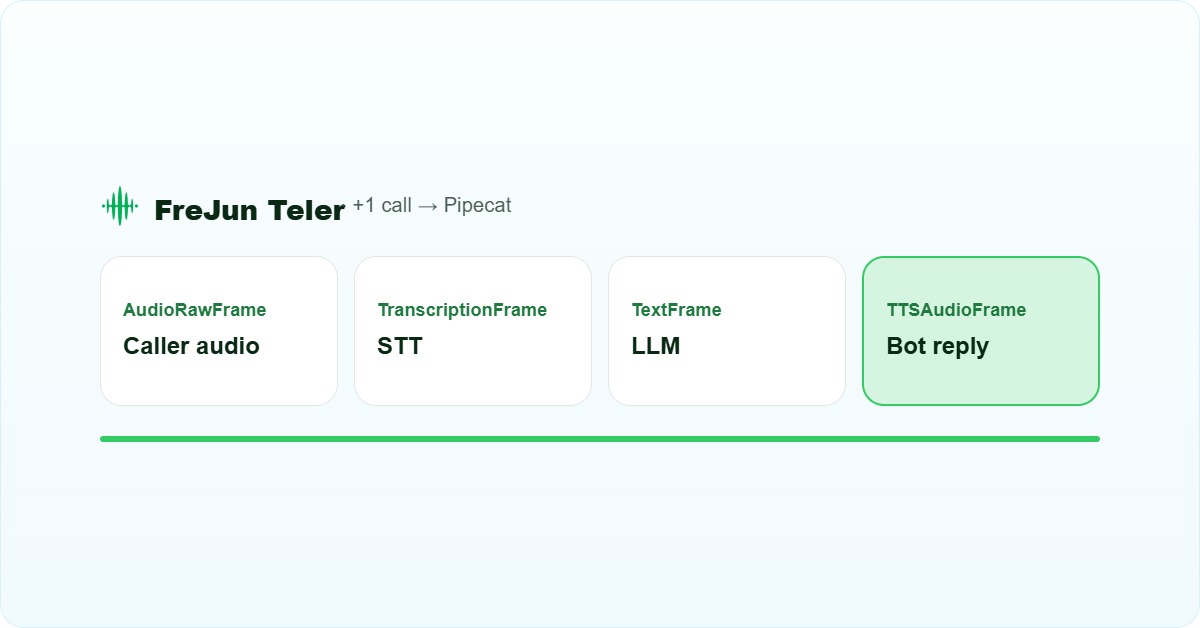
Pipecat is an open-source Python framework for building real-time, multimodal AI voice agents. Developers use it to wire together speech-to-text (STT) engines, large language models (LLMs), and text-to-speech (TTS) engines into a single, low-latency conversation pipeline. Because Pipecat handles the AI orchestration layer, it needs a separate telephony layer underneath it to connect those pipelines to real phone calls. That telephony layer is what a pipecat voice api USA provider supplies: carrier connectivity, real-time audio transport, and phone number infrastructure so the AI agent can actually speak and listen over the public telephone network.
As of 2026, the global conversational AI market is projected to grow at a 22% compound annual growth rate through 2030, according to Grand View Research. US developers building on Pipecat need a voice API that delivers raw PCM or L16 audio over WebSocket, supports TCPA (Telephone Consumer Protection Act) compliance for automated outbound calling, and integrates without forcing a proprietary AI stack on the team. Developers building the same kind of Pipecat integration for teams based in India should review the pipecat voice API India options, since carrier compliance and pricing differ by region.
Which pipecat voice api USA providers rank highest in 2026?
The table below compares all seven providers on best-fit use case, starting price, and free trial availability so you can shortlist quickly before reading the full profiles.
| # | Provider | Best for | Starting price (USD) | Free trial |
|---|---|---|---|---|
| 1 | FreJun Teler | AI voice agent infrastructure | $15/channel/month | Yes free credits on signup |
| 2 | Twilio | General CPaaS voice apps | Contact sales | Check website |
| 3 | Telnyx | Carrier-native low-cost calling | $0.002/minute | Check website |
| 4 | Plivo | Cost-conscious telephony teams | $0.003/minute | Check website |
| 5 | Vonage API | App voice calling via WebRTC | Contact sales | Check website |
| 6 | Daily | Embedded real-time agents | $0.004/participant-minute | Yes 2,000 free minutes |
| 7 | SignalWire | Open-source FreeSWITCH teams | Contact sales | Check website |
Scroll for the full breakdown of each pipecat voice api USA tool, including features, pros, cons, pricing, and ideal use case.
How do you choose the best pipecat voice api USA in 2026?
Step 1: Understand what Pipecat needs from a telephony layer
Pipecat’s pipeline expects raw audio it can feed directly into an STT engine. That means the telephony provider must stream unprocessed audio, ideally in L16/8000Hz PCM format, over a persistent WebSocket connection. A WebSocket is a full-duplex connection that stays open continuously between the caller and your server, unlike standard HTTP which closes after each request. If the voice API abstracts the audio into a proprietary format or adds a conversion layer, latency climbs and the STT engine receives degraded input. Before evaluating any pipecat voice api USA option, confirm it supports raw WebSocket audio streaming, not just REST-based call control.
Step 2: Choose between WebSocket streaming and SIP trunking
Two integration paths exist for connecting a telephony provider to Pipecat. WebSocket streaming keeps a persistent open connection and delivers raw audio in real time, making it the right choice for conversational AI agents where sub-100ms response loops are required. SIP trunking, which uses the Session Initiation Protocol (SIP) to establish calls over the internet, is better suited for connecting existing enterprise telephony infrastructure or SIP-enabled platforms to your Pipecat pipeline. If you are building a new AI voice agent from scratch, start with WebSocket. If you are extending an existing PBX or contact center, SIP trunking is the more practical path. eams evaluating alternatives beyond Pipecat should also consider the LiveKit voice API USA for WebRTC-based real-time agent architectures.
Step 3: Check US carrier and TCPA compliance requirements
In the US, automated outbound calling is governed by the FCC and the TCPA (Telephone Consumer Protection Act). TCPA requires prior express written consent before placing automated calls or sending prerecorded messages to mobile numbers. AI voice agents making outbound calls must also comply with the National Do Not Call Registry. Some pipecat voice api USA providers handle TCPA-related number registration and consent management tooling natively. Others leave compliance entirely to the developer. Confirm which approach each provider takes before building outbound calling features into your Pipecat agent. Developers in India comparing frameworks should also check the LiveKit voice API India guide for region-specific carrier and pricing details.
Step 4: Evaluate pricing in USD against your expected call volume
Voice API pricing in the US typically combines a channel cost (a fixed monthly fee per concurrent call slot), a per-minute rate for outbound calls, a per-minute rate for inbound calls, and separate fees for media streaming and call recording. Calculate a realistic monthly cost by multiplying your expected daily call volume by average call duration, then applying the per-minute rate. Add channel costs based on your peak concurrency. A provider with a low per-minute rate but high channel minimums can cost more than a provider with a slightly higher per-minute rate and no channel floor, depending on your usage pattern. Developers weighing managed voice AI platforms against a Pipecat build should also review the Vapi voice API USA comparison before deciding on an architecture.
Step 5: Test latency and audio quality on a real call before committing
Latency is the delay between when a person speaks and when they hear a response. For conversational AI agents, anything above 400ms starts to feel unnatural. The only reliable way to measure latency for your specific STT, LLM, and TTS stack is to run a real call through the full pipeline. Teler provides $5 in free calling credits on first upgrade for US and UAE accounts, so developers can test the complete media streaming loop before committing to a paid plan. Run at least 20 test calls across different times of day before making a final decision. For teams that prefer a more managed alternative, the Retell AI voice API USA breakdown covers a similar latency-first evaluation approach.
Top 7 pipecat voice api USA providers reviewed for 2026
1. FreJun Teler – Purpose-built voice API for AI voice agents
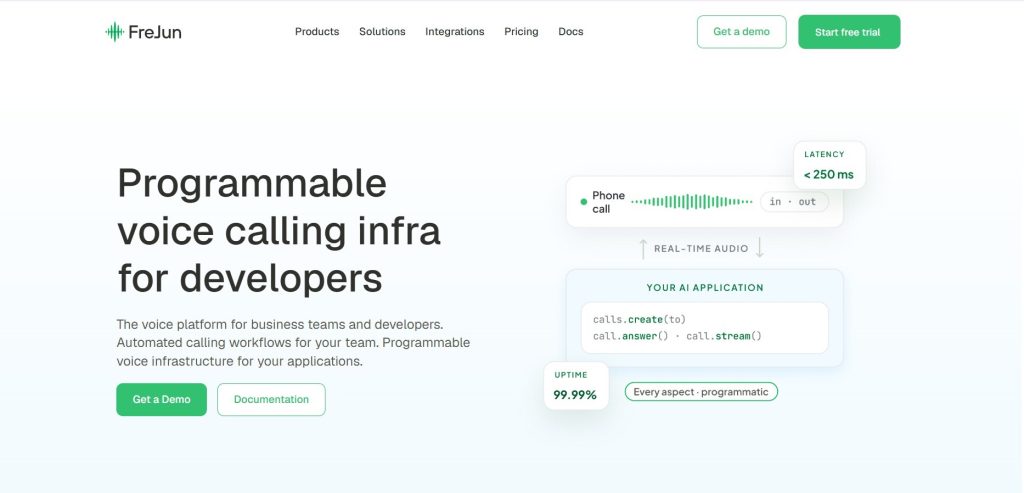
FreJun Teler is a developer-first pipecat voice api USA platform that streams raw L16/8000Hz audio over WebSocket directly into your Pipecat STT pipeline, with sub-100ms end-to-end latency and zero AI provider lock-in.
Best for: AI voice agent infrastructure
Key features
- Raw WebSocket audio streaming in L16/8000Hz format delivers audio directly to your STT engine with no proprietary conversion layer, so the full media streaming loop (Voice to STT to LLM to TTS to Voice) completes in under 100ms.
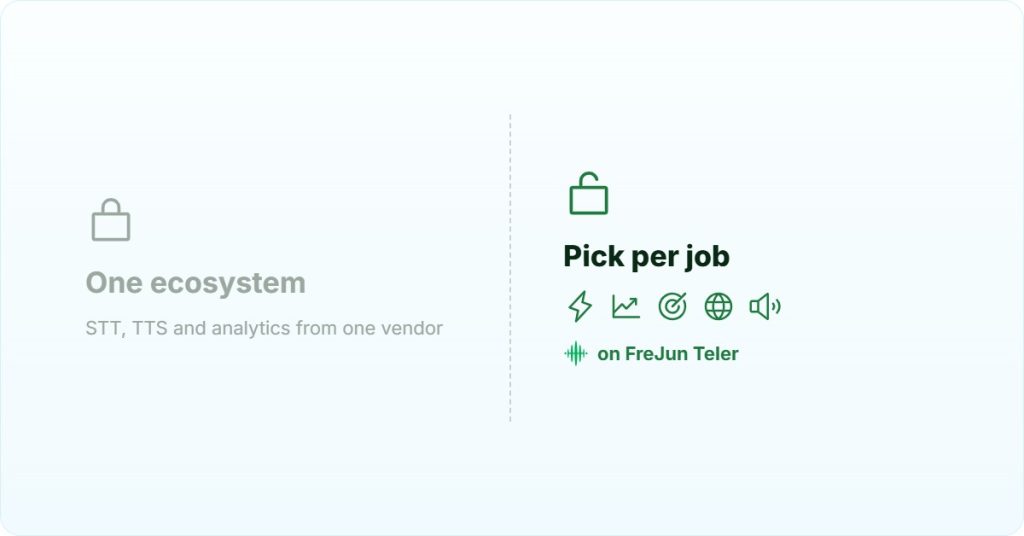
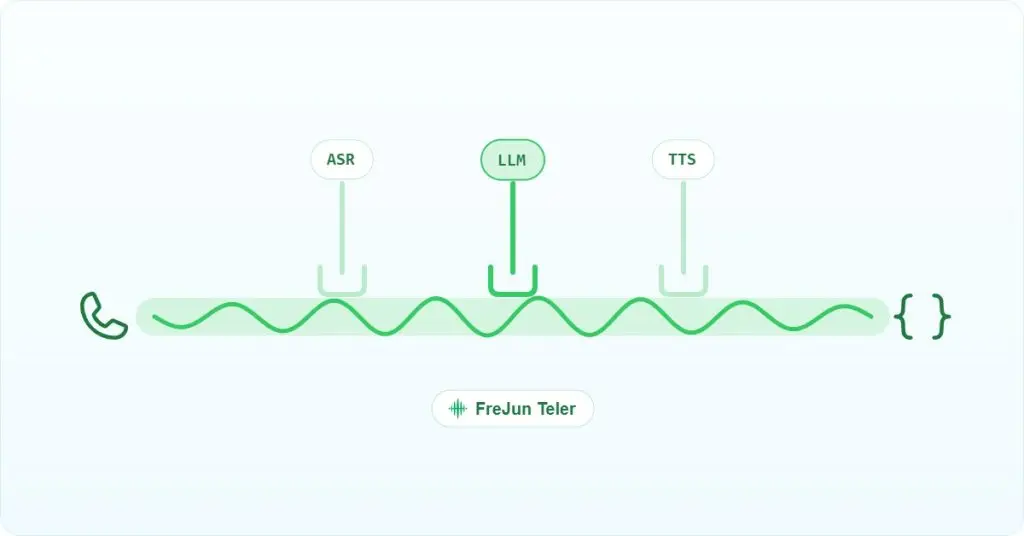
- Model-agnostic architecture means Teler handles only the voice transport layer. Developers bring their own STT (Deepgram, Whisper, Google STT, AssemblyAI), LLM (OpenAI GPT, Anthropic Claude, Google Gemini), and TTS (ElevenLabs, Azure TTS, Play.ht) and pay those providers directly.
- SIP trunking with TCP and TLS transport supports credential-based or IP-based authentication, connecting existing SIP-enabled platforms or enterprise telephony infrastructure directly to Teler’s carrier network.
- REST API endpoints and webhook callbacks give developers standard HTTP call control and event-based notifications when calls start, end, or change state, so no proprietary SDK is required to get a first call working.
- Virtual US numbers are available alongside India and UAE numbers, with same-day provisioning after purchasing the minimum channel allocation.
- Prepaid billing with monthly, quarterly, half-yearly, or annual options means developers only pay for what they use, with no enterprise contract required to start.
Pros and cons
| Pros | Cons |
|---|---|
| Sub-100ms WebSocket latency purpose-built for Pipecat-style AI pipelines | Minimum 10 channels required to start, so very low-volume prototypes carry a fixed monthly floor cost |
| Fully model-agnostic: works with any STT, LLM, or TTS provider the team already uses | Elastic SIP trunking (auto-scaling without channel limits) is on the roadmap but not yet available |
| Same-day integration via WebSocket or SIP with no physical telecom infrastructure needed | Virtual numbers currently available for India and UAE; US number availability should be confirmed with the sales team |
Pricing
Pricing (USD): Channel cost starts at $15 per channel per month (minimum 10 channels). Outbound calling is $0.20 per minute, inbound is $0.10 per minute, media streaming is $0.0017 per minute, and recording plus storage is $0.00046 per minute. First upgrade includes $5 in free calling credits. SIP trunking is available at $11.50 per channel per month (minimum 10 channels, 6-month commitment) with outbound at $0.12 per minute. See full pricing
Why Teler is the top recommendation
Why Teler ranks #1 for pipecat voice api USA: Teler is the only provider in this list designed specifically for AI voice agent infrastructure rather than general CPaaS, delivering raw WebSocket audio at sub-100ms latency that plugs directly into Pipecat’s STT pipeline without any conversion overhead. US developers get transparent per-minute USD pricing, TCPA-aware outbound calling infrastructure, and a model-agnostic architecture that no general CPaaS platform can match for real-time AI voice workloads. Start building →
Teler by the numbers: Sub-100ms latency | Model-agnostic: 10+ AI providers | Virtual numbers: India and UAE | Same-day integration via WebSocket or SIP | $5 in free calling credits on first upgrade (USD)
2. Twilio – Broad CPaaS platform with programmable voice
Twilio is a cloud communications CPaaS (Communications Platform as a Service) platform offering programmable voice features including inbound and outbound calls, IVR, call routing, recording, transcription, conferencing, SIP connectivity, and real-time audio streaming, making it a widely used pipecat voice api USA option for general voice applications.Best for: General CPaaS voice apps
Key features
- Real-time audio streaming via Media Streams lets developers pipe call audio to an external server, though the abstraction layer adds latency compared to raw WebSocket delivery.
- SIP connectivity supports enterprise telephony integration, so existing PBX infrastructure can connect to Twilio’s carrier network without replacing hardware.
- IVR and call routing let developers build menu-driven or AI-driven call flows using TwiML, Twilio’s XML-based call control language.
- Recording and transcription are built in, so every call can be stored and converted to text automatically without a third-party service.
- Voice Intelligence and STT/TTS tooling allow developers to stream audio to external AI providers, making BYO STT, LLM, and TTS stacks workable, though they require significant custom engineering to wire together.
Pros and cons
| Pros | Cons |
|---|---|
| Large developer ecosystem with extensive documentation and community support | Audio abstraction layer adds 400-800ms latency, making real-time AI voice loops harder to achieve |
| Broad channel set covering voice, SMS, and video under one API | Heavy Twilio-specific engineering overhead required to wire AI providers into the Media Streams path |
| SIP connectivity and IVR support enterprise telephony use cases alongside AI workloads | Pricing complexity increases significantly at scale, with multiple per-feature charges stacking up |
Pricing
Pricing (USD): Twilio does not publish a flat starting price for voice API access. Per-minute rates vary by number type and destination. See full pricing
Integration with Pipecat: Twilio’s Media Streams path is the closest integration point for Pipecat, but the audio abstraction layer means developers must account for additional latency in their pipeline design.
3. Telnyx – Carrier-native voice API with built-in AI tooling
Telnyx is an API-driven programmable voice and call-control telephony platform that positions itself as a carrier-native pipecat voice api USA option, with on-platform STT, TTS, and LLM workflows running close to the voice network to reduce inference latency.
Best for: Carrier-native low-cost calling
Key features
- Low per-minute carrier pricing starts at $0.002 per minute, making Telnyx one of the most cost-competitive options for high-volume outbound calling in the US.
- SIP trunking with call control API gives developers programmatic control over call state, routing, and recording without needing a separate telephony management layer.
- Built-in STT, TTS, and LLM workflows run on Telnyx infrastructure adjacent to the voice network, so inference happens closer to the audio source than cloud-only AI providers.
- Voice-network-adjacent inference reduces the round-trip time between audio capture and AI response, which benefits latency-sensitive Pipecat pipelines.
- USD pricing is published transparently, so US developers can calculate monthly costs without a sales call.
Pros and cons
| Pros | Cons |
|---|---|
| Among the lowest published per-minute rates for US voice calling | Third-party STT, LLM, and TTS provider support is not clearly documented, which may limit model-agnostic Pipecat builds |
| Carrier-native infrastructure reduces network hops between audio and AI processing | No confirmed Pipecat-ready quickstart or working WebSocket audio loop in public documentation |
Pricing
Pricing (USD): Outbound calling starts at $0.002 per minute plus SIP trunking fees. See full pricing
Integration with Pipecat: Telnyx’s call control API and SIP trunking are the primary integration paths for Pipecat. Developers building a raw WebSocket audio loop should confirm audio format compatibility before committing.
4. Plivo – Cost-conscious programmable voice for business telephony
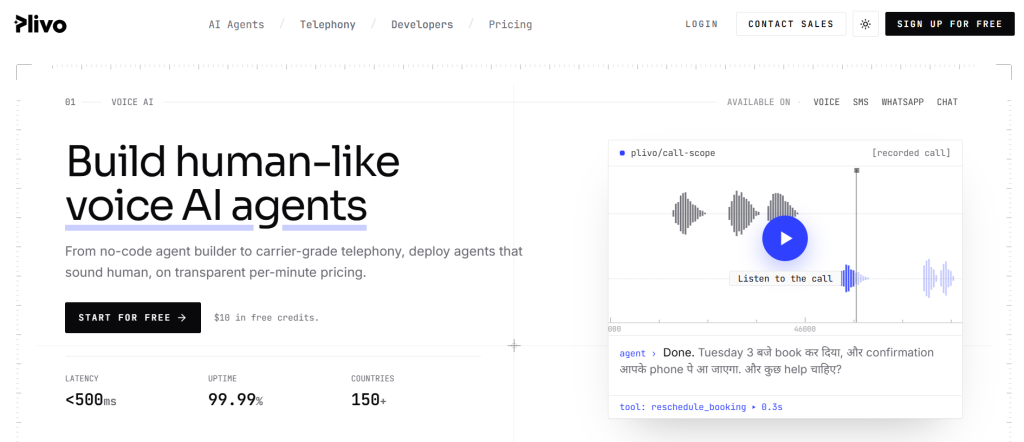
Plivo is a programmable voice API for business telephony and call control, offering account setup, API credentials, number purchase, and SDK-based call handling as the primary pipecat voice api USA integration path for cost-focused teams.
Best for: Cost-conscious telephony teams
Key features
- API credential-based authentication with phone number provisioning lets developers get a US number and start making calls quickly without complex carrier agreements.
- Outbound call creation via REST API and SDK-based inbound call handling cover the two most common Pipecat telephony integration patterns.
- Per-minute voice billing with published USD rates means developers can estimate monthly costs before writing a single line of code.
- SIP trunking is available alongside REST call control, giving teams flexibility to connect existing SIP infrastructure to the Plivo network.
- SDK support is documented, though the full language coverage matrix is not publicly listed, so developers should confirm their preferred language is supported before starting integration.
Pros and cons
| Pros | Cons |
|---|---|
| Transparent per-minute USD pricing with no hidden channel fees at entry level | Raw WebSocket audio streaming for AI voice pipelines is not clearly documented in public sources |
| Quick account setup with API credentials and number provisioning in one flow | Pricing inconsistency across sources makes accurate cost forecasting difficult before a sales conversation |
Pricing
Pricing (USD): Outbound calling from $0.003 per minute, though third-party sources report $0.010 to $0.012 per minute outbound and $0.0055 to $0.0085 per minute inbound, so current pricing should be confirmed directly. See full pricing
Integration with Pipecat: Plivo’s REST call control and SDK-based call handling are the documented integration paths. Developers building a Pipecat WebSocket audio loop should verify raw audio streaming support before starting.
5. Vonage API – App voice calling with WebRTC and client SDKs
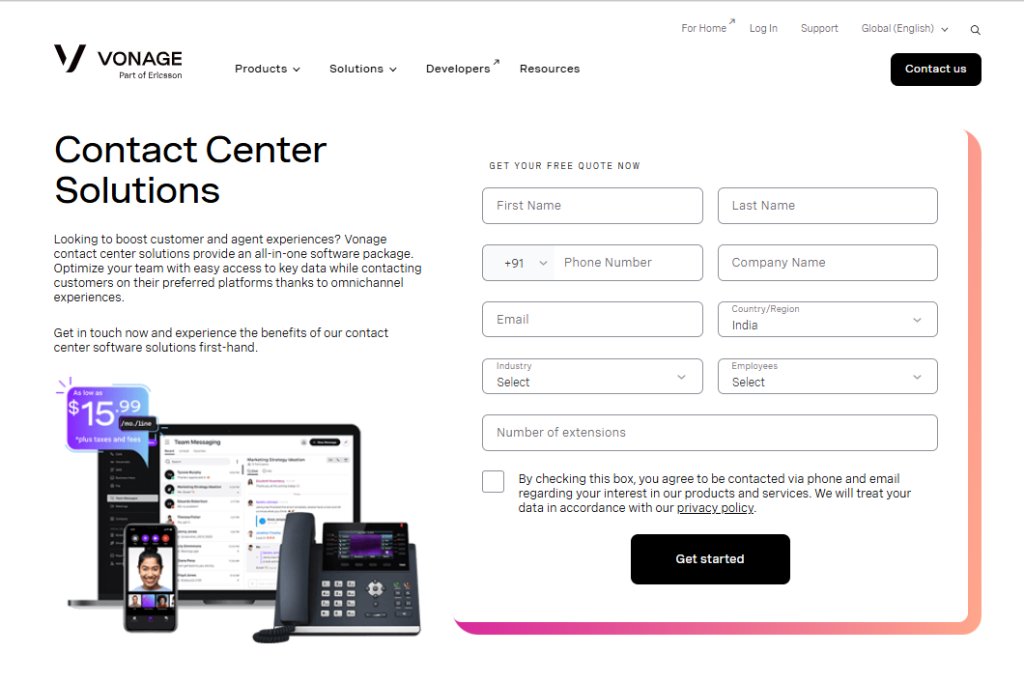
Vonage API is a programmable voice platform for making, receiving, and controlling calls via REST call control and client SDKs for web, iOS, and Android, positioning it as a pipecat voice api USA option for teams building browser or mobile-native voice experiences.
Best for: App voice calling via WebRTC
Key features
- Python outbound-call quickstart lets developers place a first call quickly without deep telephony knowledge, reducing initial setup time for Pipecat prototypes.
- Client SDKs for web, iOS, and Android enable voice calling directly from browser or mobile apps, which suits Pipecat agents embedded in consumer-facing products.
- WebRTC integration handles the browser-side audio transport layer, so developers do not need to manage peer-to-peer connection negotiation manually.
- External AI-service compatibility means Vonage’s TTS and ASR tooling can route audio to third-party AI providers, though the WebSocket audio-streaming path for raw AI pipelines is not clearly documented.
- Outbound call control via REST API gives developers programmatic call management without a separate telephony management platform.
Pros and cons
| Pros | Cons |
|---|---|
| Well-documented Python quickstart lowers the barrier for Pipecat developers already working in Python | WebSocket raw audio streaming path for AI voice pipelines is not documented in public sources |
| Client SDKs for web, iOS, and Android cover browser and mobile voice use cases alongside server-side calling | No published starting price, making cost comparison difficult without a sales conversation |
Pricing
Pricing (USD): Vonage does not publish a flat starting price for voice API access. See full pricing
Integration with Pipecat: Vonage’s REST call control and WebRTC client SDKs are the documented integration paths. Teams building a raw audio streaming loop for Pipecat should confirm WebSocket audio support before starting.
6. Daily – WebRTC infrastructure for embedded real-time agents
Daily is a developer platform for real-time voice and video calls, AI workflows, and conversational agents built on WebRTC infrastructure, making it a pipecat voice api USA option for teams embedding voice agents directly into web or mobile applications rather than connecting to the public telephone network.
Best for: Embedded real-time agents
Key features
- WebRTC infrastructure handles the real-time audio transport layer, so developers building browser-embedded Pipecat agents do not need to manage peer-to-peer connection setup manually.
- AI workflow support is built into the platform, with documented patterns for connecting conversational agents to the Daily audio transport layer.
- Usage-based pricing with 2,000 free participant-minutes on the Launch plan lets developers test a full Pipecat integration before paying anything.
- SDKs and APIs are documented for embedding voice and video calls directly into web and mobile products, covering the most common embedded agent use cases.
- Overage pricing at $0.004 per participant-minute is predictable, so cost scales linearly with usage rather than jumping at tier boundaries.
Pros and cons
| Pros | Cons |
|---|---|
| 2,000 free participant-minutes on Launch plan allow real integration testing before any payment | WebRTC-only transport means Daily does not connect to the public telephone network for standard PSTN calls |
| Usage-based pricing scales linearly, making cost forecasting straightforward for growing teams | Telephony SIP trunking and REST call-control flows are not documented, limiting use cases to app-embedded agents |
Pricing
Pricing (USD): Launch plan includes 2,000 base participant-minutes. Overage is $0.004 per participant-minute. See full pricing
Integration with Pipecat: Daily’s WebRTC infrastructure is well-suited for browser-embedded Pipecat agents. Teams that need PSTN connectivity for outbound phone calls should evaluate a separate telephony provider alongside Daily.
7. SignalWire – Open-source FreeSWITCH-based voice infrastructure
SignalWire is a cloud communications platform built by the creators of FreeSWITCH, an open-source telephony engine, positioning it as a pipecat voice api USA option for developer teams already familiar with FreeSWITCH or seeking an open-standards-based alternative to proprietary CPaaS platforms.
Best for: Open-source FreeSWITCH teams
Key features
- FreeSWITCH heritage means SignalWire’s architecture is familiar to developers who have built on open-source telephony stacks, reducing the learning curve for teams migrating from self-hosted FreeSWITCH deployments.
- Programmable voice API supports inbound and outbound call control, giving developers the standard REST-based call management patterns Pipecat integrations typically require.
- SIP trunking is available, so existing SIP-enabled platforms can connect to SignalWire’s carrier network without replacing infrastructure.
- Open-standards approach means SignalWire avoids proprietary lock-in at the protocol level, which aligns with Pipecat’s model-agnostic design philosophy.
- US carrier connectivity is available, making SignalWire a viable pipecat voice api USA option for teams that need PSTN access alongside their AI pipeline.
Pros and cons
| Pros | Cons |
|---|---|
| FreeSWITCH heritage lowers the barrier for teams already experienced with open-source telephony | Limited public documentation on Pipecat-specific WebSocket audio streaming integration patterns |
| Open-standards SIP approach avoids proprietary protocol lock-in at the telephony layer | Pricing is not publicly listed, requiring a sales conversation before cost comparison is possible |
Integration with Pipecat: SignalWire’s SIP trunking and programmable voice API are the most likely integration paths for Pipecat. Developers should confirm raw WebSocket audio streaming support and audio format compatibility directly with the SignalWire team before starting a build.
Pipecat voice api USA feature comparison: 2026
| Feature | Teler | Twilio | Telnyx | Plivo | Vonage API | Daily | SignalWire |
|---|---|---|---|---|---|---|---|
| Raw WebSocket audio streaming | Yes | Partial via Media Streams with abstraction layer | Partial not confirmed for raw PCM | No not documented | No not documented | Yes via WebRTC | Partial not confirmed |
| Model-agnostic (BYO STT/LLM/TTS) | Yes | Partial requires custom engineering | Partial built-in AI stack, third-party not confirmed | No not documented | Partial external AI services supported | No not documented | No not documented |
| Sub-100ms latency claim | Yes | No abstraction adds 400-800ms | Partial network-adjacent inference, no numeric claim | No | No | No numeric claim published | No |
| PSTN outbound calling (US) | Yes | Yes | Yes | Yes | Yes | No WebRTC only | Yes |
| Published USD per-minute pricing | Yes | No contact sales | Yes | Yes inconsistent across sources | No contact sales | Yes per participant-minute | No contact sales |
| SIP trunking | Yes | Yes | Yes | Yes | No not documented | No | Yes |
Teler is the only provider in this pipecat voice api USA comparison that combines confirmed raw WebSocket audio streaming, a fully model-agnostic architecture, a published sub-100ms latency claim, PSTN outbound calling, and transparent USD per-minute pricing in a single platform.
Which pipecat voice api USA is right for your team in 2026?
Different teams have different constraints. The right pipecat voice api USA choice depends on whether you need PSTN connectivity, how much latency your use case tolerates, and whether you want to bring your own AI providers or use a bundled stack.
If you are building a conversational AI voice agent on Pipecat that needs sub-100ms response loops and full control over your STT, LLM, and TTS stack: Choose Teler. It is the only provider in this list purpose-built for this exact use case, with raw WebSocket audio streaming and zero AI provider lock-in.
If you are building a general voice application that also needs SMS, video, or other channels alongside voice: Choose Twilio. Its broad CPaaS channel set covers more communication types than any other provider here, though you will need to engineer around the audio abstraction layer for AI workloads.
If you are running high call volumes and need the lowest possible per-minute rate with carrier-native infrastructure: Choose Telnyx. Its $0.002 per minute starting rate and voice-network-adjacent AI inference make it the most cost-competitive option for volume-heavy outbound campaigns.
If you are embedding a Pipecat voice agent directly into a web or mobile application rather than connecting to the public telephone network: Choose Daily. Its WebRTC infrastructure and 2,000 free participant-minutes on the Launch plan make it the fastest path to a working browser-embedded agent.
If your team has existing FreeSWITCH experience and wants an open-standards telephony layer for Pipecat: Choose SignalWire. The FreeSWITCH heritage reduces the learning curve for teams already comfortable with open-source telephony stacks.
Which pipecat voice api USA tool wins overall in 2026?
If you want the best overall pipecat voice api USA with AI-first features, transparent USD billing, and TCPA-aware outbound calling infrastructure: Choose Teler. Its sub-100ms WebSocket latency and model-agnostic architecture are the specific technical properties that Pipecat’s real-time STT pipeline requires, and no general CPaaS platform in this list delivers both without significant custom engineering overhead.
Frequently asked questions about pipecat voice api USA in 2026
What is the best pipecat voice api USA in 2026?
The best pipecat voice api USA in 2026 is FreJun Teler. It delivers raw L16/8000Hz audio over a persistent WebSocket connection at sub-100ms latency, which is the specific technical requirement Pipecat’s STT pipeline needs to run a natural-sounding AI conversation. Teler is also fully model-agnostic, so developers bring their own STT engine (Deepgram, Whisper, Google STT), their own LLM (OpenAI GPT, Anthropic Claude), and their own TTS engine (ElevenLabs, Azure TTS) without any lock-in. Since Teler handles only the voice transport layer, the AI stack remains entirely under the developer’s control.
How much does a pipecat voice api USA cost in 2026?
Pricing for pipecat voice api USA providers varies significantly. Teler starts at $15 per channel per month (minimum 10 channels), with outbound calling at $0.20 per minute, inbound at $0.10 per minute, and media streaming at $0.0017 per minute. The first upgrade includes $5 in free calling credits. Telnyx publishes a lower per-minute rate of $0.002 per minute for outbound, but does not publish channel costs. Twilio and Vonage do not publish starting prices and require a sales conversation. Daily charges $0.004 per participant-minute with 2,000 free minutes on the Launch plan, though it does not provide PSTN connectivity.
What latency can developers expect from a pipecat voice api USA in 2026?
Latency is the delay between when a person speaks and when they hear a response. For conversational AI agents, sub-100ms is the target for natural-sounding conversation. Teler’s WebSocket streaming delivers sub-100ms end-to-end latency for the full media streaming loop (Voice to STT to LLM to TTS to Voice playback). General CPaaS platforms like Twilio add 400 to 800ms by abstracting the audio path through a proprietary conversion layer before it reaches the developer’s server. That abstraction is designed for human-to-human calls where latency is less critical. But for AI voice agents, it means the STT engine receives audio later, the LLM responds later, and the caller hears a noticeable pause.
Which pipecat voice api USA works with any STT, LLM, or TTS provider?
Teler is the only provider in this pipecat voice api USA comparison that is fully model-agnostic by design. It handles only the voice transport layer and streams raw audio to the developer’s server, where the developer’s own STT engine (such as Deepgram or Whisper) converts it to text, the developer’s own LLM (such as OpenAI GPT or Anthropic Claude) generates a response, and the developer’s own TTS engine (such as ElevenLabs or Azure TTS) converts that response back to audio. Developers pay their AI providers directly. There is no Teler-mandated AI provider and no proprietary audio format that locks the stack in. This matters for production AI voice agents because it means the team can swap any component of the AI stack without changing the telephony layer.
What does TCPA compliance mean for AI outbound calling in the US?
The TCPA (Telephone Consumer Protection Act) is the primary US federal law governing automated outbound calls. It requires prior express written consent before placing automated calls or sending prerecorded messages to mobile numbers. For AI voice agents making outbound calls, this means every number in the calling list must have provided documented consent before the agent dials. The FCC enforces TCPA, and violations carry per-call fines. Developers building pipecat voice api USA outbound agents should also check numbers against the National Do Not Call Registry before dialing. Some voice API providers offer number scrubbing tools or consent management integrations. Others leave compliance entirely to the developer, so confirm the provider’s approach before building outbound features.
Does Pipecat require a specific SIP trunk provider or audio format?
Pipecat does not mandate a specific SIP trunk provider, but it does expect audio in a format its STT pipeline can process directly. Raw PCM audio, typically L16 encoding at 8000Hz or 16000Hz sample rate, is the most compatible format for the STT engines Pipecat commonly integrates with. When a voice API abstracts the audio into a proprietary format or compresses it before delivery, the STT engine must decode it first, which adds latency and can reduce transcription accuracy. Teler streams raw L16/8000Hz audio over WebSocket, which plugs directly into Pipecat’s STT stage without any intermediate decoding step. If you use SIP trunking instead of WebSocket, confirm the codec and sample rate the provider delivers before starting integration.
How do I get started building an AI voice agent with a pipecat voice api USA provider?
Start by mapping the media streaming loop: the caller speaks, the voice API captures the audio and streams it to your server over WebSocket, your STT engine converts the audio to text, your LLM reads the text and generates a response, your TTS engine converts that response to audio, and the voice API plays it back to the caller. The full loop should complete in under 100ms for natural conversation. With Teler, sign up at platform.frejun.ai, purchase the minimum 10 channels, and follow the WebSocket integration guide at the knowledge base. The $5 in free calling credits on first upgrade lets you run real test calls through the full pipeline before paying for production usage. A working first call is achievable the same day using the getting-started guide at knowledge.frejun.com.
What is the difference between SIP trunking and WebSocket streaming for AI voice?
SIP trunking uses the Session Initiation Protocol to establish and manage voice calls over the internet. It is the standard protocol for connecting enterprise telephony infrastructure, PBX systems, and contact center platforms to a carrier network. WebSocket streaming keeps a persistent, full-duplex connection open between the caller and the developer’s server, delivering raw audio in real time without closing and reopening the connection for each audio chunk. For AI voice agents built on Pipecat, WebSocket is the preferred path because it delivers audio with lower latency and gives the STT engine a continuous stream to process. SIP trunking is better suited for connecting existing enterprise telephony infrastructure to a Pipecat pipeline, since it uses the same protocol those systems already speak.
Conclusion: Best pipecat voice api USA in 2026
The top three pipecat voice api USA providers in 2026 are Teler (AI-first), Telnyx (cost-competitive), and Daily (embedded WebRTC). Teler is the top recommendation for developers building real-time AI voice agents on Pipecat in the US because its raw WebSocket audio streaming at sub-100ms latency and fully model-agnostic architecture are the specific technical properties Pipecat’s STT pipeline requires, and no general CPaaS platform in this list delivers both without significant custom engineering. Sign up at platform.frejun.ai and use the $5 in free calling credits to test the full media streaming loop before committing to a plan.