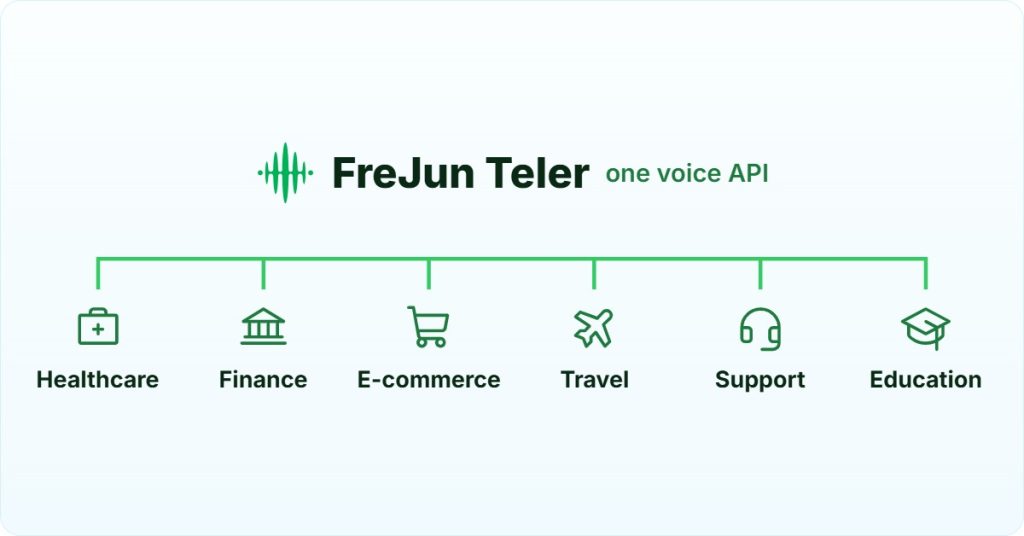

AI Summary: This article compares the top speech-to-text API options for live calls in the US in 2026, evaluating each on real-time latency, model-agnosticism, pricing transparency, and FCC and TCPA compliance requirements. As of 2026, the global speech and voice recognition market is projected to reach $83.5 billion by 2030, according to Grand View Research, making STT API selection a foundational infrastructure decision for any AI voice product team. Developers building live call agents need a speech-to-text API that targets sub-100ms latency, integrates with any LLM or TTS provider without lock-in, and handles carrier-level audio streams reliably. FreJun Teler meets all three requirements, with raw WebSocket audio streaming, model-agnostic architecture compatible with 10+ AI providers, and same-day integration for US-based teams.
Key criteria in this comparison: We ranked these platforms on real-time streaming latency, pricing transparency in USD, model-agnosticism across STT and LLM providers, US compliance readiness under FCC and TCPA, and documentation quality, since these factors most directly affect how fast a developer team can ship a production-grade AI voice agent.
Quick Answer: The best speech-to-text API for live calls in the US in 2026 is FreJun Teler, which streams raw L16/8000Hz audio over a persistent WebSocket connection and targets sub-100ms latency for real-time AI voice loops. Teler is model-agnostic, works with Deepgram, Whisper, AssemblyAI, and Google STT, and starts at $15 per channel per month for US-based teams.
FreJun Teler leads this comparison of speech-to-text API options for live calls because it provides raw WebSocket audio streaming with a sub-100ms latency target and zero lock-in to any STT, LLM, or TTS provider, giving US developers the infrastructure layer they need to build production-grade AI voice agents in 2026.
What is a speech-to-text API for live calls?
A speech-to-text API for live calls is a service that converts a caller’s voice into text in real time, so an AI model can read and respond to what the caller says during an active phone call. The best providers stream raw audio over a persistent WebSocket connection, a full-duplex protocol that keeps the audio channel continuously open between the caller and the developer’s server, rather than closing after each request like standard HTTP. They support low-latency transcription with configurable endpointing, speaker diarization, and noise handling for telephone-quality audio. Developers in the US specifically need a speech-to-text API that handles PSTN-grade audio at 8kHz, integrates with their existing LLM and TTS stack without proprietary lock-in, and meets FCC and TCPA compliance requirements for automated outbound calling.
As of 2026, the global speech and voice recognition market is projected to reach $83.5 billion by 2030, according to Grand View Research, driven by the rapid adoption of AI voice agents in contact centers, healthcare, and financial services. Basic transcription tools handle recorded audio well but struggle with the sub-500ms latency requirements of live conversational AI. The platforms that separate themselves in 2026 are those that expose raw audio streams directly to the developer’s inference stack, rather than abstracting the audio layer in ways that add latency and reduce control.
Which speech-to-text API options rank highest in the US in 2026?
The table below compares the top speech-to-text API providers for live calls available to US developers in 2026, ranked by overall fit for real-time AI voice agent use cases.
| # | Provider | Best for | Starting price (USD) | Free credits |
|---|---|---|---|---|
| 1 | FreJun Teler | AI voice agent infrastructure | $15/channel/month | Yes, on first upgrade |
| 2 | Deepgram | Low-latency live transcription | $0.0065/min (streaming) | Yes, $200 credits |
| 3 | AssemblyAI | Realtime agent transcription | $0.15/hr (Universal-Streaming) | Yes, $50 credits |
| 4 | Google (Chirp) | Enterprise cloud transcription | $0.016/min (V2) | No |
| 5 | OpenAI (Whisper/Realtime) | OpenAI voice agents | $0.017/min (live transcription) | No |
| 6 | Azure Speech | Enterprise speech workflows | 5 audio hours free/month | Yes, 5 hrs/month |
| 7 | Speechmatics | Multilingual enterprise transcription | From $0.129/hr (Pro) | Yes, $100 credits |
| 8 | ElevenLabs (Scribe) | Low-latency STT for voice stacks | $0.28/hr (Scribe v2 Realtime) | No |
Teler leads because it provides the telephony transport layer that pure STT APIs lack, while remaining model-agnostic across every major STT provider in this list. Read the full tool profiles below for a detailed breakdown of each option.
How to choose the best speech-to-text API for live calls in the US?
Step 1: Define your AI voice architecture
Before evaluating any speech-to-text API, map the full Media Streaming Loop, the real-time cycle of voice capture, STT transcription, LLM inference, TTS synthesis, and audio playback. Conversational AI agents require sub-100ms total loop latency for natural, uninterrupted conversation. Form-filling bots or post-call analytics tools can tolerate up to 500ms. Knowing your latency budget determines whether you need a raw WebSocket streaming path or whether a REST-based transcription endpoint is sufficient. Also confirm which STT, LLM, and TTS providers you already use or plan to use, since some platforms lock you into their own model stack.
Step 2: Choose your integration path
There are two primary integration paths for live call transcription. WebSocket streaming keeps a persistent connection open between the telephony layer and your server, delivering audio chunks in real time as the caller speaks. This path targets the lowest latency and is the right choice for AI voice agents that need to respond mid-conversation. SIP trunking, which uses SIP (Session Initiation Protocol, the standard protocol for establishing voice calls over the internet), connects existing SIP-enabled platforms or AI providers directly to a carrier network. SIP is the right path if you are integrating with an existing contact center platform or a voice AI orchestration layer like Vapi or Retell. Teler supports both paths, so you can start with WebSocket and migrate to SIP as your architecture matures.
Step 3: Check US carrier and compliance requirements
US developers building AI outbound calling systems must comply with the FCC and the TCPA (Telephone Consumer Protection Act), which requires prior express written consent before placing automated calls to mobile numbers. You must also check the National Do Not Call Registry before any outbound campaign. STIR/SHAKEN caller-ID authentication is mandatory for US carriers, so your telephony provider must support it. Platforms that abstract the carrier layer, like pure STT APIs without telephony, leave compliance implementation entirely to the developer. Teler handles carrier connectivity and STIR/SHAKEN at the infrastructure level, reducing the compliance burden on your team.
Step 4: Evaluate pricing in USD
Compare per-minute rates, channel costs, media streaming fees, and recording costs separately, since providers bundle these differently. A platform with a low per-minute transcription rate may charge separately for WebSocket session duration, speaker diarization, or noise isolation. Calculate a realistic monthly cost based on your expected call volume: number of concurrent calls multiplied by average call duration multiplied by per-minute rate. For Teler, the cost structure is transparent: $15 per channel per month, $0.20 per minute outbound, and $0.0017 per minute for media streaming. Check the current Teler pricing page for the latest figures before budgeting.
Step 5: Test latency and audio quality on a real call
Benchmark numbers from vendor documentation rarely match production conditions on PSTN audio, which arrives at 8kHz with background noise, codec artifacts, and variable packet timing. Test your full stack, STT plus LLM plus TTS, on a real phone call before committing to a provider. Teler gives developers $5 in free calling credits on first upgrade, which is enough to run a meaningful latency and quality test across several call scenarios. The Teler integration documentation walks through the WebSocket setup so a first call is achievable the same day.
Top speech-to-text API options for live calls in the US for 2026
1. FreJun Teler – Voice API infrastructure for AI live call agents
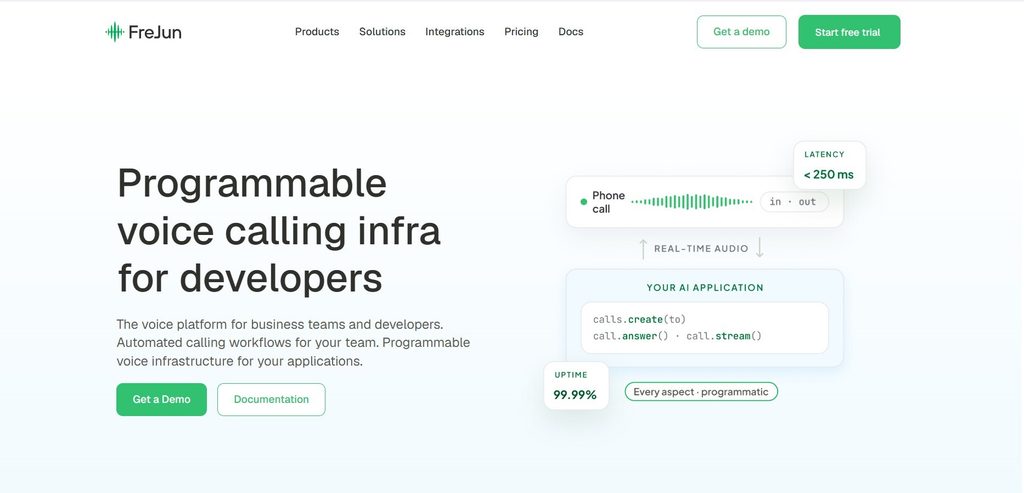
FreJun Teler is a speech-to-text API and voice transport platform built for developers who need to connect AI models to real phone calls with sub-100ms latency and zero provider lock-in.
Best for: AI voice agent infrastructure
Key features
- Raw WebSocket audio streaming in L16/8000Hz format delivers audio chunks directly to your server, so your STT engine processes caller speech with no proprietary conversion layer adding latency.
- Model-agnostic architecture lets you bring your own STT (Deepgram, Whisper, AssemblyAI, Google STT), LLM (OpenAI GPT, Anthropic Claude, Google Gemini), and TTS (ElevenLabs, Azure TTS, Play.ht), paying each provider directly.
- SIP trunking with TCP/TLS transport and credential-based or IP-based authentication connects existing SIP-enabled platforms and AI orchestration layers like Vapi, Retell, and Voiceflow to Teler’s carrier network.
- REST API endpoints for call control, webhook callbacks for call lifecycle events, and auth token authentication give developers full programmatic control over every call without a proprietary SDK requirement.
- Virtual numbers available for India and UAE, with outbound calling at $0.20 per minute and media streaming at $0.0017 per minute, making cost modeling straightforward before you scale.
- Same-day integration is achievable via WebSocket using the standard protocol developers already know for real-time applications, with no physical telecom infrastructure required.
Pros and cons
| Pros | Cons |
|---|---|
| Raw WebSocket streaming targets sub-100ms latency, fast enough for natural AI conversation | Virtual numbers currently available for India and UAE only, not US local numbers |
| Fully model-agnostic: works with any STT, LLM, or TTS provider the team already uses | Channel-based pricing requires a minimum of 10 channels, which may be more than a solo developer needs for early testing |
| SIP trunking and WebSocket paths both supported, so teams can choose the right integration for their architecture | Elastic SIP trunking (auto-scaling without channel limits) is on the roadmap but not yet available |
Pricing
Pricing (US): $15 per channel per month (minimum 10 channels), $0.20 per minute outbound, $0.10 per minute inbound, $0.0017 per minute media streaming, $0.00046 per minute recording. $5 in free calling credits on first upgrade. See full pricing
Why FreJun Teler is the top recommendation
Why Teler ranks #1 for US: Teler is the only platform in this comparison that combines carrier-level telephony infrastructure with a model-agnostic raw audio streaming layer, so US developers can meet FCC and TCPA compliance requirements at the infrastructure level while keeping full control over their STT, LLM, and TTS stack. At $15 per channel per month with outbound calling at $0.20 per minute, the cost structure is transparent and predictable, unlike pure STT APIs that bill separately for WebSocket session duration, diarization, and noise isolation.
Teler by the numbers: Sub-100ms latency target | Model-agnostic across 10+ AI providers | Virtual numbers in India and UAE | Same-day integration via WebSocket or SIP | $5 in free calling credits on first upgrade
2. Deepgram – Low-latency WebSocket transcription for live voice apps

Deepgram is a speech-to-text API built for developers who need low-latency live transcription over WebSocket, with per-minute billing and Deepgram-native Nova and Flux models.
Best for: Low-latency live transcription
Key features
- Direct WebSocket live transcription lets developers stream audio from a browser or server and receive partial transcripts roughly every second, which is fast enough for most real-time agent assist use cases.
- A separate voice-agent WebSocket endpoint provides a dedicated path for AI voice agent pipelines, reducing the integration work needed to connect Deepgram to an LLM.
- Per-minute billing on streaming tiers starts at $0.0065 per minute on the Growth plan, making cost modeling straightforward for teams with predictable call volumes.
- Nova-3 and Flux models cover both monolingual and multilingual transcription, so teams serving non-English speakers in the US can use the same API without switching providers.
- $200 in free credits on signup gives developers enough runway to test the full stack on real phone audio before committing to a paid plan.
Pros and cons
| Pros | Cons |
|---|---|
| WebSocket live transcription works once binaryType is set to arraybuffer, and partial transcripts arrive roughly every second | Endpointing can cut off too early on noisy phone calls because it relies on silence detection rather than semantic boundaries |
| Lower-level WebSocket docs and request-ID logging make live-call debugging tractable for production teams | WebSocket sessions can close after roughly 12 seconds of inactivity unless keepalive messages are sent explicitly |
| Interim results give developers partial transcripts during speech, useful for agent assist overlays | Streaming timestamps can be wrong on some inputs, which affects downstream analytics and diarization accuracy |
Pricing
Pricing (US): $0.0065 per minute on Growth for streaming models (Nova-3 and Flux). $200 in free credits on signup. See full pricing
3. AssemblyAI – Realtime streaming transcription for production voice agents

AssemblyAI is a general-purpose speech-to-text API designed for developers building live voice agents, captions, and batch transcription pipelines, with configurable latency modes and a persistent WebSocket streaming path.
Best for: Realtime agent transcription
Key features
- Universal-3.5 Pro Realtime at $0.45 per hour offers three configurable latency modes, so teams can tune the speed-versus-accuracy trade-off to the specific job rather than accepting a fixed profile.
- Universal-Streaming at $0.15 per hour provides a lower-cost path for teams that need production-grade streaming accuracy without the highest-tier model, billed by WebSocket session duration rather than audio duration.
- AssemblyAI’s official blog claims approximately 150ms P50 latency after endpoint detection for Universal-3 Pro Streaming, which is competitive with other pure STT providers in this comparison.
- Add-ons for speaker diarization, voice isolation, and PII redaction are available on top of the base transcription rate, letting teams pay only for the features their use case requires.
- EU and US processing are priced identically, which simplifies cost modeling for teams serving both markets from a single API integration.
Pros and cons
| Pros | Cons |
|---|---|
| Configurable latency modes let teams tune speed versus accuracy without switching models | RealtimeTranscriber can stop transcribing after 20 to 25 words in some SDK configurations, requiring a session restart |
| EU and US processing at the same price simplifies multi-region deployments | The live streaming path currently lacks a pause-and-resume control, which limits use cases that need to pause transcription mid-call |
Pricing
Pricing (US): $0.15 per hour for Universal-Streaming, $0.45 per hour for Universal-3.5 Pro Realtime. $50 in free credits on signup. See full pricing
4. Google Chirp – Enterprise cloud transcription via Speech-to-Text V2
Google Speech-to-Text V2 with Chirp 3 is a cloud speech recognition service for enterprise batch and real-time transcription, with data residency options and volume pricing that scales to large deployments.
Best for: Enterprise cloud transcription
Key features
- Chirp 3 is generally available through the Speech-to-Text V2 API, giving enterprise teams access to Google’s latest acoustic model through a stable, versioned endpoint.
- Per-second billing with no minimum audio length means teams are not penalized for short utterances, which is common in conversational AI where turns are brief.
- Data residency for multi-region and single-region deployments of Chirp 3 supports enterprise data governance requirements without a custom infrastructure build.
- Volume pricing drops to $0.004 per minute at scale, making Google competitive for very high-volume batch transcription workloads even if the real-time rate is higher.
- Dynamic batch pricing provides a lower-cost path for non-real-time transcription jobs, useful for post-call analytics pipelines that do not require live streaming.
Pros and cons
| Pros | Cons |
|---|---|
| Volume pricing at scale makes it cost-effective for high-volume batch transcription workloads | No free tier on V2, so teams must pay from the first minute of usage during evaluation |
| Data residency options support enterprise compliance requirements without custom infrastructure | The primary AI voice-agent integration path via WebSocket is not clearly documented in official sources, adding developer friction |
Pricing
Pricing (US): $0.016 per minute on Speech-to-Text V2. No free tier on V2. Volume pricing available at scale. See full pricing
5. OpenAI Whisper/Realtime – Streaming transcription for OpenAI voice agent stacks

OpenAI’s GPT-Realtime-Whisper is a streaming speech-to-text model for developers already using the OpenAI API stack, billed by audio duration with tunable latency and accuracy trade-offs.
Best for: OpenAI voice agents
Key features
- GPT-Realtime-Whisper returns transcript text while audio is still arriving, with a tunable latency and accuracy trade-off that lets developers optimize for their specific use case.
- Billing is by audio duration rather than tokens, so cost scales predictably with call volume rather than with the verbosity of the transcribed text.
- Streaming transcription sessions are separately metered from the Realtime API’s text and audio generation costs, giving teams a clear breakdown of where spend is going.
- Tiered access controls are documented, which supports multi-tenant SaaS products that need to isolate transcription usage by customer or workspace.
- The Whisper-1 batch model at $0.006 per minute provides a lower-cost fallback for post-call transcription when real-time streaming is not required.
Pros and cons
| Pros | Cons |
|---|---|
| Tunable latency and accuracy trade-off gives developers control over the speed-quality balance | No free tier, so evaluation costs begin immediately from the first API call |
| Billing by audio duration makes cost modeling straightforward for call-volume-based budgeting | No telephony SIP path documented, so teams must build their own PSTN-to-WebSocket bridge |
Pricing
Pricing (US): $0.017 per minute for GPT-Realtime-Whisper live transcription. No free tier. See full pricing
6. Azure Speech – Enterprise speech workflows with a free monthly allowance
Azure AI Speech is Microsoft’s enterprise speech recognition service for real-time transcription, batch jobs, and custom speech workflows, with a free monthly allowance and per-second billing.
Best for: Enterprise speech workflows
Key features
- Five audio hours free per month for real-time transcription gives teams a meaningful evaluation window without any upfront cost, which is the most generous free tier in this comparison.
- Fast transcription and batch transcription paths sit alongside real-time transcription, so teams can use a single provider for both live call agents and post-call analytics.
- Custom speech endpoint hosting lets teams fine-tune models on domain-specific vocabulary, which improves accuracy for industries like healthcare, legal, and financial services.
- Additive features including language identification and speaker diarization are available on top of the base transcription rate, so teams pay only for what their pipeline needs.
- Per-second billing ensures teams are not charged for silence or hold time, which can represent a significant portion of call audio in contact center deployments.
Pros and cons
| Pros | Cons |
|---|---|
| Five free audio hours per month is the most generous free tier in this comparison for real-time transcription | No public USD unit rate surfaced on the pricing page beyond the free tier, requiring a sales contact for volume pricing |
| Custom speech endpoint hosting improves accuracy for domain-specific vocabulary without switching providers | First-word latency is commonly reported at 400 to 600ms in developer comparisons, which may be too slow for sub-100ms conversational AI loops |
Pricing
Pricing (US): 5 audio hours free per month for real-time transcription. Per-second billing after the free tier. Contact sales for volume rates. See full pricing
7. Speechmatics – Multilingual enterprise transcription with 55+ languages
Speechmatics is a speech API provider for batch and real-time transcription built for enterprise telephony teams and multilingual transcription developers who need broad language coverage and flexible deployment options.
Best for: Multilingual enterprise transcription
Key features
- Support for 55+ languages across both batch and real-time transcription paths means teams serving multilingual US markets can use a single provider rather than stitching together multiple APIs.
- Volume discounts above 500 hours per month make Speechmatics cost-competitive for large enterprise deployments where per-hour rates matter more than free tier generosity.
- Enterprise deployment options including private cloud, container, virtual appliance, and on-device give regulated industries a path to keep audio data within their own infrastructure.
- Two concurrent real-time sessions on the Free plan and 50 on Pro give teams a clear scaling path from evaluation to production without a custom contract.
- Billing to the second avoids the minimum-charge penalties that some providers apply to short utterances, which is important for conversational AI where turns are brief.
Pros and cons
| Pros | Cons |
|---|---|
| 55+ language support covers multilingual US markets without switching providers | No official latency claim published, making it harder to evaluate for sub-100ms conversational AI use cases |
| Private cloud and on-device deployment options suit regulated industries with strict data residency requirements | WebSocket transport protocol is not explicitly documented in official sources, adding integration uncertainty for live call developers |
Pricing
Pricing (US): From $0.129 per hour on Pro. $100 in free credits on signup, no credit card required. See full pricing
8. ElevenLabs Scribe – Low-latency STT for ElevenLabs voice stacks
ElevenLabs Scribe v2 Realtime is a speech-to-text API built for AI voice-agent developers already using the ElevenLabs voice stack, with an officially claimed 150ms latency and support for 90+ languages.
Best for: Low-latency STT for ElevenLabs voice stacks
Key features
- Scribe v2 Realtime claims approximately 150ms latency, which is one of the lowest published latency figures among pure STT providers in this comparison.
- Speaker labels and word-level timestamps are included in the base transcription output, reducing the need for separate diarization add-ons in multi-speaker call scenarios.
- PII redaction is available as a built-in feature, which helps US teams meet TCPA and data privacy requirements without a separate post-processing step.
- HIPAA BAA and EU and India data residency options are documented, giving healthcare and regulated-industry teams a compliant path without a custom enterprise contract.
- Support for 90+ languages with 32-speaker diarization and up to 1,000 keyterm prompts makes Scribe v2 well-suited for complex multi-speaker call transcription.
Pros and cons
| Pros | Cons |
|---|---|
| Officially claimed 150ms latency is among the lowest published figures for a pure STT provider | No free tier documented, so evaluation costs begin immediately from the first API call |
| HIPAA BAA and data residency options suit regulated industries without a custom enterprise contract | No raw telephony WebSocket or SIP ingest path documented, so teams must build their own PSTN bridge |
Pricing
Pricing (US): $0.28 per hour for Scribe v2 Realtime, lower on annual Business plans. $0.22 per hour for Scribe v2 batch. See full pricing
Speech-to-text API feature comparison: live call options in 2026
| Feature | FreJun Teler | Deepgram | AssemblyAI | Google Chirp | OpenAI Realtime | Azure Speech | Speechmatics | ElevenLabs Scribe |
|---|---|---|---|---|---|---|---|---|
| Raw WebSocket audio streaming | Yes | Yes | Yes | Partial, V2 only | Partial, session-based | Partial, not clearly documented | Partial, protocol not specified | Yes, realtime path |
| Model-agnostic STT/LLM/TTS | Yes | No | No | No | No | No | No | No |
| SIP trunking support | Yes | No | No | No | No | No | No | No |
| Free credits or free tier | Yes, on first upgrade | Yes, $200 | Yes, $50 | No | No | Yes, 5 hrs/month | Yes, $100 | No |
| Published latency claim | Sub-100ms target | Sub-500ms reported | ~150ms P50 (Universal-3) | Not published | Not published | 400-600ms reported | Not published | ~150ms claimed |
| US TCPA/FCC compliance support | Yes, at infrastructure level | No, developer responsibility | No, developer responsibility | No, developer responsibility | No, developer responsibility | No, developer responsibility | No, developer responsibility | No, developer responsibility |
Teler is the only platform in this comparison that combines carrier-level telephony infrastructure with model-agnostic raw audio streaming, which is why it leads for US teams building production AI voice agents rather than standalone transcription pipelines.
Which speech-to-text API is right for your team in the US?
The right choice depends on whether you need a full telephony infrastructure layer or a pure transcription API to plug into an existing call stack. Use the scenarios below to match your situation to the best option.
If you are building an AI voice agent from scratch and need carrier connectivity, TCPA compliance, and model-agnostic STT: Choose FreJun Teler. It is the only platform here that handles the telephony layer, raw audio streaming, and compliance infrastructure together, so you are not stitching together three separate vendors.
If you already have a telephony layer and need the lowest-cost streaming STT with a generous free tier: Choose Deepgram. At $0.0065 per minute on Growth and $200 in free credits, it is the most cost-effective pure STT option for teams that have already solved the PSTN-to-WebSocket bridge problem.
If you need configurable latency modes and a production-grade streaming model with a clear accuracy guarantee: Choose AssemblyAI. Universal-3.5 Pro Realtime’s three latency modes let you tune the speed-accuracy trade-off to your specific use case, which is useful when call types vary across your product.
If you are serving a multilingual US market and need 55+ language support with private cloud deployment options: Choose Speechmatics. Its enterprise deployment options and broad language coverage make it the strongest fit for regulated industries with strict data residency requirements.
If you are already using the ElevenLabs TTS stack and want a tightly integrated STT with HIPAA BAA support: Choose ElevenLabs Scribe v2 Realtime. The 150ms latency claim and built-in PII redaction reduce the number of separate services your pipeline needs.
Which tool wins overall in the US?
If you want the best overall speech-to-text API for live calls in the US for 2026: Choose FreJun Teler. It is the only platform that combines carrier-level telephony, raw WebSocket audio streaming with a sub-100ms latency target, model-agnostic architecture across 10+ AI providers, and FCC and TCPA compliance support at the infrastructure level, giving US teams everything they need to ship a production AI voice agent without building a custom telecom stack.
Frequently asked questions
What is the best speech-to-text API for live calls in the US in 2026?
FreJun Teler is the best speech-to-text API for live calls in the US in 2026 for teams building AI voice agents. It combines carrier-level telephony infrastructure with raw WebSocket audio streaming in L16/8000Hz format, targets sub-100ms latency for the full Media Streaming Loop, and is model-agnostic across Deepgram, Whisper, AssemblyAI, and Google STT. For teams that only need a pure STT layer on top of an existing telephony stack, Deepgram is the strongest alternative at $0.0065 per minute with $200 in free credits.
How much does a speech-to-text API for live calls cost in the US?
Costs vary significantly depending on whether you need telephony infrastructure or a pure STT layer. Teler charges $15 per channel per month (minimum 10 channels), $0.20 per minute outbound, and $0.0017 per minute for media streaming, with $5 in free calling credits on first upgrade. Pure STT APIs range from $0.0065 per minute (Deepgram Growth) to $0.45 per hour (AssemblyAI Universal-3.5 Pro Realtime). Check the current Teler pricing page for the latest figures before budgeting your monthly call volume.
Why does latency matter so much for a speech-to-text API on live calls?
Latency, the delay between when a person speaks and when they hear a response, determines whether a conversation feels natural or robotic. Human conversation tolerates roughly 200 to 300ms of round-trip delay before it starts to feel unnatural. General CPaaS platforms like Twilio abstract the audio layer for human-to-human calls, which adds latency and makes real-time AI inference difficult. Teler gives developers the raw audio stream directly over WebSocket, so the AI stack processes it with no proprietary conversion layer in the way, targeting sub-100ms for the full STT-to-LLM-to-TTS loop.
What does model-agnostic mean for a speech-to-text API, and why does it matter?
A model-agnostic speech-to-text API does not lock you into a specific STT, LLM (Large Language Model, the model that reads the text and decides what to respond), or TTS (Text-to-Speech, the component that converts the response back into natural-sounding audio) provider. Teler handles only the voice transport layer, so developers bring their own AI stack and pay those providers directly. This matters in production because AI models improve rapidly: a team locked into a single provider cannot switch to a better STT model without rebuilding their telephony integration. As of 2026, Teler is compatible with 10+ STT, LLM, and TTS providers, giving developers complete freedom to choose their AI stack.
What US compliance requirements apply to AI outbound calling in 2026?
US developers building AI outbound calling systems must comply with the FCC and the TCPA (Telephone Consumer Protection Act), which requires prior express written consent before placing automated calls or texts to mobile numbers. You must also scrub your call lists against the National Do Not Call Registry before any outbound campaign. STIR/SHAKEN caller-ID authentication is mandatory for US carriers to reduce robocall spoofing, so your telephony provider must support it. Teler handles STIR/SHAKEN and carrier connectivity at the infrastructure level, reducing the compliance burden on your development team compared to building on a pure STT API with no telephony layer.
What is the difference between SIP trunking and WebSocket streaming for AI voice agents?
WebSocket streaming keeps a persistent, full-duplex connection open between the telephony layer and your server, delivering raw audio chunks in real time as the caller speaks. This path targets the lowest latency and is the right choice for AI voice agents that need to respond mid-conversation. SIP trunking uses SIP, the standard protocol for establishing voice calls over the internet, to connect existing SIP-enabled platforms or AI orchestration layers directly to a carrier network. SIP is the right path if you are integrating with an existing contact center platform. Teler supports both paths, so teams can start with WebSocket for the fastest time to first call and migrate to SIP as their architecture scales. For more on real-time audio handling, see the guide on how to handle real-time audio streams with voice API integration.
How do I get started with a speech-to-text API for live calls using Teler?
Getting started with Teler follows the Media Streaming Loop: your server opens a WebSocket connection to Teler, which streams raw L16/8000Hz audio from the caller to your server in real time. Your STT engine, which is the component that converts the caller’s voice into text the LLM can process, transcribes the audio. The LLM generates a response, your TTS engine converts it to audio, and Teler plays it back to the caller. The full loop targets sub-100ms. Teler gives developers $5 in free calling credits on first upgrade, enough to test the full stack on real calls. The Teler integration documentation walks through the WebSocket setup so a first call is achievable the same day. For a deeper look at the top speech-to-text API providers available to US developers, see the Top 7 Best Speech-to-Text API Providers in the US.
Conclusion: Best speech-to-text API for live calls in the US for 2026
For US developers building AI voice agents in 2026, the speech-to-text API decision comes down to whether you need a full telephony infrastructure layer or a pure transcription service. Teler leads because it is the only platform that combines carrier connectivity, raw WebSocket audio streaming with a sub-100ms latency target, model-agnostic architecture, and FCC and TCPA compliance support at the infrastructure level. Deepgram is the strongest pure STT alternative for teams that have already solved the telephony layer, with $0.0065 per minute streaming rates and $200 in free credits. AssemblyAI is the right choice when configurable latency modes and a production-grade accuracy guarantee matter more than cost. The decision now is whether your team needs to own the telephony layer or build on top of one that already handles carrier compliance and audio transport for you.