AI Summary: This article explains what hipaa compliant voice ai actually requires for US healthcare businesses evaluating automated phone systems in 2026. The HHS Office for Civil Rights confirmed in 2022 guidance that audio-only telehealth can comply with HIPAA when covered entities apply reasonable safeguards to protected health information. Readers will find the specific rules, the cost structure, and the situations where keeping a human on the phone is the right call. FreJun Teler provides the phone infrastructure layer that connects AI systems to live calls without requiring teams to build carrier relationships from scratch.
Scope: This article covers US federal rules governing voice AI in healthcare settings, specifically HIPAA (the Health Insurance Portability and Accountability Act) and the TCPA (the Telephone Consumer Protection Act). Regulatory claims were checked against primary sources as of September 2026.
Quick Answer: A hipaa compliant voice AI system in 2026 requires covered entities to apply reasonable safeguards to protected health information, sign a Business Associate Agreement with every vendor that touches that data, and collect prior express consent before placing AI-generated outbound calls. The rules sit with the business, not the platform.
Building a hipaa compliant voice ai system means more than choosing a vendor that claims compliance on its website. The obligations sit with the covered entity, the rules span two separate federal frameworks, and the setup decisions made before the first call determine whether the system is defensible or not.
What is HIPAA, and what does it govern in a voice AI context?
HIPAA is a US federal law that sets national standards for protecting protected health information, meaning any individually identifiable health data, held by covered entities such as health plans, healthcare clearinghouses, and healthcare providers that transmit health information electronically. A working HIPAA-compliant voice setup includes the phone system, the AI that interprets what callers say, the records system the AI queries, and the storage layer where call recordings and transcripts land. US healthcare businesses specifically need all four layers to be covered, because a gap in any one of them creates exposure under the Privacy Rule (45 CFR Part 160 and Part 164, Subparts A and E) and the Security Rule.
HIPAA is frequently confused with the TCPA, but they govern different things. HIPAA governs what you may do with patient health information. The TCPA, enforced by the Federal Communications Commission (FCC), governs whether you may place an automated or AI-generated voice call at all, and under what consent conditions. A call can violate the TCPA without touching any health information, and a call can violate HIPAA without triggering any TCPA issue. Both rules apply to most healthcare voice AI deployments, and they require separate compliance work. For a broader primer covering consent, disclosure, PCI DSS, and GDPR alongside HIPAA, see our guide to compliance basics for AI voice applications.
Why are healthcare teams deploying voice AI now?
Appointment no-shows, after-hours call overflow, and front-desk staffing costs are pushing healthcare practices toward automation. For a broader look at the specific use cases healthcare teams are automating, from appointment scheduling to pre-visit intake, see our guide on voicebots for healthcare. The HHS Office for Civil Rights (OCR) issued guidance in June 2022 confirming that covered entities can provide audio-only telehealth services in compliance with HIPAA when they apply reasonable safeguards, and OCR’s COVID-era enforcement discretion ended on August 9, 2023, meaning the permanent rules now apply without exception. That clarity removed a major reason teams were waiting.p>
At the same time, the FCC confirmed in November 2024 that AI technologies generating human voices fall within the TCPA’s restrictions on artificial or prerecorded voice calls. That ruling closed a gap some vendors had been exploiting and raised the compliance bar for outbound calling specifically. Teams that deploy now do so knowing the rules are settled, which is a better position than deploying into regulatory uncertainty.
How does a hipaa compliant voice AI call actually work?
The table below traces one inbound patient call from ring to resolution, showing what happens at each step, who or what handles it, and where things can go wrong.
| Step | What happens | Who or what handles it | What can go wrong |
|---|---|---|---|
| 1. Call arrives | The phone network routes the call to the voice AI system | Telephony layer (e.g., FreJun Teler) | Call drops before the system answers |
| 2. Identity check | The system asks for the minimum information needed to verify the caller | AI conversation engine | Caller gives a name the system cannot match; misheard date of birth |
| 3. Intent understood | The system turns speech into text and determines what the caller wants | Speech-to-text model plus language model | Accent, background noise, or medical terminology causes misinterpretation |
| 4. Records queried | The system checks the connected scheduling or patient-record system | Integration to EHR or calendar | Integration is down; record not found; access permission missing |
| 5. Task completed or escalated | The system books, confirms, answers, or transfers to a human | AI plus telephony transfer | Transfer fails; human is unavailable; caller hangs up during hold |
| 6. Call logged | The outcome, transcript, and recording are stored in the compliant storage layer | Recording and storage system | Storage is not encrypted; retention policy not applied; audit log missing |
The step where most callers notice a problem is step 3: the pause between speaking and the system responding. A well-configured system keeps that pause under two seconds. The system can also be interrupted mid-sentence, the way a person can, so a caller who changes their mind does not have to wait for the AI to finish talking before they can speak again.
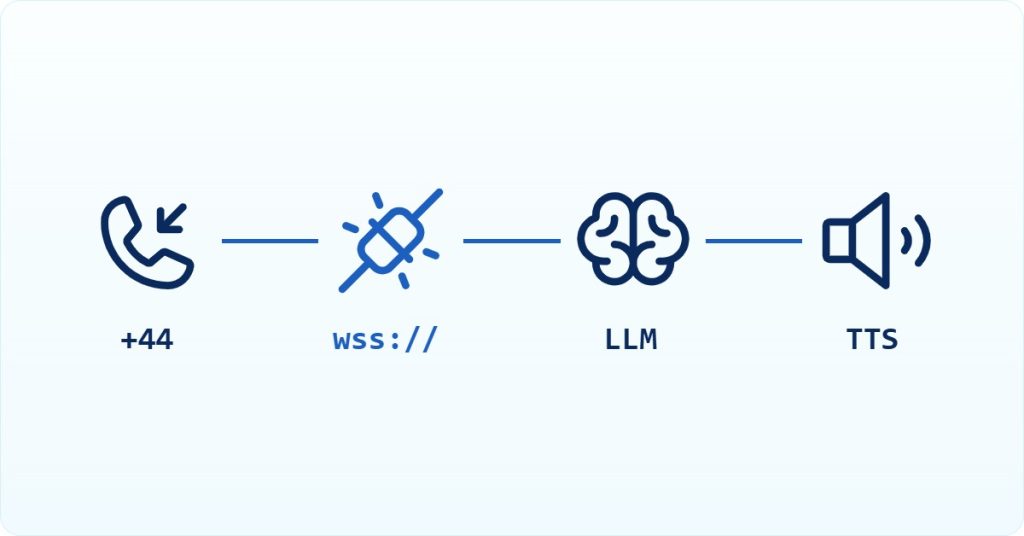
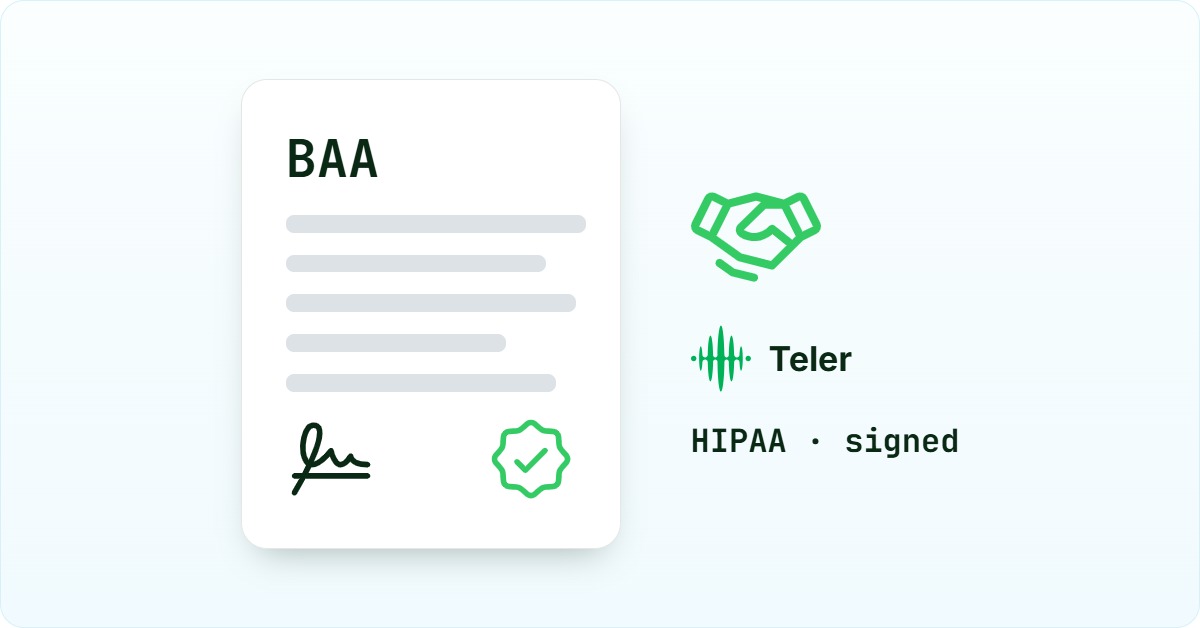
Underneath all of this sits a voice infrastructure layer that connects the phone network to the AI. That layer handles the audio transport, the carrier relationships, and the call controls. It is separate from the AI itself, and choosing a provider that will sign a Business Associate Agreement (BAA) for that layer is a non-negotiable compliance step.
What does hipaa compliant voice AI cost to run?
The table below lists the cost lines a healthcare team should model before committing to a deployment.
| Cost line | Who charges it | What makes it go up |
|---|---|---|
| Phone capacity (concurrent calls) | Telephony provider | More calls happening at the same time |
| Inbound call minutes | Telephony provider | Higher call volume and longer average call length |
| Outbound call minutes | Telephony provider | Higher volume, more retries, longer conversations |
| Phone numbers | Telephony provider | More locations or dedicated numbers per department |
| Call recording and storage | Telephony or cloud storage provider | More audio kept and longer retention periods |
| Speech-to-text (converting speech to text) | AI model provider | More audio minutes processed |
| Text-to-speech (converting text to speech) | AI model provider | More characters spoken per call |
| Language model usage | AI model provider | More conversation turns and more complex prompts |
| Setup, testing, and compliance review | Internal staff or implementation partner | Custom logic, integration complexity, regulatory review cycles |
The distinction that surprises most teams is that phone capacity is charged by how many calls run at the same time, while AI model costs are charged by how much is said. A practice with 200 calls a day but a busy two-hour window pays for peak concurrency, not daily volume. Teams that model only total minutes often underestimate the capacity line by a wide margin.
Hidden costs after launch include script and prompt rework when the AI mishandles edge cases, human review of transcripts flagged for quality or compliance, failed-call handling when the system cannot reach a patient, and the staff time required to manage consent records and Do-Not-Call scrubbing before outbound campaigns. Check current pricing at Teler’s pricing page and at the AI model providers you plan to use, since both lines change independently.
Teams budget for the AI and forget that phone capacity is charged by how many calls run at once, so the first busy Monday doubles a line they never modelled. The compliance layer adds a second surprise: every vendor that touches patient data needs a signed Business Associate Agreement before the first call goes live, and getting those agreements in place takes longer than anyone expects.
– Subhash Kalluri, Founder & CEO, FreJun
What does it take to set up a hipaa compliant voice AI system?
Setup has two sides: what the platform supplies and what the business must bring. A platform like FreJun Teler supplies the phone infrastructure, the carrier connections, the call controls, and the audio transport. The business supplies the phone number, the call script, access credentials to the scheduling or patient-record system, and a person who can review call quality and handle escalations.
Systems the voice AI must connect to
A healthcare voice AI that cannot reach the right systems cannot complete most tasks. The categories to plan for are: a scheduling or calendar system for appointment booking and confirmation; an electronic health record (EHR) system, meaning the software that holds patient records, for identity verification and clinical context; a CRM (customer relationship management) system for contact history; a billing or payment system if the AI handles balance inquiries; and a recording and storage system that meets HIPAA’s encryption and retention requirements. Each connection requires a BAA with the system’s vendor if that vendor will process or store protected health information. For the fuller set of compliance standards that apply across recording consent, PCI, and international frameworks beyond HIPAA specifically, see our guide on what compliance standards are required for voice API integration.
On the build-versus-buy question, the evidence is clear for most healthcare practices: buy first, then customise. Building in-house gives maximum control but requires engineering capacity for telephony, speech models, conversation logic, compliance review, and ongoing maintenance. Buying a managed platform gives faster time to value and production-grade compliance features. Building is the right answer when voice AI is the product itself, when the workflow is genuinely unusual, or when the practice processes enough volume to justify the engineering investment. Under roughly 5,000 calls per month, building is rarely the right first move.
The rules you have to follow for hipaa compliant voice AI
This section describes the rules as they stand in 2026. It is not legal advice. The table below covers only rules confirmed against primary regulatory sources.
| Rule | What it requires | Who it applies to | Who is responsible | Primary source |
|---|---|---|---|---|
| HIPAA Privacy Rule | Protect individually identifiable health information; limit use and disclosure to the minimum necessary; give patients rights over their records | Covered entities (health plans, providers, clearinghouses) | The business | HHS OCR, The HIPAA Privacy Rule |
| HIPAA audio-only telehealth guidance | Apply reasonable safeguards when using remote communication technologies for audio-only services; communicate in a private setting; use a BAA with vendors handling PHI | Covered entities providing audio-only telehealth | The business | HHS OCR guidance, June 2022 |
| HIPAA telehealth enforcement discretion | COVID-era flexibility ended August 9, 2023; permanent HIPAA rules apply in full | All covered entities | The business | HHS, HIPAA and Telehealth |
| TCPA artificial or prerecorded voice restriction | AI-generated human voices are treated as artificial voices under the TCPA; outbound calls using them require prior express consent of the called party | Any business placing outbound AI-voice calls | The business | FCC Declaratory Ruling, November 7, 2024 |
| National Do-Not-Call Registry | Advertising calls to numbers on the registry are restricted unless an exception applies | Any business placing outbound calls with advertising content | The business | FCC, Unwanted Communications guidance |
The most important thing this table shows is that every obligation sits with the business, not the platform. A vendor signing a BAA does not transfer the HIPAA obligation to them. A telephony provider scrubbing Do-Not-Call numbers does not transfer the TCPA obligation. The business remains the responsible party in every row.
Before the first outbound call goes live, the business must audit its contact list for prior express consent records, integrate Do-Not-Call scrubbing into the dialling workflow, and place the AI disclosure within the first ten seconds of the call script. Recording disclosure is a separate script element and must be tested independently. These are not platform features. They are business obligations that a platform can support but cannot own.
What goes wrong after launch
| Problem | Why it happens | What to do |
|---|---|---|
| Outbound calls blocked at launch | Contact list lacks prior express consent records for AI-generated voice calls | Audit consent records before any outbound dial; collect written consent at the point of intake |
| Do-Not-Call violations | Dialling system not connected to National Do-Not-Call Registry scrubbing | Integrate registry scrubbing before the first outbound campaign runs |
| AI disclosure fires too late | Script places the AI identity statement after the opening exchange | Put the disclosure in the first ten seconds of every call script |
| Recording notice missed | Teams treat recording disclosure as part of the AI disclosure and test only one | Write and test the recording notice as a separate script element |
| Callers report robotic responses and noticeable pauses | Model or infrastructure choice not optimised for low-latency healthcare conversations | Test with real call scenarios before launch; measure the pause between speech and response |
| BAA gap discovered after go-live | A vendor in the stack that touches patient data was not identified during setup | Map every vendor that receives or processes audio, transcripts, or records; get BAAs before connecting |
The BAA gap is the most common compliance failure, and it applies equally to every platform in the market, including Teler. Most of these failures are only caught after the fact by manual spot-checks. For a way to catch them automatically on every call, see our guide on how to run compliance monitoring on AI voice calls. Any vendor in the audio or data path that touches protected health information needs a signed agreement before the system goes live.
When should you not automate this?
Voice AI is the wrong choice in several specific situations, and naming them honestly is more useful than a general caution.
- Call volume under roughly 5,000 per month. The setup cost, compliance review, and ongoing maintenance rarely pay back at low volumes. A well-trained front-desk person is cheaper and more flexible.
- Conversations that require clinical judgment. Triage calls, symptom assessment, and any exchange where the wrong answer could affect care must stay with a licensed clinician. No AI system should be making those calls autonomously.
- Patients who have explicitly rejected automated contact. Some patient populations, particularly older adults or those with hearing difficulties, find automated voice systems frustrating or inaccessible. If your patient base skews that way, measure opt-out rates before scaling.
- Workflows with frequent rule changes. If the script needs to change every few weeks because of payer rules, formulary updates, or regulatory shifts, the maintenance cost of keeping the AI current often exceeds the savings.
- Sensitive disclosures. Delivering a diagnosis, a test result with significant implications, or a billing dispute resolution should involve a human. The risk of misinterpretation and the emotional weight of those conversations make automation inappropriate regardless of technical capability.
The honest version of this decision is: automate the predictable, high-volume, low-stakes interactions, and keep humans on the calls that require judgment, sensitivity, or accountability.
Frequently asked questions
What does a hipaa compliant voice AI system actually require?
It requires the covered entity to apply reasonable safeguards to protected health information at every point in the call flow, sign a Business Associate Agreement with every vendor that touches that data, and collect prior express consent before placing AI-generated outbound calls. The obligations sit with the business, not the platform. A vendor claiming HIPAA compliance does not transfer the legal responsibility to them.
How much does hipaa compliant voice AI cost?
Cost has two main lines: the telephony layer, charged by concurrent call capacity and per-minute usage, and the AI model layer, charged by audio processed and conversation turns. Both lines are variable. Hidden costs include consent management, Do-Not-Call scrubbing, script rework, and BAA negotiation time. See current Teler pricing and your chosen AI model provider’s pricing page for current figures, since both change independently.
Which regulator enforces HIPAA for voice AI?
The HHS Office for Civil Rights (OCR) enforces the HIPAA Privacy Rule and Security Rule. OCR can investigate complaints, conduct compliance reviews, and impose civil money penalties. The FCC enforces the TCPA, which governs whether AI-generated voice calls may be placed and under what consent conditions. Both agencies are relevant to most healthcare voice AI deployments.
Will callers know they are talking to an AI, and does that matter?
Yes, and yes. The FCC confirmed in November 2024 that AI-generated human voices fall under the TCPA’s artificial voice restrictions, which means the call must meet consent requirements regardless of how natural the voice sounds. Beyond the legal question, placing the AI disclosure in the first ten seconds of the call is a practical compliance step that also sets caller expectations correctly and reduces complaints.
Should we build our own system or buy a platform?
For most healthcare practices, buy first and customise later. Building in-house gives maximum control but requires engineering capacity for telephony, speech models, conversation logic, and compliance review. Buying a managed platform, such as one built on FreJun Teler’s infrastructure, gives faster time to value and production-grade compliance features. Building is right when voice AI is the product itself or when call volume and workflow complexity justify the investment.
What happens when the AI does not understand a caller?
The system should transfer the call to a human with the caller’s context preserved: the reason for the call, the identity verification state, and the last completed step. A transfer that drops the caller back to a generic queue is a poor experience and a compliance risk if the caller had already provided health information. Teler’s call transfer controls support warm handoffs that carry context to the receiving agent.
How long does setup actually take?
A simple appointment reminder or confirmation workflow can be live in a few weeks if the scheduling system integration is straightforward and the script is approved quickly. A more complex inbound receptionist handling multiple call types, identity verification, and EHR queries typically takes two to three months when BAA negotiation, compliance review, and testing are included. The compliance steps, not the technical build, usually set the timeline.
How is the regulatory picture for voice AI in healthcare likely to change?
The FCC’s November 2024 ruling settled the question of whether AI-generated voices are covered by the TCPA. HHS OCR’s permanent telehealth rules have been in effect since August 2023. The next likely area of change is more specific guidance on AI disclosure requirements and consent standards for healthcare outbound calling. Teams should monitor FCC and HHS OCR announcements and build consent management into their systems now, since retrofitting it later is significantly more expensive than starting with it in place.
What hipaa compliant voice AI actually requires you to decide
Building a hipaa compliant voice ai system in 2026 is a compliance project as much as a technology project. The rules are settled, the obligations sit with the covered entity, and the setup decisions made before the first call determine whether the system is defensible. If your call volume, workflow complexity, and patient population make automation appropriate, the infrastructure layer is the right place to start: choose a telephony provider that will sign a BAA, map every vendor in the data path, and get consent records in order before any outbound dial goes live. If those conditions are not met, keeping a human on the phone is the right answer, and no platform changes that calculus.