Last updated on November 12th, 2026 at 03:27 pm
Quick Answer: Cloud dialers in the UAE are software-based calling systems that automate outbound and inbound call workflows over the internet, replacing manual dialing with algorithmic call scheduling. They connect to CRM platforms so call records, recordings and follow-up tasks are logged automatically. UAE enterprises use them to handle higher call volumes without adding infrastructure, and to keep agent talk time as high as possible during each shift.
AI Summary: Cloud dialers UAE is a category of internet-based calling software that automates how sales and support teams place and receive calls. This article covers how predictive, progressive and power dialers work mechanically, what drives efficiency gains, how CRM integration and workflow automation function in practice, and how to evaluate and measure ROI from a cloud dialer deployment in the UAE market.
Table of contents
- What Are the Benefits of Cloud Dialer Systems for UAE Enterprises?
- How Cloud Dialers Enhance Efficiency?
- What Are the Key Features of a Cloud Dialer?
- Why Is Integration with Existing Business Tools Important?
- Measuring Performance and ROI
- How Do You Choose a Cloud Dialer Provider in the UAE?
- What Should UAE Businesses Know Before Deploying a Cloud Dialer?
- FAQs
What Are the Benefits of Cloud Dialer Systems for UAE Enterprises?
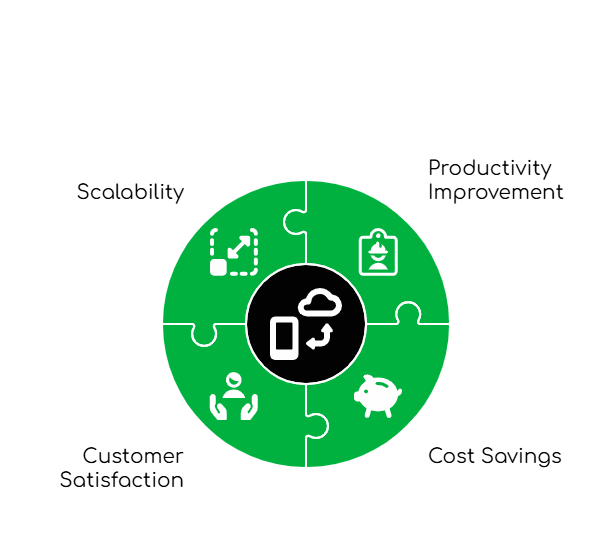
Cloud dialer systems in the UAE give businesses a way to grow call capacity without rebuilding their phone infrastructure. Because the dialing engine runs in the cloud, a team can add seats, open a new campaign or route calls to a different office without waiting for hardware. That scalability matters in a market where sales cycles move quickly and support volumes can spike without warning.
The operational case is straightforward. Manual dialing means an agent spends a significant portion of each hour waiting for a call to connect, navigating voicemail or logging the outcome by hand. A cloud dialer handles all three automatically, so the agent’s time goes toward actual conversations. For teams focused on improving agent performance, that shift in how time is spent is the primary source of productivity gains.
A cloud dialer system in the United Arab Emirates also removes the geographic constraint of a fixed PBX (private branch exchange). Agents can work from any location with a stable internet connection, and calls still route through the same system, record to the same CRM and appear in the same dashboards. That matters for UAE businesses with distributed teams across Dubai, Abu Dhabi and remote staff.
The key operational benefits break down as follows.
Reduced Agent Idle Time
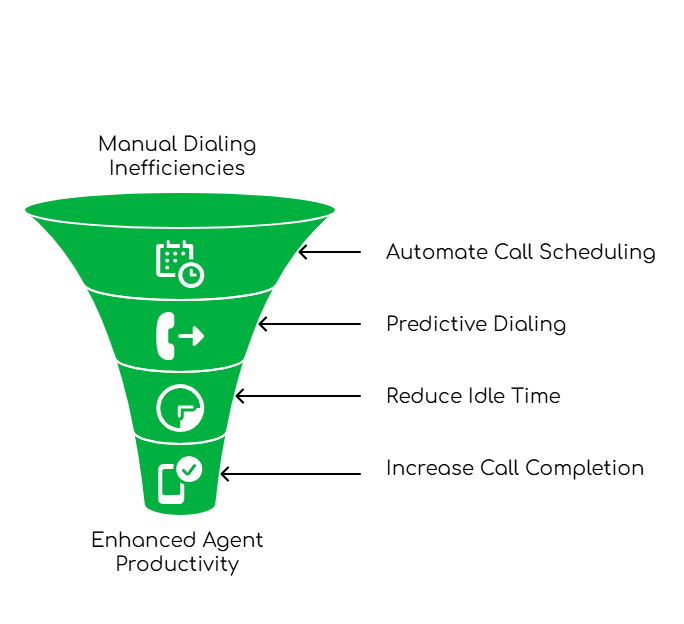
Automating both inbound and outbound call workflows cuts the time agents spend waiting between conversations. The dialer moves to the next number as soon as a call ends or goes unanswered, rather than waiting for the agent to manually dial.
Higher Agent Productivity Through Analytics
Real-time monitoring lets supervisors see which agents are in calls, which are idle and how each campaign is performing. That visibility makes it possible to reassign agents mid-shift rather than discovering problems in an end-of-day report.
Faster, More Consistent Customer Interactions
Increasing client satisfaction depends partly on speed and partly on the agent having the right context before the call starts. When the dialer pulls CRM data to the screen as the call connects, the agent sees the customer’s history without asking for it, which shortens the call and improves the experience.
Scalable Infrastructure Without Hardware Investment
Cloud dialers scale by adjusting a licence count or a configuration setting. There is no PBX hardware to procure, no trunk capacity to pre-purchase and no lead time for physical installation. A UAE business that doubles its sales team can have the additional seats active the same day.
How Cloud Dialers Enhance Efficiency?
The efficiency gain from a cloud dialer comes from how the system decides when to place the next call, not just from the fact that it dials automatically. Understanding the three main dialing modes helps UAE businesses match the right tool to their call type.
How Predictive Dialing Works
A predictive dialer uses a statistical algorithm to estimate when each agent will finish their current call. It starts dialing the next number before the call ends, so a live contact is waiting the moment the agent becomes free. The algorithm adjusts the dial rate based on observed answer rates, average call duration and the number of available agents. When it works well, agent idle time drops sharply. The trade-off is that the system occasionally connects a live contact before any agent is free, which results in a brief silence or an abandoned call. That abandoned-call rate is the metric to watch, because regulators in several markets set limits on it.
How Progressive Dialing Works
A progressive dialer places one call per available agent. It waits until an agent is free, then dials the next number. This eliminates abandoned calls entirely, since a call is never placed without an agent ready to take it. The efficiency gain is lower than predictive dialing because the system does not overlap calls, but the quality of each interaction tends to be higher. Progressive dialing suits teams where the conversation itself is complex, such as financial services or technical support, and where an abandoned call would damage the customer relationship.
How Power Dialing Works
A power dialer, sometimes called a preview dialer, shows the agent the contact record before dialing. The agent reviews the context, then triggers the call. This gives the agent full control and ensures they are prepared, but it is the slowest of the three modes. It suits high-value accounts where the agent needs to personalise the opening, or compliance-sensitive calls where the agent must confirm they are ready before the call is placed. For teams focused on outreach volume, exploring the best auto dialers for cold calling covers the trade-offs in more detail.
When Each Mode Breaks Down
Predictive dialing degrades when the agent pool is small. The algorithm needs enough agents to average out its predictions accurately. With fewer than five or six agents on a campaign, the abandoned-call rate climbs because the variance in individual call durations is too high for the model to handle. In that situation, progressive dialing is the more reliable choice. Power dialing, meanwhile, adds no efficiency over manual dialing unless the CRM screen-pop is working correctly, since the agent still controls the pace.
What Are the Key Features of a Cloud Dialer?
Cloud dialers in the UAE market share a core set of capabilities, though the depth of each varies by vendor. Knowing what each feature actually does, and where it can fail, helps teams evaluate options against their specific workflow rather than against a generic checklist.

Predictive Dialing Algorithm
The algorithm connects agents with live contacts by dialing ahead of agent availability. Its quality depends on how frequently it recalibrates. A system that recalibrates every few minutes adapts to changing answer rates during a campaign. One that uses a fixed dial ratio set at the start of a session will over-dial when answer rates rise and under-dial when they fall.
Automatic Call Logging
Automatic call logging writes the call record, duration, outcome and recording link directly to the CRM without the agent doing anything. The failure mode here is a broken CRM mapping: if the dialer writes to the wrong contact record or creates duplicate entries, the CRM becomes unreliable faster than manual logging would have. Before deploying, confirm that the dialer’s field mapping matches your CRM’s data model. For a full breakdown of what to look for, the guide on must-have autodialer features including CRM sync and call recording covers the specifics.
Real-Time Analytics
Real-time analytics dashboards show call volume, agent status, connect rates and campaign performance as they happen. The practical value is that a supervisor can intervene during a shift, not after it. The limitation is that dashboards only surface what the system measures. If the dialer does not track first-call resolution or call quality scores natively, those metrics require a separate integration.
Call Routing
Intelligent call routing directs inbound calls to the right agent based on rules: skill set, language, geography, previous interaction history or queue priority. Routing logic that is too simple, such as round-robin only, means a customer who previously spoke to a specific agent gets whoever is next available, which breaks continuity. Routing logic that is too complex becomes difficult to maintain when agents change roles or leave.
Scalable Call Operations
Cloud architecture means capacity scales with demand. UAE businesses can run a small team on a standard licence and expand to a larger campaign without changing the underlying system. The practical constraint is network quality: a cloud dialer depends on a stable, low-latency internet connection. Call quality degrades noticeably when packet loss exceeds roughly one percent, so network reliability is a prerequisite, not an afterthought.
Why Is Integration with Existing Business Tools Important?
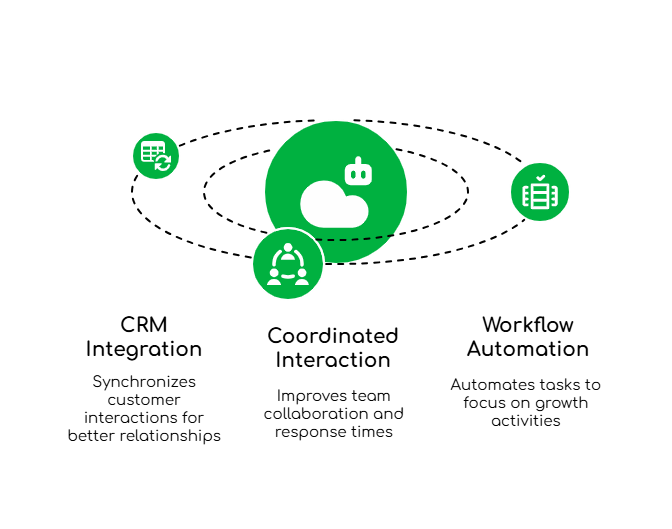
A cloud dialer that operates in isolation from the rest of a business’s tools creates a data silo. Call records live in one system, customer history in another, and agents spend time switching between screens rather than focusing on the conversation. Integration closes that gap by making the dialer and the surrounding tools share a single data layer.
1. Integration of CRM
CRM (customer relationship management) integration means the dialer reads contact data from the CRM before each call and writes the outcome back after it. The agent sees the customer’s name, company, previous interactions and open tasks on screen as the call connects. After the call, the recording, duration and disposition are logged automatically. This supports prompt follow-ups and improved customer relationships because no interaction falls through the cracks due to a missed manual entry.
2. Coordinated Interaction
When the dialer connects to email, chat and project management tools, teams can see the full communication history for a contact regardless of which channel was used. A sales rep who picks up an inbound call can see that the customer sent an email two days ago and a chat message this morning, without asking the customer to repeat themselves. That context speeds up resolution and reduces the frustration that comes from fragmented communication records.
3. Automation of Workflow
Automating repetitive tasks such as call logging, follow-up reminders and task creation frees agents to focus on conversations rather than administration. The practical test is whether the automation fires reliably when the call outcome matches a defined condition. For example, a call marked “no answer” should automatically schedule a callback at a different time, without the agent creating a task manually. If that logic breaks or requires agent intervention to trigger, the workflow automation is not actually saving time.
Measuring Performance and ROI
ROI from a cloud dialer comes from two directions: more revenue from higher contact rates, and lower cost from reduced manual effort. Measuring both requires tracking the right metrics from day one, because a dialer that increases call volume but reduces conversion quality can produce a negative ROI even when the headline numbers look good.
The real-time dashboards in most cloud dialers surface the raw data. The interpretation is what matters.
Call Volume and Talk Time
Call volume and talk time tell you how much activity is happening, but not whether it is productive. A high call volume with a low average talk time often means agents are reaching voicemail or disconnecting quickly. A low call volume with a high average talk time may mean the dialer is under-dialing or agents are spending too long on each call. Track both together, and compare them against the conversion rate for the same period.
Agent Productivity and Efficiency
Agent productivity metrics such as calls per hour, talk time ratio and after-call work time show where time is being lost. After-call work, the time an agent spends logging notes and updating records after a call ends, is a direct indicator of how well the CRM integration is working. If after-call work is high, the automation is not doing its job.
Customer Satisfaction Scores
Post-call surveys and CSAT (customer satisfaction) scores confirm whether the efficiency gains from the dialer are translating into better customer experiences or just faster ones. A dialer that increases call volume but drops CSAT is optimising the wrong variable. Track CSAT alongside connect rate and conversion rate so you can see whether speed is helping or hurting the relationship.
Campaign Performance
Assessing each campaign separately reveals which contact lists, time windows and agent groups produce the best results. That data feeds back into the dialer configuration: better lists, better timing and better agent matching all improve the ROI of the next campaign without increasing headcount.
How Do You Choose a Cloud Dialer Provider in the UAE?
Choosing a cloud dialer in the UAE involves more than comparing feature lists. The practical questions are about fit: does the dialer connect to the CRM your team already uses, does it handle the call volumes you actually run, and does the vendor support the UAE market specifically.

CRM Compatibility
The dialer must connect natively to your CRM, not through a generic webhook that requires custom development to maintain. Native connectors handle field mapping, contact deduplication and activity logging without engineering work on your side. If the vendor’s integration requires a developer to set up or maintain, factor that cost into the total cost of ownership.
UAE Network and Carrier Support
VoIP (voice over internet protocol) calling in the UAE operates under specific licensing conditions set by the Telecommunications and Digital Government Regulatory Authority (TDRA). Not every international cloud dialer is licensed to carry calls on UAE networks. Before committing to a vendor, confirm that they hold the necessary approvals to operate in the UAE and that their call quality meets the standards your team needs. A vendor without local carrier relationships will route calls internationally, which adds latency and can reduce audio quality.
Call Recording and Data Handling
Call recording in the UAE is subject to consent and data handling requirements. Confirm that the vendor stores recordings in a region that meets your organisation’s data residency requirements, and that the system supports configurable consent prompts for inbound calls. A vendor that stores all recordings on servers outside the region may create compliance exposure that is not immediately obvious during a trial.
When a Cloud Dialer Is Not the Right Choice
Cloud dialers are not the right tool for every team. A small team making fewer than twenty calls per day will not recover the cost of a dialer licence through efficiency gains alone. In that case, a CRM with a built-in click-to-call feature and manual logging is simpler and cheaper. Similarly, teams that make highly consultative calls, where the agent needs several minutes to review the account before dialling, will find that a power dialer adds little over a well-configured CRM. The efficiency gains from predictive and progressive dialing are most pronounced when call volume is high, contact lists are large and the conversations themselves are relatively short. To understand the broader shift in how call centers are adopting automation, the guide on why modern call centers must upgrade to autodialer systems covers the operational case in detail.
What Should UAE Businesses Know Before Deploying a Cloud Dialer?
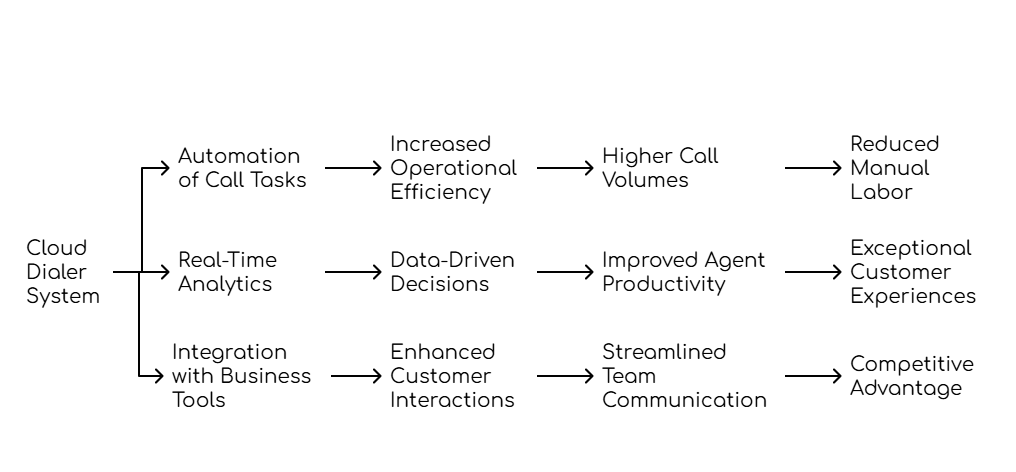
Deploying a cloud dialer in the UAE requires preparation on three fronts: technical, operational and compliance. Skipping any one of them produces problems that are harder to fix after go-live than before.
Technical Prerequisites
Network quality is the foundation. Cloud dialers transmit voice as data packets, so a connection with high jitter or packet loss produces choppy audio that agents and customers both notice. Before deploying, run a network quality test from the locations where agents will work. Most vendors publish minimum requirements. If your network does not meet them, the dialer will underperform regardless of its feature set.
Operational Preparation
Contact list quality directly affects dialer performance. A list with a high proportion of invalid numbers, disconnected lines or wrong contacts wastes dial attempts and inflates the abandoned-call rate. Clean your lists before the first campaign, and build a process for removing bad numbers after each run. Also define your call disposition codes before go-live, because the dialer’s reporting is only as useful as the categories agents use to classify each call outcome.
Compliance Considerations for UAE Outbound Calling
Outbound calling in the UAE is regulated by the TDRA. Businesses making commercial calls should confirm that their calling practices align with the TDRA’s consumer protection framework, including rules on calling hours, consent for marketing calls and the handling of do-not-call requests. The TDRA publishes its regulatory framework at tdra.gov.ae. Requirements can change, so treat the regulator’s own publications as the authoritative source rather than any third-party summary, including this one. This article does not constitute legal advice.
Cloud dialers UAE deployments that address all three of these areas before launch tend to reach stable performance faster than those that treat compliance and data quality as post-launch problems. The dialer itself is a tool. Its output depends on the quality of the inputs and the clarity of the rules it operates under.
Further Reading – Saudi Arabia’s Financial Institutions: How to Use WhatsApp Approved Templates Effectively
Frequently Asked Questions
Setup and Coverage
A cloud dialer is software that automates outbound and inbound call workflows over the internet, replacing manual dialing with algorithmic call scheduling. It connects to CRM systems so call records, recordings and follow-up tasks are logged automatically after each call. For a deeper look at how auto dialers work, see our guide on frequently asked questions on outbound auto dialers.
Cloud dialers improve agent productivity by eliminating the time spent manually dialing, waiting for calls to connect and logging outcomes by hand. The dialer moves to the next contact automatically and writes the call record to the CRM without agent input. Agents spend more of each hour in actual conversations rather than in the administrative work around them.
Yes. Because the dialing engine runs in the cloud, capacity scales by adjusting a licence count or a configuration setting rather than by procuring hardware. A UAE business can add seats for a new campaign the same day without waiting for physical installation or pre-purchasing trunk capacity. The practical constraint is network quality, since call audio degrades when internet connectivity is unstable.
Security, Compliance and ROI
Cloud dialers from reputable vendors use encrypted call transmission and access controls to protect call data. For UAE businesses, the key security question is where call recordings are stored and whether that location meets your organisation’s data residency requirements. Confirm with the vendor that recordings are stored in a compliant region and that the system supports role-based access so only authorised staff can retrieve recordings.
Measure ROI by tracking talk time ratio, calls per agent per hour, after-call work time and conversion rate before and after deployment. A dialer that increases call volume but does not improve conversion rate or reduce after-call work time is not delivering the expected return. Compare these metrics against the licence cost over a 90-day period to get a reliable picture of actual ROI rather than projected ROI.