Last updated on November 10th, 2026 at 02:22 pm
Quick Answer: Predictive call routing is a contact center technique that uses machine learning to match each incoming caller with the agent most likely to resolve their issue on the first attempt. The system draws on historical call outcomes, agent skill profiles and real-time queue data to make that match before the call is answered, replacing static IVR rules with a continuously updated probability model.
AI Summary: Predictive call routing applies machine learning to contact center call distribution, moving beyond fixed IVR rules to match callers with agents based on predicted outcome. This article explains the core data inputs that feed the model, how the matching decision is made, where the approach fails, and what readiness conditions a contact center needs before deployment is worthwhile.
Table of contents
- What Is Predictive Call Routing and Why Does It Matter?
- How Does Predictive Call Routing Improve Contact Center Efficiency?
- How Does Predictive Call Routing Enhance Customer Experiences?
- What Capabilities Does AI-Powered Routing Add to a Contact Center?
- How Does AI Help Measure and Improve Agent Performance?
- What Are the Core Components of a Predictive Call Routing System?
- When Is Predictive Call Routing the Right Choice?
- Frequently Asked Questions
What Is Predictive Call Routing and Why Does It Matter?
Defining Predictive Call Routing
Predictive call routing is a contact center technology that uses artificial intelligence (AI) to match each incoming caller with the most suitable available agent, based on historical interaction data and real-time signals, rather than fixed menu selections or round-robin queue rules.
Traditional routing relies on static rules: press 1 for billing, press 2 for technical support. Those rules send callers to a queue, not to a specific agent, and they cannot account for which agent in that queue is actually best placed to handle this particular caller’s issue. Predictive routing changes the unit of decision from “which queue” to “which agent,” and it makes that decision using data rather than a menu tree.
The practical difference shows up quickly. Consider a billing dispute call. Two agents both carry a billing skill tag. But one resolves billing disputes in fewer exchanges, while the other handles new account setups faster. A static IVR (interactive voice response) system sends the call to whichever agent picks up first. A predictive system routes it to the agent whose historical pattern matches this call type, because that match predicts a better outcome for the caller and a shorter handle time for the team.
This distinction matters because it shifts routing from a queue-management problem to a prediction problem. The question is no longer “where does this call go?” but “who is most likely to resolve it well?” That reframing is what separates predictive routing from skills-based call routing, which matches on skill tags alone without predicting outcome probability.
How Does Predictive Call Routing Improve Contact Center Efficiency?
Predictive call routing improves efficiency by reducing the mismatch between caller needs and agent capabilities, which is the root cause of most unnecessary transfers and repeat calls. When the routing decision is based on predicted outcome rather than availability alone, fewer calls need to be escalated or transferred after they connect.
What Data Signals Feed the Prediction Model?
The model draws on several categories of input. Historical call data is the foundation: which agent handled similar calls before, how long those calls took, whether the issue was resolved on the first contact, and whether the caller called back within 24 hours. Agent skill profiles add a second layer, capturing not just what an agent is certified to handle but how their actual performance varies by call type. Real-time queue data tells the system which agents are available right now and how long each has been idle. Some systems also incorporate caller history, pulling CRM records to identify whether this number has called before and what happened on previous contacts.
The model combines these signals to produce a probability score for each available agent: the estimated likelihood that this agent will resolve this call without a transfer or callback. The call goes to the agent with the highest score who is currently available. That scoring loop runs continuously, so the model updates as agents complete calls and new data comes in. This is what AI call automation adds that static rules cannot: the system gets more accurate over time rather than staying fixed at whatever the administrator last configured.
How Does Predictive Routing Compare to Traditional IVR Menus?
A traditional IVR menu routes by caller self-selection. The caller chooses a category, and the system sends them to the corresponding queue. This works when callers accurately know which department they need, but it breaks down when the issue spans categories, when the caller is unsure, or when the right agent is not in the queue the caller selected. Predictive routing bypasses self-selection entirely for calls where the system has enough historical data to make a confident match. For calls where it does not, it falls back to skills-based or queue-based routing rather than guessing.
The efficiency gain is not just about speed. Fewer transfers mean shorter average handle time (AHT) per interaction. Higher first-call resolution (FCR) rates mean fewer repeat contacts consuming queue capacity. Both effects compound: a contact center that handles the same call volume with fewer repeat contacts and fewer transfers has effectively increased its capacity without adding headcount. For teams already using auto dialers for outbound calling, predictive routing on the inbound side completes the picture by making sure returning callers reach the right person just as reliably as outbound campaigns reach the right prospect.
How Does Predictive Call Routing Enhance Customer Experiences?
Predictive call routing improves customer experience by removing the friction points that frustrate callers most: being transferred between agents, repeating context after each transfer, and waiting in a queue only to reach someone who cannot help. When the routing decision is made correctly before the call connects, the caller’s first interaction is with the agent best placed to resolve their issue.

How the System Understands Customer Intent Before the Call Connects
The system infers likely customer intent from several sources before the call is answered. Caller ID matched against CRM records reveals whether this person has an open support ticket, a recent purchase, or a history of billing questions. Time-of-day patterns show that calls arriving on the first of the month from account holders with outstanding balances are disproportionately billing calls. IVR selection, where used, adds a stated category. The model weighs these signals together to estimate what the caller needs, then scores available agents against that estimate.
This pre-call inference is what makes the experience feel personalised rather than mechanical. The caller does not need to explain their situation from scratch because the agent who picks up already has context from the CRM record and has been selected because their skill profile matches the predicted need. The system dynamically evaluates agent skills and availability on each incoming call, so the match reflects current conditions rather than a static configuration set weeks ago.
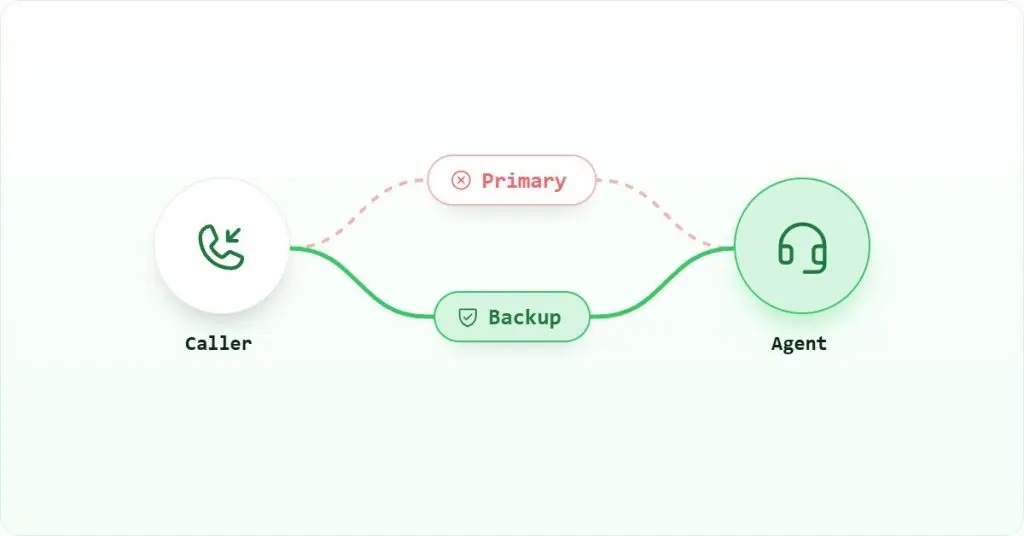
Real-time signals also allow the routing path to adjust mid-queue. If the predicted best agent becomes unavailable while the caller is waiting, the system re-scores remaining agents and updates the assignment rather than holding the caller for an agent who is now occupied. Real-time insights from the call analytics layer feed this re-scoring loop continuously.
Where Predictive Routing Reduces Wait Times
Wait time reduction comes from two mechanisms. First, the system avoids routing callers to agents who are technically available but unlikely to resolve the issue, which would result in a transfer and a second wait. Second, because the model tracks agent handle time by call type, it can factor in how quickly each agent is likely to free up, not just whether they are free right now. A caller routed to an agent who will finish their current call in 30 seconds waits less than one routed to an agent who is free but whose handle time for this call type averages 12 minutes. This predictive queue management improves caller satisfaction by reducing the total time from dial to resolution, not just the time spent in the queue.
What Capabilities Does AI-Powered Routing Add to a Contact Center?
AI-powered routing adds capabilities that static rule engines cannot replicate, because the value comes from continuous learning rather than from the rules themselves. A rule engine is only as good as the last time an administrator updated it. An AI routing model improves with every call it processes, so a contact center running it for six months has a more accurate model than one that just deployed it.

Skill-Based Precision Beyond Skill Tags
Standard skills-based routing matches calls to agents who hold the relevant skill tag. AI routing goes further by weighting those tags against actual performance data. Two agents can both carry a “technical support” tag, but if one resolves network configuration issues in four minutes and the other takes eleven, the model learns that distinction and routes network calls accordingly. The skill tag tells the system who is eligible; the performance history tells it who is likely to succeed.
Adaptive Learning Across Every Interaction
Each completed call produces new outcome data: was the issue resolved, did the caller call back, how long did the interaction take? The model incorporates this data into its next scoring cycle. So when a new call type emerges, such as a product recall or a billing system change that generates unusual call patterns, the model begins adapting within hours rather than waiting for an administrator to write new rules. This adaptive loop is also what makes the system resilient to agent turnover: when a new agent joins, the model starts with their skill profile and updates their scores as their actual performance data accumulates.
Instant Insights From Call Analytics
Instant insights from the analytics layer give supervisors visibility into routing performance in real time, not just in end-of-day reports. They can see which call types are generating the most transfers, which agents are being over-routed to specific categories, and where the model’s confidence scores are lowest. That visibility lets operations teams intervene before a routing problem compounds across hundreds of calls. When paired with autodialer features like CRM sync and call recording, the analytics layer also captures the full interaction history that the routing model needs to improve its predictions.
Where AI Routing Has Limits
AI routing is not the right choice for every contact center. The model needs historical data to make accurate predictions, which means a team with fewer than a few thousand calls per month may not generate enough signal to train a reliable model. This is the cold-start problem: the system’s predictions are weakest when it is new, precisely when the team is most dependent on it. For smaller call centers or teams with low call volume, skills-based routing with well-maintained skill tags often delivers comparable results without the data requirement. AI routing earns its complexity at scale, where the volume of calls makes manual rule maintenance impractical and where the performance differences between agents are large enough to matter.
We’d choose skills-based routing over predictive routing when a team handles fewer than 500 calls per week, because the model simply does not have enough data to outperform a well-configured rule set at that volume.
How Does AI Help Measure and Improve Agent Performance?
AI-assisted performance measurement closes the feedback loop that manual coaching leaves open. A supervisor reviewing call recordings can catch problems in a sample of calls. An AI system processing every call can identify patterns across the full population: which call types consistently produce longer handle times for specific agents, which conversation moments correlate with escalations, and which agents are improving versus plateauing over time.

1. Metrics That Evaluate Agent Effectiveness
The most useful agent metrics combine efficiency and outcome. First-call resolution (FCR) measures whether the caller’s issue was resolved without a callback or transfer. Average handle time (AHT) measures how long the interaction took. Talk time versus after-call work time shows whether an agent is spending disproportionate time on post-call logging, which often signals a CRM workflow problem rather than a skill gap. Caller satisfaction scores, where collected through post-call surveys, add a direct quality signal. Together, these indicators let you distinguish between an agent who is fast but generates callbacks and one who takes longer but resolves issues cleanly. To streamline workflows effectively, you need both dimensions, not just speed.
2. AI-Driven Feedback to Boost Agent Skills
AI-powered analysis of call recordings identifies specific conversation patterns that predict good or poor outcomes. It can flag calls where the agent interrupted the caller frequently, where the resolution took more than three exchanges to reach, or where the caller’s tone shifted negatively after a specific agent response. This granularity makes coaching concrete. Instead of telling an agent to “handle billing calls better,” a supervisor can show them the specific moment in a recorded call where the interaction went off track and why the data suggests that pattern recurs. Over time, this targeted coaching improves agent performance more reliably than general feedback because it is grounded in the agent’s own call history rather than generic best practices.
3. Predicting Agent Success Through Pattern Recognition
Pattern recognition across a large call population also enables forward-looking predictions. If an agent’s FCR rate on a specific call type has been declining over three weeks, that trend is visible in the data before it shows up in a customer complaint or a supervisor’s review. Similarly, if a new agent’s performance on straightforward calls is strong but their handle time on complex escalations is high, the routing model can initially direct complex calls away from them while their skills develop, then gradually increase exposure as their scores improve. This is smarter than either routing all calls equally or manually managing each agent’s queue, because the model updates continuously rather than waiting for a quarterly performance review.
What Are the Core Components of a Predictive Call Routing System?
A predictive call routing system has four components that must work together for the model to produce reliable matches. Understanding each one helps you evaluate whether a system is genuinely predictive or simply marketing a rules engine with a new label.
Historical Call Data Repository
The model needs a structured record of past interactions: who called, which agent handled it, how long it took, whether the issue was resolved, and whether the caller called back. Without this repository, the system has no basis for prediction. The quality of the data matters as much as the volume. If call outcomes are not consistently logged, such as when agents close tickets without recording resolution status, the model trains on incomplete signal and its predictions degrade. This is why CRM hygiene is a prerequisite for predictive routing, not an afterthought.
Agent Skill and Performance Profiles
Skill profiles capture what each agent is qualified to handle. Performance profiles capture how well they actually handle each category, based on outcome data rather than certification. The gap between these two layers is where predictive routing adds value over skills-based routing. An agent certified in four call types may perform well in two and poorly in two others. The model learns that distinction; a static skill tag does not.
Real-Time Queue and Availability Data
Prediction without real-time availability data produces routing decisions that are theoretically optimal but practically impossible. The system needs to know which agents are currently available, how long each has been in their current state, and how long their active calls are likely to run. This real-time layer is what allows the model to balance outcome quality against wait time, routing to the second-best agent if the best agent is occupied and the wait would be unacceptably long.
Machine Learning Scoring Engine
The scoring engine combines the three data layers above into a probability estimate for each available agent on each incoming call. The specific algorithm varies by vendor, but the output is always a ranked list of agents ordered by predicted outcome quality. The engine retrains on new call data continuously, so its accuracy improves as the contact center accumulates more interaction history. This continuous retraining is what distinguishes a predictive system from a rule engine: the rules stay fixed until someone changes them, while the model updates itself.
When Is Predictive Call Routing the Right Choice?
Predictive call routing earns its deployment cost when three conditions are met. First, the contact center handles enough call volume to generate meaningful training data, generally several thousand calls per month across a consistent set of call types. Second, there is measurable performance variation between agents on specific call types, because if all agents perform similarly, the model has nothing to optimise. Third, the CRM and call logging systems are reliable enough to produce clean outcome data, since a model trained on incomplete records will make worse predictions than a well-configured rule set.
When those conditions are not met, the better path is usually to start with skills-based routing, invest in consistent call outcome logging, and revisit predictive routing once the data foundation is solid. Deploying a predictive system on top of poor data does not fix the data problem; it amplifies it, because the model will confidently route calls based on patterns that do not reflect reality.
For teams that do meet the readiness conditions, the decision to upgrade to autodialer systems and add predictive routing together makes sense, because both improvements depend on the same underlying data infrastructure: clean CRM records, consistent call logging and reliable outcome tracking. Building that foundation once serves both capabilities.
Predictive call routing is also not a set-and-forget deployment. The model needs ongoing monitoring to catch drift, which happens when call patterns shift, agent teams change, or product changes alter the distribution of call types. A routing model that was accurate six months ago may be routing on stale patterns today if nobody is watching its performance metrics. Treating the model as a living system rather than a one-time configuration is the operational discipline that separates teams that get sustained value from predictive routing from those that see an initial improvement followed by gradual degradation.
Further Reading: Future of Call Center Automation: AI Agents, Predictive CX
Frequently Asked Questions
Routing Mechanics and Data
Predictive call routing is a contact center technology that uses machine learning to match each incoming caller with the agent most likely to resolve their issue on the first attempt. The system scores available agents against historical outcome data, real-time queue status and caller signals, then routes the call to the highest-scoring available agent rather than the next available one.
AI improves routing by learning from past call outcomes rather than following fixed rules. Each completed call produces new data: resolution status, handle time, callback rate. The model incorporates this data into its next scoring cycle, so its predictions become more accurate over time. A rule engine stays fixed until an administrator changes it; an AI model updates itself continuously.
It can, but the mechanism is indirect. Predictive routing reduces wait times primarily by cutting transfers and repeat calls, which free up agent capacity. It also factors predicted handle time into routing decisions, so callers are not held for an agent who is technically available but likely to take a long time on their current call. The net effect is shorter total time from dial to resolution.
Readiness, Limitations and Agent Impact
Small centers with low call volume often do not generate enough historical data for the model to outperform a well-configured skills-based routing setup. The cold-start problem is real: predictions are weakest when the system is new and data is sparse. For teams handling fewer than a few hundred calls per week, skills-based routing with consistent outcome logging is usually the better starting point, with predictive routing reconsidered once data volume grows.
By matching agents to call types where their historical performance is strongest, the system reduces the frequency of mismatched calls that generate frustration and callbacks. Agents spend more time on calls they handle well, which reinforces their strengths. The analytics layer also surfaces coaching opportunities by identifying specific call patterns that correlate with poor outcomes, making feedback concrete rather than general.
Before deploying a predictive routing model, establish clean call outcome logging in your CRM. The model trains on historical data, so if resolution status, handle time and callback rates are not consistently recorded, the system will learn from incomplete signal. Fix the data foundation first, then evaluate routing vendors. A well-configured skills-based system running on clean data will outperform a predictive system running on poor data.
Predictive routing principles apply to any channel where historical outcome data can be collected and agent performance can be measured by call type. Voice is the most common deployment because call outcome data is well-structured. Extending the same model to chat or email requires consistent outcome logging across those channels and enough volume per channel to train reliable predictions. Mixed-channel deployments are more complex but follow the same data requirements.