Last updated on November 6th, 2026 at 10:40 pm
Quick Answer: Outbound calls from TurboHire work by connecting a VoIP dialer to TurboHire through the platform’s integrations settings. Once connected, a call icon appears on every candidate profile. Recruiters click it to launch the dialer and place calls without leaving TurboHire. All call activity, including duration, notes and recordings, logs automatically to the candidate’s timeline.
AI Summary: Outbound calls from TurboHire require a VoIP integration connected through TurboHire’s Settings panel. This article covers the five-step setup process, explains why manual calling workflows fail in recruitment, and describes what automatic call logging actually does inside TurboHire. It also addresses Indian outbound calling compliance considerations recruiters should understand before running a candidate outreach campaign.
Table of contents
- Why Outbound Calling Matters in Recruitment?
- TurboHire + FreJun: A Seamless Calling Experience
- How to Enable Outbound Calls from TurboHire via FreJun
- Key Benefits of Using FreJun for TurboHire
- Common Challenges in Manual Calling Workflows
- Best Practices for Recruiters Making Calls
- Key Takeaways
- Final Thoughts
- FAQs
Why Outbound Calling Matters in Recruitment?
Outbound calling gives recruiters something that email and automated messages cannot: a live, two-way conversation where a candidate’s hesitation, interest or confusion surfaces in real time. A recruiter who calls a shortlisted candidate can answer objections on the spot, gauge genuine enthusiasm and move the hiring decision forward in a single interaction. That speed matters when strong candidates are fielding multiple offers at once.
Phone calls also carry a different signal than a message in an inbox. When a recruiter calls directly, the candidate understands the role is real and the interest is genuine. That personal touch is harder to replicate through text-based channels, especially during initial outreach when the candidate has no existing relationship with the company.
For recruitment teams working inside TurboHire, the practical question is not whether to call but how to call without breaking their workflow. Switching between TurboHire and a separate phone app means context is lost, notes get forgotten and call outcomes rarely make it back into the candidate record. The sections below explain how a VoIP (Voice over Internet Protocol) integration solves that problem and what the setup actually involves.
- Direct calls create faster hiring decisions than asynchronous messages
- Real-time conversation surfaces candidate intent that written responses hide
- Calling from inside TurboHire keeps the candidate record accurate without extra steps
For more on turning cold recruitment calls into productive conversations, see How to Turn Recruitment Cold Calls.
TurboHire + FreJun: A Seamless Calling Experience
TurboHire supports VoIP integrations so recruiters can call candidates directly from the platform portal, as documented on TurboHire’s integrations page. When a VoIP dialer is connected, the calling experience lives inside TurboHire rather than in a separate application. Recruiters do not switch tabs, copy phone numbers or open a second tool.
The integration works through TurboHire’s native connector. Once the VoIP account is authenticated, a call icon appears on every candidate profile. Clicking it launches the dialer inside TurboHire. The call goes out, and when it ends, the outcome is logged automatically to the candidate’s timeline, including call duration, any notes added during the call and the recording if that feature is enabled.
Three capabilities define what this integration actually delivers in practice:
- Click-to-call directly from any TurboHire candidate profile
- Auto-logging of call notes, duration and recordings to the candidate record
- In-platform dashboards to track team call activity and recruiter performance
Auto-logging matters because it removes the step where information gets lost. When a recruiter finishes a call and has to manually type the outcome into TurboHire, that step is often skipped or done hours later from memory. With automatic logging, the record is accurate by the time the recruiter moves to the next profile. That accuracy is what makes follow-up scheduling and team handovers reliable.
For a broader look at what VoIP calling software adds to a recruitment workflow, see Benefits of Outbound Calling Software.
How to Enable Outbound Calls from TurboHire via FreJun
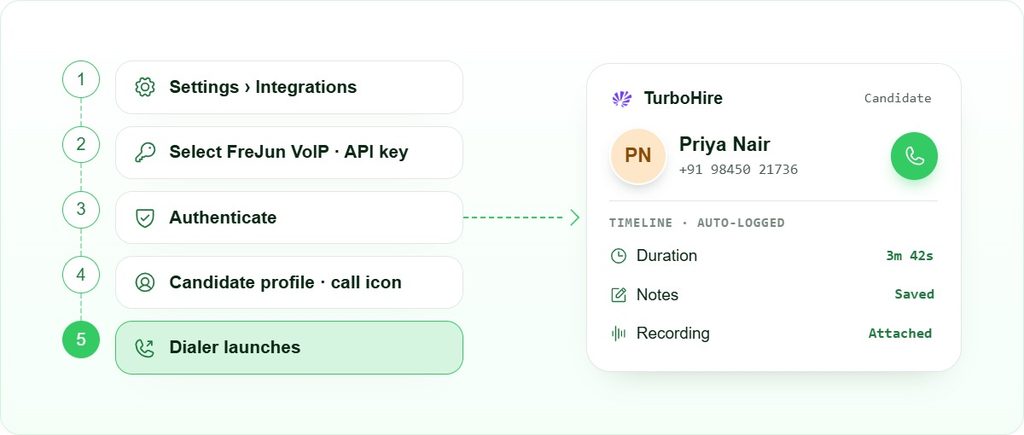
Enabling outbound calls from TurboHire requires connecting a VoIP account through TurboHire’s integrations panel. The process uses an API key to authenticate the connection. No code changes are needed, and the setup does not require IT involvement. The steps below cover the full process from the TurboHire settings panel to placing the first call.
Before starting, confirm you have admin access to your TurboHire account and that your VoIP account is active. You will need your VoIP API key, which is available in your VoIP account’s settings or developer panel.
1. Go to TurboHire > Settings > Integrations
Log in to TurboHire with an admin account. Navigate to the Settings panel using the menu in the top or side navigation. From Settings, open the Integrations section. This is where TurboHire manages all third-party connections, including VoIP providers.
2. Select FreJun VoIP and enter your API key
Inside the Integrations section, locate the VoIP category and select the provider you want to connect. Enter your API key in the field provided. The API key is the credential that links your VoIP account to TurboHire, so copy it carefully from your VoIP account settings to avoid authentication errors.
3. Authenticate your FreJun account
After entering the API key, TurboHire initiates an authentication handshake with the VoIP provider. This step verifies that the API key is valid and that the two accounts are correctly linked. If authentication fails, the most common cause is a copied key with a trailing space or a key generated for the wrong environment. Check the key and retry before contacting support.
4. Open any candidate profile and click the call icon
Once authentication succeeds, the integration activates across all candidate profiles. Open any candidate record in TurboHire and look for the call icon near the candidate’s contact details. If the icon does not appear, refresh the page. In some cases, a browser cache clear is needed before the icon renders correctly.
5. FreJun dialer launches → Start calling
Clicking the call icon launches the VoIP dialer inside TurboHire. The call connects through your VoIP account using the candidate’s stored phone number. When the call ends, TurboHire automatically logs the call duration, any notes entered during the call and the recording if your plan includes that feature. The candidate’s timeline updates immediately, so the record is current before you move to the next profile.
For the full integration reference, see Enable TurboHire Outbound Calling with FreJun.
Key Benefits of Using FreJun for TurboHire
Connecting a VoIP dialer to TurboHire changes how recruiters spend their time during a calling session. Instead of copying numbers, opening a phone app, making the call and then returning to TurboHire to log the outcome, the entire sequence happens inside one interface. The practical effect is that recruiters spend more time in actual conversations and less time on the steps around them.
The benefits below reflect what the integration actually delivers, not what any calling tool promises in general.
One-click calling from candidate profiles
The call icon on each TurboHire profile removes the need to dial manually. Recruiters working through a call list move from one candidate to the next without switching applications or re-entering numbers. This is most valuable during high-volume outreach, where the time cost of manual dialing compounds across dozens of calls in a session.
Automatic call logging to the candidate record
Every call outcome, including whether the call was answered, the duration and any notes added during the conversation, writes back to the candidate’s TurboHire timeline without manual input. This matters for team handovers: when a second recruiter picks up a candidate, the full call history is already there. It also matters for compliance, since a complete call record is easier to audit than a patchwork of notes in different places.
Call recording for review and coaching
Recorded calls stored against the candidate profile give hiring managers a way to review how conversations went, not just what was logged. This is useful for quality checks on recruiter calls and for onboarding new team members who can listen to real examples. Note that call recording in India requires compliance with applicable consent and data protection rules, which are covered in the FAQ section below.
Team performance visibility
In-platform dashboards show call volume, connection rates and activity by recruiter. Managers can see which team members are making calls, how many connect and where candidates are dropping out of the outreach sequence. Without this data, recruitment managers rely on self-reported activity, which is rarely accurate at scale.
When this integration is not the right fit
This setup works well for recruiters making individual outbound calls from candidate profiles. It is not designed for high-volume predictive dialing campaigns where a dialer automatically sequences through hundreds of numbers without recruiter input. For that use case, a standalone Ultimate Guide to Outbound Autodialers covers the options in more depth. Also, teams that need to call international numbers from India should verify that their VoIP plan includes international calling before relying on this integration for cross-border outreach.
Common Challenges in Manual Calling Workflows

Manual calling workflows fail in predictable ways. Understanding the mechanism behind each failure helps explain why integrating calling into TurboHire fixes the problem rather than just moving it.
Missed follow-ups caused by no automatic logging
When a recruiter calls from a mobile phone or a separate dialer, the call outcome exists only in their memory until they manually enter it into TurboHire. That step is frequently skipped during a busy session. The result is a candidate record that shows no call activity, so the next recruiter who opens the profile has no idea whether the candidate was contacted, what was discussed or what the agreed next step was.
Data entry errors from manual transcription
Typing call outcomes by hand introduces errors. A recruiter who takes notes on paper during a call and enters them later misremembers details, abbreviates inconsistently or enters the wrong candidate record entirely. Over a week of calls, these small errors accumulate into a candidate database that cannot be trusted for reporting or handover.
Fragmented tools that slow down each call
A recruiter using TurboHire for candidate management and a separate phone or dialer for calls has to switch between at least two applications for every call. Each switch takes time and breaks concentration. At ten calls per day, that friction is noticeable. At fifty calls per day, it becomes a significant drag on productivity.
No visibility into call quality or recruiter activity
Without call data inside TurboHire, managers cannot see how many calls each recruiter made, how many connected or how long conversations lasted. They rely on self-reporting, which is unreliable. This makes it impossible to identify whether a low offer-acceptance rate is caused by too few calls, poor call quality or a problem at a later stage of the process.
Scalability limits in high-volume hiring
Manual workflows do not scale. A recruiter managing twenty candidates can keep track of call status in their head. A recruiter managing two hundred cannot. Without automated logging and a centralised call record, high-volume hiring creates a coordination problem that no amount of individual effort resolves reliably.
For a broader view of how VoIP integrations address these problems across TurboHire’s ecosystem, see Top 5 TurboHire VoIP Integrations in 2025.
Best Practices for Recruiters Making Calls
Good call outcomes depend on preparation and process, not just on having the right tool. The practices below apply to recruiters making outbound calls from TurboHire in India and address both call quality and regulatory considerations.
Review the candidate profile before dialing
Opening the candidate’s TurboHire profile before clicking the call icon takes thirty seconds and changes the quality of the conversation. A recruiter who knows the candidate’s current role, the position they applied for and any previous call notes can personalise the opening immediately. Candidates notice when a recruiter is reading from a generic script versus speaking to their specific situation.
Call during standard business hours
Calling during normal working hours increases the likelihood of a connection and signals professionalism. For recruitment calls in India, be aware that TRAI (Telecom Regulatory Authority of India) sets permitted calling windows for commercial communications. Recruitment calls to candidates who have not registered a DND (Do Not Disturb) preference are generally permissible during business hours, but teams running structured outreach campaigns should verify current TRAI guidelines directly with their legal or compliance team, since rules can change. The TRAI website is the authoritative source for current regulations.
Introduce yourself clearly at the start of every call
State your name, your company and the reason for the call in the first fifteen seconds. Candidates who do not recognise the number are deciding whether to stay on the line during those first moments. A clear, direct introduction reduces the chance they disengage before the conversation starts.
Keep initial outreach calls brief
The goal of a first outbound call is usually to confirm interest and schedule a longer conversation, not to conduct a full screening. Respecting a candidate’s time during initial contact builds goodwill and increases the likelihood they show up for the follow-up call.
Log notes and schedule follow-ups immediately after the call
Even with automatic call logging, the notes field requires recruiter input. Add a brief summary of the conversation and the agreed next step before moving to the next profile. Notes written immediately after a call are accurate. Notes written at the end of a session are reconstructions.
For outbound dialing practices that apply beyond recruitment, see 5 Tips to Improve Outbound Sales Conversions.
Key Takeaways
Making outbound calls from TurboHire in India requires a VoIP integration connected through TurboHire’s Settings panel. The five-step process covers navigating to Integrations, selecting the VoIP provider, entering an API key, authenticating the account and then using the call icon on candidate profiles. Once active, all call activity logs automatically to the candidate record.
- TurboHire supports VoIP integrations natively through its Settings panel
- The API key is the credential that links the VoIP account to TurboHire
- Automatic logging removes the manual step where call outcomes are most often lost
- This integration suits individual recruiter outbound calls, not high-volume predictive dialing
- Indian outbound calling compliance requires checking current TRAI and DND rules before running structured campaigns
Final Thoughts
Connecting a VoIP dialer to TurboHire solves a specific operational problem: call activity that happens outside the platform never makes it back into the candidate record. The integration closes that gap by keeping the entire calling workflow inside TurboHire, from the initial click to the logged outcome.
The setup is straightforward for any recruiter with admin access to TurboHire and an active VoIP account. The five steps described above cover the full process. The more important question for most teams is not how to set it up but whether their current calling volume and workflow justify the change. For teams making more than ten to fifteen outbound recruitment calls per day, the time saved on manual logging and tool-switching compounds quickly. For teams making fewer calls, the benefit is still real but less urgent.
Outbound calls from TurboHire work best when the candidate data in TurboHire is current and the recruiter has reviewed the profile before calling. The tool removes friction from the calling process. The quality of the conversation still depends on preparation.
Further Reading: Top 5 TurboHire VoIP Integrations in 2025
Frequently Asked Questions
Setup and calling features
Yes. TurboHire supports VoIP integrations that place a call icon on every candidate profile. Once a VoIP account is connected through TurboHire’s Settings panel, recruiters click the icon to launch the dialer and place the call without leaving TurboHire. The integration works through TurboHire’s native connector, as documented on TurboHire’s integrations page.
Yes. When a VoIP dialer is connected to TurboHire, all call outcomes, including whether the call was answered, the call duration and any notes entered during the call, log automatically to the candidate’s timeline. Missed, answered and declined calls all appear in the record without manual input from the recruiter.
No coding is required. The setup uses TurboHire’s Settings panel and an API key from your VoIP account. Any recruiter or hiring manager with admin access to TurboHire can complete the process. The main prerequisite is having an active VoIP account and the API key ready before starting.
Compliance and follow-up
Yes. After each call, recruiters can add tags such as Follow-Up, Interested or Not Available to the candidate record in TurboHire. Combined with automatic call logging, these tags give the full team visibility into where each candidate stands without relying on individual memory or separate spreadsheets.
Outbound calling in India is regulated by TRAI (Telecom Regulatory Authority of India) under the TCCCPR framework. Recruiters should verify current permitted calling hours and DND (Do Not Disturb) obligations directly with their legal team, since rules apply differently depending on whether the call is classified as a commercial communication. The TRAI website is the authoritative source. This article is not legal advice.
Whether international calls are supported depends on the VoIP plan connected to TurboHire. The integration itself does not restrict international calling, but the VoIP account must include international calling coverage for the destination countries. Verify your plan’s coverage before relying on this integration for cross-border outreach.
If the call icon does not appear on candidate profiles after completing authentication, try refreshing the page first. If the icon still does not appear, clear your browser cache and reload TurboHire. The most common causes are a cached page state or an authentication that did not complete correctly due to a copied API key with a trailing space or incorrect environment setting.