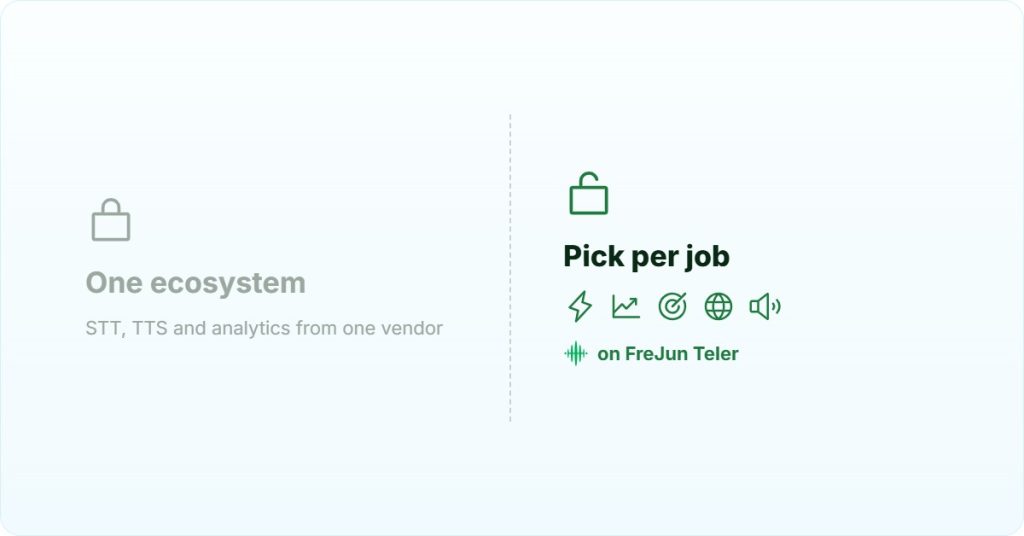

AI Summary: This article compares the top 7 Vonage API alternative USA platforms for developers building AI voice agents in 2026, evaluating each on real-time latency, model compatibility, US pricing, and TCPA compliance. As of 2026, the global conversational AI market is projected to exceed $29 billion by 2028, according to MarketsandMarkets, making voice API selection a foundational infrastructure decision for any AI product team. Developers need a platform that delivers sub-100ms latency, integrates with any STT, LLM, or TTS provider without lock-in, and handles US carrier compliance automatically. FreJun Teler meets all three requirements, with outbound calling from $0.20 per minute and raw WebSocket streaming that works with any AI stack the team already uses.
Key criteria in this comparison: We ranked these platforms on pricing transparency, real-time WebSocket latency, TCPA compliance support, model-agnosticism, and documentation quality, since these are the factors that most affect a developer team’s build speed and total cost when choosing a Vonage API alternative USA.
Quick Answer: The best Vonage API alternative USA in 2026 is FreJun Teler, a purpose-built voice API that streams raw audio over WebSocket with sub-100ms latency so AI agents can respond in real time. Teler is model-agnostic, works with any STT, LLM, or TTS provider, and starts at $15 per channel per month with outbound calling at $0.20 per minute.
The best Vonage API alternative USA for AI voice agent development is Teler, which delivers sub-100ms WebSocket streaming latency and a fully model-agnostic architecture that general CPaaS platforms cannot match for real-time AI voice workloads.
What is Vonage API?
Vonage API, now part of Ericsson, is a CPaaS (Communications Platform as a Service) platform that gives developers programmable access to voice, SMS, and video over the internet. Businesses use it to add calling and messaging to their applications without building telecom infrastructure from scratch. Many teams look for a Vonage API alternative USA because Vonage’s pricing model can become unpredictable at scale, its audio abstraction layer adds latency that makes real-time AI inference difficult, and its general-purpose design means developers must build significant custom engineering to support AI voice agent architectures. For US teams specifically, TCPA (Telephone Consumer Protection Act) compliance, A2P 10DLC registration, and predictable per-minute pricing in USD are the key requirements any alternative must meet. Teams building AI voice agents outside the US should note that requirements differ by region, and developers evaluating Vonage API alternatives in India will find different pricing, number provisioning, and compliance rules than the TCPA-driven US market covered here.
The US voice API market is growing fast. As of 2026, the global CPaaS market is projected to reach $45 billion by 2030 at a CAGR of over 20%, according to Grand View Research, driven largely by AI voice agent deployments in customer service, healthcare, and financial services. What separates the best Vonage API alternative USA platforms from basic CPaaS providers is the ability to stream raw audio directly to a developer’s server over WebSocket, a persistent full-duplex connection that keeps the audio channel continuously open, rather than abstracting it through a proprietary layer that adds 400 to 800ms of latency.
Which Vonage API alternative USA platforms rank highest in 2026?
The table below compares all seven platforms on best-fit use case, starting price in USD, and free trial availability so you can shortlist quickly before reading the full profiles.
| # | Provider | Best for | Starting price (USD) | Free trial |
|---|---|---|---|---|
| 1 | FreJun Teler | AI voice agent infrastructure | $15/channel/month + $0.20/min outbound | Yes – free credits on signup |
| 2 | Twilio | Broad CPaaS teams | ~$0.013/min voice | Yes – free trial with credits |
| 3 | Plivo | Budget voice APIs | ~$0.01/min voice | Yes – free to start |
| 4 | Telnyx | Low-cost voice control | ~$0.002/min voice | Check website |
| 5 | Bandwidth | US enterprise voice | ~$0.0055/min voice | Check website |
| 6 | Sinch | Enterprise omnichannel scale | Contact sales | Check website |
| 7 | Bird (MessageBird) | Omnichannel messaging teams | Free tier; paid from ~$45/month | Yes – free tier available |
Scroll down for the full breakdown of each Vonage API alternative USA option, covering features, pros, cons, pricing, and ideal use case.
How do you choose the best Vonage API alternative USA in 2026?
Step 1: Define your AI voice architecture
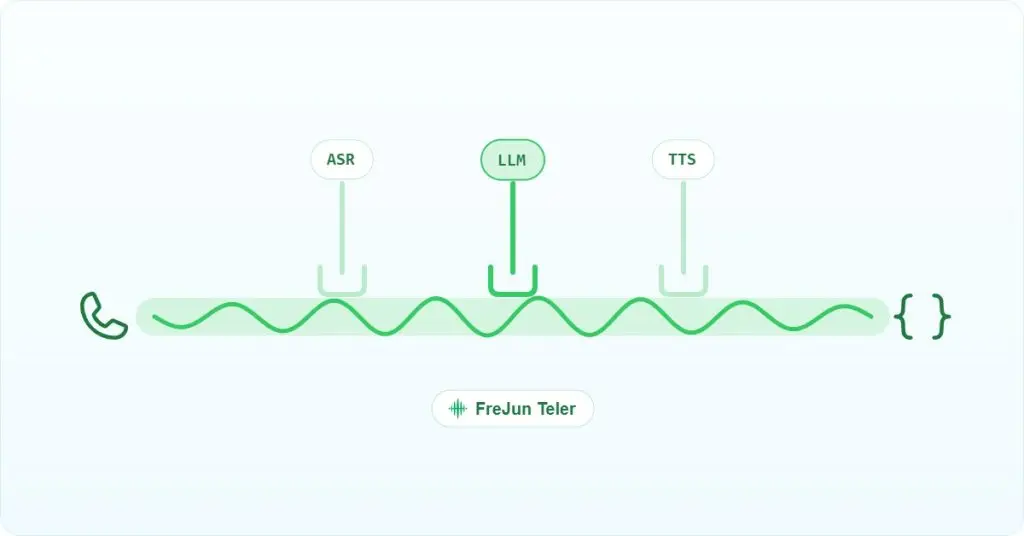
Before comparing providers, map out the STT (Speech-to-Text) engine, LLM (Large Language Model), and TTS (Text-to-Speech) components you plan to use. STT converts the caller’s voice into text the LLM can process. The LLM reads that text and decides what to respond. TTS converts the AI’s text response back into natural-sounding audio. If you need conversational AI that feels natural, your full media streaming loop must complete in under 100ms. Form-filling bots or appointment schedulers can tolerate up to 500ms. Knowing your latency budget upfront eliminates providers that abstract the audio layer and add unnecessary delay.
Step 2: Choose your integration path
Two integration paths exist for AI voice: WebSocket streaming and SIP trunking. WebSocket keeps a persistent, full-duplex connection open between the caller and your server, so raw audio flows continuously with no HTTP round-trip overhead. This is the right path for AI voice agents that need sub-100ms response loops. SIP (Session Initiation Protocol), the standard protocol for establishing voice calls over the internet, is better when you are connecting an existing SIP-enabled platform or enterprise PBX to a carrier network. If you are building a new AI voice product from scratch, WebSocket is almost always the right starting point. If you are integrating with legacy telephony infrastructure, SIP trunking gives you the carrier connectivity without replacing what already works.
Step 3: Check US carrier and TCPA compliance requirements
In the US, the FCC enforces TCPA (Telephone Consumer Protection Act) rules that require prior express written consent before placing automated calls or sending automated texts to mobile numbers. AI outbound calling adds an extra layer of complexity because the FCC has clarified that AI-generated voice calls are subject to the same consent requirements as pre-recorded messages. Any Vonage API alternative USA you choose must support A2P 10DLC registration for SMS and must not call numbers on the National Do Not Call Registry. Confirm that your provider documents these compliance steps clearly, since the carrier-level registration burden falls on the developer, not the platform.
Step 4: Evaluate US pricing in detail
Per-minute voice rates are only one part of the cost. Compare channel costs (the concurrent call capacity you are paying for), media streaming fees (charged separately by some providers for WebSocket audio), recording and storage fees, and virtual number rental. A provider with a low per-minute rate but a high channel cost can end up more expensive than a provider with a slightly higher per-minute rate and no channel minimum. Build a realistic monthly cost model based on your expected call volume before committing to any platform.
Step 5: Test latency and audio quality on a real call
Published latency numbers are a starting point, not a guarantee. Run a real call through your full STT to LLM to TTS pipeline before signing a contract. Teler gives developers $5 in free calling credits on first upgrade for UAE plans, so you can test the complete stack before paying. The getting-started guide at knowledge.frejun.com walks through WebSocket integration step by step. A working first call is achievable the same day, since Teler uses the same WebSocket protocol developers already know from real-time web applications.
Top 7 Vonage API alternative USA platforms for AI voice in 2026
1. FreJun Teler – Purpose-built voice API for AI agents

FreJun Teler is a developer-first voice API built specifically for AI voice agent infrastructure, giving teams in the US a Vonage API alternative USA that streams raw audio over WebSocket with sub-100ms latency and zero AI provider lock-in.
Best for: AI voice agents and real-time bots
Key features
- Raw WebSocket audio streaming in L16/8000Hz format delivers the full media streaming loop (Voice to STT to LLM to TTS to Voice) in under 100ms, so AI agents respond at a pace that feels natural to callers.
- Model-agnostic architecture means developers bring their own STT engine (Google STT, Deepgram, Whisper, AssemblyAI), LLM (OpenAI GPT, Anthropic Claude, Google Gemini), and TTS (ElevenLabs, Azure TTS, Play.ht) without any Teler-mandated provider.
- SIP trunking with TCP/TLS transport and credential-based or IP-based authentication connects existing SIP-enabled platforms directly to Teler’s carrier network, so teams with legacy telephony infrastructure do not need to replace it.
- REST API endpoints and webhook callbacks give developers standard HTTP call control and event-based notifications when calls start, end, or change state, so no proprietary SDK is required to get a first call working.
- Compatible with orchestration platforms including AWS, Google Cloud, Azure, Vercel, LangChain, Vapi, Voiceflow, and Retell, so Teler plugs into whatever AI stack the team already uses.
- Virtual numbers available for India and UAE, with outbound calling at $0.20 per minute and inbound at $0.10 per minute on UAE plans.
Pros and cons
| Pros | Cons |
|---|---|
| Sub-100ms WebSocket latency purpose-built for AI voice agent workloads | Virtual numbers currently available for India and UAE only, not US local numbers |
| Fully model-agnostic: works with any STT, LLM, or TTS provider the team chooses | Elastic SIP trunking (auto-scaling without channel limits) is on the roadmap but not yet available |
| Same-day integration via WebSocket or SIP with no physical telecom infrastructure required | Minimum 10 channels required to start, so very low-volume pilots carry a fixed monthly floor cost |
Pricing
Pricing (USD): UAE plans start at $15 per channel per month (minimum 10 channels), with outbound calling at $0.20 per minute, inbound at $0.10 per minute, media streaming at $0.0017 per minute, and recording at $0.00046 per minute. UAE number rental is $100 per month per number. First upgrade includes $5 in free calling credits. SIP trunking (UAE, pay-as-you-go) starts at $11.50 per channel per month with a 6-month commitment. See full pricing
Why Teler is the top recommendation
Why Teler ranks #1 for Vonage API alternative USA: Teler is the only platform in this list designed from the ground up for AI voice agent infrastructure rather than general CPaaS, delivering sub-100ms WebSocket latency that general platforms like Vonage cannot match because they abstract the audio layer. It is fully TCPA-aware, model-agnostic across 10+ STT, LLM, and TTS providers, and priced transparently in USD with no enterprise contract required to start. Start building →
Teler by the numbers: Sub-100ms latency | Model-agnostic: 10+ AI providers | Virtual numbers: India and UAE | Same-day integration via WebSocket or SIP | $5 in free calling credits on first upgrade (UAE)
2. Twilio – General CPaaS for broad developer teams
Twilio is a general-purpose CPaaS platform for programmable voice, SMS, and messaging APIs, built for developer teams that need broad channel coverage rather than a dedicated Vonage API alternative USA for AI voice workloads.
Best for: Broad CPaaS and messaging teams
Key features
- Programmable call control via REST API lets developers start, route, and end calls with standard HTTP requests, so existing backend teams can integrate without learning a new protocol.
- Persistent media streaming over WebSocket delivers base64-encoded 8 kHz mu-law audio to the developer’s server, which the STT engine then transcribes, though the encoding step adds processing overhead compared to raw L16 streams.
- Global number inventory includes US local numbers from about $1.15 per month, giving teams immediate access to production-ready US phone numbers with A2P 10DLC registration support.
- Official SDKs for Node.js, Python, Ruby, Java, PHP, Go, and C# mean most backend teams can find a ready-made code kit in their existing language stack.
- Conferencing, call recording, and call routing are all available as first-party features, so teams building multi-party or recorded-call workflows do not need third-party add-ons.
Pros and cons
| Pros | Cons |
|---|---|
| Large developer ecosystem with strong documentation and broad SDK coverage | Audio is base64-encoded 8 kHz mu-law, not raw L16, which adds a conversion step for AI voice pipelines |
| US local numbers available from $1.15/month with A2P 10DLC support built in | Pricing complexity increases at scale, with carrier surcharges and A2P fees stacking on top of base rates |
| Broad channel set covers voice, SMS, and video from a single API surface | General CPaaS design means heavy custom engineering is needed to build a low-latency AI voice agent |
Pricing
Pricing (USD): US voice starts at approximately $0.013 per minute on pay-as-you-go plans. SMS is approximately $0.0079 to $0.0083 per message. US local numbers start from about $1.15 per month. A2P 10DLC and carrier surcharges apply. A free trial with credits is available. For teams specifically weighing Twilio against other options, a dedicated Twilio alternative USA comparison can help clarify pricing and latency tradeoffs beyond what’s covered here. Developers based in India comparing options outside the US market should instead check a dedicated Twilio alternative India guide for region-specific pricing and compliance details. See full pricing
3. Plivo – Budget-friendly voice API with SIP trunking
Plivo is a programmable voice and SMS CPaaS with SIP trunking built for cost-sensitive developers who need a Vonage API alternative USA with lower per-minute rates and a straightforward REST API.
Best for: Budget-conscious voice API teams
Key features
- Low-cost US voice rates at approximately $0.01 per minute let cost-sensitive teams run high call volumes without the per-minute bill shock that comes with larger CPaaS providers.
- Zentrunk SIP trunking gives teams a direct SIP path to Plivo’s carrier network, so existing SIP-enabled platforms connect without rebuilding the telephony layer.
- REST call control API follows standard HTTP patterns, so developers already familiar with REST-based integrations can get a first call working quickly without learning a proprietary call-flow language.
- US local and toll-free numbers are available from $0.50 to $1.00 per month, with no monthly minimum required to start on the Professional plan.
- Official SDKs for Node.js, Python, Ruby, Java, PHP, Go, and .NET cover most common backend stacks.
Pros and cons
| Pros | Cons |
|---|---|
| Among the lowest US voice per-minute rates of any CPaaS provider at ~$0.01/min | WebSocket media streaming support is not documented, so AI voice builders must assemble the streaming layer themselves |
| No monthly minimum to start, so low-volume pilots carry no fixed floor cost | AI-specific integrations are limited compared to platforms designed for AI voice agent workloads |
| SIP trunking via Zentrunk connects existing SIP infrastructure without a full migration | Documentation is strong for standard telephony but thin on AI voice streaming patterns |
Pricing
Pricing (USD): US voice starts at approximately $0.01 per minute. SMS starts at approximately $0.0055 per message. US local numbers from $0.50 per month. Free to start on the Professional plan with no stated credit limit. Teams weighing Plivo specifically against other budget-friendly options can also review a focused Plivo alternative USA comparison for a deeper look at pricing and streaming capabilities. See full pricing
4. Telnyx – Carrier-grade voice at low US per-minute rates

Telnyx is a carrier-grade communications and networking platform for voice, messaging, SIP, and identity, positioned as a low-cost Vonage API alternative USA for developers who want direct carrier access without the CPaaS markup.
Best for: Low-cost voice control with carrier access
Key features
- Owned carrier network means Telnyx routes calls directly without a wholesale intermediary, which is why US voice rates can be as low as $0.002 per minute, significantly below most CPaaS providers.
- WebSocket media streaming delivers base64-encoded 8 kHz mu-law audio to the developer’s server, giving AI voice builders a real-time audio path, though the encoding format differs from raw L16 streams.
- SIP trunking alongside REST call control gives teams two integration paths: WebSocket for AI voice agents and SIP for connecting existing enterprise telephony infrastructure.
- Fax and identity-style telco primitives are available as first-party features, so teams building compliance-heavy workflows do not need separate providers for those channels.
- Official SDKs for Node.js, Python, Ruby, Java, PHP, Go, and C# cover most common backend stacks.
Pros and cons
| Pros | Cons |
|---|---|
| Among the lowest US voice per-minute rates available at ~$0.002/min due to owned carrier network | Audio format is base64-encoded 8 kHz mu-law, not raw L16, adding a conversion step for AI pipelines |
| WebSocket streaming and SIP trunking both available, giving developers two real integration paths | No free trial documented, so teams must commit spend before testing the full stack |
| Strong documentation for real-time telephony and AI voice builders | Pricing model can feel complex for teams new to carrier-grade platforms |
Pricing
Pricing (USD): US voice starts at approximately $0.002 per minute. SMS starts at approximately $0.004 per message. No free trial found. Developers who want to explore other low-cost, carrier-grade options can also read a dedicated Telnyx alternative USA comparison for additional context on pricing and streaming support. See full pricing
5. Bandwidth – US-primary carrier platform for enterprise voice
Bandwidth is a US-primary carrier-grade telephony platform for voice, SMS, SIP trunking, call recording, and compliance-heavy deployments, built for enterprise teams that need direct carrier control as a Vonage API alternative USA.
Best for: US enterprise voice and 911 compliance
Key features
- Direct carrier control over US number management means Bandwidth owns the underlying network, so enterprise teams get carrier-level reliability without routing through a wholesale intermediary.
- E911 and 911-oriented deployment support makes Bandwidth a strong fit for enterprise voice applications where emergency call routing is a compliance requirement.
- Call recording and real-time transcription are available as first-party features, so teams building quality-assurance or compliance-recording workflows do not need a separate recording provider.
- SIP trunking gives existing enterprise PBX and UCaaS platforms a direct path to Bandwidth’s carrier network without replacing the telephony infrastructure already in place.
- REST API call control follows standard HTTP patterns, so backend teams can integrate without learning a proprietary call-flow language.
Pros and cons
| Pros | Cons |
|---|---|
| US-focused direct carrier with strong E911 and compliance-heavy deployment support | No raw WebSocket audio streaming documented, so AI voice builders need a SIP or media bridge to connect an AI stack |
| Real-time transcription and call recording available as first-party features | Documentation is thin on AI agent streaming patterns, requiring significant custom engineering |
| Low US voice rate at ~$0.0055/min makes it cost-effective for high-volume enterprise deployments | No free trial found, and pricing requires a sales conversation for most enterprise configurations |
Pricing
Pricing (USD): US voice starts at approximately $0.0055 per minute. SMS starts at approximately $0.004 per message. No free trial found. Contact sales for enterprise configurations. See full pricing
6. Sinch – Enterprise omnichannel communications at scale

Sinch is an enterprise communications platform for SMS, verification, voice, and omnichannel messaging, built for large-scale teams that need a Vonage API alternative USA with global reach and enterprise-grade support contracts.
Best for: Enterprise omnichannel at global scale
Key features
- Global verification and OTP workflows let enterprise teams run identity verification at scale across SMS, voice, and WhatsApp from a single API surface.
- Omnichannel messaging covers SMS, WhatsApp, Instagram, and email in one platform, so enterprise teams managing multiple customer channels do not need separate providers for each.
- Voice API with REST call control gives developers a standard HTTP path to programmable voice, though raw WebSocket audio streaming is not documented for AI voice agent workloads.
- Official SDKs for Node.js, Python, Java, and C# cover the most common enterprise backend stacks.
- Enterprise support contracts and SLA-backed uptime commitments are available for teams that need guaranteed response times and dedicated account management.
Pros and cons
| Pros | Cons |
|---|---|
| Single API surface for SMS, WhatsApp, voice, and email reduces vendor sprawl for omnichannel teams | No public US pricing found; requires a sales conversation before teams can model costs |
| Global verification and OTP workflows are well-documented and production-ready | No raw WebSocket audio streaming documented, so AI voice builders must assemble the media layer themselves |
| Enterprise SLA and support contracts available for teams with uptime requirements | Not purpose-built for AI voice agent workloads, so latency for real-time AI inference is not optimized |
Pricing (USD): Contact sales. No public US pricing found.
7. Bird (MessageBird) – Omnichannel messaging with a free tier

Bird, originally known as MessageBird, is an omnichannel communications platform for messaging, support, and marketing workflows, built for teams that want SMS, WhatsApp, email, and automation in one stack as a Vonage API alternative USA.
Best for: Omnichannel messaging and marketing teams
Key features
- Omnichannel inbox and automation combine SMS, WhatsApp, and email into a single workflow engine, so support and marketing teams manage all channels without switching between tools.
- One API surface for SMS, WhatsApp, and email reduces integration complexity for teams that need to reach customers across multiple channels from a single codebase.
- Free tier with paid plans from approximately $45 per month gives teams a low-friction entry point for pilots before committing to a production contract.
- REST API and webhook-style integration follow standard patterns, so developers familiar with event-driven architectures can connect Bird to existing backend systems quickly.
- Official SDKs for Node.js and Python cover the most common web backend stacks for messaging-focused teams.
Pros and cons
| Pros | Cons |
|---|---|
| Free tier available with paid plans from ~$45/month, making pilots accessible without a sales call | No raw WebSocket audio streaming documented, so AI voice builders need external media plumbing |
| Single API surface for SMS, WhatsApp, and email reduces vendor count for omnichannel teams | Not designed for real-time AI voice agent workloads; latency for live voice inference is not optimized |
| Low-friction onboarding with a free tier lets teams test messaging workflows before committing | US virtual number and TCPA compliance specifics are not clearly documented in public resources |
Pricing
Pricing (USD): Free tier available. Paid plans start at approximately $45 to $49 per month depending on the plan. See full pricing
Vonage API alternative USA feature comparison: 2026
| Feature | Teler | Twilio | Plivo | Telnyx | Bandwidth | Sinch | Bird |
|---|---|---|---|---|---|---|---|
| Raw WebSocket audio streaming | Yes – L16/8000Hz, sub-100ms | Partial – base64 8kHz mu-law | No | Partial – base64 8kHz mu-law | No | No | No |
| Model-agnostic AI stack (BYO STT/LLM/TTS) | Yes – zero lock-in | Yes – via media stream | Yes – via REST/SIP | Yes – via media stream | Yes – via REST/SIP | Yes – via REST | Yes – via REST |
| SIP trunking | Yes – TCP/TLS, credential or IP auth | Partial – via Elastic SIP | Yes – Zentrunk | Yes – owned carrier | Yes | Partial | No |
| TCPA compliance documentation | Yes | Yes | Partial | Partial | Yes | Partial | Partial |
| Free trial or free tier | Yes – $5 credits on first upgrade | Yes – free trial with credits | Yes – free to start | No | No | No | Yes – free tier |
| AI orchestration platform compatibility | Yes – Vapi, Retell, LangChain, Voiceflow | Partial – custom integration required | No documented compatibility | No documented compatibility | No documented compatibility | No documented compatibility | No documented compatibility |
Teler is the only platform in this comparison with documented compatibility across AI orchestration layers like Vapi, Retell, and LangChain, while also offering raw WebSocket streaming that keeps the full media loop under 100ms.
Which Vonage API alternative USA is right for your team in 2026?
Different teams have different priorities. The right Vonage API alternative USA depends on whether you are building a new AI voice product, migrating enterprise telephony, or running omnichannel messaging campaigns.
If you are building an AI voice agent from scratch: Choose Teler. It is the only platform in this list designed specifically for AI voice agent infrastructure, with sub-100ms WebSocket latency and zero AI provider lock-in.
If you need a broad CPaaS with SMS, voice, and video from one provider: Choose Twilio. Its channel breadth and developer ecosystem are unmatched, though you will need custom engineering to hit low-latency AI voice performance.
If you are cost-sensitive and running high call volumes on a tight budget: Choose Plivo or Telnyx. Both offer US voice rates well below the CPaaS average, with Telnyx’s owned carrier network pushing rates as low as $0.002 per minute.
If you are an enterprise team with E911 requirements and existing SIP infrastructure: Choose Bandwidth. Its direct carrier control and E911 support make it the strongest fit for compliance-heavy US enterprise deployments.
If you need omnichannel messaging across SMS, WhatsApp, and email: Choose Bird for smaller teams or Sinch for enterprise scale. Neither is optimized for AI voice agent workloads, but both cover messaging channels that voice-only APIs do not.
Which tool wins overall in the US?
If you want the best overall Vonage API alternative USA with AI features, USD billing, and TCPA compliance support: Choose Teler. No other platform in this list combines sub-100ms WebSocket latency, model-agnostic architecture across 10+ AI providers, and same-day integration via the same WebSocket protocol developers already know.
Frequently asked questions about Vonage API alternative USA in 2026
What is the best Vonage API alternative USA in 2026?
The best Vonage API alternative USA in 2026 is FreJun Teler. It is purpose-built for AI voice agent infrastructure rather than general CPaaS, which means it delivers sub-100ms latency over a raw WebSocket stream instead of abstracting the audio layer the way Vonage does. Teler is also fully model-agnostic, so developers bring their own STT, LLM, and TTS providers without any platform-mandated lock-in. Since the full media streaming loop completes in under 100ms, AI agents built on Teler respond at a pace that feels natural to callers, which general CPaaS platforms cannot reliably achieve.
How much does a Vonage API alternative USA cost in 2026?
Costs vary significantly by provider and use case. Teler’s UAE plans start at $15 per channel per month (minimum 10 channels), with outbound calling at $0.20 per minute, inbound at $0.10 per minute, and media streaming at $0.0017 per minute. Twilio charges approximately $0.013 per minute for US voice. Telnyx is the lowest-cost option at approximately $0.002 per minute, while Bandwidth comes in at approximately $0.0055 per minute. Plivo sits around $0.01 per minute with no monthly minimum. For AI voice workloads, per-minute rate is only part of the cost: channel fees, media streaming fees, and recording fees all add up, so build a full monthly model before choosing.
What latency can developers expect from a Vonage API alternative USA?
Latency, the delay between when a person speaks and when they hear a response, is the most critical metric for AI voice agents. As of 2026, Teler’s WebSocket streaming delivers sub-100ms latency for real-time AI voice loops, fast enough for natural, uninterrupted conversation. General CPaaS platforms like Vonage, Twilio, and Plivo abstract the audio layer through a proprietary conversion step, which typically adds 400 to 800ms of delay. That extra delay is acceptable for human-to-human calls but breaks the conversational feel of an AI agent. Raw WebSocket streaming, which keeps the audio channel continuously open between the caller and the developer’s server, is the only architecture that reliably achieves sub-100ms end-to-end latency.
Which Vonage API alternative USA works with any STT, LLM, or TTS provider?
Teler is the only platform in this list explicitly designed for model-agnostic AI voice stacks. Developers bring their own STT engine (Google STT, Deepgram, Whisper, or AssemblyAI), their own LLM (OpenAI GPT, Anthropic Claude, or Google Gemini), and their own TTS engine (ElevenLabs, Azure TTS, or Play.ht). Teler handles only the voice transport layer and pays nothing to any AI provider on the developer’s behalf. This matters in production because AI model costs and capabilities change fast. If a better STT engine ships next quarter, a model-agnostic architecture lets you swap it in without renegotiating a platform contract or rebuilding the telephony layer.
What does TCPA compliance mean for AI outbound calling in the US?
TCPA (Telephone Consumer Protection Act), enforced by the FCC, requires prior express written consent before placing automated calls or sending automated texts to mobile numbers in the US. For AI voice agents specifically, the FCC has clarified that AI-generated voice calls are subject to the same consent requirements as pre-recorded messages, since the caller cannot distinguish between a live human and a well-built AI agent. Any Vonage API alternative USA used for outbound AI calling must support A2P 10DLC registration for SMS campaigns and must not dial numbers listed on the National Do Not Call Registry. Developers carry the compliance burden at the application layer, so choose a provider that documents these requirements clearly and supports the carrier registration steps needed to stay compliant.
What does Teler offer that Vonage does not for AI voice agents?
Vonage abstracts the audio layer for general CPaaS use cases, which adds latency that makes real-time AI inference difficult. Teler streams raw L16/8000Hz audio directly to the developer’s server over a persistent WebSocket connection, so the STT engine receives it with no conversion layer in the way. The full media streaming loop completes in under 100ms on Teler, compared to 400 to 800ms on general CPaaS platforms. Teler is also model-agnostic across 10+ STT, LLM, and TTS providers, while Vonage’s AI integrations are more limited. Since Teler is purpose-built for AI voice agent infrastructure rather than general telephony, developers spend less time building custom audio plumbing and more time building the AI product itself.
What is the difference between SIP trunking and WebSocket streaming for AI voice?
SIP (Session Initiation Protocol) is the standard protocol for establishing voice calls over the internet. SIP trunking connects an existing SIP-enabled platform or enterprise PBX to a carrier network, so teams with legacy telephony infrastructure can add carrier connectivity without replacing what already works. WebSocket streaming is a persistent, full-duplex connection that keeps the audio channel continuously open between the caller and the developer’s server. Because WebSocket never closes between turns, raw audio flows to the STT engine in real time with no HTTP round-trip overhead. For new AI voice agent builds, WebSocket is the right starting point. For teams integrating with existing enterprise telephony, SIP trunking is the practical path. Teler supports both.
How do I get started building an AI voice agent with a Vonage API alternative USA?
Start by mapping the full media streaming loop: the caller speaks, Teler captures the voice and streams raw audio to your server over WebSocket, your STT engine converts the audio to text, your LLM reads the text and decides what to respond, your TTS engine converts that response back to audio, and Teler plays it back to the caller. The full loop completes in under 100ms on Teler. Sign up at platform.frejun.ai and use the $5 in free calling credits included on first upgrade to test the complete stack before paying. The getting-started guide at knowledge.frejun.com walks through WebSocket integration step by step, and a working first call is achievable the same day since Teler uses standard WebSocket, not a proprietary protocol.
Conclusion: Best Vonage API alternative USA in 2026
The top three Vonage API alternative USA platforms in 2026 are Teler (AI-first), Twilio (breadth), and Telnyx (cost). Teler is the top recommendation for any team building real-time AI voice agents in the US because it is the only platform in this list that combines sub-100ms WebSocket latency, a fully model-agnostic architecture across 10+ AI providers, and transparent USD pricing with no enterprise contract required to start. If your team is ready to build, sign up at platform.frejun.ai and use the free credits to test the full stack today.