Quick Answer: The best voiceflow voice api india option in 2026 is FreJun Teler, which delivers sub-100ms WebSocket streaming latency, a fully model-agnostic architecture compatible with any STT, LLM, or TTS provider, and outbound calling from ₹0.15 per minute with 25,000 free minutes on first upgrade. Teler is purpose-built for AI voice agents, unlike general CPaaS platforms that abstract the audio layer and add latency.
AI Summary: This article compares the top 7 voiceflow voice api india options for developers building real-time AI voice agents in India in 2026, evaluating each on WebSocket latency, model compatibility, INR pricing, and TRAI compliance. As of 2026, the global conversational AI market is projected to exceed $29 billion by 2028, according to MarketsandMarkets, making telephony infrastructure selection a foundational decision for any AI product team. Developers need a voice API that delivers sub-100ms latency, integrates with any STT, LLM, or TTS provider without lock-in, and handles carrier-level TRAI compliance automatically.
Key criteria in this comparison: We ranked these platforms on real-time WebSocket latency, model-agnostic architecture, India-specific pricing transparency, TRAI compliance support, and documentation quality, since these are the factors that most affect a developer team’s build speed and total cost when deploying AI voice agents in India.
The best voiceflow voice api india solution gives developers raw audio access over WebSocket so their AI stack can process speech in real time, and Teler leads this category with its sub-100ms media streaming loop and zero provider lock-in.
What is Voiceflow and why does it need a voice API in India?
Voiceflow is a visual AI agent builder that lets developers and product teams design, prototype, and deploy conversational AI agents without writing every component from scratch. When those agents need to speak and listen over real phone calls, Voiceflow requires a telephony layer underneath it, which is where a voiceflow voice api india provider becomes essential. The best providers supply real-time audio streaming, virtual phone numbers, and carrier-grade call control so the Voiceflow agent can handle inbound and outbound calls on the Indian PSTN network. Businesses in India specifically need a provider that offers INR pricing, TRAI-compliant number series, and low-latency audio delivery to Indian carriers, since latency and regulatory gaps are the two most common reasons AI voice deployments fail in production.
India’s AI voice agent market is growing fast. As of 2026, the Indian conversational AI market is projected to grow at a CAGR of over 25% through 2030, according to IMARC Group, driven by demand from BFSI, e-commerce, and healthcare sectors that need automated outbound calling at scale. What separates a basic voiceflow voice api india provider from the best platforms is the combination of raw WebSocket audio access, model-agnostic design, and genuine TRAI compliance support built into the platform rather than bolted on as an afterthought. Teams building similar AI voice agents on Voiceflow outside India can also compare Voiceflow voice API options for the US market, since the underlying model-agnostic architecture principles carry over even when local pricing and compliance rules differ.
Which voiceflow voice api india providers rank highest in India in 2026?
The table below compares all seven voiceflow voice api india providers on best use case, starting price, and free trial availability so you can shortlist quickly before reading the full profiles.
| # | Provider | Best for | Starting price (India) | Free trial |
|---|---|---|---|---|
| 1 | FreJun Teler | AI voice agent infrastructure | Check Pricing | Yes 25,000 free minutes on first upgrade |
| 2 | Twilio | Voiceflow call automation | Contact sales | Check website |
| 3 | Plivo | India SIP and streaming | ₹0.34/min (browser/SIP) or ₹0.60/min (local) | Check website |
| 4 | Telnyx | Low-cost AI routing | $0.002/min | Check website |
| 5 | Exotel | India voice compliance | Contact sales | Check website |
| 6 | Vonage API | Webhook-based voice apps | Contact sales | Check website |
| 7 | Daily | Browser-native voice agents | Check website | Check website |
Scroll down for the full breakdown of each voiceflow voice api india tool, including features, pros, cons, pricing, and ideal use case. For teams specifically comparing open-source, self-hosted streaming frameworks, our breakdown of the LiveKit voice API in India covers how it stacks up against carrier-first platforms like Teler on latency and compliance.
How do you choose the best voiceflow voice api india provider in 2026?
Step 1: Understand what Voiceflow needs from a telephony layer
Voiceflow handles the conversation logic, but it needs a telephony provider to carry the actual audio over phone networks. That provider must support real-time audio streaming so the Voiceflow agent can receive speech, process it through an STT (Speech-to-Text) engine that converts voice to text, pass the text to an LLM (Large Language Model) that decides the response, and return audio via TTS (Text-to-Speech) back to the caller. The full loop must complete in under 100ms for the conversation to feel natural. If the telephony layer abstracts the audio path, it adds 400 to 800ms of extra latency, which breaks the conversational experience entirely.
Step 2: Choose between WebSocket streaming and SIP trunking
WebSocket is a persistent, full-duplex connection that keeps the audio channel continuously open between the caller and the developer’s server. It is the lowest-latency path for AI voice agents because audio flows in real time without the overhead of repeated HTTP requests. SIP (Session Initiation Protocol), the standard protocol for establishing voice calls over the internet, is better suited for connecting existing enterprise telephony infrastructure or SIP-enabled platforms directly to a carrier network. If you are building a new AI voice agent on Voiceflow, WebSocket streaming is almost always the right choice. SIP trunking makes more sense when you are integrating Voiceflow into an existing PBX or contact centre stack. Developers evaluating open-source alternatives in the US market may also want to review LiveKit voice API options for the US, which take a different architectural approach compared to the carrier-first providers covered here.
Step 3: Check India-specific TRAI compliance requirements
TRAI (Telecom Regulatory Authority of India) governs all outbound calling in India, and AI voice agents face additional rules beyond standard telephony. Promotional calls must use 140-series numbers, while transactional calls use 1600-series numbers. No outbound calls are permitted after 9 PM IST. The NCPR (National Customer Preference Register) must be checked before dialling any consumer number. A voiceflow voice api india provider that does not handle these requirements at the carrier level forces your engineering team to build compliance logic from scratch, which is a significant hidden cost.
Step 4: Evaluate India pricing in INR
Pricing for voiceflow voice api india providers varies widely. Some charge per channel per month plus per-minute rates for outbound, inbound, media streaming, and recording separately. Others bundle everything into a per-minute rate. Calculate a realistic monthly cost based on your expected call volume, average call duration, and whether you need media streaming for AI processing. A provider with a low per-minute rate but no INR billing or hidden streaming fees can end up costing more than a provider with transparent, locally-priced plans.
Step 5: Test latency and audio quality before committing
Latency, the delay between when a person speaks and when they hear a response, is the single most important quality metric for AI voice agents. A 500ms delay feels like a dropped call. A 100ms delay feels like a natural conversation. Before committing to any voiceflow voice api india provider, run a real call through your full STT to LLM to TTS stack and measure the end-to-end response time. Teler offers 3,000 free minutes on first upgrade in India, so developers can test the full media streaming loop before paying for production capacity.
Top 7 Voiceflow Voice API India Providers Reviewed for 2026
1. FreJun Teler – Purpose-built voice API for AI voice agents
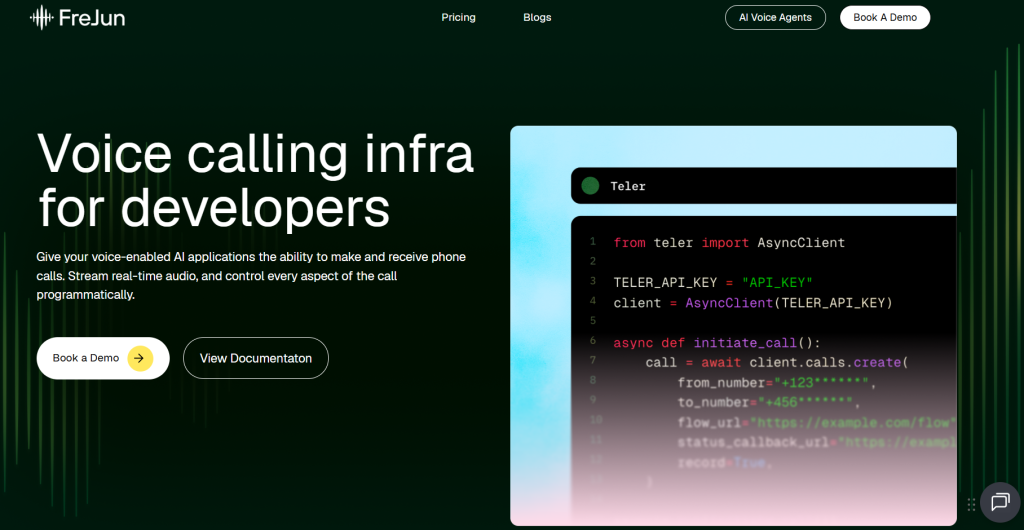
FreJun Teler is a developer-first voiceflow voice api india platform that connects AI agents and LLMs to real phone calls over raw WebSocket streaming, so teams can build production-grade AI voice agents without building any telecom infrastructure from scratch.
Best for: AI voice agent infrastructure in India
Key features
- Raw WebSocket audio streaming in L16/8000Hz format delivers sub-100ms end-to-end latency, so your Voiceflow agent responds fast enough for natural, uninterrupted conversation.
- Model-agnostic architecture means developers bring their own STT, LLM, and TTS providers and pay those providers directly. Teler handles only the voice transport layer, with zero lock-in to any AI vendor.
- SIP trunking with TCP/TLS transport and credential-based or IP-based authentication connects existing SIP-enabled platforms directly to Teler’s carrier network.
- Virtual numbers available for India with TRAI-compliant number series, so outbound AI calling campaigns meet regulatory requirements without custom compliance engineering.
- REST API endpoints, webhook callbacks, and auth token authentication give developers standard, familiar tooling. A working first call is achievable the same day using the getting-started guide at frejun.ai/docs.
- Compatible with Google STT, Deepgram, Whisper, AssemblyAI, OpenAI GPT, Anthropic Claude, Google Gemini, ElevenLabs, Azure TTS, and Play.ht, covering the full range of AI providers teams already use.
- Outbound calling from ₹0.15 per minute with prepaid billing on monthly, quarterly, half-yearly, or annual cycles, so teams only pay for what they use with no enterprise contract required to start.
Pros and cons
| Pros | Cons |
|---|---|
| Sub-100ms WebSocket latency purpose-built for real-time AI voice loops | No native Voiceflow connector or setup steps described; teams build the audio flow themselves |
| Fully model-agnostic: works with any STT, LLM, or TTS provider the team already uses | Elastic SIP trunking is on the roadmap but not yet available; capacity is managed through channels |
| Transparent INR pricing with 3,000 free minutes on first upgrade for real-world testing | UAE and India are the primary supported geographies; global number coverage is more limited than large CPaaS platforms |
Pricing
Pricing (India): ₹600 per channel per month (no minimum requirement ). Get 25,000 free calling credits on your first upgrade with Teler. Billing is prepaid on monthly, quarterly, half-yearly, or annual cycles. See full pricing
Why Teler is the top recommendation
Why Teler ranks #1 for voiceflow voice api india: Teler is the only provider in this list purpose-built for AI voice agent infrastructure in India, with transparent INR pricing starting at ₹0.15 per minute, TRAI-compliant virtual numbers, and sub-100ms WebSocket latency that general CPaaS platforms cannot match because they abstract the audio layer. Its model-agnostic design means Voiceflow developers can connect any STT, LLM, or TTS provider they already use without switching vendors or paying lock-in premiums. Start building →
Teler by the numbers: Sub-100ms latency | Model-agnostic: 10+ AI providers | Virtual numbers: India and UAE | Same-day integration via WebSocket or SIP | 3,000 free minutes on first upgrade (India)
2. Twilio – Programmable voice CPaaS for call automation

Twilio is a broad CPaaS (Communications Platform as a Service), a cloud-based platform that adds voice, SMS, and video capabilities to applications via APIs, and it is widely used for voiceflow voice api india call automation workflows through WebSocket media streaming and TwiML call control.
Best for: Voiceflow call automation with existing Twilio infrastructure
Key features
- Persistent WebSocket audio streaming via Twilio Media Streams delivers base64-encoded 8 kHz mu-law audio to your server, so your STT engine can process caller speech in near real time.
- TwiML (Twilio Markup Language) call control and REST webhooks let developers manage call flow programmatically, including outbound call initiation from server-side helper libraries.
- Phone number purchase and voice-number setup through the Twilio console gives teams a self-serve path to getting a number active without a sales call.
- Official SDKs for Node.js, Python, Java, C#, Ruby, PHP, and Go reduce integration time for teams already working in those languages.
- Documented Dialogflow integration path provides a reference architecture for teams building AI voice agents on Google’s NLU platform.
Pros and cons
| Pros | Cons |
|---|---|
| Large developer ecosystem with SDKs in seven languages and extensive documentation | Audio is abstracted through base64-encoded mu-law conversion, which adds latency compared to raw PCM streaming |
| Self-serve phone number purchase with no sales call required to get started | No India-specific INR pricing, TRAI compliance guidance, or virtual number details published in official docs |
Pricing
Pricing (India): Public per-minute pricing for India was not found in the provided research. See full pricing
Integration with Voiceflow: Twilio integrates with Voiceflow through WebSocket media streaming and REST call control. Third-party tutorials document the integration path, though no official Twilio-Voiceflow guide exists at the time of writing.
3. Plivo – India SIP and streaming for developer teams

Plivo is a programmable voice CPaaS with public India pricing in INR and audio streaming support, making it a practical voiceflow voice api india option for teams that need transparent local pricing without a sales conversation.
Best for: India SIP and streaming with transparent INR pricing
Key features
- Public India pricing in INR at ₹0.34 per minute for browser SDK and SIP calls, or ₹0.60 per minute for local outbound and inbound voice calls, so teams can budget accurately before signing up.
- Audio streaming with noise cancellation is included in the platform, giving AI voice agents cleaner input audio for STT processing without a separate preprocessing step.
- XML application setup using answer and hangup URLs gives developers a webhook-driven call control model that is familiar to anyone who has worked with TwiML.
- Browser SDK and SIP routes are separately priced, so teams can choose the integration path that matches their architecture without paying for both.
- Public GitHub repository for voice audio stream setup provides a working code reference for developers integrating audio streaming into their Voiceflow stack.
Pros and cons
| Pros | Cons |
|---|---|
| Transparent INR pricing published publicly, so no sales call is needed to estimate costs | Audio format for streaming is not specified in documentation, which creates uncertainty for AI stack integration |
| Noise cancellation included in audio streaming reduces STT error rates on noisy Indian mobile networks | No documented end-to-end AI voice agent walkthrough for Voiceflow specifically |
Pricing
Pricing (India): ₹0.34 per minute for browser SDK and SIP calls. ₹0.60 per minute for local outbound and inbound voice calls. Billing is per minute. See full pricing
Integration with Voiceflow: Plivo connects to Voiceflow through its REST API call control and audio streaming path. No official Plivo-Voiceflow integration guide was found, but the audio streaming and XML app setup docs provide the building blocks.
4. Telnyx – Low-cost AI voice routing with SIP support

Telnyx is a carrier-network voice CPaaS with the lowest published per-minute starting price in this voiceflow voice api india comparison, offering REST call control, SIP connections, and a no-code AI assistant path for teams that want to move fast.
Best for: Low-cost AI voice routing with SIP flexibility
Key features
- Starting price of $0.002 per minute is the lowest published rate in this comparison, which matters for teams running high call volumes where per-minute costs compound quickly.
- Automatic selection of the closest anchor site reduces network latency for calls, so audio quality stays consistent even when callers are geographically distributed across India.
- SIP connection setup with generated credentials lets developers connect existing SIP-enabled platforms directly to Telnyx’s carrier network without additional hardware.
- No-code AI assistant support with Vapi and OpenAI gives teams a faster path to a working voice agent prototype before committing to a custom WebSocket integration.
- OPUS codec support is available in voice application setup, which is useful for teams that need higher audio quality than standard mu-law encoding provides.
Pros and cons
| Pros | Cons |
|---|---|
| Lowest published per-minute starting price at $0.002, making it cost-effective for high-volume deployments | No India-specific INR pricing, virtual number details, or TRAI compliance guidance found in official documentation |
| Vapi integration is officially documented, giving Voiceflow developers a clear path to connecting Telnyx as a telephony provider | Full WebSocket audio-loop code example is not available in official docs, so custom AI voice agent integration requires more engineering effort |
Pricing
Pricing (India): $0.002 per minute starting rate. India-specific INR pricing was not found in official documentation. See full pricing
Integration with Voiceflow: Telnyx supports Vapi as an officially documented provider, and Vapi connects to Voiceflow. Teams can also use Telnyx Flow for custom webhook-based orchestration alongside Voiceflow agents. Teams already evaluating no-code voice agent builders may also find it useful to compare the Vapi voice API in India against Teler’s model-agnostic, carrier-first approach before deciding which layer to build on.
5. Exotel – India-focused voice CPaaS with TRAI compliance
Exotel is an India-focused voice CPaaS with a Mumbai API endpoint, KYC-based onboarding, and a bidirectional AgentStream path for real-time AI voice assistants, making it a voiceflow voice api india option for teams that prioritise local compliance over global flexibility.
Best for: India voice compliance with local carrier infrastructure
Key features
- Mumbai India API endpoint reduces network round-trip time for calls originating and terminating in India, which directly improves audio quality and reduces latency for local deployments.
- Bidirectional AgentStream provides a real-time speech-to-speech path for AI voice assistants, so Voiceflow agents can receive and send audio in a continuous loop rather than in discrete request-response cycles.
- Connect-number-to-call-flow REST endpoint and webhook configuration docs give developers a clear path to routing inbound calls to their Voiceflow agent logic.
- KYC and voicebot applet enablement are required prerequisites, which means Exotel handles carrier-level TRAI compliance verification before a team can go live with outbound AI calling.
- OpenAI Realtime integration is documented in Exotel’s official blog, providing a reference architecture for teams building GPT-4o-based voice agents on the platform.
Pros and cons
| Pros | Cons |
|---|---|
| Mumbai endpoint and KYC-based onboarding provide genuine TRAI compliance support built into the platform | No public INR pricing; contact sales is required to get a quote, which slows down evaluation |
| Bidirectional AgentStream enables real-time AI voice loops without polling or batch audio processing | No public SDK or open-source repo found; REST API only, which increases integration effort for teams expecting a language-specific SDK |
Pricing (India): Contact sales. No public INR pricing was found in official documentation. See full pricing
Integration with Voiceflow: Exotel connects to Voiceflow through its REST call control and AgentStream path. The platform’s KYC and voicebot applet setup must be completed before any Voiceflow-based AI calling goes live in India.
6. Vonage API – Webhook-driven voice call control
Vonage API is a programmable voice platform that uses answer webhooks and NCCO (Nexmo Call Control Object) responses to control call flow, making it a voiceflow voice api india option for teams already familiar with webhook-driven architectures.
Best for: Webhook-based voice apps with Node.js
Key features
- Answer webhook returns an NCCO response that controls what happens when a call connects, so Voiceflow developers can route calls to their agent logic without writing low-level telephony code.
- Application creation with a public/private keypair provides secure authentication for API calls, so call control requests are cryptographically verified rather than relying on shared secrets.
- Outbound call creation in Node.js is documented with a working Express webhook server example, giving teams a concrete starting point for building outbound AI calling campaigns.
- Caller-ID control lets teams set the displayed number for outbound calls, which is important for branded AI calling campaigns where recognition rates affect answer rates.
Pros and cons
| Pros | Cons |
|---|---|
| NCCO webhook model is clean and well-documented for basic call control use cases | No WebSocket audio-loop example in official docs, making real-time AI voice agent integration significantly harder |
| Keypair-based authentication is more secure than shared-secret models used by some competitors | No India-specific pricing, number availability, or TRAI compliance guidance found in official documentation |
Pricing (India): Public pricing was not found in the provided research. See full pricing
Integration with Voiceflow: Vonage API connects to Voiceflow through its answer webhook and NCCO call control model. No official Vonage-Voiceflow integration guide was found, and the absence of a WebSocket audio-loop example means teams building real-time AI voice agents will need to engineer that path themselves.
7. Daily – Browser-native real-time audio for voice agents
Daily is a real-time communications platform for embedded audio and video calling, and while it supports browser-native voice agent use cases, it is not a PSTN-first telephony CPaaS, which limits its fit as a voiceflow voice api india provider for teams that need to call standard Indian phone numbers.
Best for: Browser-native voice agents without PSTN requirements
Key features
- Real-time audio and video calling embedded directly in the browser, so voice agents can run inside a web application without requiring the end user to have a phone number.
- WebRTC-based transport provides low-latency audio delivery for browser-to-browser or browser-to-server communication, which suits AI voice agents deployed in web chat or customer portal contexts.
- Developer-friendly SDK for embedding calling into web applications reduces the time needed to add voice capabilities to an existing product.
- Room-based session model lets developers create isolated audio sessions for each conversation, which simplifies session management for multi-tenant AI voice agent deployments.
Pros and cons
| Pros | Cons |
|---|---|
| Strong fit for browser-native AI voice agents that do not need to reach standard phone numbers | Not available for India PSTN calling; cannot dial or receive calls on standard Indian mobile or landline numbers |
| WebRTC transport delivers low latency for browser-to-server audio, suitable for web-based Voiceflow deployments | No India-specific pricing, TRAI compliance support, or virtual number availability documented |
Pricing: Public pricing was not found in the provided research. See full pricing
Integration with Voiceflow: Daily suits Voiceflow deployments where the end user interacts through a browser rather than a phone call. If your Voiceflow agent needs to reach Indian phone numbers via PSTN, Daily is not the right choice for this use case.
voiceflow voice api india feature comparison: all 7 providers side by side
| Feature | Teler | Twilio | Plivo | Telnyx | Exotel | Vonage API | Daily |
|---|---|---|---|---|---|---|---|
| Raw WebSocket audio streaming | Yes L16/8000Hz, sub-100ms | Partial base64 mu-law via Media Streams | Partial audio streaming included, format unspecified | Partial webhook/Flow path, no full loop example | Partial AgentStream bidirectional path | No NCCO only, no WebSocket audio loop | Yes WebRTC browser-to-server |
| India INR pricing published | Yes | No | Yes ₹0.34/min or ₹0.60/min | No USD only | No contact sales | No | No |
| TRAI compliance support | Yes TRAI-compliant virtual numbers | No documented India compliance | Partial India pricing available, no TRAI guide | No documented India compliance | Yes KYC and voicebot applet required | No documented India compliance | No not available for India PSTN |
| Model-agnostic AI stack | Yes any STT, LLM, TTS | Yes bring your own stack | Yes no native AI lock-in documented | Partial Vapi and OpenAI documented natively | Partial OpenAI Realtime documented | Yes bring your own AI stack | Yes bring your own AI stack |
| Virtual numbers for India | Yes | Check website | Partial India pricing available, number details unconfirmed | No India-specific number details found | Yes via KYC onboarding | No India-specific number details found | No not a PSTN provider |
| Official Voiceflow integration docs | Yes Voiceflow listed as compatible platform | Partial third-party tutorials only | No documented Voiceflow integration | Partial via Vapi which connects to Voiceflow | No documented Voiceflow integration | No documented Voiceflow integration | No documented Voiceflow integration |
Teler leads on the features that matter most for voiceflow voice api india deployments in India: raw WebSocket streaming, transparent INR pricing, TRAI compliance, and genuine model-agnostic design across all three AI stack layers.
Which voiceflow voice api india provider is right for your team in India?
Different teams have different constraints. The right voiceflow voice api india provider depends on your call volume, your AI stack, your compliance requirements, and whether you need to reach Indian phone numbers via PSTN or only browser-based users.
If you are building a production AI voice agent that calls Indian phone numbers: Choose Teler. It is the only provider in this list purpose-built for AI voice agent infrastructure with transparent INR pricing, TRAI-compliant virtual numbers, and sub-100ms WebSocket latency.
If you are already running Twilio infrastructure and want to add Voiceflow on top: Choose Twilio. The existing SDK investment and developer familiarity reduce migration risk, though you will need to engineer around the mu-law audio abstraction for low-latency AI loops.
If you need the lowest published per-minute rate and are comfortable with USD billing: Choose Telnyx. At $0.002 per minute, it undercuts every other provider in this list, and its Vapi integration gives a documented path to Voiceflow.
If your team needs India-local carrier infrastructure with KYC-based TRAI compliance built in: Choose Exotel. Its Mumbai endpoint and voicebot applet onboarding handle compliance at the carrier level, though you will need to contact sales for pricing.
If your Voiceflow agent runs inside a browser and never needs to call a standard phone number: Choose Daily. Its WebRTC-based audio is well-suited for browser-native AI voice experiences, but it cannot reach Indian PSTN numbers.
Which voiceflow voice api india tool wins overall in India?
If you want the best overall voiceflow voice api india provider for India with AI-first architecture, INR billing, and TRAI compliance: Choose Teler. No other provider in this list combines sub-100ms WebSocket latency, fully model-agnostic design across STT, LLM, and TTS, transparent INR pricing, and TRAI-compliant virtual numbers in a single platform built specifically for AI voice agent infrastructure.
Frequently asked questions about voiceflow voice api india in 2026
What is the best voiceflow voice api india provider in 2026?
The best voiceflow voice api india provider in 2026 is FreJun Teler. It delivers sub-100ms WebSocket streaming latency, which is fast enough for natural, uninterrupted AI conversation. Teler is fully model-agnostic, so developers can connect any STT engine, LLM, or TTS provider they already use without switching vendors. It also offers transparent INR pricing starting at ₹0.15 per minute for outbound calls and TRAI-compliant virtual numbers for India, which removes two of the most common blockers for AI voice deployments in the Indian market.
How much does voiceflow voice api india cost in India?
Pricing varies by provider. Teler charges ₹600 per channel per month with no minimum requirements of channels, plus ₹0.15 per minute for outbound calls, ₹0.10 per minute for inbound calls, ₹0.15 per minute for media streaming, and ₹0.04 per minute for recording and storage. Plivo publishes India pricing at ₹0.34 per minute for browser SDK and SIP calls, or ₹0.60 per minute for local voice calls. Telnyx starts at $0.002 per minute in USD. Exotel and Vonage require a sales conversation for pricing. Teler also includes 3,000 free minutes on first upgrade, so teams can test the full stack before paying for production capacity.
What latency can developers expect from voiceflow voice api india providers?
Latency, the delay between when a person speaks and when they hear a response, is the most critical performance metric for AI voice agents. Teler’s WebSocket streaming delivers sub-100ms end-to-end latency for the full media streaming loop: Voice to STT to LLM to TTS to Voice playback. General CPaaS platforms like Twilio add 400 to 800ms by abstracting the audio layer through base64-encoded mu-law conversion rather than delivering raw PCM audio directly to the developer’s server. That extra delay is the difference between a conversation that feels natural and one that feels like a bad phone call. Since WebSocket keeps a persistent, full-duplex connection open, audio flows continuously without the overhead of repeated HTTP requests.
Which voiceflow voice api india provider works with any STT, LLM, or TTS provider?
Teler is fully model-agnostic across all three layers of the AI voice stack. Developers bring their own STT engine, such as Google STT, Deepgram, Whisper, or AssemblyAI, their own LLM, such as OpenAI GPT, Anthropic Claude, or Google Gemini, and their own TTS engine, such as ElevenLabs, Azure TTS, or Play.ht. Teler handles only the voice transport layer and charges nothing for the AI providers. Zero lock-in means teams can swap any component of their stack without changing their telephony provider, which matters in a fast-moving AI market where the best STT or LLM today may not be the best option in six months.
What does TRAI compliance mean for AI outbound calling in India?
TRAI (Telecom Regulatory Authority of India) is the regulatory body that governs all outbound calling in India, and AI voice agents face specific rules beyond standard telephony. Promotional calls must use 140-series numbers, while transactional calls use 1600-series numbers. No outbound calls are permitted after 9 PM IST. Before dialling any consumer number, the NCPR (National Customer Preference Register) must be checked to avoid calling opted-out numbers. A voiceflow voice api india provider that does not handle these requirements at the carrier level forces the engineering team to build compliance logic from scratch. Teler provides TRAI-compliant virtual numbers for India, and Exotel requires KYC completion and voicebot applet enablement before any AI calling goes live, which handles compliance at the platform level.
What is the difference between SIP trunking and WebSocket streaming for AI voice agents?
WebSocket streaming keeps a persistent, full-duplex connection open between the caller and the developer’s server, so raw audio flows continuously in real time. This is the right path for AI voice agents because the STT engine can process audio as it arrives rather than waiting for a complete audio file. SIP (Session Initiation Protocol) is the standard protocol for establishing voice calls over the internet and is better suited for connecting existing enterprise telephony infrastructure, such as a PBX or contact centre platform, to a carrier network. If you are building a new Voiceflow-based AI voice agent from scratch, WebSocket streaming is almost always the lower-latency, simpler choice. SIP trunking makes sense when you are integrating Voiceflow into an existing SIP-enabled stack that already manages call routing.
Does Voiceflow require a specific audio format from a telephony API?
Voiceflow’s telephony integration layer expects raw audio that can be passed to an STT engine for transcription. The audio format matters because different STT engines accept different inputs. Teler streams audio in L16/8000Hz format over WebSocket, which is raw 16-bit linear PCM at 8 kHz, a format accepted by Google STT, Deepgram, and most other major STT engines without conversion. Twilio’s Media Streams deliver base64-encoded 8 kHz mu-law audio, which requires a decoding step before most STT engines can process it. Plivo does not specify its streaming audio format in documentation, which creates integration uncertainty. When evaluating a voiceflow voice api india provider, confirm the exact audio format and sample rate before starting integration work.
How do I get started building an AI voice agent with voiceflow voice api india in India?
Start by choosing your AI stack: an STT engine to convert caller speech to text, an LLM to process the text and generate a response, and a TTS engine to convert the response back to audio. Then connect a voiceflow voice api india provider to handle the telephony layer. The full media streaming loop works like this: the caller speaks, the provider captures voice via WebSocket and streams raw audio to your server, your STT engine converts audio to text, the text goes to your LLM, the LLM response goes to your TTS engine, and the audio streams back through the provider to the caller.
The full loop completes in under 100ms on Teler. Sign up at the Teler platform to get 3,000 free minutes on first upgrade in India, which is enough to test the complete stack end to end before committing to production capacity. The getting-started guide at knowledge.frejun.com walks through WebSocket integration step by step, and a working first call is achievable the same day.
Conclusion: Best voiceflow voice api india providers in India for 2026
The top three voiceflow voice api india providers for 2026 are Teler (AI-first infrastructure), Plivo (transparent INR pricing), and Exotel (India carrier compliance). Teler is the top recommendation for teams building production AI voice agents on Voiceflow in India because it is the only provider that combines sub-100ms WebSocket latency, fully model-agnostic design across STT, LLM, and TTS, transparent INR pricing, and TRAI-compliant virtual numbers in a single platform. Developers comparing purpose-built AI calling platforms may also want to see how the Retell AI voice API in India handles latency and TRAI compliance relative to Teler’s WebSocket-first architecture. Sign up at platform.frejun.ai to claim your 3,000 free minutes and start building today.