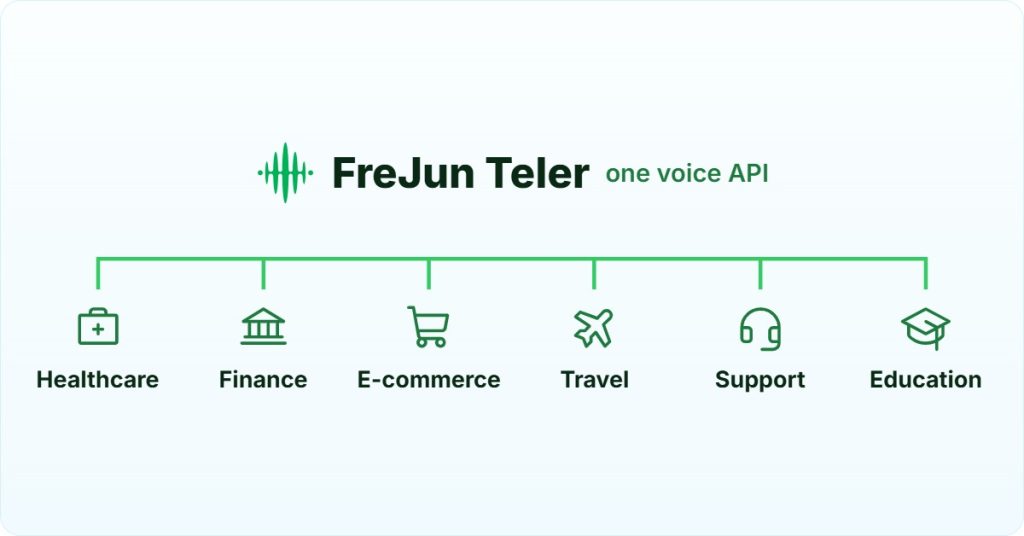
AI Summary: This article compares the top 11 voice API providers UK developers can use to build AI voice agents in 2026, evaluating each on real-time latency, model compatibility, Ofcom and PECR compliance, and pricing transparency. As of 2026, the global conversational AI market is projected to exceed $29 billion by 2028, according to MarketsandMarkets, making telephony infrastructure selection a foundational decision for any AI product team. UK developers need a voice API that delivers sub-100ms latency, integrates with any STT, LLM, or TTS provider without lock-in, and handles carrier-level compliance automatically. FreJun Teler meets all three requirements, with raw WebSocket streaming, a model-agnostic architecture, and outbound calling from $0.20 per minute.
Key criteria in this comparison: We ranked these voice API providers UK teams rely on based on real-time WebSocket latency, model-agnosticism, Ofcom and PECR compliance support, pricing transparency, and documentation quality, since these factors most directly affect a developer team’s build speed and total cost of ownership.
Quick Answer: The best voice API providers UK developers can use for AI voice agents in 2026 is FreJun Teler, which delivers sub-100ms WebSocket latency, a fully model-agnostic architecture compatible with any STT, LLM, or TTS provider, and outbound calling from $0.20 per minute with same-day integration via WebSocket or SIP trunking.
The best voice API providers UK teams should evaluate in 2026 is Teler, which offers purpose-built programmable voice infrastructure for AI agents with sub-100ms latency and a model-agnostic design that no general CPaaS platform can match for real-time AI voice workloads.
What are voice API providers UK developers use for AI voice agents?
Voice API providers UK developers rely on are cloud-based platforms that expose programmable telephony infrastructure via REST APIs, WebSocket streams, and SIP trunking, so engineering teams can build AI voice agents, automated outbound callers, and intelligent IVR systems without constructing any physical telecom infrastructure. The best providers specifically deliver raw audio streaming over persistent WebSocket connections, a latency (the delay between when a person speaks and when they hear a response) low enough for natural conversation, and carrier-grade number provisioning. UK businesses need providers that comply with Ofcom regulations and the ICO’s PECR (Privacy and Electronic Communications Regulations), support TPS (Telephone Preference Service) registry checks, and offer transparent per-minute pricing in a currency that maps cleanly to GBP budgets.
Demand for voice API providers UK teams can deploy is accelerating fast. As of 2026, the global AI voice agent market is growing at a CAGR above 23%, according to Grand View Research, driven by enterprise adoption of conversational AI for customer support, appointment scheduling, and outbound sales automation. What separates basic CPaaS (Communications Platform as a Service, a cloud-based platform that adds voice, SMS, and video capabilities to applications via APIs) from the best platforms in the UK is the ability to stream raw audio directly to a developer’s server over WebSocket, so an STT (Speech-to-Text) engine, LLM (Large Language Model), and TTS (Text-to-Speech) engine can process and respond in under 100ms without a proprietary conversion layer adding delay.
Which voice API providers UK teams rank highest in 2026?
The table below ranks all 11 voice API providers UK developers should consider in 2026, comparing each on best-fit use case, starting price, and free trial availability so you can shortlist quickly before reading the full profiles.
| # | Provider | Best for | Starting price | Free trial |
|---|---|---|---|---|
| 1 | FreJun Teler | AI voice agent infrastructure | $15/channel/month + $0.20/min outbound | Yes – free credits on signup |
| 2 | Twilio | Enterprise programmable voice | $0.0085/min outbound UK | No |
| 3 | Plivo | Low-cost SIP voice | $0.0033/min | No |
| 4 | Telnyx | Carrier-network AI voice | $0.002/min | No |
| 5 | Vonage API | Simple inbound calling | $0.0059/min outbound UK | No |
| 6 | Bandwidth | High-volume voice ops | $0.0055/min inbound | No |
| 7 | Sinch | Enterprise voice CPaaS | Contact sales | No |
| 8 | MessageBird (Bird) | Omnichannel comms teams | Contact sales | No |
| 9 | Infobip | Enterprise contact centers | Contact sales | No |
| 10 | SignalWire | Budget programmable voice | $0.0070/min outbound landline | No |
| 11 | Agora | In-app voice SDKs | Contact sales | No |
Teler leads this list because it is the only provider purpose-built for real-time AI voice agent infrastructure, while every other platform on this list was designed primarily for human-to-human telephony and adapted for AI use cases afterward. Teams comparing telephony options beyond the UK can also review our breakdown of the best voice API providers in the USA for AI voice agent infrastructure.
↓ Scroll for full breakdown of each tool – features, pros, cons, pricing, and ideal use case.
How do you choose the best voice API providers UK in 2026?
Choosing between voice API providers UK teams can deploy requires more than comparing per-minute rates. The right platform depends on your AI architecture, your integration path, your compliance obligations under Ofcom and PECR, and the actual call volume you expect to run in production.
Step 1: Define your AI voice architecture
Before evaluating any provider, map out the three components your AI voice agent needs: an STT engine to convert caller speech to text, an LLM to decide what to respond, and a TTS engine to convert that response back to audio. Providers like Teler are model-agnostic, so you bring your own stack and pay those providers directly. General CPaaS platforms sometimes bundle their own STT or TTS, which can create lock-in and limit your ability to swap providers as the AI landscape evolves. If your use case is a conversational agent, you need sub-100ms end-to-end latency. If it is a form-filling bot or a simple IVR, up to 500ms is acceptable. Decide this threshold before you test any provider, since it will immediately eliminate several options.
Step 2: Choose your integration path
Two integration paths exist for voice API providers UK developers use. WebSocket streaming keeps a persistent, full-duplex connection open between the caller and your server, so raw audio flows continuously in both directions without the overhead of repeated HTTP requests. This is the lowest-latency path and the right choice for conversational AI agents. SIP (Session Initiation Protocol, the standard protocol for establishing voice calls over the internet) trunking is better when you are connecting an existing SIP-enabled platform, a PBX, or an enterprise telephony system to a carrier network. Teler supports both paths. If you are starting from scratch with an AI agent, use WebSocket. If you are integrating with an existing enterprise phone system, use SIP trunking.
Step 3: Check UK-specific carrier and compliance requirements
UK voice API deployments must comply with Ofcom’s numbering and carrier regulations and the ICO’s PECR consent rules. PECR requires explicit consent before making automated marketing calls to UK numbers. The TPS (Telephone Preference Service) registry must be checked before any outbound campaign, since calling a registered number without consent can result in ICO enforcement action. AI outbound calling adds an additional layer of complexity because automated systems must identify themselves as automated under UK consumer protection guidelines. Any provider you choose should be able to confirm its UK carrier registration status and provide guidance on PECR-compliant call flows.
Step 4: Evaluate pricing in the UK context
Most voice API providers UK teams evaluate publish pricing in USD. When comparing costs, calculate a realistic monthly total based on your expected call volume. Include per-minute outbound rates, per-minute inbound rates, media streaming fees, recording and storage costs, and channel or number rental fees. A provider with a low per-minute rate but high channel minimums may cost more at low volume than a provider with a slightly higher per-minute rate and no channel minimum. Teler charges $15 per channel per month with a minimum of 10 channels, plus $0.20 per minute outbound and $0.10 per minute inbound. Run the numbers against your projected monthly minutes before committing.
Step 5: Test latency and audio quality on a real call
No benchmark replaces a real call test. Before committing to any provider, run a live call through your full STT, LLM, and TTS stack and measure the round-trip time from caller speech to AI response. Teler offers $5 in free calling credits on first upgrade for UAE accounts and 3,000 free minutes on first upgrade for India accounts, so you can test the full Media Streaming Loop (the complete real-time cycle: Voice input, STT transcription, LLM processing, TTS synthesis, and Voice playback) before paying. For teams building similar AI voice agent infrastructure outside the UK, our guide to the top voice API providers in India covers region-specific pricing and compliance considerations. Ask every provider on your shortlist for a trial or sandbox environment before signing any contract.
Top 11 voice API providers UK developers should evaluate in 2026
1. FreJun Teler – Purpose-built voice API for AI voice agents
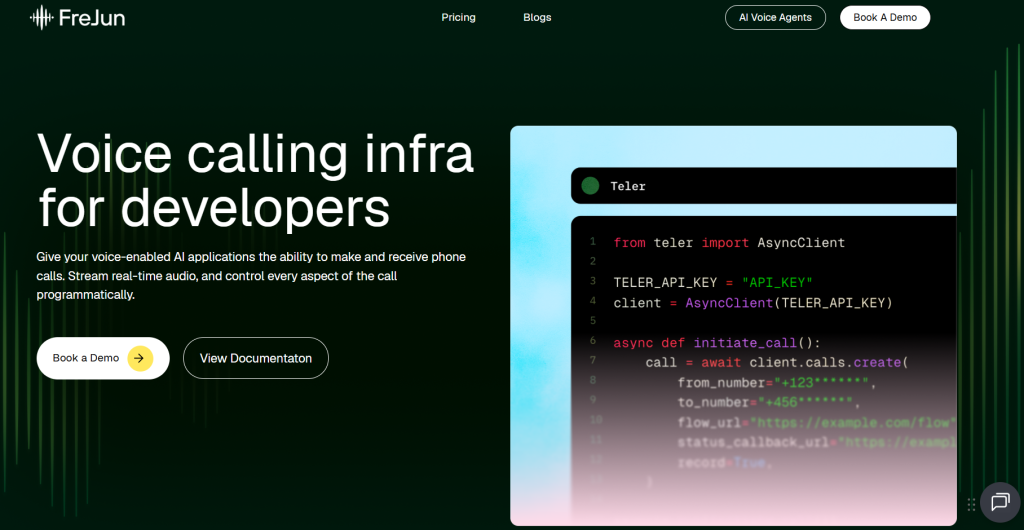
FreJun Teler is a voice API platform built specifically for developers constructing AI voice agents, connecting LLMs and STT/TTS engines to real phone calls over a persistent WebSocket stream with sub-100ms latency making it the top choice among voice API providers UK AI teams should consider in 2026.
Best for: AI voice agent infrastructure
Key features
- Raw WebSocket audio streaming delivers L16/8000Hz audio directly to your server, so your STT engine receives caller speech with no proprietary conversion layer adding delay the full Media Streaming Loop completes in under 100ms.
- Model-agnostic architecture means you connect any STT engine (Google STT, Deepgram, Whisper, AssemblyAI), any LLM (OpenAI GPT, Anthropic Claude, Google Gemini), and any TTS engine (ElevenLabs, Azure TTS, Google TTS, Play.ht). Teler handles only the voice transport layer.
- SIP trunking with TCP/TLS transport supports credential-based and IP-based authentication, so existing SIP-enabled platforms and enterprise PBX systems connect directly to Teler’s carrier network without rebuilding telephony infrastructure.
- REST API endpoints, webhook callbacks, and auth token authentication give developers standard, familiar tooling no proprietary SDK is required to place a first call.
- Outbound calling from $0.20 per minute and inbound from $0.10 per minute, with media streaming at $0.0017 per minute and recording at $0.00046 per minute, so every cost line is transparent before you build.
- Compatible with AWS, Google Cloud, Azure, Vercel, LangChain, Vapi, Voiceflow, and Retell, so Teler plugs into the orchestration layer your team already uses rather than replacing it.
Pros and cons
| Pros | Cons |
|---|---|
| Sub-100ms WebSocket latency purpose-built for conversational AI agents | Virtual numbers currently available for India and UAE, not yet UK-local numbers |
| Zero AI provider lock-in bring any STT, LLM, or TTS stack and pay those providers directly | Elastic SIP trunking (auto-scaling without channel limits) is on the roadmap but not yet available |
| Same-day integration via WebSocket or SIP with no physical telecom infrastructure required | Pricing is published in USD, so UK teams need to confirm GBP billing availability with the sales team |
Pricing
Pricing (USD): Channel cost $15/channel/month (minimum 10 channels). Outbound calling $0.20/min. Inbound calling $0.10/min. Media streaming $0.0017/min. Recording and storage $0.00046/min. UAE number rental $100/month. First upgrade includes $5 in free calling credits. SIP trunking pay-as-you-go: $11.50/channel/month (min. 10 channels, 6-month commitment), outbound $0.12/min, inbound $0.03/min. See full pricing
Why Teler is the top recommendation
Why Teler ranks #1 for voice API providers UK teams building AI agents: Teler is the only platform on this list designed from the ground up for real-time AI voice infrastructure, delivering sub-100ms WebSocket latency and a fully model-agnostic architecture that lets UK developers bring their own STT, LLM, and TTS stack without any lock-in. While Ofcom and PECR compliance guidance should be confirmed with the sales team for UK-specific deployments, Teler’s transparent per-minute pricing and same-day integration path make it the fastest way to get a production AI voice agent running. Start building →
UK teams expanding into the Gulf market can also explore our comparison of voice API providers in the UAE for AI voice agent deployments.
Teler by the numbers: Sub-100ms latency | Model-agnostic: 10+ AI providers | Virtual numbers: India and UAE | Same-day integration via WebSocket or SIP | 3,000 free minutes on first upgrade (India)
2. Twilio – Programmable voice API for enterprise CPaaS
Twilio is a broad CPaaS platform offering programmable voice, SMS, and messaging APIs, and it remains one of the most widely used voice API providers UK enterprise teams evaluate when they need a large developer ecosystem and extensive documentation.
Best for: Enterprise programmable voice
Key features
- Media Streams lets you pipe live call audio to your own server over WebSocket, so your STT engine can process caller speech in near real time though the audio is delivered as base64-encoded mu-law chunks rather than raw L16, which adds a decoding step.
- SIPREC support enables SIP/PBX interoperability, so enterprise teams can connect existing telephony infrastructure to Twilio’s carrier network without replacing hardware.
- Conversation Relay provides a voice-agent-oriented call flow that handles turn-taking and barge-in detection, reducing the amount of custom state management your team needs to build.
- Speech recognition add-ons include Deepgram Nova and Google v2 STT, so teams that want a managed STT option can enable it without a separate provider contract.
- Official SDKs in Python, Node.js, Java, PHP, Ruby, C#, and Go mean most engineering teams can integrate without learning a new language or toolchain.
Pros and cons
| Pros | Cons |
|---|---|
| Large developer ecosystem with extensive documentation and community support | Audio delivered as base64 mu-law over WebSocket rather than raw L16, adding a decoding step for AI pipelines |
| London datacentre available, reducing round-trip latency for UK deployments | Pricing complexity increases significantly at scale, with separate line items for Media Streams, SIPREC, and add-on STT |
| Broad channel set covers voice, SMS, and messaging under one account | Designed as a general CPaaS platform, not purpose-built for AI voice agent latency requirements |
Pricing
Pricing (USD): From $0.0085/min outbound UK and $1.00/month per UK number. Inbound minutes are also priced per minute. Media Streams and SIPREC are separately metered. See full pricing
3. Plivo – Low-cost SIP voice for developer teams
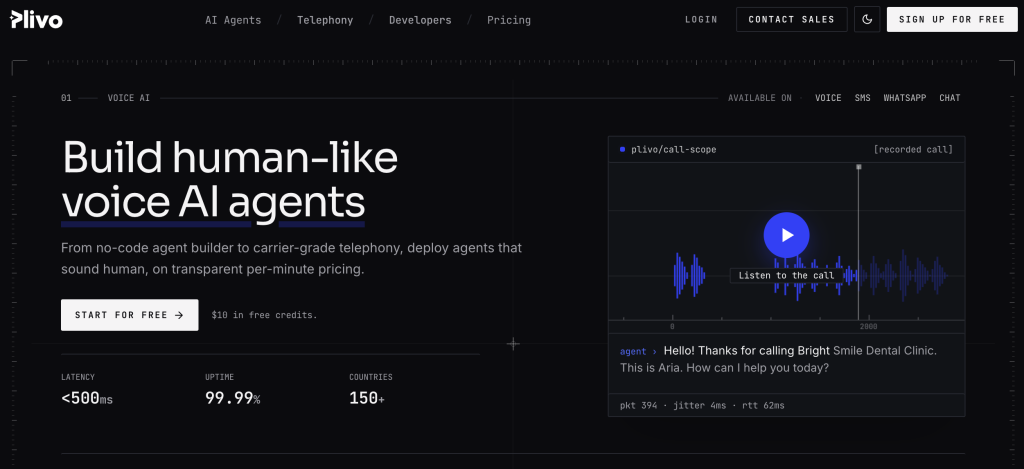
Plivo is a CPaaS platform covering voice APIs, SMS APIs, and SIP trunking, and it is one of the more cost-competitive voice API providers UK teams with SIP-heavy architectures should consider when per-minute rate is the primary constraint.
Best for: Low-cost SIP voice
Key features
- Browser SDK and SIP calls are separately priced at $0.0033/min, so teams building web-based voice clients or SIP-connected systems can pick the path that fits their architecture without paying for features they do not use.
- Audio streaming and noise cancellation are included in the platform, so developers building AI voice agents get cleaner audio input for their STT engine without a separate preprocessing step.
- UK voice routes have published per-minute pricing for local, mobile, and toll-free numbers, making cost modelling straightforward before you commit to a build.
- Enterprise volume discounts start at $1,000/month, so high-volume teams can negotiate rates once call volume justifies it.
- Official SDKs in Python, Node.js, Java, PHP, Ruby, C#, and Go, plus a Browser SDK for web clients, cover most team tech stacks.
Pros and cons
| Pros | Cons |
|---|---|
| Among the lowest published per-minute rates for UK voice routes on this list | Audio format for WebSocket streaming is not clearly documented, which complicates AI pipeline integration |
| Noise cancellation included without a separate add-on fee | No verified full WebSocket voice loop example in public documentation for AI agent builds |
Pricing
Pricing (USD): From $0.0033/min for Browser SDK and SIP calls. UK local, mobile, and toll-free routes are separately listed. Enterprise discounts from $1,000/month. See full pricing
4. Telnyx – Carrier-network voice API with built-in AI add-ons

Telnyx is a voice API built on its own carrier network, offering some of the lowest published per-minute rates among voice API providers UK cost-sensitive AI teams should evaluate, with native STT and TTS options that reduce the number of third-party integrations required.
Best for: Carrier-network AI voice
Key features
- Carrier-network routing keeps per-minute costs low by removing intermediary carrier markups, so UK teams running high call volumes see meaningful savings compared to reseller-based CPaaS platforms.
- Native STT options include Telnyx STT and Deepgram Nova 2, while native TTS options include Telnyx TTS, Amazon Polly standard and neural voices, and Telnyx HD Voices so teams can use managed AI speech without a separate provider contract.
- Answering machine detection and deepfake detection are separately priced add-ons, giving outbound campaign teams tools to improve connect rates and flag suspicious inbound audio.
- Secure media is included at no extra cost, so call audio is encrypted in transit without a separate configuration step.
- Official SDKs in Python, Node.js, Java, PHP, Ruby, C#, and Go cover most engineering team stacks.
Pros and cons
| Pros | Cons |
|---|---|
| Among the lowest published per-minute rates on this list at $0.002/min | WebSocket audio streaming format is not clearly documented for AI agent builds |
| Native deepfake detection add-on is a differentiator for fraud-sensitive UK use cases | Pricing model has multiple add-on line items that can make total cost harder to predict at scale |
Pricing
Pricing (USD): From $0.002/min for the Voice API. Answering machine detection, deepfake detection, and STT/TTS add-ons are separately priced. Secure media is included. See full pricing
5. Vonage API – Simple inbound calling for webhook-driven workflows
Vonage API is a programmable voice platform using NCCO (Nexmo Call Control Objects) and webhooks for call flow management, and it is one of the more accessible voice API providers UK teams building straightforward inbound call handling should consider.
Best for: Simple inbound calling
Key features
- NCCO-based call control lets developers define call flows as JSON objects delivered via webhook, so inbound call routing logic can be updated without redeploying application code.
- WebSocket and SIP options are available for voice streaming and enterprise telephony interop, giving teams flexibility to choose the integration path that fits their existing stack.
- UK landline outbound rates are lower than Twilio’s published rates according to independent comparison sources, so cost-sensitive teams running UK outbound campaigns should compare both providers directly.
- London datacentre availability reduces round-trip latency for UK-based deployments compared to providers routing through US or EU datacentres.
- Official SDKs in Python, Node.js, Java, PHP, Ruby, C#, and Go are available for most engineering team stacks.
Pros and cons
| Pros | Cons |
|---|---|
| Lower UK landline outbound rates than Twilio based on published comparison data | No documented full AI voice-agent audio loop in available public sources |
| London datacentre reduces latency for UK deployments | NCCO-based call control adds complexity for teams building dynamic AI conversation flows |
Pricing
Pricing (USD): From $0.0059/min outbound UK landline and $0.90/month per UK number. Inbound minutes are also priced per minute. See full pricing
6. Bandwidth – High-volume programmable voice for business ops
Bandwidth is a programmable voice platform with recording, conferencing, transcription, answering machine detection, and unidirectional media streaming, making it one of the more feature-complete voice API providers UK enterprise operations teams should evaluate for high call volume workloads.
Best for: High-volume voice ops
Key features
- Unidirectional media streaming lets you pipe call audio to your server for real-time processing, so AI transcription and analysis pipelines can run alongside live calls without interrupting the call flow.
- Call billing rounds to 6-second increments rather than full minutes, so high-volume teams pay only for the time actually used and avoid the rounding waste common on per-minute plans.
- Recording, conferencing, transcription, and answering machine detection are all available as separately priced features, so teams can enable only the capabilities their use case requires.
- REST API call control with JavaScript/Node.js, Python, Java, and C# SDKs covers the most common enterprise engineering stacks.
- The platform is explicitly positioned for business voice workloads, so documentation and support are oriented toward production-scale deployments rather than hobbyist or prototype use cases.
Pros and cons
| Pros | Cons |
|---|---|
| 6-second billing increments reduce cost waste for high-volume short-duration calls | No UK-specific pricing or compliance guidance found in public documentation |
| Full suite of recording, conferencing, and AMD features under one account | No complete end-to-end AI voice quickstart documented in available public sources |
Pricing
Pricing (USD): From $0.0055/min inbound US local voice. Unidirectional media streaming, recording, conferencing, transcription, and AMD are separately priced. UK-specific pricing should be confirmed directly with Bandwidth’s sales team. See full pricing
7. Sinch – Enterprise CPaaS for voice and messaging

Sinch is an enterprise CPaaS platform covering voice call control, number provisioning, recording, routing, and SIP interconnect, and it is one of the larger voice API providers UK enterprise telephony teams should evaluate when they need voice and messaging under one vendor contract.
Best for: Enterprise voice CPaaS
Key features
- Enterprise voice call control with number provisioning lets large teams manage UK number inventory and routing rules from a single platform without separate carrier contracts.
- SIP interconnect supports integration with existing enterprise PBX and UC systems, so Sinch can extend rather than replace existing telephony infrastructure.
- Recording and routing capabilities cover the core operational requirements for contact centre and outbound campaign workloads.
- Voice and messaging are available under one CPaaS umbrella, so teams that need both channels can consolidate vendor relationships and billing.
- REST API plus webhooks provide standard integration patterns that most enterprise engineering teams already know.
Pros and cons
| Pros | Cons |
|---|---|
| Voice and messaging under one enterprise vendor contract simplifies procurement | Pricing requires a sales conversation, making cost modelling difficult before engagement |
| SIP interconnect supports existing enterprise telephony infrastructure | No verified AI voice-agent quickstart or audio-loop example in public documentation |
8. MessageBird (Bird) – Omnichannel communications platform

Bird, formerly MessageBird, is an omnichannel communications platform with voice and SIP capabilities, and it is one of the voice API providers UK enterprise teams managing multiple communication channels should consider when consolidating messaging, voice, and SIP under one platform.
Best for: Omnichannel comms teams
Key features
- SIP trunking availability in the UK VoIP landscape means Bird can serve as a carrier connectivity layer for teams already running SIP-based telephony infrastructure.
- REST API plus SIP trunking provides two integration paths, so teams can choose between programmatic call control and direct SIP connectivity depending on their architecture.
- Omnichannel workflow support covers voice alongside messaging channels, so customer-facing teams can manage voice and digital interactions from one platform.
- Enterprise-grade routing and number management support large-scale deployments with complex routing requirements.
- The platform has been rebranded from MessageBird to Bird, so teams evaluating it should confirm current product naming and feature availability directly with the vendor.
Pros and cons
| Pros | Cons |
|---|---|
| Omnichannel platform covers voice and messaging under one vendor | No verified full developer quickstart for AI voice-agent use in public documentation |
| SIP trunking available in UK VoIP landscape | Pricing requires a sales conversation, with no public per-minute rates available |
9. Infobip – Enterprise CPaaS with contact-centre tooling
Infobip is an enterprise CPaaS platform with voice routing, number management, contact-centre integration, and omnichannel workflow capabilities, making it one of the voice API providers UK enterprise contact-centre teams should evaluate when they need voice tightly integrated with broader customer engagement tooling.
Best for: Enterprise contact centers
Key features
- Voice routing and number management support large enterprise deployments with complex inbound and outbound routing requirements across multiple UK numbers.
- Contact-centre integration connects voice calls to broader customer engagement workflows, so agents and AI systems can access customer context during live calls.
- Omnichannel workflow support covers voice alongside digital channels, so enterprise teams can manage customer interactions across touchpoints from one platform.
- REST API plus webhooks and SIP/voice routing provide standard integration patterns for enterprise engineering teams.
- Enterprise routing capabilities support high-volume deployments with SLA requirements that smaller CPaaS platforms may not be able to meet.
Pros and cons
| Pros | Cons |
|---|---|
| Contact-centre integration connects voice to broader customer engagement workflows | Pricing requires a sales conversation, with no public per-minute rates available |
| Omnichannel platform covers voice and digital channels under one enterprise vendor | No verified AI voice-agent audio loop or quickstart in public documentation |
10. SignalWire – Budget programmable voice with WebSocket support

SignalWire is a programmable voice and SIP platform positioned as a cost-sensitive alternative among voice API providers UK teams with tight per-minute budgets should evaluate, with published UK rates below Twilio’s and standard WebSocket and SIP integration paths.
Best for: Budget programmable voice
Key features
- UK outbound landline rates at $0.0070/min and mobile at $0.0130/min are lower than Twilio’s published UK rates, so cost-sensitive teams running high outbound volumes should compare both providers directly.
- WebSocket and SIP trunking integration paths give developers flexibility to choose between real-time audio streaming and enterprise telephony connectivity depending on their architecture.
- Per-minute plus per-number pricing is straightforward to model before committing to a build, with no hidden platform fees in the published rate card.
- SIP trunking availability in the UK VoIP landscape means SignalWire can serve as a carrier layer for teams already running SIP-based infrastructure.
- Official SDKs in Python, Node.js, Java, PHP, Ruby, C#, and Go cover most engineering team stacks.
Pros and cons
| Pros | Cons |
|---|---|
| Lower published UK per-minute rates than Twilio for outbound landline and mobile | No UK datacentre noted in comparison sources, which may increase latency for UK deployments |
| Straightforward per-minute plus per-number pricing with no hidden platform fees | No verified full AI voice-agent quickstart or audio-loop example in public documentation |
Pricing
Pricing (USD): $0.0070/min outbound landline, $0.0130/min mobile, and $1.00/month per number. See full pricing
11. Agora – Real-time RTC SDK for in-app voice
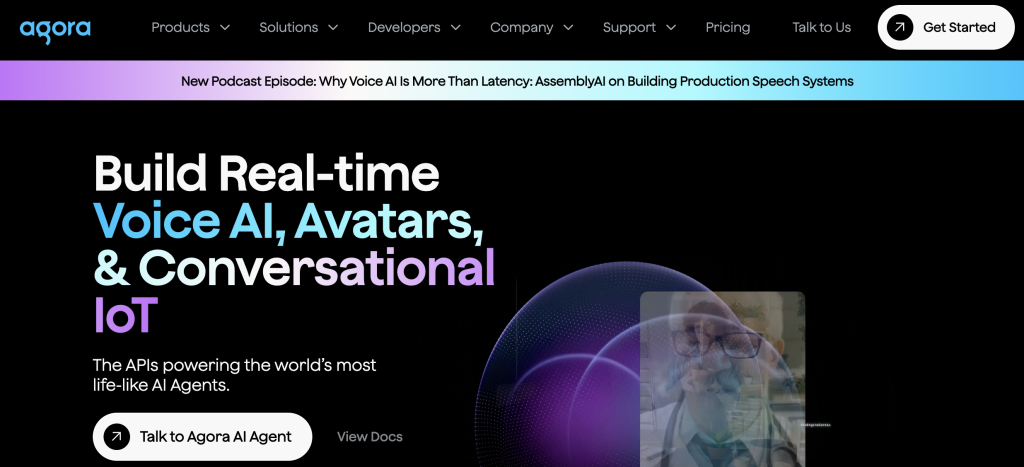
Agora is a real-time voice and RTC SDK platform built for app developers embedding low-latency audio into products, and it is one of the voice API providers UK teams building in-app voice features rather than PSTN telephony should consider when WebRTC-based audio transport fits their architecture better than SIP.
Best for: In-app voice SDKs
Key features
- Low-latency RTC audio transport is built on WebRTC rather than PSTN telephony, so Agora is a strong fit for in-app voice agents that never need to dial a real phone number.
- Cross-platform SDKs cover iOS, Android, web, and desktop, so teams building embedded voice agents across multiple surfaces can use one SDK rather than maintaining separate integrations.
- Noise suppression is included in the audio pipeline, so STT engines receive cleaner input without a separate preprocessing step.
- Real-time audio with low-latency transport makes Agora suitable for conversational AI agents embedded in consumer or enterprise apps where PSTN connectivity is not required.
- The platform is stack-agnostic at the audio-transport layer, so teams can connect their own STT, LLM, and TTS providers to the audio stream.
Pros and cons
| Pros | Cons |
|---|---|
| WebRTC-based audio transport is a strong fit for in-app voice agents without PSTN requirements | Not suitable for use cases that require dialling real UK phone numbers over PSTN |
| Cross-platform SDKs cover iOS, Android, web, and desktop under one integration | Pricing requires a sales conversation, with no public per-minute rates available |
Voice API providers UK feature comparison: 2026
| Feature | Teler | Twilio | Plivo | Telnyx | Vonage | Bandwidth | Sinch | Bird | Infobip | SignalWire | Agora |
|---|---|---|---|---|---|---|---|---|---|---|---|
| Raw WebSocket audio streaming (sub-100ms) | Yes | Partial – base64 mu-law, not raw L16 | Partial – audio streaming available, format undocumented | Partial – not fully documented | Partial – WebSocket available, latency undocumented | Partial – unidirectional only | No | No | Partial – WebSocket available, format undocumented | Yes – WebRTC, not PSTN | |
| Model-agnostic (bring any STT/LLM/TTS) | Yes | Partial – Deepgram or Google STT bundled | No | Partial – native STT/TTS options available | No | No | No | No | No | Partial – transport layer only | |
| SIP trunking | Yes | Yes | Yes | Yes | Yes | Yes | Yes | Yes | Yes | Yes | No |
| Published UK per-minute pricing | Yes – USD, GBP on request | Yes – USD | Yes – USD | Yes – USD | Yes – USD | Partial – US pricing published, UK on request | No – contact sales | No – contact sales | No – contact sales | Yes – USD | No – contact sales |
| Answering machine detection | No | Yes | No | Yes – add-on | No | Yes – add-on | No | No | No | No | No |
| PSTN connectivity for UK numbers | Yes – via SIP trunking | Yes | Yes | Yes | Yes | Partial – UK coverage unconfirmed | Yes | Yes | Yes | Yes | No – app-to-app only |
Teler is the only provider on this list that combines raw WebSocket audio streaming with a fully model-agnostic architecture and published per-minute pricing, which is why it leads this comparison of voice API providers UK AI teams should evaluate in 2026.
Which voice API providers UK platform is right for your team in 2026?
Different teams have different requirements. The right voice API depends on your architecture, your call volume, your compliance obligations under Ofcom and PECR, and whether you are building a new AI voice agent from scratch or connecting an existing telephony system.
If you are building a conversational AI voice agent from scratch: Choose Teler. It is the only platform on this list purpose-built for real-time AI voice infrastructure, with sub-100ms WebSocket latency and zero AI provider lock-in.
If you are a large enterprise team that needs voice and messaging under one vendor contract: Choose Twilio. Its broad CPaaS channel set, London datacentre, and large developer ecosystem make it the most practical choice for teams that need more than voice alone.
If your primary constraint is per-minute cost and you are running a SIP-heavy architecture: Choose Telnyx. Its carrier-network routing delivers some of the lowest published per-minute rates on this list, and its native STT/TTS options reduce the number of third-party integrations required.
If you are building an in-app voice agent that never needs to dial a real phone number: Choose Agora. Its WebRTC-based audio transport and cross-platform SDKs are a better fit for embedded in-app voice than PSTN-based telephony APIs.
If you need a budget-friendly programmable voice option with published UK rates below Twilio: Choose SignalWire. Its per-minute rates for UK outbound landline and mobile are lower than Twilio’s published rates, and its pricing model is straightforward to model before you build. Developers scaling AI voice agents into APAC markets should also check our review of the leading voice API providers in Singapore.
Which tool wins overall in the UK in 2026?
If you want the best overall voice API providers UK platform for AI voice agents with sub-100ms latency, model-agnostic architecture, and Ofcom-compatible carrier connectivity: Choose Teler. It is the only platform on this list designed from the ground up for real-time AI voice infrastructure, so developers spend their time building the AI product rather than engineering around CPaaS abstractions that add latency and limit model choice.
Frequently asked questions about voice API providers UK in 2026
What is the best voice API providers UK option for AI agents in 2026?
The best voice API providers UK AI teams can use in 2026 is FreJun Teler. It delivers sub-100ms latency via raw WebSocket audio streaming, so the full Media Streaming Loop (Voice input, STT transcription, LLM processing, TTS synthesis, and Voice playback) completes fast enough for natural, uninterrupted conversation. Teler is fully model-agnostic, so developers bring their own STT engine, LLM, and TTS engine without any lock-in. Since it is purpose-built for AI voice agent infrastructure rather than adapted from a general CPaaS platform, the integration path is simpler and the latency profile is more predictable in production.
How much do voice API providers UK teams use actually cost in 2026?
Costs vary significantly across voice API providers UK teams evaluate. Teler charges $15 per channel per month with a minimum of 10 channels, plus $0.20 per minute outbound and $0.10 per minute inbound. Media streaming adds $0.0017 per minute and recording adds $0.00046 per minute. Twilio charges $0.0085 per minute outbound UK plus $1.00 per month per UK number. Telnyx starts at $0.002 per minute, while Plivo starts at $0.0033 per minute. Providers like Sinch, Bird, Infobip, and Agora require a sales conversation before pricing is available. Always calculate a realistic monthly total based on your expected call volume, including channel costs, per-minute rates, and any add-on fees, before committing to a provider.
What latency can developers expect from voice API providers UK platforms?
Latency, the delay between when a person speaks and when they hear a response, varies significantly across voice API providers UK developers evaluate. Teler’s WebSocket streaming delivers sub-100ms end-to-end latency for the full Media Streaming Loop, which is fast enough for natural conversation. General CPaaS platforms like Twilio and Vonage abstract the audio layer for human-to-human call handling, and that abstraction typically adds 400 to 800ms of delay. This is acceptable for standard telephony but creates noticeable pauses in AI voice agent conversations. If your use case is a conversational AI agent, sub-100ms is the threshold to target. If it is a simpler form-filling bot or IVR, up to 500ms is generally acceptable.
Which voice API providers UK platform works with any STT, LLM, or TTS provider?
Teler is the only fully model-agnostic platform on this list. It handles only the voice transport layer, so developers connect any STT engine (Google STT, Deepgram, Whisper, AssemblyAI), any LLM (OpenAI GPT, Anthropic Claude, Google Gemini, or a custom model), and any TTS engine (ElevenLabs, Azure TTS, Google TTS, Play.ht) and pay those providers directly. Zero lock-in matters in production because the AI landscape is moving fast. Teams that lock into a bundled STT or TTS provider today may find themselves unable to switch to a better model without rebuilding their telephony integration. Telnyx offers partial model choice at the STT and TTS layer, but its native options are limited compared to Teler’s fully open architecture.
What UK compliance rules apply to voice API providers UK teams use for outbound AI calling?
UK outbound AI calling must comply with Ofcom’s carrier and numbering regulations and the ICO’s PECR (Privacy and Electronic Communications Regulations). PECR requires explicit consent before making automated marketing calls to UK numbers. The TPS (Telephone Preference Service) registry must be checked before any outbound campaign, since calling a registered number without consent can result in ICO enforcement action. AI outbound calling adds a further requirement: automated systems must identify themselves as automated under UK consumer protection guidelines. Any voice API providers UK teams use for outbound AI campaigns should be able to confirm their UK carrier registration status and provide guidance on building PECR-compliant call flows. Confirm these details with your chosen provider before launching any outbound AI campaign.
What is the difference between SIP trunking and WebSocket streaming for AI voice agents?
SIP trunking and WebSocket streaming are two different integration paths that voice API providers UK developers can use, and they serve different purposes. WebSocket streaming keeps a persistent, full-duplex connection open between the caller and your server, so raw audio flows continuously in both directions without the overhead of repeated HTTP requests. This is the lowest-latency path and the right choice for conversational AI agents that need sub-100ms response loops. SIP (Session Initiation Protocol) is the standard protocol for establishing voice calls over the internet. SIP trunking is better when you are connecting an existing SIP-enabled platform, a PBX, or an enterprise telephony system to a carrier network. Teler supports both paths, so teams can choose based on their architecture rather than being forced into one approach.
How do I get started building an AI voice agent with voice API providers UK in 2026?
Getting started with voice API providers UK developers use for AI agents follows the same pattern regardless of which provider you choose. First, define your Media Streaming Loop: caller speaks, the voice API captures audio and streams it to your server via WebSocket, your STT engine converts it to text, your LLM decides what to respond, your TTS engine converts the response to audio, and the voice API plays it back to the caller. Teler completes this loop in under 100ms. Sign up at platform.frejun.ai, upgrade to access $5 in free calling credits (UAE) or 3,000 free minutes (India), and follow the getting-started guide at knowledge.frejun.com to get a first call working the same day via WebSocket or SIP. Since Teler is model-agnostic, you connect the STT, LLM, and TTS providers your team already uses without rebuilding your AI stack.
Can voice API providers UK platforms integrate with AI orchestration tools like Vapi or Retell?
Yes. Teler sits at the infrastructure layer below AI orchestration platforms like Vapi, Retell, and Voiceflow. Those platforms are orchestration layers that manage conversation logic, turn-taking, and LLM routing. Teler provides the actual carrier connectivity, real-time audio streaming, and SIP trunking that those platforms need to make and receive real phone calls. So if your team is building on Vapi or Retell, you can connect Teler as the telephony provider underneath. This is a common architecture for teams that want a managed orchestration layer on top of a low-latency, model-agnostic telephony foundation. Twilio is also compatible with these platforms, but its audio abstraction layer adds latency compared to Teler’s raw WebSocket streaming path.
Conclusion: Best voice API providers UK teams should use in 2026
The top voice API providers UK developers should evaluate in 2026 are Teler (AI-first), Twilio (ecosystem), and Telnyx (cost). Teler is the top recommendation for any team building real-time AI voice agents in the UK because it is the only platform on this list purpose-built for sub-100ms WebSocket latency with a fully model-agnostic architecture, so developers spend their time building the AI product rather than working around CPaaS abstractions that add latency and limit model choice. If you are ready to build, start with Teler’s free credits and get a first call working the same day. Teams with a presence in Oceania may also find it useful to compare the top voice API providers in Australia before finalising an AI voice agent stack.