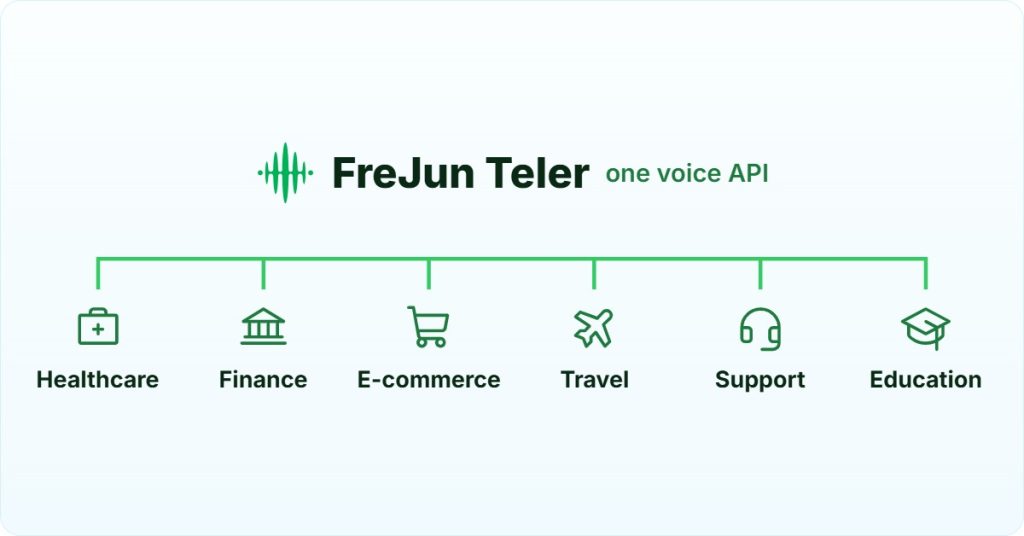
AI Summary: This article compares the top sip trunk providers for AI agents in the US in 2026, evaluating each platform on real-time latency, model-agnostic architecture, per-minute pricing in USD, and FCC/TCPA compliance for outbound AI voice deployments. As of 2026, the global conversational AI market is projected to exceed $29 billion by 2028, according to MarketsandMarkets, making SIP trunk selection a foundational infrastructure decision for any AI voice product team. Developers need a provider that targets sub-100ms latency for natural conversation, integrates with any STT, LLM, and TTS provider without lock-in, and handles carrier-level compliance automatically. FreJun Teler meets all three requirements, with raw WebSocket streaming and SIP trunking that works with any AI stack the team already uses.
Key criteria in this comparison: We ranked these sip trunk providers on real-time WebSocket latency, model-agnostic architecture, pricing transparency in USD, FCC and TCPA compliance support, and documentation quality, since these are the factors that most affect a developer team’s build speed and total cost of ownership.
Quick Answer: The best sip trunk providers for AI agents in the US in 2026 are FreJun Teler, Twilio, and Telnyx. FreJun Teler ranks first because it targets sub-100ms latency via raw WebSocket streaming, is fully model-agnostic across 10+ STT, LLM, and TTS providers, and offers SIP trunking with same-day integration and no proprietary lock-in.
The best sip trunk providers for AI agents in the US in 2026 combine carrier-grade SIP infrastructure with real-time WebSocket audio streaming, so AI voice agents can speak and listen with latency low enough for natural conversation.
What are sip trunk providers for AI agents?
SIP trunk providers are cloud telephony services that use SIP (Session Initiation Protocol), the standard protocol for establishing voice calls over the internet, to connect software applications to the public telephone network without physical phone lines. The best sip trunk providers for AI agents go further: they expose real-time audio streams over WebSocket, a persistent, full-duplex connection that keeps the audio channel continuously open between the caller and the developer’s server, so an AI model can process speech and respond within a single conversation turn. Developers in the US specifically need providers that comply with FCC regulations and the TCPA (Telephone Consumer Protection Act), which requires explicit consent for automated calls to mobile numbers, while also delivering the sub-100ms audio pipeline that conversational AI requires.
As of 2026, the global conversational AI market is projected to grow at a 22% CAGR through 2030, according to Grand View Research, and US enterprises are deploying AI voice agents for appointment scheduling, outbound sales, and customer support at scale. What separates basic SIP trunking from the best platforms in 2026 is whether the provider exposes raw audio directly to the developer’s stack or abstracts it behind a proprietary layer that adds latency and limits AI model choice.
Which sip trunk providers rank highest in the US in 2026?
The table below ranks the top sip trunk providers for AI agents in the US by best use case, starting price, and free credit availability.
| # | Provider | Best for | Starting price (USD) | Free credits |
|---|---|---|---|---|
| 1 | FreJun Teler | AI-first WebSocket voice agents | $15/channel/month + $0.20/min outbound | Yes, on first upgrade |
| 2 | Twilio | WebSocket voice streaming | $0.0044/min Media Streams | Check website |
| 3 | Telnyx | Carrier-grade AI trunks | $0.0032/min inbound SIP | Check website |
| 4 | Plivo | General CPaaS voice | Contact sales | Check website |
| 5 | Bandwidth | Enterprise carrier connectivity | Contact sales | Check website |
| 6 | Sinch | Global CPaaS with voice | Contact sales | Check website |
| 7 | SignalWire | Open-source SIP infrastructure | Contact sales | Check website |
Teler leads on AI-specific architecture and pricing transparency, while Twilio and Telnyx offer mature ecosystems with published per-minute rates. Full technical breakdowns follow in the tool profiles below. For a broader comparison of general-purpose SIP trunking beyond this AI-specific shortlist, see our guide to the top SIP trunking providers in the US.
How to choose the best sip trunk providers for AI agents in the US?
Step 1: Define your AI voice architecture
Before evaluating any sip trunk providers, map out the STT (Speech-to-Text) engine, LLM (Large Language Model), and TTS (Text-to-Speech) components you already use or plan to use. If your use case is a conversational AI agent, such as a sales bot or appointment scheduler, you need sub-100ms end-to-end latency. If it is a form-filling or notification bot, up to 500ms is acceptable. This decision drives every other choice, because not all SIP trunk providers expose raw audio at the speed conversational AI requires.
Step 2: Choose your integration path
Two integration paths exist for AI voice agents. WebSocket streaming gives your server raw audio in real time, so your STT engine can begin transcribing before the caller finishes speaking. SIP trunking connects existing SIP-enabled platforms, PBX systems, or AI orchestration layers directly to the carrier network using credential-based or IP-based authentication. WebSocket is the right choice when you are building a new AI voice agent from scratch. SIP trunking is the right choice when you are connecting an existing platform, such as Vapi or Retell AI, to a carrier. Some providers, including Teler, support both paths from the same account. For a step-by-step walkthrough of connecting elastic SIP trunking to an AI voice platform, see our guide on integrating elastic SIP trunking with your AI voice platform.
Step 3: Check US carrier and compliance requirements
In the US, outbound AI calling is governed by the FCC and the TCPA (Telephone Consumer Protection Act). The TCPA requires explicit prior written consent before placing automated calls or sending automated messages to mobile numbers. Violations carry fines of up to $1,500 per call. Your SIP trunk provider must support caller ID authentication via STIR/SHAKEN, the FCC-mandated framework for reducing robocall spoofing, and must allow you to register your numbers correctly. Confirm that your chosen provider holds the necessary US carrier licenses and supports DNC (Do Not Call) registry compliance workflows before going to production.
Step 4: Evaluate pricing in USD
Compare per-minute rates, channel costs, media streaming fees, and recording costs separately. A provider with a low per-minute rate may charge a separate media streaming fee that doubles the real cost. Calculate a realistic monthly bill based on your expected call volume: multiply expected minutes by the per-minute rate, add channel costs, and add any media streaming or recording fees. Teler’s current Teler pricing publishes all components transparently so you can model costs before committing.
Step 5: Test latency and audio quality on a real call
Benchmark latency on a live call before committing to any provider. Run the full Media Streaming Loop, the real-time cycle of voice capture, STT transcription, LLM inference, TTS synthesis, and audio playback, and measure the round-trip time from when the caller stops speaking to when they hear the response. Teler offers free credits on first upgrade, so you can test the full stack on real US phone numbers before paying for production capacity. A working first call is achievable the same day using the getting-started guide at Teler’s documentation.
Top sip trunk providers for AI agents in the US for 2026
1. FreJun Teler – Purpose-built SIP and WebSocket voice infrastructure for AI agents
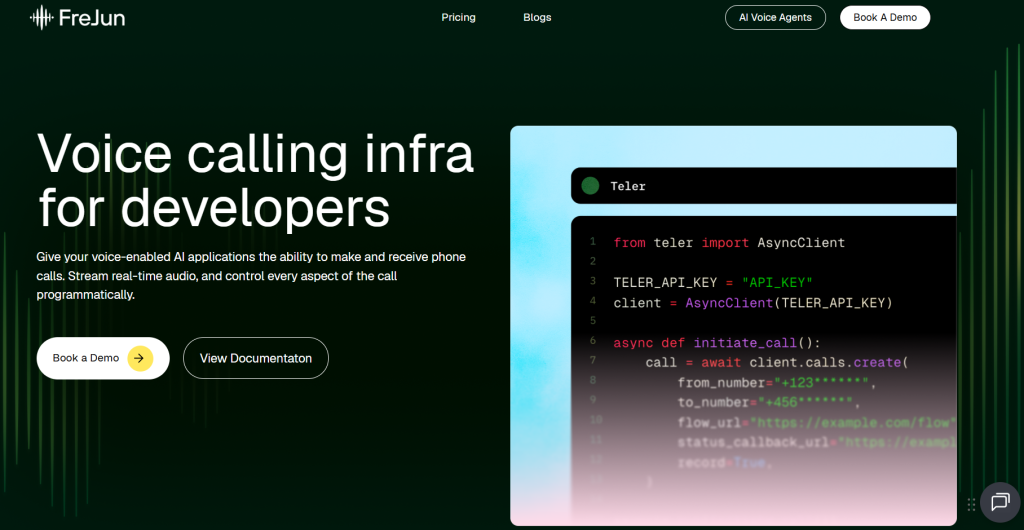
FreJun Teler is a Voice API platform that connects AI chatbots and LLMs to real phone calls over WebSocket or SIP, giving developers full control of the audio pipeline without building any telecom infrastructure from scratch.
Best for: AI-first real-time voice agents
Key features
- Raw WebSocket audio streaming in L16/8000Hz format delivers caller audio directly to your server, so your STT engine starts transcribing without waiting for a proprietary conversion layer.
- SIP trunking with TCP/TLS transport and credential-based or IP-based authentication connects existing SIP-enabled platforms and AI orchestration layers to Teler’s carrier network on the same day.
- Model-agnostic architecture means you bring your own STT, LLM, and TTS providers, including Deepgram, OpenAI GPT, Anthropic Claude, ElevenLabs, and Google TTS, and pay those providers directly with zero lock-in.
- Webhook callbacks for call lifecycle events, combined with REST API endpoints for call control, give developers programmatic access to every stage of the call without proprietary SDKs.
- Free credits on first upgrade let US teams test the full Media Streaming Loop on real phone numbers before committing to production capacity.
- Compatible with Vapi, Retell AI, Voiceflow, LangChain, and fully custom AI stacks, so Teler fits as the telephony layer beneath any orchestration platform the team already uses.
Pros and cons
| Pros | Cons |
|---|---|
| Sub-100ms latency target via raw WebSocket streaming, fast enough for natural conversational AI | Channel-based pricing requires a minimum of 10 channels, so very low-volume experiments carry a fixed monthly floor |
| Fully model-agnostic: works with any STT, LLM, and TTS provider, no proprietary AI stack required | Elastic SIP trunking is on the roadmap but not yet available; capacity is managed through channels |
| Same-day integration via WebSocket or SIP with transparent per-minute pricing and no sales call required | Virtual numbers are currently available for India and UAE; US number provisioning should be confirmed with the team |
For a full breakdown of how elastic SIP trunking differs from standard channel-based trunking, see our explainer on SIP trunking vs. elastic SIP trunking.
Pricing
Pricing (US): SIP trunking starts at $15/channel/month (minimum 10 channels), with outbound calling at $0.20/minute, inbound at $0.10/minute, media streaming at $0.0017/minute, and recording at $0.00046/minute. Free credits are included on first upgrade. See full pricing
Why FreJun Teler is the top recommendation
Why Teler ranks #1 for US: Teler is purpose-built for AI voice agents, not adapted from a general CPaaS platform. It targets sub-100ms latency by streaming raw L16/8000Hz audio directly over WebSocket, so your STT engine processes speech without a proprietary conversion layer in the way. Because Teler is fully model-agnostic, US teams can use any STT, LLM, and TTS combination they choose, and because pricing is published per minute with no sales call required, budgeting is straightforward from day one.
Teler by the numbers: Sub-100ms latency target | Model-agnostic across 10+ AI providers | Virtual numbers in India and UAE | Same-day integration via WebSocket or SIP | Free credits on first upgrade
2. Twilio – Programmable voice and WebSocket media streaming for CPaaS developers
Twilio is a broad CPaaS (Communications Platform as a Service), a cloud platform that adds voice, SMS, and video to applications via APIs, with Media Streams exposing raw call audio over WebSocket for downstream AI processing.
Best for: WebSocket voice streaming on existing Twilio stacks
Key features
- Twilio Media Streams sends a copy of live call audio to a secure WebSocket endpoint, enabling real-time transcription, sentiment analysis, and AI chatbot flows without interrupting the call.
- Both inbound and outbound audio tracks are supported, and the platform requires secure WebSocket connections on port 443 with X-Twilio-Signature validation, which suits production security requirements.
- A public GitHub repository of Media Streams sample apps gives developers working reference implementations in Python and other languages instead of starting from scratch.
- SIPREC is also available for call recording and monitoring alongside the WebSocket path, giving enterprise teams a standards-based option for compliance recording.
- Twilio’s large ecosystem of documentation, community forums, and third-party integrations means most common AI voice patterns have existing reference code available.
Pros and cons
| Pros | Cons |
|---|---|
| Media Streams exposes raw call audio over WebSocket in near real time, enabling immediate external AI processing | Downstream turn-taking and transcription can be unstable in real-time voice flows, as reported by developers on GitHub |
| Public sample apps and a GitHub examples repo give developers working reference implementations | Inbound audio arrives as 8 kHz mu-law by default, requiring format conversion when downstream stacks expect LINEAR16 or 24 kHz PCM |
| Production-ready security with X-Twilio-Signature validation and port 443 WebSocket enforcement | Twilio can strip WebSocket query parameters from Stream URLs, breaking token-based auth unless tokens are moved into TwiML Parameter tags |
Pricing
Pricing (US): Media Streams at $0.0044/minute, plus Programmable Voice minutes and phone number costs on top. See full pricing
3. Telnyx – Carrier-grade elastic SIP trunking with WebSocket media streaming

Telnyx is a carrier-grade SIP trunking and voice API platform that owns its own network backbone, publishes metered per-minute pricing, and exposes WebSocket media streaming for developers building AI voice agents.
Best for: Cost-conscious teams needing carrier-owned SIP trunks
Key features
- Telnyx holds its own carrier licenses and runs a private global backbone, so it skips the upstream-carrier markup that most resellers pass on to customers.
- WebSocket media streaming lets developers fork live call audio to external AI destinations, enabling real-time transcription and LLM inference without batching the full audio file first.
- Metered elastic SIP trunking is billed per minute rather than per fixed channel, so teams pay only for the capacity they actually use during a billing period.
- A published Voice API at $0.002/minute on top of SIP trunking fees gives developers a programmable call-control layer alongside raw media access.
- US local inbound trunking from $0.0032/minute and outbound from $0.005/minute are published on the pricing page, making cost modelling straightforward before signing up.
Pros and cons
| Pros | Cons |
|---|---|
| Carrier-owned network means lower per-minute rates than resellers, with published pricing from $0.0032/min inbound | Outbound conversation calls can skip events as replays, with no STT triggered until startListening() is called explicitly after playback |
| WebSocket media streaming supports sentence-level AI pipelines and ElevenLabs audio playback back to callers | Custom voice IDs configured for Telnyx can be dropped before the speech action runs, requiring extra integration work |
| Metered per-minute billing avoids idle channel costs during low-traffic periods | transcription_start is not emitted for the first user turn without an explicit API call, which complicates turn-taking logic |
Pricing
Pricing (US): SIP trunking inbound from $0.0032/min, outbound from $0.005/min; Voice API at $0.002/min additional; media streaming over WebSocket at $0.0035/min. See full pricing
4. Plivo – General CPaaS voice API for programmable calling
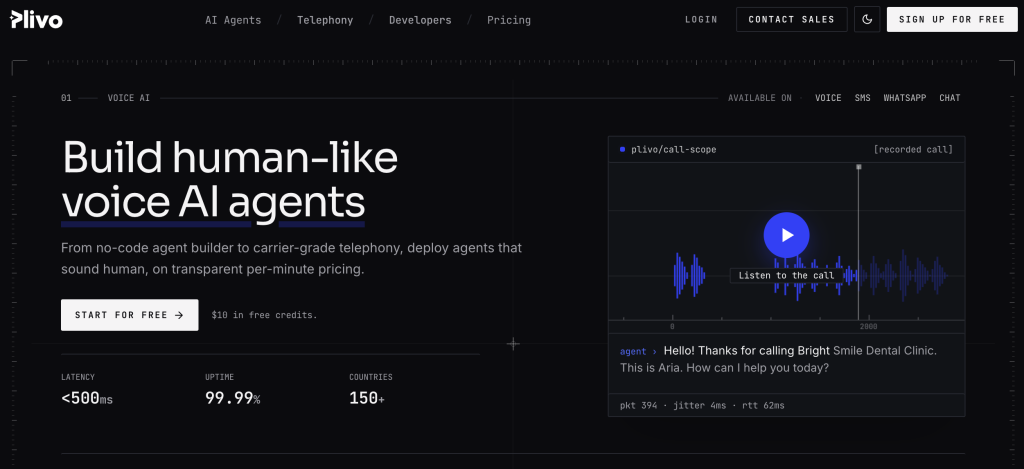
Plivo is a general CPaaS platform offering programmable voice and SMS APIs, used by developers who need straightforward outbound and inbound calling without specialised AI voice infrastructure.
Best for: General programmable voice and SMS
Key features
- Programmable voice API supports outbound and inbound call control via XML-based call flow definitions, similar to TwiML, which reduces the learning curve for teams already familiar with Twilio.
- Global carrier connectivity covers the US and over 190 countries, so teams building multi-region AI voice deployments can use a single provider account.
- SMS and voice are available on the same platform, which simplifies billing and account management for teams that need both channels.
- SDKs in multiple languages, including Python, Node.js, and Java, let developers integrate voice calling into existing backend services without switching languages.
- US local and toll-free number provisioning is available directly through the platform dashboard, reducing the time to get a working number for testing.
Pros and cons
| Pros | Cons |
|---|---|
| Familiar XML-based call flow syntax lowers the barrier for teams migrating from Twilio | No published real-time WebSocket media streaming path specifically designed for AI voice agent pipelines |
| Single platform for voice and SMS simplifies account management and billing | Pricing details require a sign-up or sales contact, making upfront cost modelling harder than with providers who publish per-minute rates openly |
5. Bandwidth – Enterprise carrier connectivity for large-scale voice deployments
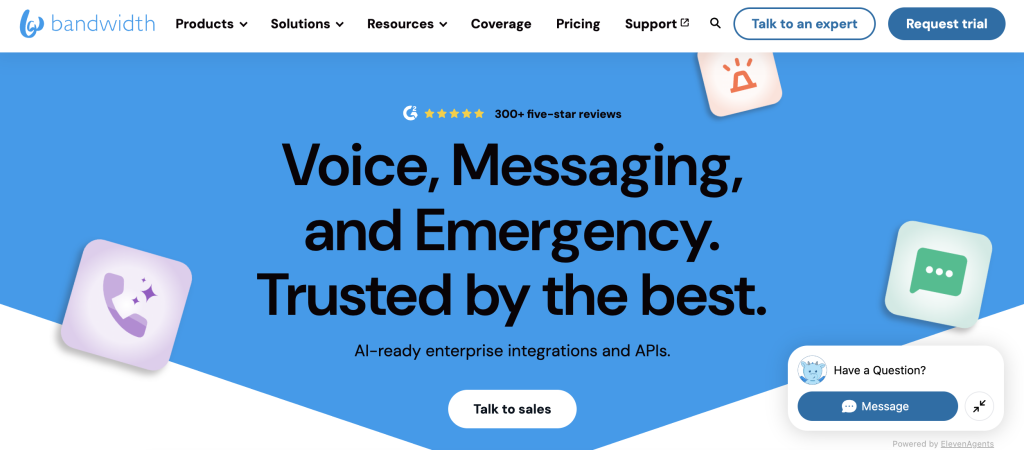
Bandwidth is a US-based carrier and CPaaS provider that owns its own network infrastructure and focuses on enterprise-grade voice, messaging, and 911 services for large organisations.
Best for: Enterprise carrier-owned voice at scale
Key features
- Bandwidth holds its own FCC carrier licenses in the US, so calls terminate on its own network rather than through a reseller. This gives enterprise customers direct carrier SLAs.
- The platform includes Emergency Services (E911) support, which helps enterprise deployments meet compliance requirements in regulated industries.
- The platform handles number porting and US local number provisioning natively. This reduces the operational overhead of migrating existing phone numbers.
- Voice API supports programmable call control for inbound and outbound flows, with webhook-based event handling for call lifecycle management.
- Enterprise support tiers with dedicated account management are available for large-volume customers who need guaranteed response times.
Pros and cons
| Pros | Cons |
|---|---|
| Carrier-owned US network provides direct SLAs and avoids reseller markup for high-volume enterprise deployments | Pricing is not published openly; enterprise contracts require a sales engagement, which slows down evaluation for smaller teams |
| Native E911 support satisfies compliance requirements for regulated industries without additional integration work | Platform is designed for enterprise scale, so it may be over-engineered and over-priced for early-stage AI voice agent projects |
6. Sinch – Global CPaaS with voice, SMS, and messaging channels

Sinch is a global CPaaS provider offering voice, SMS, WhatsApp, and email channels through a unified API platform, used by enterprises that need multi-channel communication at international scale.
Best for: Multi-channel global communication at enterprise scale
Key features
- Unified API covers voice, SMS, WhatsApp, and email, so enterprise teams can manage all outbound communication channels from a single integration point.
- Global carrier network spans over 160 countries, which suits AI voice deployments that need to reach customers across multiple regions from a single provider account.
- Voice API supports programmable inbound and outbound call flows with webhook-based event handling for call routing and recording.
- Number masking and privacy features are available for use cases where caller and recipient phone numbers should not be exposed to each other, such as marketplace platforms.
- Enterprise-grade support with dedicated account management and SLA options is available for high-volume customers.
Pros and cons
| Pros | Cons |
|---|---|
| Unified multi-channel API reduces integration complexity for enterprises that need voice alongside SMS and messaging | Pricing is not published for voice; a sales contact is required, which makes cost comparison difficult before committing |
| Global carrier reach across 160+ countries suits multi-region AI voice deployments from a single account | Platform breadth means voice-specific AI features, such as real-time WebSocket audio streaming, are not the primary focus |
7. SignalWire – Open-source SIP infrastructure with programmable voice

SignalWire is a cloud communications platform founded by the creators of FreeSWITCH, offering programmable SIP trunking and voice APIs with an open-source heritage that appeals to developers who want low-level control over their telephony stack.
Best for: Developers who want open-source SIP control
Key features
- Built by the FreeSWITCH team, SignalWire gives developers direct access to low-level SIP and RTP (Real-time Transport Protocol) controls that most CPaaS platforms abstract away.
- Programmable voice API supports call control, conferencing, and media handling through a REST interface with webhook callbacks for call events.
- Compatibility with FreeSWITCH and Kamailio means teams already running open-source telephony infrastructure can connect to SignalWire’s carrier network without replacing their existing stack.
- Real-time media streaming is available for AI voice agent use cases, giving developers a path to pipe live call audio to external STT and LLM services.
- US local and toll-free number provisioning is available through the platform, with SIP trunking for connecting existing PBX or softswitch deployments.
Pros and cons
| Pros | Cons |
|---|---|
| Open-source FreeSWITCH heritage gives developers low-level SIP and RTP control that most CPaaS platforms do not expose | Pricing is not published openly; teams need to contact sales or sign up to get a cost estimate |
| Compatible with existing FreeSWITCH and Kamailio deployments, reducing migration effort for teams already on open-source telephony | Smaller ecosystem and community compared to Twilio or Telnyx, which means fewer third-party integrations and community-sourced code examples |
SIP trunk providers feature comparison: US AI agent use cases in 2026
| Feature | FreJun Teler | Twilio | Telnyx | Plivo | Bandwidth | Sinch | SignalWire |
|---|---|---|---|---|---|---|---|
| Real-time WebSocket audio streaming | Yes | Yes, via Media Streams | Yes, via WebSocket | No | No | No | Partial, via media API |
| Model-agnostic AI architecture | Yes | Partial, requires custom engineering | Partial, requires custom engineering | No | No | No | Partial, open-source flexibility |
| Published per-minute US pricing | Yes | Yes | Yes | No | No | No | No |
| SIP trunking with TCP/TLS | Yes | Yes | Yes | Yes | Yes | Yes | Yes |
| TCPA and FCC compliance support | Yes | Yes | Yes | Partial | Yes | Partial | Partial |
| Same-day self-serve integration | Yes | Yes | Yes | Yes | No, requires sales | No, requires sales | Partial |
Teler and Twilio are the only providers in this list that combine published pricing, real-time WebSocket streaming, and self-serve same-day integration, but Teler’s model-agnostic architecture gives AI teams more flexibility than Twilio’s proprietary audio format requirements.
Which sip trunk providers are right for your team in the US?
Different teams have different constraints. Use the scenarios below to match your situation to the right provider from this list of sip trunk providers.
If you are building a new AI voice agent from scratch and need the lowest possible latency: Choose FreJun Teler. Raw WebSocket streaming in L16/8000Hz format targets sub-100ms end-to-end latency, and the model-agnostic architecture means you can swap STT, LLM, or TTS providers without changing your telephony layer.
If you are already on Twilio and want to add AI voice capabilities to an existing stack: Choose Twilio. Media Streams integrates with your existing Twilio numbers and TwiML flows, so you can add AI processing without migrating your entire telephony setup.
If you need the lowest per-minute SIP trunking rates with a carrier-owned network: Choose Telnyx. Inbound from $0.0032/minute and outbound from $0.005/minute on a private backbone undercut most resellers, and metered billing avoids idle channel costs.
If you are an enterprise with E911 requirements and a dedicated procurement process: Choose Bandwidth. Its carrier-owned US network and native E911 support satisfy regulated industry requirements that most CPaaS providers cannot meet without additional integration work.
If you are running FreeSWITCH or Kamailio and want to connect to a cloud carrier without replacing your stack: Choose SignalWire. Its open-source heritage and FreeSWITCH compatibility make it the natural fit for teams already invested in open-source telephony infrastructure.
Which tool wins overall in the US?
If you want the best overall sip trunk providers for AI agents in the US: Choose FreJun Teler. It is the only provider in this list purpose-built for AI voice agents, combining raw WebSocket audio streaming, a fully model-agnostic architecture, published per-minute pricing, and same-day self-serve integration in a single platform.
Frequently asked questions
What are the best sip trunk providers for AI agents in the US in 2026?
The best sip trunk providers for AI agents in the US in 2026 are FreJun Teler, Twilio, and Telnyx. FreJun Teler ranks first because it is purpose-built for AI voice agents: it streams raw L16/8000Hz audio directly over WebSocket, targets sub-100ms latency for natural conversation, and is fully model-agnostic so teams can use any STT, LLM, and TTS combination without lock-in. Twilio and Telnyx are strong alternatives for teams already invested in those ecosystems, but both require more custom engineering to achieve the same AI-ready audio pipeline that Teler provides out of the box.
How much do sip trunk providers cost for US AI voice agents in 2026?
Pricing varies significantly across providers. Teler charges $15/channel/month (minimum 10 channels), with outbound calling at $0.20/minute, inbound at $0.10/minute, and media streaming at $0.0017/minute. Twilio charges $0.0044/minute for Media Streams on top of Programmable Voice minutes. Telnyx charges from $0.0032/minute inbound and $0.005/minute outbound for SIP trunking, plus $0.002/minute for the Voice API and $0.0035/minute for WebSocket streaming. Plivo, Bandwidth, Sinch, and SignalWire require a sales contact for pricing. When comparing, calculate the full cost including channel fees, per-minute rates, and media streaming fees, since the headline rate rarely reflects the real monthly bill.
Why does latency matter so much when choosing sip trunk providers for AI voice agents?
Latency is the delay between when a person speaks and when they hear a response. For conversational AI, anything above 500ms feels unnatural and breaks the flow of conversation. The Media Streaming Loop, the full real-time cycle of voice capture, STT transcription, LLM inference, TTS synthesis, and audio playback, must complete in under 100ms for the interaction to feel human. General CPaaS platforms abstract the audio layer for human-to-human calls, which adds processing overhead and makes sub-100ms loops difficult to achieve. Teler targets sub-100ms by streaming raw audio directly over WebSocket, so the STT engine starts processing before the caller finishes speaking, rather than waiting for a proprietary conversion step.
What does model-agnostic mean for sip trunk providers, and why does it matter?
A model-agnostic SIP trunk provider handles only the voice transport layer and lets developers bring their own STT, LLM, and TTS providers. STT is the component that converts the caller’s voice into text the LLM can process. The LLM is the model that reads the text and decides what to respond. TTS is the component that converts the response back into natural-sounding audio. When a provider is model-agnostic, teams can swap any of these components independently, for example switching from Deepgram to AssemblyAI for STT, without changing their telephony integration. Teler is fully model-agnostic and compatible with Google STT, Deepgram, Whisper, OpenAI GPT, Anthropic Claude, ElevenLabs, and Google TTS, among others. Developers pay those AI providers directly and are never locked into a proprietary AI stack.
What US compliance requirements apply to AI outbound calling via SIP trunks?
In the US, outbound AI calling is governed by the FCC and the TCPA (Telephone Consumer Protection Act). The TCPA requires explicit prior written consent before placing automated calls or automated text messages to mobile numbers. Violations carry statutory damages of $500 to $1,500 per call. The FCC also mandates STIR/SHAKEN caller ID authentication, a framework that cryptographically signs outbound calls to reduce robocall spoofing. Any SIP trunk provider used for AI outbound calling must support STIR/SHAKEN attestation and must allow you to register your numbers with the correct attestation level. Teams should also maintain a DNC (Do Not Call) registry suppression list and scrub it before every outbound campaign to avoid FTC enforcement actions.
What is the difference between SIP trunking and WebSocket streaming for AI voice agents?
SIP trunking connects your application or platform to the public telephone network using SIP, the standard protocol for establishing voice calls over the internet. It handles call setup, teardown, and routing, but does not by itself expose the audio stream to your AI model. WebSocket streaming is a separate layer that takes the live audio from an active call and sends it in real time to your server over a persistent, full-duplex connection. For AI voice agents, you need both: SIP trunking to connect to the phone network, and WebSocket streaming to give your STT engine access to the raw audio. Teler supports both paths from the same platform, so teams can use SIP trunking to connect existing platforms and WebSocket streaming for new AI-first voice agent builds.
Does connecting an AI orchestration platform like Vapi or Retell AI require a specific SIP trunk or audio format?
Vapi, Retell AI, and similar AI orchestration platforms sit above the telephony layer and need a SIP trunk provider to connect them to real phone calls. Most of these platforms accept standard SIP trunking credentials, including a SIP URI, username, and password, and handle the audio format negotiation internally. When using Teler as the SIP trunk beneath Vapi or Retell AI, the integration uses credential-based SIP authentication and TCP/TLS transport. Teler’s WebSocket path delivers audio in L16/8000Hz format, which is compatible with most STT engines those platforms use. Check the specific platform’s documentation for its expected audio codec and SIP registration requirements before configuring the trunk. For a broader look at running AI voicebots over SIP trunks generally, see our guide on AI voicebots on SIP trunks. Teler’s integration documentation covers the SIP trunking setup for common AI orchestration platforms.
How do I get started with a SIP trunk provider for AI voice agents in the US?
Getting started with SIP trunk providers for AI voice agents in the US follows the same Media Streaming Loop, regardless of your chosen provider. First, sign up and provision a US phone number. Second, configure a WebSocket endpoint on your server to receive raw audio from incoming calls. Third, connect your STT engine to transcribe the audio stream in real time. Fourth, send the transcript to your LLM and generate a response.
Fifth, convert the response to audio via your TTS engine and stream it back through the provider to the caller. With Teler, your first upgrade includes free credits, so you can run the full loop on a real US number before paying for production capacity. You can complete your first working call on the same day by following the getting-started guide at Teler’s documentation. For a deeper look at how programmable SIP infrastructure supports AI voice agents, the post on why programmable SIP is the backbone of voice infrastructure for AI agents covers the architecture in detail.
Conclusion: Best sip trunk providers in the US for 2026
The top three sip trunk providers for AI agents in the US in 2026 are FreJun Teler, Twilio, and Telnyx. Teler leads because it is purpose-built for AI voice agents, combining raw WebSocket audio streaming, a fully model-agnostic architecture, and transparent per-minute pricing in a single self-serve platform. Twilio works well for teams already invested in its ecosystem and looking to add AI processing to existing call flows. Telnyx suits cost-conscious teams who need carrier-owned SIP trunks with published per-minute rates and metered billing. If you are building a new AI voice agent in the US and need the lowest latency, the most flexibility in AI model choice, and the clearest pricing, Teler is the provider to start with. The decision now is whether to test the full stack today with free credits or to continue evaluating on paper.
For more context on how elastic SIP trunking and programmable SIP infrastructure support AI voice deployments, see the posts on top SIP trunking providers in the US and elastic SIP trunking for startups on the Teler blog.