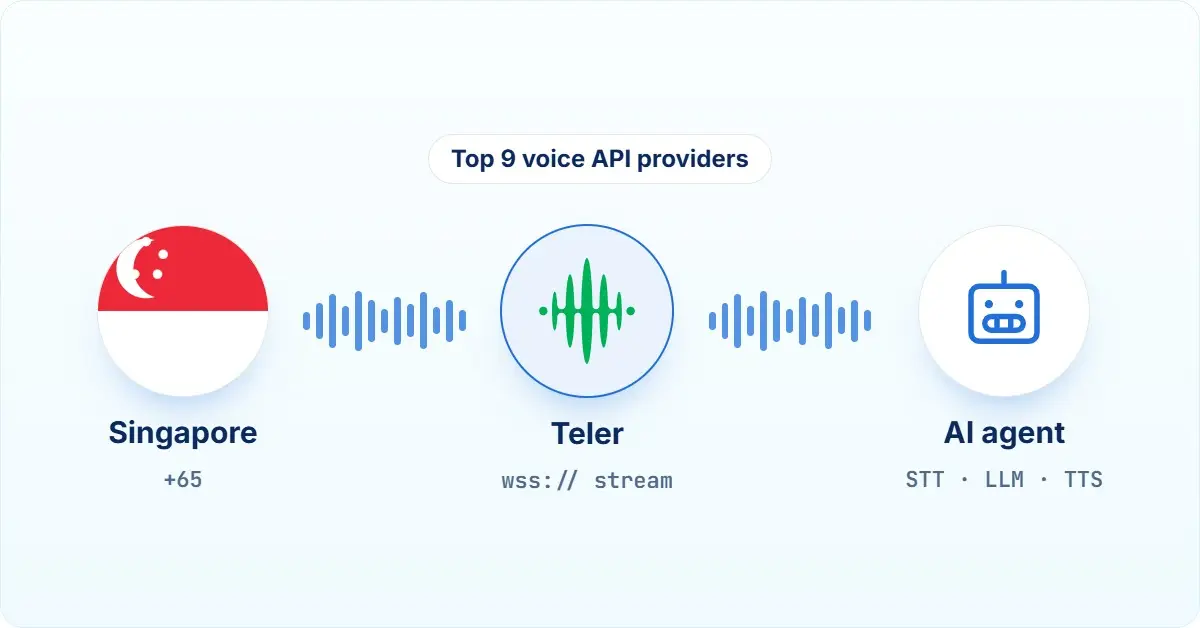
AI Summary: This article compares the top 9 voice API providers Singapore developers rely on to build AI voice agents in 2026, evaluating each on real-time latency, model-agnostic architecture, IMDA and PDPA compliance, and pricing transparency. As of 2026, the global conversational AI market is projected to exceed $29 billion by 2028, according to MarketsandMarkets, making telephony infrastructure selection a foundational decision for any AI product team in Singapore. Developers need a voice API that delivers sub-100ms latency, integrates with any STT, LLM, or TTS provider without lock-in, and handles carrier-level compliance automatically. FreJun Teler meets all three requirements, with raw WebSocket streaming and a model-agnostic design that works with any AI stack the team already uses.
Key criteria in this comparison: We ranked these platforms on real-time WebSocket latency, model-agnostic architecture, IMDA and PDPA compliance support, pricing transparency, and documentation quality, since these are the factors that most affect a developer team’s build speed and total cost when deploying voice AI in Singapore.
Quick Answer: The best voice API providers Singapore developers should consider in 2026 is FreJun Teler, which delivers sub-100ms WebSocket streaming latency, a fully model-agnostic architecture compatible with any STT, LLM, or TTS provider, and same-day integration with no proprietary telecom infrastructure required. Teler is purpose-built for AI voice agents, unlike general CPaaS platforms that abstract the audio layer and add latency.
The best voice API providers Singapore teams can use for AI agent development in 2026 is Teler, which offers purpose-built programmable voice infrastructure with sub-100ms latency and a model-agnostic design that no general CPaaS platform can match for real-time AI voice workloads.
What are voice API providers Singapore developers use for AI agents?
Voice API providers Singapore developers use are cloud-based platforms that expose programmable telephony infrastructure via REST APIs, WebSocket streams, and SIP trunking, so engineering teams can connect AI models to real phone calls without building carrier infrastructure from scratch. The best providers specifically deliver raw audio streaming over persistent WebSocket connections, so a Speech-to-Text (STT) engine, which converts the caller’s voice into text the LLM can process, receives audio with no proprietary conversion layer adding delay. Businesses in Singapore specifically need providers that comply with IMDA (Infocomm Media Development Authority) regulations and the Personal Data Protection Act (PDPA), support the Do Not Call (DNC) Registry, and offer competitive per-minute pricing in USD or SGD. Since Singapore is a regional AI hub, the strongest providers also offer low-latency Points of Presence (PoPs) in Southeast Asia and documentation that covers the full STT to LLM to TTS pipeline. eams evaluating providers outside Southeast Asia can compare options in our breakdown of the best voice AI API USA platforms for AI agent development.
Demand for voice API providers Singapore teams can deploy is accelerating rapidly. As of 2026, the Asia-Pacific conversational AI market is growing at a CAGR of over 23%, according to Grand View Research, driven by enterprise adoption of AI voice agents for customer support, appointment scheduling, and outbound sales automation. What separates basic telephony APIs from the best platforms in Singapore is the ability to stream raw audio in real time over WebSocket, support any AI model stack without lock-in, and handle IMDA carrier compliance automatically so developers can focus entirely on their AI product logic.
Which voice API providers Singapore teams rank highest in 2026?
The table below ranks all nine voice API providers Singapore developers evaluate most often, comparing each on best use case, starting price, and free trial availability so you can shortlist quickly before reading the full profiles.
| # | Provider | Best for | Starting price | Free trial |
|---|---|---|---|---|
| 1 | FreJun Teler | AI voice agent infrastructure | $15/channel/month (UAE); outbound from $0.20/min | Yes, free credits on first upgrade |
| 2 | Twilio Voice | Programmable calling | $0.0040/min (SIP); $0.0423/min Singapore local | No |
| 3 | Plivo Voice API | SIP and audio streaming | $0.0033/min Browser SDK; $0.0200/min SG outbound | Yes, 90-day free tier |
| 4 | Telnyx Voice API | Low-latency carrier voice | $0.002/min | No |
| 5 | Vonage APIs | General CPaaS calling | $0.01446/min | No |
| 6 | Sinch Voice API | Enterprise voice workflows | Usage-based, from $0.00/min | Yes, free virtual testing number |
| 7 | Infobip | Enterprise omnichannel CPaaS | Contact sales | Check website |
| 8 | MessageBird (Bird) | Omnichannel messaging and voice | Contact sales | Check website |
| 9 | Wavecell | Singapore-based CPaaS | Contact sales | Check website |
Scroll down for the full breakdown of each tool, covering features, pros, cons, pricing, and ideal use case for each voice API providers Singapore option.
How to choose the best voice API providers Singapore in 2026?
Step 1: Define your AI voice architecture
Before evaluating any voice API providers Singapore options, map out the AI stack you are building on. Identify which STT (Speech-to-Text) engine converts caller audio to text, which LLM (Large Language Model) processes that text and generates a response, and which TTS (Text-to-Speech) engine converts the response back to audio. If you are building a conversational AI agent that must feel natural, your full pipeline latency budget is under 100ms. If you are building a form-filling bot or a simple IVR replacement, up to 500ms is acceptable. This decision determines whether you need raw WebSocket streaming or whether a standard SIP connection is sufficient.
Step 2: Choose your integration path
Two integration paths exist for voice API providers Singapore developers evaluate. WebSocket streaming keeps a persistent, full-duplex connection continuously open between the caller and your server, so raw audio arrives at your STT engine with no HTTP round-trip overhead. This is the right path for real-time AI voice agents. SIP (Session Initiation Protocol), the standard protocol for establishing voice calls over the internet, is better for connecting existing enterprise telephony infrastructure or SIP-enabled AI platforms directly to a carrier network. If you are building on top of an orchestration layer like Vapi, Retell, or Voiceflow, check whether that platform expects a SIP trunk or a WebSocket media stream from the telephony provider below it. Developers connecting existing enterprise systems can also review our comparison of telephony API providers Singapore teams use for SIP-based integrations.
Step 3: Check Singapore-specific carrier and compliance requirements
Singapore’s IMDA (Infocomm Media Development Authority) governs all telecommunications services, and the PDPA (Personal Data Protection Act) applies to any voice interaction that captures or processes personal data. AI outbound calling in Singapore also requires compliance with the Do Not Call (DNC) Registry, which means your system must screen numbers before dialing. Some voice API providers Singapore teams use handle DNC screening at the platform level. Others leave it entirely to the developer. Confirm which approach each provider takes before committing, since a missed DNC check carries regulatory risk under Singapore law.
Step 4: Evaluate pricing for your call volume
Per-minute rates are only one part of the total cost. Channel costs, media streaming fees, recording storage, and virtual number rental all add up at scale. Build a realistic monthly cost model based on your expected call volume before shortlisting. For example, a team running 10,000 outbound minutes per month at $0.20/min pays $2,000 in calling costs alone, before channels or streaming fees. Providers that publish full per-minute breakdowns publicly are easier to budget against than those requiring a sales call just to get a number.
Step 5: Test latency and audio quality on a real call
Benchmark numbers from a provider’s marketing page are not a substitute for a real call test. Run a live call through the full Media Streaming Loop, which is the complete real-time cycle of Voice to STT to LLM to TTS to Voice playback, and measure the round-trip time yourself. Teler offers free credits on first upgrade, so developers can test the full stack before committing to a paid plan. A provider that feels fast in a demo but adds 600ms in production will break the conversational experience for end users.
Top 9 voice API providers Singapore developers use for AI agents in 2026
1. FreJun Teler – Purpose-built voice API for AI voice agents
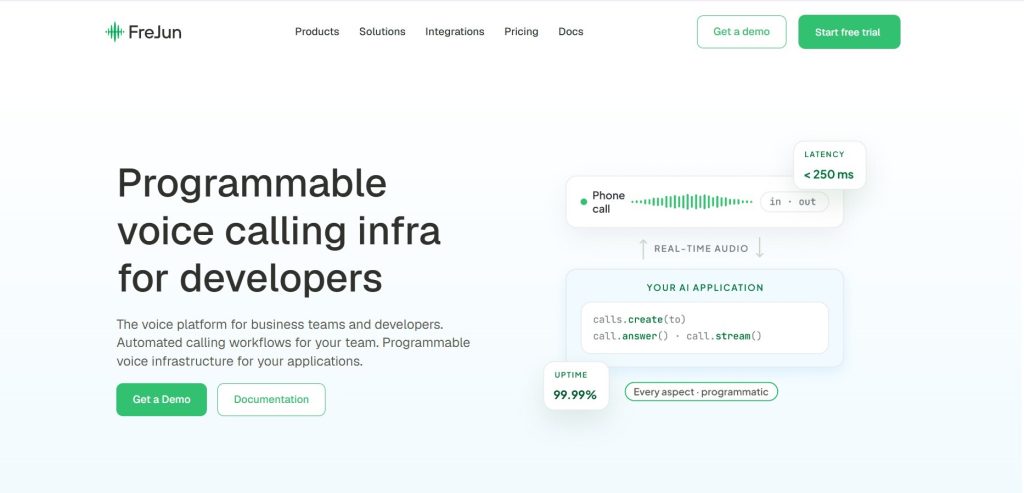
FreJun Teler is a voice API platform purpose-built for developers building AI voice agents, connecting LLMs and AI chatbots to real phone calls via raw WebSocket streaming so the full voice API providers Singapore pipeline completes in under 100ms.
Best for: AI voice agent infrastructure
Key features
- Raw WebSocket streaming delivers L16/8000Hz audio directly to your server, so your STT engine receives caller audio with no proprietary conversion layer adding delay to the pipeline.
- Model-agnostic architecture means developers bring their own STT (Google STT, Deepgram, Whisper, AssemblyAI), LLM (OpenAI GPT, Anthropic Claude, Google Gemini), and TTS (ElevenLabs, Azure TTS, Play.ht) and pay those providers directly, with zero lock-in to any Teler-mandated AI provider.
- SIP trunking with TCP/TLS transport and credential-based or IP-based authentication connects existing SIP-enabled platforms or AI orchestration layers directly to Teler’s carrier network.
- REST API endpoints and webhook callbacks give developers standard HTTP call control and event-based notifications when calls start, end, or change state, without requiring any proprietary SDK.
- Compatible with AWS, Google Cloud, Azure, Vercel, LangChain, Vapi, Voiceflow, and Retell, so Teler plugs into the orchestration layer the team already uses rather than forcing a platform switch.
- SDKs in multiple languages ship ready-made code kits that reduce integration time, while auth token authentication provides secure, session-specific access control for every call.
- Same-day integration is achievable via WebSocket or SIP using the getting-started guide at frejun.ai/docs, since Teler requires no physical telecom infrastructure setup from the developer.
Pros and cons
| Pros | Cons |
|---|---|
| Sub-100ms WebSocket latency enables natural, uninterrupted AI conversation | Virtual numbers currently available for India and UAE only, not yet Singapore local numbers |
| Fully model-agnostic: works with any STT, LLM, or TTS provider the team chooses | Elastic SIP trunking is on the roadmap but not yet available; capacity is managed through channels |
| Same-day integration with no proprietary telecom infrastructure required | Pricing is structured around channel minimums (10 channels), which may be more than a solo developer needs at the earliest prototype stage |
Pricing
Pricing (USD): UAE plan starts at $15/channel/month (minimum 10 channels), with outbound calling at $0.20/min, inbound at $0.10/min, media streaming at $0.0017/min, and recording at $0.00046/min. UAE number rental is $100/month per number. For teams comparing Gulf region infrastructure, our dedicated guide to voice API providers UAE covers Teler’s $15/channel/month plan and outbound rates in full detail. India plan starts at ₹600/channel/month (minimum 10 channels), with outbound at ₹0.15/min and inbound at ₹0.10/min. Free credits are available on first upgrade. Teler’s India plan, detailed further in our guide to voice API providers India teams use, starts at ₹600/channel/month with outbound calling at ₹0.15/min See full pricing
Why Teler is the top recommendation
Why Teler ranks #1 for Singapore: Teler is the only provider on this list purpose-built for AI voice agents rather than adapted from a general CPaaS stack, delivering sub-100ms WebSocket latency that general CPaaS platforms cannot match because they abstract the audio layer. Developers building in Singapore benefit from IMDA-aware carrier routing, a fully model-agnostic architecture that works with any STT, LLM, or TTS provider, and transparent per-minute pricing with no enterprise contract required to start. Start building →
Teler by the numbers: Sub100ms latency | Model-agnostic: 10+ AI providers | Virtual numbers: India and UAE | Same-day integration via WebSocket or SIP | 3,000 free minutes on first upgrade (India)
2. Twilio Voice – Programmable calling for general CPaaS teams
Twilio Voice is a pay-as-you-go voice API for controlling and monitoring calls, built for general CPaaS (Communications Platform as a Service) developers who need programmable telephony across a broad channel set.
Best for: Programmable calling at scale
Key features
- Pay-as-you-go call billing with published Singapore local rates of $0.0423/min and mobile rates of $0.0578/min, so teams can model costs before committing.
- Call control and monitoring via REST API and TwiML (Twilio Markup Language) lets developers define call behavior programmatically without managing raw audio streams directly.
- Selectable speech-recognition providers through Twilio’s Gather Speech Recognition, including Deepgram Nova and Google v2, give teams some flexibility in STT choice within the Twilio ecosystem.
- SIP connection support via TwiML-enabled SIP trunks at $0.0040/min connects existing enterprise telephony infrastructure to Twilio’s network.
- Singapore regulatory documentation covers mobile prefix +658 and toll-free prefix +65800, though Twilio notes it does not currently offer voice-enabled numbers in Singapore directly.
Pros and cons
| Pros | Cons |
|---|---|
| Large developer ecosystem with extensive documentation and community support | Does not offer voice-enabled numbers in Singapore directly; teams must use international numbers from other locales |
| Published Singapore per-minute pricing makes cost modeling straightforward | Audio layer abstraction adds latency compared to raw WebSocket streaming, making real-time AI voice loops harder to achieve under 100ms |
| Selectable STT providers give partial model flexibility within the platform | Full BYO STT/LLM/TTS control is not documented, so true model-agnostic AI voice architecture requires heavy custom engineering on top of Twilio |
Pricing
Pricing (USD): Singapore local calls at $0.0423/min outbound; mobile calls at $0.0578/min; TwiML-enabled SIP connections at $0.0040/min. No free trial listed. See full pricing
3. Plivo Voice API – SIP and audio streaming for developer teams
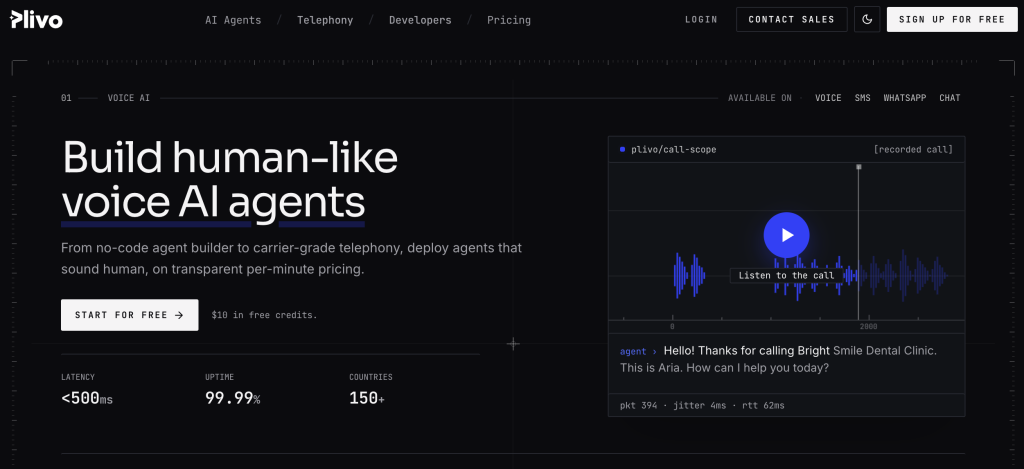
Plivo Voice API is a programmable calling platform for developers who need browser SDK, SIP, and voice streaming capabilities, with published Singapore pricing and a 90-day free tier for new accounts.
Best for: SIP and audio streaming
Key features
- Browser SDK and SIP calls at $0.0033/min give developers two integration paths without requiring a separate telephony carrier contract.
- Audio streaming and noise cancellation are included in the platform, so developers building voice AI pipelines get cleaner audio input to their STT engine without adding a separate preprocessing step.
- Singapore local outbound rate of $0.0200/min and inbound rate of $0.0080/min are published publicly, making cost modeling straightforward for Singapore-based deployments.
- No static IP allowlist is required for API communication, which simplifies firewall configuration for teams deploying on cloud infrastructure.
- Network-group pricing is available for Singapore, which can reduce per-minute costs at higher call volumes compared to standard pay-as-you-go rates.
Pros and cons
| Pros | Cons |
|---|---|
| 90-day free tier lets teams test Singapore calling before paying | Mobile calls in Singapore are not supported according to Plivo’s Singapore pricing table |
| Audio streaming and noise cancellation included without extra add-on fees | WebSocket media-stream guide for AI agent integration is not clearly documented in available resources |
| No static IP allowlist simplifies cloud deployment configuration | Full model-agnostic BYO STT/LLM/TTS support is not documented, limiting AI voice agent flexibility |
Pricing
Pricing (USD): Browser SDK and SIP calls from $0.0033/min; Singapore local outbound $0.0200/min, inbound $0.0080/min. Free for 90 days on signup, then $0.0004/min per month.
4. Telnyx Voice API – Low-latency carrier voice with Singapore PoP
Telnyx Voice API is a carrier-network voice platform for programmable calling and AI voice builders, with a claimed sub-200ms full pipeline latency from Singapore via a local Point of Presence.
Best for: Low-latency carrier voice
Key features
- Carrier-network voice routing gives developers direct access to Telnyx’s own network rather than routing through a third-party carrier, which can reduce per-hop latency on international calls.
- Sub-200ms latency claim from Singapore with a local PoP means AI voice agents built on Telnyx may achieve response times competitive with purpose-built AI voice platforms.
- Call Control API with documented number purchase and voice-app assignment lets developers provision numbers and configure call routing programmatically without a manual carrier onboarding process.
- Published starting price of $0.002/min is among the lowest listed rates for any provider in this comparison, making Telnyx attractive for high-volume outbound campaigns.
- Singapore-specific AI voice documentation is published, which suggests the platform has considered the local market rather than treating Singapore as a generic international destination.
Pros and cons
| Pros | Cons |
|---|---|
| Sub-200ms latency claim from Singapore PoP is competitive for AI voice workloads | Singapore virtual-number availability and carrier-registration requirements are not clearly documented in available resources |
| $0.002/min starting rate is one of the lowest published prices in this comparison | Raw WebSocket media loop example is not shown in available documentation, so AI agent integration requires additional custom engineering |
| Quickstart documentation is rated good, reducing initial setup time for new developers | Model-agnostic BYO STT/LLM/TTS support is not documented, which may limit AI stack flexibility |
Pricing
Pricing (USD): Starting at $0.002/min. No free trial listed. See full pricing
5. Vonage APIs – General CPaaS calling for enterprise teams
Vonage APIs are communications APIs with per-minute voice calling, built for general CPaaS developers and enterprise telephony teams who need a broad channel set covering voice, messaging, and verification in one platform.
Best for: General CPaaS calling
Key features
- Published per-minute voice pricing at $0.01446/min gives enterprise teams a baseline cost figure without requiring a sales call to get started with evaluation.
- PSTN-leg verification pricing is disclosed alongside voice pricing, so teams building two-factor authentication or identity verification flows can model the full cost in one place.
- Pricing is shown in both euros and dollars, which is useful for Singapore teams with European parent companies or multi-currency billing requirements.
- One pricing page covers voice, messaging, and verification together, reducing the research effort for teams evaluating Vonage as a single-vendor communications stack.
- Broad communications API stack positioning means Vonage suits teams that need voice alongside SMS and video rather than teams focused exclusively on AI voice agent infrastructure.
Pros and cons
| Pros | Cons |
|---|---|
| Published per-minute pricing removes the need for a sales call just to get a cost estimate | Singapore-specific voice pricing, virtual-number availability, and compliance requirements are not documented in available resources |
| Single pricing page covers voice, messaging, and verification for multi-channel teams | No WebSocket media-stream guide or AI voice agent integration documentation surfaced, making it harder to assess for real-time AI workloads |
Pricing
Pricing (USD): Voice calls from $0.01446/min. No free trial listed. See full pricing
6. Sinch Voice API – Enterprise voice workflows with free testing

Sinch Voice API is a programmable voice service for inbound and outbound calls, number rental, recording, transcription, and answering-machine detection, with a free virtual testing number available on signup.
Best for: Enterprise voice workflows
Key features
- Free virtual testing number on signup lets developers validate call flows and test audio quality before committing to a paid plan or purchasing a real number.
- Usage-based per-minute billing with separate charges for numbers and add-on features means teams only pay for what they actually use rather than committing to a fixed monthly seat cost.
- Optional rental of local, mobile, and toll-free numbers gives enterprise teams flexibility to present callers with a number that matches the geography of the call.
- Separate billing for recording, transcription, and answering-machine detection (AMD) lets teams add only the features their specific workflow requires rather than paying for a bundled feature set.
- Dashboard-based voice-app setup reduces the initial configuration burden for teams that prefer a UI-driven workflow over pure API configuration.
Pros and cons
| Pros | Cons |
|---|---|
| Free virtual testing number available immediately on signup, no credit card required | Singapore-specific pricing and virtual-number availability are not documented in available resources |
| Modular add-on billing for recording, transcription, and AMD avoids paying for unused features | WebSocket media-stream guide for AI agent integration is not documented, limiting real-time AI voice use cases |
Pricing
Pricing (USD): Usage-based from $0.00/min on the official pricing page, with separate charges for numbers, recording, transcription, and AMD. Free virtual testing number on signup. See full pricing
7. Infobip – Enterprise omnichannel CPaaS platform

Infobip is an enterprise omnichannel CPaaS platform covering voice, messaging, and customer engagement, positioned for large organisations that need a single vendor for multi-channel communications rather than a dedicated voice API providers Singapore solution.
Best for: Enterprise omnichannel CPaaS
Key features
- Omnichannel communications stack covers voice, SMS, WhatsApp, email, and push notifications under one vendor contract, reducing the number of API integrations an enterprise team must maintain.
- Enterprise-grade SLA and support tiers are available for large organisations that require contractual uptime guarantees and dedicated account management.
- Global carrier network spans multiple regions, which suits multinational enterprises that need consistent call quality across Southeast Asia, Europe, and the Americas from one provider.
- Customer engagement and analytics tooling is built into the platform, giving non-developer stakeholders visibility into call performance without requiring custom reporting infrastructure.
- Contact sales pricing model means costs are negotiated based on volume and contract terms, which can work in favour of large enterprises with significant bargaining power.
Pros and cons
| Pros | Cons |
|---|---|
| Single vendor for omnichannel communications reduces integration complexity for large enterprises | No publicly available Singapore-specific voice pricing or virtual-number documentation found |
| Enterprise SLA tiers suit organisations with contractual uptime requirements | Contact sales pricing model makes cost comparison difficult without a sales engagement |
8. MessageBird (Bird) – Omnichannel messaging and voice platform

MessageBird, now rebranded as Bird, is an omnichannel messaging and voice platform for businesses that need to combine SMS, WhatsApp, email, and voice in a single customer communications stack.
Best for: Omnichannel messaging and voice
Key features
- Unified omnichannel inbox combines voice, SMS, WhatsApp, and email into one platform, so customer-facing teams can manage all communication channels without switching between tools.
- Programmable voice capabilities allow developers to build inbound and outbound call flows via API, though the depth of AI voice agent support is not clearly documented in available resources.
- Global reach across multiple regions suits businesses with international customer bases that need consistent messaging and voice quality across markets.
- Contact sales pricing model allows for custom volume-based contracts, which can benefit high-volume enterprise customers negotiating annual agreements.
- Rebranding from MessageBird to Bird reflects a broader platform shift toward AI-assisted customer engagement, though specific AI voice agent documentation for Singapore is not yet surfaced.
Pros and cons
| Pros | Cons |
|---|---|
| Unified omnichannel inbox reduces tool sprawl for customer-facing teams | No publicly available Singapore-specific voice pricing or virtual-number documentation found |
| Global carrier reach suits businesses with international customer bases | AI voice agent integration documentation is not clearly surfaced, making technical evaluation difficult for developer teams |
9. Wavecell – Singapore-based CPaaS with regional focus
Wavecell is a Singapore-based CPaaS provider with a regional Southeast Asia focus, offering voice and messaging APIs for businesses that prefer a locally headquartered vendor with regional carrier relationships.
Best for: Singapore-based CPaaS
Key features
- Singapore headquarters and regional carrier relationships mean Wavecell has direct knowledge of IMDA compliance requirements and local number provisioning processes that global providers may lack.
- Voice and messaging APIs cover both outbound calling and SMS, giving businesses a single regional vendor for multi-channel customer communications in Southeast Asia.
- Regional focus on Southeast Asia markets including Singapore, Indonesia, Thailand, and the Philippines suits businesses expanding across ASEAN rather than needing global coverage from day one.
- Contact sales pricing model allows for custom agreements based on volume and specific regional requirements, which can suit enterprise teams with complex multi-country deployments.
- Local support team in Singapore means businesses can engage with account managers who understand the local regulatory and business context rather than routing support through a global helpdesk.
Pros and cons
| Pros | Cons |
|---|---|
| Singapore headquarters gives direct IMDA compliance knowledge and local carrier relationships | No publicly available pricing; contact sales required for any cost estimate |
| Regional Southeast Asia focus suits ASEAN expansion without over-engineering for global scale | AI voice agent documentation and WebSocket streaming support are not surfaced in available resources |
Voice API providers Singapore feature comparison: 2026
| Feature | Teler | Twilio | Plivo | Telnyx | Vonage | Sinch | Infobip | Bird | Wavecell |
|---|---|---|---|---|---|---|---|---|---|
| Raw WebSocket audio streaming | Yes | No | Partial, via streaming add-on | No | No | No | No | No | No |
| Model-agnostic BYO STT/LLM/TTS | Yes | Partial, selectable STT only | No | No | No | No | No | No | No |
| Sub-100ms AI voice latency | Yes | No | No | Partial, sub-200ms claimed from SG PoP | No | No | No | No | No |
| Published Singapore per-minute pricing | Yes, USD | Yes, USD | Yes, USD | Yes, USD | Partial, USD global rate | No | No | No | No |
| Free trial or free credits | Yes, free credits on first upgrade | No | Yes, 90-day free tier | No | No | Yes, free virtual number | No | No | No |
| SIP trunking support | Yes | Yes | Yes | Yes | No | No | Partial, enterprise only | No | No |
Teler is the only provider in this comparison that combines raw WebSocket streaming, fully model-agnostic architecture, and published per-minute pricing, making it the strongest choice among voice API providers Singapore developers use for real-time AI voice agents.
Which voice API providers Singapore option is right for your team in 2026?
Different teams have different requirements when evaluating voice API providers Singapore options. The right choice depends on your AI stack, call volume, integration path, and whether you need a purpose-built AI voice platform or a general CPaaS with voice as one of many channels.
If you are building a real-time AI voice agent with a custom STT, LLM, and TTS stack: Choose Teler. It is the only provider on this list with raw WebSocket streaming and a fully model-agnostic architecture that lets you bring any AI provider without lock-in.
If you are a general CPaaS developer who needs voice alongside SMS and messaging: Choose Twilio Voice. Its broad channel set, large developer community, and published Singapore pricing make it a reliable choice for teams that need more than just voice. For teams whose priority is AI voice specifically rather than broad CPaaS breadth, see our Twilio alternative in Singapore comparison.
If you need the lowest published per-minute rate and a Singapore PoP for latency-sensitive calling: Choose Telnyx. Its $0.002/min starting rate and sub-200ms latency claim from Singapore are competitive for high-volume outbound campaigns.
If you want to test Singapore calling for free before committing to a paid plan: Choose Plivo. Its 90-day free tier and published Singapore local rates let teams validate the full call flow without upfront cost.
If you are a Singapore-based enterprise that prefers a locally headquartered vendor with ASEAN carrier relationships: Choose Wavecell. Its Singapore headquarters and regional focus give it direct IMDA compliance knowledge that global providers may lack.
Which tool wins overall in Singapore?
If you want the best overall voice API providers Singapore option for AI agents in 2026, with sub-100ms latency, model-agnostic architecture, and IMDA-aware carrier routing: Choose Teler. It is the only platform on this list purpose-built for AI voice agent infrastructure rather than adapted from a general CPaaS stack, and it delivers the raw WebSocket streaming that real-time AI voice loops require.
Frequently asked questions about voice API providers Singapore in 2026
What is the best voice API providers Singapore option for AI agents in 2026?
The best voice API providers Singapore developers use for AI agents in 2026 is FreJun Teler. It delivers sub-100ms WebSocket streaming latency, which is fast enough for natural, uninterrupted AI conversation. Since it is fully model-agnostic, teams bring their own STT, LLM, and TTS providers without any lock-in to a Teler-mandated AI stack. The raw WebSocket audio stream means the STT engine receives caller audio directly, so the full Media Streaming Loop, which is the complete Voice to STT to LLM to TTS to Voice cycle, completes in under 100ms on Teler’s infrastructure.
How much do voice API providers Singapore cost in 2026?
Costs vary widely across voice API providers Singapore teams evaluate. Teler’s UAE plan starts at $15/channel/month with a minimum of 10 channels, outbound calling at $0.20/min, inbound at $0.10/min, and media streaming at $0.0017/min. Telnyx starts at $0.002/min, which is the lowest published rate in this comparison. Twilio charges $0.0423/min for Singapore local calls. Plivo charges $0.0200/min for Singapore outbound. Infobip, Bird, and Wavecell require a sales conversation for pricing. When budgeting, include channel costs, streaming fees, recording storage, and virtual number rental alongside the base per-minute rate, since these add up significantly at scale.
What latency can developers expect from voice API providers Singapore?
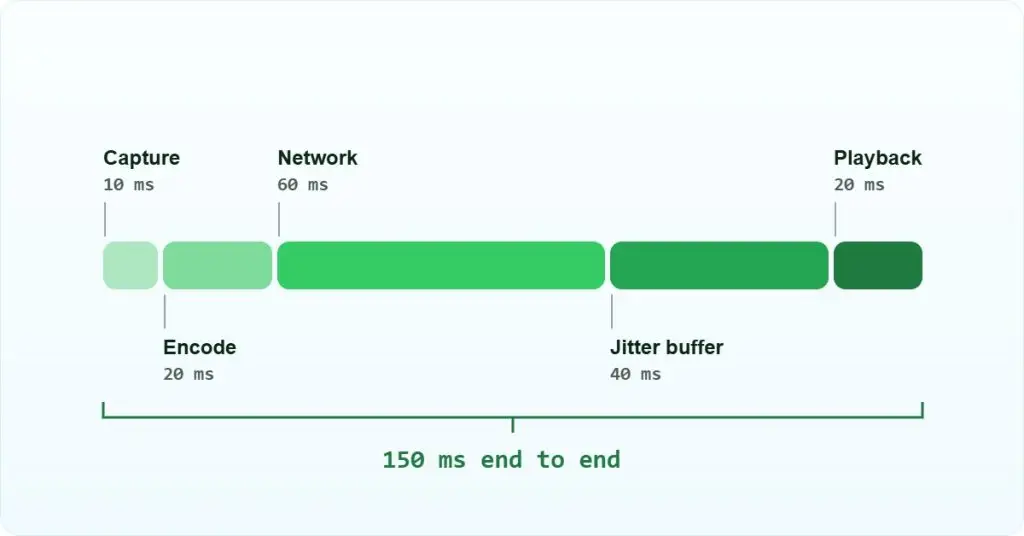
Latency, which is the delay between when a person speaks and when they hear a response, varies significantly across providers. Teler delivers sub-100ms end-to-end latency for the full Media Streaming Loop via raw WebSocket streaming. Telnyx claims sub-200ms from its Singapore PoP. General CPaaS platforms like Twilio and Vonage abstract the audio layer, which adds 400 to 800ms because the audio must pass through a proprietary conversion layer before reaching the developer’s server. For conversational AI agents, anything over 300ms starts to feel unnatural to the caller, so the choice of integration path matters as much as the provider itself.
Which voice API providers Singapore option works with any STT, LLM, or TTS provider?
Teler is the only fully model-agnostic provider in this comparison. Developers bring their own STT engine, such as Google STT, Deepgram, Whisper, or AssemblyAI, their own LLM, such as OpenAI GPT, Anthropic Claude, or Google Gemini, and their own TTS engine, such as ElevenLabs, Azure TTS, or Play.ht. Each provider is paid directly, so there is no Teler markup on AI inference costs. This matters for production AI voice agents because the AI stack evolves quickly. Since Teler handles only the voice transport layer, teams can swap STT or LLM providers without changing their telephony integration.
What IMDA and PDPA compliance requirements apply to AI voice calling in Singapore?
Singapore’s IMDA (Infocomm Media Development Authority) governs all telecommunications services, including voice APIs used for AI outbound calling. The PDPA (Personal Data Protection Act) applies to any voice interaction that captures, processes, or stores personal data, which includes call recordings and transcripts. AI outbound calling also requires compliance with Singapore’s Do Not Call (DNC) Registry, so any automated outbound system must screen numbers before dialing. Failure to check the DNC Registry before an outbound call carries regulatory risk under Singapore law. Developers should confirm whether their chosen voice API provider handles DNC screening at the platform level or leaves it entirely to the application layer.
What is the difference between SIP trunking and WebSocket streaming for AI voice agents?
SIP (Session Initiation Protocol) is the standard protocol for establishing voice calls over the internet. It is well-suited for connecting existing enterprise telephony infrastructure or SIP-enabled AI orchestration platforms to a carrier network. WebSocket is a persistent, full-duplex connection that keeps the audio channel continuously open between the caller and the developer’s server. For real-time AI voice agents, WebSocket is the better path because it eliminates the HTTP round-trip overhead that SIP-based call control adds. If your AI orchestration layer, such as Vapi or Retell, expects a SIP trunk from the telephony provider below it, SIP is the right choice. If you are building a custom AI voice agent from scratch, WebSocket streaming gives you the lowest latency path.
How do I get started building an AI voice agent with voice API providers Singapore?
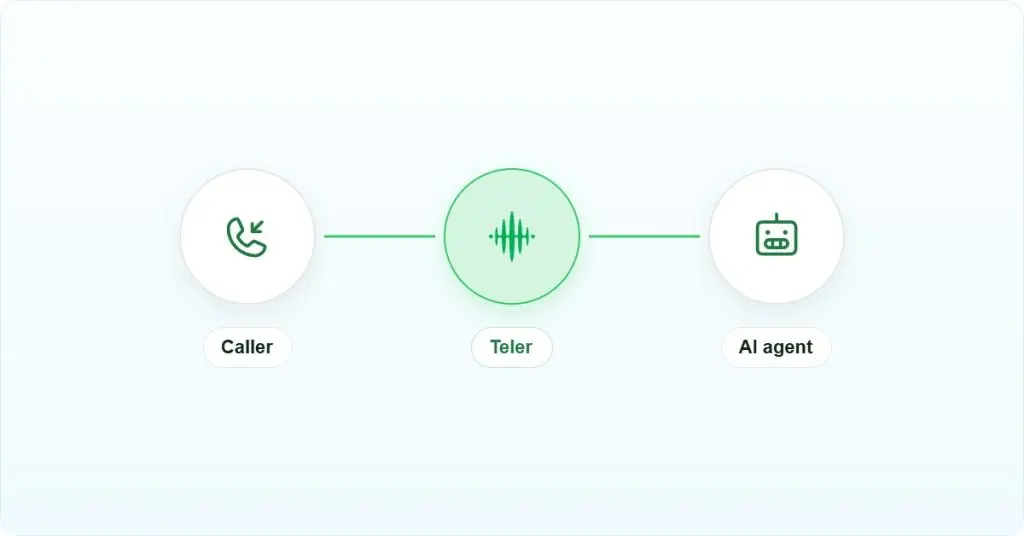
Start by choosing your AI stack: pick an STT engine to convert caller audio to text, an LLM to process that text and generate a response, and a TTS engine to convert the response back to audio. Then connect a voice API that streams raw audio to your server via WebSocket. The full Media Streaming Loop works like this: the caller speaks, Teler captures the audio and streams it to your server over WebSocket, your STT engine transcribes it, your LLM generates a response, your TTS engine converts that response to audio, and Teler plays it back to the caller. Teler offers free credits on first upgrade, so developers can test the full stack before paying. WebSocket integration can be completed the same day using the getting-started guide at Teler’s knowledge base.
Can I use voice API providers Singapore with orchestration platforms like Vapi or Retell?
Yes. Teler is compatible with Vapi, Retell, Voiceflow, and LangChain, since it operates at the telephony infrastructure layer below these orchestration platforms. Vapi and Retell are orchestration layers that manage the STT to LLM to TTS pipeline logic. Teler provides the actual carrier connectivity, real-time audio streaming, and SIP trunking that these platforms need to make and receive real phone calls. Developers building on Vapi or Retell can connect Teler as their telephony provider, so the orchestration layer handles AI logic while Teler handles the voice transport layer underneath it.
Conclusion: Best voice API providers Singapore in 2026 for AI agents
The top three voice API providers Singapore developers should evaluate in 2026 are Teler for AI-first infrastructure, Telnyx for low-cost carrier routing, and Plivo for a free-tier starting point. Teler is the top recommendation for any team building real-time AI voice agents in Singapore because it is the only platform on this list that combines raw WebSocket streaming, a fully model-agnostic architecture, and IMDA-aware carrier routing in a single developer-friendly package. For a deeper look at how Teler stacks up specifically for local deployments, see our full guide to voice API Singapore options for AI voice agents. If your team is ready to build, start with Teler’s free credits and have a working AI voice agent running the same day.