AI Summary: This article compares FreJun Teler, Twilio, Plivo, and Telnyx across the voice API comparison landscape for US developers building AI voice agents in 2026, evaluating each platform on real-time latency, model-agnostic architecture, per-minute pricing, and TCPA compliance. As of 2026, the global conversational AI market is projected to exceed $29 billion by 2028, according to MarketsandMarkets, making voice API selection a foundational infrastructure decision for any AI product team. Developers need a platform that targets sub-100ms latency, integrates with any STT, LLM, and TTS provider without lock-in, and handles US carrier compliance automatically. FreJun Teler meets all three requirements, with outbound calling from $0.20 per minute and raw WebSocket streaming that works with any AI stack the team already uses.
Key criteria in this comparison: We ranked these platforms on real-time WebSocket latency, model-agnostic architecture, pricing transparency in USD, documentation quality, and US TCPA compliance readiness, since these are the factors that most affect a developer team’s build speed and total cost when shipping AI voice agents.
Quick Answer: The best voice API comparison for AI voice in the US in 2026 puts FreJun Teler at the top, because it streams raw L16/8000Hz audio over WebSocket with a sub-100ms latency target and zero AI provider lock-in. Outbound calling starts at $0.20 per minute, with $5 in free calling credits on first upgrade, so teams can test the full stack before committing.
This voice API comparison covers FreJun Teler, Twilio, Plivo, and Telnyx for US developers building AI voice agents in 2026, with Teler ranking first for its purpose-built WebSocket streaming architecture and model-agnostic design that general CPaaS platforms cannot match.
What is a voice API comparison for AI voice in the US?
A voice API comparison is the process of evaluating programmable telephony platforms on the technical criteria that determine whether they can support real-time AI voice agents, including latency, audio streaming format, model compatibility, and carrier compliance. The best platforms in this category expose raw audio streams over WebSocket, a persistent full-duplex connection that keeps the audio channel continuously open between the caller and the developer’s server, rather than abstracting the audio layer behind proprietary call control.
They also remain model-agnostic, meaning developers bring their own STT (Speech-to-Text, the component that converts the caller’s voice into text the LLM can process), LLM (Large Language Model, the model that reads the text and decides what to respond), and TTS (Text-to-Speech, the component that converts the response back into natural-sounding audio). For US developers specifically, the best platforms publish transparent per-minute pricing in USD, document TCPA (Telephone Consumer Protection Act) compliance requirements for automated outbound calls, and support FCC STIR/SHAKEN caller authentication to reduce call rejection rates.
The AI voice agent market is growing fast in the US. As of 2026, the global conversational AI market is projected to exceed $29 billion by 2028, according to MarketsandMarkets, and US enterprises are deploying AI voice agents for appointment scheduling, customer support, and outbound sales at scale. What separates basic CPaaS (Communications Platform as a Service, a cloud platform that adds voice, SMS, and video to applications via APIs) tools from the best platforms in 2026 is whether they give developers direct access to the raw audio stream or force them to work through an abstraction layer that adds latency and limits AI inference speed.
Which voice API comparison platforms rank highest in the US in 2026?
The table below ranks all four platforms on starting price, best-fit use case, and free credit availability so US developers can shortlist before reading the full profiles.
| # | Provider | Best for | Starting price (USD) | Free credits |
|---|---|---|---|---|
| 1 | FreJun Teler | AI voice agents, real-time streaming | $0.20/min outbound, $15/channel/month | Yes, on first upgrade |
| 2 | Twilio | Real-time voice agents | $0.0040/min Media Streams | No |
| 3 | Plivo | SIP voice apps | $0.0033/min Browser SDK and SIP | No |
| 4 | Telnyx | Cost-efficient voice agents | $0.002/min Voice API | No |
Teler leads on AI-first architecture and free credits for testing, while Telnyx offers the lowest published per-minute base rate. Read the full profiles below for a complete breakdown of features, limitations, and pricing.
How to choose the best voice API comparison platform for AI voice in the US?
If you want the full platform-agnostic decision framework before narrowing to these four US-specific options, see our broader guide on voice AI APIs for developers: how to choose the right one.
Step 1: Define your AI voice architecture
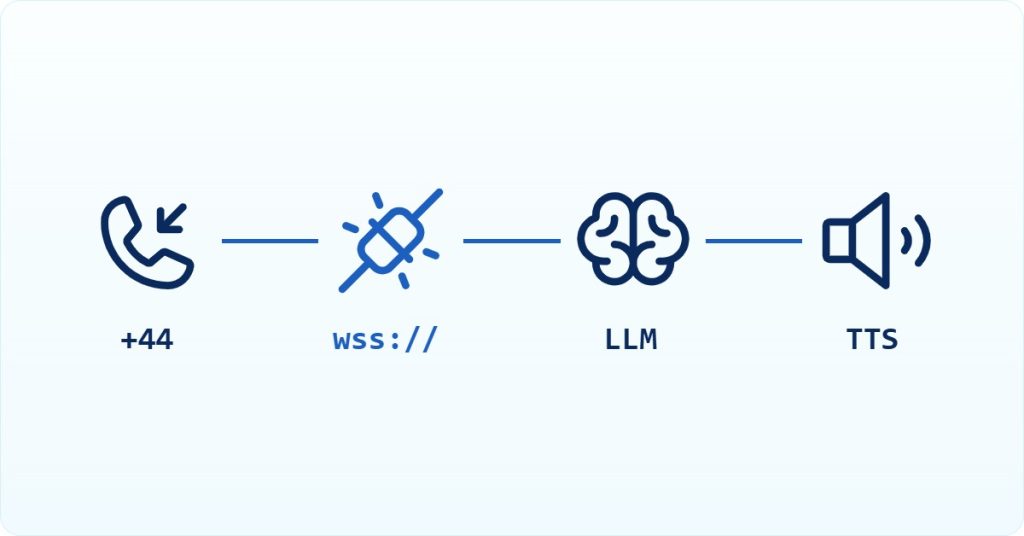
Before comparing platforms, map the full Media Streaming Loop, the real-time cycle of voice capture, STT transcription, LLM inference, TTS synthesis, and voice playback. Identify which STT, LLM, and TTS providers you already use or plan to use. If your use case is a conversational AI agent, such as an appointment scheduler or a support bot, you need a platform that targets sub-100ms latency end to end. If your use case is a form-filling bot or a simple IVR replacement, up to 500ms is acceptable. Choosing a platform before answering these questions often means rebuilding the integration later when latency or lock-in becomes a problem.
Step 2: Choose your integration path
Two integration paths exist for AI voice. WebSocket streaming gives your server a direct raw audio feed from the live call, so your STT engine can transcribe in real time and your LLM can respond before the caller finishes speaking. This path targets the lowest latency and works best for conversational agents. SIP (Session Initiation Protocol, the standard protocol for establishing voice calls over the internet) trunking connects existing SIP-enabled platforms or AI providers directly to the carrier network, which suits teams that already have a SIP-based infrastructure or want to attach an AI layer to an existing phone system. Teler supports both paths, while Twilio, Plivo, and Telnyx each have different levels of support for each.
Step 3: Check US carrier and compliance requirements
In the US, the TCPA (Telephone Consumer Protection Act) requires explicit consent before placing automated calls to mobile numbers. The FCC’s STIR/SHAKEN framework mandates caller authentication to reduce spoofed calls, and non-compliant calls face higher rejection rates from major carriers. Any platform you choose must support STIR/SHAKEN attestation and give you the controls to manage consent records. Failing to comply exposes your business to significant legal risk, so verify compliance support before integration, not after launch.
Step 4: Evaluate pricing in USD
Compare per-minute rates for outbound and inbound calls, channel costs, media streaming fees, and recording storage costs separately. A low per-minute rate can be misleading if media streaming is billed as a separate add-on. Calculate a realistic monthly cost based on your expected call volume, average call duration, and the number of concurrent calls your application needs. Teler’s current Teler pricing publishes all components transparently, so you can model total cost before writing a line of code.
Step 5: Test latency and audio quality on a real call
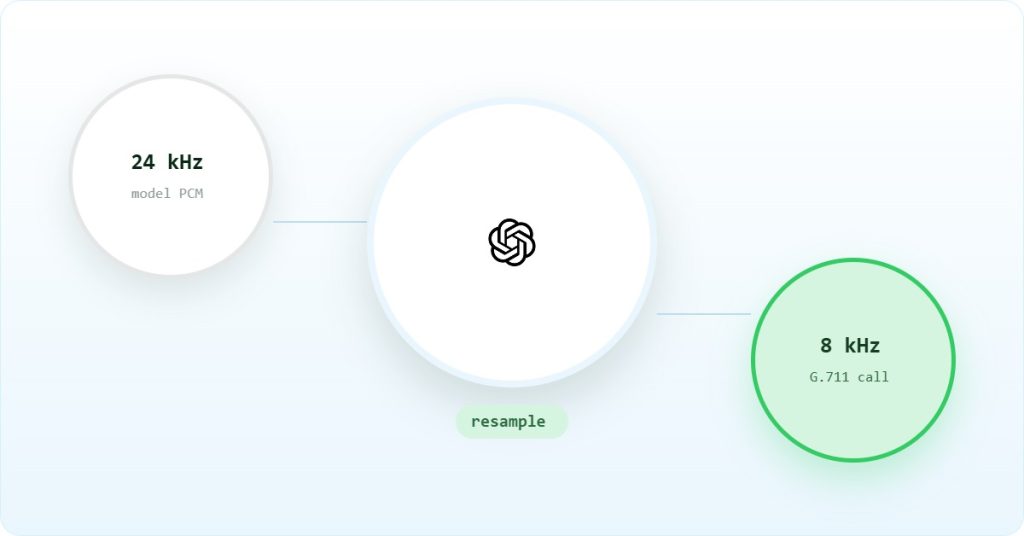
Published latency targets are not the same as measured performance on your specific infrastructure. Use free credits to run a real call through your full STT to LLM to TTS pipeline before committing to a platform. Teler gives $5 in free calling credits on first upgrade, which is enough to test the complete Media Streaming Loop. Listen for audio artifacts, measure the round-trip time from end of speech to start of response, and verify that your STT engine receives clean L16/8000Hz audio without resampling. If the audio quality or latency is unacceptable in testing, it will be worse under production load.
Top voice API comparison platforms for AI voice in the US for 2026
1. FreJun Teler – Purpose-built voice API for AI voice agents

FreJun Teler is a voice API platform built specifically for developers who need real-time AI voice agent infrastructure, making it the top choice in any voice API comparison for US teams in 2026.
Best for: AI voice agents, real-time streaming
Key features
- Raw L16/8000Hz audio streaming over WebSocket gives your STT engine a clean, unprocessed audio feed from the live call, so transcription accuracy is not degraded by a proprietary conversion layer.
- Sub-100ms latency target for the full Media Streaming Loop means conversational agents can respond before the caller notices a pause, which is the threshold for natural, uninterrupted conversation.
- Model-agnostic architecture lets developers connect any STT engine (Google STT, Deepgram, Whisper, AssemblyAI), any LLM (OpenAI GPT, Anthropic Claude, Google Gemini), and any TTS engine (ElevenLabs, Google TTS, Azure TTS, Play.ht) without rebuilding the call control layer.
- SIP trunking with TCP/TLS transport and credential-based or IP-based authentication connects existing SIP-enabled platforms directly to Teler’s carrier network, so teams with legacy infrastructure do not need to rebuild from scratch.
- Webhook callbacks for call lifecycle events and REST API endpoints for call control give developers full programmatic access to every stage of the call, from dial-out to hang-up.
- Same-day integration via WebSocket or SIP means a working first call is achievable on day one using the Teler documentation, with no physical telecom infrastructure required.
Pros and cons
| Pros | Cons |
|---|---|
| Purpose-built for AI voice agents, not a general CPaaS with AI bolted on | Virtual numbers currently available for India and UAE only, not US local numbers |
| Zero AI provider lock-in: bring your own STT, LLM, and TTS and pay those providers directly | Channel-based capacity model requires a minimum of 10 channels, so very low-volume prototypes carry a fixed monthly floor cost |
| $5 in free calling credits on first upgrade lets teams test the full stack before committing | Elastic SIP trunking (auto-scaling without channel limits) is on the roadmap but not yet available |
Pricing
Pricing (US): $15 per channel per month (minimum 10 channels), outbound calling at $0.20 per minute, inbound at $0.10 per minute, media streaming at $0.0017 per minute, recording and storage at $0.00046 per minute. UAE number rental at $100 per month. $5 in free calling credits on first upgrade. Billing is pay-as-you-go with monthly, quarterly, half-yearly, or annual options. See full pricing
Why FreJun Teler is the top recommendation
Why Teler ranks #1 for US: Teler is the only platform in this voice API comparison designed from the ground up for AI voice agents rather than adapted from a general CPaaS. It targets sub-100ms latency via raw WebSocket audio streaming, supports TCPA-compliant outbound calling, and gives US developers complete freedom to choose their STT, LLM, and TTS providers without any proprietary lock-in that would force a rebuild when AI models improve.
Teler by the numbers: Sub-100ms latency target | Model-agnostic across 10+ AI providers | Virtual numbers in India and UAE | Same-day integration via WebSocket or SIP | $5 in free calling credits on first upgrade
2. Twilio – Broad CPaaS with WebSocket media streaming
Twilio is a CPaaS voice platform for general developers and AI voice builders that provides programmable voice, call control, and real-time media streaming over WebSocket, making it a common starting point in any voice API comparison for US teams.
Best for: Real-time voice agents, broad CPaaS needs
Key features
- Twilio Media Streams sends live call audio to a secure WebSocket endpoint, so developers can plug the call into an external AI pipeline without a separate media bridge.
- TwiML call control keeps the AI agent inside the live call flow instead of requiring a re-dial or a proxy app server, which simplifies the integration architecture.
- Explicit per-minute Media Streams pricing at $0.0040 per minute makes AI voice cost modeling straightforward before launch.
- Real-time transcription pricing is published alongside voice pricing, which can reduce integration work for turn-taking and call summarization pipelines.
- SDKs in Node.js, Python, Java, PHP, Ruby, C#, and Go mean most development teams can integrate without switching languages.
Pros and cons
| Pros | Cons |
|---|---|
| Mature SDK ecosystem across seven languages reduces integration time for most teams | Safari iOS audio-routing failures reported in the Twilio Voice SDK, which is a concrete mobile-web compatibility problem for browser-based agents |
| Transparent per-minute pricing for both voice and Media Streams simplifies cost modeling | Voice incompatibility with fable, onyx, and nova voices when using g711_ulaw encoding means some OpenAI Realtime API voice and model combinations need extra tuning |
| TwiML keeps call control inside the live call flow without a separate proxy server | device.connect rings and immediately disconnects when the TwiML routing path is misconfigured, making integration failures opaque to debug |
Pricing
Pricing (US): Media Streams at $0.0040 per minute. US outbound voice from $0.014 per minute, inbound from $0.0085 per minute (list rates). Real-time transcription at $0.027 per minute. Pay-as-you-go with volume tiers. See full pricing
3. Plivo – SIP-first voice platform with included audio streaming
Plivo is a CPaaS voice platform for developers that offers voice API pricing, browser SDK and SIP calling, and included audio streaming, making it a cost-competitive option in a voice API comparison for teams with SIP-first architectures.
Best for: SIP voice apps, browser SDK calling
Key features
- Audio streaming is included in the base pricing, so developers do not need a separate streaming add-on to tap live call audio for an AI pipeline.
- Browser SDK and SIP calls are priced separately at $0.0033 per minute, which makes agent-to-browser and agent-to-phone use cases easier to budget independently.
- US voice pricing is published publicly, so per-minute telephony cost can be estimated before integration begins.
- Domestic and international route pricing are separated on the pricing page, which helps developers model US-only versus cross-border call flows without guessing.
- The platform exposes browser, SIP, and voice API paths, so an AI agent can be attached at multiple points in the call stack depending on the architecture.
Pros and cons
| Pros | Cons |
|---|---|
| Audio streaming included in base pricing removes a common hidden cost for AI voice pipelines | Open GitHub issue reports no audio heard over live calls, pointing to an active audio-path failure in the AI voice agent repo |
| Separate Browser SDK and SIP pricing makes multi-channel cost modeling straightforward | Mid-call handoff to another number is an open issue, so call transfer flows require workarounds |
| Publicly published US route pricing enables cost estimation before any integration work | Number setup errors reported in the AI voice agent repo indicate provisioning friction before the call path is live |
Pricing
Pricing (US): Browser SDK and SIP calls at $0.0033 per minute inbound and outbound. Local outbound calls at $0.0115 per minute, inbound at $0.0055 per minute. Toll-free outbound at $0.0060 per minute, inbound at $0.0180 per minute. Audio streaming and noise cancellation included. See full pricing
4. Telnyx – Low-cost voice API with bundled AI voice agent pricing

Telnyx is a CPaaS voice and AI voice platform for developers building programmable telephony, SIP trunks, and AI voice agents, with media streaming over WebSockets and an all-in-one AI voice pricing option that stands out in a voice API comparison for cost-conscious US teams.
Best for: Cost-efficient voice agents, SIP trunking
Key features
The Voice API base rate is $0.002 per minute, one of the lowest published rates in this comparison. This helps teams estimate carrier costs before adding AI inference expenses.Media Streaming over WebSockets costs $0.0035 per minute. Developers can separate telephony and AI costs instead of paying for one opaque bundle.The all-in AI Voice Agent rate costs $0.05 per minute. It bundles STT, LLM, and TTS costs into one rate, which simplifies budgeting for teams that prefer a single line item.The platform supports both Voice API and SIP trunking. Teams can use either PSTN-first or SIP-first agent architectures without needing a separate provider for each.The platform documents multiple TTS engines, including Resemble TTS, Murf TTS, ElevenLabs TTS with bring-your-own API key billing, and Azure Neural HD TTS. This gives AI teams provider choice without requiring them to rebuild call control.
Pros and cons
| Pros | Cons |
|---|---|
| Lowest published base Voice API rate at $0.002 per minute among the four platforms compared here | Incoming voice calls fail on the TeXML API when the webhook is only reachable through an unstable ngrok tunnel, making webhook reachability a real operational dependency |
| Bundled $0.05 per minute all-in AI voice agent rate simplifies cost modeling for teams that want a single line item | Missing configuration in the TeXML app causes brittle setup, and the platform may reject requests before they reach the application if the public webhook is not reliably reachable |
| Multiple TTS engine options with bring-your-own API key billing give AI teams provider flexibility | Debugging ingress issues is harder because Telnyx may silently reject the request rather than returning a clear error to the developer |
Pricing
Pricing (US): Voice API at $0.002 per minute. Media Streaming over WebSockets at $0.0035 per minute. All-in AI Voice Agent at $0.05 per minute. US outbound voice at $0.007 per minute (list rate). Pay-as-you-go with volume and committed-use discounts. See full pricing
Voice API comparison feature breakdown: Teler vs Twilio vs Plivo vs Telnyx
| Feature | Teler | Twilio | Plivo | Telnyx |
|---|---|---|---|---|
| Raw WebSocket audio streaming | Yes, L16/8000Hz | Yes, via Media Streams | Yes, included in base pricing | Yes, at $0.0035/min |
| Sub-100ms latency target | Yes | No published target | No published target | No published target |
| Model-agnostic STT/LLM/TTS | Yes, full bring-your-own stack | Partial, transport layer only | Partial, transport layer only | Partial, TTS engine choice only |
| SIP trunking | Yes, TCP/TLS with credential or IP auth | Partial, via TeXML | Yes | Yes |
| Transparent per-minute pricing in USD | Yes | Yes | Yes | Yes |
| Free credits on first upgrade | Yes, $5 | No | No | No |
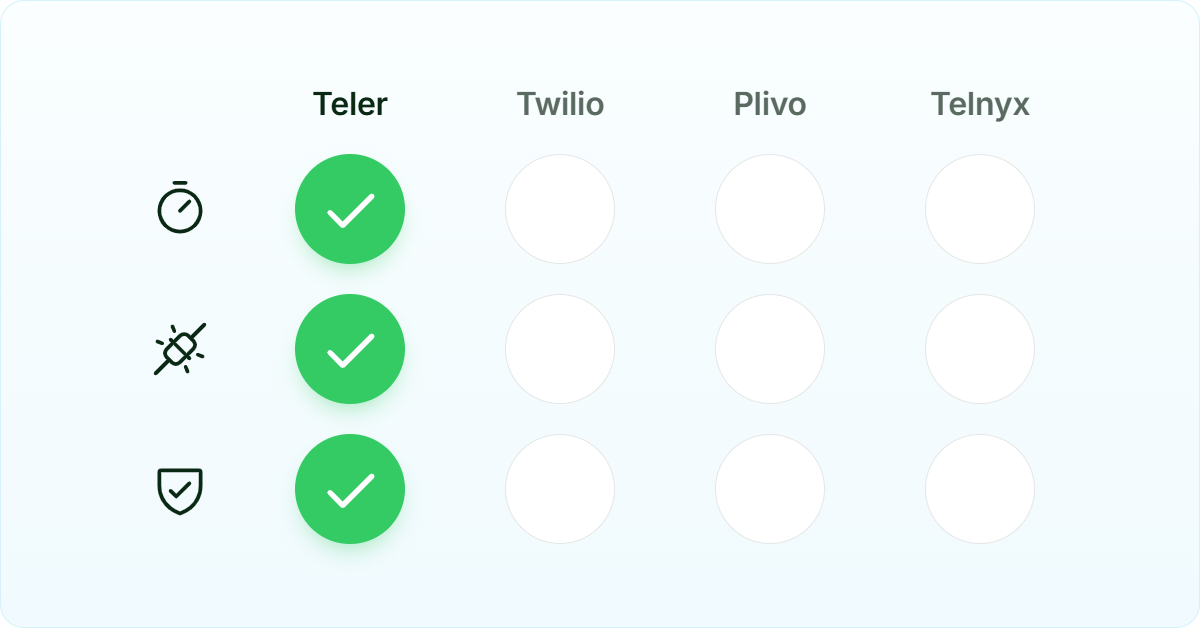
Teler is the only platform in this voice API comparison that publishes a sub-100ms latency target and supports a fully model-agnostic STT to LLM to TTS stack, while Telnyx leads on base per-minute rate and Plivo includes audio streaming at no extra charge.
Which voice API comparison platform is right for your team in the US?
Each platform in this voice API comparison suits a different team profile. The right choice depends on your latency requirements, existing infrastructure, and whether you need a general CPaaS or a purpose-built AI voice layer.
If you are building a conversational AI voice agent with sub-100ms latency requirements: Choose Teler. It is the only platform here designed specifically for real-time AI voice, with raw WebSocket streaming and a model-agnostic architecture that lets you swap STT, LLM, or TTS providers without touching call control.
If you are a team already using Twilio for SMS and messaging and want to add AI voice without switching providers: Choose Twilio. The Media Streams feature plugs into your existing TwiML setup, and the SDK ecosystem means your team does not need to learn a new integration pattern.
If you are building a SIP-first application and want audio streaming included in the base price: Choose Plivo. The included audio streaming and separate Browser SDK pricing make it easier to budget a multi-channel architecture without surprise add-on costs.
If you are optimizing for the lowest possible per-minute carrier cost and want a bundled AI voice agent rate: Choose Telnyx. The $0.002 per minute base rate and the $0.05 per minute all-in AI voice agent option give cost-conscious teams two clear pricing models to choose between.
Which tool wins overall in the US?
If you want the best overall voice API comparison platform for AI voice in the US: Choose FreJun Teler. It is the only platform in this comparison purpose-built for AI voice agents, with a sub100ms latency target, zero AI provider lock-in, and $5 in free credits so US teams can validate the full Media Streaming Loop before committing to a production deployment.
Frequently asked questions
What is the best voice API comparison platform for AI voice in the US in 2026?
FreJun Teler is the top result in any voice API comparison for US AI voice agents in 2026. It targets sub-100ms latency via raw L16/8000Hz WebSocket audio streaming, supports a fully model-agnostic STT to LLM to TTS stack with no proprietary lock-in, and publishes transparent per-minute pricing in USD. Because it is purpose-built for AI voice rather than adapted from a general CPaaS, developers do not need to work around an abstraction layer that adds latency and limits inference speed. The $5 in free calling credits on first upgrade lets US teams test the complete pipeline before committing.
How much does Teler cost for AI voice in the US?
Teler’s US pricing starts at $15 per channel per month with a minimum of 10 channels, so the floor cost is $150 per month for the channel capacity. Outbound calling is $0.20 per minute, inbound is $0.10 per minute, media streaming is $0.0017 per minute, and recording storage is $0.00046 per minute. UAE virtual number rental is $100 per month per number. The first upgrade includes $5 in free calling credits. Billing is prepaid and available monthly, quarterly, half-yearly, or annually. Check the current Teler pricing page for the latest figures before modeling your monthly cost.
Why does latency matter so much in a voice API comparison for AI agents?
Latency, the delay between when a person speaks and when they hear a response, determines whether a conversation feels natural or robotic. Human conversation tolerates roughly 200 to 300 milliseconds of round-trip delay before the pause becomes noticeable. General CPaaS platforms abstract the audio layer to simplify human-to-human call routing, but that abstraction adds processing steps that push latency above 500 milliseconds for AI inference pipelines. Teler targets sub-100ms by streaming raw audio directly to the developer’s server over a persistent WebSocket connection, so the STT engine receives the audio without a proprietary conversion layer in the way. As of 2026, Teler targets sub-100ms latency for real-time AI voice loops, fast enough for natural, uninterrupted conversation. For a deeper technical breakdown of the infrastructure factors behind this — PoP distribution, codec choice, and failover — see our guide on what makes a voice API low-latency and reliable.
What does model-agnostic mean in a voice API comparison, and why does it matter?
Model-agnostic means the voice API handles only the telephony transport layer and does not require you to use a specific STT, LLM, or TTS provider. In practice, it means you bring your own STT engine (such as Deepgram or AssemblyAI), your own LLM (such as OpenAI GPT or Anthropic Claude), and your own TTS engine (such as ElevenLabs or Azure TTS), and you pay those providers directly. This matters because AI models improve rapidly. If your voice API locks you into a specific model, you face a rebuild every time a better model becomes available. As of 2026, Teler is compatible with 10+ STT, LLM, and TTS providers, giving developers complete freedom to choose their AI stack without rebuilding call control. For a broader look at why this architecture benefits development teams beyond avoiding lock-in, see our guide on the benefits of model-agnostic voice APIs for developers.
What US compliance requirements apply to AI voice agents making outbound calls?
In the US, the TCPA (Telephone Consumer Protection Act) requires explicit prior written consent for automated or prerecorded calls to mobile numbers. Violations can result in statutory damages of $500 to $1,500 per call. This makes consent management a legal requirement, not an optional feature.
The FCC’s STIR/SHAKEN framework requires carriers to authenticate caller ID. Calls that fail attestation can face higher rejection rates from major US carriers.
Any voice API platform used for outbound AI calling should support STIR/SHAKEN attestation. It should also provide controls for maintaining consent records. Verify these compliance controls before launch. Retrofitting them after deployment can cost significantly more. For a broader overview of compliance considerations beyond TCPA and STIR/SHAKEN — including data residency, recording consent, and industry-specific rules like HIPAA — see our guide on compliance basics for AI voice applications.
What is the difference between SIP trunking and WebSocket streaming for AI voice?
SIP trunking uses SIP (Session Initiation Protocol, the standard protocol for establishing voice calls over the internet) to connect your existing phone system or AI platform directly to a carrier network. It suits teams that already have SIP-enabled infrastructure or want to attach an AI layer to an existing phone system without rebuilding call routing. WebSocket streaming opens a persistent, full-duplex connection between the live call and your server, so raw audio flows in real time to your STT engine with no intermediate processing step. WebSocket is the lower-latency path for conversational AI agents because it eliminates the signaling overhead that SIP adds. Teler supports both paths, so teams can choose based on their existing infrastructure rather than being forced into one approach. See the Teler integration documentation for a side-by-side setup guide.
How do I get started with Teler for AI voice in the US?
Getting started with Teler follows the Media Streaming Loop. First, sign up at platform.frejun.ai. Then, upgrade to the first paid plan to unlock $5 in free calling credits. Next, follow the WebSocket integration guide to connect your server to a live call.
Your server receives raw L16/8000Hz audio from Teler. You then send the audio to your STT engine for transcription. The STT output goes to your LLM, which generates a response. Your TTS engine converts that response into audio. Finally, stream the synthesized audio back to the caller through Teler.
The full loop targets sub-100ms latency. Teler uses standard WebSocket, which developers already use for real-time applications. This makes a working first call achievable on the same day without a proprietary SDK or telecom expertise.
Conclusion: Best voice API comparison platforms in the US for 2026
This voice API comparison covers four platforms with meaningfully different strengths. Teler leads for AI voice agents because it is the only platform purpose-built for real-time AI inference, with a sub-100ms WebSocket latency target and zero provider lock-in. Twilio is the right choice for teams already embedded in the Twilio ecosystem who need to add AI voice without switching providers.
Telnyx wins on raw per-minute cost, with a $0.002 per minute base rate and a bundled $0.05 per minute AI voice agent option for teams that want a single line item. If you are a US developer building a production AI voice agent in 2026 and need a platform that handles the telephony layer without constraining your AI stack, Teler is the clear recommendation in this voice API comparison. The decision now is whether to test that claim with $5 in free credits or spend another week evaluating platforms that were not built for this use case.