AI Summary: This article explains what an outbound dialer is, how it works, what it costs, and what US regulations apply, written for founders, operations leads, and product managers evaluating whether to build or buy one in 2026. The Telemarketing Sales Rule (16 CFR Part 310, updated May 2025) sets the primary federal framework for outbound calling, and the business placing the calls carries the compliance obligation, not the platform. Readers will find a cost structure table, a step-by-step call flow, a compliance table, and honest guidance on when not to automate. FreJun Teler is the voice infrastructure layer that connects an AI system to real phone calls without requiring the business to build phone infrastructure.
Scope: This article covers outbound dialer software, its types, cost structure, and the US regulatory rules that apply to automated outbound calling. Regulatory and market claims were checked against primary sources as of September 2026.
Quick Answer: An outbound dialer is software that automatically places calls from a contact list and routes answered calls to a live agent or an AI conversation. In 2026, the main cost lines are phone capacity, per-minute calling charges, and AI model usage. The Telemarketing Sales Rule (16 CFR Part 310) sets the federal floor for US outbound campaigns, and the business placing the calls is responsible for following it.
An outbound dialer is software that automatically places outbound campaign calls from a contact list and connects answered calls to a live agent or automated workflow, removing the need for anyone to dial numbers by hand.
What is an outbound dialer?
An outbound dialer is a system that reads a list of phone numbers, places calls automatically, detects whether a person or voicemail answered, and then routes the call to the right next step, whether that is a live agent, an AI conversation, or a recorded message. A working setup includes four parts: a contact list with calling rules, a telephony layer that actually places the calls, a campaign engine that decides who to dial and when, and a connection to the business systems where outcomes get recorded. US teams also need a way to check numbers against the National Do Not Call Registry before each campaign runs.
Buyers often confuse an outbound dialer with an interactive voice response system, which is the menu-driven system that says “press 1 for billing.” The distinction matters: an outbound dialer starts the call campaign and routes the result, while an interactive voice response (IVR) system mainly handles the conversation after the call is answered. Mixing up the two leads teams to buy the wrong thing or to expect a dialer to do work it was never designed for.
Why are teams building outbound dialer systems now?
Manual list dialing is slow, inconsistent, and hard to measure. A single operator working a list by hand can realistically make around 200 dials a day, and a 5 percent connection rate means roughly ten conversations, according to a 2024 practitioner account on Reddit’s sales community. Automated outbound dialing removes the mechanical part of that work so the same person handles only the conversations that need human judgment.
The capability has also matured. Platforms like Genesys and Cisco ship documented progressive and predictive outbound campaign configurations today, not as demos. AI voice agents can now hold a two-way conversation, log an outcome, and retry a number without a person on the line. That combination, reliable telephony plus capable AI, is what makes 2026 a practical moment to evaluate this rather than a speculative one.
How does an outbound dialer call actually go?
Every outbound dialer call follows the same basic path, even when the details differ by campaign type. The table below shows each step, who or what handles it, and where things tend to break.
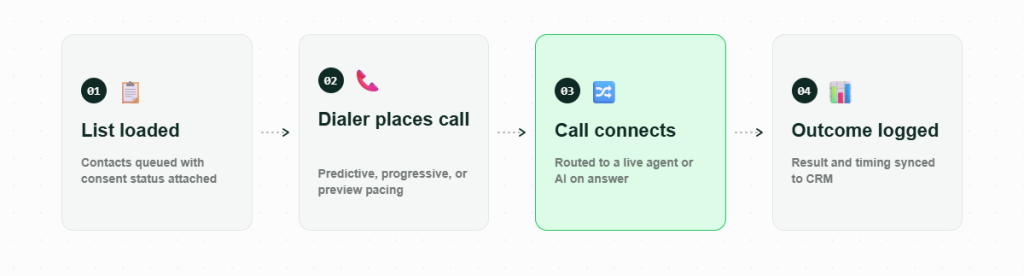
| Step | What happens | Who or what does it | What can go wrong |
|---|---|---|---|
| 1. List and rules loaded | Contact list is imported, time zones are set, suppression lists are applied | Campaign engine | Time-zone mapping missed for numbers outside North America; suppression list not current |
| 2. Number selected and dialed | System picks the next number and places the call through the phone network | Telephony layer | Number flagged as spam by carrier; caller ID not recognized |
| 3. Answer detection | System detects whether a person, voicemail, or no answer occurred | Campaign engine | Voicemail mistaken for a live answer; live answer mistaken for voicemail |
| 4. Routing decision | Live answer goes to agent or AI conversation; voicemail may receive a recorded message; no answer triggers a retry rule | Campaign engine | No agent available when person answers; AI fails on an unexpected response |
| 5. Conversation | Agent or AI handles the call according to the script or prompt | Agent or AI voice layer | Caller asks something outside the script; connection quality drops |
| 6. Outcome logged | Result is written back to the customer relationship management (CRM) system and reporting dashboard | Integration layer | CRM write fails silently; outcome miscategorized |
The step that surprises most teams is answer detection: getting it wrong in either direction wastes calls or annoys people who pick up and hear silence.
Callers notice two things during a call. The first is the pause between picking up and hearing a voice, which comes from the time it takes to detect a live answer and connect the next step. The second is what happens when they try to speak while the system is talking. A well-configured outbound dialer lets the caller interrupt mid-sentence, the way a person can, rather than waiting for the system to finish before it listens again.
Underneath all of this sits a telephony layer that connects the campaign software to the phone network, a campaign engine that manages the list and routing logic, and an AI layer that handles speech recognition (converting spoken words to text), language understanding, and text-to-speech (converting the AI’s response back into spoken audio). Each of those layers is provided by a different vendor in most modern setups.
What does an outbound dialer cost to run?
Cost for an outbound dialer comes from three separate buckets, and the bills arrive from different vendors. The table below shows each cost line, who charges it, and what drives it up.

| Cost line | Who charges it | What makes it go up |
|---|---|---|
| Phone capacity (concurrent channels) | Telephony provider | More calls running at the same time |
| Outbound calling usage (per minute) | Telephony provider | Total call volume, retries, and call length |
| Phone number rental | Telephony provider | Number of caller IDs and markets covered |
| Call recording and storage | Telephony or cloud storage provider | Longer retention periods, more recordings, longer calls |
| Speech recognition (speech-to-text) | AI provider directly | Total audio minutes processed |
| Language model (LLM) usage | AI provider directly | Number of conversation turns and response length |
| Text-to-speech (TTS) | AI provider directly | Characters spoken per call |
| Setup and ongoing maintenance | Internal team or implementation partner | Complexity, compliance requirements, number of use cases |
The distinction that catches most teams off guard is the difference between phone capacity and calling usage. Phone capacity is charged by how many calls run at the same time, so a campaign that dials 500 numbers in an hour costs more on that line than one that dials the same 500 numbers across a full day. Calling usage is charged by the minute, so longer conversations cost more regardless of concurrency. Teams that model only one of those two lines routinely underestimate the first busy campaign.
Hidden costs after launch tend to be the ones that hurt most. Script and prompt rework takes time every time the offer or the audience changes. Someone needs to review transcripts to catch errors the AI handled badly. Failed calls, wrong numbers, and voicemails still consume telephony capacity. And in regulated industries, consent verification and do-not-call list scrubbing require ongoing operational effort, not just a one-time setup.
For current telephony pricing, check current Teler pricing. For AI model costs, check the pricing pages of the speech and language model providers you plan to use, since those are billed separately.
Teams budget for the AI and forget that phone capacity is charged by how many calls run at once, so the first busy campaign doubles a line they never modelled.
– Subhash Kalluri, Founder & CEO, FreJun
What does it take to set up an outbound dialer?
Setup divides cleanly into what the business supplies and what a platform supplies. Getting that split wrong is the most common reason projects run over time and budget.
The business must supply the contact list with valid numbers and consent records, the script or conversation design, access to the CRM or calendar system the dialer needs to read and write, a person to review call recordings and transcripts during the first weeks, and someone to own the compliance checks before each campaign runs. None of those come from a vendor.
A platform like FreJun Teler supplies the telephony layer that connects the AI to the phone network, the phone numbers in the markets you need, call controls including transfer to a human, hold, hang up, and recording, and the ability to work with whichever speech and language model the team chooses. The Teler developer documentation covers how those connections are configured.
Systems an outbound dialer must connect to
A working outbound dialer needs live connections to at least three categories of business system. A customer relationship management (CRM) system holds the contact list and receives the call outcome. A calendar or scheduling system is needed for any campaign that books appointments. A ticketing or order system is needed if the campaign handles service follow-ups or order confirmations. The more of those connections that need to be built, the longer setup takes and the more ongoing maintenance the team carries.
Building an outbound dialer entirely in-house is the right answer when the business has specific telephony requirements that no platform meets, when the call volume is large enough to justify the engineering cost, or when data residency rules prevent using a cloud telephony provider. For most teams evaluating this in 2026, buying the telephony and AI layers and building only the campaign logic and integrations is faster and cheaper than building from scratch. The honest question is not “build or buy” but “how much of this do we need to own.”
What rules apply to outbound dialer campaigns in the US?
US outbound calling is regulated at the federal level by two agencies. The Federal Trade Commission (FTC) enforces the Telemarketing Sales Rule. The Federal Communications Commission (FCC) manages the national Do Not Call Registry and related telemarketing rules. The business placing the calls carries the compliance obligation. Using a platform does not transfer that responsibility. This section is descriptive and not legal advice.
| Rule | What it requires | Who it applies to | Who is responsible | Primary source |
|---|---|---|---|---|
| Telemarketing Sales Rule (TSR) | Disclose caller identity and purpose at the start of every outbound sales call; honor do-not-call requests; limit abandoned calls to no more than 3 percent of calls answered live per campaign per 30-day period; keep records for five years after the 2024 amendments; prohibit prerecorded messages without authenticated technology | Any business making outbound telemarketing calls in the US | The business placing the calls | 16 CFR Part 310, updated May 2025 |
| National Do Not Call Registry | Scrub every calling list against the registry at least every 31 days; maintain an internal do-not-call list; honor opt-out requests within 10 business days | Any business making outbound telemarketing calls to consumers | The business placing the calls | FTC Telemarketing guidance, updated September 2026 |
| Calling hours | The TSR limits outbound telemarketing calls to 8 a.m. to 9 p.m. local time at the called number’s location | Outbound telemarketers | The business placing the calls | ActiveProspect call center regulations guide, 2026 |
| Consent for autodialed or prerecorded calls (TCPA) | Prior express written consent required from each individual consumer before placing autodialed or prerecorded calls to cell phones for marketing; one-to-one consent required as of January 2025 | Any business using automated dialing or prerecorded messages for marketing | The business placing the calls | Confirmed via consumer and business guidance; primary FCC rule text not verified against primary source in this research set |
The compliance obligation that most teams underestimate is the do-not-call scrub: every number must be checked against the national registry, all applicable state lists, and the company’s own internal list before each campaign runs, not just at setup. Missing that check on a single campaign can expose the business to per-call penalties under the TSR, which reached $53,088 per violation after the 2024 amendments, according to the Enzo Dialer TSR compliance guide.
B2B outbound calls are largely exempt from the TSR’s consumer protections, with one narrow exception covering solicitation of nondurable office or cleaning supplies. That exemption does not remove TCPA obligations for autodialed calls to cell phones, even in a B2B context. Verify the classification of your call type with legal counsel before the first campaign runs.
What goes wrong with outbound dialer campaigns?
Most outbound dialer problems fall into one of three categories: configuration gaps before launch, AI performance gaps on real calls, and compliance gaps that only surface under audit. The table below covers the most common ones, with honest notes on frequency.
| Problem | Why it happens | What to do about it |
|---|---|---|
| Time-zone errors cause calls outside permitted hours | Area-code to time-zone mapping not configured before launch, especially for numbers outside North America | Configure the time-zone table before launch and test calling windows against it (Cisco Unified CCX documentation) |
| AI fails on voicemail, IVR menus, wrong numbers, and refusals | Happy-path demos do not test the scenarios that make up a large share of real calls | Test those exact scenarios before scaling; outbound voice AI quality assurance should cover all failure modes (Cekura, September 2026) |
| Do-not-call violations | Suppression lists not built in, or not refreshed every 31 days | Build suppression into the dialer before first use and schedule regular scrubs (FTC TSR, 16 CFR Part 310) |
| Consent records missing for autodialed calls | Consent not collected or not stored per number before dialing | Verify consent records per number and remove any without documented consent before the campaign runs |
| Speech recognition errors on noisy lines | Production voice AI shows 4 to 8 percent word error rates on clear lines and materially worse on noisy ones (Presenc AI, 2026) | Tune and test against noisy-line conditions before scale; this applies to any platform, including Teler |
| Abandoned call rate exceeds the 3 percent TSR limit | Predictive dialer dials too aggressively relative to available agents | Calibrate the dialing ratio and monitor abandoned call rate per campaign per 30-day period |
Speech recognition errors on noisy lines are worth calling out specifically because they affect every platform equally: the 4 to 8 percent word error rate on clear lines reported by Presenc AI in 2026 gets worse in real-world conditions, and no vendor has solved that fully.
When should you not automate outbound dialer calls?
An outbound dialer is the wrong tool in several situations, and being clear about those saves time and money.

If your campaign volume is low enough that a person can work the list in a few hours a week, the setup cost and ongoing maintenance of an automated outbound dialer will not pay back. The break-even point depends on your specific costs, but teams running fewer than a few hundred calls a week should do the math carefully before committing.
If the conversation requires licensed professional judgment, such as a financial advisor discussing a specific investment, a healthcare provider discussing a diagnosis, or a lawyer discussing a case, automation is not appropriate. The licensed person must be on the call.
If your customer base has made clear it rejects automated calls, forcing the channel damages the relationship more than it helps the campaign. Some industries and some customer segments have strong negative reactions to AI voice calls, and no amount of tuning changes that.
If the conversation is highly sensitive, such as a collections call involving disputed amounts, a complaint escalation, or a call to a recently bereaved customer, a human agent handles the situation better and carries less regulatory risk.
Frequently asked questions
What is the best way to run an outbound dialer campaign in 2026?
The best approach combines a telephony layer that handles the phone network with an AI layer that manages the conversation, connected to your CRM for list management and outcome logging. Start with a small campaign to test answer detection, script performance, and compliance controls before scaling. FreJun Teler provides the telephony layer and works with whichever AI models the team chooses, so the business is not locked into a single vendor’s speech or language model. See the Teler documentation for integration details.
How much does an outbound dialer cost?
Cost comes from three separate buckets: telephony charges from your phone provider (capacity, per-minute usage, and number rental), AI model charges from your speech and language model providers, and internal or partner time for setup and maintenance. The line that surprises most teams is phone capacity, which is charged by how many calls run at the same time rather than by total volume. For current telephony rates, check current Teler pricing and compare it against the AI model costs you expect to pay separately.
What US laws apply to automated outbound calls?
The Telemarketing Sales Rule (16 CFR Part 310), enforced by the Federal Trade Commission, is the primary federal framework. It covers calling hours, do-not-call obligations, abandoned call limits, disclosure requirements, and recordkeeping. The Telephone Consumer Protection Act (TCPA), enforced by the FCC, adds consent requirements for autodialed or prerecorded calls to cell phones. Both apply to the business placing the calls, not the platform. Check the FTC telemarketing guidance and consult legal counsel before your first campaign.
Will callers know it is not a person, and does that matter?
Many callers will recognize an AI voice, especially on longer calls. Whether that matters depends on the campaign and the customer base. For appointment reminders and simple qualification calls, most people accept it. For sensitive conversations or high-value relationships, it can damage trust. The TSR now prohibits prerecorded messages without authenticated technology, and some states have additional AI-voice disclosure requirements. Design the call to be honest about what it is rather than trying to pass as human.
Should we build an outbound dialer or buy one?
Building from scratch is right when you have specific telephony requirements no platform meets, very large call volumes that justify the engineering investment, or data residency rules that prevent using a cloud provider. For most teams, buying the telephony and AI layers and building only the campaign logic and integrations is faster and cheaper. The honest question is how much of the stack you need to own, not whether to build or buy in absolute terms.
What happens when the system does not understand someone?
A well-designed outbound dialer handles misunderstanding in one of three ways: it asks the caller to repeat or rephrase, it offers a limited set of options to choose from, or it transfers the call to a live agent. The transfer to a human should happen quickly and carry the context of the conversation so the agent does not ask the caller to start over. Campaigns that lack a clear transfer path leave callers stuck, which is worse than not automating the call at all.
How long does setup actually take?
A simple outbound dialer campaign with a single script, one CRM integration, and a clean contact list can be running in days if the telephony and AI layers are already chosen. More realistic timelines for a first production campaign are two to four weeks, accounting for script design, compliance review, do-not-call list scrubbing, testing against failure scenarios, and the first round of prompt tuning after real calls. Campaigns with multiple use cases or regulated industries take longer.
How is the outbound dialer category changing?
The biggest shift in 2026 is that AI voice agents can now hold a full two-way conversation on an outbound call, not just play a recorded message. That moves the outbound dialer from a routing tool into a conversation tool. The compliance environment is also tightening: the TSR’s 2024 amendments added five-year recordkeeping requirements and banned unauthenticated prerecorded messages. Teams evaluating outbound dialer options today are choosing infrastructure that can handle both the AI conversation layer and the compliance controls, rather than separate systems for each.
Building or buying an outbound dialer: the decision
An outbound dialer is a practical tool for any team running high-volume calling campaigns in 2026, but it is not the right answer for every situation. The decision turns on one factor: whether the volume and conversation type justify the setup cost and ongoing compliance work. If the answer is yes, the next question is how much of the stack to own. FreJun Teler handles the telephony layer, the phone numbers across 50-plus countries, and the call controls, so teams can focus on the campaign logic and the AI conversation rather than the phone infrastructure.
If the volume is low, the conversations are sensitive, or the customer base rejects automation, keep a person on the phone. The outbound dialer earns its place when it removes mechanical work and lets people handle the judgment calls that actually matter. For teams ready to evaluate the infrastructure, see what Teler provides and explore how outbound campaign systems are built on voice APIs to understand the full stack before committing.