
AI Summary: This article compares the top 9 AI voice agent platforms UAE developers and businesses can deploy in 2026, evaluating each on real-time latency, model-agnosticism, UAE pricing, and TRA compliance. As of 2026, the global conversational AI market is projected to exceed $29 billion by 2028, according to MarketsandMarkets, making voice infrastructure selection a foundational decision for any AI product team in the region. Developers building in the UAE need a platform that delivers sub-100ms latency, integrates with any STT, LLM, or TTS provider without lock-in, and handles carrier-level compliance automatically. FreJun Teler meets all three requirements, with outbound calling from $0.20 per minute and raw WebSocket streaming that works with any AI stack the team already uses.
Key criteria in this comparison: We ranked these platforms on real-time WebSocket latency, model-agnosticism, UAE-specific pricing transparency, TRA compliance support, and documentation quality, since these are the factors that most affect a developer team’s build speed and total cost in the UAE market.
Quick Answer: The best AI voice agent platforms UAE developers can use in 2026 is FreJun Teler, which delivers sub-100ms WebSocket latency, a fully model-agnostic architecture compatible with any STT, LLM, or TTS provider, and UAE outbound calling from $0.20 per minute with $5 in free credits on first upgrade. No other platform on this list combines purpose-built AI voice infrastructure with local UAE virtual numbers and TRA-aware carrier connectivity.
The best AI voice agent platforms UAE teams can build on in 2026 is Teler, which offers purpose-built programmable voice infrastructure for AI agents with sub-100ms latency and a model-agnostic design that no general CPaaS platform can match for real-time AI voice workloads.
What are AI voice agent platforms UAE developers use?
AI voice agent platforms UAE developers rely on are cloud-based infrastructure services that connect AI chatbots and Large Language Models (LLMs, the AI brain that reads text and decides what to respond) to real phone calls, so they can speak and listen in real time over any phone network. The best providers handle the entire voice transport layer, stream raw audio to the developer’s server via WebSocket (a persistent, full-duplex connection that keeps the audio channel continuously open), and return synthesised speech back to the caller in under 100ms.
Latency, meaning the delay between when a person speaks and when they hear a response, is the single most important technical metric because it determines whether a conversation feels natural or robotic. For UAE businesses specifically, the right platform must also support local virtual numbers, comply with TRA (Telecommunications and Digital Government Regulatory Authority) carrier requirements, and price calls in USD with transparent per-minute rates rather than opaque enterprise contracts.
The UAE is one of the fastest-growing markets for AI voice automation in the Middle East, driven by high smartphone penetration, a large multilingual workforce, and rapid enterprise adoption of AI-first customer service. As of 2026, the Middle East and Africa conversational AI market is growing at a CAGR of over 22%, according to Grand View Research, making voice infrastructure selection a critical early decision for any product team. What separates the best AI voice agent platforms UAE teams choose from basic CPaaS (Communications Platform as a Service, a cloud-based platform that adds voice, SMS, and video capabilities to applications via APIs) is the ability to stream raw audio directly to the developer’s AI stack without adding conversion-layer latency. Developers evaluating regional options can also compare the AI voice agent platforms USA teams rely on to see how latency, pricing, and compliance requirements differ outside the UAE market.
Which AI voice agent platforms UAE rank highest in 2026?
The table below ranks the top 9 AI voice agent platforms UAE developers and businesses can choose from in 2026, compared on best-fit use case, starting price, and free trial availability.
| # | Provider | Best for | Starting price (USD) | Free trial |
|---|---|---|---|---|
| 1 | FreJun Teler | AI voice agent infrastructure UAE | $15/channel/month + $0.20/min outbound | Yes – $5 free credits on first upgrade |
| 2 | Vapi | BYO-stack voice agent orchestration | $0.05/min platform fee | Check website |
| 3 | Retell AI | Production inbound and outbound phone agents | From $0.07/min | Yes – $10 free credits |
| 4 | Bland AI | High-volume phone automation | ~$0.09/min (third-party reported) | Yes – reported free tier |
| 5 | Synthflow | No-code phone agent builder | Free to build; ~$0.13–$0.24/min | Yes – free to build, no card required |
| 6 | PolyAI | Enterprise contact centre AI | Contact sales | Check website |
| 7 | Voiceflow | No-code conversation design | Check website | Check website |
| 8 | Twilio | General CPaaS telephony backbone | Usage-based voice pricing | Check website |
| 9 | Infobip | Omnichannel enterprise telephony | Contact sales | Check website |
Teler leads this list because it is the only platform purpose-built for AI voice agent infrastructure with UAE virtual numbers, TRA-aware carrier connectivity, and raw WebSocket audio streaming at sub-100ms latency. Scroll down for the full breakdown of each tool. Teams with operations spanning multiple regions may also want to review the AI voice agent platforms India businesses use to understand how pricing and carrier compliance compare across markets.
↓ Scroll for full breakdown of each tool – features, pros, cons, pricing, and ideal use case.
How to choose the best AI voice agent platforms UAE in 2026?
Choosing among the AI voice agent platforms UAE market offers requires more than comparing per-minute rates. The decision affects your entire AI stack architecture, your compliance posture, and how fast your team can ship a working voice agent. These five steps will help you make the right call.
Step 1: Define your AI voice architecture
Before evaluating any platform, map out the STT (Speech-to-Text, the component that converts the caller’s voice into text the LLM can process), LLM, and TTS (Text-to-Speech, the component that converts the AI’s text response back into natural-sounding audio) providers you plan to use. If you already have a preferred LLM like OpenAI GPT or Anthropic Claude, you need a platform that is model-agnostic and lets you bring your own stack. Conversational agents that must feel natural require sub-100ms end-to-end latency. Form-filling bots or appointment schedulers can tolerate up to 500ms. Knowing your latency requirement upfront eliminates most platforms from consideration immediately.
Step 2: Choose your integration path – WebSocket or SIP
Two integration paths exist for AI voice agents. WebSocket streaming keeps a persistent open connection between the caller and your server, so raw audio arrives at your STT engine in real time with no polling delay. This is the right path for conversational AI agents where natural turn-taking matters. SIP (Session Initiation Protocol, the standard protocol for establishing voice calls over the internet) trunking is better when you are connecting an existing SIP-enabled platform or enterprise PBX to a carrier network. Teler supports both paths. WebSocket delivers sub-100ms latency for real-time AI voice loops. SIP trunking on Teler starts at $11.50 per channel per month with a six-month commitment, and uses TCP/TLS transport with credential-based or IP-based authentication.
Step 3: Check UAE-specific carrier and compliance requirements
The UAE’s TRA (Telecommunications and Digital Government Regulatory Authority) governs all voice communications in the country, including AI-driven outbound calling. The UAE also maintains a DNCR (Do Not Call Registry), and any number registered on the DNCR must not be called by automated systems. This is not just a legal formality. Calling a DNCR-registered number with an AI voice agent can result in regulatory action against your business. Before deploying any outbound AI voice campaign in the UAE, confirm that your platform’s carrier layer performs DNCR checks or that your team has a process to scrub lists against the registry. Teler’s UAE carrier connectivity is built with these requirements in mind. Before committing to any provider, it also helps to understand how voice API UAE infrastructure is priced and regulated at the carrier level, independent of the AI layer built on top of it.
Step 4: Evaluate UAE pricing in full – not just the headline rate
Per-minute rates are only part of the cost picture. You also need to account for channel costs (the fixed monthly fee per concurrent call slot), media streaming fees, recording and storage costs, and virtual number rental. For UAE deployments, Teler charges $15 per channel per month (minimum 10 channels), $0.20 per minute outbound, $0.10 per minute inbound, $0.0017 per minute for media streaming, and $100 per month for a UAE virtual number. Run a realistic monthly cost model based on your expected call volume before committing to any platform. A platform with a low per-minute rate but high channel costs can be more expensive than it first appears at scale.
Step 5: Test latency and audio quality on a real call before committing
Latency figures published by vendors are measured under ideal lab conditions. Real-world performance depends on your server location, your STT engine’s processing time, and the carrier path to the UAE. The only reliable way to validate a platform is to run a live call through your full STT, LLM, and TTS stack. Teler gives new accounts $5 in free calling credits on first upgrade, which is enough to run several hundred minutes of test calls before paying. Use those credits to measure the full Media Streaming Loop (the real-time cycle: Voice input, STT transcription, LLM inference, TTS synthesis, and Voice playback) end-to-end on your own infrastructure, not just the vendor’s demo environment.
Top 9 AI voice agent platforms UAE developers can use in 2026
1. FreJun Teler – Purpose-built AI voice infrastructure for the UAE
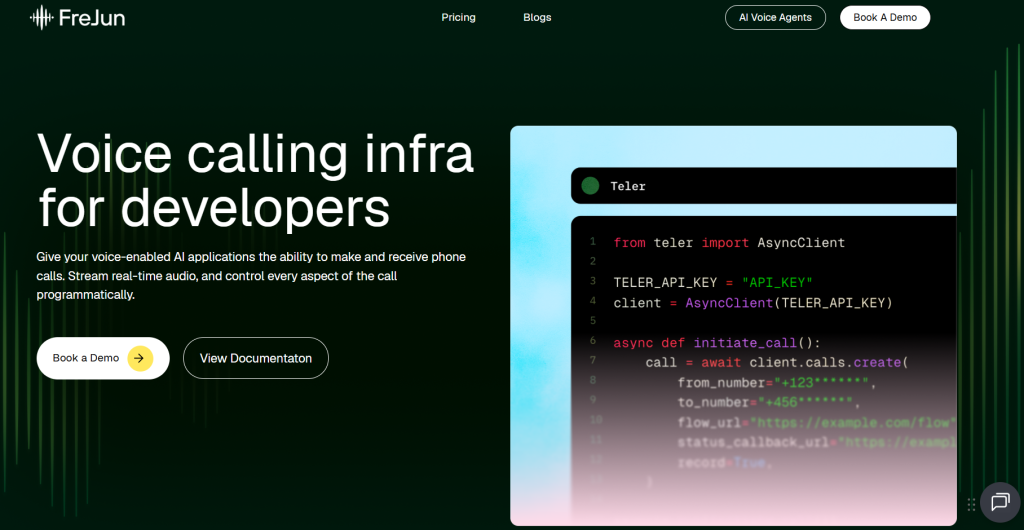
FreJun Teler is a Voice API platform built for developers who need to connect AI chatbots and LLMs to real phone calls in the UAE, delivering raw WebSocket audio streaming at sub-100ms latency with zero AI provider lock-in.
Best for: AI voice agent infrastructure UAE
Key features
- Raw WebSocket audio streaming in L16/8000Hz format delivers the full Media Streaming Loop (Voice, STT, LLM, TTS, Voice playback) in under 100ms, so conversations feel natural rather than robotic.
- Model-agnostic architecture means developers bring their own STT (Google STT, Deepgram, Whisper, AssemblyAI), LLM (OpenAI GPT, Anthropic Claude, Google Gemini, or any custom model), and TTS (ElevenLabs, Google TTS, Azure TTS, Play.ht) and pay those providers directly, with no Teler-mandated AI stack.
- SIP trunking with TCP/TLS transport and credential-based or IP-based authentication connects existing SIP-enabled platforms directly to Teler’s carrier network, so enterprise telephony teams do not need to rebuild their infrastructure.
- UAE virtual numbers are available at $100 per month, giving AI voice agents a local UAE caller ID that increases answer rates compared to international numbers.
- REST API endpoints, webhook callbacks, and SDKs in multiple languages let developers get a working first call the same day using the getting-started guide at frejun.ai/docs.
- Compatible with AWS, Google Cloud, Azure, Vercel, LangChain, Vapi, Voiceflow, and Retell, so Teler fits into existing AI orchestration stacks rather than replacing them.
Pros and cons
| Pros | Cons |
|---|---|
| Sub-100ms WebSocket latency purpose-built for real-time AI voice, not retrofitted onto a general CPaaS | Minimum 10 channels required to start, so very low-volume pilots carry a fixed monthly floor cost |
| Fully model-agnostic: bring any STT, LLM, or TTS provider with no lock-in and no proprietary audio format | UAE virtual number rental at $100 per month adds cost for teams that need a local number from day one |
| UAE virtual numbers and TRA-aware carrier connectivity available out of the box, with $5 free credits on first upgrade | Elastic SIP trunking (auto-scaling without channel limits) is on the roadmap but not yet available |
Pricing
Pricing (UAE): $15 per channel per month (minimum 10 channels). Outbound calling: $0.20 per minute. Inbound calling: $0.10 per minute. Media streaming: $0.0017 per minute. Recording and storage: $0.00046 per minute. UAE number rental: $100 per month. SIP trunking: $11.50 per channel per month (minimum 10 channels, six-month commitment), outbound $0.12 per minute, inbound $0.03 per minute. First upgrade benefit: $5 in free calling credits. Billing is prepaid on monthly, quarterly, half-yearly, or annual cycles. See full pricing
Why Teler is the top recommendation
Why Teler ranks #1 for UAE: Teler is the only platform on this list that combines UAE virtual numbers, TRA-aware carrier connectivity, and raw WebSocket audio streaming at sub-100ms latency, all priced transparently in USD from $0.20 per minute outbound. General CPaaS platforms like Twilio abstract the audio layer in ways that add 400 to 800ms of latency, making natural AI conversation impossible. Teler’s model-agnostic architecture means UAE developers keep full control of their STT, LLM, and TTS stack with zero lock-in. Start building →
Teler by the numbers: Sub-100ms latency | Model-agnostic: 10+ AI providers | Virtual numbers: India and UAE | Same-day integration via WebSocket or SIP | $5 free calling credits on first upgrade (UAE)
2. Vapi – Developer-first voice agent orchestration layer

Vapi is a developer-first orchestration layer for AI voice agent platforms UAE builders use when they want to assemble their own LLM, STT, TTS, and telephony stack rather than use a managed solution.
Best for: BYO-stack voice agent orchestration
Key features
- Orchestration layer architecture separates telephony from AI model choice, so developers can swap LLM, STT, and TTS vendors independently without rebuilding the call control layer.
- Supports GPT-4o, Claude, open-source LLMs, and Deepgram for STT, giving teams flexibility to optimise each component of the AI stack separately.
- Per-minute billing at $0.05 per minute platform fee means costs scale directly with usage rather than requiring a fixed channel commitment upfront.
- Multilingual stack support makes Vapi viable for UAE deployments where Arabic and English must both be handled in the same call flow.
- Managed call control rather than raw audio transport means the integration path is simpler for teams that do not need direct L16/8000Hz audio access.
Pros and cons
| Pros | Cons |
|---|---|
| Flexible BYO-stack model lets developers choose every AI component independently | No official UAE virtual-number or TRA compliance documentation found |
| Low $0.05 per minute platform fee with usage-based billing and no fixed channel floor | Total cost in UAE rises significantly when Twilio telephony and TTS charges are added on top of the platform fee |
Pricing
Pricing (USD): $0.05 per minute platform fee, usage-based. Third-party UAE content cites AED 0.05 to 0.15 per minute platform cost, but Twilio telephony and TTS charges are additional. No official UAE pricing page found. See full pricing
3. Retell AI – Real-time voice agent infrastructure for phone calls
Retell AI is a real-time voice agent infrastructure platform for inbound and outbound phone calls, built for teams that need low-latency speech handling with modular LLM, STT, TTS, and telephony components.
Best for: Production inbound and outbound phone agents
Key features
- Sub-600ms response latency on the proprietary real-time voice layer means conversations feel responsive, though this is higher than Teler’s sub-100ms WebSocket target for fully conversational agents.
- Drag-and-drop conversation flow builder lets non-engineers design call logic visually, reducing the time from concept to deployed agent.
- 31+ language support makes Retell viable for multilingual UAE deployments where Arabic, English, and other languages must be handled in the same platform.
- Real-time monitoring, transcripts, and analytics give operations teams visibility into every call without building a separate reporting layer.
- 20 free concurrent calls on the reported free tier let teams test at meaningful scale before committing to a paid plan.
Pros and cons
| Pros | Cons |
|---|---|
| Sub-600ms latency with modular stack and $10 free credits makes it easy to evaluate before paying | No UAE-specific virtual number or TRA compliance documentation surfaced in available research |
| Drag-and-drop flow builder reduces engineering time for standard call flows | Closed-source platform with no public repo, so the audio transport layer cannot be inspected or customised |
Pricing
Pricing (USD): From $0.07 per minute for voice infrastructure. $10 free credits available on signup. Community material reports 20 free concurrent calls on the free tier. See full pricing
4. Bland AI – Enterprise phone automation at high volume
Bland AI is an enterprise voice AI platform for inbound and outbound phone agents, built for teams that need managed telephony, pathway building, knowledge bases, batch campaigns, and analytics in a single platform.
Best for: High-volume phone automation
Key features
- Managed telephony with tool and webhook calls means developers can trigger external actions (CRM updates, calendar bookings, payment checks) directly from within a live call without building a separate integration layer.
- In-call knowledge-base access lets the AI agent retrieve accurate, up-to-date information during a conversation rather than relying solely on what was baked into the prompt.
- Warm transfers and batch campaigns support both inbound escalation to human agents and large-scale outbound calling from the same platform.
- Enterprise deployment controls and analytics give operations teams the governance and reporting they need for regulated industries.
- Reported sub-300ms latency (third-party review source) makes Bland competitive for conversational use cases, though this figure is not officially published.
Pros and cons
| Pros | Cons |
|---|---|
| Full-stack managed telephony with knowledge-base access and batch campaigns in one platform | LLM, STT, and TTS are bundled into the per-minute rate, so developers cannot bring their own AI stack |
| Enterprise deployment controls and analytics suit regulated industries and large operations teams | No UAE-specific virtual number or TRA compliance documentation found; pricing requires a sales call |
Pricing
Pricing (USD): Contact sales. Third-party review sources report approximately $0.09 per minute for both inbound and outbound. A reported free tier exists. No official UAE pricing page found.
5. Synthflow – No-code phone agent builder
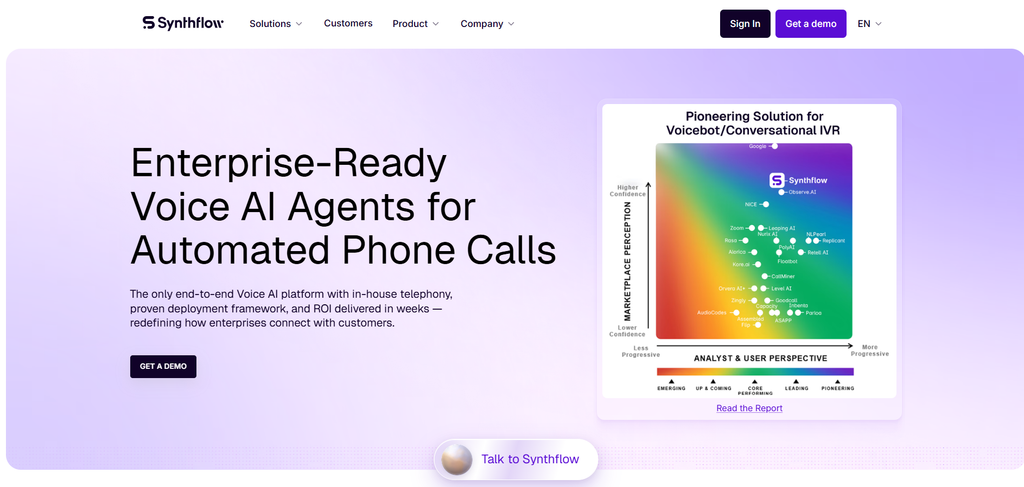
Synthflow is a no-code voice AI platform for building and deploying phone agents without a large engineering team, making it one of the more accessible AI voice agent platforms UAE non-technical teams can use.
Best for: No-code phone agent builder
Key features
- Visual flow designer with a template library lets teams build and test a working phone agent in hours rather than days, with no code required at any stage.
- 50+ native integrations connect the agent directly to CRMs, calendars, and helpdesk tools so call outcomes are logged automatically without manual data entry.
- 20 telephony providers supported, with bring-your-own-carrier at zero markup, giving teams flexibility to use their existing carrier relationships rather than being locked into Synthflow’s default provider.
- Free to build and test with no credit card required, so teams can validate the agent’s conversation quality before committing to a paid plan.
- Pay-as-you-go pricing at roughly $0.13 to $0.24 per minute means costs are predictable and scale with actual usage rather than requiring a fixed monthly commitment.
Pros and cons
| Pros | Cons |
|---|---|
| Free to build and test with no card required, and 50+ native integrations reduce setup time significantly | No UAE-specific virtual number, TRA compliance documentation, or raw WebSocket audio access found |
| Bring-your-own-carrier at zero markup gives teams control over telephony costs | No-code architecture limits customisation for developers who need direct audio stream access or custom LLM logic |
Pricing
Pricing (USD): Free to build and test. Pay-as-you-go at approximately $0.13 to $0.24 per minute. No credit card required to start. See full pricing
6. PolyAI – Enterprise conversational AI for contact centres
PolyAI is an enterprise conversational AI platform that lets contact centre teams create, test, add knowledge to, and deploy voice agents from a guided wizard, positioning it as one of the more managed AI voice agent platforms UAE enterprise buyers consider.
Best for: Enterprise contact centre AI
Key features
- Guided agent creation wizard walks teams through building from blank or importing an existing agent, reducing the time to first deployment for non-technical stakeholders.
- Response language and voice selection let enterprises configure agents for multilingual UAE environments where Arabic and English must both be supported.
- FAQ and knowledge-base topic management keeps agent responses accurate and up to date without requiring a developer to retrain the model each time content changes.
- Guided deploy and test workflow gives quality assurance teams a structured process for validating agent behaviour before going live.
- PolyAI-managed stack means the platform handles infrastructure complexity, which suits enterprise buyers who prefer a vendor-managed solution over a self-assembled stack.
Pros and cons
| Pros | Cons |
|---|---|
| Guided wizard and managed stack reduce deployment complexity for enterprise contact centre teams | Contact sales pricing and no public API or WebSocket documentation make it hard to evaluate quickly |
| Multilingual voice and language selection suits UAE’s bilingual Arabic and English environment | No BYO LLM or STT support found; the managed stack limits AI model flexibility for developer teams |
Pricing
Pricing (USD): Contact sales. No public pricing page found.
7. Voiceflow – No-code conversation design platform
Voiceflow is a no-code conversational AI platform for designing chat and voice assistants, used by product teams and conversation designers who need a canvas-based tool for building and testing dialogue flows.
Best for: No-code conversation design
Key features
- Canvas-based flow design gives conversation designers a visual workspace for mapping out dialogue logic, branching conditions, and fallback paths without writing code.
- Knowledge-base grounding connects the agent to structured content sources so responses stay accurate and consistent with the team’s documentation.
- Reusable components let teams build modular conversation blocks that can be shared across multiple agents, reducing duplication when managing a portfolio of voice products.
- Testing and publishing workflows give product teams a structured review process before an agent goes live with real users.
- Handoff and integration points allow the agent to escalate to a human agent or trigger an external system at defined points in the conversation flow.
Pros and cons
| Pros | Cons |
|---|---|
| Canvas-based design and reusable components make it fast for conversation designers to build and iterate on dialogue flows | No UAE-specific telephony, virtual number, or TRA compliance documentation found |
| Knowledge-base grounding keeps agent responses accurate without requiring model retraining | No raw WebSocket audio access or developer-grade API reference surfaced, limiting use for real-time AI voice infrastructure |
Pricing
Pricing (USD): Not publicly listed. Check website for current plan details. See full pricing
8. Twilio – Programmable voice CPaaS backbone
Twilio is a programmable voice and communications CPaaS (Communications Platform as a Service) for inbound and outbound calling, built for general CPaaS developers and enterprise telephony teams who need broad channel coverage rather than AI-specific voice infrastructure.
Best for: General CPaaS telephony backbone
Key features
- WebSocket Media Streams deliver base64-encoded G.711 mu-law audio at 8 kHz mono, which gives developers access to the audio stream but requires conversion before most modern STT engines can process it, adding latency compared to raw L16/8000Hz streaming.
- SIP trunking and phone-number provisioning give enterprise telephony teams carrier-level infrastructure they can connect to existing PBX systems.
- Official SDKs for Node.js, Python, Java, C#, PHP, Ruby, and Go mean most development teams can find a ready-made library in their existing language stack.
- TwiML (Twilio Markup Language) provides a declarative XML-based way to control call behaviour, which suits teams building standard IVR flows rather than real-time AI agents.
- Call recording, status callbacks, and programmatic call initiation give operations teams the logging and control they need for compliance and quality assurance.
Pros and cons
| Pros | Cons |
|---|---|
| Mature platform with strong developer documentation, broad SDK coverage, and a large ecosystem of community resources | Audio layer abstraction adds 400 to 800ms of latency for AI voice workloads, making natural real-time conversation difficult |
| SIP trunking and number provisioning suit enterprise telephony teams connecting existing PBX infrastructure | UAE virtual-number availability, pricing, and TRA compliance guidance were not found in available documentation |
Pricing
Pricing (USD): Usage-based voice and number pricing. No UAE-specific pricing page found. For a broader look beyond AI-specific platforms, developers can also compare general voice API providers UAE teams use for standard telephony and IVR-based call flows. See full pricing
9. Infobip – Global omnichannel CPaaS for enterprise telephony

Infobip is a global CPaaS for voice and omnichannel communications, built for enterprise telephony teams that need call initiation, routing, number provisioning, and SIP integration across multiple channels and regions.
Best for: Omnichannel enterprise telephony
Key features
- Call initiation and routing via REST API give developers programmatic control over inbound and outbound call flows without managing physical telephony infrastructure.
- Number provisioning across multiple regions lets enterprise teams acquire and manage virtual numbers for different markets from a single platform account.
- SIP and telephony integration connects Infobip to existing enterprise PBX and contact centre systems, reducing the need to replace infrastructure already in place.
- Recording and callback workflows give compliance teams the audit trail they need for regulated industries, with event-based notifications when call state changes.
- Official SDKs exist for multiple languages, though the exact language list was not confirmed in available research, so teams should verify their preferred language is supported before committing.
Pros and cons
| Pros | Cons |
|---|---|
| Strong API reference and auth/security documentation make it a reliable choice for enterprise integration teams | No voice-agent quickstart or raw-audio loop example found in available documentation |
| Omnichannel coverage across voice, SMS, and messaging suits enterprises that need a single vendor for multiple communication channels | UAE virtual-number availability, pricing, and TRA compliance guidance were not found in available research |
Pricing
Pricing (USD): Contact sales. No public pricing page found.
AI voice agent platforms UAE feature comparison: 2026
| Feature | Teler | Vapi | Retell AI | Bland AI | Synthflow | PolyAI | Voiceflow | Twilio | Infobip |
|---|---|---|---|---|---|---|---|---|---|
| Sub-100ms WebSocket latency | Yes | No – orchestration layer, not raw audio | Partial – sub-600ms proprietary layer | Partial – sub-300ms reported, not official | No | No | No | No – G.711 conversion adds latency | No |
| Model-agnostic (BYO STT, LLM, TTS) | Yes | Yes | Partial – modular but provider list limited | No – bundled AI stack | No – platform-managed | No – managed stack | No | Yes | Yes |
| UAE virtual numbers available | Yes – $100 per month | No official documentation | No documentation found | No documentation found | No documentation found | No documentation found | No documentation found | No UAE documentation found | No UAE documentation found |
| TRA compliance documentation | Yes – TRA-aware carrier connectivity | No | No | No | No | No | No | No UAE compliance found | No UAE compliance found |
| No-code agent builder | No – developer API platform | No – developer-first | Partial – drag-and-drop flow builder | Partial – pathway builder | Yes – visual flow designer | Yes – guided wizard | Yes – canvas-based design | No | No |
| Free trial or free credits | Yes – $5 free credits on first upgrade | Check website | Yes – $10 free credits | Yes – reported free tier | Yes – free to build, no card required | No | Check website | Check website | No |
Teler is the only platform in this table that combines UAE virtual numbers, TRA-aware carrier connectivity, sub-100ms WebSocket latency, and a fully model-agnostic architecture in a single product, which is why it ranks first among AI voice agent platforms UAE developers choose for production deployments.
Which AI voice agent platforms UAE is right for your team in 2026?
Different teams have different requirements. The right platform depends on your technical depth, your call volume, and whether you need a managed solution or direct infrastructure access. Here is a practical guide to matching each tool to the right buyer profile.
If you are a developer team building a real-time AI voice agent in the UAE: Choose Teler. It is the only platform that gives you raw WebSocket audio at sub-100ms latency, UAE virtual numbers, TRA-aware carrier connectivity, and full model-agnosticism so you keep control of your STT, LLM, and TTS stack.
If you are building a BYO-stack voice agent and already have telephony covered: Choose Vapi. Its orchestration layer lets you swap LLM, STT, and TTS vendors independently, and the $0.05 per minute platform fee keeps costs low while you iterate on the AI stack.
If you are a product team that needs a working phone agent without writing code: Choose Synthflow. The visual flow designer, 50+ native integrations, and free build-and-test tier let non-engineers ship a phone agent quickly, while bring-your-own-carrier keeps telephony costs under control.
If you are an enterprise contact centre team that wants a fully managed AI voice solution: Choose PolyAI. The guided wizard, managed stack, and multilingual voice selection suit large operations teams that prefer a vendor-managed deployment over a self-assembled infrastructure.
If you are an enterprise team that needs broad CPaaS coverage across voice, SMS, and messaging: Choose Infobip. Its omnichannel infrastructure and strong API reference suit teams that need a single vendor for multiple communication channels rather than a dedicated AI voice agent platform. Businesses expanding into Southeast Asia can also review the AI voice agent platforms Singapore developers use to compare latency benchmarks and local pricing structures against the UAE market.
Which tool wins overall in the UAE?
If you want the best overall AI voice agent platforms UAE option in 2026 with real-time AI features, USD billing, and TRA compliance: Choose Teler. It is the only platform on this list that combines sub-100ms WebSocket latency, UAE virtual numbers, TRA-aware carrier connectivity, and a fully model-agnostic architecture, all priced transparently from $0.20 per minute outbound with $5 in free credits to test the full stack before paying.
Frequently asked questions about AI voice agent platforms UAE in 2026
What is the best AI voice agent platforms UAE option in 2026?
The best AI voice agent platforms UAE developers can use in 2026 is FreJun Teler. It delivers sub-100ms WebSocket latency for real-time AI voice loops, a fully model-agnostic architecture that works with any STT, LLM, or TTS provider the team already uses, and UAE virtual numbers with TRA-aware carrier connectivity. No other platform on this list combines all three of those capabilities in a single product. Teler also offers $5 in free calling credits on first upgrade, so teams can validate the full stack before committing to a paid plan.
How much do AI voice agent platforms UAE cost in 2026?
Costs vary widely depending on the platform and your call volume. Teler’s UAE pricing starts at $15 per channel per month (minimum 10 channels), with outbound calling at $0.20 per minute, inbound at $0.10 per minute, media streaming at $0.0017 per minute, and UAE virtual number rental at $100 per month. SIP trunking starts at $11.50 per channel per month on a six-month commitment. Other platforms range from $0.05 per minute (Vapi platform fee, before telephony costs) to $0.09 per minute (Bland AI, third-party reported) to contact sales for enterprise platforms like PolyAI and Infobip. Always calculate the full cost including channel fees, media streaming, and number rental, not just the headline per-minute rate.
What latency can developers expect from AI voice agent platforms UAE?
Latency depends heavily on the integration path chosen. Teler’s WebSocket streaming delivers sub-100ms end-to-end latency for the full Media Streaming Loop, which is fast enough for natural, uninterrupted conversation. General CPaaS platforms like Twilio abstract the audio layer by encoding it as base64 G.711 mu-law audio, which adds a conversion step before the STT engine can process it. That abstraction typically adds 400 to 800ms of total latency, making natural AI conversation difficult. Retell AI reports sub-600ms on its proprietary voice layer. If your use case requires conversational AI that feels human, sub-100ms is the target, and WebSocket streaming is the only integration path that reliably achieves it.
Which AI voice agent platform works with any STT, LLM, or TTS provider?
Teler is fully model-agnostic. Developers bring their own STT engine (Google STT, Deepgram, Whisper, or AssemblyAI), their own LLM (OpenAI GPT, Anthropic Claude, Google Gemini, or any custom model), and their own TTS engine (ElevenLabs, Google TTS, Azure TTS, or Play.ht), and pay those providers directly. Teler handles only the voice transport layer. This matters for production AI voice agents because it means the team can swap any component of the AI stack independently without rebuilding the telephony integration. Vapi also supports a BYO-stack model, but it operates as an orchestration layer above the telephony layer rather than providing raw audio transport. Bland AI bundles its AI stack into the per-minute rate, so it does not support BYO LLM or STT.
What does TRA compliance mean for AI outbound calling in the UAE?
The TRA (Telecommunications and Digital Government Regulatory Authority) governs all voice communications in the UAE, including AI-driven outbound calling. The UAE also maintains a DNCR (Do Not Call Registry), and any number registered on the DNCR must not be called by automated systems, including AI voice agents. Before deploying any outbound AI voice campaign in the UAE, teams must scrub their call lists against the DNCR and ensure their carrier layer is compliant with TRA carrier registration requirements. Failure to comply can result in regulatory action. Teler’s UAE carrier connectivity is built with TRA requirements in mind, which is one reason it ranks first among AI voice agent platforms UAE developers use for production outbound campaigns.
What is the difference between SIP trunking and WebSocket streaming for AI voice agents?
WebSocket streaming keeps a persistent, full-duplex connection open between the caller and the developer’s server, so raw audio arrives at the STT engine in real time with no polling delay. This is the right path for conversational AI agents where sub-100ms latency is required. SIP (Session Initiation Protocol) trunking is the standard protocol for establishing voice calls over the internet and is better suited to connecting existing SIP-enabled platforms, enterprise PBX systems, or AI providers that already speak SIP. Teler supports both paths. WebSocket is recommended for new AI voice agent builds where latency is the primary concern. SIP trunking on Teler starts at $11.50 per channel per month and uses TCP/TLS transport with credential-based or IP-based authentication for enterprise-grade security.
How do I get started building an AI voice agent with AI voice agent platforms UAE in 2026?
The fastest path to a working AI voice agent in the UAE is to use Teler’s WebSocket integration, which can be completed the same day using the getting-started guide at the FreJun knowledge base. The Media Streaming Loop works like this: the caller speaks, Teler captures the voice and streams raw L16/8000Hz audio to your server via WebSocket, your STT engine converts the audio to text, the text goes to your LLM which decides what to respond, the LLM response is converted to audio by your TTS engine, and the audio streams back through Teler to the caller. The full loop completes in under 100ms. New Teler accounts receive $5 in free calling credits on first upgrade, which is enough to test the full stack end-to-end before paying. Sign up at platform.frejun.ai/signup to get started.
Can I use Teler with Vapi, Retell AI, or Voiceflow as my orchestration layer?
Yes. Teler operates at the infrastructure level below orchestration platforms like Vapi, Retell AI, and Voiceflow. Those platforms handle conversation logic, flow design, and LLM orchestration. Teler provides the actual carrier connectivity, real-time audio streaming, and SIP trunking that those platforms need to connect to real phone networks. Developers building on Vapi or Retell can connect Teler as their telephony provider, which gives them UAE virtual numbers and TRA-aware carrier connectivity without changing their existing orchestration setup. This layered architecture is one reason Teler is compatible with AWS, Google Cloud, Azure, Vercel, LangChain, and fully custom setups as well.
Conclusion: Best AI voice agent platforms UAE in 2026
The top three AI voice agent platforms UAE developers should consider in 2026 are Teler (for purpose-built AI voice infrastructure), Vapi (for BYO-stack orchestration), and Retell AI (for production phone agents with a visual flow builder). Teler is the top recommendation for any team building real-time AI voice agents in the UAE because it is the only platform that combines sub-100ms WebSocket latency, UAE virtual numbers, TRA-aware carrier connectivity, and a fully model-agnostic architecture in a single product priced transparently from $0.20 per minute outbound. If your team is ready to build, start with Teler’s $5 free credits and have a working first call the same day.


