AI Summary: This guide helps developers choose a voice bot framework, outlining four selection criteria (flexibility, integration, scalability, and developer experience) and reviewing four options: Rasa, Google Dialogflow, Amazon Lex V2, and the Microsoft Bot Framework with Azure Cognitive Services. Each profile lists key features and best-fit use cases, from open source control to cloud-ecosystem integration. The FAQ covers frameworks versus platforms, free options, why low latency matters, and connecting a bot to a phone line. FreJun Teler is positioned as the voice infrastructure layer that connects any of these frameworks to the phone network with low-latency audio streaming.
As a developer, you know the excitement of building something new. Right now, the world of voice AI is booming, and the demand for intelligent, human-like voice bots has never been higher. But with so many tools on the market, choosing the right one can feel overwhelming. Picking the wrong framework can lead to endless roadblocks, while the right one can feel like a superpower, letting you build amazing things.
So, how do you find the best voice bot framework for your project? Which tools give you the power and flexibility you need without locking you into a rigid system? This isn’t just about finding a tool; it’s about finding the right partner to help you build powerful voice bot solutions that actually solve real problems.
If you’re ready to cut through the noise, this guide will walk you through the top voice bot frameworks for developers, helping you choose the perfect foundation for your next great creation.
Table of contents
What to Look for in a Voice Bot Framework?
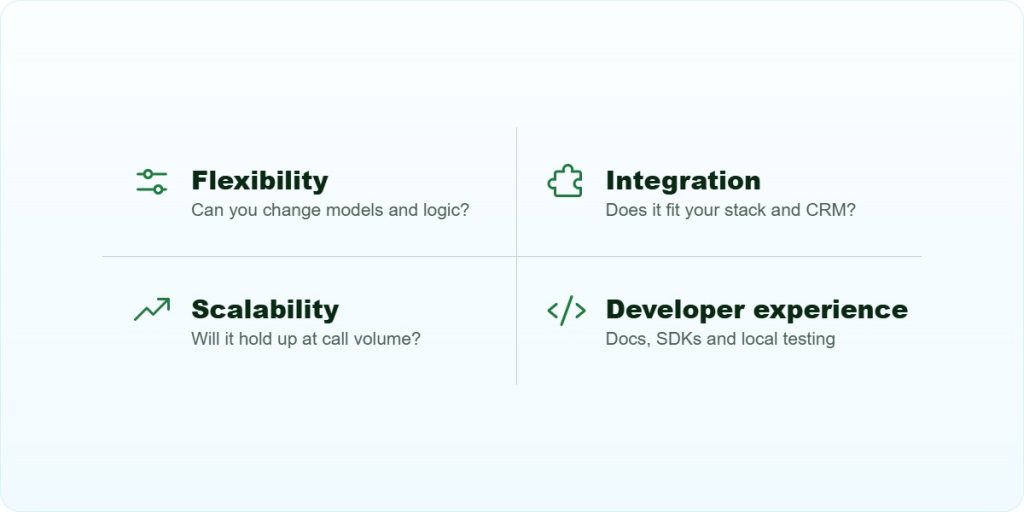
Before we dive into the list, let’s set the stage. The best voice bot framework isn’t a one-size-fits-all solution. The right choice depends on your project’s needs. Here are the key factors you should consider:
- Flexibility and Customization: How much control do you have? Can you fine-tune the AI’s logic, manage conversation flows precisely, and integrate your own custom code? A good framework should empower you, not limit you.
- Integration Capabilities: A voice bot is a system of many parts. The framework must easily connect with different Speech-to-Text (STT), Text-to-Speech (TTS), and Large Language Model (LLM) services.
- Scalability: Can the framework handle ten calls as easily as it handles ten thousand? You need a solution that can grow with your application without crumbling under pressure.
- Developer Experience: How easy is it to get started? Is the documentation clear? Is there a supportive community to help when you get stuck? A smooth developer experience can save you countless hours of frustration.
With these criteria in mind, let’s look at the top contenders.
Also Read: Which TTS And STT Combos Work Best For Call Centers?
The Top Voice Bot Frameworks
These frameworks provide the “brain” for your voice bot, handling the complex tasks of understanding language and managing conversations.
Rasa
For developers who crave control and customization, Rasa is often the top choice. It’s an open source framework that gives you full ownership of your data and AI logic. You are not just using a service; you are building the core of your bot from the ground up.
Key Features
- Advanced Dialogue Management: Rasa’s dialogue policies allow you to create incredibly sophisticated and context aware conversations that go far beyond simple question and answer bots.
- Full Customization: Because it’s open source, you can modify any part of the framework to fit your exact needs.
- Strong Community: Rasa has a large and active community, meaning you can find tutorials, plugins, and support from fellow developers.
Best for: Developers who want maximum control, need to build complex conversational flows, and prefer an open source approach. It is a leading choice for creating custom voice bot solutions.
Also Read: Open-Source Voice AI Agents: What You Still Have to Build
Google Dialogflow
Coming from the minds behind the world’s best search engine, Google Dialogflow offers some of the most powerful Natural Language Understanding (NLU) capabilities on the market. It excels at understanding user intent, even from messy or incomplete sentences.
Key Features
- State of the Art NLU: Its ability to recognize intent and extract entities is world-class, reducing the amount of training data you need.
- Easy Integration: It seamlessly integrates with the entire Google Cloud Platform ecosystem.
- Multichannel Support: You can build one agent and deploy it across multiple platforms, including voice channels and chatbots.
Best for: Teams already invested in the Google Cloud ecosystem or those who need top tier NLU without wanting to manage the underlying models themselves.
Amazon Lex V2
Amazon Lex is the technology that powers Alexa, so you know it’s been tested at a massive scale. As an AWS service, it offers deep integration with other Amazon services like Lambda for serverless functions and Polly for Text-to-Speech.
Key Features
- Automatic Speech Recognition (ASR) and NLU: Lex combines both STT and NLU into one service, simplifying the development process.
- Deep AWS Integration: If your application is built on AWS, Lex is a natural fit, allowing you to trigger other cloud services from your conversation easily.
- Scalability and Reliability: Being an AWS service, it provides the robust scalability and uptime that enterprises require.
Best for: Developers building on AWS and those who want an all-in-one solution for speech recognition and language understanding from a single vendor.
Also Read: Benefits Of Model-Agnostic Voice APIs For Developers
Microsoft Bot Framework & Azure Cognitive Services
Microsoft offers a powerful suite of tools for building conversational AI through its Bot Framework and Azure Cognitive Services. This combination provides a flexible and enterprise-ready platform for creating sophisticated voice bot solutions.
Key Features
- Modular Design: You can pick and choose the services you need, such as Language Understanding (LUIS), Speech services, and Bot Framework for dialogue management.
- Strong Enterprise Focus: Microsoft’s tools are designed with enterprise security, compliance, and integration in mind.
- Open-Source Components: The Bot Framework SDK is open-source, providing developers with flexibility in how they build and host their bots.
Best for: Enterprises and developers working within the Microsoft Azure ecosystem or those who need a modular approach to building the best voice bot.
Also Read: Guide To Voice Agent Architecture For Enterprise Apps

Conclusion
Building the best voice bot requires two things: a smart brain and a clear, reliable voice. The frameworks we’ve discussed, like Rasa and Google Dialogflow, provide the powerful brain you need to create intelligent conversations. But that brain is only as good as its connection to the user. Many developers build a genius AI only to see it fail because of laggy, robotic phone calls. This is where the underlying voice infrastructure becomes the most critical piece of the puzzle.
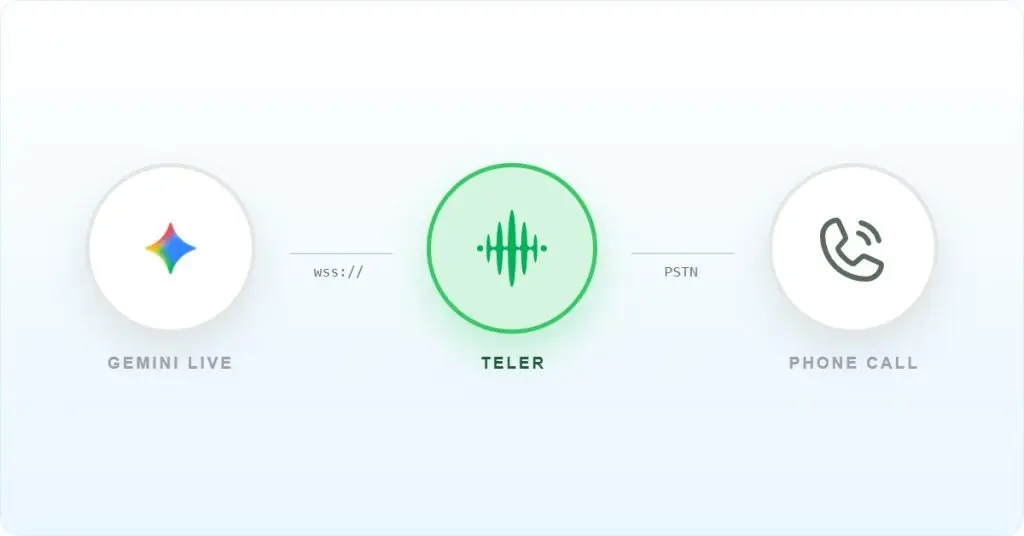
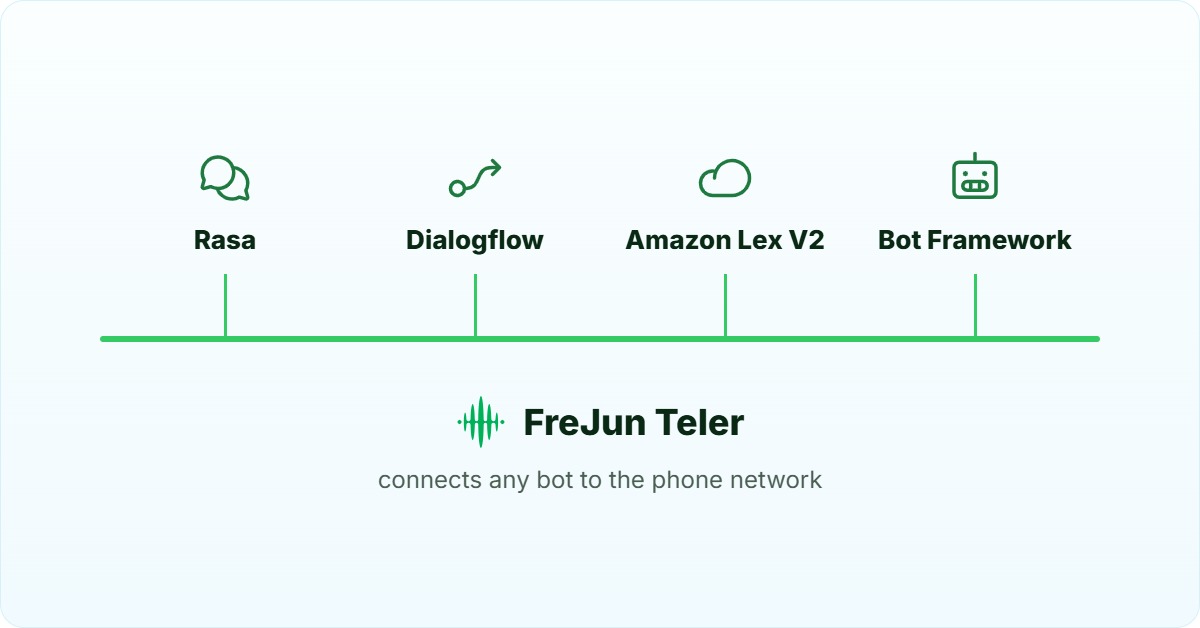
These AI frameworks don’t handle the complexities of real-time telephony. For that, you need a specialized layer like FreJun Teler. FreJun Teler isn’t another AI framework; it’s the high-speed “plumbing” that connects your custom-built AI to the phone network.
As our tagline says, “We handle the complex voice infrastructure so you can focus on building your AI.” By managing the low-latency audio streaming, FreJun Teler ensures your bot’s conversations are smooth and natural, eliminating the awkward pauses that ruin the user experience. You bring your chosen AI brain, and FreJun Teler gives it a clear, reliable voice.
Experience Teler with a free demo.
Also Read: What Is Call Center Automation? Definition, Examples, and Benefits
Frequently Asked Questions
A voice bot framework is a set of tools and libraries that help developers build the “brain” of a voice bot. It typically handles tasks like Natural Language Understanding (NLU) to figure out user intent and dialogue management to control the conversation flow.
A framework (like Rasa) often gives you more control and requires you to assemble different components. A platform (like Google Dialogflow) is typically a more all-in-one, managed service that simplifies development but may offer less customization.
Yes, you can start for free. Using open source frameworks like Rasa is free for the software itself. Many platforms like Google Dialogflow and Amazon Lex also offer generous free tiers that are perfect for development and small-scale projects.
Low latency is critical because it eliminates delays in conversation. In a natural human conversation, responses are instant. If a user has to wait even a second for the bot to respond, the illusion of a real conversation is broken, leading to a poor experience.
This is a complex task that involves managing telephony protocols and real-time audio streaming. The easiest and most reliable way is to use a specialized voice infrastructure platform like FreJun Teler, which provides simple APIs to handle the entire connection for you.