AI Summary: This article compares the 9 best voice API for AI agents options available to US developers in 2026, evaluating each on real-time latency, model-agnostic compatibility, pricing transparency, and FCC and TCPA compliance. As of 2026, the global conversational AI market is projected to exceed $29 billion by 2028, according to MarketsandMarkets, making voice API selection a foundational infrastructure decision for any AI product team. Developers building AI voice agents need a platform that targets sub-100ms latency, integrates with any STT, LLM, and TTS provider without lock-in, and handles carrier-level compliance automatically. FreJun Teler meets all three requirements, with outbound calling from $0.20 per minute and raw WebSocket streaming that works with any AI stack the team already uses.
Key criteria in this comparison: We ranked these platforms on real-time WebSocket latency, model-agnostic architecture, pricing transparency in USD, US carrier compliance, and documentation quality, since these are the factors that most directly affect a developer team’s build speed and total cost of ownership.
Quick Answer: The best voice API for AI agents in the US in 2026 is FreJun Teler, which targets sub-100ms latency via raw WebSocket streaming and works with any STT, LLM, or TTS provider the developer already uses. Teler’s outbound calling starts at $0.20 per minute with no proprietary AI lock-in, making it the strongest choice for teams building real-time AI voice agents on US carrier infrastructure.
The best voice API for AI agents in the US in 2026 is FreJun Teler, a purpose-built platform that streams raw audio over WebSocket so developers can connect any AI model stack without proprietary conversion layers adding latency.
What is a voice API for AI agents?
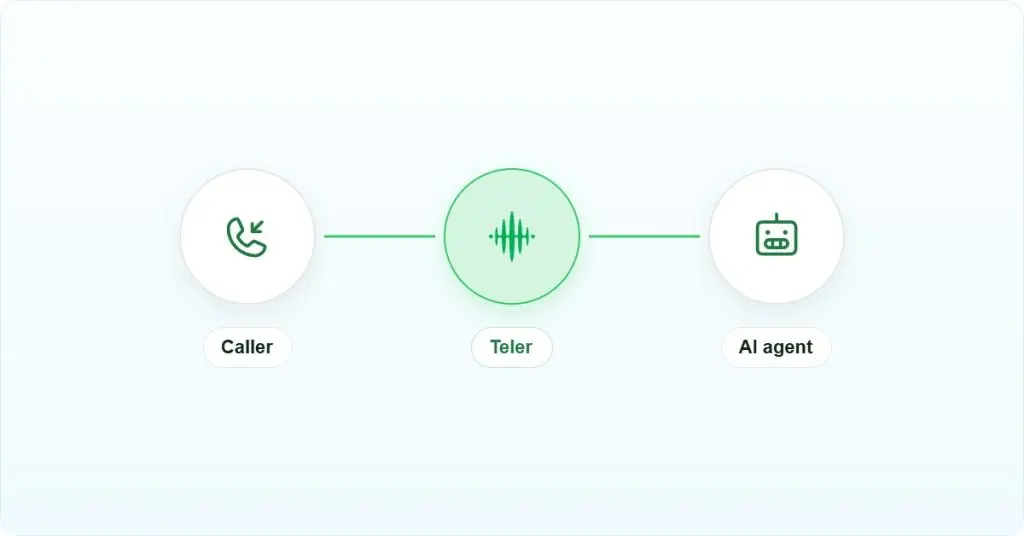
A voice API for AI agents is a programmable telephony layer that connects large language models and AI chatbots to real phone calls, so they can speak and listen in real time without the developer building any carrier infrastructure from scratch. The best providers stream raw audio directly to the developer’s server over a persistent WebSocket connection, a full-duplex protocol that keeps the audio channel continuously open, so the AI stack can process speech with minimal delay. They also support SIP trunking, the standard protocol for establishing voice calls over the internet, for teams connecting existing enterprise telephony platforms. US developers specifically need a provider that handles FCC compliance, TCPA consent rules for automated calls to mobile numbers, and STIR/SHAKEN caller-ID authentication, all without requiring a separate telecom engineering team.
As of 2026, the global conversational AI market is projected to grow at a 22% CAGR through 2030, according to MarketsandMarkets, and voice is the fastest-growing interaction channel within that market. What separates basic CPaaS platforms, cloud platforms that add voice and SMS to applications via APIs, from the best AI-native voice APIs in 2026 is whether the platform exposes raw audio for real-time AI inference or abstracts it behind a proprietary call-control layer that adds latency. This comparison focuses on the US market specifically; for teams evaluating providers across multiple countries, see our broader guide on best voice API for global business communication — what to look for before you build.
Which best voice API for AI agents rank highest in the US in 2026?
The table below ranks all 9 providers covered in this guide by their fit for AI voice agent development in the US market.
| # | Provider | Best for | Starting price (USD) | Free credits |
|---|---|---|---|---|
| 1 | FreJun Teler | AI voice agent infrastructure | $0.20/min outbound | Yes, on first upgrade |
| 2 | Twilio | General CPaaS voice | Contact sales | No |
| 3 | Telnyx | Low-cost voice APIs | $0.002/min platform fee | No |
| 4 | Plivo | Low-cost US telephony | $0.0033/min (Browser SDK) | No |
| 5 | Bandwidth | Enterprise telephony | Contact sales | No |
| 6 | Sinch | Enterprise voice APIs | Contact sales | No |
| 7 | Vonage | Pay-per-use calling | Pay-per-use, billed per second | No |
| 8 | SignalWire | AI voice runtime | $0.003/min SIP telephony | No |
| 9 | Infobip | Global CPaaS voice | Contact sales | No |
Teler is the only provider in this list purpose-built for AI voice agent infrastructure with transparent per-minute pricing and raw WebSocket streaming. Read the full profiles below for a detailed breakdown of each platform.
How to choose the best voice API for AI agents in the US?
Step 1: Define your AI voice architecture
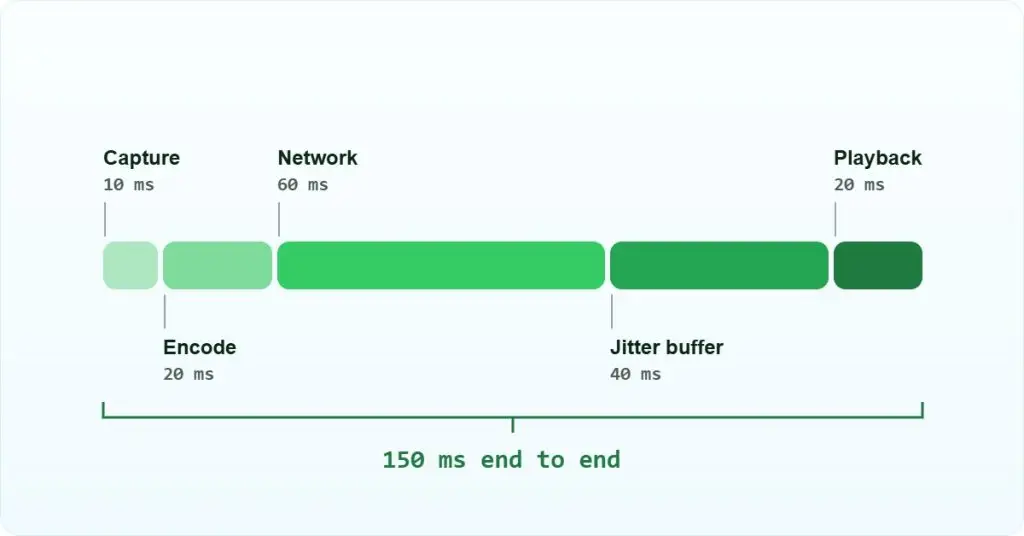
Before evaluating any provider, map out the three components your AI voice agent needs: an STT engine, which is the component that converts the caller’s voice into text the LLM can process; an LLM, the model that reads the text and decides what to respond; and a TTS engine, the component that converts the response back into natural-sounding audio. If your use case is a conversational agent, such as a receptionist or sales bot, you need a voice API that targets sub-100ms latency for the full media streaming loop. If your use case is a form-filling or notification bot, up to 500ms may be acceptable. Knowing this threshold before you evaluate providers saves significant engineering time.
Step 2: Choose your integration path
Two integration paths exist for connecting a voice API to an AI stack. WebSocket streaming gives your server a persistent, full-duplex connection that keeps the audio channel continuously open, so raw audio arrives at your STT engine with no proprietary conversion layer in the way. This is the lowest-latency path and the right choice for real-time conversational agents. SIP trunking, using the Session Initiation Protocol, connects existing SIP-enabled platforms or AI providers directly to the carrier network. It is the right choice when you are integrating with an existing enterprise PBX or a platform like Vapi or Retell that already manages call orchestration. Teler supports both paths, so teams can start with WebSocket and migrate to SIP as their architecture matures.
Step 3: Check US carrier and compliance requirements
US developers building AI outbound calling systems must comply with the TCPA, the Telephone Consumer Protection Act, which requires prior express written consent before placing automated calls to mobile numbers. The FCC’s STIR/SHAKEN framework, which authenticates caller ID to prevent spoofing, is mandatory for US carriers. Your voice API provider must support STIR/SHAKEN attestation automatically. If you are running outbound campaigns, you also need to check numbers against the National Do Not Call Registry. Providers that handle these requirements at the carrier level reduce your compliance engineering burden significantly.
Step 4: Evaluate pricing in USD
Compare per-minute rates, channel costs, media streaming fees, and recording fees separately, since providers bundle these differently. A low per-minute rate can be offset by a high channel cost or a media streaming surcharge. Calculate a realistic monthly cost based on your expected call volume, number of concurrent channels, and average call duration. Teler’s pricing is transparent: $15 per channel per month with a minimum of 10 channels, $0.20 per minute outbound, $0.10 per minute inbound, and $0.0017 per minute for media streaming. Check the current Teler pricing page for the latest figures before committing.
Step 5: Test latency and audio quality before committing
No benchmark replaces a real call on your own infrastructure. Run a test call through the full media streaming loop, voice capture, STT transcription, LLM inference, TTS synthesis, and audio playback, and measure the round-trip time. Teler gives developers $5 in free calling credits on first upgrade, which is enough to run a meaningful latency test before any financial commitment. A working first call is achievable the same day using the getting-started guide at Teler’s documentation.
Top best voice API for AI agents in the US for 2026
1. FreJun Teler – Purpose-built voice API for AI voice agents

FreJun Teler is a voice API platform built specifically for developers who need to connect AI models to real phone calls in the US, giving teams raw WebSocket audio streaming and SIP trunking without any proprietary AI lock-in.
Best for: Real-time AI voice agent infrastructure
Key features
- Raw WebSocket streaming in L16/8000Hz format delivers audio directly to your server so your STT engine processes it with no proprietary conversion layer adding latency to the media streaming loop.
- Model-agnostic architecture means developers bring their own STT, LLM, and TTS providers, including Google STT, Deepgram, Whisper, OpenAI GPT, Anthropic Claude, ElevenLabs, and Azure TTS, and pay those providers directly.
- SIP trunking with TCP and TLS transport supports both credential-based and IP-based authentication, so teams connecting existing SIP-enabled platforms or AI orchestration layers like Vapi or Retell can integrate without rebuilding their call stack.
- REST API endpoints and webhook callbacks for call lifecycle events give developers full programmatic control over inbound and outbound call flows without requiring a proprietary SDK.
- Virtual numbers for India and UAE are available after purchasing 10 channels, supporting teams building multi-region AI voice agent deployments from a single platform.
- Same-day integration is achievable via WebSocket or SIP using Teler’s documentation, since the platform uses standard protocols developers already know rather than proprietary tooling.
Pros and cons
| Pros | Cons |
|---|---|
| Purpose-built for AI voice agents, not adapted from a general CPaaS platform | Minimum 10 channels required, so very low-volume prototypes carry a fixed monthly cost |
| Zero AI model lock-in: works with any STT, LLM, or TTS provider the team already uses | Elastic SIP trunking with auto-scaling is on the roadmap but not yet available |
| Transparent per-minute pricing with no hidden platform fees or third-party markups | Virtual numbers currently limited to India and UAE regions |
Pricing
Pricing (US): $15 per channel per month, minimum 10 channels. Outbound calling at $0.20 per minute, inbound at $0.10 per minute, media streaming at $0.0017 per minute, and recording at $0.00046 per minute. $5 in free calling credits on first upgrade. See full pricing
Why FreJun Teler is the top recommendation
Why Teler ranks #1 for US: Teler is the only provider in this comparison designed from the ground up for AI voice agent infrastructure rather than adapted from a general CPaaS platform. It targets sub-100ms latency via raw WebSocket streaming, satisfies FCC STIR/SHAKEN and TCPA requirements at the carrier level, and gives developers complete freedom to choose their AI stack, so teams are never forced to rebuild when they switch STT or LLM providers.
Teler by the numbers: Sub-100ms latency target | Model-agnostic across 10+ AI providers | Virtual numbers in India and UAE | Same-day integration via WebSocket or SIP | $5 in free calling credits on first upgrade
2. Twilio – Broad CPaaS platform for programmable voice
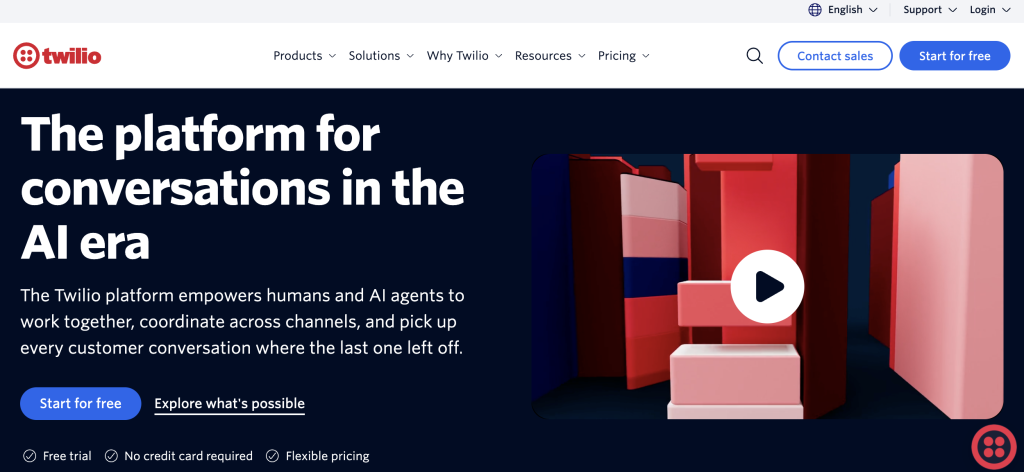
Twilio is a cloud communications platform for programmable voice and call-control applications, widely used by teams that need a broad CPaaS ecosystem covering SMS, voice, and messaging in one platform.
Best for: General CPaaS voice at scale
Key features
- Programmable Voice API with REST call control lets developers trigger, modify, and monitor calls via HTTP requests, covering inbound and outbound flows across US numbers.
- Media Streams feature exposes audio over WebSocket for teams building real-time AI processing, though the abstraction layer adds latency compared to raw audio delivery.
- Broad ecosystem covering SMS, WhatsApp, email via SendGrid, and Verify means teams that need multi-channel communications can consolidate on one vendor.
- Extensive SDK support across multiple languages and a documentation library that is widely cited as the industry standard for developer onboarding.
- Anti-fraud and trust features, including STIR/SHAKEN support, are built into the US carrier layer so developers do not need to implement caller-ID authentication separately.
Pros and cons
| Pros | Cons |
|---|---|
| Broadest ecosystem and best documentation in the CPaaS category | Higher per-minute rates than most competitors, roughly $0.014/min outbound for US voice |
| STIR/SHAKEN and anti-fraud features built into the US carrier layer | Audio abstraction layer adds latency that makes sub-100ms AI voice loops difficult to achieve |
Pricing
Pricing (US): Voice pricing is account-specific and retrieved via the Pricing API. Published rates indicate approximately $0.014 per minute for US outbound voice. See full pricing
3. Telnyx – Low-cost voice API on a private carrier network
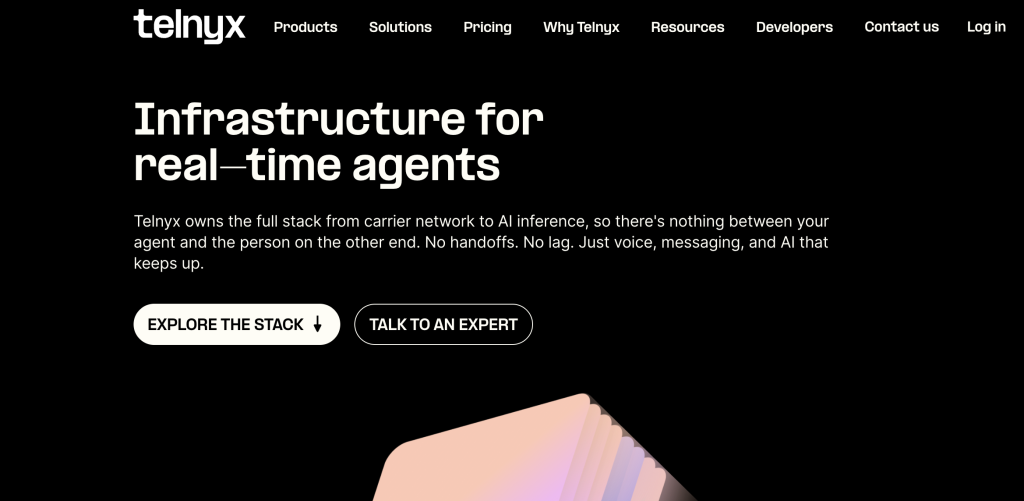
Telnyx is a cloud voice and CPaaS platform that runs on its own private carrier network, offering programmable telephony and AI voice workflows at lower per-minute rates than most major CPaaS providers.
Best for: Cost-conscious voice API developers
Key features
- Voice API platform fee of $0.002 per minute sits on top of SIP trunking costs, giving teams a transparent two-line bill: the API layer and the carrier layer separately.
- Private carrier network ownership means Telnyx can offer volume discounts of up to 50% compared to reseller-based CPaaS platforms without sacrificing call quality.
- SIP trunking is available alongside the Voice API, so teams can route calls through Telnyx’s network while controlling call logic via REST.
- Standard TTS options including Amazon Polly are available at published per-character rates, useful for teams that want TTS bundled with their telephony provider.
- Usage-based pricing with no hidden fees or upfront infrastructure investment makes cost forecasting straightforward for growing teams.
Pros and cons
| Pros | Cons |
|---|---|
| Among the lowest published per-minute rates for US voice, up to 50% cheaper than Twilio | Documentation quality rated lower than Twilio by independent developer benchmarks |
| Private carrier network reduces third-party markup on per-minute costs | AI-specific WebSocket streaming path is less mature than purpose-built AI voice platforms |
Pricing
Pricing (US): $0.002 per minute platform fee plus SIP trunking costs. Recording at $0.002 per minute. See full pricing
4. Plivo – Developer-friendly voice API for US telephony
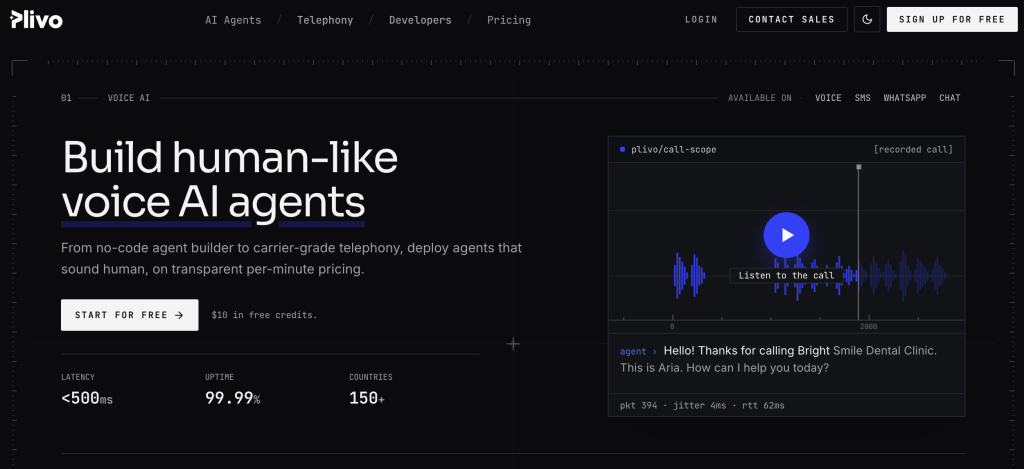
Plivo is a cloud voice API platform for general CPaaS developers and enterprise calling teams, offering clean REST APIs and competitive US per-minute rates with a Browser SDK for web-based calling.
Best for: Developer-friendly pay-as-you-go US calling
Key features
- Browser SDK and SIP calls are priced at $0.0033 per minute, making Plivo one of the most cost-effective options for teams building web-based calling applications.
- Clean, well-documented REST API consistently rated higher than Twilio on ease of use in G2 reviews, reducing the time from first API call to working call flow.
- US local and toll-free number pricing is published transparently on the pricing page, so teams can calculate total monthly costs without a sales conversation.
- Voice AI agent tier at $0.03 per minute covers voice models, transcription, and orchestration, with telephony billed separately, giving teams a clear cost structure for AI deployments.
- Migration guide from Twilio is available in the official documentation, reducing switching costs for teams moving off Twilio’s higher-priced infrastructure.
Pros and cons
| Pros | Cons |
|---|---|
| Higher G2 ease-of-use scores than Twilio, with cleaner API design for standard voice flows | AI voice agent features are less mature than purpose-built AI voice infrastructure platforms |
| Transparent US pricing published without requiring a sales call | WebSocket streaming for real-time AI inference is not as well-documented as core REST API flows |
Pricing
Pricing (US): Local outbound at $0.0115 per minute, inbound at $0.0055 per minute. Browser SDK and SIP calls at $0.0033 per minute. Voice AI agent at $0.03 per minute excluding telephony. See full pricing
5. Bandwidth – Enterprise communications platform for voice

Bandwidth is an enterprise communications platform for voice and number management, built for large organizations that need direct carrier access and high-volume US telephony infrastructure.
Best for: Large enterprise telephony deployments
Key features
- Direct carrier network ownership in the US gives enterprise customers a shorter path to the PSTN, which can improve call quality and reduce per-minute costs at high volume.
- Number management APIs let large teams provision, port, and manage US phone numbers programmatically without manual carrier coordination.
- Voice API supports inbound and outbound call control for enterprise contact center and communications platform builders.
- STIR/SHAKEN compliance is handled at the carrier level, satisfying FCC caller-ID authentication requirements for US outbound calling.
- Enterprise SLA and support tiers are available for teams that need guaranteed uptime commitments and dedicated technical account management.
Pros and cons
| Pros | Cons |
|---|---|
| Direct US carrier ownership gives enterprise teams a shorter, higher-quality path to the PSTN | Pricing requires a sales conversation, making cost comparison difficult for smaller teams |
| Strong number management APIs for large-scale US number provisioning | AI voice agent tooling is limited compared to platforms built specifically for AI workloads |
6. Sinch – Communications APIs provider for enterprise voice

Sinch is a communications APIs provider with voice products for developers, offering pay-as-you-go call-leg pricing for enterprise teams that need global voice coverage alongside US telephony.
Best for: Enterprise teams needing global voice coverage
Key features
- Pay-as-you-go call-leg pricing model means teams pay only for the call legs they use, with no minimum monthly commitment published on the pricing page.
- Global voice coverage across multiple regions makes Sinch a practical choice for enterprise teams that need a single vendor for both US and international calling.
- Voice API supports programmable call control for inbound and outbound flows, with REST-based integration for standard enterprise telephony use cases.
- Omnichannel platform includes SMS, WhatsApp, and email alongside voice, so teams consolidating communications vendors can manage multiple channels in one place.
- Enterprise support tiers are available for teams that need dedicated account management and SLA-backed uptime commitments.
Pros and cons
| Pros | Cons |
|---|---|
| Strong global coverage makes it practical for enterprise teams with multi-region voice needs | AI-specific voice agent features are not a core product focus |
| Omnichannel platform reduces vendor count for teams needing voice plus messaging | Pricing requires contact with sales for US-specific rates, reducing transparency |
7. Vonage – Pay-per-use voice API billed by the second

Vonage is a communications APIs provider with a Voice API for programmable calling, offering pay-per-use billing down to the second for teams that want granular cost control on US and international voice.
Best for: Pay-per-use calling with second-level billing
Key features
- Second-level billing means teams are charged only for the exact duration of each call, which reduces costs for short-duration AI voice agent interactions compared to per-minute rounding.
- Forward-to-application flows are structured so the inbound leg from the caller to Vonage is billed, but the leg from Vonage to the Voice API application is free, reducing total cost for inbound AI agent deployments.
- Voice API call control via REST supports standard inbound and outbound programmable calling for web and mobile applications.
- Pricing API endpoint lets developers retrieve real-time, account-specific pricing for any country or phone number, useful for teams building multi-region cost calculators.
- Pay-per-use model with no upfront infrastructure investment makes Vonage accessible for teams at early stages of building AI voice products.
Pros and cons
| Pros | Cons |
|---|---|
| Second-level billing reduces costs for short AI voice agent calls compared to per-minute rounding | US-specific per-minute rates are not published transparently without account login |
| Free inbound-to-application leg reduces total cost for inbound AI agent deployments | AI voice agent tooling requires significant custom engineering on top of the base Voice API |
Pricing
Pricing (US): Pay-per-use, billed down to the second. Published rate for US outbound is approximately $0.01538 per minute. See full pricing
8. SignalWire – Communications and AI infrastructure platform

SignalWire is a communications and AI infrastructure platform with voice pricing for developers, offering both standard SIP telephony and an AI voice runtime tier for teams building AI-powered calling applications.
Best for: Developers wanting bundled AI voice runtime
Key features
- AI voice runtime at $0.16 per minute bundles TTS into the runtime rate, so teams that want a single line item for AI voice processing rather than separate STT, LLM, and TTS billing can simplify their cost structure.
- SIP telephony at $0.003 per minute is among the lowest published SIP rates in this comparison, making SignalWire competitive for high-volume SIP-based deployments.
- US local and toll-free number pricing is published transparently, with local inbound at $0.0066 per minute and outbound at $0.008 per minute.
- Flat-rate AI voice runtime pricing is positioned similarly to LiveKit’s model, giving teams a predictable cost per minute for AI voice workloads.
- Communications infrastructure platform covers voice, messaging, and video, so teams building multi-modal AI applications can consolidate on one provider.
Pros and cons
| Pros | Cons |
|---|---|
| Bundled AI voice runtime simplifies billing for teams that want one line item for AI voice | $0.16 per minute AI runtime rate is high compared to building your own STT and TTS stack |
| Low SIP telephony rate at $0.003 per minute suits high-volume SIP deployments | Model-agnostic flexibility is limited when using the bundled AI runtime tier |
Pricing
Pricing (US): SIP telephony at $0.003 per minute. AI voice runtime at $0.16 per minute with TTS included. Local inbound at $0.0066 per minute, outbound at $0.008 per minute. See full pricing
9. Infobip – Global CPaaS platform with voice APIs

Infobip is a global communications platform with voice APIs for developers, suited to enterprise teams that need omnichannel messaging and voice coverage across a large number of countries from a single vendor.
Best for: Global enterprise omnichannel voice
Key features
- Global carrier coverage across a large number of countries makes Infobip practical for enterprise teams that need a single vendor for both US and international voice deployments.
- Omnichannel platform covers SMS, WhatsApp, email, and voice in one API surface, reducing integration complexity for teams building multi-channel customer communication systems.
- Voice API supports programmable inbound and outbound call control for enterprise contact center and notification use cases.
- Enterprise support and professional services are available for large organizations that need dedicated onboarding and technical account management.
- Compliance tooling for regulated industries is part of the enterprise offering, useful for teams in finance or healthcare that need documented compliance support.
Pros and cons
| Pros | Cons |
|---|---|
| Broad global coverage suits enterprise teams with multi-region voice requirements | Pricing is not published and requires a sales conversation, reducing transparency for developers |
| Omnichannel platform reduces vendor count for teams needing voice plus messaging at scale | AI voice agent tooling is not a core product focus compared to purpose-built AI voice platforms |
Best voice API for AI agents feature comparison: US 2026
| Feature | FreJun Teler | Twilio | Telnyx | Plivo | Bandwidth | Sinch | Vonage | SignalWire | Infobip |
|---|---|---|---|---|---|---|---|---|---|
| Raw WebSocket audio streaming | Yes | Partial, via Media Streams with abstraction layer | No | No | No | No | No | Partial, via AI runtime | No |
| Model-agnostic STT/LLM/TTS | Yes | No, partial lock-in to Twilio ecosystem | Partial, TTS bundled | Partial, AI agent tier bundles components | No | No | No | Partial, bundled AI runtime | No |
| Transparent per-minute pricing | Yes | Partial, account-specific via API | Yes | Yes | No | No | Partial, requires login | Yes | No |
| SIP trunking | Yes | Yes | Yes | Yes | Yes | Yes | Yes | Yes | Yes |
| STIR/SHAKEN support (US) | Yes | Yes | Yes | Yes | Yes | Yes | Yes | Yes | Yes |
| Free credits on first upgrade | Yes | No | No | No | No | No | No | No | No |
Teler is the only provider in this comparison that combines raw WebSocket audio streaming, full model-agnostic flexibility, transparent per-minute pricing, and free credits for testing, making it the strongest choice for teams building real-time AI voice agents in the US.
Which best voice API for AI agents is right for your team in the US?
Different teams have different constraints. The right voice API depends on your AI architecture, call volume, budget, and whether you need a general CPaaS platform or a purpose-built AI voice infrastructure layer.
If you are building a real-time AI voice agent, such as a receptionist, sales bot, or appointment scheduler: Choose FreJun Teler. It targets sub-100ms latency via raw WebSocket streaming and works with any STT, LLM, or TTS provider your team already uses.
If you are a large enterprise team that needs direct US carrier access and high-volume number management: Choose Bandwidth. Its direct carrier ownership gives enterprise teams a shorter path to the PSTN at scale.
If you are a cost-conscious developer team that needs low per-minute rates and does not require AI-specific streaming: Choose Telnyx. Its private carrier network delivers up to 50% lower rates than Twilio for standard voice workloads.
If you are building a multi-channel application that needs voice, SMS, and WhatsApp from one vendor: Choose Sinch or Infobip. Both offer broad omnichannel coverage for enterprise teams that want to reduce vendor count.
If you want a bundled AI voice runtime with TTS included at a flat per-minute rate: Choose SignalWire. Its $0.16 per minute AI runtime simplifies billing for teams that prefer one line item over separate STT, LLM, and TTS costs.
Which tool wins overall in the US?
If you want the best overall best voice API for AI agents for the US: Choose FreJun Teler. It is the only provider in this comparison purpose-built for AI voice agent infrastructure, with raw WebSocket streaming that targets sub-100ms latency, full model-agnostic flexibility across 10+ AI providers, and transparent per-minute pricing with free credits to test before committing.
Frequently asked questions
What is the best voice API for AI agents in the US in 2026?
The best voice API for AI agents in the US in 2026 is FreJun Teler. It targets sub-100ms latency via raw WebSocket streaming in L16/8000Hz format, so the full media streaming loop, voice capture, STT transcription, LLM inference, TTS synthesis, and audio playback, completes fast enough for natural, uninterrupted conversation. Teler is also model-agnostic, meaning developers bring their own STT, LLM, and TTS providers and pay those providers directly, with no proprietary lock-in. For US teams, Teler handles FCC STIR/SHAKEN and TCPA compliance at the carrier level.
How much does a voice API for AI agents cost in the US?
Pricing varies significantly by provider and architecture. Teler charges $15 per channel per month with a minimum of 10 channels, $0.20 per minute for outbound calling, $0.10 per minute for inbound, and $0.0017 per minute for media streaming. Telnyx charges $0.002 per minute as a platform fee on top of SIP trunking costs. Plivo charges $0.0115 per minute for US local outbound. Twilio’s US voice rates are account-specific but published rates indicate approximately $0.014 per minute outbound. SignalWire’s AI voice runtime costs $0.16 per minute with TTS included. Check the current Teler pricing page for the latest figures.
Why does latency matter so much for AI voice agents, and how does WebSocket help?
Latency, the delay between when a person speaks and when they hear a response, determines whether a conversation feels natural or robotic. Human conversation tolerates roughly 200-300ms of delay before it starts to feel unnatural. General CPaaS platforms abstract the audio layer for human-to-human calls, which adds latency because the audio passes through a proprietary conversion layer before reaching the developer’s server. WebSocket, a persistent full-duplex connection that keeps the audio channel continuously open, eliminates that conversion layer. Teler targets sub-100ms for the full media streaming loop using raw WebSocket streaming, which is fast enough for natural AI voice conversations. For a deeper technical breakdown of the mechanics behind this — codecs, PoP distribution, and failover — see our explainer on what is low-latency voice streaming for AI agents.
What does model-agnostic mean for a voice API, and why does it matter in production?
A model-agnostic voice API handles only the voice transport layer, capturing and delivering audio, without dictating which STT, LLM, or TTS providers the developer uses. This matters in production because AI models evolve rapidly. If your voice API locks you into a specific STT or LLM provider, switching to a better model requires rebuilding your telephony integration. Teler is fully model-agnostic: it works with Google STT, Deepgram, Whisper, AssemblyAI, OpenAI GPT, Anthropic Claude, Google Gemini, ElevenLabs, Azure TTS, and Play.ht, among others. Developers pay their AI providers directly and can swap any component without touching the telephony layer. You can learn more about building these integrations in the Teler documentation. For a fuller look at why this architecture matters — vendor lock-in risk, cost optimization, and faster iteration — see our guide on the benefits of model-agnostic voice APIs for developers.
What US compliance requirements apply to AI outbound calling in 2026?
US developers running AI outbound calling systems must comply with the TCPA, the Telephone Consumer Protection Act, which requires prior express written consent before placing automated calls or texts to mobile numbers. The FCC’s STIR/SHAKEN framework mandates caller-ID authentication to prevent spoofing, and all US carriers must implement it. Teams running outbound campaigns must also check numbers against the National Do Not Call Registry before dialing. Providers that handle STIR/SHAKEN attestation at the carrier level, as Teler does, reduce the compliance engineering burden on the developer team significantly. For more on FCC call authentication requirements, see the FCC STIR/SHAKEN overview.
What is the difference between SIP trunking and WebSocket streaming for AI voice agents?
SIP trunking uses the Session Initiation Protocol to establish voice calls over the internet, connecting your platform to the carrier network via a standard signaling layer. It is the right choice when integrating with existing enterprise PBX systems or AI orchestration platforms like Vapi or Retell that already manage call logic. WebSocket streaming keeps a persistent, full-duplex connection open between the caller and your server, delivering raw audio in real time with no proprietary conversion layer. It is the right choice for AI voice agents that need sub-100ms response loops. Teler supports both paths, so teams can choose based on their architecture and switch as their needs evolve. For a deeper look at how these integrate with AI pipelines, see the guide on top voice API providers for context on integration patterns.
How do I get started with a voice API for AI agents in the US?
Getting started with the best voice API for AI agents in the US follows a straightforward path. First, sign up and upgrade your Teler account to receive $5 in free calling credits for testing. Second, choose your integration path: WebSocket for lowest-latency AI voice loops, or SIP trunking for existing enterprise platforms. Third, connect your STT engine to the incoming audio stream, pass the transcript to your LLM, convert the response via your TTS engine, and stream the audio back through Teler to the caller. This is the full media streaming loop. A working first call is achievable the same day using Teler’s getting-started guide. For teams building on popular AI frameworks, the blog post on top voice API providers for AI agents in the US covers common integration patterns in detail.
Can I use Teler with Vapi, Retell AI, or Pipecat?
Yes. Vapi, Retell AI, and Pipecat are AI orchestration layers that sit above the telephony layer. Teler provides the carrier connectivity, real-time audio streaming, and SIP trunking those platforms need underneath. Developers building on Vapi or Retell can connect Teler as their telephony provider, so the orchestration layer handles conversation logic while Teler handles the carrier network and audio transport. This separation of concerns means teams can upgrade their AI orchestration layer without changing their telephony infrastructure. For specific integration guidance, see the posts on top voice APIs for Vapi in the US and top voice APIs for Retell AI in the US.
How do I evaluate audio quality before committing to a voice API provider?
Run a real call through your full AI stack before committing to any provider. Measure the round-trip latency from voice capture to audio playback, listen for jitter or packet loss on the audio stream, and test under realistic concurrent call loads. Teler gives developers $5 in free calling credits on first upgrade, which is enough to run a meaningful quality test across multiple call scenarios. Because Teler uses standard WebSocket and SIP protocols, the test environment matches the production environment exactly, so results from the free credits test are reliable predictors of production performance. For the underlying factors that separate a reliably low-latency provider from an unreliable one, see our guide on what makes a voice API low latency and reliable.
Conclusion: Best voice API for AI agents in the US for 2026
Three providers stand out in this comparison. Teler leads for teams building real-time AI voice agents, because its raw WebSocket streaming targets sub-100ms latency and its model-agnostic architecture works with any STT, LLM, or TTS provider without lock-in. Telnyx is the strongest choice for cost-conscious teams that need low per-minute rates on standard voice workloads without AI-specific streaming. Bandwidth suits large enterprise teams that need direct US carrier access and high-volume number management at scale. If your team is building an AI voice agent in the US in 2026 and needs the best voice API for AI agents that combines real-time audio streaming, full model flexibility, transparent pricing, and FCC compliance out of the box, FreJun Teler is the clear top recommendation. The decision now is whether to start with WebSocket streaming for lowest latency or SIP trunking for existing platform integration.