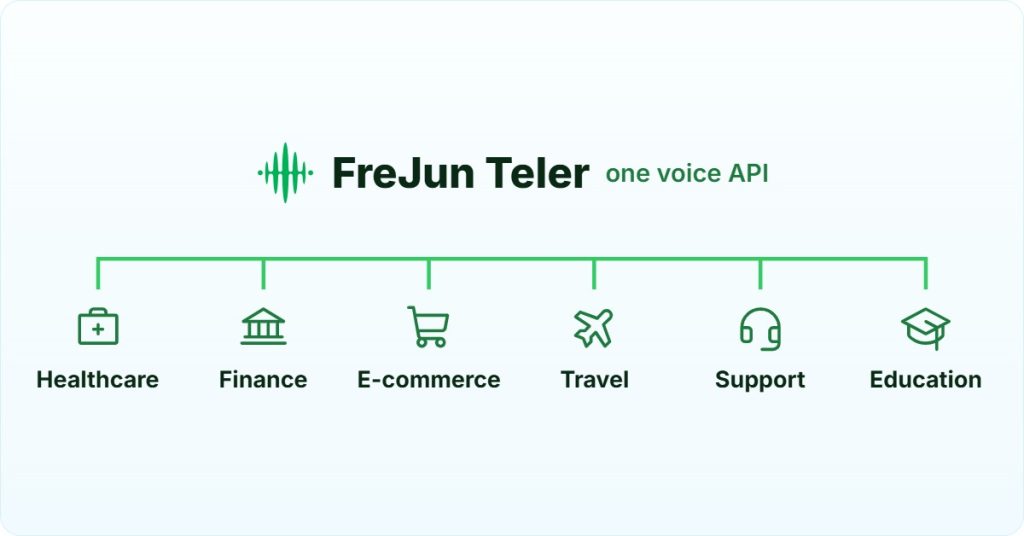
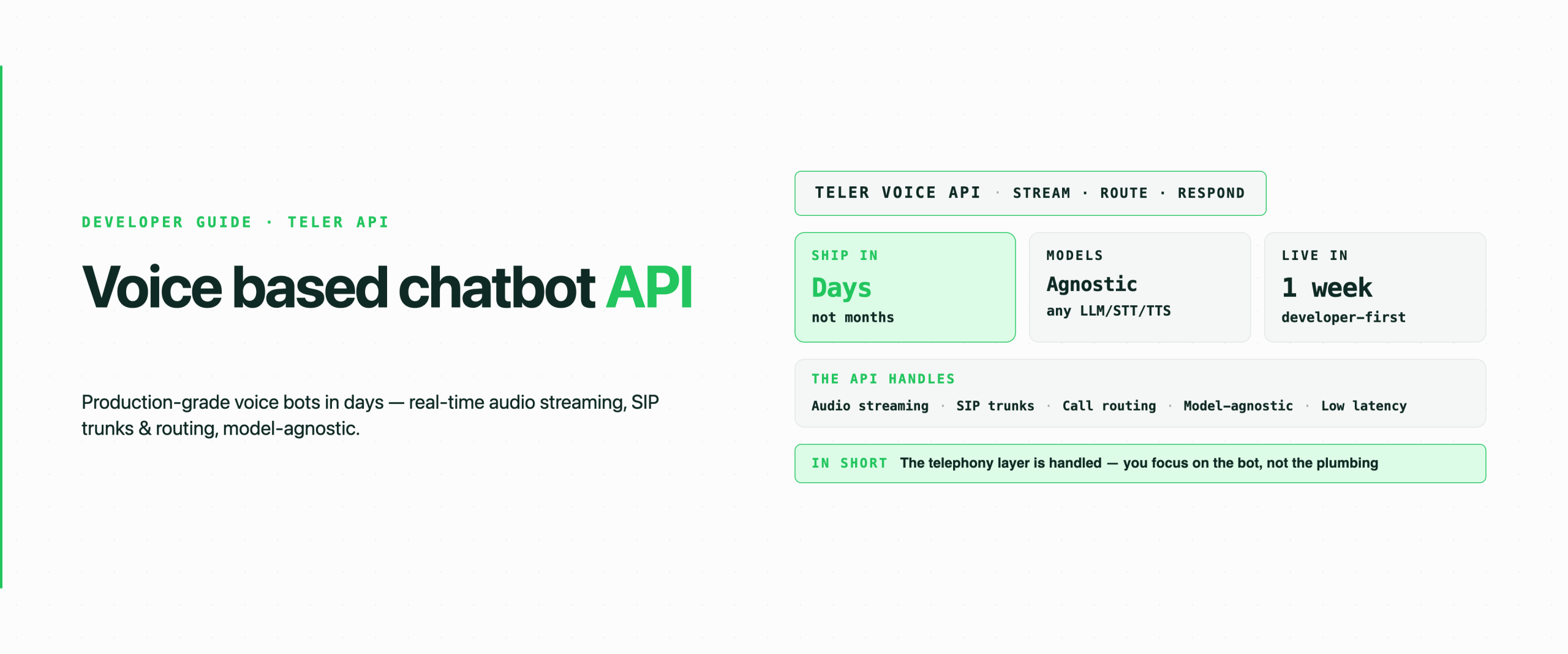
AI Summary: This guide is for developers, technical leads, and product engineers. It covers evaluating voice infrastructure APIs for building AI voice agents on real phone calls. FreJun Teler is a developer-first voice platform. It handles real-time telephony and audio streaming, SIP trunks, WebSocket audio, virtual numbers, and call lifecycle management. Your team focuses on AI logic. Teler handles the carrier infrastructure. Key decisions covered: when to build vs buy voice infrastructure, how to connect your STT, LLM, and TTS stack to a live call, and how FreJun Teler compares to building from scratch. Teams using Teler move from concept to a production-grade voice based chatbot in days, not months.
In 2025, building a voice-based chatbot isn’t a luxury, it’s a mission-critical strategy. But most teams hit a wall not because of weak AI, but because of poor voice infrastructure. From dropped calls to high latency, DIY setups crumble fast. FreJun AI solves this by giving you a developer-first platform that bridges your AI with the real-time voice layer. In this guide, we’ll show you how to go from raw AI to a fully functional voicebot, in minutes, not months, with FreJun.
Quick Answer: A voice based chatbot needs more than a good LLM, it needs reliable voice infrastructure to function on real phone calls. FreJun Teler is the developer-first API that handles the telephony layer: real-time audio streaming, SIP trunk management, virtual numbers, and call routing, so your STT, LLM, and TTS services connect to live inbound and outbound calls with low latency. Teams building on Teler skip 6-12 months of infrastructure work and go live in days.
What is Voice-based Chatbot?
A voice-based chatbot is an AI-driven agent that conducts real conversations over a live phone call, understanding what a caller says, processing it through an LLM, and responding with synthesised speech in real time.
Get API access in under 5 minutes. No hardware, no carrier contracts, no telephony expertise required. Just connect your STT, LLM, and TTS stack and your voice agent is live on a real phone call.
- What is a Voice Based Chatbot and Why Does the Infrastructure Matter?
- The Hidden Complexity: Why Most Voice AI Projects Fail Before They Start
- FreJun AI: The Infrastructure Layer for Your Intelligent Voice Agents
- Best Practices for Building a High-Performing Voice-Based Chatbot
- FreJun AI vs. Building from Scratch: A Clear Comparison
- How to Deploy Your Voice-Based Chatbot with FreJun AI in 3 Steps?
- Final Thoughts
- Frequently Asked Questions (FAQs)
What is a Voice Based Chatbot and Why Does the Infrastructure Matter?
A voice based chatbot is an AI agent that holds real spoken conversations over a live phone call, processing caller audio through a speech-to-text engine, reasoning with an LLM, and delivering a synthesised voice response in real time. Unlike text chatbots, it operates on the global telephone network, which requires a dedicated voice infrastructure layer to handle audio streaming, SIP connectivity, and call management before any AI logic runs.
The market has moved fast. The global voice AI agents market is projected to grow from $2.4 billion in 2024 to $47.5 billion by 2034, a 34.8% CAGR that reflects one simple reality: voice remains the dominant customer interaction channel, accounting for more than 68% of all customer service touchpoints globally. Businesses that automate it well gain a structural cost and availability advantage. Those that don’t are staffing a problem their competitors are solving with software.
Why is it Now Mission-Critical?
The use cases driving adoption are not experimental. AI voice agents are running production workloads today, handling inbound customer support, qualifying outbound sales leads, automating appointment scheduling, and running post-call surveys at scale. In 2025 alone, production voice agent deployments grew 340% year-over-year across 500+ organisations, and 67% of Fortune 500 companies are now running at least one production voice AI system. This is infrastructure, not experimentation.
The goal is clear: transform your AI logic into a voice agent that can understand, reason, and respond on a real phone call, inbound or outbound, 24/7, at scale. However, many ambitious teams stall not because their AI is weak, but because they dramatically underestimate the complexity of the infrastructure required to put that AI on the global telephone network. According to Gartner, over 40% of agentic AI projects will be cancelled by the end of 2027, with integration complexity cited as the primary cause, not the model itself. The AI is rarely the problem. The voice layer underneath it almost always is.
The Hidden Complexity: Why Most Voice AI Projects Fail Before They Start
Building an effective voice agent involves far more than just connecting a Large Language Model (LLM) to an API. The real challenge lies in the “plumbing”,the intricate, real-time voice infrastructure that is notoriously difficult to build and maintain.
This is the part most companies don’t see coming. It includes:
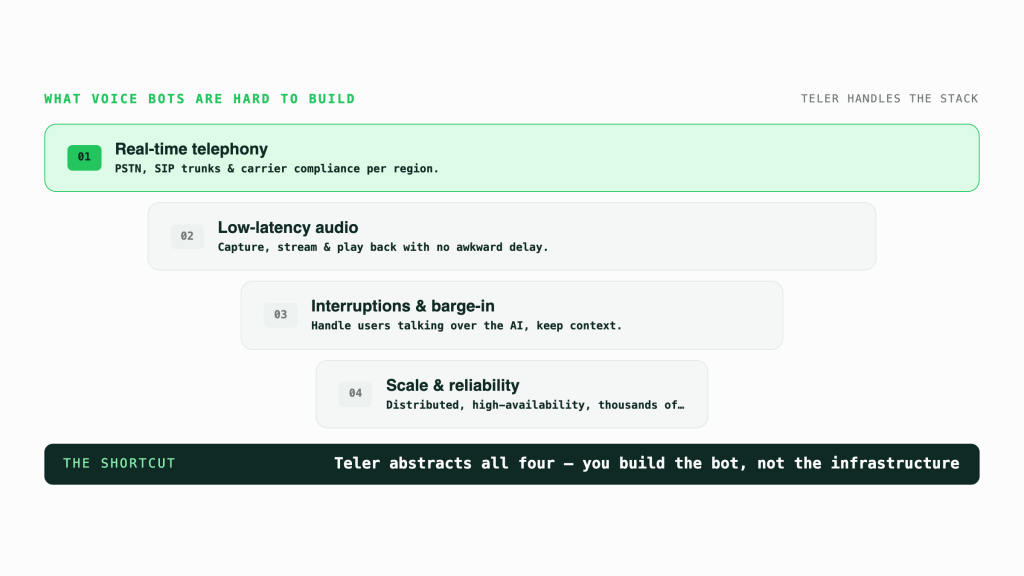
- Real-Time Telephony Integration: Managing PSTN (Public Switched Telephone Network) connections, handling SIP trunks, and ensuring carrier compliance across different regions.
- Low-Latency Audio Streaming: Capturing audio from a phone call, streaming it for processing, and playing back a response without the awkward, conversation-killing delays that frustrate users.
- Handling Interruptions and Barge-in: Architecting a system that can manage a user speaking over the AI’s response without dropping the connection or losing context.
- Infrastructure Scalability and Reliability: Building a geographically distributed, high-availability system that can handle thousands of concurrent calls without faltering.
Attempting to build this in-house is a massive resource drain. It diverts your best engineers from focusing on your core product,the AI itself,and forces them to become telephony experts. This is where most projects lose months of time and hundreds of thousands of dollars, only to end up with a brittle, high-latency solution.
FreJun AI: The Infrastructure Layer for Your Intelligent Voice Agents
FreJun AI was built to solve this exact problem. We handle the complex voice infrastructure so you can focus on what you do best: building your AI. We provide a robust, developer-first platform that acts as the essential voice transport layer. Our architecture is engineered from the ground up for speed and clarity, turning your text-based AI into a production-grade voice-based AI chatbot that can be deployed in days, not months.
It’s critical to understand what FreJun AI is,and what it is not:
- We do NOT provide the LLM, Speech-to-Text (STT), or Text-to-Speech (TTS) services.
- We DO provide the high-performance “plumbing” that connects your chosen STT, LLM, and TTS services to any inbound or outbound phone call.
FreJun is model-agnostic. You bring your own AI,whether it’s from OpenAI, Anthropic, Google, or a custom-built model,and we provide the seamless, low-latency bridge to the world of voice communication.
Also Read: Remote Team Communication Using Softphones for SMBs in India
Best Practices for Building a High-Performing Voice-Based Chatbot
With the Teler voice infrastructure handling the telephony layer, your team can focus entirely on what actually differentiates a great voice agent from a mediocre one, the conversation itself. The following best practices apply whether you are building an AI receptionist, an outbound qualification agent, or an automated support flow.
Design Intuitive and Human-Like Conversations
The quality of a voice based chatbot is ultimately measured by one thing: whether the person on the other end of the call feels heard and helped. That requires thoughtful conversation design that anticipates what users need, guides them toward a resolution, and handles the unexpected without breaking down. Research shows that 3 out of 5 customers have had a bad experience with an AI bot, and 68% say the reason was simply that the bot failed to understand their question. Conversation design, not model choice, is usually what separates the good deployments from the ones that get switched off after three weeks.
Map user journeys before writing a line of code
Sketch the potential paths a conversation can take, the happy path, the edge cases, and the moments where a user changes their mind mid-sentence. Design a logical flow that feels natural, but build in the flexibility to handle deviations. A voice agent that can only follow a script will fail the moment a caller goes off script. For a practical framework on mapping call flows, the FreJun Teler API docs cover how to structure call lifecycle events around your conversation logic.
Plan for fallbacks at every decision point
No AI is perfect. A critical part of conversation design is deciding what happens when the agent gets stuck, not if, but when. Build clear fallback paths: escalate to a human agent via intelligent call routing, offer to send a follow-up via SMS, or schedule a callback. A graceful fallback preserves trust. A dead end destroys it.
Guide the user with strategic prompts
Use concise, directed prompts that keep the conversation on track without feeling restrictive. Offer the user clear options where the path branches. This reduces cognitive load on the caller, shortens handle time, and prevents the dialogue from veering into territory your agent is not equipped to handle.
Maintain conversational context across turns
The ability to remember what was said earlier in the call and act on it is what separates a voice agent from an IVR. Your application needs to track context, intent, preferences, and history across turns so that responses stay relevant even when the user shifts topics or contradicts themselves. This state management lives in your backend; FreJun Teler maintains the persistent call connection that gives your application a stable channel to manage that dialogue state independently.
FreJun’s role here is to provide a stable, persistent connection for the call, giving your backend application a reliable channel to manage this dialogue state independently.
Choose Your AI & Leverage Machine Learning
Your AI is the brain of your operation. The flexibility to choose and refine your models is a significant competitive advantage.
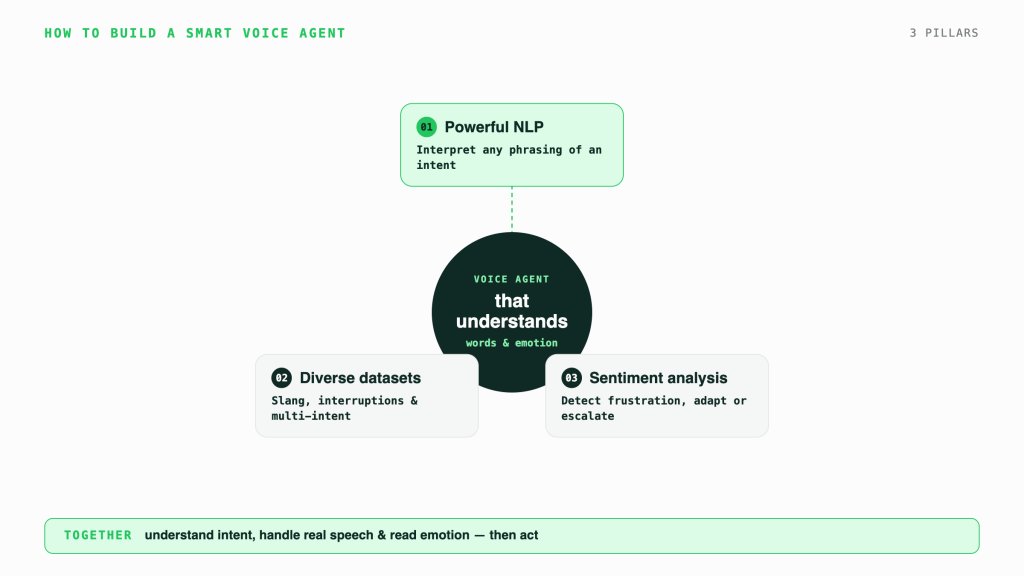
- Use Powerful NLP: Select AI and machine learning models with strong Natural Language Processing (NLP) to accurately interpret the wide variety of ways users can phrase a question or intent.
- Train on Diverse Datasets: To be truly effective, your AI must understand more than just formal language. Train your models on datasets that include slang, informalities, interruptions, and queries with multiple intents.
- Incorporate Sentiment Analysis: Advanced voice agents can detect user emotions like frustration or satisfaction. Using sentiment analysis allows your application to adapt its tone or escalate the call to a human agent when a user is becoming upset.
Because FreJun AI is model-agnostic, you maintain full control. You can connect to any AI chatbot or LLM, allowing you to choose the best technology for your specific use case without being locked into a proprietary ecosystem.
Engineer for Low-Latency and Natural Interaction
Nothing destroys the user experience more than awkward pauses and delays. The interaction must feel immediate and natural, just like a real human conversation.
- Deliver Quick Responses: The time between a user finishing their sentence and the AI beginning its response must be minimal. Any noticeable delay breaks the conversational flow and leads to frustration.
- Master Conversational Rhythm: A human-like interaction isn’t just about the words; it’s about the timing. Your system must balance speech speed and pausing to mimic a natural rhythm, avoiding a robotic, monotonous delivery.
- Handle Interruptions Gracefully: Users will often interject or change their minds mid-sentence. A sophisticated voice-based chatbot must be designed to handle these interruptions without faltering, recognizing when to stop speaking and listen.
- Support Multiple Languages and Accents: To serve a diverse user base, your chosen STT and TTS services must be able to accurately understand and reproduce various languages and accents.
This is where FreJun AI’s core architecture shines. Real-time media streaming is at the heart of our platform. Our entire stack is obsessively optimized to minimize latency at every step, ensuring your AI’s responses are delivered to the user with imperceptible delay.
Implement Robust Testing and Continuous Refinement
A voice agent is not a “set it and forget it” tool. It requires continuous monitoring and improvement to remain effective.
- Test Extensively: Before deployment, your agent must be tested against a wide range of variables, including different accents, speech patterns, levels of background noise, and languages.
- Monitor Live Interactions: Once live, use analytics and user feedback to find areas for improvement. This data is invaluable for refining your AI models and conversation flows.
- Identify and Fix Gaps: Look for patterns where the bot misunderstands users or provides inaccurate responses. Use these insights to address gaps in the AI’s training and logic.
FreJun provides the reliable, clear audio stream needed for accurate testing. Our developer-first SDKs make it easy to log interactions and pipe the necessary data back to your systems for analysis and model refinement.
Also Read: Virtual PBX Phone Systems Solutions for Businesses in Nigeria
FreJun AI vs. Building from Scratch: A Clear Comparison
Choosing the right foundation for your voice AI project can be the difference between launching in weeks and struggling for over a year. Here is a clear comparison of building the voice infrastructure yourself versus leveraging FreJun AI.
| Feature / Aspect | Building Infrastructure Manually | Using FreJun AI |
| Time to Deploy | 6-12+ months | Days to weeks |
| Developer Focus | Telephony, latency, carrier management, streaming protocols | AI logic, conversation design, business value |
| Latency Management | High. A constant, difficult engineering challenge. | Low. Optimized across the entire stack by default. |
| Initial Cost | Extremely high (dedicated engineering team, infrastructure) | Low (predictable subscription model) |
| Scalability & Reliability | Brittle, requires significant ongoing engineering to scale | Built on resilient, geo-distributed infrastructure for high availability |
| Maintenance Overhead | Massive and ongoing | Zero. Managed entirely by FreJun. |
| Key Differentiator | You are forced to become a telecom company. | You get to be an AI company. |
The choice is strategic. By offloading the complex infrastructure to FreJun, you free your team to focus on creating a truly intelligent and valuable conversational voice-based chatbot that directly impacts your business goals.
Most teams that evaluate Teler against building from scratch go live within the same week. Explore the API docs and run your first test call before your next sprint ends.
How to Deploy Your Voice-Based Chatbot with FreJun AI in 3 Steps?
Our platform is designed to get your AI talking as quickly and simply as possible. The process abstracts away all the complexity, allowing you to connect your services via our robust API and SDKs.

Step 1: Stream Voice Input
FreJun’s API captures real-time, low-latency audio from any inbound or outbound call. This raw audio stream is sent directly to your application, ensuring every word is captured clearly and without delay. You pipe this audio into your chosen Speech-to-Text (STT) service to get a transcript.
Step 2: Process with Your AI
Once you have the text transcript from your STT service, you send it to your AI model (e.g., GPT-4, Claude, or your own NLU). Your application maintains full control over the AI logic and dialogue state. FreJun acts as the reliable transport layer, maintaining the call connection while your AI processes the information and formulates a response.
Step 3: Generate Voice Response
You take the text response from your AI and pipe it into your chosen Text-to-Speech (TTS) service to generate response audio. This audio is then streamed back to FreJun’s API, which plays it back to the user over the call with minimal latency, completing the conversational loop seamlessly.
Ready to run through these three steps with a live call? Access the Teler sandbox, follow the quickstart guide, and have audio streaming to your AI in under an hour.
Final Thoughts
In the rush to capitalize on the AI revolution, it is easy to get distracted by the wrong problems. Building and maintaining global voice infrastructure is a monumental task that offers zero competitive advantage for most companies. It is a solved problem, but one that requires specialized expertise, significant capital investment, and constant maintenance.
Your true advantage lies in the intelligence of your AI, the quality of your data, and the ingenuity of your conversation design.
By choosing FreJun AI, you are making a strategic decision to bypass the infrastructure roadblock entirely. You are choosing to accelerate your time-to-market, reduce your development costs, and empower your engineers to work on features that directly create business value. Our platform provides the enterprise-grade security, reliability, and low-latency performance your mission-critical voice applications deserve, backed by dedicated support to ensure your success.
Don’t let your AI innovations get trapped behind a wall of telephony complexity. Let us handle the voice infrastructure, so you can focus on giving your AI its voice.
Further Reading: What Is a Call Routing System? Features, Examples, and Benefits
Frequently Asked Questions
What is the FreJun Teler API and how does it work?
FreJun Teler is a developer-first voice infrastructure API that connects your AI stack, STT, LLM, and TTS services to real inbound and outbound phone calls. It handles SIP trunk management, real-time audio streaming over WebSocket, and call lifecycle events, so your application receives raw audio from a live call, processes it with your chosen AI, and streams a voice response back, all with sub-second latency.
What is the difference between FreJun Teler and platforms like Twilio or Telnyx?
Twilio and Telnyx are full CPaaS platforms that bundle messaging, voice, and telephony management together. FreJun Teler is purpose-built for one thing: providing the voice transport layer for AI voice agents. It is model-agnostic, developer-first, and focused on the real-time audio streaming pipeline that connects your LLM to a phone call, without locking you into a proprietary AI or STT/TTS stack.
What latency can I expect when building a voice AI agent on Teler?
FreJun Teler’s infrastructure is optimized for low end-to-end latency across India, the UAE, APAC, and other supported regions. The platform is engineered to minimize the audio capture → STT → LLM → TTS → playback loop so that the AI’s response begins playing back to the caller within a perceptible window of natural conversation. For production benchmarks specific to your region, contact the Teler team during your integration onboarding.
What programming languages and SDKs does FreJun Teler support?
FreJun Teler provides SDKs and client libraries for the most common server-side environments used in AI development. Full SDK documentation, quickstart guides, and code samples are available at frejun.com/docs. The API is REST-based with WebSocket support for real-time audio streaming, making it compatible with any backend language or framework.
Does FreJun Teler support both inbound and outbound calls?
Yes. The Teler API supports both inbound call handling, where the platform receives a call on a virtual number and streams audio to your application, and outbound call initiation, where your application triggers a call to a phone number and the same real-time audio pipeline applies. Common outbound use cases include automated reminders, surveys, and AI-driven outreach campaigns.
Can I use FreJun Teler with OpenAI Realtime API or other real-time LLM providers?
Yes. Because FreJun Teler is model-agnostic, you can route the audio stream to any LLM provider that accepts real-time or streaming input, including OpenAI, Anthropic, Google, or a self-hosted model. Your application controls the AI logic entirely; Teler handles the call connection and audio transport layer.
Is there a sandbox or developer trial available for FreJun Teler?
Yes. FreJun Teler provides a developer sandbox environment so you can test the API, simulate inbound and outbound calls, and validate your STT/LLM/TTS integration before going live. Access the sandbox and developer credentials through the Teler developer portal.
What geographic regions and carriers does FreJun Teler support?
FreJun Teler supports voice connectivity across India, UAE, APAC, North America, and Europe, with virtual numbers available across these regions. SIP trunk support allows you to connect existing carrier infrastructure where needed. For specific country coverage, number availability, or compliance requirements in your target region, the Teler team can provide a pre-integration assessment.
You have just seen how FreJun Teler solves every layer of voice infrastructure your team would otherwise spend months building, from SIP trunk management and real-time audio streaming to call routing, virtual numbers, and WebSocket-based media delivery. The gap between reading about it and running a live voice agent on a real phone call is usually just one API connection. Most teams that get Teler API access are streaming audio to their LLM and handling live calls within a week.
Where can developers find proven patterns for chatbot voice assistant design?
Developers refining their chatbot’s conversational flow can explore a practical guide covering voicebot conversation design patterns for production-grade assistants.