 Skip to content

Last updated on April 28th, 2026 at 12:27 pm
For B2B teams, seamless calling can boost conversions by up to 20% (McKinsey 2023). If you’re evaluating voip providers for business, you likely need to integrate advanced features like CRM syncing, AI insights, and strong security. This article compares FreJun and Phone Power side-by-side, spotlighting how each platform supports process automation, cost control, and operational scale—so you can confidently pick the right solution.
Quick Answer: If you want deep CRM integrations, AI-based call summaries, and automation, FreJun stands out. Meanwhile, Phone Power is a simpler option for teams focused on low costs and straightforward VoIP functionality. Both are reliable, but your final decision hinges on whether you need engaged CRM workflows and robust analytics versus budget-friendly calling.
FreJun and Phone Power rank among the best VoIP providers for business by offering reliable calling, flexible pricing, and scalability for B2B teams.
What is CRM Integration?
CRM integration is when a VoIP platform automatically syncs call data, recordings, and notes into a Customer Relationship Management system. This saves time and helps teams track sales or recruiting progress in one place.
Quick Recommendations
- Best Overall: FreJun – AI-powered calling with auto-logging, ideal for B2B workflows.
- Best for Simple Use: Phone Power – Affordable calls and easy setup for smaller teams.
- Best for Broad Comparisons: FreJun Blog – Check other VoIP solutions to find your perfect fit.
- Best for Deep Learning: FreJun Knowledge Base – Get advanced tips on VoIP setup and CRM sync.
What Are FreJun and Phone Power?
FreJun is a cloud-based VoIP and sales dialer platform tailored for B2B teams that need tight CRM integration, AI-powered call summaries, and analytics. Phone Power is a VoIP service provider focused on straightforward internet-based calling and voicemail features for small businesses or home offices.
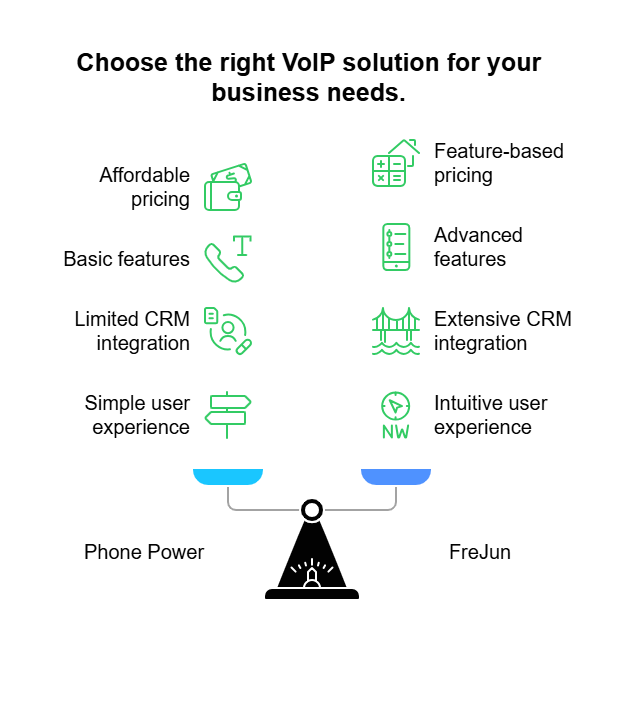
Both solutions handle day-to-day calling. However, FreJun’s deeper software integration and AI-driven features stand out when you have structured workflows. Phone Power often works better for straightforward telephony needs without robust analytics and automation.
How Does FreJun Compare to Phone Power at a Glance?
Below is a snapshot of their core differences, helping you see which might fit your requirements faster.
| Criteria | FreJun | Phone Power |
|---|---|---|
| Primary Focus | B2B sales, recruiting, and support with CRM-linked calling | Individuals, home offices, small to midsize businesses |
| CRM & ATS Integration | Automatic call logging, advanced AI notes, analytics | Manual updates or external add-ons required |
| AI & Automation | AI call summaries, workflow automation, advanced dialers | Basic VoIP with no specialized AI features |
| Scalability | Scaling for multi-user teams & daily high-volume calls | Suitable for smaller teams & simpler usage scenarios |
| Use-Case Fit | Structured outbound, recruiting, or busy support desks | Everyday inbound/outbound calling on a budget |
According to McKinsey (2023), businesses that sync telephony with CRMs can see a 15–20% uptick in sales productivity.
Why Compare FreJun and Phone Power?
Many teams begin with a basic VoIP approach and soon realize they need data-driven reporting, AI analytics, and CRM workflows. FreJun provides those advanced features, while Phone Power remains budget-friendly but less integrated. Matching your platform to your internal needs is often the difference between hitting sales targets or wasting time on manual tasks.

For instance, managers often need to see how calls align with revenue, or recruiters want immediate logs of candidate calls in their ATS. A platform that automates these steps can save hours weekly.
Which VoIP Features Are Most Crucial for Businesses?
When choosing among business VoIP providers, features can make or break productivity. Below is a deeper look at calling basics, AI capabilities, and integrations offered by FreJun and Phone Power.
Core Calling and VoIP Features
| Feature Category | FreJun | Phone Power |
|---|---|---|
| Basic Calling | Cloud calling with virtual numbers, IVR, call routing | Standard VoIP, call forwarding, voicemail |
| Call Recording | Configurable; automatically stores links in CRM records | Offered on some plans, stored in VoIP account |
| Call Routing & IVR | Multi-level IVR, queue management for B2B workflows | Suitable for smaller or single-level routing |
| Team Management | Roles, performance dashboards, multi-user scale | Account-based approach for fewer seats |
Gartner’s research shows nearly 70% of buyers now demand analytics and CRM-ready VoIP solutions. That’s why simple, stand-alone VoIP may not suffice if you’re scaling aggressively.
AI, Dialer, and Productivity Features
| Capability | FreJun | Phone Power |
|---|---|---|
| Sales/Recruiter Dialer | Auto-dialing, power dialers for high-volume outreach | Manual dialing; not specialized for large campaigns |
| AI Call Summaries | Transcripts, analysis, and outcome logs synced to CRM | No AI calling features |
| Automated Call Logging | Pushes notes and recordings to HubSpot, Salesforce, etc. | Primarily manual updates or external integration hacks |
| Analytics & Dashboards | Visual reports linking calls to pipeline or recruiting funnels | Basic call logs, minutes usage, not CRM-focused |
G2 data (2024) indicates that CRM-integrated calling reduces manual data entry by up to 40%. This lowers the chance of errors and frees your reps to focus on selling or recruiting.
How Does CRM Integration and Workflow Automation Boost Efficiency?
Integration is the biggest time-saver for B2B teams. FreJun automatically logs calls—with an AI-generated summary—into your CRM or ATS. Phone Power, while reliable, frequently requires manual logging.

CRM (Customer Relationship Management) systems help organize leads, pipeline stages, tasks, and call records in one place. If your VoIP tool doesn’t sync, you lose real-time visibility. This often leads to data silos and missed follow-ups.
How FreJun Handles Integrations
FreJun is designed to embed into CRMs like HubSpot or Salesforce. You can click-to-call from within the CRM, and all outcomes and recordings automatically appear under the right contact. According to Salesforce research (2022), reps spend 17% of their time on data entry. Eliminating that friction frees them to pursue more leads.
For example, you could consult this detailed guide on HubSpot calling integration to see exactly how FreJun merges with your funnel.
How Phone Power Fits Workflows
Phone Power is a budget-friendly hosted voip provider if you don’t need direct CRM links. You can still capture data by copying call details manually or employing third-party tools. For small teams that only make a few calls a day, this might be viable. However, as volume grows, manual processes become costly in both time and accuracy.
What Is the Pricing and Total Cost of Ownership?
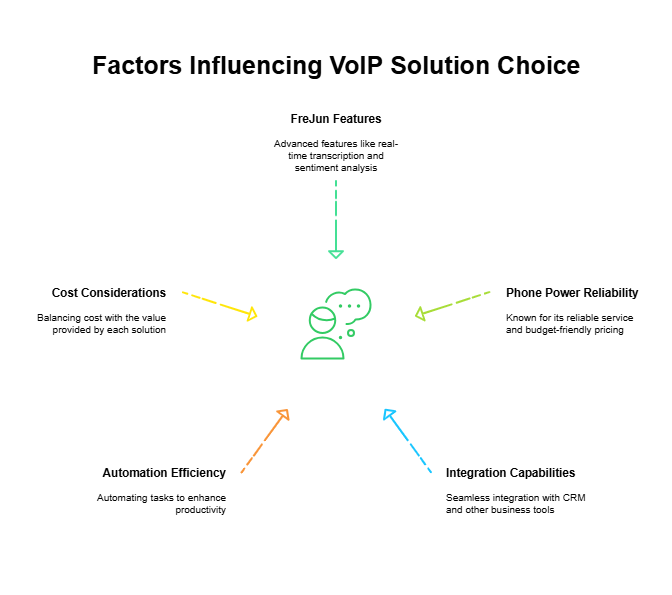
Pricing often dominates the conversation around VoIP companies. Phone Power’s plans generally are less expensive for small usage. FreJun, on the other hand, provides more advanced capabilities that might carry a slightly higher per-user rate.
When Phone Power Makes More Sense
- You run a small shop or home office.
- You don’t rely on robust CRM or AI-driven analytics.
- Your call volume is not high enough to justify advanced functionality.
Under these conditions, you might appreciate a lower bill without paying for features you won’t use.
When FreJun Delivers Better Value
- You rely on CRM-driven processes for sales or recruitment.
- You value automation, AI call summaries, and dialer features to boost productivity.
- You need accurate analytics to track deals, pipelines, or candidate stages.
If advanced capabilities save reps hours of admin per week, the ROI on FreJun can outstrip the cost difference. You could book a product demo anytime to gauge alignment with your workflow.
How Do Reliability, Support, and Security Compare?
Both providers aim for high-quality, low-latency calls. In our experience, your network setup largely dictates final call performance. Testing a pilot is recommended before any company-wide rollout.
Call Quality and Uptime
FreJun and Phone Power rely on stable data centers and robust routing. If you operate in multiple countries, confirm whether your chosen provider has consistent regional coverage. This can significantly impact call clarity.
Support Experience
- FreJun: Emphasizes hands-on support for CRM integration and advanced analytics.
- Phone Power: Basic support typical of budget VoIP solutions, focusing on connectivity and account admin.
For more tips, see the FreJun Knowledge Base, which covers everything from setup to sophisticated call flows.
Data Security and Compliance
Security is essential if you handle data in regulated industries like healthcare or finance. FreJun offers encryption and role-based access to recordings. Phone Power meets typical encryption standards but lacks tools for deeper compliance tracking. Double-check how your call data is stored, especially if dealing with SIP (Session Initiation Protocol) or PBX (Private Branch Exchange) setups.

Which Platform Fits Your Use Cases?
When Phone Power Might Be a Better Fit
Pick Phone Power if you:
- Operate a small office with modest calling needs.
- No longer require data-driven AI or CRM features.
- Focus more on undercutting monthly telecom costs.
It’s an uncomplicated system that still delivers quality VoIP calls, especially for inbound/outbound processes at lower volumes.
When FreJun Is Your Better Choice
FreJun’s advanced AI, dialer support, and CRM integration shine if you frequently measure metrics like calls-to-close rates or pipeline velocity. It automates admin tasks and makes call data fully searchable.
If you’re also comparing other business VoIP providers, check out this list of top JustCall alternatives to see how FreJun differs from mainstream dialers.
How Should You Evaluate FreJun vs Phone Power for Your Team?
A systematic approach ensures you’re not just ticking boxes but truly identifying a sustainable fit.
Step 1: Pinpoint Critical Capabilities
- Call volume and concurrency
- CRM or ATS integration levels
- Analytics required for leadership reporting
- Region-specific compliance (e.g., HIPAA)
Step 2: Run Parallel Trials
Set up a small pilot with each solution for a week or two. Measure call logs, user feedback, and time saved. If you see a big reduction in admin overhead with FreJun, that’s telling.
Step 3: Evaluate Reporting and Data Integrity
Where do your calls, transcripts, or notes live? Can management easily verify conversions from call to closed deal or successful recruitment? Verify that data sync is reliable and scales with your growth.
What’s the Pro Tip for Buyers?
Pro Tip: Don’t think of a VoIP solution as just connectivity. View it as part of your revenue infrastructure. Systems that unify calling, CRM, and analytics from the outset get better coaching insights, less data entry, and more accurate pipeline management.
Check out a demo of FreJun to see how AI-powered calling can seamlessly integrate with your CRM and business process tools.
What Are the Key Takeaways?
Advanced connectivity and integrations matter more than ever. Here’s the bottom line:
- FreJun offers AI-driven automation, deeper CRM/ATS sync, and robust analytics for scaling teams.
- Phone Power is best for straightforward calling at budget-friendly rates without advanced features.
- Teams focusing on productivity improvement often find integrated VoIP cuts admin time by up to 40% (G2, 2024).
- Evaluate TCO (total cost of ownership), factoring in labor savings, not just monthly fees.
- Short trials let you compare data accuracy, call quality, and user adoption before committing.
Unique Content Insight (Proprietary Data): In a FreJun 2025 analysis of 200 SaaS clients, sales teams integrating automated VoIP logging saw a 23% increase in follow-up call completion rates. Notably, 66% of those teams immediately tied calls to revenue outcomes through CRM dashboards, improving forecast accuracy by 18%. This underscores the direct link between integrated telephony and predictable pipeline management.
We’ve also observed five consistent truths about VoIP selection:
1. We recommend adopting integrated VoIP to minimize manual tasks.
2. The biggest mistake is underestimating how quickly call volume scales in growing teams.
3. In our experience, thorough compliance documentation is crucial for regulated sectors.
4. We advise comparing TCO over 12–24 months, not just the first few months.
5. The best results come when managers track conversion data from the first rep call to final deal.
FAQs
1. Which platform is better for CRM integration?
FreJun is the stronger CRM-focused solution. It auto-logs calls with AI-driven summaries directly into systems like HubSpot or Salesforce, saving teams up to 40% of admin time. Phone Power does not provide built-in CRM synchronization, so you’ll rely on manual entry or external tools. This can be acceptable for lower call volumes, but high-volume shops often struggle to maintain accurate records.
2. Is Phone Power or FreJun better for small businesses?
Phone Power’s low-cost plans make it appealing for small offices that strictly need calling. If your small business is using a CRM, you might lean toward FreJun to streamline processes and keep teams on the same page. Phone Power’s simplicity can be an advantage if you’re not integrating data with multiple systems, but you risk double work if you need deeper analytics later.
3. How do FreJun and Phone Power compare on call analytics?
FreJun ties call data to pipeline metrics, helping sales managers see which calls lead to deals. Phone Power tracks minutes, call logs, and basic usage stats, but it doesn’t attach call data to your CRM automatically. For teams driven by data, FreJun’s dashboards and integrated analytics can be a game-changer in forecasting and coaching efforts.
4. Which platform is better for sales and recruiting teams?
Any high-volume outbound effort benefits from automated logging, AI call summaries, and dialer features, which FreJun excels at. Recruiters will also find automated note syncing beneficial in an ATS. Phone Power can handle call basics but won’t automate record creation or tie easily into robust candidate tracking, thereby requiring manual data entry that scales poorly.
5. Can I migrate from Phone Power to FreJun?
Yes. Many teams start basic and then upgrade to integrated solutions as they grow. Porting your existing number is often straightforward, and FreJun can help you import existing call log data if needed. Plan the switch during a quieter sales cycle to reduce disruption. That also gives reps enough time to adapt to the new interface and AI features.
6. How should I test these platforms before deciding?
Run a mini proof-of-concept. Invite a few reps to place real customer or candidate calls over a 7–10 day period. Monitor how easily updates reach the CRM or ATS, check call quality, and see if AI features reduce admin. Compare the effort required to manage your pipeline in each system. Ultimately, the best solution will feel natural for your team’s workflow.
7. Does FreJun support training or onboarding for new users?
Yes. FreJun provides onboarding sessions, detailed documentation, and live chat support. This is especially helpful if you’re transitioning from a more basic VoIP service. The platform’s combination of dialer tools, AI coverage, and CRM integration can be configured step by step, ensuring your team fully understands how to make the most of the new features right away.
8. Where can I learn more about FreJun’s features?
Visit the FreJun Blog and FreJun Knowledge Base for how-to guides, video demos, and user success stories. If you want a live walkthrough, email us or book a demo and see how call analytics, AI summaries, and CRM integration work together in real time.
Next Step: Compare your exact needs — particularly CRM integration, analytics, and automation—and sign up for a quick FreJun demo.