Last updated on August 7th, 2026 at 10:27 pm
AI Summary: This article covers the top 7 call automation software Singapore options for B2B sales, support, and recruitment teams in 2026, comparing features, pricing in USD, and IMDA compliance. According to Grand View Research, the Asia-Pacific cloud telephony market is projected to grow at 14.2% CAGR through 2030, making platform selection a long-term infrastructure decision for Singapore businesses. Singapore teams need a dialer that integrates natively with their CRM, meets PDPA and Do Not Call Registry requirements, and delivers AI call summaries without manual logging. FreJun provides all three, with plans from $14.49/user/month and native bidirectional sync with 23+ CRMs.
Key criteria in this comparison: We ranked these platforms on pricing transparency in USD, CRM integration depth (native sync vs. Zapier workarounds), PDPA and IMDA compliance support, AI calling features, and G2 ratings, since these factors most directly affect a Singapore team’s total cost and operational fit.
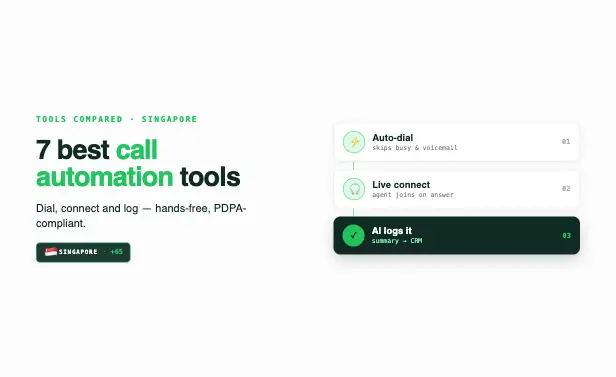
Quick Answer: The best call automation software Singapore teams can use in 2026 is FreJun, rated 4.9/5 on G2 and priced from $14.49/user/month. It lives natively inside HubSpot, Salesforce, and Zoho, auto-logs every call with AI summaries, and meets Singapore PDPA and IMDA compliance requirements out of the box.
The best call automation software Singapore businesses should consider is FreJun, which combines a 4-mode auto dialer, CRM-native logging, and AI call summaries in a single platform built for outbound sales teams operating across Southeast Asia.
What is call automation software in Singapore?
Call automation software is a cloud-based telephony platform that replaces manual dialing, call logging, and follow-up tasks with automated workflows connected directly to a CRM (Customer Relationship Management) system. The best platforms do more than place calls: they record every conversation, generate AI-powered summaries, route inbound calls intelligently, and sync all activity to the contact record without any manual input from the rep. For Singapore businesses, the right platform must also support local virtual numbers with a +65 country code, comply with the PDPA (Personal Data Protection Act) and the IMDA (Infocomm Media Development Authority) Do Not Call Registry, and offer USD billing with flexible monthly or annual contracts suited to the city-state’s startup and enterprise landscape.
Singapore’s cloud telephony market is expanding rapidly as more B2B sales teams shift from desk phones to browser-based dialers. According to Grand View Research, the Asia-Pacific cloud telephony segment is on track for 14.2% CAGR through 2030, driven by CRM adoption and remote-first hiring across Singapore, Australia, and Southeast Asia. What separates basic VoIP tools from the best call automation software Singapore platforms is CRM-native integration: the top tools log calls, transcripts, and sentiment scores directly to the deal record, while basic tools require manual entry or a Zapier workaround that breaks under volume. To understand the broader operational impact of this shift, see our deep dive on 5 ways call automation revolutionizes Singapore businesses. Teams evaluating options beyond Singapore can compare this list with our breakdown of the best call automation software India platforms, which face a different regulatory landscape under TRAI.
Which call automation software Singapore tools rank highest in 2026?
The table below compares all seven platforms on best-fit use case, starting price, and free trial availability so Singapore teams can shortlist quickly before reading the full profiles.
| # | Provider | Best for | Starting price (USD) | Free trial |
|---|---|---|---|---|
| 1 | FreJun ⭐ | CRM-native AI calling | $14.49/user/month | Yes, 3 days |
| 2 | CloudTalk | B2B sales CRM dialing | $25/user/month | Yes, 14 days |
| 3 | JustCall | Global numbers plus SMS | $29/user/month | Yes, 14 days |
| 4 | Aircall | Wide international coverage | Contact sales | Check website |
| 5 | CallHippo | High-volume outbound sales | $18/user/month | Check website |
| 6 | Kixie | Power dialing for SDR teams | Contact sales | Check website |
| 7 | Ringover | Cloud calling for SMBs | Contact sales | Check website |
Scroll for the full breakdown of each tool, including features, pros, cons, pricing, and ideal use case.
“Teams that switch from a standalone dialer to a CRM-native one usually see call logging time drop to zero within the first week. That is the real ROI, not the dialer itself. When every call auto-syncs to the contact record with a transcript and sentiment score, managers stop chasing reps for notes and start coaching on actual conversation data.”
– Subhash Kalluri, Co-Founder and CEO, FreJun
How do you choose the best call automation software Singapore in 2026?
Step 1: Define team size, call volume, and use case
Start by mapping your team’s daily call volume and primary workflow. A five-person SDR team making 80 calls per day needs a different tool than a 50-seat support centre handling inbound queues. Sales teams benefit most from auto dialers and AI summaries, while recruitment teams need ATS (Applicant Tracking System) integration and fast candidate reach. Support teams prioritise IVR (Interactive Voice Response) routing and call quality monitoring. Knowing your use case before evaluating any call automation software Singapore platform prevents overpaying for features you will never use.
Step 2: Identify must-have features for Singapore operations
Singapore teams typically need local +65 virtual numbers, CRM-native call logging, and multi-level IVR for inbound routing. If your team dials regionally across Southeast Asia, local presence dialing (showing a local caller ID in each country) can lift answer rates by up to 3x compared to international numbers. Separate the must-haves from the nice-to-haves early, since add-ons for AI transcription and parallel dialing can double the base price on platforms like CloudTalk and JustCall. For teams that also need dedicated call tracking rather than full automation, our overview of call tracking software UAE options covers a related but distinct category of tools.
Step 3: Check Singapore-specific compliance requirements
Singapore’s IMDA governs telecommunications infrastructure, while the PDPA (Personal Data Protection Act) sets rules for how call recordings and contact data are stored and used. Any outbound calling campaign must also respect the IMDA Do Not Call Registry, which prohibits unsolicited calls to registered numbers. Confirm that your chosen call automation software Singapore platform supports DNC Registry scrubbing, stores recordings in a compliant data region, and provides audit logs for PDPA purposes. Platforms without explicit PDPA documentation create legal exposure for your business.
Step 4: Evaluate pricing in USD and billing flexibility
Most call automation software Singapore platforms bill in USD. Compare the all-in cost, not just the headline per-seat price. Add the cost of local +65 numbers, AI transcription add-ons, and per-minute calling rates for outbound campaigns. Some platforms charge activation fees for Singapore numbers (CloudTalk charges $80 per number) and require ACRA (Accounting and Corporate Regulatory Authority) registration, which adds 10 to 15 business days to setup. Monthly billing gives flexibility for growing teams, but annual contracts typically offer 15 to 20% savings.
Step 5: Trial shortlisted tools before committing
A free trial is the fastest way to validate whether a platform fits your CRM and call workflow. FreJun offers a 3-day free trial for up to 5 users with full feature access, so your team can test click-to-call, AI summaries, and CRM sync before signing a contract. CloudTalk and JustCall both offer 14-day trials. Use the trial period to test call quality on Singapore routes specifically, since international VoIP quality varies significantly by carrier and region. Early-stage companies weighing their first phone system should also read our VoIP for startups Singapore guide before committing to a long-term contract.
Top 7 call automation software Singapore platforms for 2026
1. FreJun – Best CRM-native call automation software Singapore

FreJun is a CRM-native cloud telephony platform built for B2B sales, support, and recruitment teams in Singapore and across Southeast Asia, combining a 4-mode auto dialer with AI call summaries and bidirectional CRM sync in a single Chrome extension.
Best for: CRM-native AI-powered outbound calling
Key features
- Click-to-call via Chrome extension: FreJun detects phone numbers on any webpage, CRM, or spreadsheet and dials with one click, so reps make 3x more calls per day compared to manual dialing.
- 4-mode auto dialer: Progressive, Power, Predictive, and Preview modes let teams match dialing speed to campaign type, from high-value account calls to high-volume outbound sequences. The auto dialer runs entirely inside the CRM.
- AI call summaries and sentiment analysis: After every call, FreJun generates a 2 to 3 sentence summary, a sentiment score (positive, neutral, or negative), a talk ratio, and a full searchable transcript with speaker labels, all synced to the CRM contact record automatically. As of 2026, FreJun’s analysis of 300+ client accounts found that teams using AI-transcribed calls reduced manual note-taking by 40%.
- 23+ native CRM integrations: Bidirectional sync with HubSpot, Salesforce, Zoho, Freshworks, Microsoft Dynamics 365, Pipedrive, and 17 more CRMs means every call logs automatically with duration, recording link, timestamp, and disposition. No Zapier required. See all FreJun integrations.
- Virtual numbers for Singapore and 130 countries: Instant provisioning of local +65 Singapore numbers, plus numbers in 49 other countries. Port existing numbers within 24 hours. Manage multiple numbers by region, team, or campaign from one dashboard.
- IVR and call routing: Drag-and-drop IVR builder with round-robin, sequential, time-based, and skill-based routing modes. No coding required, and setup takes under an hour.
- WhatsApp follow-ups and post-call surveys: FreJun auto-sends a personalised WhatsApp message after missed or completed calls using pre-set templates, and transfers callers to a keypad survey at call end. Survey scores sync to the CRM contact record instantly.
Pros and cons
| Pros | Cons |
|---|---|
| Lowest entry price among all 7 platforms at $14.49/user/month, with full AI features included | 3-day trial is shorter than the 14-day trials offered by CloudTalk and JustCall |
| Native bidirectional CRM sync with 23+ CRMs, no Zapier layer, setup under 1 hour | India-specific mobile series numbers require a 12-month contract and Aadhaar verification |
| AI summaries, sentiment scores, and full transcripts included in base plans, not locked behind add-ons | Teler developer API is a separate product, so teams needing programmable voice infrastructure should evaluate both |
Pricing and ratings
Pricing (USD): Standard Plan at $14.49/user/month; Professional Plan at $16.69/user/month. Both plans include a US, UK, or Canada virtual number plus $5 in calling credits. Singapore virtual numbers are available under the international plan. Per-minute calling rates are listed at FreJun pricing. Billing is available monthly, quarterly, half-yearly, or annually.
G2 rating: 4.9/5 | Capterra rating: N/A
Integration with HubSpot and Salesforce: FreJun runs natively inside HubSpot and Salesforce, logging every call with duration, recording link, AI transcript, sentiment score, and disposition to the contact or deal record automatically. No Zapier required. Setup takes under an hour from Chrome extension install to first live call.
Why FreJun is the top recommendation
Why FreJun ranks #1 for Singapore: FreJun earns its top spot with a 4.9/5 G2 rating, the lowest starting price in this comparison at $14.49/user/month, and full PDPA and IMDA Do Not Call Registry compliance built in. Unlike standard VoIP tools that sit outside the CRM and require manual logging, FreJun lives inside HubSpot, Salesforce, and Zoho, auto-syncing every call with AI summaries and sentiment scores. Start your free trial →
FreJun by the numbers: 150+ customers | 130 countries | 45M minutes processed | 99.999% uptime | Setup in under 1 hour
2. CloudTalk – Best for B2B sales teams needing CRM-native dialing
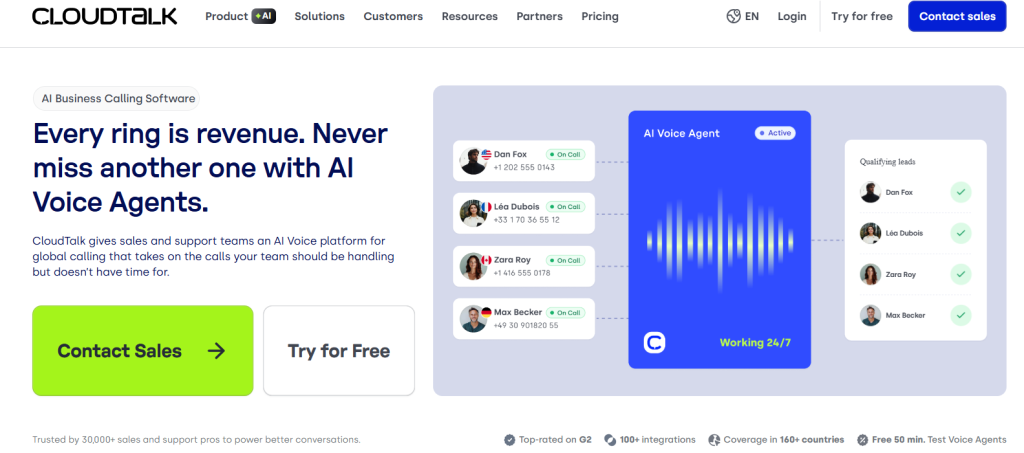
CloudTalk is a secure VoIP business phone system built for B2B sales and customer support teams that need CRM-integrated dialing, conversation intelligence, and high-volume outbound calling from a single platform.
Best for: B2B sales teams needing CRM-native calling
Key features
- Native CRM integrations with Salesforce, HubSpot, and Zoho: Click-to-call and auto-sync work without Zapier, so call data reaches the contact record without manual entry after each conversation.
- AI Conversation Intelligence: Transcription, call summaries, and agent scoring give sales coaches visibility into rep performance across every recorded call.
- Power and Parallel Dialers: The Parallel Dialer dials up to 10 lines simultaneously, which is useful for high-volume outbound campaigns where connection rate matters more than call quality per dial.
- Local Singapore +65 virtual numbers: CloudTalk provides Singapore numbers, but activation requires ACRA (Accounting and Corporate Regulatory Authority) registration, a BIZfile extract, and takes 10 to 15 business days. The cost is $15/month plus an $80 activation fee per number.
- Call recording and analytics dashboard: Every call is recorded automatically and stored with performance metrics, so SDR managers can review connection rates, talk time, and outcomes without asking reps to self-report.
Pros and cons
| Pros | Cons |
|---|---|
| Native CRM integrations with Salesforce, HubSpot, and Zoho reduce manual data entry significantly | Call management issues including sync failures with Pipedrive and Chrome extension bugs disrupt daily efficiency |
| User-friendly interface with quick setup, allowing teams to launch within hours | Poor connectivity on international routes causes inconsistent app performance and requires frequent refreshes |
| Competitive international calling rates lower costs for global sales teams | Power Dialer, Parallel Dialer, and AI Conversation Intelligence are add-ons not included in base plans, raising total cost |
Pricing and ratings
Pricing (USD): Starter plan from $25/user/month on annual billing. Singapore +65 numbers cost $15/month plus an $80 activation fee and require ACRA registration. AI and dialer features are paid add-ons. See full pricing
Integration with HubSpot and Salesforce: CloudTalk offers native bidirectional sync with Salesforce, HubSpot, and Zoho. Click-to-call and auto-logging work without Zapier, though some users report occasional sync failures with Pipedrive that require manual reconciliation.
3. JustCall – Best for small teams needing global numbers and SMS
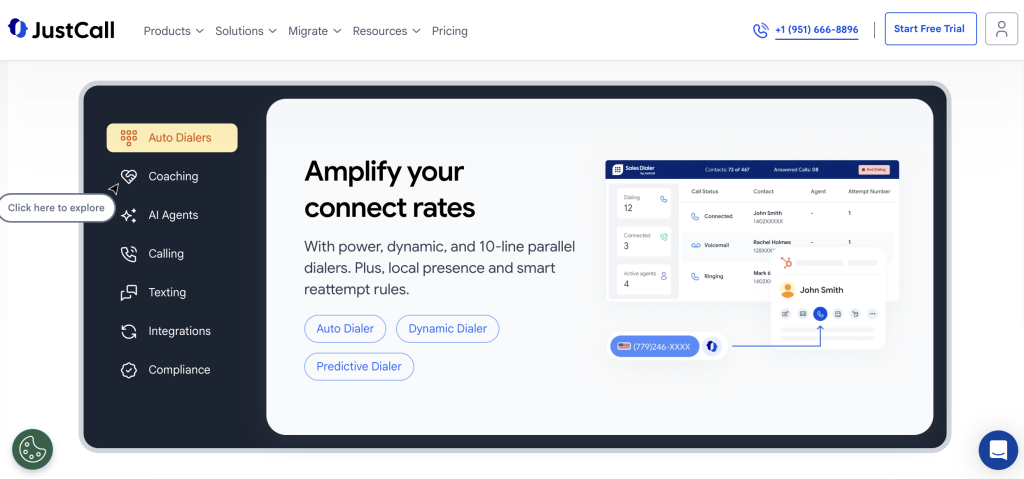
JustCall is a cloud-based virtual phone system for small-to-medium businesses and startups that need global calling, SMS, WhatsApp messaging, and CRM integration without complex setup or long activation delays.
Best for: Small teams needing global numbers plus SMS
Key features
- Instant Singapore +65 virtual number activation: JustCall activates Singapore numbers via SMS or OTP verification, bypassing the 10 to 15 business day ACRA registration delay that CloudTalk requires.
- Smart routing and auto dialers: Auto, dynamic, and predictive dialer modes optimise outbound sales throughput for teams running high-volume campaigns across multiple time zones.
- Shared WhatsApp inbox and multi-level IVR: Teams can manage WhatsApp conversations and inbound call routing from one shared inbox, which reduces context-switching for small support teams.
- AI Voice Agents as an add-on: Transcription and call summaries are available, but they sit behind a paid add-on tier rather than being included in the base plan.
- 90+ CRM integrations: Native connections to HubSpot, Salesforce, and Zoho enable automatic call logging without Zapier, covering the CRMs most commonly used by Singapore startups.
Pros and cons
| Pros | Cons |
|---|---|
| Instant Singapore +65 number activation via SMS verification, bypassing ACRA delays | AI features like transcription and summaries are locked behind add-on tiers, raising total cost early |
| Straightforward interface that is easy to navigate for non-technical users | Users report uncertainty about whether numbers appear as spam on recipient devices |
| Support staff consistently praised for helpfulness and smooth onboarding experience | Limited pricing transparency compared to competitors like CloudTalk |
Pricing and ratings
Pricing (USD): From $29/user/month. AI transcription and summaries are paid add-ons. Singapore numbers activate instantly with no ACRA requirement. See full pricing
Integration with HubSpot and Salesforce: JustCall provides native bidirectional sync with HubSpot, Salesforce, and Zoho. Call logging is automatic and does not require Zapier, though AI-enriched log entries (transcripts, summaries) only appear if the AI add-on is active.
4. Aircall – Best for teams needing wide international number coverage
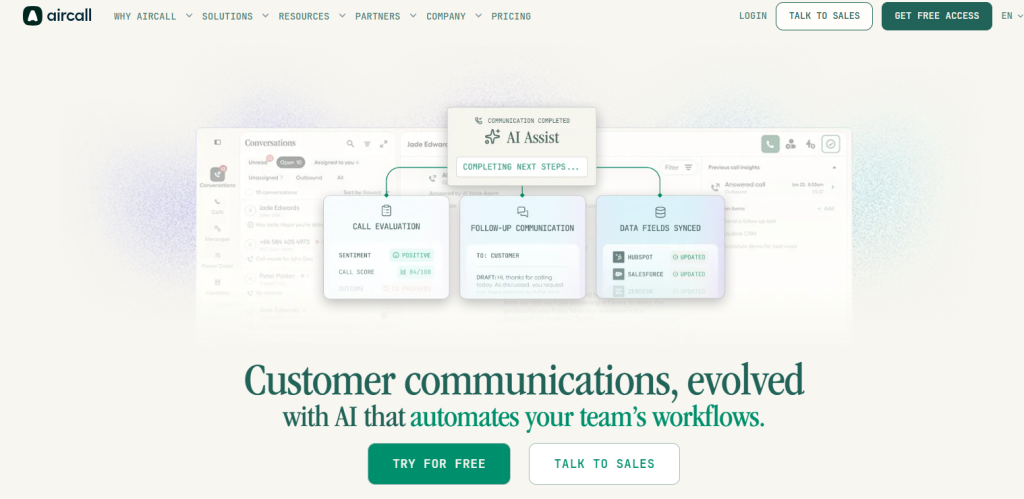
Aircall is a cloud-based business phone system for sales and support teams that need local numbers across 100+ countries, native CRM integrations, and a clean interface that non-technical users can operate from day one.
Best for: Teams needing wide international number coverage
Key features
- Local numbers in 100+ countries: Aircall provisions local numbers across more countries than most competitors, so teams running multi-region campaigns can show a local caller ID in each market without managing separate providers.
- Native CRM integrations with Salesforce and HubSpot: Click-to-call and bidirectional sync work without Zapier, keeping call data in the CRM contact timeline automatically after each conversation.
- AI transcription for remote sales teams: AI-powered transcription supports remote teams that need a written record of every call without relying on reps to take notes manually.
- Easy number creation via dashboard: New numbers can be created directly in the Aircall dashboard after submitting the required regulatory documents for each country, which simplifies multi-market expansion.
- Mobile and desktop apps: Full call handling is available on iOS, Android, and desktop, so reps can manage calls from any device without being tied to a desk.
Pros and cons
| Pros | Cons |
|---|---|
| Intuitive platform with quick CRM integrations for seamless click-to-call and sync | Mobile app lags frequently, requiring multiple restarts during busy periods |
| Ideal for ecommerce remote support with call tracking and business tool integrations | Device synchronisation is inconsistent and CRM call logging is sometimes problematic |
| Local numbers in 100+ countries enable global local presence without complex setup | Call notification delays during peak usage make real-time response challenging |
Pricing and ratings
Pricing (USD): Pricing is not publicly listed. Contact Aircall’s sales team for a quote. Singapore numbers are supported but require regulatory documentation. See full pricing
Integration with HubSpot and Salesforce: Aircall provides native bidirectional sync with Salesforce and HubSpot. Click-to-call and auto-logging work without Zapier, though some users report CRM logging failures that require manual reconciliation during high-volume periods.
5. CallHippo – Best for outbound sales teams needing high call volume
CallHippo is an AI-powered VoIP virtual phone system for SMBs and mid-market sales teams that need high-throughput outbound calling with local presence numbers across 50+ countries, including Singapore.
Best for: High-volume outbound sales teams
Key features
- Local presence dialing in 50+ countries: CallHippo shows a local area code on the caller ID in each target country, which the platform claims increases call acceptance rates by up to 4x compared to international numbers.
- AI Voice Agent and conversation intelligence: Automated follow-ups and call summaries reduce the manual work reps do after each call, though these features sit in higher-tier plans.
- Power Dialer and Parallel Dialer: Both dialer modes support high-volume outbound campaigns, letting teams configure pacing to match their connection rate targets.
- IVR, call recording, and team collaboration tools: Real-time agent coordination features and automatic call recording give managers visibility into team performance without requiring manual reporting.
- 90+ CRM integrations: Native connections to HubSpot, Salesforce, Pipedrive, and Zoho enable automatic call logging without Zapier for the CRMs most commonly used by Singapore sales teams.
Pros and cons
| Pros | Cons |
|---|---|
| User-friendly interface with reliable call quality for basic outbound campaigns | 2-second call latency and dropped calls during peak hours, with audio distortion reported by users |
| Easy setup and seamless call management features that improve daily communication efficiency | Pricing structure has hidden add-ons, forced seats, and non-refundable credits driving 38% negative reviews |
| Mobile app enables VoIP line usage on the go, supporting remote sales teams | Customer support quality is inconsistent, with slow response times and limited product knowledge reported |
Pricing and ratings
Pricing (USD): Starter plan from $18/user/month on annual billing. Singapore +65 numbers activate within minutes with no ACRA requirement mentioned. AI and dialer features may require higher-tier plans. See full pricing
Integration with HubSpot and Salesforce: CallHippo provides native bidirectional sync with HubSpot, Salesforce, Pipedrive, and Zoho. Call logging is automatic without Zapier, but teams should verify that AI-enriched entries are included in their chosen plan tier before committing.
6. Kixie – Best for high-volume outbound SDR teams
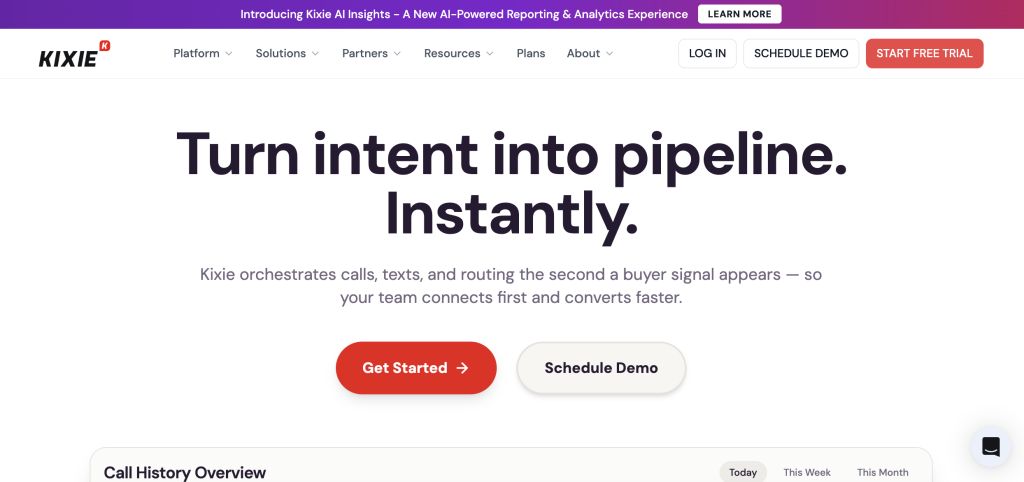
Kixie is a power dialer and CRM-native calling platform built for sales development teams that need to maximise outbound call volume and automate lead engagement directly from Salesforce or HubSpot.
Best for: Power dialing for SDR teams
Key features
- Power and Parallel Dialers: Both dialer modes automate high-volume outbound campaigns, so SDRs spend more time talking and less time waiting between dials.
- Native Salesforce and HubSpot integration: Click-to-call and auto-sync work without Zapier, keeping call data in the CRM deal record after every conversation.
- Lead enrichment and automated follow-ups: Kixie reduces manual data entry by enriching lead records and triggering follow-up sequences automatically after calls, based on call outcome.
- Call recording and analytics: Every call is recorded and stored with performance metrics, so managers can track SDR connection rates, talk time, and outcomes without relying on self-reported data.
- US-based support team: Support is available Monday to Friday, 7am to 5pm PT, which may create response time gaps for Singapore teams operating in the SGT (UTC+8) time zone.
Pros and cons
| Pros | Cons |
|---|---|
| Seamless CRM integration with Salesforce and HubSpot, with automated logging that saves significant time | Chrome extension is fragile, causing frequent failures that disrupt dialing workflows |
| Technical support is responsive, knowledgeable, and thorough in isolating issues | CRM logging failures reported in recent reviews, leading to missed data sync |
| Dialer speed and efficiency drive strong lead generation volume improvements | Mobile app is unreliable, with error messages, text-sending issues, and frequent crashes |
Pricing and ratings
Pricing (USD): Pricing is not publicly listed. Contact Kixie’s sales team for a quote. No Singapore-specific number or compliance information is available on the Kixie website. See full pricing
Integration with HubSpot and Salesforce: Kixie provides native bidirectional sync with Salesforce and HubSpot. Auto-logging works without Zapier, but recent user reviews note occasional CRM logging failures that require manual reconciliation to keep deal records accurate.
7. Ringover – Cloud calling for SMB and mid-market teams
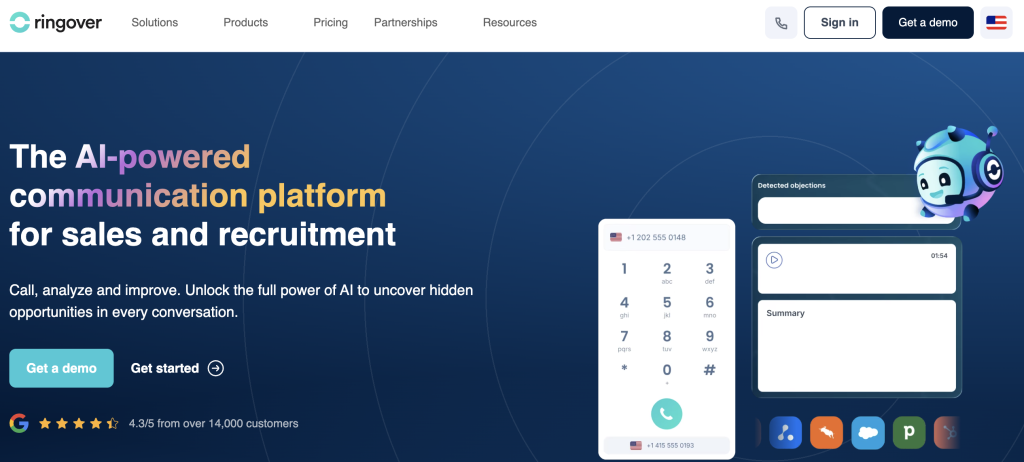
Ringover is a cloud-based business phone system for sales and support teams that need a straightforward calling platform with CRM integrations and team collaboration features without heavy IT overhead.
Best for: Cloud calling for SMBs
Key features
- Cloud-based calling with CRM integrations: Ringover connects to major CRMs so call activity logs automatically to contact records, reducing manual entry for sales and support reps.
- Team collaboration tools: Internal messaging, call transfer, and shared call notes help teams coordinate on live calls without switching to a separate communication platform.
- Call recording and analytics: Calls are recorded automatically and stored with basic performance metrics, giving managers visibility into team activity without manual reporting.
- IVR and call routing: Multi-level IVR and routing rules direct inbound calls to the right agent or team based on time of day, caller input, or agent availability.
- Mobile and desktop apps: Ringover is accessible on iOS, Android, and desktop, so reps can handle calls from any device without being tied to a fixed workstation.
Pros and cons
| Pros | Cons |
|---|---|
| Straightforward setup with CRM integrations that reduce manual call logging for small teams | No Singapore-specific pricing, local number details, or PDPA compliance documentation publicly available |
| Team collaboration features like internal messaging and call transfer reduce context-switching | Limited public review data makes it harder to validate call quality on Singapore routes before committing |
| Mobile and desktop apps give reps flexibility to handle calls from any device |
Pricing and ratings
Pricing (USD): Pricing is not publicly listed for Singapore. Contact Ringover’s sales team for a quote specific to your region and team size.
Integration with HubSpot and Salesforce: Ringover offers CRM integrations for major platforms, but specific details on bidirectional sync depth and whether Zapier is required for Singapore deployments are not publicly confirmed. Verify integration scope directly with the Ringover team before committing.
How does call automation software Singapore compare on key features in 2026?
| Feature | FreJun | CloudTalk | JustCall | Aircall | CallHippo | Kixie | Ringover |
|---|---|---|---|---|---|---|---|
| Native CRM sync (no Zapier) | Yes, 23+ CRMs | Yes, Salesforce, HubSpot, Zoho | Yes, 90+ CRMs | Yes, Salesforce, HubSpot | Yes, Salesforce, HubSpot | Yes, Salesforce, HubSpot | Partial, verify scope |
| AI call summaries included in base plan | Yes | No, paid add-on | No, paid add-on | Partial, higher plans | Partial, higher plans | Partial, higher plans | No |
| Singapore +65 virtual numbers | Yes, instant | Yes, ACRA required, 10-15 days | Yes, instant | Yes, regulatory docs required | Yes, instant | No confirmed | No confirmed |
| Auto dialer (4 modes) | Yes, Progressive, Power, Predictive, Preview | Partial, Power and Parallel add-ons | Partial, auto and predictive | No | Partial, Power and Parallel | Yes, Power and Parallel | No |
| PDPA and IMDA DNC compliance | Yes | Partial, verify locally | Partial, verify locally | Partial, verify locally | Partial, verify locally | No confirmed | No confirmed |
| Starting price (USD/user/month) | $14.49 | $25.00 | $29.00 | Contact sales | $18.00 | Contact sales | Contact sales |
FreJun is the only platform in this comparison that includes AI call summaries in its base plan and offers instant Singapore +65 number provisioning at the lowest starting price, making it the strongest all-round choice for call automation software Singapore teams evaluating total cost of ownership. Businesses expanding into the Gulf region can also review our guide to call automation software UAE teams use to meet local telecom regulations.
“Call automation tools in Singapore solve the core problem of high outbound rejection rates by enabling local presence dialing. Without it, cold call acceptance drops by 75% compared to using international numbers.”
– Rajiv Mehta, VP of Sales, Nexa Solutions Singapore via r/sales
Which call automation software Singapore is right for your team in 2026?
Different teams have different priorities. The right call automation software Singapore platform depends on your team size, CRM stack, call volume, and budget. Use the guidance below to match your situation to the best fit.
If you are a Singapore B2B sales team using HubSpot or Salesforce: Choose FreJun. It lives natively inside both CRMs, auto-logs every call with AI summaries and sentiment scores, and starts at $14.49/user/month with no Zapier required.
If you are a small startup needing instant Singapore numbers and SMS: Choose JustCall. It activates +65 numbers instantly via SMS verification, bypassing the ACRA registration delays that affect CloudTalk, and supports WhatsApp and multi-level IVR from a single inbox.
If you are a mid-market sales team running high-volume outbound campaigns: Choose CallHippo. Its Power and Parallel Dialers handle large outbound volumes, and local presence dialing across 50+ countries lifts answer rates for teams calling beyond Singapore into Southeast Asia.
If you are a team expanding across 10+ countries and need local numbers everywhere: Choose Aircall. Its coverage of 100+ countries is the widest in this comparison, and its CRM integrations with Salesforce and HubSpot work without Zapier for teams managing multi-region pipelines.
If you are an SDR team that lives inside Salesforce or HubSpot and needs maximum dial speed: Choose Kixie. Its Power and Parallel Dialers are purpose-built for high-volume SDR workflows, and its CRM-native logging saves reps from manual data entry after every call.
Which tool wins overall for Singapore teams?
If you want the best overall call automation software Singapore platform with AI features, USD billing, and PDPA and IMDA compliance: Choose FreJun. It is the only tool in this list that includes AI summaries in the base plan, offers instant Singapore number provisioning, and starts at $14.49/user/month, making it the strongest value for Singapore sales and support teams of any size.
Frequently asked questions about call automation software Singapore in 2026
What is the best call automation software Singapore in 2026?
The best call automation software Singapore teams can use in 2026 is FreJun, rated 4.9/5 on G2. It ranks first because it combines the lowest starting price in this comparison ($14.49/user/month), native bidirectional CRM sync with 23+ platforms including HubSpot and Salesforce, and AI call summaries included in the base plan rather than locked behind a paid add-on. It also meets Singapore PDPA and IMDA Do Not Call Registry requirements, which is a non-negotiable for any outbound calling operation in the city-state.
How much does call automation software Singapore cost in 2026?
Pricing for call automation software Singapore platforms ranges from $14.49 to $29/user/month for entry-level plans. FreJun’s Standard Plan starts at $14.49/user/month and its Professional Plan at $16.69/user/month, both in USD with monthly, quarterly, or annual billing options. CloudTalk starts at $25/user/month, JustCall at $29/user/month, and CallHippo at $18/user/month. Aircall, Kixie, and Ringover do not publish pricing publicly. Watch for add-on costs: AI transcription and parallel dialing can add $10 to $15/user/month on some platforms, which doubles the effective cost for a 10-agent team within the first year.
What compliance rules apply to call automation software in Singapore?
Singapore’s IMDA (Infocomm Media Development Authority) governs telecommunications infrastructure and carrier licensing. The PDPA (Personal Data Protection Act) sets rules for how call recordings, transcripts, and contact data are stored, processed, and shared. Any outbound calling campaign must also comply with the IMDA Do Not Call Registry, which prohibits unsolicited voice calls and text messages to registered numbers. Before deploying any call automation software Singapore platform, confirm it supports DNC Registry scrubbing, stores data in a compliant region, and provides audit logs for PDPA accountability. Platforms without explicit PDPA documentation create real legal exposure.
Which call automation software Singapore integrates best with HubSpot?
FreJun offers the deepest HubSpot integration among all seven platforms in this comparison. It runs natively inside HubSpot, logging every call with duration, recording link, AI transcript, sentiment score, and call disposition directly to the contact or deal record. No Zapier layer is required, and setup takes under an hour from Chrome extension install to first live call. JustCall and CloudTalk also offer native HubSpot sync, but AI-enriched log entries require a paid add-on on both platforms, while FreJun includes them in the base plan.
How do I switch from a traditional phone system to call automation software in Singapore?
Switching from a traditional desk phone or PBX (Private Branch Exchange) system to a cloud-based call automation software Singapore platform is faster than most teams expect. FreJun’s setup takes under one hour: install the Chrome extension, connect your CRM, and provision a Singapore +65 virtual number. The 3-day free trial for up to 5 users lets your team test the full platform before committing. Port your existing numbers within 24 hours if you need to keep your current Singapore number. Since FreJun is browser-based, there is no hardware to replace and no IT team required for deployment.
Which call automation software Singapore has the best AI call summaries?
FreJun provides the most complete AI call summary package among the platforms in this comparison. After every call, it generates a 2 to 3 sentence summary, a sentiment score (positive, neutral, or negative), a talk ratio showing how much the rep spoke versus the customer, and a full searchable transcript with speaker labels. All of this syncs automatically to the CRM contact record. As of 2026, FreJun teams see an average 3x increase in daily call volume because reps spend zero time on manual note-taking. JustCall and CloudTalk offer similar AI features, but both require a paid add-on tier to access them.
Can I get a local Singapore +65 number with call automation software?
Yes. FreJun, JustCall, and CallHippo all provide local Singapore +65 virtual numbers. FreJun and JustCall activate Singapore numbers instantly without requiring ACRA registration. CloudTalk also provides Singapore numbers, but activation requires a BIZfile extract from ACRA and takes 10 to 15 business days, plus an $80 activation fee per number. Aircall supports Singapore numbers but requires country-specific regulatory documentation. Kixie and Ringover do not publicly confirm Singapore number availability, so verify directly with their sales teams before committing.
How is AI changing call automation software Singapore in 2026?
AI is shifting call automation software Singapore from a dialing tool into a full conversation intelligence layer. Platforms now generate real-time transcripts, sentiment scores, and call summaries that sync directly to CRM records, so managers can coach on actual conversation data rather than rep self-reports. FreJun’s AI features include sentiment analysis, talk ratio tracking, and keyword search across all call history, all included in the base plan. The next wave is AI voice agents that handle inbound qualification and outbound follow-ups autonomously, which FreJun supports through its Teler developer infrastructure for teams ready to build that layer.
Conclusion: Best call automation software Singapore in 2026
The top three call automation software Singapore platforms in 2026 are FreJun (best overall for CRM-native AI calling), JustCall (best for instant Singapore number activation and SMS), and CloudTalk (best for B2B sales teams needing conversation intelligence). FreJun is the top recommendation for Singapore sales and support teams because it is the only platform in this comparison that includes AI summaries in the base plan, starts at $14.49/user/month, and lives natively inside HubSpot and Salesforce without a Zapier layer. Start your 3-day free trial today and your team can be making calls within the hour.