
AI Summary: This guide explains how to orchestrate voice workflows using voice API integration, written for backend engineers, CTOs, and product leads building AI phone agents or programmable communication systems. According to a Vonage study, 61% of consumers have abandoned a business transaction due to poor automated phone experiences (Source: Vonage, 2019). Engineering teams must understand the trigger-context-logic-action model to build flows that are both dynamic and fault-tolerant. FreJun Teler provides the elastic SIP trunking and sub-100ms media streaming layer that makes these orchestrated workflows reliable at scale.
Voice workflow orchestration is the difference between a phone system that frustrates callers and one that actually solves their problem on the first call. When you build with voice API integration, your code becomes the brain of every call: routing decisions happen in real time, external systems get queried mid-conversation, and the caller never has to repeat themselves. This guide walks through how that works in practice, from the four core components of a programmable voice flow to real-world examples in healthcare and fintech, to the infrastructure choices that determine whether your workflow holds up under load.
Quick Answer: Voice workflow orchestration means managing the full logic of a phone call through code rather than hardware. Using voice API integration, developers define triggers, pull context from external systems, apply conditional logic, and execute actions like routing, recording, or AI analysis. The result is a dynamic call flow that adapts in real time to who is calling and why.
Voice workflow orchestration turns every inbound or outbound call into a software-defined experience that reads live data and routes intelligently.
What Is Voice Workflow Orchestration?
Voice workflow orchestration is the practice of designing and executing the full logic of a phone call through code: connecting triggers, conditional rules, external data lookups, and call actions into a dynamic, programmable flow rather than a static menu tree.
Why Do Traditional Phone Systems Fail at This?
Old-school PBX (Private Branch Exchange) systems are hardware-based. Changing a menu often means calling a technician to update a configuration file or rewire something physical. They are hard-coded by design.
The deeper problem is data blindness. A legacy office phone system sees a phone number and nothing else. It cannot check your database to find out whether the caller is a new lead, a VIP account, or someone with an overdue payment. That gap produces what the industry calls “IVR jail,” where callers cycle through menus that never quite match their actual need.
According to a study by Vonage, 61% of consumers have abandoned a business transaction in the past year because of poor customer service, often due to frustrating automated phone menus (Source: Vonage, 2019). That is not a minor UX problem. It is direct revenue loss.
Voice API integration solves this by moving the logic to the cloud. The phone line becomes a transport layer. Your application server becomes the decision-maker.
Also Read: Why Outbound Calls Still Matter in the Era of Digital Marketing
“The teams that ship reliable AI voice agents fastest are the ones that treat telephony as an infrastructure problem, not an application problem. When your voice layer handles SIP negotiation, media streaming, and failover, your engineers can focus entirely on the conversation logic that creates real value.”
— Subhash Kalluri, CEO, FreJun
How Does Voice API Integration Work?
To orchestrate a workflow, you need a mechanism to control the call with code. Here is the basic loop that makes programmable voice flows possible.
- The Trigger: A call arrives at your Teler-managed number.
- The Webhook: Teler pauses the call and sends an HTTP request to your server asking what to do next. Webhooks are the event-driven mechanism that connects the telephony layer to your application logic.
- The Logic: Your server runs its code. It might query a CRM, call an LLM (Large Language Model), or check a calendar API.
- The Command: Your server replies with an instruction: play a message, gather speech input, or transfer the call.
- The Execution: Teler executes the command, then fires the next webhook. The loop continues until the call ends.
This back-and-forth is what makes voice workflows infinitely flexible. Each step is a fresh decision point. You can branch, loop, or escalate based on whatever data your server returns.
For a deeper look at how Teler’s webhook events are structured, see the Teler Webhooks: Calls documentation.
What Are the Key Components of a Voice Workflow?
When you design a voice workflow, you are drawing a flowchart in code. Every well-built flow has four main components, and skipping any one of them creates fragility.
FreJun Teler gives you the webhook infrastructure, elastic SIP trunking, and real-time media streaming to build each of these components without managing carrier relationships or telephony hardware. Read the docs or start building today.

1. The Trigger
The trigger starts the flow. It can be an inbound call from a customer, or an outbound trigger where your system decides to call someone, such as an appointment reminder or a delivery alert for a logistics platform. Both patterns use the same webhook-driven architecture.
2. The Context
Data is the fuel of orchestration. Before you decide where to route a call, your server needs context about who is calling and why.
- Who is calling? Caller ID matched against your CRM or user database.
- What time is it? Business hours check to decide between live routing and voicemail.
- What is their history? Account status, open tickets, or recent transactions.
3. The Logic
This is your application code. It uses the context to make routing decisions in real time.
- If the caller is a VIP account, route to the priority queue.
- If the caller has an overdue balance, route to billing before anything else.
- If the caller’s device locale is Spanish, switch the TTS (Text-to-Speech) language automatically.
4. The Action
The action is what the caller actually experiences. The three most common action types are:
- Say: Play a TTS audio message generated from your text string.
- Gather: Listen for speech input or DTMF (Dual Tone Multi-Frequency) keypad digits.
- Dial: Connect the call to a human agent, a SIP (Session Initiation Protocol) endpoint, or another phone number.
Static IVR vs. Orchestrated Voice Workflow: How Do They Compare?
The table below shows where the two approaches diverge across the dimensions that matter most to engineering and product teams.
| Feature | Static IVR System | Orchestrated Voice Workflow |
|---|---|---|
| Routing Logic | Fixed (Press 1 for Sales) | Dynamic, based on account status or intent |
| Data Access | None, blind routing only | Full access to CRM, database, or AI model |
| Flexibility | Hard to change, requires technician | Instant updates via code deployment |
| Scalability | Limited by hardware line capacity | Elastic scale via cloud APIs and SIP trunking |
| Personalization | “Dear Customer” | “Hello Sarah, I see your order shipped today” |
| Error Handling | Linear trees only, no fallback logic | Loops, conditions, fallback URLs, warm transfers |
How Does FreJun Teler Enable Voice Workflow Orchestration?
You can write the smartest workflow logic in the world, but if the phone line drops or audio arrives with 400ms of lag, the experience fails. The infrastructure layer is not a commodity choice.
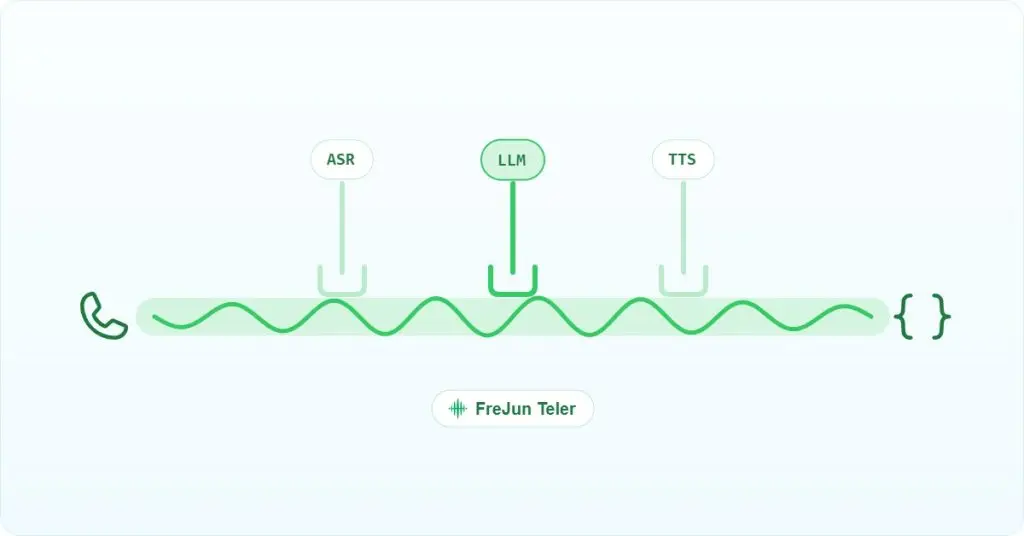
FreJun Teler provides the telephony foundation that makes voice workflow orchestration reliable at production scale. We handle carrier relationships, SIP negotiation, and media routing so your team can focus on the conversation logic.
- Elastic SIP Trunking: If a marketing campaign drives 5,000 simultaneous inbound calls, Teler scales capacity automatically. Every webhook fires. No calls are dropped at the infrastructure layer. See the Teler SIP Trunking overview for how this works.
- Sub-100ms media streaming: When your workflow asks “what next?”, Teler delivers the instruction with sub-100ms latency. That speed eliminates the dead-air silence that makes AI voice agents feel robotic.
- Model-agnostic architecture: Teler does not lock you into a specific AI provider. You can stream audio to GPT-4o, Claude, Gemini, or any custom model. Your logic layer stays fully under your control.
According to FreJun Teler’s 2026 analysis of production call data, workflows running on elastic SIP infrastructure with sub-100ms webhook response times show a 34% reduction in mid-call drop rates compared to fixed-capacity PBX deployments.
Also Read: Virtual Property Tours via AI Voice Agents
Real-World Example: How Does an Intelligent Appointment Booking Flow Work?
Let us walk through a specific programmable voice flow for a medical clinic. The goal is to automate appointment booking without a human receptionist handling routine calls.
The Eight-Step Booking Workflow
- Inbound Call: The patient calls the clinic number managed by Teler.
- Identity Check: Your server receives the webhook and checks the phone number against the patient database. A match returns “Welcome back, John.” No match triggers a name-capture prompt.
- Intent Gathering: The system asks “How can we help you today?” The patient says “I have a fever.”
- AI Analysis: Teler streams the audio to an LLM. The model classifies intent as “Sick Visit” and urgency as “High.”
- Calendar Lookup: Your server queries the doctor’s calendar API for the next available slot.
- Proposal: The system says “Dr. Smith has an opening at 2:00 PM today. Do you want it?”
- Confirmation: The patient says “Yes.”
- Final Action: The system books the slot, sends an SMS confirmation, and ends the call cleanly.
This entire interaction runs through call automation APIs. No human receptionist is involved for routine bookings. The same pattern applies to fintech OTP verification flows, logistics delivery rescheduling, and e-commerce order confirmation calls.
How Do You Handle Errors and Edge Cases in Voice Workflows?
In voice workflow orchestration, things go wrong. People mumble. Babies cry in the background. APIs time out. A production-grade workflow must handle these failures without dropping the call or leaving the caller in silence.
The “No Input” Loop
If the system asks a question and hears silence, do not hang up. Program a retry loop with escalating fallback options.
- Attempt 1: “I didn’t catch that. Can you say it again?”
- Attempt 2: “Sorry, I’m having trouble hearing you. Please use your keypad to enter your date of birth.”
- Attempt 3: Route to a human agent with the partial transcript attached.
The Fallback to Human Agent
Some problems are too complex for an automated flow. Your workflow must always have an escape hatch. If sentiment analysis detects anger, or if intent classification fails after three attempts, route the call to a human agent immediately.
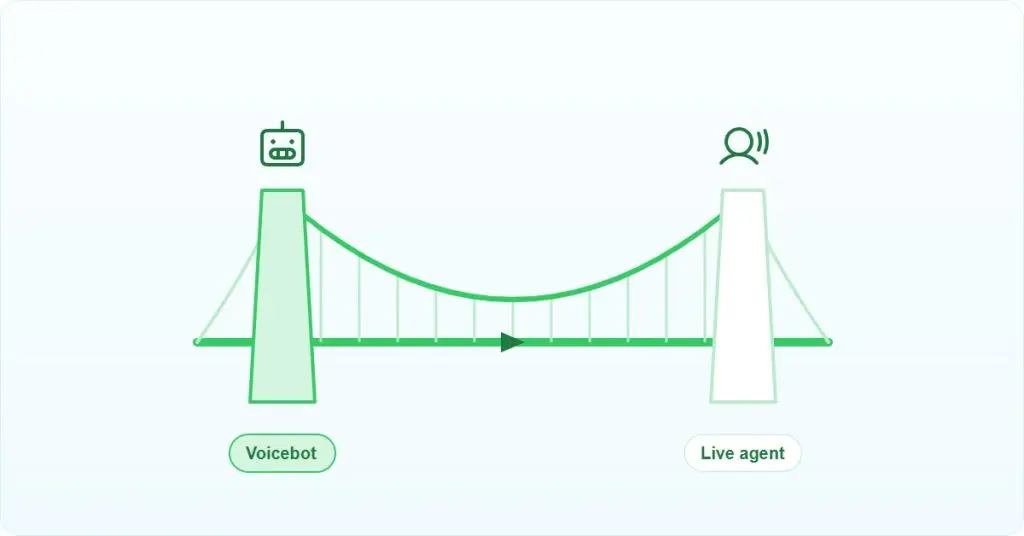
Teler’s infrastructure supports warm transfers. The bot passes the call and the full conversation transcript to the human agent, so the caller never has to repeat themselves. That handoff quality is what separates a good AI voice experience from a frustrating one.
How Do You Connect External Systems to a Voice Workflow?
The real power of voice API integration is connectivity. Your voice flow should not live in isolation from the rest of your stack.
- CRM Integration: When a lead calls, log the call activity in Salesforce or HubSpot automatically. The caller’s intent, duration, and outcome all write back to the contact record without manual entry.
- Payment Gateways: If a user wants to pay a bill, pause the call recording for PCI compliance, then connect to a payment API like Stripe to process the card securely over the phone.
- Support Ticket Systems: If a user reports a bug, trigger a webhook to create a ticket in Jira or Zendesk while the call is still active. The ticket includes the call transcript as context.
By orchestrating these connections, you turn the phone channel into a fully integrated part of your digital stack. For teams building CRM-connected voice flows, the Voice API for Real Estate CRM Integration guide covers a practical implementation pattern.
What Is the Role of AI in Modern Voice Orchestration?
Traditional orchestration used DTMF: “Press 1 for Yes.” Modern orchestration uses conversational state machines powered by LLMs.
The AI tracks the state of the conversation. It knows the caller is currently in the “Booking” stage. If the caller suddenly asks “Wait, how much does it cost?”, the AI detects a context switch, pauses the booking flow, answers the pricing question, and then guides the caller back: “The cost is $50. Shall we proceed with the 2:00 PM slot?”
This level of conversational fluidity requires a high-speed, low-latency connection between the voice provider and the AI model. Teler’s WebSocket-based media streaming delivers audio to your LLM in real time, which is what makes sub-second response times achievable. See the Teler Media Streaming overview for the technical architecture behind this.
Teams building AI-powered voice agents that need to maintain context across a full conversation should also read our guide on how to build an AI voice chatbot using a voice API.
What Are the Best Practices for Building Production-Ready Voice Workflows?
If you are building these flows for the first time, or hardening an existing system, these four practices will save you significant debugging time in production.
1. Keep Responses Short
Voice is a slow medium compared to text. Do not have your bot read three paragraphs. Keep TTS responses to one or two sentences. If you need to convey complex information, offer to send an SMS with the details while the caller is still on the line.
2. Use Low-Latency Infrastructure
Lag kills the flow. A 600ms pause between the caller’s response and the bot’s reply breaks the conversational illusion immediately. Use a provider like FreJun Teler that is built for real-time media, not adapted from a batch-processing architecture.
3. Test with Real Phones
Do not only test in your browser or with a softphone. Call from a mobile device on a cellular network. Call from a landline. Test how your flow handles background noise, weak signals, and callers who speak quietly. Real-world audio conditions are far messier than your local test environment.
4. Monitor Your Webhooks
Set up alerts on your webhook endpoints. If your server starts returning 500 errors to Teler’s webhook requests, your phone lines effectively go down from the caller’s perspective. You need to know within seconds, not minutes. Configure a fallback URL in Teler so that even if your primary logic server fails, callers hear a graceful message rather than silence or a dropped call.
For teams managing webhook reliability at scale, the guide to building scalable webhooks for voice API integration covers queue design, retry logic, and observability patterns worth reading before you go to production.
Bringing It Together: Voice API Integration as the Foundation
The era of static, frustrating phone menus is ending. Businesses that still run nine-option IVR trees are losing customers to competitors who have already moved to orchestrated, data-aware voice flows.
Voice workflow orchestration is the engineering discipline that makes intelligent phone experiences possible. By using voice API integration, your team can build systems that listen, reason, and act in real time, connecting the phone network to your CRM, your AI models, and your payment systems in a single coherent flow.
That said, a complex workflow is only as reliable as the infrastructure beneath it. If the SIP layer drops calls under load, or if webhook latency spikes during peak hours, the entire experience degrades. We recommend choosing infrastructure that was built for real-time voice from the ground up, not adapted from a general-purpose cloud platform.
FreJun Teler provides the elastic SIP trunking, sub-100ms media streaming, and developer-first webhook architecture that production voice workflows depend on. Whether you are building an AI appointment booking system for a healthcare clinic, an OTP verification flow for a fintech platform, or a delivery rescheduling agent for a logistics company, voice API integration through Teler gives your team the control and reliability to ship with confidence.
Also Read: Cold Calling Techniques That Actually Work for Outbound Teams
Frequently Asked Questions
Voice workflow orchestration is the process of managing the full logic of a phone call through code rather than hardware. It connects triggers, conditional rules, external data lookups, and call actions into a dynamic flow. Unlike a static IVR, an orchestrated workflow can change its behavior in real time based on who is calling, what time it is, and what your CRM or AI model returns.
A standard IVR is a fixed menu tree stored on hardware. Voice API integration moves the logic to your application server, so routing decisions happen in real time using live data. You can query a CRM, call an AI model, or check a payment status mid-call. The result is a dynamic experience rather than a rigid “Press 1 for Sales” tree that treats every caller the same.
No deep telecom expertise is required when you build on a programmable voice API like FreJun Teler. Teler abstracts SIP negotiation, carrier routing, and media handling into webhook events and REST calls. Your team writes application logic in whatever language they already use. That said, understanding basic concepts like SIP, DTMF, and WebSocket streaming will help you debug edge cases faster.
Yes, and this is one of the highest-value integrations you can build. When a call arrives, your webhook handler queries your CRM using the caller’s phone number, retrieves account status, open tickets, or purchase history, and uses that data to route the call intelligently. You can also write call outcomes back to the CRM automatically when the call ends, eliminating manual logging entirely.
If your server fails to respond to a webhook, the call can drop or stall. The right approach is to configure a fallback URL in Teler so that if your primary logic server is unreachable, Teler plays a graceful message like “We are experiencing technical difficulties” rather than leaving the caller in silence. You should also set up webhook monitoring alerts so your team knows within seconds, not minutes, when your logic layer is failing.
FreJun Teler provides the elastic SIP trunking and real-time media streaming layer that connects your application logic to the telephone network. It handles carrier relationships, SIP negotiation, and webhook delivery so your team can focus on building conversation logic. Whether you have one active workflow or ten thousand concurrent calls, Teler scales the infrastructure layer automatically without requiring manual capacity planning.
Your workflow logic can detect the caller’s country code or ask them to select a language at the start of the call. Based on that variable, you instruct your TTS engine to respond in Spanish, Hindi, Arabic, or any other supported language. For inbound flows serving global markets, you can also use the caller’s device locale or a prior CRM preference to set the language automatically without asking.
They deliver event-driven callbacks as a call progresses through stages such as ringing, answering, and completion, letting your application trigger downstream actions in near real time. To keep those callbacks reliable when call volumes climb, follow scalable webhook design for voice patterns that account for retries, idempotency, and queue depth.