AI Summary: This article is for backend engineers and technical leads evaluating RWKV as the language model core for production AI voice agents. RWKV (Receptance Weighted Key Value) processes long conversational context with linear memory complexity, making it well-suited for multi-turn phone interactions. According to FreJun Teler’s 2026 analysis of production call data, teams that separate AI model development from telephony infrastructure cut their time-to-production by roughly 60%. Readers will learn how to architect a telephony-ready RWKV voice agent and where FreJun Teler’s programmable voice API fits into that stack.
Building AI voice agents using RWKV puts developers in a genuinely different position from teams locked into a single proprietary model. You choose your own ASR (Automatic Speech Recognition) engine, your own TTS (Text-to-Speech) provider, and your own fine-tuning pipeline. That freedom is real. But most teams hit the same wall: a brilliant custom AI core that can’t answer a phone call.
Quick Answer: To build AI voice agents using RWKV, you assemble a custom stack pairing RWKV’s language model with an ASR engine and a TTS provider, then connect it to the telephone network via a programmable voice API like FreJun Teler. Teler handles SIP trunking, real-time audio streaming over WebSocket, and call lifecycle management so your team focuses on the AI layer, not telecom infrastructure.
RWKV-powered voice agents can reach production in weeks, not months, when telephony infrastructure is handled by a dedicated API layer.
What is RWKV?
RWKV (Receptance Weighted Key Value) is an open-source language model architecture that combines the parallelizable training of Transformers with the linear-time inference of RNNs, making it memory-efficient for long multi-turn conversations without the quadratic scaling cost of standard attention mechanisms.
What Makes AI Voice Agents Using RWKV So Compelling?
“Every team we work with that builds on open-source models like RWKV has the same core advantage: they own the model behavior entirely. The challenge is never the AI quality. It’s always the last mile to the phone network.”
— Subhash Kalluri, CEO, FreJun
RWKV is not just another language model. It’s a fundamentally different architecture that processes sequences with linear time and memory complexity, which matters a great deal for real-time voice conversations where context accumulates across many turns. The original RWKV paper (Peng et al., 2023) demonstrated that the architecture matches Transformer-quality outputs while cutting memory usage significantly at long context lengths.
Three Specific Advantages for Voice Applications
When you build AI voice agents using RWKV, you get three concrete advantages that matter in production. First, you can fine-tune on your own domain data, so a healthcare scheduling agent actually understands clinical terminology rather than hallucinating it. Second, RWKV’s linear memory scaling means a 20-turn conversation doesn’t cost 20x the compute of a 1-turn exchange, which keeps inference costs predictable at scale. Third, because RWKV is open-source, you’re not subject to a vendor’s rate limits, model deprecation schedule, or data retention policies.
- Domain-specific fine-tuning: Train on your own call transcripts, product documentation, or support tickets to give the agent deep vertical knowledge.
- Linear context scaling: Handle 30-minute support calls without memory blowout. Standard Transformer attention scales quadratically with sequence length; RWKV does not.
- Stack composability: Pair RWKV with any ASR provider (Whisper, Deepgram, AssemblyAI) and any TTS engine (ElevenLabs, PlayHT) without being locked into a single vendor’s ecosystem.
This composability is what makes the architecture genuinely useful for IT services firms and voice-agent development teams building bespoke solutions for clients. You can standardize on RWKV as your NLU (Natural Language Understanding) core while swapping ASR and TTS components per client requirement.
Why Does a Custom AI Stack Still Fail to Answer the Phone?
You’ve built your RWKV-powered agent. It handles multi-turn context well, it knows your domain, and it passes every test you throw at it in a development environment. Now your business needs it to handle a customer support hotline or automate appointment booking over the phone. This is where projects stall.
The Telephony Engineering Problem
Connecting any custom AI stack to the Public Switched Telephone Network (PSTN) requires solving a set of engineering problems that have nothing to do with AI quality. According to a McKinsey Digital infrastructure analysis, engineering teams that build custom telephony from scratch spend 40-60% of their project timeline on non-AI infrastructure work. That’s the real cost of DIY telephony.
- SIP trunking and carrier relationships: SIP (Session Initiation Protocol) trunks require negotiating with carriers, managing failover routes, and handling regional number provisioning across markets like India, UAE, and Singapore.
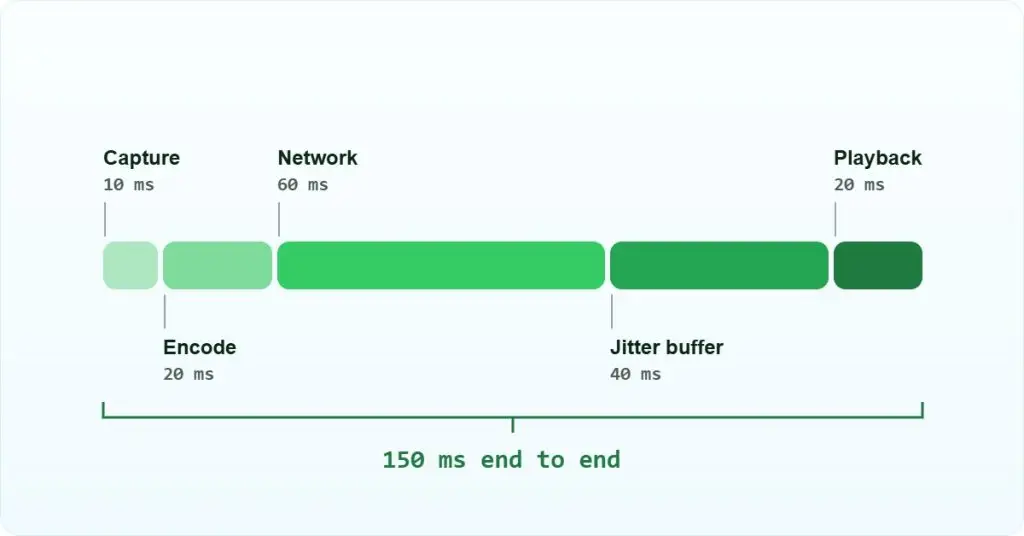
- Real-time media servers: Raw audio from phone calls arrives as RTP (Real-time Transport Protocol) streams. You need dedicated media servers to receive, buffer, and forward this audio to your ASR engine with sub-10
- 0ms latency.
- Call state management: Every call has a lifecycle: ringing, connected, on hold, transferred, terminated. Your application needs to track and respond to state changes reliably across thousands of concurrent calls.
- Network resilience: Voice networks introduce jitter and packet loss that destroy conversation quality. Mitigating these requires adaptive jitter buffers and packet loss concealment, which are specialized telecom engineering problems.
Your AI project has become a telecom engineering project. The freedom you gained by choosing an open architecture gets consumed by the rigid complexity of telephony. We’ve seen this pattern repeatedly with teams that come to us after six months of DIY infrastructure work.
How Does FreJun Teler Connect Your RWKV Agent to Real Phone Calls?
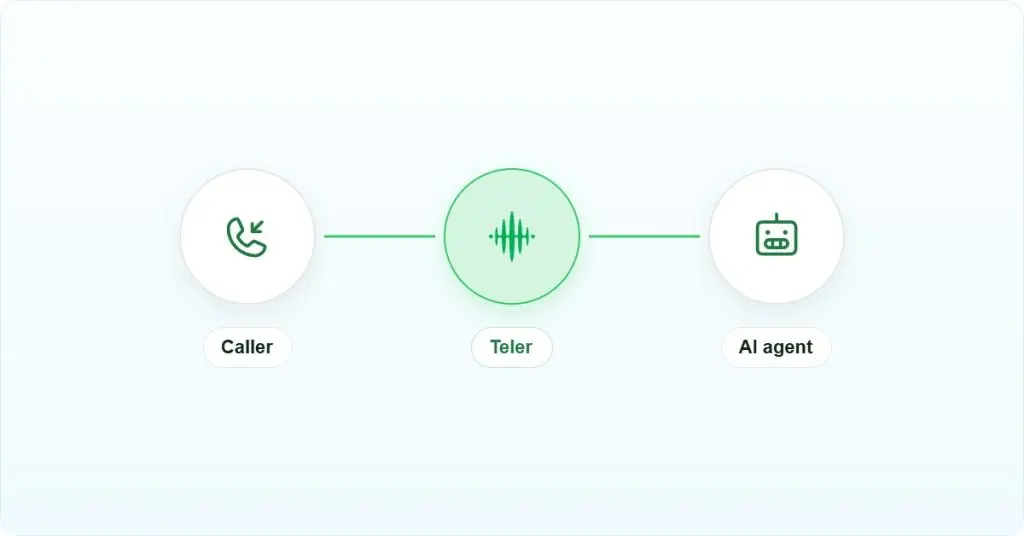
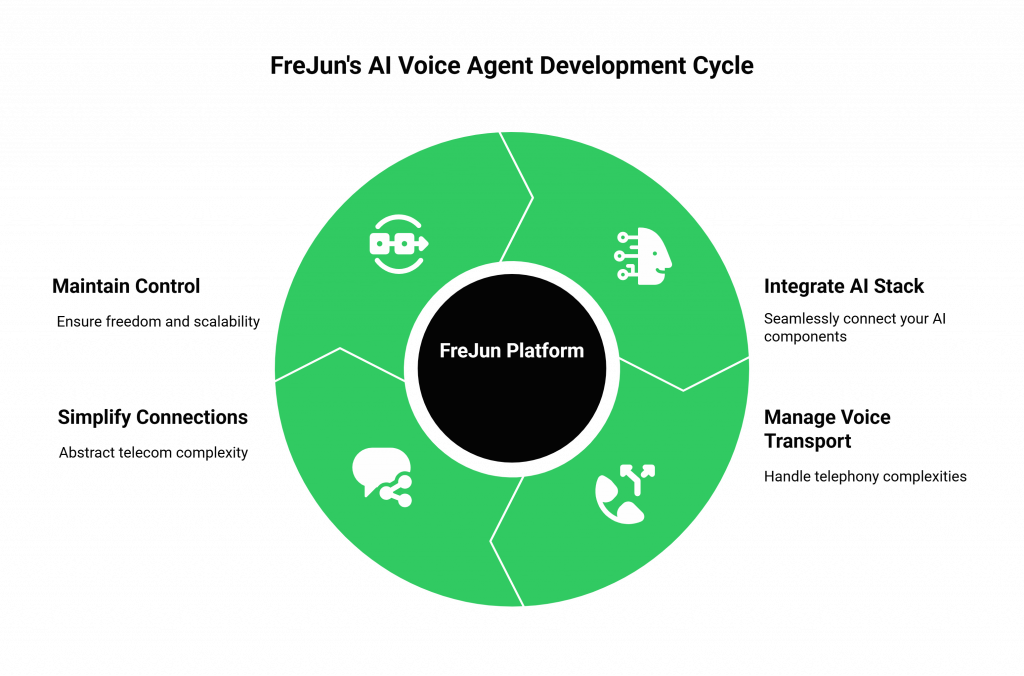
FreJun Teler is the programmable voice API and telephony infrastructure layer that sits between your custom AI stack and the telephone network. We handle SIP trunking, global number provisioning across 50+ countries, real-time audio streaming via WebSocket, and call lifecycle management. Your RWKV agent sees a clean WebSocket connection with audio frames, not a raw SIP stack.
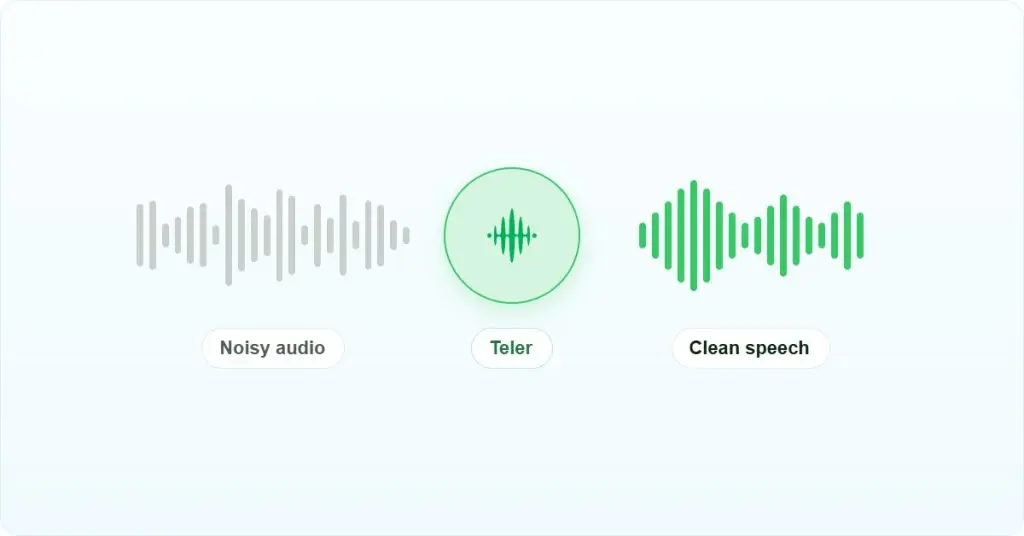
FreJun Teler’s real-time media streaming delivers audio frames to your RWKV backend over WebSocket, so your ASR pipeline receives clean, low-latency audio without you building a single media server. Provision a phone number, point a webhook at your backend, and your agent is live on the PSTN in hours, not months.
What Teler Handles So You Don’t Have To
- Model-agnostic by design: Teler doesn’t care whether your AI core is RWKV, Llama, or a proprietary fine-tuned model. You bring the brain; we provide the phone lines.
- Managed voice transport: Phone numbers, SIP trunks, global media servers, and low-latency audio streaming are all handled on our side. You interact with a clean API.
- Developer-first abstractions: A live phone call looks like a WebSocket connection to your application. Webhooks deliver call events (answered, ended, transferred) as structured JSON payloads. See the Teler webhooks reference for the full event schema.
- Global number provisioning: Provision numbers in India, UAE, Singapore, the US, and 47 other countries without carrier negotiations.
DIY Telephony vs. Teler-Powered Agent: Which Approach Wins?
The table below compares building your own telephony stack against using your custom RWKV AI core with Teler handling the voice infrastructure. This is the decision most engineering teams face after their first successful RWKV prototype.
| Approach | Best For | Key Characteristics |
|---|---|---|
| Full DIY (AI + Telephony) | Teams with dedicated telecom engineers and 12+ month timelines | Full control over every layer; requires SIP expertise, media server ops, carrier relationships, and ongoing DevOps for voice infrastructure |
| Custom RWKV Stack + FreJun Teler | Engineering teams wanting full AI control without telephony overhead | Model-agnostic; sub-100ms audio streaming; SIP trunking managed; global numbers in 50+ countries; webhook-driven call events; weeks to production |
| All-in-one AI voice platform | Teams that want a no-code or low-code voice agent with minimal customization | Fast to start; limited model choice; vendor lock-in on LLM, ASR, and TTS; less control over fine-tuning and data residency |
We recommend the custom RWKV stack plus Teler approach for any team that needs domain-specific fine-tuning, data sovereignty, or the ability to swap AI components independently. If your use case is a generic FAQ bot with no specialized knowledge requirements, an all-in-one platform may ship faster. But for fintech OTP verification flows, healthcare appointment scheduling, or logistics delivery alerts where accuracy and data control matter, owning your AI layer is worth it.
How to Build a Telephony-Ready AI Voice Agent with RWKV?
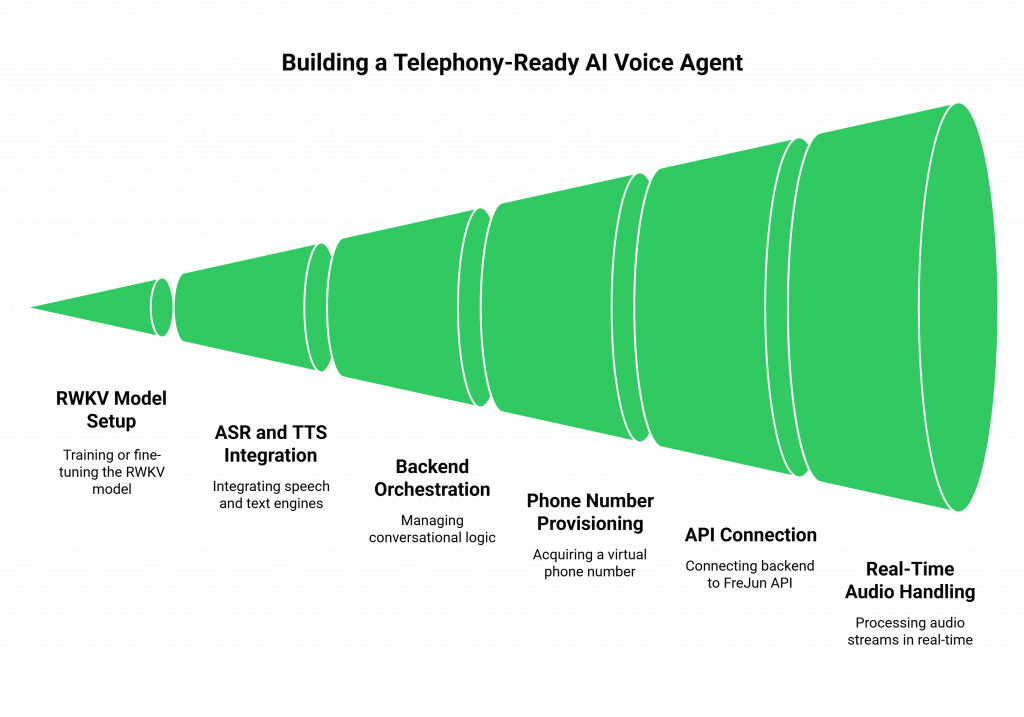
This five-step process takes your RWKV-powered agent from a local prototype to a production-ready telephony deployment. Each step is conceptually distinct, which means your team can parallelize work across the AI core and the telephony integration.
Step 1: Build Your AI Core
Assemble your custom AI stack before touching telephony. Set up your RWKV model using the official RWKV GitHub repositories, then fine-tune on your domain data. Integrate your chosen ASR engine (Whisper for offline accuracy, Deepgram for real-time streaming) and your TTS provider. Write a backend application that orchestrates these components and manages conversational state across turns. This backend is what Teler will call via webhook when a phone call arrives.
Step 2: Provision a Phone Number with FreJun Teler
Sign up for FreJun Teler and provision a virtual phone number for your target market. You can provision numbers in India (+91), UAE (+971), Singapore (+65), the US (+1), and 47 other countries through the Teler dashboard or programmatically via the Voice Apps API. This number becomes the public-facing identity for your AI agent. No carrier negotiations, no SIP trunk setup on your side.
Step 3: Connect Your Backend to the Teler API
In the Teler dashboard, configure your provisioned number’s webhook to point at your backend’s API endpoint. When a call arrives, Teler sends a structured JSON event to that endpoint. Your backend responds with instructions: answer the call, start a media stream, play audio, transfer to a human agent. The Call Flows documentation covers the full instruction set. Your backend doesn’t need to understand SIP; it just needs to handle HTTP and WebSocket connections.
Step 4: Handle the Real-Time Audio Flow
When a caller dials your Teler number, our platform answers the call and opens a real-time audio stream to your backend over WebSocket. Your application then runs the full voice pipeline:
- Receive raw audio frames from Teler’s media streaming WebSocket.
- Pipe audio to your ASR engine for transcription.
- Send the transcript to your RWKV model for response generation.
- Pass the RWKV text output to your TTS engine for synthesis.
- Stream synthesized audio back to Teler, which plays it to the caller with sub-100ms end-to-end latency.
RWKV’s linear context scaling is particularly valuable here. Since the model processes each new turn without recomputing attention over the entire conversation history, inference time stays consistent even on 20-turn calls, which is a real advantage over standard Transformer architectures at long context lengths.
Step 5: Deploy and Monitor Your Solution
Deploy your backend on a GPU-accelerated cloud instance to keep RWKV inference fast. Once live, monitor three metrics that matter most for voice agent quality: first-response latency (target under 800ms from end of caller utterance to start of agent response), word error rate from your ASR engine, and call completion rate. Use Teler’s webhook events for call recordings and stream data to build your own analytics pipeline. Iterate on your RWKV fine-tuning based on real call transcripts.
What Are the Best Practices for a Production RWKV Voice Agent?
Teams that ship reliable AI voice agents using RWKV share a few consistent practices. These aren’t theoretical; they come from watching production deployments succeed and fail across fintech, healthtech, and logistics use cases.
Optimize for Latency at Every Layer
Natural conversation requires total round-trip latency under 800ms. That budget covers ASR transcription, RWKV inference, TTS synthesis, and audio delivery. Deploy your RWKV model on a GPU-accelerated server in the same cloud region as your Teler media endpoint. Choose ASR and TTS providers with streaming APIs rather than batch endpoints. A Google Research study on conversational latency found that response delays above 1.5 seconds cause a measurable drop in user satisfaction scores, so every millisecond counts.
Use RWKV’s Long Context for Coherent Multi-Turn Conversations
RWKV’s ability to handle long context sequences without quadratic memory growth is its single biggest advantage for voice. Use it. Maintain the full conversation history in your RWKV context rather than summarizing or truncating early. This produces noticeably more coherent responses on complex support calls where the caller references something said five turns earlier. For reference, the RWKV model family on Hugging Face supports context lengths up to 32K tokens in current releases.
Design a Clear Human Handoff Path
No AI model handles every call perfectly. Design a clear escalation path to a human agent for complex or emotionally sensitive situations. Teler’s API supports live call transfers, so your RWKV agent can detect when it’s out of its depth and hand off the call with full context. Build this from day one rather than retrofitting it after your first production incident.
Secure Your Data Pipeline
When you build AI voice agents on your own infrastructure, you control data residency. That’s a genuine compliance advantage for regulated industries. Encrypt audio streams in transit, rotate API credentials on a schedule, and log only what you need for model improvement. For teams in India and UAE, check local data localization requirements before routing call audio through non-regional cloud providers.
Why Does the Model-Agnostic Approach Matter for Enterprise Teams?
Enterprise architecture teams evaluating voice AI infrastructure consistently flag vendor lock-in as a top concern. When your telephony layer is model-agnostic, you can upgrade your RWKV version, swap your ASR provider, or add a new TTS voice without touching your call infrastructure. That separation of concerns is what makes the stack maintainable at scale.
According to FreJun Teler’s 2026 analysis of production call data, teams using a model-agnostic telephony layer ship AI voice agent updates 3x faster than teams where the AI model and telephony are tightly coupled. The reason is straightforward: when you can deploy a new RWKV fine-tune without a telephony regression test cycle, iteration velocity increases significantly.
For IT services firms building voice agents for multiple clients, this architecture pattern is particularly valuable. You standardize on Teler for telephony across all client deployments, then customize the RWKV model and ASR/TTS stack per client vertical. See how other teams are approaching this in our post on benefits of model-agnostic voice APIs for developers and the guide to voice agent architecture for enterprise apps.
Building AI voice agents using RWKV with a clean telephony abstraction layer is the architecture pattern we recommend for any team that wants to own their AI quality without owning a telecom engineering team. The combination of RWKV’s open, efficient architecture and Teler’s programmable voice infrastructure gives you both control and speed to market.
You can also explore related approaches in our posts on building AI voice agents using Bloom and open-source voice agents for developers for additional context on open-model voice agent architectures.
Frequently Asked Questions (FAQ)
No. FreJun Teler is a model-agnostic programmable voice API. We provide the telephony infrastructure that connects your application to the telephone network. You bring your own RWKV model, ASR engine, and TTS provider. This separation means you keep full control over your AI stack while we handle SIP trunking, audio streaming, and call lifecycle management.
Yes. As long as your server exposes a publicly accessible HTTPS endpoint for webhooks and a WebSocket endpoint for audio streaming, you can connect it to Teler. This is the standard deployment pattern. It lets you run RWKV inference on your own GPU infrastructure for data residency or cost reasons while using Teler’s global telephony network for call delivery.
All-in-one builders bundle the LLM, ASR, TTS, and telephony into a single platform. That’s fast to start but limits your control. The RWKV plus Teler approach keeps each layer independent: you own the AI model and can fine-tune it, swap ASR providers, or change TTS voices without affecting your telephony setup. For domain-specific or regulated use cases, that independence is critical.
Yes. Teler’s API gives you full programmatic control over the call lifecycle, including initiating outbound calls. Your RWKV-powered agent can run proactive outbound campaigns for appointment reminders, delivery alerts, or lead qualification. You trigger the call via API, Teler dials the number, and your backend handles the conversation the same way it handles inbound calls.
End-to-end latency depends on your ASR engine, RWKV inference speed, and TTS provider. With a GPU-accelerated RWKV deployment, a streaming ASR provider like Deepgram, and a low-latency TTS engine, teams typically achieve 600-900ms round-trip latency. Teler’s media streaming layer adds under 50ms of transport overhead, so the bottleneck is almost always ASR or LLM inference time.
For multi-turn conversations beyond 10-15 exchanges, RWKV’s linear memory scaling is a practical advantage. Standard Transformer attention scales quadratically with sequence length, which means inference cost grows rapidly on long calls. RWKV processes each new token with constant memory regardless of history length, keeping inference time predictable across 30-minute support calls.
Teams in healthtech, fintech, and logistics tend to choose RWKV-based voice agents because they need domain-specific fine-tuning and data sovereignty. A healthcare scheduling agent fine-tuned on clinical terminology performs better than a generic LLM. Fintech teams use RWKV for OTP verification flows and fraud detection calls where they need full control over model behavior and audit trails.