AI Summary: This article explains what the DPDPA (Digital Personal Data Protection Act 2023) means for businesses in India that make or receive commercial voice calls through cloud calling systems. The Telecom Commercial Communications Customer Preference Regulations, 2018, confirmed by TRAI, require sender registration, header registration, and voice-call template registration before any commercial call can be placed. Businesses must decide which obligations they can delegate to a platform and which they must handle themselves. FreJun Teler provides the phone infrastructure layer that connects AI systems to live calls, but registration obligations stay with the business.
Scope: This article covers India’s Digital Personal Data Protection Act 2023 and TRAI’s (Telecom Regulatory Authority of India’s) commercial voice-call framework as they apply to cloud calling and AI voice systems. Regulatory claims were checked against primary TRAI and MeitY (Ministry of Electronics and Information Technology) sources in September 2026.
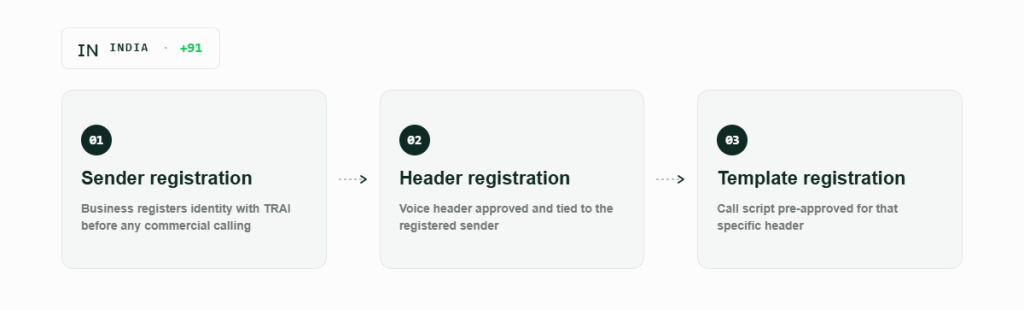
Quick Answer: The DPDPA governs how businesses collect and process personal data from voice calls in India. Separately, TRAI’s commercial-call rules require every business to register as a sender, register a caller identity (called a header), and register the script template before placing any commercial voice call in 2026. Both sets of rules apply at once.
The DPDPA, India’s Digital Personal Data Protection Act 2023, sets the rules for how any personal data collected during a voice call must be handled, and it applies to every business running cloud calling in India today.
What is the Digital Personal Data Protection Act 2023?
The DPDPA (Digital Personal Data Protection Act 2023, Act No. 22 of 2023) is an Indian law that sets rules for how businesses collect, store, and use digital personal data, including the voice recordings, transcripts, and caller details that cloud calling systems generate. The President of India gave assent to the Act on 11 August 2023, and it comes into force on dates the Central Government notifies. A working cloud calling setup that falls under the Act requires a lawful reason to process the data, a way to record and honour caller preferences, and controls over how long recordings and transcripts are kept.
The DPDPA is most often confused with TRAI’s (Telecom Regulatory Authority of India’s) commercial-communication framework. The two are separate. The DPDPA governs what a business does with personal data once it has it. TRAI’s Telecom Commercial Communications Customer Preference Regulations, 2018 (TCCCPR 2018) govern how a commercial voice call reaches a phone in the first place: who is registered to send it, what number series it uses, and what script template it follows. Both sets of rules apply to a business running cloud calling in India, and neither replaces the other.
Why are Indian businesses moving to cloud calling now?
Contact centres and sales teams across India are replacing on-premise phone systems with cloud calling because it lets them add AI-driven voice agents, record every call automatically, and scale the number of simultaneous calls without buying hardware. The shift also brings the DPDPA and TRAI’s registration requirements into sharper focus, because cloud systems generate far more data per call than a traditional phone line does.
Financial services firms, healthcare providers, and e-commerce businesses are among the early adopters, partly because their regulators, including SEBI (Securities and Exchange Board of India), have already directed them to comply with TRAI’s DLT (Distributed Ledger Technology) registration rules for commercial communications. The DPDPA adds a second layer: those same businesses must now also account for how the voice data they collect is stored, accessed, and eventually deleted.
How does a DPDPA-compliant cloud call actually work?
Walking through a single outbound commercial call shows where the rules apply and where things can go wrong.
| Stage | What happens | Who or what does it | What can go wrong |
|---|---|---|---|
| Registration | The business registers as a sender on the DLT platform, registers a caller identity (header), and registers the voice-call script template | The business, before the first call | Unregistered headers are blocked by the network; calls never connect |
| Number assignment | The correct number series is assigned: 140 for promotional calls, 160 for service or transactional calls | The access provider (telecom operator) | Using the wrong series causes the call to be flagged as unsolicited commercial communication |
| Call placement | The cloud calling platform dials the number using the registered header and approved template | The cloud calling platform | Template mismatch causes the network to reject delivery |
| Conversation | The AI or human agent speaks; the system may record audio and convert speech to text (transcription) | The AI model and the calling platform | Recording without a lawful basis under the DPDPA creates a compliance gap |
| Data handling | The recording, transcript, and caller details are stored, used, and eventually deleted according to the business’s data policy | The business | Retaining data longer than necessary, or sharing it without a lawful basis, breaches the DPDPA |
The table shows that most compliance failures happen at the first and last stages: before the call is placed and after it ends.
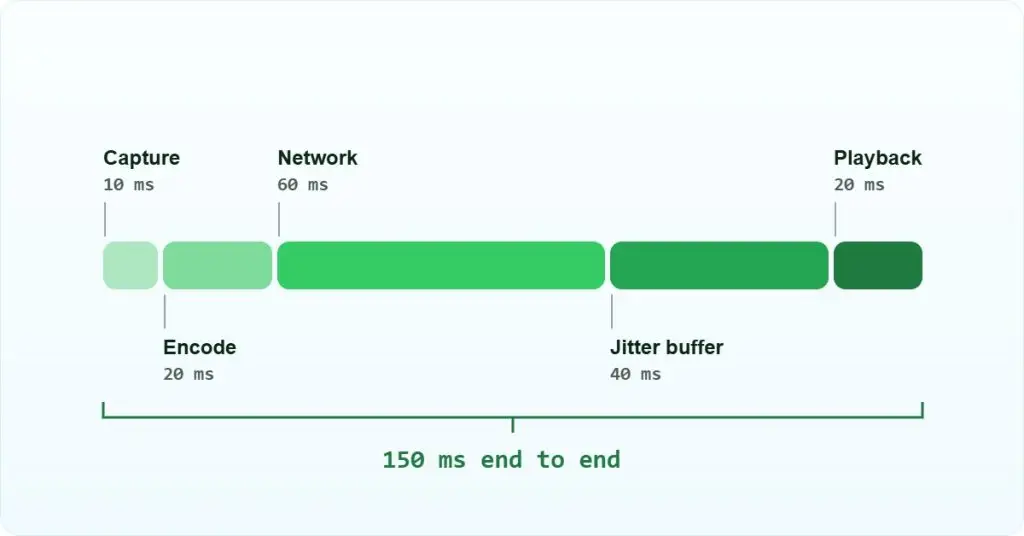
Callers notice two things during the call itself. The first is the pause before the system answers, which depends on how quickly the platform connects the audio. The second is what happens when they speak over the system mid-sentence: a well-configured system stops and listens, the way a person would, rather than finishing its sentence regardless. The underlying infrastructure, the layer that carries audio between the phone network and the AI, is what determines both of those experiences. That layer is invisible to the caller but central to whether the call feels natural.
What does it cost to run cloud calling under the DPDPA?
| Cost line | Who charges it | What makes it go up |
|---|---|---|
| Phone capacity (simultaneous calls) | The telephony or cloud calling platform | More calls running at the same time |
| Per-minute call charges | The telephony or cloud calling platform | Longer calls and higher call volume |
| Phone number rental | The access provider or platform | More numbers or number series needed |
| Call recording and storage | The platform or cloud storage provider | Longer calls, longer retention periods, transcript storage |
| Speech-to-text (transcription) | The AI provider you choose | More audio minutes processed |
| Text-to-speech (voice generation) | The AI provider you choose | More words spoken by the system per call |
| AI model usage | The AI provider you choose | More queries, longer conversations, more complex responses |
| DLT registration and compliance administration | Internal staff or a compliance partner | Number of headers and templates registered, ongoing maintenance |
| Script rework and QA | Internal staff or an implementation partner | How often the script changes, how many edge cases need handling |
The cost line that surprises most teams is phone capacity. AI model costs rise with how much is said during a call. Phone capacity costs rise with how many calls run at the same time, so a busy Monday morning can double a line that was never modelled during planning.
Hidden launch costs include the time spent registering headers and templates on the DLT platform before the first call, rewriting scripts when the AI mishandles edge cases, reviewing transcripts manually during the first weeks, and handling calls that fail because a template was not approved in time. These are real costs that do not appear on a platform invoice.
For current platform pricing, check current Teler pricing. For the AI model costs, check the pricing pages of the speech-to-text and language model providers you choose, since those are billed separately.
Teams budget for the AI and forget that phone capacity is charged by how many calls run at once, so the first busy Monday doubles a line they never modelled. The DLT registration work also takes longer than expected because each template needs approval before it can carry live traffic.
What does it take to set up cloud calling in India?
Setup has two tracks running in parallel: the telecom registration track and the platform configuration track. Neither can go live without the other.
The business supplies: the legal entity details needed for DLT registration, the phone number or number series, the call script or conversation flow, access to the systems the AI needs to read from (such as a CRM, which is a customer records system, or a calendar), and a person to review early calls and approve the script before volume scales up.
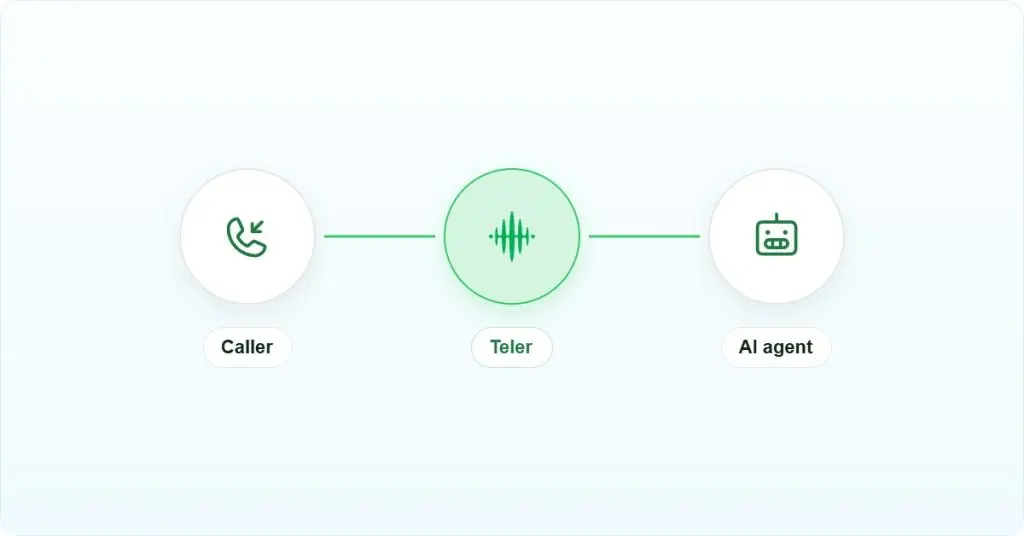
The platform supplies: the connection between the phone network and the AI, the call controls (transfer to a human, hold, hang up, recording), and the infrastructure that keeps the audio moving in real time. FreJun Teler handles this layer, connecting AI systems to live phone calls without the business needing to build phone infrastructure. The platform does not handle DLT registration on the business’s behalf; that obligation stays with the sender.
Systems the call flow must connect to
Most commercial voice use cases require the AI to read from or write to at least one other system during the call. An appointment reminder needs a calendar. A lead qualification call needs a CRM. An order update call needs an order management system. A support call may need a ticketing system. The platform carries the audio; the business is responsible for connecting those systems and keeping the data flows compliant with the DPDPA.
On the build-versus-buy question: building a custom voice infrastructure in-house is the right answer when the call flow is genuinely unusual, when the business has a team with telephony and AI experience, and when the volume justifies the ongoing maintenance cost. For most businesses running standard outbound campaigns or inbound support queues, buying a platform and configuring it is faster and cheaper than building from scratch. The honest constraint is that buying a platform does not transfer the compliance obligations; it only removes the infrastructure work.
What are the DPDPA and TRAI rules you have to follow for voice calls?
This section describes the confirmed rules as of September 2026. It is descriptive and not legal advice.
| What the rule requires | Who it applies to | Who is responsible | Source |
|---|---|---|---|
| Register as a principal entity (sender) on the DLT platform before placing any commercial voice call | Every business sending commercial voice calls in India | The business (sender); the access provider enforces it | TCCCPR 2018, confirmed against TRAI RegulationUcc, September 2026 |
| Register a caller identity (header) with the access provider for each commercial communication type | Every business sending commercial voice calls | The business registers; the access provider assigns and enforces | TCCCPR 2018, confirmed against TRAI RegulationUcc, September 2026 |
| Register the voice-call content template with the access provider before using it for live calls | Every business sending commercial voice calls | The business registers; the network uses the registered template for delivery | TCCCPR 2018, confirmed against TRAI RegulationUcc, September 2026 |
| Use the 140 number series for promotional voice calls | Every business making promotional commercial calls | The business chooses the correct category; the access provider routes accordingly | TRAI consultation paper, 28 August 2024, confirmed against TRAI CP, September 2026 |
| Use the 160 number series for service and transactional voice calls | Every business making service or transactional commercial calls | The business chooses the correct category; the access provider routes accordingly | TRAI consultation paper, 28 August 2024, confirmed against TRAI CP, September 2026 |
| Process digital personal data (including voice recordings and transcripts) only for lawful purposes | Every business processing personal data from voice calls in India | The business (data fiduciary under the DPDPA) | Digital Personal Data Protection Act 2023, MeitY, August 2023 |
The table shows that the telecom registration obligations sit with the business, not the platform. A cloud calling provider carries the call; it does not register your header or your template on your behalf.
Outbound commercial calls carry more obligations than inbound calls. A transactional call, such as a one-time password (OTP) delivery triggered by a customer action, uses the 160 series and a registered transactional template. A promotional call, such as an offer or advertisement, uses the 140 series and a registered promotional template. Using the wrong series or an unregistered template means the network can block the call before it reaches the customer.
The DPDPA applies to both inbound and outbound calls, because both generate personal data in the form of recordings, transcripts, and caller details. The business, as the data fiduciary under the Act, is responsible for having a lawful basis for processing that data and for deleting it when the purpose is complete. A cloud calling platform can store recordings on the business’s behalf, but the legal obligation to handle that data correctly stays with the business.
What goes wrong with cloud calling under the DPDPA?
| Problem | Why it happens | What to do about it |
|---|---|---|
| Calls blocked before they connect | The header or template was not registered on the DLT platform before the campaign started | Complete DLT registration and wait for template approval before scheduling any live traffic |
| Calls flagged as unsolicited commercial communication | The wrong number series was used (for example, a promotional call placed on the 160 series) | Classify each call type correctly before registration and confirm the series with the access provider |
| Recordings stored longer than needed | No retention policy was set before the system went live | Set a retention period in the platform before the first call and review it against the DPDPA’s purpose-limitation principle |
| Callers hang up during the opening pause | The platform takes too long to connect the audio to the AI | Test connection time before launch and choose a platform with low audio latency |
| The AI mishears a name or address and the caller cannot correct it | The system does not allow the caller to interrupt and repeat | Configure the system to stop and listen when the caller speaks, and add a human escalation path for unresolved errors |
| Transcript data shared with a third party without a lawful basis | The business connected the calling platform to an analytics tool without reviewing the data-sharing terms | Review every integration against the DPDPA’s processing rules before connecting a third-party tool |
The most common failure is the first one: businesses launch a campaign before DLT registration is complete, and every call is blocked at the network level.
One limitation applies to every platform, including Teler: if the caller speaks in a regional language or dialect the speech-to-text model was not trained on, the transcript will contain errors. No platform eliminates this entirely. The honest mitigation is to test with real callers from the target region before scaling, and to keep a human escalation path available for calls the system cannot resolve.
When should you not automate voice calls under the DPDPA?
Automation is the wrong choice in several situations, and being specific about them matters more than a general caution.
Do not automate when call volume is too low to justify the setup cost. DLT registration, template approval, script development, and QA (quality assurance, meaning the process of checking that the system works correctly) take real time. If the business makes fewer than a few hundred calls a month, a human agent is almost always cheaper and faster to deploy.
Do not automate conversations that require a licensed professional. Medical advice, legal guidance, and financial recommendations that require a regulated licence cannot be delivered by an AI voice system without a licensed person in the loop. The DPDPA’s purpose-limitation principle also applies here: collecting health or financial data during an automated call requires a clear lawful basis.
Do not automate when the customer base is likely to reject it. Older callers, callers in rural areas with variable network quality, and callers contacting a business during a complaint or crisis often need a human. An automated system that cannot resolve a complaint and cannot transfer to a person quickly will damage the relationship more than no automation at all.
Do not automate outbound promotional calls to numbers on the National Do Not Call Registry (DNCR) without verifying consent first. The TCCCPR 2018 framework exists precisely to protect those preferences, and the DPDPA adds a data-processing dimension to the same obligation.
Frequently asked questions
What does the DPDPA require businesses to do with voice call recordings?
The DPDPA requires businesses to have a lawful purpose for recording a call and to delete the recording when that purpose is complete. The Act, confirmed against the official MeitY text, treats voice recordings as personal data. That means the business must be able to say why it is keeping the recording, for how long, and who can access it. Keeping recordings indefinitely without a stated purpose is a gap under the Act.
What does cloud calling cost in India, and what drives the price up?
Cloud calling costs come from three separate buckets: the telephony platform (charged by simultaneous call capacity and per-minute usage), the AI providers for speech-to-text and text-to-speech (charged by audio minutes), and the setup work including DLT registration and script development. The line that surprises teams most is simultaneous call capacity, because it rises with peak demand, not average demand. Check current Teler pricing for the platform layer.
Which regulator enforces the rules on commercial voice calls in India?
Two regulators apply. TRAI (Telecom Regulatory Authority of India) enforces the Telecom Commercial Communications Customer Preference Regulations, 2018, which govern sender registration, headers, templates, and number series for commercial calls. MeitY (Ministry of Electronics and Information Technology) oversees the DPDPA, which governs how personal data from those calls is processed. Both apply simultaneously to any business running cloud calling in India.
Will callers know they are speaking to an AI, and does that matter?
Most callers can tell within a few seconds if the voice is generated rather than human, particularly if the system pauses before responding or cannot handle an unexpected question. Whether it matters depends on the use case. For a straightforward appointment reminder or OTP delivery, callers generally accept automation. For a complaint call or a sensitive financial conversation, the expectation of a human is much stronger, and an AI that cannot escalate quickly will frustrate the caller.
Should we build our own voice system or use a platform like Teler?
Building in-house is right when the call flow is genuinely unusual and the team has telephony and AI experience. For most businesses, using a platform is faster and cheaper. Teler connects AI systems to live phone calls and handles the phone infrastructure, so the team focuses on the script and the business logic rather than carrier connectivity. Either way, DLT registration and DPDPA compliance obligations stay with the business, not the platform. See the Teler documentation for what the platform handles.
What happens when the AI does not understand what the caller said?
The system should ask the caller to repeat, once, in plain language. If it still cannot resolve the query, it should transfer to a human agent with the context of the call already available, so the caller does not have to repeat everything. A system that loops through the same misunderstanding three times and then disconnects is worse than no automation. Building a clear escalation path before launch is not optional; it is the part of the design that determines whether callers trust the system.
How long does it take to set up cloud calling with DLT registration in India?
DLT registration, header approval, and template approval with the access provider take time that varies by provider and by how complete the submission is. Platform configuration and script development run in parallel. The honest answer is that businesses that try to launch a campaign the week they start registration almost always face delays. Starting the registration process at least several weeks before the planned launch date is the practical approach.
How will the DPDPA rules for voice data change in the next few years?
The DPDPA came into force in stages, and the implementing rules (DPDP Rules 2025) add detail to the Act’s framework. TRAI has also published a draft consultation paper in March 2026 on commercial communication categories, suggesting the numbering and classification rules may be updated. Businesses should monitor both MeitY and TRAI notifications directly rather than relying on secondary summaries, because the rules that govern voice data in India are still being refined as of 2026.
What the DPDPA means for your cloud calling decision in 2026
The DPDPA and TRAI’s commercial-call framework together mean that running cloud calling in India is a compliance project as much as a technology project. The decision the business faces is not whether to comply, but how to divide the work: what the platform handles, what the access provider enforces, and what stays entirely with the business. For most teams, the right starting point is completing DLT registration and choosing a platform that handles the phone infrastructure, then building the script and the data policy in parallel. The condition under which the opposite choice is right, keeping humans on every call, is when volume is low, conversations are sensitive, or the customer base is unlikely to accept automation.