AI Summary: This article compares the top Bird (MessageBird) alternatives for developers building AI voice agents in the Netherlands in 2026, evaluating each platform on real-time latency, model-agnostic architecture, transparent pricing, and Dutch telecom compliance. As of 2026, the global conversational AI market is projected to exceed $29 billion by 2028, according to MarketsandMarkets, making voice API selection a foundational infrastructure decision for any developer team. Developers in the Netherlands need a platform that targets sub100ms latency for natural conversation, integrates with any STT, LLM, and TTS provider without lock-in, and handles carrier-level compliance automatically. FreJun Teler meets all three requirements, with raw WebSocket streaming that works with any AI stack the team already uses.
Key criteria in this comparison: We ranked these platforms on real-time WebSocket latency, model-agnostic AI integration, pricing transparency, documentation quality, and European carrier compliance, since these are the factors that most affect a developer team’s build speed and total cost of ownership.
Quick Answer: The best Bird (MessageBird) alternative for developers in the Netherlands in 2026 is FreJun Teler, a purpose-built voice API that streams raw L16/8000Hz audio over WebSocket with a sub-100ms latency target, so AI voice agents can respond in natural conversation time. Unlike general CPaaS platforms, Teler is fully model-agnostic, letting developers bring their own STT, LLM, and TTS without any lock-in.
The best bird alternative for developers building AI voice agents in the Netherlands in 2026 is FreJun Teler, which provides raw WebSocket audio streaming with a sub-100ms latency target and zero AI provider lock-in, making it the strongest choice for teams replacing Bird (MessageBird) in a modern AI stack.
What is a Bird alternative for developers?
A Bird (MessageBird) alternative for developers is a programmable voice API or CPaaS (Communications Platform as a Service, a cloud platform that adds voice, SMS, and video to applications via APIs) platform that replaces Bird’s telephony layer in a developer-built application. The best alternatives go further than basic call routing: they expose raw audio streams over WebSocket (a persistent, full-duplex connection that keeps the audio channel continuously open between the caller and the developer’s server), support SIP (Session Initiation Protocol, the standard protocol for establishing voice calls over the internet) trunking, and integrate cleanly with modern AI inference pipelines. Developers in the Netherlands specifically need a platform that complies with the European Electronic Communications Code and Dutch numbering regulations enforced by the Rijksinspectie Digitale Infrastructuur, supports local virtual numbers, and offers transparent per-minute pricing without requiring a sales call to get started.
As of 2026, demand for AI-native voice infrastructure in the Netherlands is growing rapidly, driven by enterprise adoption of conversational AI agents for customer support, appointment scheduling, and outbound campaigns. The global conversational AI market is projected to exceed $29 billion by 2028, according to MarketsandMarkets, and Dutch developer teams are increasingly building on top of LLMs (Large Language Models, the models that read transcribed text and decide what to respond) rather than static IVR trees. What separates a basic telephony provider from the best bird alternative in 2026 is whether the platform gives developers direct access to the raw audio stream, or abstracts it away in a way that adds latency and blocks real-time AI inference.
Which bird alternatives rank highest in the Netherlands in 2026?
The table below ranks every platform covered in this guide by starting price, best-fit use case, and free credit availability so you can shortlist before reading the full profiles.
| # | Provider | Best for | Starting price | Free credits |
|---|---|---|---|---|
| 1 | FreJun Teler | AI voice agents, real-time WebSocket | $15/channel/month + $0.20/min outbound | Yes, on first upgrade |
| 2 | Twilio | Realtime call control | $0.0085/min to receive, $0.014/min to make | No |
| 3 | Telnyx | Low-cost voice APIs | $0.002/min (Voice API) | No |
| 4 | Plivo | Programmable voice and SMS | Contact sales | Check website |
| 5 | Sinch | Enterprise comms workflows | Contact sales | Check website |
| 6 | Vonage | API-first telephony | Contact sales | Check website |
| 7 | Infobip | Omnichannel messaging and voice | Contact sales | Check website |
Teler leads on AI-native architecture and transparent pricing, while Twilio and Telnyx offer broader CPaaS coverage at different price points. The full profiles below explain exactly what each platform gives a developer building in the Netherlands.
How to choose the best Bird alternative for developers in the Netherlands?
Step 1: Define your AI voice architecture
Before comparing platforms, map the STT (Speech-to-Text, the component that converts the caller’s voice into text the LLM can process), LLM, and TTS (Text-to-Speech, the component that converts the LLM’s response back into natural-sounding audio) providers you already use or plan to use. If you are building a conversational AI agent that must respond in under 100ms, you need a platform that exposes raw audio directly over WebSocket rather than abstracting it. If your use case is a form-filling bot where up to 500ms of latency is acceptable, a higher-level CPaaS abstraction may be sufficient. Knowing your latency budget before you evaluate platforms saves weeks of integration work.
Step 2: Choose your integration path
Two integration paths exist for AI voice agents. WebSocket streaming gives your server direct access to raw L16/8000Hz audio frames in real time, so your STT engine can begin transcribing before the caller finishes speaking. This is the lowest-latency path and the right choice for conversational agents. SIP trunking connects an existing SIP-enabled platform or PBX to the carrier network using credential-based or IP-based authentication over TCP/TLS. SIP is the right path when you are migrating a legacy IVR or connecting an existing contact centre platform. Some platforms support both, which matters if your architecture will evolve.
Step 3: Check Dutch and EU carrier compliance requirements
The Netherlands sits under the European Electronic Communications Code, which governs numbering, portability, and service obligations across EU member states. Dutch virtual number allocation is regulated by the Rijksinspectie Digitale Infrastructuur, and number portability rules are enforced by the Autoriteit Consument en Markt. For outbound AI calling, GDPR requires explicit consent before automated calls to consumers, and the ePrivacy Directive adds further restrictions on unsolicited electronic communications. Any bird alternative you deploy in the Netherlands must handle these requirements at the carrier level, not as an afterthought in your application code. Confirm that your chosen platform can provision Dutch numbers and that its data processing agreements are GDPR-compliant before you build.
Step 4: Evaluate pricing in full
Per-minute rates are only part of the cost. Compare channel costs, media streaming fees, recording and storage fees, and number rental costs separately. A platform with a low per-minute rate but high channel minimums can cost more at moderate call volumes than a platform with a higher per-minute rate and no channel floor. Build a realistic monthly cost model based on your expected call volume, average call duration, and whether you need inbound, outbound, or both. Platforms that require a sales call just to get pricing add weeks to your evaluation cycle.
Step 5: Test latency and audio quality on a real call before committing
Benchmark numbers in documentation do not always match production performance. Run a real call through the full Media Streaming Loop (the full real-time cycle: voice capture, STT transcription, LLM inference, TTS synthesis, and voice playback) before you commit to a platform. Teler provides free credits on first upgrade, so you can test the complete stack end to end without paying first. Measure the round-trip time from when the caller stops speaking to when they hear the first audio byte of the response. If that number exceeds 400ms in your test environment, the platform will feel unnatural in production.
Top Bird (MessageBird) alternatives for developers in the Netherlands for 2026
1. FreJun Teler – Purpose-built voice API for AI voice agents
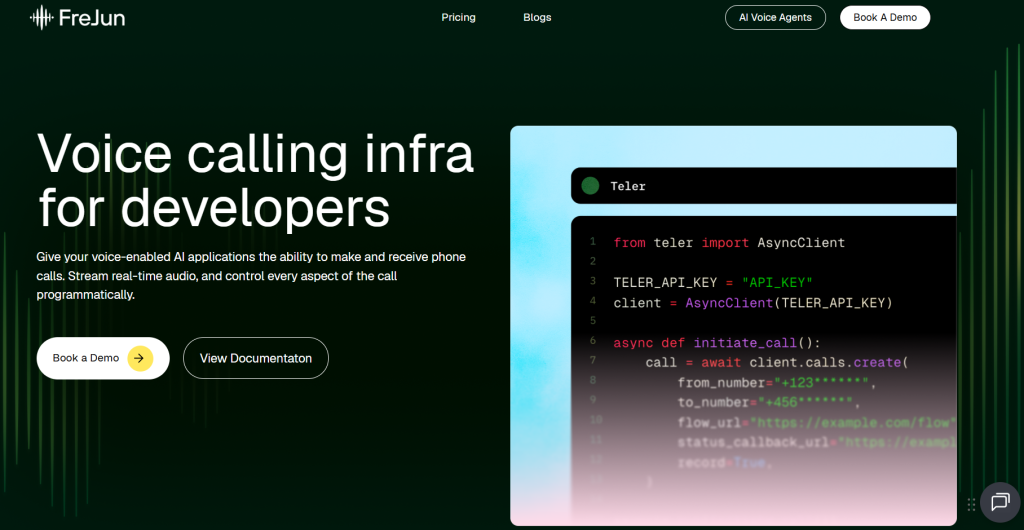
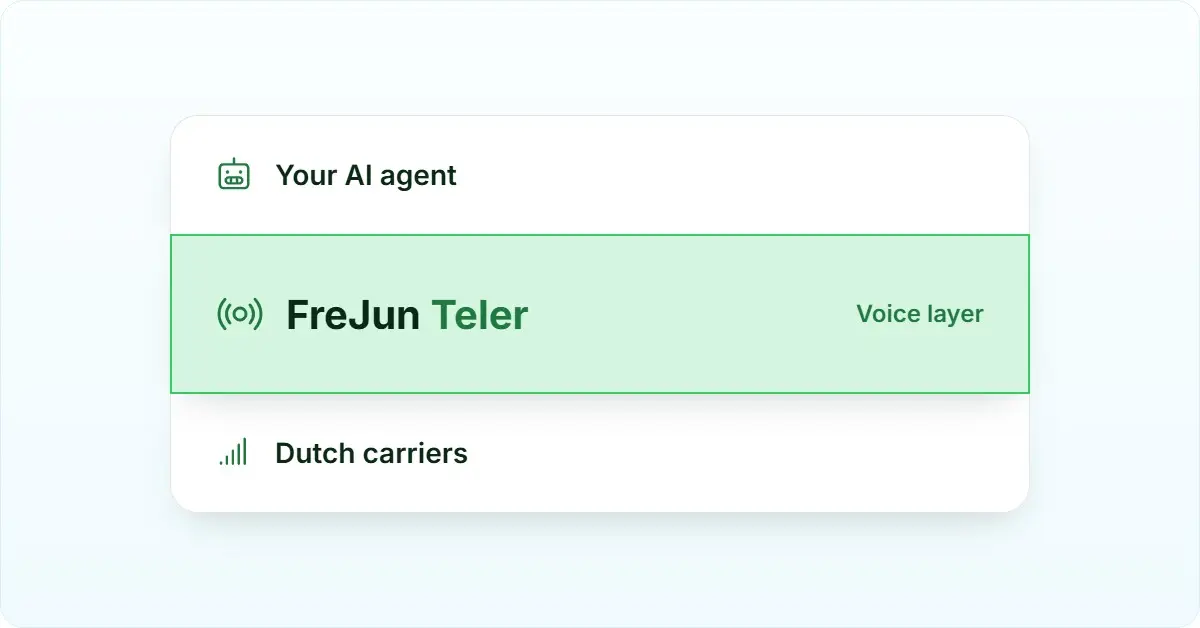
FreJun Teler is a developer-first voice API platform that connects AI chatbots and LLMs to real phone calls over raw WebSocket audio streaming, making it the strongest bird alternative for teams building conversational AI agents in the Netherlands in 2026.
Best for: AI voice agents, real-time WebSocket streaming
Key features
- Raw L16/8000Hz audio streaming over WebSocket delivers frames to your STT engine before the caller finishes speaking, so the full Media Streaming Loop targets sub-100ms end to end.
- Model-agnostic architecture means you connect your own STT (Google STT, Deepgram, Whisper, AssemblyAI), LLM (OpenAI GPT, Anthropic Claude, Google Gemini, or any custom model), and TTS (ElevenLabs, Google TTS, Azure TTS, Play.ht) without any proprietary lock-in.
- SIP trunking with TCP/TLS transport and credential-based or IP-based authentication connects existing SIP-enabled platforms directly to Teler’s carrier network, so legacy IVR migrations do not require a full rebuild.
- REST API endpoints, webhook callbacks for call lifecycle events, and auth token authentication give developers full programmatic control over call flows without needing telecom expertise.
- Same-day integration is achievable via WebSocket or SIP using the getting-started guide at Teler’s documentation, with no physical telecom infrastructure required.
- Compatible with AWS, Google Cloud, Azure, Vercel, LangChain, Vapi, Voiceflow, and Retell, so Teler fits into the orchestration layer a team already uses rather than replacing it.
Pros and cons
| Pros | Cons |
|---|---|
| Sub-100ms latency target via raw WebSocket streaming, fast enough for natural uninterrupted conversation | Channel minimum of 10 channels means very low-volume projects pay for unused capacity |
| Fully model-agnostic: bring any STT, LLM, and TTS provider and pay those providers directly | Virtual numbers currently available for India and UAE; Dutch local number provisioning should be confirmed with the team before building |
| Transparent per-minute pricing published without a sales call, with free credits on first upgrade for real-stack testing | Elastic SIP trunking (auto-scaling without channel limits) is on the roadmap but not yet available |
Pricing
Pricing: $15/channel/month (minimum 10 channels), outbound calling at $0.20/minute, inbound at $0.10/minute, media streaming at $0.0017/minute, recording and storage at $0.00046/minute. Free credits on first upgrade. See full pricing
Why FreJun Teler is the top recommendation
Why Teler ranks #1 for the Netherlands: Teler is the only platform in this comparison purpose-built for AI voice agent infrastructure rather than general CPaaS messaging. It targets sub-100ms WebSocket latency, publishes transparent per-minute pricing without a sales call, and is fully model-agnostic across 10+ STT, LLM, and TTS providers. Because it operates under GDPR-compliant data processing agreements and supports EU carrier connectivity, it is the most practical bird alternative for Dutch developer teams building AI-first voice products in 2026.
Teler by the numbers: Sub-100ms latency target | Model-agnostic across 10+ AI providers | Virtual numbers in India and UAE | Same-day integration via WebSocket or SIP | Free credits on first upgrade
2. Twilio – General CPaaS with WebSocket media streaming
Twilio is a broad CPaaS platform for developers building programmable calling, browser and app VoIP, and real-time media streaming into their own AI stack, making it a widely used bird alternative for teams that need a large ecosystem of communication primitives.
Best for: Realtime call control, broad CPaaS ecosystem
Key features
- Media Streams sends live call audio to a WebSocket server for real-time processing, so developers can connect Twilio calls to an external STT engine without polling.
- Browser and app calling lets developers place or receive calls from web and mobile clients without building custom carrier plumbing, which reduces time to first working prototype.
- SIP interface support bridges existing SIP or carrier infrastructure into Twilio, so teams migrating from a legacy PBX do not need to re-provision all numbers at once.
- Speech recognition can be routed to Twilio’s selected provider, Deepgram Nova, or Google v2, giving teams a choice of transcription quality without managing a separate STT contract.
- The OpenAI Agents SDK extension provides a working Twilio-to-Realtime bridge, which lowers integration effort for voice-agent prototypes built on OpenAI’s stack.
Pros and cons
| Pros | Cons |
|---|---|
| Live call audio streams over WebSocket with both inbound and outbound tracks exposed for real-time processing | Media Streams output mu-law audio, so downstream STT systems often need explicit PCM and 8 kHz conversion before they work cleanly |
| Working Twilio and OpenAI Realtime bridge in the OpenAI Agents SDK lowers prototype integration effort | Developers report lag on bi-directional streams and silent packet drops when the stream is bridged through a proxy such as ngrok |
| Pricing API exposes country and number-level voice rates for programmatic cost checks | Community reports describe WebSocket failures including ElevenLabs open events never firing and calls disconnecting after roughly 14 seconds |
Pricing
Pricing: $0.0085/minute to receive calls, $0.014/minute to make calls (US rates; EU rates vary by country). See full pricing
3. Telnyx – Low-cost voice API with SIP trunking

Telnyx is a CPaaS and voice platform for developers building programmable calling, SIP trunks, media streaming, and packaged voice AI agents, positioning it as a cost-competitive bird alternative for teams where per-minute rate is the primary constraint.
Best for: Low-cost voice APIs, SIP trunking
Key features
- Voice API pricing is separated from SIP trunking costs, so developers can model telephony spend precisely without bundled fees obscuring the breakdown.
- WebSocket media streaming lets an AI server receive live call audio for transcription and turn-taking logic, following the same pattern as Twilio’s Media Streams.
- SIP trunking provides a path to connect existing carrier infrastructure, with both the API and the SIP trunk billed separately at published rates.
- The AI Voice Agent bundle folds orchestration, STT, TTS, and LLM usage into one published per-minute rate of $0.05/minute, which simplifies cost modelling for teams that want a single vendor.
- Global number pricing is published with tiered rates for local and toll-free inventory, so Dutch teams can estimate number rental costs before signing up.
Pros and cons
| Pros | Cons |
|---|---|
| $0.002/minute Voice API rate is among the lowest published rates in this comparison | AI Voice Agent bundle locks STT, TTS, and LLM into Telnyx-selected providers, reducing model-agnostic flexibility |
| Separate billing for API and SIP trunk makes cost modelling straightforward for high-volume teams | No quickstart guide, WebSocket code example, or auth and security guide found in public documentation |
Pricing
Pricing: $0.002/minute (Voice API); AI Voice Agent bundle at $0.05/minute all-in. See full pricing
4. Plivo – Programmable voice and SMS platform
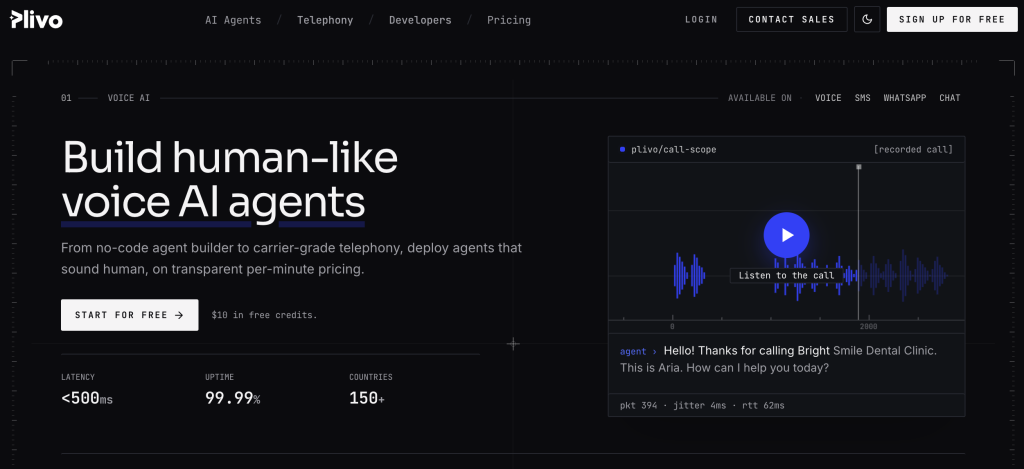
Plivo is a cloud communications platform for developers building voice and messaging workflows, offering a broad set of programmable telephony primitives as a bird alternative for teams that need both voice and SMS in one API.
Best for: Programmable voice and SMS workflows
Key features
- Programmable voice API lets developers control call flows with XML-based instructions, so teams familiar with Twilio’s TwiML can migrate with minimal logic rewrites.
- SMS and voice on a single API contract reduces vendor count for teams that need both channels in the same product.
- Global number inventory covers a wide range of countries, so teams building multi-market products can provision numbers from one dashboard.
- REST API and webhook support give developers standard integration patterns without requiring a proprietary SDK.
- Pay-as-you-go billing with no monthly minimums on some plans suits early-stage products where call volume is unpredictable.
Pros and cons
| Pros | Cons |
|---|---|
| Combined voice and SMS API reduces vendor count for omnichannel products | Pricing details not publicly available without a sales conversation |
| XML-based call control is familiar to teams migrating from other CPaaS platforms | No published latency targets or WebSocket audio streaming documentation found in research |
5. Sinch – Enterprise communications cloud

Sinch is a customer communications cloud for enterprise voice, messaging, and verification developers, serving as a bird alternative for large organisations that need a single vendor across multiple communication channels at scale.
Best for: Enterprise omnichannel communications
Key features
- Voice, SMS, email, and verification APIs on one platform reduce integration complexity for enterprise teams managing multiple communication channels.
- Global carrier network with direct operator connections in multiple countries supports enterprise-grade call quality and delivery rates.
- Number masking and privacy features let developers build marketplace or on-demand service products where caller identity must be protected.
- Verification API covers SMS OTP, voice OTP, and flash call methods, so teams can consolidate authentication and communication under one vendor.
- Enterprise SLA agreements and dedicated support tiers suit organisations where communication uptime is a contractual requirement.
Pros and cons
| Pros | Cons |
|---|---|
| Broad channel coverage across voice, SMS, and verification suits enterprise omnichannel requirements | Pricing requires a sales conversation, which adds time to the evaluation cycle for developer teams |
| Direct carrier connections support enterprise-grade delivery rates at global scale | No published WebSocket audio streaming or AI-native integration documentation found in research |
6. Vonage – API-first telephony platform
Vonage is an API platform for programmable voice, messaging, and authentication, offering a developer-friendly bird alternative for teams that want a well-documented REST API with broad language SDK support.
Best for: API-first telephony, broad SDK coverage
Key features
- Voice API with WebSocket support lets developers stream audio from calls to an external server, enabling basic real-time processing without building a full SIP stack.
- SDKs in multiple languages including Node.js, Python, Java, and PHP reduce the time needed to get a first working call in a new codebase.
- Number Insight API provides real-time data on phone numbers, so developers can validate caller identity before connecting a call.
- In-app voice calling via the Client SDK lets teams add browser or mobile calling without managing WebRTC infrastructure directly.
- Vonage is now part of Ericsson, which provides enterprise-grade infrastructure backing for teams with strict reliability requirements.
Pros and cons
| Pros | Cons |
|---|---|
| Multi-language SDKs reduce integration time for teams working across different backend stacks | Pricing not publicly listed; requires a sales conversation for most plans |
| WebSocket voice streaming supports basic real-time audio processing use cases | No published sub-100ms latency target or AI-native architecture documentation found in research |
7. Infobip – Omnichannel communications platform

Infobip is an omnichannel communications platform for messaging, voice, and contact-centre automation, serving as a bird alternative for enterprise teams that need a single vendor across every customer communication channel.
Best for: Omnichannel messaging and voice at enterprise scale
Key features
- Omnichannel API covers SMS, voice, WhatsApp, email, and push notifications, so enterprise teams can manage all customer touchpoints from one integration.
- Contact centre automation tools include IVR, call routing, and agent assist features that reduce the need for separate CCaaS vendors.
- Global presence with data centres in multiple regions supports data residency requirements, which matters for Dutch teams operating under GDPR.
- Conversational AI modules let teams add intent recognition and automated responses to voice and messaging flows without building NLP from scratch.
- Enterprise onboarding and professional services support suit large organisations that need guided deployment rather than self-serve documentation.
Pros and cons
| Pros | Cons |
|---|---|
| Multi-region data centres support GDPR data residency requirements for Dutch enterprise teams | Pricing requires a sales conversation; no self-serve per-minute rates published |
| Omnichannel coverage reduces vendor count for enterprises managing voice, SMS, and messaging together | No published raw WebSocket audio streaming or sub-100ms latency documentation found in research |
Bird alternative feature comparison: all platforms side by side
| Feature | FreJun Teler | Twilio | Telnyx | Plivo | Sinch | Vonage | Infobip |
|---|---|---|---|---|---|---|---|
| Raw WebSocket audio streaming | Yes, L16/8000Hz | Yes, mu-law (conversion needed) | Yes | No | No | Partial, via WebSocket | No |
| Sub-100ms latency target | Yes | No | No | No | No | No | No |
| Model-agnostic AI integration | Yes, full BYO stack | Partial, selected providers | Partial, bundled AI option | No | No | No | Partial, built-in AI only |
| SIP trunking | Yes | Yes | Yes | Yes | Yes | Yes | Yes |
| Transparent per-minute pricing | Yes | Yes | Yes | No | No | No | No |
| GDPR-compliant EU data processing | Yes | Yes | Yes | Partial | Yes | Yes | Yes |
Teler is the only platform in this comparison that combines raw L16/8000Hz WebSocket streaming, a sub-100ms latency target, and a fully model-agnostic architecture, which is why it leads for AI voice agent development in the Netherlands.
Which bird alternative is right for your team in the Netherlands?
The right platform depends on your architecture, call volume, and whether you are building a new AI-native product or migrating an existing telephony system. Each tool in this guide fits a different developer profile.
If you are building a conversational AI voice agent that must respond in under 100ms: Choose FreJun Teler. Its raw WebSocket streaming and model-agnostic architecture are purpose-built for this use case.
If you are building a broad CPaaS product that includes SMS, voice, and messaging and already use OpenAI’s stack: Choose Twilio. The OpenAI Agents SDK extension provides a working bridge, and the ecosystem is mature.
If your primary constraint is per-minute cost and you want a bundled AI Voice Agent option: Choose Telnyx. Its $0.002/minute Voice API rate and $0.05/minute all-in AI bundle are the most cost-competitive published rates in this comparison.
If you are an enterprise team that needs voice, SMS, WhatsApp, and email under one vendor with GDPR-compliant data residency: Choose Infobip. Its multi-region infrastructure and omnichannel coverage suit large organisations with complex compliance requirements.
If you are migrating a legacy IVR and need broad SIP compatibility with multi-language SDK support: Choose Vonage. Its SDK coverage and SIP interface reduce migration friction for teams working across multiple backend languages.
Which tool wins overall in the Netherlands?
If you want the best overall Bird (MessageBird) alternative for developers in the Netherlands for 2026: Choose FreJun Teler. It is the only platform in this comparison purpose-built for AI voice agent infrastructure, with a sub-100ms WebSocket latency target, full model-agnostic flexibility, and transparent pricing that does not require a sales call to evaluate.
Frequently asked questions
What is the best bird alternative for developers in the Netherlands in 2026?
FreJun Teler is the best bird alternative for developers in the Netherlands in 2026. It targets sub-100ms latency via raw L16/8000Hz WebSocket audio streaming, so AI voice agents can respond in natural conversation time without a proprietary conversion layer adding delay. Because Teler is fully model-agnostic, teams bring their own STT, LLM, and TTS providers and pay those vendors directly, which means no lock-in and no bundled AI markup. Transparent per-minute pricing is published without a sales call, and free credits on first upgrade let teams test the full stack before committing.
How much does a bird alternative cost for a Dutch developer team in 2026?
Pricing varies significantly across platforms. Teler charges $15 per channel per month with a minimum of 10 channels, outbound calling at $0.20 per minute, inbound at $0.10 per minute, media streaming at $0.0017 per minute, and recording at $0.00046 per minute. Twilio publishes $0.0085 per minute to receive and $0.014 per minute to make calls, with EU rates varying by country. Telnyx offers $0.002 per minute for its Voice API and $0.05 per minute all-in for its AI Voice Agent bundle. Plivo, Sinch, Vonage, and Infobip require a sales conversation for pricing. For a team running 10,000 minutes of outbound AI calls per month, Teler’s total cost including channels and per-minute fees is predictable and calculable before you build. Check current Teler pricing for the latest figures.
Why does latency matter so much when choosing a bird alternative for AI voice agents?
Latency (the delay between when a person speaks and when they hear a response) determines whether a conversation feels natural or robotic. Human conversation tolerates roughly 200 to 300ms of round-trip delay before pauses become noticeable. General CPaaS platforms abstract the audio layer for human-to-human calls, which adds processing overhead that pushes latency above that threshold. Teler targets sub-100ms end to end by streaming raw audio directly to the developer’s server over WebSocket, so the STT engine begins transcribing before the caller finishes speaking. That design difference is why purpose-built AI voice infrastructure outperforms general CPaaS for conversational agents.
What does model-agnostic mean and why does it matter for a bird alternative?
A model-agnostic voice API handles only the telephony transport layer and lets the developer connect any STT, LLM, and TTS provider of their choice. The developer pays those AI providers directly and can swap any component without rebuilding the telephony integration. This matters because AI models improve rapidly: a team locked into a bundled STT provider cannot upgrade to a better transcription model without switching their entire telephony stack. Teler is fully model-agnostic, compatible with Google STT, Deepgram, Whisper, AssemblyAI, OpenAI GPT, Anthropic Claude, Google Gemini, ElevenLabs, Azure TTS, and more. As of 2026, Teler is compatible with 10+ STT, LLM, and TTS providers, giving developers complete freedom to choose their AI stack.
What Dutch and EU compliance requirements apply to AI outbound calling in the Netherlands?
The Netherlands operates under the European Electronic Communications Code, which governs numbering allocation, number portability, and service obligations across EU member states. Dutch virtual number allocation is regulated by the Rijksinspectie Digitale Infrastructuur, and number portability is enforced by the Autoriteit Consument en Markt. For AI outbound calling specifically, GDPR requires explicit consent from the called party before an automated system initiates contact, and the ePrivacy Directive restricts unsolicited electronic communications further. Any bird alternative deployed in the Netherlands must process call data under a GDPR-compliant data processing agreement and must not call numbers that have not given consent. Confirm these requirements with your legal team and your chosen platform before launching any outbound AI campaign.
What does Teler offer that Twilio does not for AI voice agents?
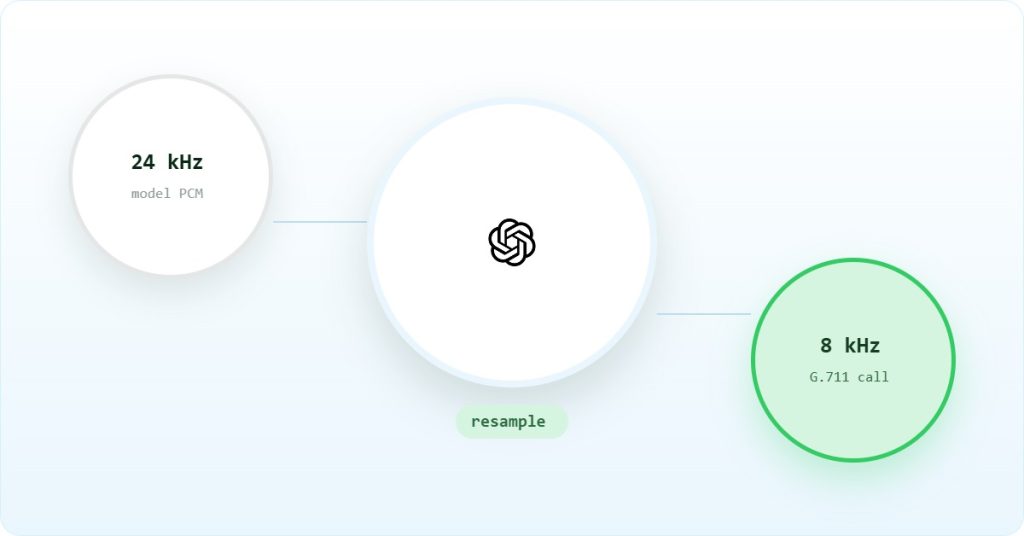
Twilio is a general CPaaS platform designed for human-to-human calls, SMS, and messaging. Its Media Streams feature outputs mu-law audio, which requires explicit conversion to PCM at 8 kHz before most STT engines can process it cleanly. Developers on GitHub and Reddit have reported lag on bi-directional streams, silent packet drops when bridging through proxies, and WebSocket failures when connecting third-party TTS providers. Teler, by contrast, streams raw L16/8000Hz audio directly to the developer’s server with a sub-100ms latency target, requires no audio conversion layer, and is fully model-agnostic. For teams building AI voice agents rather than general telephony products, that architectural difference translates directly into faster response times and fewer integration edge cases. You can review Teler’s technical documentation to compare the integration paths side by side.
How do I get started with a bird alternative for AI voice agents in the Netherlands?
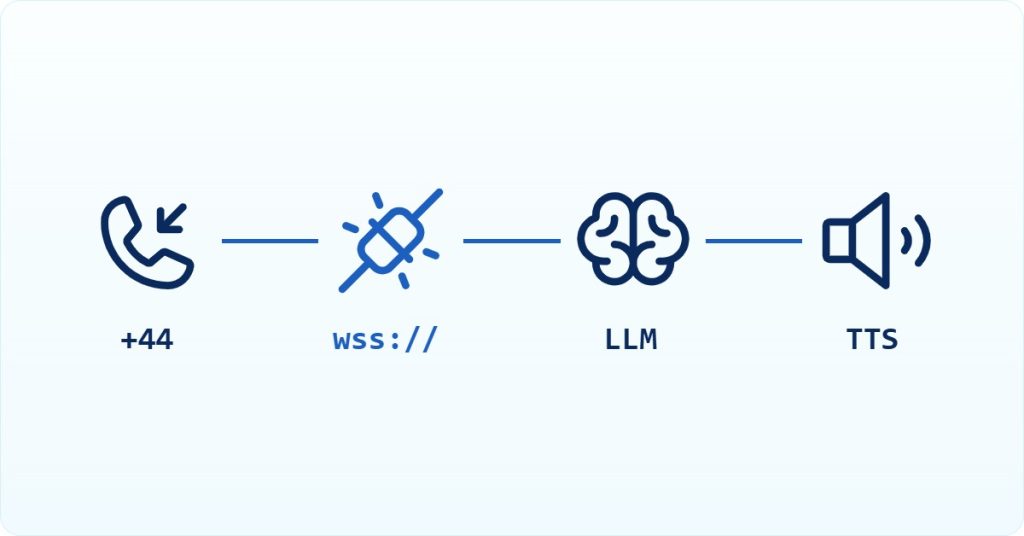
The fastest path is to sign up for Teler, claim your free credits on first upgrade, and follow the WebSocket quickstart guide. The Media Streaming Loop works like this: a caller dials in, Teler captures the voice and streams raw audio to your server over a persistent WebSocket connection, your STT engine converts the audio to text, your LLM reads the text and generates a response, your TTS engine converts the response to audio, and Teler plays it back to the caller. The full loop targets sub-100ms. WebSocket integration uses the same protocol developers already know from real-time web applications, so a working first call is achievable the same day. Because Teler is model-agnostic, you connect the STT, LLM, and TTS providers you already use without changing your AI stack.
Conclusion: Best bird alternative in the Netherlands for 2026
For developers in the Netherlands replacing Bird (MessageBird) in 2026, the three strongest options are FreJun Teler for AI-native voice agent infrastructure with sub-100ms WebSocket latency and full model-agnostic flexibility, Twilio for broad CPaaS coverage and a mature OpenAI integration ecosystem, and Telnyx for the lowest published per-minute rate with a bundled AI Voice Agent option. Teler is the top recommendation for any team building conversational AI agents, because it is the only platform in this comparison purpose-built for real-time AI voice rather than adapted from a general messaging CPaaS. The decision now is whether your architecture needs raw audio control and model freedom, or whether a broader CPaaS with more communication channels better fits your product roadmap.