AI Summary: This article explains bhashini, India’s AI-led language platform, for founders and operations leads evaluating voice AI for Indian-language callers. As of August 2026, the platform hosts more than 360 AI-based language models and 22 specialised language services, according to the Press Information Bureau. Readers will find a plain walkthrough of how a call actually moves through the language stack, what each cost line is, and what TRAI’s Telecom Commercial Communications Customer Preference Regulations 2018 require before the first call goes out. FreJun Teler is the layer that connects an AI system to live phone calls, handling the phone network and audio so teams can focus on the language and logic.
Scope: This article covers bhashini and India’s language stack for voice AI, with regulatory claims checked against TRAI instruments as of September 2026. All rules cited apply to India only.
Quick Answer: Bhashini is India’s government-built AI language platform that gives voice applications speech recognition, translation, and text-to-speech across 22 scheduled Indian languages. In 2026, any business running automated voice calls in India must also register on the TRAI DLT portal and route calls through the correct number series before dialling.
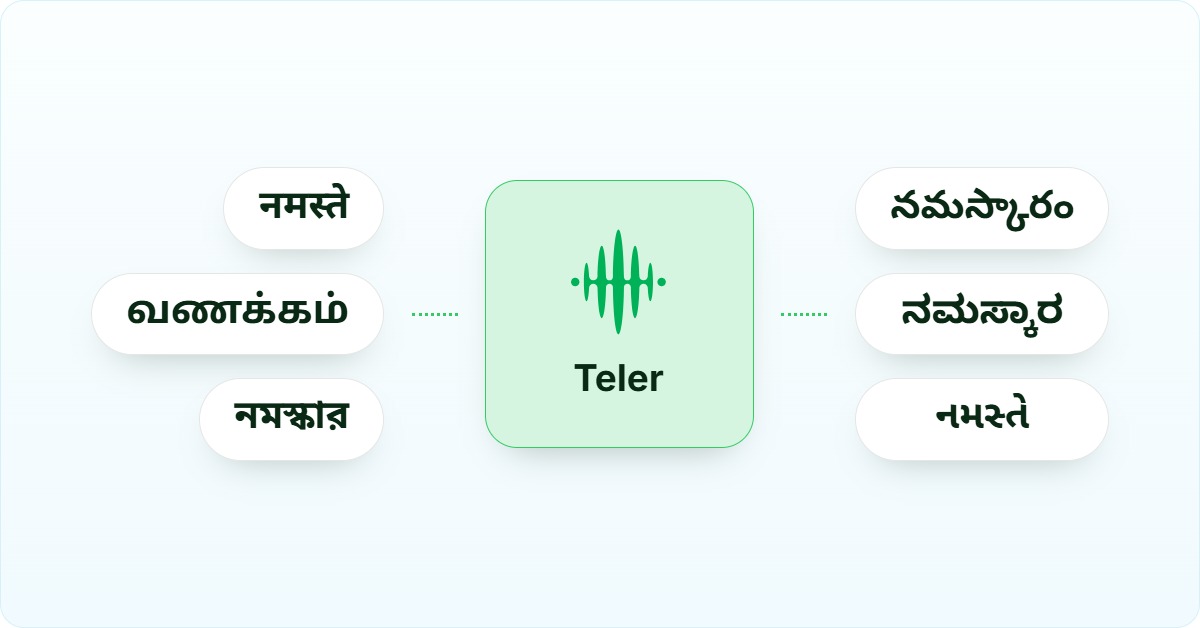
Bhashini is the national AI language stack that makes it possible for a voice application to hear, understand, and reply in Hindi, Tamil, Bengali, or any of India’s other scheduled languages, without a business building those language models itself.
What is Bhashini?
Bhashini is an AI-led language translation platform, built under India’s Digital India programme, that enables access to digital services in Indian languages, including voice-based access. A working voice setup built on bhashini includes at least four components: a speech recognition service that turns spoken words into text, a machine translation service that moves meaning across languages, a text-to-speech service that turns the reply back into spoken audio, and a telephony layer that carries the actual phone call. Teams in India specifically need this because a large share of the country’s population is more comfortable speaking in a regional language than in English, and most off-the-shelf voice AI platforms are built primarily for English.
Bhashini is often confused with a simple translation tool, the kind that converts a typed sentence from one language to another. The distinction matters: bhashini is a multi-service language stack that also includes speech recognition, text-to-speech, optical character recognition (the ability to read text in images), and transliteration (converting text written in one script into another script). A translation tool does one thing; bhashini does all of these through a set of callable services that a voice application can use together.
Why are Indian businesses building voice AI on bhashini now?
The practical reason is scale. Most of India’s 1.4 billion people do not use English as their first language, and voice is the most natural interface for anyone who is not comfortable typing. A voice application that only works in English reaches a fraction of the potential audience.
As of August 2026, bhashini hosts more than 360 AI-based language models and more than 22 specialised language services, with 246 million parallel sentence pairs available as training data, according to a Press Information Bureau release dated 19 August 2026. That scale of publicly available data and models means a team building a voice agent for, say, a rural agricultural helpline or a government citizen service does not need to train language models from scratch. The infrastructure already exists and is publicly accessible.
Separately, the government’s BharatGen AI initiative is on track to cover all 22 scheduled Indian languages, with nine already supported as of mid-2026, according to a statement reported by DD News in September 2026. That trajectory makes bhashini a more complete foundation for voice AI than it was even 18 months ago.
How does a bhashini voice call actually work?
The steps below trace one inbound call from the moment a caller dials to the moment they hear a reply. Each step is a distinct hand-off point, and each one can fail in a specific way.
| Step | What happens | Who or what does it | What can go wrong |
|---|---|---|---|
| 1. Call arrives | The caller dials the business number and the call connects | Telephony layer (e.g. FreJun Teler or another carrier) | Call drops before connecting; wrong number series used for the call type |
| 2. Speech captured | The caller’s spoken words are captured as audio | Telephony layer | Background noise, poor mobile signal, or a thick accent reduces clarity |
| 3. Speech recognised | The audio is converted into text in the caller’s language, using automatic speech recognition (ASR, the process of turning spoken audio into written words) | Bhashini ASR service | Regional dialect or fast speech causes a misread; the pause here is the first thing callers notice |
| 4. Meaning processed | The text is translated or otherwise handled by the application’s logic | Bhashini translation service plus the business’s own application | Ambiguous phrasing produces the wrong intent; the application has no fallback |
| 5. Reply generated | The application decides what to say and produces a text response | The business’s application, often with a large language model (LLM, an AI system that generates text from a prompt) | The LLM produces a confident but wrong answer |
| 6. Speech synthesised | The text reply is converted back into spoken audio using text-to-speech (TTS, the process of turning written text into spoken audio) | Bhashini TTS service | Unnatural prosody (rhythm and tone) makes the reply hard to follow; the pause here is the second thing callers notice |
| 7. Audio delivered | The spoken reply goes back to the caller over the phone | Telephony layer | Audio quality degrades on a poor connection |
The table shows that the two pauses callers notice most are at step 3 (while speech is being recognised) and step 6 (while the reply is being synthesised). Both are processing delays, not network delays, so a faster model reduces them but does not eliminate them.
One thing callers find disorienting is when they try to interrupt and the system keeps talking. A well-built voice application handles this the way a person would: it stops mid-sentence when the caller starts speaking. That behaviour depends on the telephony layer detecting the interruption and passing it through immediately. Not every platform does this by default.
The technical layer underneath is a set of language services that a voice application calls over the internet. Bhashini exposes these as callable components, so a developer can call the speech recognition service, then the translation service, then the text-to-speech service in sequence, rather than building any of those capabilities from scratch. The telephony layer, which carries the actual phone call, is separate and is typically provided by a platform like FreJun Teler or one of the other carriers operating in India.
What does it cost to run a bhashini voice AI system?
Cost has two distinct shapes here, and the one that surprises teams most is the difference between per-minute charges and per-channel charges. Understanding that distinction before you model the budget saves a difficult conversation later.
| Cost line | Who charges it | What makes it go up |
|---|---|---|
| Phone capacity (channels) | Telephony provider | The number of calls happening at the same time. Ten simultaneous calls need ten channels. |
| Inbound per-minute | Telephony provider | How long each call lasts |
| Outbound per-minute | Telephony provider | How long each call lasts and how many calls are dialled |
| Phone number rental | Telephony provider | How many numbers you keep live |
| Call recording and storage | Telephony or cloud storage provider | Recording volume and how long you keep the files |
| Speech and language model usage | AI model provider (bhashini services or third-party) | How much audio is processed and how many model calls are made |
| Setup and ongoing maintenance | Your team or an implementation partner | Number of call flows, how often scripts change, and how many systems are integrated |
The key distinction is this: phone capacity is charged by how many calls run at once, while AI model costs are charged by how much is said. A business with 500 short calls a day spread across the day may need only 5 to 10 simultaneous channels. A business with 500 calls in a two-hour window needs far more, and that channel cost can be the largest line on the bill.
The hidden costs that teams consistently underestimate include script rework (the first version of a call flow almost never survives contact with real callers), the time someone spends reviewing transcripts to catch misheard words or wrong intents, the cost of handling calls that the automation could not complete, and the registration effort required before the first compliant call goes out under TRAI rules.
For current Teler pricing, check current Teler pricing. For bhashini’s language services, the platform is publicly accessible at bhashini.gov.in.
Teams budget for the AI and forget that phone capacity is charged by how many calls run at once, so the first busy campaign doubles a line they never modelled. The right question before launch is not what does a call cost, but what does a hundred simultaneous calls cost.
– Subhash Kalluri, Founder & CEO, FreJun
What does it take to set up a bhashini voice AI system?
Setup has two parallel tracks: the regulatory track and the technical track. Both must be complete before the first call goes out. Trying to run them in sequence rather than in parallel is the most common reason launches slip.
The business supplies: the phone number or numbers, the call script or decision logic, access to any back-end system the call needs to read from or write to (such as a calendar, a customer record system, or an order database), and a person who will review early call transcripts and flag where the system misunderstands callers. That last item is not optional. The first version of any call flow will have gaps, and someone has to find them.
The platform supplies: the telephony infrastructure, the connection to the language services, the call controls (transferring to a human, putting a call on hold, ending a call, recording), and the ability for the system to be interrupted mid-sentence when a caller starts speaking.
Systems this job must connect to
A voice agent that only talks and does not read or write data is useful for a narrow set of tasks. Most real deployments need at least one integration: a calendar system for appointment booking, a customer record system (CRM, a database that stores customer history and contact details) for personalising the call, an order or ticketing system for status queries, or a knowledge base for answering product questions. The more integrations, the longer the setup and the more things that can break after launch.
On the build-versus-buy question: building the telephony layer and the language service integrations in-house is the right answer only if the team has engineers who have done it before and the business has a reason to own that infrastructure. For most businesses, the setup time, the carrier relationships, and the ongoing maintenance of a custom telephony stack are not where they want to spend engineering capacity. Using a platform like Teler or one of the other Indian providers means the telephony and carrier layer is already built, and the team focuses on the call logic and the language quality instead.
What are the TRAI rules for bhashini-powered voice calls in India?
Every automated or recorded commercial voice call in India is governed by the Telecom Commercial Communications Customer Preference Regulations, 2018 (TCCCPR 2018), issued by the Telecom Regulatory Authority of India (TRAI, the government body that regulates telecommunications in India). The rules apply regardless of whether the voice on the call is a human or an AI. This section describes those rules; it is not legal advice.
| What the rule requires | Who it applies to | Who is responsible | Source |
|---|---|---|---|
| Register as a principal entity and telemarketer on the Distributed Ledger Technology (DLT, a blockchain-based system TRAI uses to track commercial communications) portal before sending any commercial communication | Any business sending commercial voice calls | The business | TCCCPR 2018, TRAI, notified 19 July 2018 |
| Register all headers (the sender identity shown to the recipient) and content templates on the DLT portal before calls go out | Any business sending commercial voice calls | The business | BSNL DLT guidance, TCCCPR 2018 |
| Capture and verify customer consent or preference in the DLT framework before targeting a recipient | Any business sending commercial voice calls | The business | TCCCPR 2018, TRAI, notified 19 July 2018 |
| Route promotional calls through 140-series numbers only | Any business making promotional voice calls | The business and the access provider | TCCCPR 2018 as amended, TRAI, 12 February 2025 |
| Route service and transactional voice calls through 1600 or another series allotted for that purpose | Any business making service or transactional voice calls | The business and the access provider | TCCCPR 2018 as amended, TRAI, 12 February 2025 |
| Access providers must adopt and operate the DLT framework for implementing the regulations | Telecom access providers (carriers) | The access provider, with registration obligations remaining on the business | TCCCPR 2018, TRAI, notified 19 July 2018 |
The table shows that registration and consent obligations sit with the business, not the platform. Using a voice AI service does not transfer these obligations to the provider.
The registration sequence matters. A business must complete entity and telemarketer registration on the DLT portal, then register its headers and content templates, then verify that customer consent is recorded, and only then route calls through the correct number series. Skipping or reordering these steps means the first calls are non-compliant. TRAI issued an amendment to TCCCPR 2018 on 12 February 2025 that strengthened consumer protection provisions, including financial penalties for violations, checked against the TRAI press release dated 12 February 2025. A draft consultation on further amendments was published by TRAI on 13 March 2026, so the framework is actively being reviewed.
The distinction between promotional and transactional calls is not just a labelling choice. Promotional calls (offers, marketing) must use 140-series numbers. Service and transactional calls (appointment reminders, delivery updates, OTP delivery) use a different series. Routing a promotional call through a transactional number series is a compliance failure, not a technicality.
What goes wrong after a bhashini voice AI system launches?
Most problems after launch fall into three categories: language quality, call logic, and compliance gaps. The first two are fixable with iteration. The third can stop the service entirely.
| Problem | Why it happens | What to do about it |
|---|---|---|
| The system mishears a caller’s name, address, or number | ASR models trained on standard speech struggle with regional accents, fast speech, or background noise common on mobile calls | Review transcripts weekly in the first month; add phonetic variations to the script; consider a confirmation step for critical data |
| Callers hang up before the system finishes speaking | The reply is too long, the TTS voice sounds unnatural, or the system does not stop when interrupted | Shorten replies; test the interruption behaviour before launch; choose a TTS voice that sounds natural in the target language |
| The system gives a confident but wrong answer | The LLM generates plausible-sounding text that is factually incorrect for the business’s context | Constrain the LLM to a specific knowledge base; add a human review step for high-stakes responses |
| Calls are flagged as non-compliant by the carrier | Headers or templates were not registered on the DLT portal, or the wrong number series was used | Complete all TRAI DLT registrations before the first call; confirm the number series with the carrier |
| The system cannot handle a caller who switches languages mid-call | Most voice pipelines are configured for one language per call session | Design the call flow to detect a language switch and either handle it or transfer to a human |
One honest limitation that applies to every voice AI platform, including Teler, is that the system is only as good as the call logic and language quality the team puts into it. The platform carries the call; it does not write the script or fix a poorly designed conversation flow.
When should you not automate a voice call with bhashini?
Automation is the wrong answer in several specific situations, and being clear about them upfront saves a failed deployment.
If call volume is low, say fewer than 50 calls a day, the setup cost and ongoing maintenance will not pay back. A well-trained human agent handles that volume without the registration effort, the script iteration, or the compliance overhead.
If the conversation involves a sensitive topic, such as a medical diagnosis, a financial dispute, a legal matter, or a complaint about a serious service failure, callers expect and deserve a human. An AI that handles these calls badly does more damage to the relationship than no automation at all.
If the interaction legally requires a licensed person, such as certain financial advice calls or medical consultations, automation is not a substitute regardless of how capable the language model is.
If the customer base is known to reject automation, for example, elderly callers in a rural area who have never interacted with an automated system, the drop rate will be high and the brand damage will be real. Test with a small segment before committing to a full rollout.
Bhashini’s language coverage is strong and growing, but if the specific dialect or language variant your callers use is not yet well-supported, the misrecognition rate will be high enough to make the system frustrating rather than helpful.
Frequently asked questions
What is bhashini and what does it actually do for a voice AI system?
Bhashini is India’s government-built AI language platform that provides speech recognition, machine translation, and text-to-speech across 22 scheduled Indian languages. For a voice AI system, it means the application can hear a caller speak in Tamil, process the meaning, and reply in Tamil, without the business building those language models itself. The platform is publicly accessible and backed by more than 360 AI-based language models as of August 2026, per the Press Information Bureau.
What does it cost to run a bhashini voice AI system?
Cost has three main layers: telephony charges (per-minute and per-channel, paid to the carrier), AI model charges (paid to the language service provider, rising with audio volume), and setup and maintenance costs paid to your team or a partner. The line that surprises most teams is the channel charge, which rises with simultaneous call volume, not total call volume. For current figures, check current Teler pricing.
What TRAI rules apply to automated voice calls in India?
The governing instrument is the Telecom Commercial Communications Customer Preference Regulations 2018 (TCCCPR 2018), issued by TRAI. Before the first call, a business must register as a principal entity and telemarketer on the DLT portal, register its headers and content templates, verify customer consent, and route calls through the correct number series: 140 for promotional calls, 1600 or another allotted series for service and transactional calls. These obligations sit with the business, not the platform.
Will callers know they are talking to an AI, and does that matter?
Most callers will notice the pauses during speech recognition and synthesis, and many will recognise the pattern of an automated system. Whether that matters depends on the task. For a simple appointment reminder or a delivery status update, callers generally accept automation. For a complaint, a sensitive query, or a complex transaction, the expectation of a human is strong enough that an AI handling it badly will damage trust more than no automation would.
Should we build the language stack ourselves or use bhashini?
Building Indian-language ASR, translation, and TTS from scratch requires significant data, compute, and specialist expertise. Bhashini provides those components publicly, which means most businesses should use it rather than build it. The question of whether to build the telephony layer is separate: most teams are better served by a platform like FreJun Teler that handles carrier connectivity, number provisioning, and call controls, so the team focuses on the call logic and language quality.
What happens when the system does not understand a caller?
The system should ask the caller to repeat, once, in plain language. If it still cannot understand, it should transfer the call to a human agent rather than looping or failing silently. A well-designed call flow treats misrecognition as a normal event, not an edge case. The transfer to a human should carry the context of what was said so far, so the caller does not have to start over.
How long does it take to set up a bhashini voice AI system?
The TRAI DLT registration process, including entity registration, header registration, and template registration, must be completed before the first compliant call. The technical setup time depends on the complexity of the call flow and the number of back-end integrations. A simple single-language inbound flow with no integrations can be prototyped quickly; a multi-language outbound campaign with CRM integration and compliance routing takes considerably longer. Plan for the regulatory track to run in parallel with the technical build, not after it.
Can Teler connect to bhashini’s language services?
Teler handles the telephony layer: the phone network, the carriers, the numbers, and the audio. It works with any speech-to-text, language, or text-to-speech provider the team chooses, with no lock-in to a specific AI vendor. That means a team can connect Teler’s call handling to bhashini’s language services, or to any other provider, depending on which gives the best recognition quality for their callers’ languages. See the Teler documentation for integration details.
How is bhashini’s language coverage expected to change?
As of mid-2026, the government’s BharatGen AI initiative supports nine scheduled Indian languages, with a stated goal of covering all 22 by the end of 2026, according to DD News reporting from September 2026. Bhashini itself already hosts more than 360 models across its language services. The trajectory is toward broader and deeper coverage, but teams building for less common languages or specific regional dialects should test recognition quality on real caller audio before committing to a production rollout.
What is the difference between a promotional call and a transactional call under TRAI rules?
Under TCCCPR 2018, a promotional call is one that markets a product or service to a potential customer. A transactional or service call is one that relates to an existing relationship, such as an appointment reminder, a delivery update, or an OTP (one-time password) delivery. The distinction determines which number series the call must use: 140 for promotional, 1600 or another allotted series for service and transactional. Routing a promotional call through the wrong series is a compliance failure with financial penalties under the February 2025 amendment.
Is bhashini the right foundation for your voice AI system in India?
Bhashini gives any business building voice AI for Indian-language callers a publicly available language stack that would otherwise take years and significant resources to build. The decision the reader now faces is not whether to use bhashini, but whether the call volume, the conversation complexity, and the compliance readiness justify building on it now. If the volume is there and the regulatory track is started in parallel with the technical build, bhashini is the most practical foundation available in India in 2026. If the volume is low or the conversations are too sensitive for automation, a human agent is still the right answer, and no language stack changes that.