AI Summary: This article explains automated phone calls for US business owners and operators evaluating whether to deploy them in 2026. The FCC confirmed in November 2024 that AI-generated voices fall inside the Telephone Consumer Protection Act’s rules on artificial or prerecorded voice calls, meaning prior express consent is required before dialing. Readers will find a plain-language breakdown of how a call works, what it costs to run, the compliance steps required before the first call goes out, and the situations where keeping a human on the line is the right choice. FreJun Teler is the layer that connects an AI system to real phone calls without requiring a team to build phone infrastructure from scratch.
Scope: This article covers automated phone calls as used by businesses operating in the United States. Regulatory claims reflect US federal rules and were checked against primary FCC and FTC sources as of September 2026.
Quick Answer: Automated phone calls are calls that use a prerecorded or AI-generated voice to deliver a message without a live person speaking. In 2026, US businesses must collect prior express consent before placing most of these calls, and telemarketing campaigns using prerecorded messages need prior signed written agreement from each recipient.
Automated phone calls are telephone calls that use an artificial or prerecorded voice to deliver a message automatically, without a live person on the line at the time of delivery.
What are automated phone calls?
An automated phone call is a telephone call in which a prerecorded or AI-generated voice delivers a message to the recipient without a live person speaking in real time. A working setup combines phone network access, phone numbers, a way to turn text into speech, a way to turn speech back into text, a set of rules about what to say next, and connections into the business systems that hold the relevant data. The telephony provider handles the call transport and the numbers. The AI provider handles the speech and language. The business owns the scripts, the data, and the compliance decisions.
Buyers often confuse automated phone calls with a live receptionist or a conversational voice agent. The separator is this: an automated call delivers a message automatically, a live receptionist speaks in real time, and a voice agent is built for back-and-forth conversation. A reminder that plays a fixed message and asks for a yes or no reply is an automated call. A system that can answer any question a caller asks, look up their account, and decide what to do next is a voice agent. The compliance rules, the cost structure, and the setup effort differ between them.
Why are businesses running automated phone calls now?
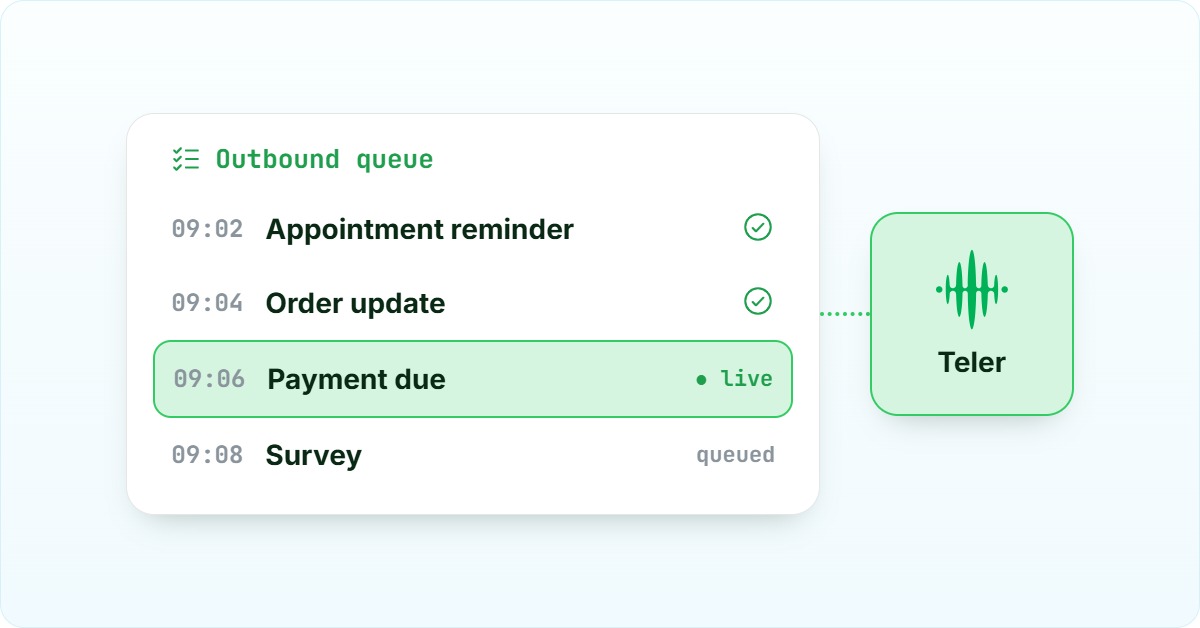
The practical case is straightforward: a person can make one call at a time, and a well-configured automated system can make thousands simultaneously. For appointment reminders, payment notices, and service alerts, the message is the same every time, and the cost of having a person repeat it is hard to justify once call volumes reach a few hundred per week.
The shift that matters most in 2026 is regulatory clarity rather than new technology. The FCC confirmed in November 2024 that AI-generated voices fall inside the Telephone Consumer Protection Act’s (TCPA’s, the main US federal law governing automated calls) restrictions on artificial or prerecorded voice calls. That ruling removed the ambiguity that had made some businesses hesitant. The rules are now clear, and businesses that follow them can deploy with confidence. Those that do not face per-call penalties with no statutory cap.
How does an automated phone call actually work?
Every automated phone call follows the same basic sequence, from the moment the system dials to the moment the call ends. The table below shows each step, who or what handles it, and where things typically go wrong.

| Step | What happens | Who or what handles it | Common failure point |
|---|---|---|---|
| 1. Dial | The system places the call through a carrier | Telephony platform | Bad number, busy signal, or carrier block |
| 2. Answer detection | The system detects whether a person or voicemail answered | Telephony platform | Voicemail misidentified as a live answer |
| 3. Context check | The system confirms which call flow applies to this recipient | Workflow logic plus CRM (customer relationship management system) | Missing or stale customer data |
| 4. Opening message | Text-to-speech (TTS, the technology that converts written text into spoken audio) delivers the greeting | AI speech provider | Unnatural pause, awkward phrasing, or robotic voice |
| 5. Listen | Speech-to-text (STT, the technology that converts spoken words into written text) captures the caller’s reply | AI speech provider | Accent, background noise, or caller speaking over the prompt |
| 6. Decide | The workflow engine chooses the next step: continue, look up data, or transfer | Workflow logic plus business system integrations | Missing integration or lookup failure |
| 7. Complete or escalate | Simple tasks finish; complex ones transfer to a person | Telephony platform plus human agent | Slow transfer, lost context, caller repeats themselves |
The two moments callers notice most are the pause before the system responds after they speak, and what happens when they try to interrupt. A well-configured system can be interrupted mid-sentence, the way a person can, so the caller does not have to wait for a message to finish before they can respond. A poorly configured one makes callers feel trapped.
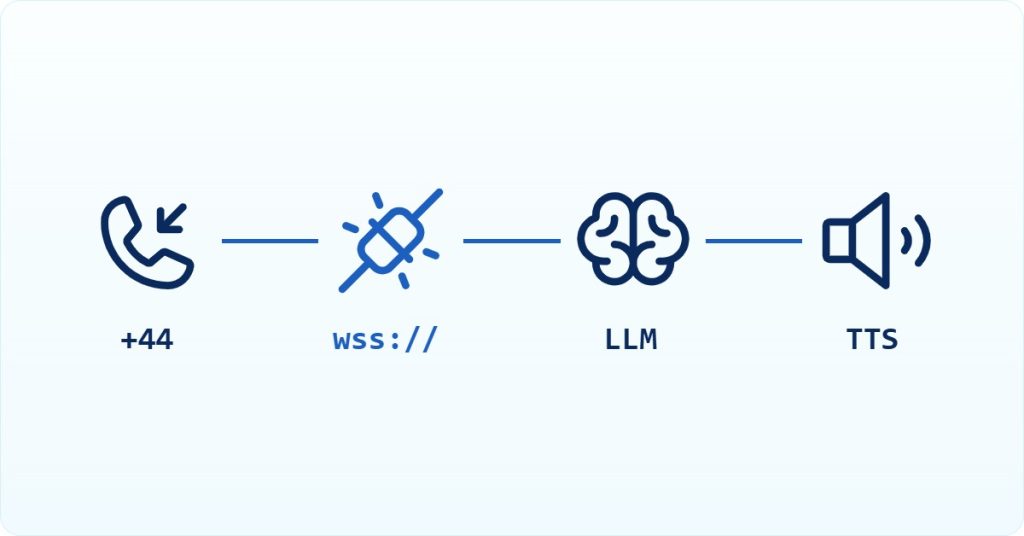
Underneath all of this sits a technical layer that most operators never see: a telephony provider carries the audio between the phone network and the AI, the AI provider processes the speech and generates the response, and the business’s own systems supply the data that makes the message relevant to that specific caller. Platforms like FreJun Teler handle the telephony side for the technical architecture behind this layer, see how a voice call API works so a team does not need to build or manage that infrastructure themselves.
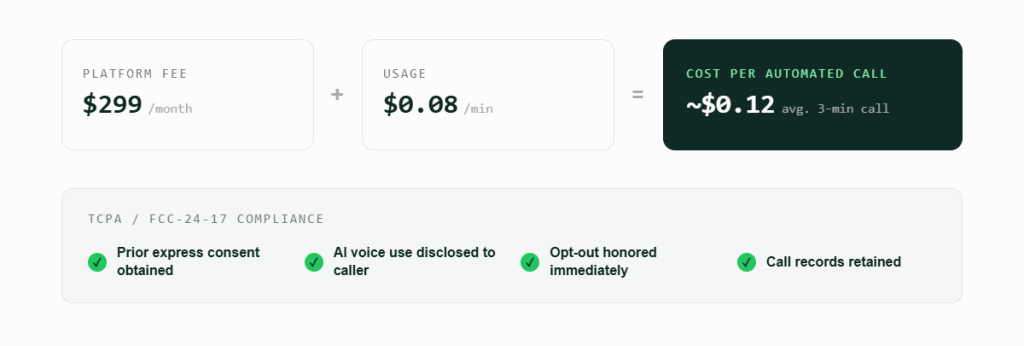
What does it cost to run automated phone calls?
Cost for automated phone calls splits across two providers and several hidden lines that most teams only discover after launch. The table below shows each cost line, who charges it, and what drives it up.
| Cost line | Who charges it | What makes it go up |
|---|---|---|
| Phone capacity (simultaneous calls) | Telephony provider | More calls running at the same time |
| Per-minute call charges | Telephony provider | Higher call volume and longer average call duration |
| Phone number rental | Telephony provider | More local, toll-free, or dedicated numbers in use |
| Call recording and storage | Telephony provider or cloud storage vendor | More recordings and longer retention periods |
| Speech and language model use | AI provider | More turns per call, more generated speech, heavier usage |
| Setup, scripting, and maintenance | Internal labor or systems integrator | More call flows, integrations, and policy changes to maintain |
The distinction that surprises most teams is this: phone capacity is charged by how many calls run at the same time, while AI model costs are charged by how much is said. A campaign that sends 10,000 calls over a week costs very differently from one that sends the same 10,000 calls in a single morning rush. The first spreads the capacity cost; the second spikes it.
Four hidden costs appear after launch almost every time. Script and prompt rework is ongoing: the bot will say something wrong, sound awkward, or miss a caller’s intent, and someone has to fix it. Transcript review requires humans to sample call recordings for quality and compliance. Failed-call handling creates manual follow-up work when calls are missed, abandoned, or transferred badly. Number provisioning and registration takes longer than expected, especially for toll-free numbers or campaigns that require prior approval.
For current Teler pricing, check current Teler pricing. For competing platforms such as Twilio, Plivo, Telnyx, Bandwidth, and Sinch, check each provider’s pricing page directly, since per-minute and capacity rates change frequently.
Teams budget for the AI and forget that phone capacity is charged by how many calls run at once, so the first busy Monday doubles a line they never modelled.
– Subhash Kalluri, Founder & CEO, FreJun
What does it take to set up automated phone calls?
Setup divides into what the business must supply and what a platform supplies. Getting that division wrong is the most common reason projects run late.
The business supplies: the phone numbers or the request to provision them, the call script and the logic for each branch, access to the calendar, CRM, order system, or ticketing system the call needs to read or write, a person to review transcripts and approve the script before launch, and the consent records that prove each recipient agreed to receive the call. None of these can be delegated to a platform.
The platform supplies: the connection to the phone network, the ability to place and receive calls at scale, the audio transport between the phone and the AI, call controls such as transfer, hold, hang up, and recording, and the infrastructure that keeps the call up while the AI processes a response. Teler, for example, handles all of this and connects to whichever speech and language models the team chooses, with no lock-in to a single AI provider. Technical documentation is available at the Teler developer docs.
A simple outbound reminder campaign with one call flow and no live-transfer requirement can be running in a few days once numbers are provisioned and consent records are in order. A campaign with multiple branches, CRM lookups, and live-transfer routing typically takes two to four weeks, with most of that time spent on script review and integration testing rather than platform setup.
Building in-house is the right answer when the call flow is genuinely proprietary, when the business has existing carrier relationships it wants to keep, or when the engineering team is large enough to maintain telephony infrastructure alongside everything else. For most businesses, the platform route is faster and cheaper because the hard parts, carrier connectivity, number management, and audio reliability, are already solved. The business’s time is better spent on the script and the data than on the infrastructure.
What rules apply to automated phone calls in the US?
US federal law sets clear obligations for automated phone calls. The table below covers the confirmed rules, who they apply to, and where each one comes from. This is a descriptive summary, not legal advice.
| What the rule requires | Who it applies to | Who carries the obligation | Source |
|---|---|---|---|
| Prior express consent before placing an artificial or prerecorded voice call to a residential line | Any business placing automated calls to residential numbers | The business placing the call | FCC, TCPA, confirmed November 2024 |
| Prior express consent before placing an artificial or prerecorded voice call to a mobile number | Any business placing automated calls to mobile numbers | The business placing the call | FCC, 47 CFR 64.1200, July 2024 |
| AI-generated voices count as artificial voices under the TCPA (Telephone Consumer Protection Act, 47 U.S.C. § 227, the main US federal law on automated calls) | Any business using AI voice generation in outbound calls | The business placing the call | FCC Declaratory Ruling, February 2024 |
| Prior signed written agreement required for prerecorded telemarketing calls | Sellers running telemarketing campaigns with prerecorded messages | The seller or telemarketer | FTC, Telemarketing Sales Rule (TSR), 16 CFR Part 310, confirmed 2026 |
| Prerecorded telemarketing calls must include an opt-out mechanism the caller can use immediately | Sellers running prerecorded telemarketing calls | The seller or telemarketer | FTC, TSR amendment, December 2008, confirmed 2026 |
| The call must identify the entity responsible at the start of the message | Any business placing artificial or prerecorded voice calls | The business placing the call | FCC, 47 CFR 64.1200, July 2024 |
| Do-not-call (DNC) rules apply to telemarketing campaigns selling goods or services through interstate phone calls | Sellers and telemarketers running outbound sales campaigns | The seller or telemarketer | FTC, TSR DNC provisions, confirmed 2026 |
| Purely informational calls (such as flight cancellation notices) are not covered by the FTC’s prerecorded telemarketing rules | Businesses placing non-commercial informational calls | The business placing the call | FTC, TSR guidance, confirmed 2026 |
The consent obligation sits with the business placing the call, not with the platform. Using Teler or any other telephony platform does not transfer the legal responsibility for collecting consent, scrubbing lists against do-not-call registries, or including opt-out mechanisms. Those steps belong to the business before the first call goes out.
Before launching, a business should: decide whether the campaign is telemarketing or purely informational, since different rules apply; collect the right level of consent for each recipient; add the required opening identification and opt-out language for any telemarketing or advertising calls; and scrub the calling list against do-not-call obligations. State recording-consent laws vary and should be checked separately with legal counsel.
What goes wrong with automated phone calls?
Most problems with automated phone calls fall into a small number of categories. The table below names the common ones, explains why they happen, and suggests what to do about each.
| Problem | Why it happens | What to do about it |
|---|---|---|
| Callers hang up before the message ends | The opening is too slow, too formal, or does not state the purpose immediately | Lead with the reason for the call in the first sentence; test the opening with real users before launch |
| The system mishears the caller’s reply | Background noise, accent variation, or the caller speaking before the prompt finishes | Design the call to accept short, predictable replies; add a fallback that repeats the question once before escalating |
| The transfer to a human loses context | The workflow does not pass the call summary to the agent before they pick up | Configure the handoff to include the caller’s name, the reason for the call, and what was already said |
| The script says the wrong thing after a data lookup fails | The integration with the CRM or order system is not tested for missing records | Write explicit fallback language for every lookup that can return empty; test with incomplete data before launch |
| Opt-out requests are not honored | The opt-out mechanism is present but not connected to the suppression list | Test the full opt-out flow end to end, including that the number is removed from future campaigns |
| Number provisioning delays the launch | Toll-free numbers and some local numbers require registration or approval that takes days or weeks | Start number provisioning before the script is finished, not after |
One limitation applies to every platform, including Teler: if the data the call depends on is wrong or missing, the call will be wrong or missing too. No telephony platform can fix a stale CRM.
When should you not automate a phone call?
Automated phone calls are the wrong tool in several situations, and being clear about them saves a business from a bad launch and a worse customer reaction.
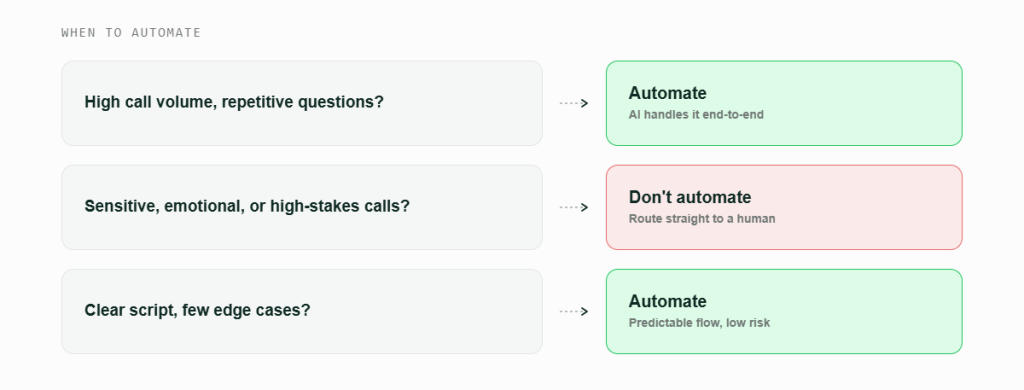
Keep a human on the line when the conversation is sensitive. Calls about a death in a family, a serious medical result, a job termination, or a significant financial loss should not be delivered by a recorded voice. The message is not the problem; the medium is.
Keep a human on the line when the interaction requires a licensed person. Certain financial advice, legal guidance, and medical consultations require a credentialed individual to be present. A platform cannot hold a license.
Do not automate when call volumes are too low to justify the setup. If a business makes fewer than 50 outbound calls per week on a single topic, the time spent building and maintaining the flow will cost more than having a person make the calls. The break-even point depends on the complexity of the script and the cost of the person’s time, but very low volumes rarely make the case.
Do not automate when the customer base has made clear it rejects automation. Some industries and some customer segments respond to automated calls with complaints, opt-outs, and lost trust at rates that outweigh the efficiency gain. If the opt-out rate on a first campaign is high, that is a signal worth taking seriously before scaling.
Finally, do not automate when the conversation cannot be scripted. If the caller’s situation is genuinely unpredictable and the right response depends on judgment rather than a lookup, a voice agent designed for open conversation is a better fit than an automated call designed to deliver a message.
Frequently asked questions
What is the best way to set up automated phone calls for a small business?
Start with a single, simple call flow: one message, one question, one outcome. Use a telephony platform that handles the phone network and the AI connection so you are not building infrastructure. Collect consent before you dial, write a short and direct script, and test with a small group before sending at volume. Teler supports this kind of phased rollout and connects to whichever speech provider the team prefers. More detail on the setup process is in the Teler developer documentation.
How much do automated phone calls cost?
Cost splits across two providers. The telephony provider charges for phone capacity, per-minute call time, and phone numbers. The AI provider charges for speech recognition and speech generation. Both sets of costs rise with call volume, but capacity costs spike when many calls run at the same time rather than spread across a day. Hidden costs include script rework, transcript review, and failed-call follow-up. For current rates, check current Teler pricing and each AI provider’s pricing page directly.
What US law governs automated phone calls?
Two federal bodies set the main rules. The FCC (Federal Communications Commission) enforces the TCPA (Telephone Consumer Protection Act, 47 U.S.C. § 227), which requires prior express consent for artificial or prerecorded voice calls to residential and mobile numbers. The FTC (Federal Trade Commission) enforces the Telemarketing Sales Rule (TSR, 16 CFR Part 310), which requires prior signed written agreement for prerecorded telemarketing calls and mandates an opt-out mechanism on every such call. The FCC confirmed in November 2024 that AI-generated voices fall inside the TCPA’s rules.
Will callers know it is not a person, and does that matter?
Most callers can tell within a few seconds, especially on a scripted message. Whether it matters depends on the context. For a routine appointment reminder or a delivery notification, most people accept it. For a sensitive conversation or a complex request, the lack of a real person creates friction. The call must identify the entity responsible at the start of the message under FCC rules, so the business is already disclosed. Designing the call to be honest about its nature, rather than trying to sound human, tends to produce better outcomes and fewer complaints.
Should we build this ourselves or use a platform?
Building in-house is right when the call flow is genuinely proprietary or when the team has existing carrier relationships worth keeping. For most businesses, a platform is faster and cheaper because carrier connectivity, number management, and audio reliability are already solved. The business’s time is better spent on the script and the data. Teler is designed for teams that want to connect their AI to real phone calls without building the telephony layer themselves. See the Teler product page for what the platform handles.
What happens when the system does not understand what a caller says?
The system should repeat the question once with a simpler prompt, then escalate to a human if it still cannot parse the reply. A well-designed call flow never leaves a caller in a loop. The handoff to a human should pass the context of the call so the caller does not have to repeat everything. Background noise, strong accents, and callers who speak before the prompt finishes are the most common causes of recognition failure, and all three are worth testing before launch.
How long does setup actually take?
A simple outbound reminder with one call flow can be live in a few days once numbers are provisioned and consent records are ready. A campaign with multiple branches, CRM lookups, and live-transfer routing typically takes two to four weeks. Most of that time is script review and integration testing, not platform configuration. Number provisioning is the most common delay, so start it before the script is finished.
How will automated phone calls change over the next few years?
The clearest near-term shift is from scripted message delivery toward systems that can hold a real conversation. The FCC’s November 2024 ruling on AI-generated voices signals that regulators are watching this space closely, so the compliance requirements are likely to become more detailed rather than less. Businesses that build good consent and opt-out practices now will be better positioned as the rules develop. The underlying technology for voice AI is improving quickly, but the compliance and data quality problems are the ones that take the most time to solve. For a broader look at where voice AI infrastructure is heading, see why outbound campaign systems are built on voice APIs.
Should your business use automated phone calls?
Automated phone calls are a practical choice for businesses that make the same call hundreds or thousands of times, have the consent records to back it up, and can maintain the script and the integrations over time. The single factor that should drive the decision is whether the conversation can be scripted: if the message is predictable and the reply is simple, automation works; if the conversation requires judgment, a voice agent or a person is the better fit. In 2026, the compliance requirements for automated phone calls in the US are clear, and the platforms to run them are mature. The work is in the preparation, not the technology.